
the Creative Commons Attribution 4.0 License.
the Creative Commons Attribution 4.0 License.
 | 04 Jan 2026
Operational performance of the Vaisala CL61 ceilometer for atmospheric profiling
Abstract. The Vaisala CL61 is a new generation elastic backscatter lidar that extends conventional ceilometer capabilities by providing depolarization ratio measurements. Reliable use of these measurements, however, requires thorough evaluation and characterisation of the instrument performance and subsequent corrections applied. This study introduces a methodology for identifying the background signal and suitable liquid cloud layers for assessing the long-term behavior of multiple CL61 instruments deployed across various sites. Results indicate some variability between instruments, with most of these early production units exhibiting a pronounced decrease in laser power over time, accompanied by an increase in background noise. Normally, the instrument scales the internal calibration factor to compensate for changes in laser power and thus provide consistent attenuated backscatter coefficient values from profile to profile over time. However, for the instrument at the Lindenberg site, by performing manual calibration with atmospheric targets it was noted that once the laser power dropped below 40% there was no further compensation in the internal calibration factor.
The instrumental noise and bias, characterized using the termination hood, were found to vary with temperature. A method was developed for correcting for the instrumental bias and for estimating the associated uncertainty. Additionally, an aerosol inversion approach is presented for retrieving the profile of aerosol particle backscatter coefficient, aerosol depolarization ratio, and their corresponding uncertainties. In a case study, the aerosol-inverted and bias-corrected depolarization ratio was found to deviate by up to 0.1 from the original instrument-provided measurement. This demonstrates the importance of accounting for the molecular contribution when qualitatively interpreting aerosol measurements at the CL61 ceilometer operating wavelength of 905 nm. Finally, signal loss in one unit was traced to optical lens fogging, and attributed to insufficient internal heating linked to the instrument's firmware behavior.
-
Notice on discussion status
The requested preprint has a corresponding peer-reviewed final revised paper. You are encouraged to refer to the final revised version.
-
Preprint
(25038 KB)
-
Supplement
(16504 KB)
-
The requested preprint has a corresponding peer-reviewed final revised paper. You are encouraged to refer to the final revised version.
- Preprint
(25038 KB) - Metadata XML
-
Supplement
(16504 KB) - BibTeX
- EndNote
- Final revised paper


Journal article(s) based on this preprint
Interactive discussion
Status: closed
-
RC1: 'Comment on egusphere-2025-6331', Anonymous Referee #1, 10 Mar 2026
- AC1: 'Reply on RC1', Viet Le, 10 Jun 2026
-
RC2: 'Comment on egusphere-2025-6331', Anonymous Referee #2, 19 Mar 2026
General comments
This manuscript presents a long-term evaluation of the Vaisala CL61 depolarization ceilometer using measurements from four ACTRIS Cloudnet sites in Finland and Germany. The study addresses several important aspects of the operational performance of this new-generation ceilometer, including background noise characterization, laser power degradation, temperature-dependent instrument bias, calibration stability, and the retrieval of aerosol backscatter and depolarization profiles.
The topic is timely and relevant. Depolarization-capable ceilometers are increasingly used in operational networks, and the CL61 represents an important step toward extending ceilometer applications to aerosol typing and cloud microphysics. A careful characterization of instrument performance under long-term operation is therefore essential for both operational and research communities. The manuscript contains several interesting aspects, such as the use of termination hood measurements to quantify instrumental noise and the comparison of cloud and Rayleigh calibration approaches.
Overall, the manuscript is reasonably well structured and generally clear, although the organization could be improved in some parts. Several methodological aspects require clarification, and some conclusions appear stronger than what is fully supported by the presented evidence. I therefore recommend publication after major revisions addressing the points outlined below.
Specific comments
- The manuscript would benefit from a clearer separation and description of the different signal components relevant to lidar measurements (true atmospheric signal, background signal, instrumental dark signal) and their associated noise contributions in the methods section. It should also be clarified which components are corrected by the instrument firmware and which require additional processing addressed in this study. The lidar equation presented in Section 2 would be more appropriately placed in this part of the paper.
- In addition, a clearer distinction between signal and noise is required throughout the manuscript, as these terms are occasionally used interchangeably, which may lead to confusion.
- It is currently not clear whether the instrumental correction (dark signal) s negligible when compared to real atmospheric measurements. The manuscript would benefit from a quantitative assessment of the magnitude of the instrumental signal relative to the atmospheric signal, as well as a discussion of whether this contribution can be neglected and over which range.
- Some statements, for example regarding the recommended frequency of termination hood measurements, are not clearly supported by the presented results. This information would be particularly important for instrument operators, given the associated effort. In addition, the temperature-dependent overlap behaviour mentioned in the conclusions cannot be clearly inferred from the data shown.
Technical comments
- Line 1: Within the community, the term ALC has become established as standing for ‘Automatic Low-Power Lidar and Ceilometer’ or ‘Automatic Lidar-Ceilometer’. Perhaps the authors also wish to use this term to distinguish them from aerosol high-power lidars (AHL).
- Line 4: In this context, the focus should not be placed on the introduction of methods, as these are already well established in the lidar community, but rather on the adaptation and application of existing methods to long-term CL61 data, which represents a key contribution of this manuscript.
- Line 6: Does this refer to an increase in noise due to e.g. changes in detector characteristics or a decrease in the signal-to-noise ratio due to weaker return signals?
- Line 11: A variation is obvious for the instrumental noise but is it also true for the bias?
- Line 13: A commonly used term would be the particle backscatter coefficient and the particle linear depolarization ratio (PLDR).
- Line 17: The correct wavelength of the CL61 according to the manual is 910.55 nm.
- Line 23: Shouldn't it be attenuated
- Line 28: An essential point here is eye-safety
- Line 33: volume linear depolarization ratio (VLDR) δ_v
- Line 46: As lidars have a blind zone or a difficult to correct range of incomplete overlap, it is in principle impossible to obtain reliable data all the way down to the surface.
- Line 50: Is it the optical path or rather the detector or transmitter unit which is temperature dependent?
- Table 1: An additional important information is the telescope field of view and the height of complete overlap or the blind zone which is shortly mentioned in the text.
- Line 59: The manual states: attenuating acquisition for both signals with measurement time of 0.2 s and same receiver module is used for both signals. This means that receiver sensitivity calibration is not necessary.
- Line 71: pulses of linear polarized laser light
- Line 73: Is B the background noise or the sum of additional signal terms like background and dark signal?
- Line 88: linear depolarization ratio
- Line 92-94: In line 4, it was referred to as a background signal, which is more accurate, as the background signal does indeed have a mean value and is not merely noise.
- Line 94: Authors should clearly distinguish between the components of the measured lidar signal and label them correctly. The measured signal consists of the true atmospheric signal plus the background signal, which may be caused by solar radiation, but also by moonlight or artificial light. Added to this is the instrument-specific signal, which may also be referred to as the ‘dark signal’ and can be determined, for example, through termination hood measurements.
- Line 95: The firmware already subtracts the background signal, but not the dark signal. Do the authors also assume that the background signal was not correctly determined and subtracted? If so, they should refer to it as the residual background signal and dark signal (determined with termination hood measurements).
- Line 97: Can B_bk be described as dark signal in this context?
- Line 105: Background signal is usually range independent and dark signal range dependent. Since the solar component is specified here, is this then an uncorrected residual component?
- Figure 1: Have σ and η for ppol and xpol been introduced yet?
- Line 131: To obtain the correct dark signal the overlap correction must be removed. It is still applied in the firmware but is not necessary for termination hood measurements and will lead to signal distortions in the incomplete overlap range which can influence interpretation of these measurements.
- Line 135: β_mol is usually the molecular backscatter coefficient. What you rather should compare to find an aerosol-free region would be the hypothetical Rayleigh signal or β'_mol.
The details of the calculation could be provided already at this point and not in the next section. - Line 147: See above. The overlap correction must be removed for the analysis. Perhaps the manufacturer can provide details if the correction is time dependent.
- Line 148: Do you mean here "possible temperature dependence of the overlap function" instead of correction?
- Line 149: Which temperature did you use? The CL61 measures laser_temperature, internal_temperature and transmitter_enclosure_temperature.
- Line 153: Which diurnal pattern do you mean? Diurnal patterns are hardly visible in Fig. 3 (a) if only times from 11:00 until 16:00 are shown and only two hours are atmospheric measurements. In Fig. 1 (a) for instance, diurnal patterns are visible.
- Line 162: Figure reference should be to Figure 3
- Figure 3: The label in plot c) should be just β_mol.
- Line 168: Shouldn't a subscript "corrected" be added so that it isn't confused with Eq. 4?
- Line 200: field of view should be added to Table 1
- Line 215: What about the uncertainty in C which is not taken into account here? In line 224 you mention a 10 % uncertainty. Did you average over several C values or have you applied a fit or trend with time between consecutive C values?
- Line 217: Termination instead of terminal
- Line 228: S_p instead of S
- Line 238: Termination instead of terminal
- Line 241: Which NWP model was used here?
- Figure 6: Please align subplots vertically. Subplot e) should be d) to be consistent with the caption.
- Line 305: Can this conclusion be drawn on the basis of three measurements taken over a period of six months, even though the last value is actually in the middle?
This would be an important conclusion for operators. This plot should be shown not only in the supplements. - Section 4.4: Is a single profile shown or is an average over a time period discussed? What would be the influence on the uncertainty if averaged over several profiles? It would be nice to see profiles compared.
To give a better idea, one could also mention some typical values for the depolarization ratio.
The authors might also consider plotting the various parameters as line plots, with the margin of uncertainty shown as a shaded area or error bars. - Line 349: Termination hood measurement
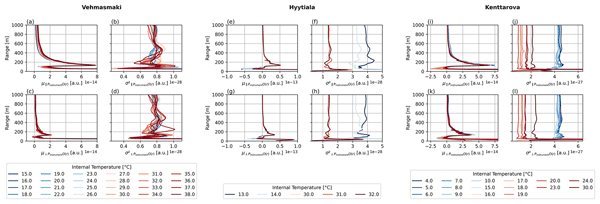
- Figure 10: Why was for the subplots e)-h) another y-axis range chosen?
- Section 4.5: What was the reason for the high humidity inside the instrument? Was there a sealing problem with the window? Adding the relative humidity from the housekeeping data to the plot would help operators to see above which values this problem can happen.
- Line 379: A temperature dependence of the overlap function was not clearly visible in Figure 7. Can this be stated here?
- Line 384: See comment for line 305. The results in Figure S3 do not really support that conclusion here.
- Line 392: If quantitatively analyzing aerosol optical properties with lidar at this wavelength and at even longer wavelength, the molecular contribution must always taken into account. The difference in the backscatter coefficient is approximately the molecular backscatter coefficient at around 910 nm at ground level which can be calculated. Also the difference in is strongly dependent on the aerosol type and load and on altitude. It is not possible to make a general statement about the difference here, but it is clear that the molecular component must be taken into account.
- Line 395: Is it the fogging of the optical lens or the window?
Citation: https://doi.org/10.5194/egusphere-2025-6331-RC2 - AC2: 'Reply on RC2', Viet Le, 10 Jun 2026
Peer review completion


Interactive discussion
Status: closed
-
RC1: 'Comment on egusphere-2025-6331', Anonymous Referee #1, 10 Mar 2026
GENERAL COMMENTS
The study by Le et al. focuses on evaluating several instrumental characteristics of the Vaisala CL61 ceilometer for aerosol vertical profiling applications. The manuscript addresses the quantification of instrumental artefacts in the measurements, in terms of bias and noise, based on several years of observations acquired both with and without a termination hood, and proposes methods to correct for these instrumental effects. In addition, the authors describe an automated calibration methodology based on liquid cloud layers and highlight signal drifts that are attributed to instrumental effects.
Overall, the manuscript is well written and allows the reader to follow most of the methodological steps taken by the authors. The topic is of considerable interest to the atmospheric remote sensing community, as this instrument - commercially available in recent years - is becoming increasingly widespread. I therefore recommend publication of the manuscript after addressing the minor comments listed below.
SPECIFIC COMMENTS
- The study refers to the difference between the background signal during daytime and nighttime conditions (e.g., Section 4.1 and Fig. 5). However, it is not entirely clear whether this difference is actually exploited to quantitatively validate the results obtained with more accurate measurements (e.g., those acquired with the termination hood). For sites or networks where the termination hood is not available, could nighttime measurements under pristine conditions be considered a reasonable proxy for estimating instrumental noise (without solar background)?
- Firmware corrections: it may be useful to provide additional details - within the limits of the manufacturer's documentation - on how the firmware attempts to compensate for both the background signal and sensitivity variations (i.e., calibration coefficient). For instance, is a test LED used for internal monitoring of sensitivity changes? How is the firmware compensation handled during measurements performed with the termination hood?
- σ_R: the approximation introduced at line 245 and in Eq. (31) appears to be dimensionally inconsistent. β_p is expressed in m-1 sr-1, whereas R is defined as a ratio between two backscatter coefficients. Could this be a typographical error?
- Additional instrumental effects not explicitly addressed: a/ The manuscript mentions the issue of overlap and refers to a correction methodology (Hervo et al., 2016), but this correction is not applied in the present analysis. Do the authors believe that the same technique developed for the CHM-15k could also be applied to the CL61 in order to separate the overlap contribution from other instrumental effects? b/ Another issue not mentioned in the manuscript, which affected previous models of Vaisala ceilometers, is absorption by water vapor. According to the manufacturer, this issue has been mitigated by selecting a different wavelength and a very narrow bandwidth. Have the authors had the opportunity to verify this aspect in their measurements?
TECHNICAL REMARKS
- Nomenclature: the CL61 is referred to both as a "ceilometer" and as an "elastic backscatter lidar" (e.g., line 1), seemingly interchangeably. In recent years, the term "Automatic Lidar-Ceilometer" has become increasingly common. The authors may wish to consider this terminology.
- Abstract: the first part mainly uses present tense verbs, whereas the second part switches to past tense. The authors may consider harmonizing the tense throughout the abstract.
- Line 4: can background noise appropriately be referred to as a "signal"? In addition, two rather different issues are mentioned consecutively: the quantification of background noise and calibration using liquid clouds. It might be better to separate these two aspects more clearly.
- Line 4: "long-term behavior" is somewhat generic and could be specified more precisely. The same applies to "variability" in line 5.
- Lines 12–14: the approach used for aerosol inversion and the calculation of the depolarization ratio are not entirely novel. Rather, the contribution of the paper could be emphasized in terms of the uncertainty propagation in the inversion and in the depolarization ratio retrieval.
- Line 14: after "accounting for molecular contribution", it would be clearer to add "both in the aerosol backscatter and in the depolarization ratio".
- Line 50: does the "optical path" referred to here correspond to the optical path inside the instrument?
- Equations (1), (2), and (3): in Eq. (1), defining B as the background noise appears correct. However, in the subsequent equations, if ppol and xpol represent the signals provided by the instrument firmware, then B should represent the firmware estimate - rather than the exact value - of the background noise, as described in the following sections.
- Section 3.1: it might be clearer to title the section "Residual background noise", since a first correction is already applied by the firmware. Similarly, in line 103, it might be useful to specify "unaccounted background terms".
- Line 97: please specify what the two letters "bk" stand for, given that B already denotes "background".
- Lines 110–115: does this description uniquely (and reproducibly) define the procedure followed? In particular, the exact PyWavelets wavelet identifier (e.g., bior1.1), the definition of the minimax threshold and the method used for noise variance estimation, the treatment of approximation coefficients, and the exact threshold computation used for noise-gate identification should be clarified.
- Line 133: if I am not mistaken, the terms µ have not been introduced previously and should therefore be defined.
- Figure 3, caption: the caption reports σ_ppol/r², whereas the axis in the figure shows σ²_ppol/r².
- Line 149: when referring to the instrument temperature, in what part of the instrument is it measured? It should be clarified whether this corresponds to the module temperature, the internal temperature, or specifically the laser temperature.
- Section 3.1.2: please clarify whether the calculation of P_solar is performed for each individual profile.
- Line 155: is σ² uniform, or σ²/r²?
- Line 162: I believe the reference should be to Figs. 3b and 3c, rather than 2b/2c.
- Lines 205–209: additional detail may be helpful here. How is the example profile selected? Presumably the cross-correlation accounts for possible shifts in cloud altitude (or other profile characteristics)? Which exact quantity is correlated along the profile (e.g., β')?
- Line 252: it might be useful to specify that the normalization assumes Poisson statistics.
- Sections 4.2 and 4.3: in the description of the figures (e.g., line 282 onward; line 311 onward), the text refers to station names. However, if the reader wants to identify the corresponding panel, they must read the figure caption and match the station name with the subfigure label (a, b, c, ...). It would be more convenient either to refer directly to the subfigure in the main text or to include the station name in each subfigure title.
- Lines 292–293: if I am not mistaken, the temperature dependence in subfigures 6k and 6m appears to reverse at some point. Are the authors able to explain this inversion?
- Figure 6: the subfigures do not appear to be vertically aligned.
- Line 339: the quantities referred to as "values" are actually differences, correct?
- Lines 351–354: is there a physical reason why σ_δ depends on signal intensity, whereas this does not appear to be the case for σ_β? Could the authors provide an intuitive explanation?
- Lines 368–369: could the authors indicate how the blower and heater are configured to remain permanently on?
- Figure 11: how does relative humidity (RH) behave inside the instrument under these conditions?
- Conclusions: Lines 372–373: please clarify what results are specific to the CL61. Line 381: since the Klett inversion depends on the signal at lower altitudes, measurements affected by the discussed issue should probably be discarded or replaced (e.g., with the immediately higher range gates) not only in the final results but also within the inversion calculation itself.
Citation: https://doi.org/10.5194/egusphere-2025-6331-RC1 - AC1: 'Reply on RC1', Viet Le, 10 Jun 2026
-
RC2: 'Comment on egusphere-2025-6331', Anonymous Referee #2, 19 Mar 2026
General comments
This manuscript presents a long-term evaluation of the Vaisala CL61 depolarization ceilometer using measurements from four ACTRIS Cloudnet sites in Finland and Germany. The study addresses several important aspects of the operational performance of this new-generation ceilometer, including background noise characterization, laser power degradation, temperature-dependent instrument bias, calibration stability, and the retrieval of aerosol backscatter and depolarization profiles.
The topic is timely and relevant. Depolarization-capable ceilometers are increasingly used in operational networks, and the CL61 represents an important step toward extending ceilometer applications to aerosol typing and cloud microphysics. A careful characterization of instrument performance under long-term operation is therefore essential for both operational and research communities. The manuscript contains several interesting aspects, such as the use of termination hood measurements to quantify instrumental noise and the comparison of cloud and Rayleigh calibration approaches.
Overall, the manuscript is reasonably well structured and generally clear, although the organization could be improved in some parts. Several methodological aspects require clarification, and some conclusions appear stronger than what is fully supported by the presented evidence. I therefore recommend publication after major revisions addressing the points outlined below.
Specific comments
- The manuscript would benefit from a clearer separation and description of the different signal components relevant to lidar measurements (true atmospheric signal, background signal, instrumental dark signal) and their associated noise contributions in the methods section. It should also be clarified which components are corrected by the instrument firmware and which require additional processing addressed in this study. The lidar equation presented in Section 2 would be more appropriately placed in this part of the paper.
- In addition, a clearer distinction between signal and noise is required throughout the manuscript, as these terms are occasionally used interchangeably, which may lead to confusion.
- It is currently not clear whether the instrumental correction (dark signal) s negligible when compared to real atmospheric measurements. The manuscript would benefit from a quantitative assessment of the magnitude of the instrumental signal relative to the atmospheric signal, as well as a discussion of whether this contribution can be neglected and over which range.
- Some statements, for example regarding the recommended frequency of termination hood measurements, are not clearly supported by the presented results. This information would be particularly important for instrument operators, given the associated effort. In addition, the temperature-dependent overlap behaviour mentioned in the conclusions cannot be clearly inferred from the data shown.
Technical comments
- Line 1: Within the community, the term ALC has become established as standing for ‘Automatic Low-Power Lidar and Ceilometer’ or ‘Automatic Lidar-Ceilometer’. Perhaps the authors also wish to use this term to distinguish them from aerosol high-power lidars (AHL).
- Line 4: In this context, the focus should not be placed on the introduction of methods, as these are already well established in the lidar community, but rather on the adaptation and application of existing methods to long-term CL61 data, which represents a key contribution of this manuscript.
- Line 6: Does this refer to an increase in noise due to e.g. changes in detector characteristics or a decrease in the signal-to-noise ratio due to weaker return signals?
- Line 11: A variation is obvious for the instrumental noise but is it also true for the bias?
- Line 13: A commonly used term would be the particle backscatter coefficient and the particle linear depolarization ratio (PLDR).
- Line 17: The correct wavelength of the CL61 according to the manual is 910.55 nm.
- Line 23: Shouldn't it be attenuated
- Line 28: An essential point here is eye-safety
- Line 33: volume linear depolarization ratio (VLDR) δ_v
- Line 46: As lidars have a blind zone or a difficult to correct range of incomplete overlap, it is in principle impossible to obtain reliable data all the way down to the surface.
- Line 50: Is it the optical path or rather the detector or transmitter unit which is temperature dependent?
- Table 1: An additional important information is the telescope field of view and the height of complete overlap or the blind zone which is shortly mentioned in the text.
- Line 59: The manual states: attenuating acquisition for both signals with measurement time of 0.2 s and same receiver module is used for both signals. This means that receiver sensitivity calibration is not necessary.
- Line 71: pulses of linear polarized laser light
- Line 73: Is B the background noise or the sum of additional signal terms like background and dark signal?
- Line 88: linear depolarization ratio
- Line 92-94: In line 4, it was referred to as a background signal, which is more accurate, as the background signal does indeed have a mean value and is not merely noise.
- Line 94: Authors should clearly distinguish between the components of the measured lidar signal and label them correctly. The measured signal consists of the true atmospheric signal plus the background signal, which may be caused by solar radiation, but also by moonlight or artificial light. Added to this is the instrument-specific signal, which may also be referred to as the ‘dark signal’ and can be determined, for example, through termination hood measurements.
- Line 95: The firmware already subtracts the background signal, but not the dark signal. Do the authors also assume that the background signal was not correctly determined and subtracted? If so, they should refer to it as the residual background signal and dark signal (determined with termination hood measurements).
- Line 97: Can B_bk be described as dark signal in this context?
- Line 105: Background signal is usually range independent and dark signal range dependent. Since the solar component is specified here, is this then an uncorrected residual component?
- Figure 1: Have σ and η for ppol and xpol been introduced yet?
- Line 131: To obtain the correct dark signal the overlap correction must be removed. It is still applied in the firmware but is not necessary for termination hood measurements and will lead to signal distortions in the incomplete overlap range which can influence interpretation of these measurements.
- Line 135: β_mol is usually the molecular backscatter coefficient. What you rather should compare to find an aerosol-free region would be the hypothetical Rayleigh signal or β'_mol.
The details of the calculation could be provided already at this point and not in the next section. - Line 147: See above. The overlap correction must be removed for the analysis. Perhaps the manufacturer can provide details if the correction is time dependent.
- Line 148: Do you mean here "possible temperature dependence of the overlap function" instead of correction?
- Line 149: Which temperature did you use? The CL61 measures laser_temperature, internal_temperature and transmitter_enclosure_temperature.
- Line 153: Which diurnal pattern do you mean? Diurnal patterns are hardly visible in Fig. 3 (a) if only times from 11:00 until 16:00 are shown and only two hours are atmospheric measurements. In Fig. 1 (a) for instance, diurnal patterns are visible.
- Line 162: Figure reference should be to Figure 3
- Figure 3: The label in plot c) should be just β_mol.
- Line 168: Shouldn't a subscript "corrected" be added so that it isn't confused with Eq. 4?
- Line 200: field of view should be added to Table 1
- Line 215: What about the uncertainty in C which is not taken into account here? In line 224 you mention a 10 % uncertainty. Did you average over several C values or have you applied a fit or trend with time between consecutive C values?
- Line 217: Termination instead of terminal
- Line 228: S_p instead of S
- Line 238: Termination instead of terminal
- Line 241: Which NWP model was used here?
- Figure 6: Please align subplots vertically. Subplot e) should be d) to be consistent with the caption.
- Line 305: Can this conclusion be drawn on the basis of three measurements taken over a period of six months, even though the last value is actually in the middle?
This would be an important conclusion for operators. This plot should be shown not only in the supplements. - Section 4.4: Is a single profile shown or is an average over a time period discussed? What would be the influence on the uncertainty if averaged over several profiles? It would be nice to see profiles compared.
To give a better idea, one could also mention some typical values for the depolarization ratio.
The authors might also consider plotting the various parameters as line plots, with the margin of uncertainty shown as a shaded area or error bars. - Line 349: Termination hood measurement
- Figure 10: Why was for the subplots e)-h) another y-axis range chosen?
- Section 4.5: What was the reason for the high humidity inside the instrument? Was there a sealing problem with the window? Adding the relative humidity from the housekeeping data to the plot would help operators to see above which values this problem can happen.
- Line 379: A temperature dependence of the overlap function was not clearly visible in Figure 7. Can this be stated here?
- Line 384: See comment for line 305. The results in Figure S3 do not really support that conclusion here.
- Line 392: If quantitatively analyzing aerosol optical properties with lidar at this wavelength and at even longer wavelength, the molecular contribution must always taken into account. The difference in the backscatter coefficient is approximately the molecular backscatter coefficient at around 910 nm at ground level which can be calculated. Also the difference in is strongly dependent on the aerosol type and load and on altitude. It is not possible to make a general statement about the difference here, but it is clear that the molecular component must be taken into account.
- Line 395: Is it the fogging of the optical lens or the window?
Citation: https://doi.org/10.5194/egusphere-2025-6331-RC2 - AC2: 'Reply on RC2', Viet Le, 10 Jun 2026
Peer review completion
Journal article(s) based on this preprint
Viewed
| HTML | XML | Total | Supplement | BibTeX | EndNote | |
|---|---|---|---|---|---|---|
| 1,592 | 1,157 | 255 | 3,004 | 351 | 140 | 142 |
- HTML: 1,592
- PDF: 1,157
- XML: 255
- Total: 3,004
- Supplement: 351
- BibTeX: 140
- EndNote: 142
Viewed (geographical distribution)
| Country | # | Views | % |
|---|
| Total: | 0 |
| HTML: | 0 |
| PDF: | 0 |
| XML: | 0 |
- 1

Ewan J. O'Connor
Maria Filioglou
Ville Vakkari
The requested preprint has a corresponding peer-reviewed final revised paper. You are encouraged to refer to the final revised version.
- Preprint
(25038 KB) - Metadata XML
-
Supplement
(16504 KB) - BibTeX
- EndNote
- Final revised paper
GENERAL COMMENTS
The study by Le et al. focuses on evaluating several instrumental characteristics of the Vaisala CL61 ceilometer for aerosol vertical profiling applications. The manuscript addresses the quantification of instrumental artefacts in the measurements, in terms of bias and noise, based on several years of observations acquired both with and without a termination hood, and proposes methods to correct for these instrumental effects. In addition, the authors describe an automated calibration methodology based on liquid cloud layers and highlight signal drifts that are attributed to instrumental effects.
Overall, the manuscript is well written and allows the reader to follow most of the methodological steps taken by the authors. The topic is of considerable interest to the atmospheric remote sensing community, as this instrument - commercially available in recent years - is becoming increasingly widespread. I therefore recommend publication of the manuscript after addressing the minor comments listed below.
SPECIFIC COMMENTS
TECHNICAL REMARKS