
the Creative Commons Attribution 4.0 License.
the Creative Commons Attribution 4.0 License.
 | 28 Aug 2025
The changing composition of the Gulf of St. Lawrence inflow waters observed from transient tracer measurements
Abstract. The deep waters of the Gulf of St. Lawrence (GSL) have experienced a significant reduction in dissolved oxygen content during the past decades. One widely documented driver of this deoxygenation is a change in the composition of the deep inflowing water that ventilates the Gulf. This deep water is known to consist of a mix of warmer, less-oxygenated North Atlantic Central Waters (NACW) and cooler, more-oxygenated Labrador Current Waters (LCW), with prior studies inferring a shift towards increased NACW contribution. However, this compositional change has only ever been inferred indirectly from physical and biogeochemical measurements via the use of inverse methods such as water mass analysis. In this study, we present results from the first spatially-comprehensive deep water transient tracer surveys in the GSL, allowing us to directly map mean age estimates and use these to infer recent changes in the composition of regional deep waters. The results reveal an unexpected age distribution, with 'older' deep waters present near the Gulf's entrance, whereas 'younger' water is found further inshore, contrary to the expected estuarine circulation pattern, which transports deep water inland (increasing age along the flow path). This implies a gradual increase in the proportion of NACW from inshore areas towards the Gulf's entrance and provides direct evidence that the shift towards NACW dominated deep waters is ongoing as of 2022, contrary to earlier predictions of the complete disappearance of the younger, well-oxygenated LCW.
-
Notice on discussion status
The requested preprint has a corresponding peer-reviewed final revised paper. You are encouraged to refer to the final revised version.
-
Preprint
(5009 KB)
-
Supplement
(1430 KB)
-
The requested preprint has a corresponding peer-reviewed final revised paper. You are encouraged to refer to the final revised version.
- Preprint
(5009 KB) - Metadata XML
-
Supplement
(1430 KB) - BibTeX
- EndNote
- Final revised paper


Journal article(s) based on this preprint
Interactive discussion
Status: closed
-
RC1: 'Comment on egusphere-2025-3999', Anonymous Referee #1, 04 Sep 2025
-
AC1: 'Reply on RC1', Lennart Gerke, 17 Oct 2025
Dear Referee #1,
We appreciate the detailed and constructive review of our manuscript. Please find attached a pdf file containing our point-by-point responses, along with the corresponding revisions we plan to include in the revised version of the manuscript (highlighted in bold).
Kind regards,
Lennart Gerke, on behalf of all co-authors
-
AC1: 'Reply on RC1', Lennart Gerke, 17 Oct 2025
-
CC1: 'Comment on egusphere-2025-3999', Mathilde Jutras, 17 Sep 2025
Comment to manuscript «The changing composition of the Gulf of St. Lawrence inflow waters observed from transient tracer measurements » by Gerke et al.
By M. Jutras
Gerke et al provide here a new and very useful estimate of water age distribution in the St. Lawrence System. This is the first assessment based on transient tracers in this region, and it helps answer important questions of the circulation and how it is changing.
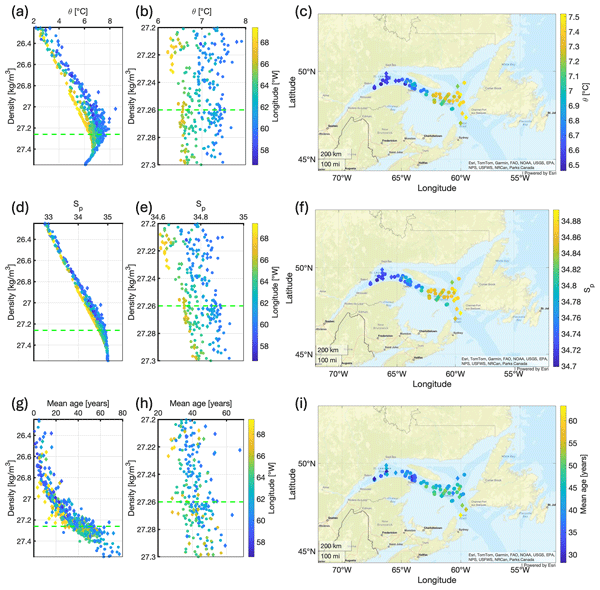
1. First of all, I have a question regarding the role of vertical mixing along the Laurentian Channel. On Fig. 4C, right panel, we see that the age is strongly dependent on the density, with older (hence NACW-rich) waters at depth. In Fig. 5 of Jutras et al. (2020), the results from the eOMP suggest that LCW and NACW are not mixed when they enter the Laurentian Channel, and that they mix as they move inland. More specifically, LCW progressively mixes with NACW on the 27.25 isopycnal, which would result in waters getting younger as they move inland along that isopycnal. Therefore, I would suggest to show the results of the water mass analysis also for different densities, as was done for the rest of the results (with figures like 4c and 3a-d, or maybe using a vertical transect along the channel), since this might influence the interpretation of the results that the rejuvenation of waters as they move inland is due to temporal changes in the water mass composition.
2. Second, I was wondering if the effect of turbulent mixing on SF6 and CFC-12 concentrations had been estimated, and if there could be some contamination by surface waters that would make the waters younger as they move inland. This effect is mentioned in the discussion, but the magnitude is not quantified.
3. Just a thought, but could the θ and Sp water mass analysis be used to “correct” for changes in age due to changes in water mass composition, and then use the age estimates to deduce the advection time along the Laurentian Channel?
Specific comments:
4. It is not clear what information the zooms on narrow density ranges provide in Fig. 3c-d and 4d. They might not be necessary.
5. In Fig. 6b, it would be relevant to mention if there are enough data points to confirm if the trend is statistically significant, using a statistical test. It looks like the trend would change significantly if for instance the last point was removed, which suggests that the trend is not statistically significant. There is significant lateral variability in water properties across Cabot Strait due to the circulation (as we can see on some of the maps), which could contribute to the variability observed here. Colouring the data points with longitude or distance from one end of the channel could allow to see if this explains part of the variability instead of temporal variability.
Citation: https://doi.org/10.5194/egusphere-2025-3999-CC1 -
AC2: 'Reply on CC1', Lennart Gerke, 17 Oct 2025
Dear M. Jutras,
We thank you for your helpful comments and feedback on our manuscript. We attached a pdf file of our responses, along with the corresponding revisions we intend to make in the revised version of the manuscript (highlighted in bold).
Kind regards,
Lennart Gerke, on behalf of all co-authors
-
AC2: 'Reply on CC1', Lennart Gerke, 17 Oct 2025
-
RC2: 'Comment on egusphere-2025-3999', Anonymous Referee #2, 06 Oct 2025
Dear authors,
Please find below my review or your manuscript entitled "The changing composition of the Gulf of St. Lawrence inflow waters observed from transient tracer measurements". This manuscript describes the composition of the waters of the Gulf of St Lawrence (GSL) using new measured transient tracers. While the science is sound, and the writing relatively good, I wonder what the novelty of this science contributions is. Some results are completely expected and not new, while other puzzling results (gradient of the mean age along the Laurentian Channel) have not been fully exploited in my view. Overall, I am afraid that this study would bring more confusion than clarity in the literature of the GSL. I recommend, if not a rejection, an in-depth re-structuration of this study. I provide below some overall comments and then comments for each section.
OVERALL COMMENTS
One of the key results of this study seems to call into question decades of research in the GSL and our basic understanding of the estuarine circulation, that is that the water is getting rejuvenated as it travels from the ocean to the head of the estuary. E.g. in the Discussion: "The temperature, salinity and mean age analysis of the deep water on the σΘ = 27.26 kg/m3 isopycnal along the Laurentian channel show young, cooler, and fresher water in the Lower Estuary and western Gulf, with older, warmer and more saline water entering through Cabot Strait and within the eastern Laurentian Channel (Figures 3 and 4a). These are the opposite pattern of water mass age that might be expected if water is transported along the Laurentian Channel..."I think that one problem with this study may be that the analysis is done over a single isopycnal. Is it possible that this isopycnal shoals as the water is advected toward the head of the estuary, giving the impression that the water is getting younger (being enriched by vertical mixing)? What about the same analysis over the bottom waters?
My second concern is that decadal cycles are completely ignored. The study is limited to 2018-2022. How those years related to ~100 years of observations in the GSL? Do we know anything about decadal changes in the circulation?
Finally, I am unsure what is the novelty in this study. I finished the reading thinking "so what?" If the authors decide to revise this study, I recommend making clear in which aspect this study contributes to new knowledge about the GSL.1. INTRODUCTION
The Introduction is well written. I don't have many comments except better explaining the SF6 and CFC-12, their relevance, and why it is useful to measure them (how it works).2. HYDROGRAPHY
Well written.
3. 2 OBSERVATIONS
- I would like more information about the transient tracers. You need to specify that this is not only valid for the GSL, but for the global ocean as well (e.g. first paragraph).
- GLODAP database is mentioned. Can you say more about this database and how representative it is? How the database was interrogated, etc. I am specifically thinking of figure 4b: why only those points are on the map? I am sure much more of Atlantic Canada was sampled.
3.4 CABOT STRAIT
- "A fixed location within Cabot Strait (47.2 °N; 59.7 °W) was selected, and the distance from each sampling point to this location was calculated."
-> How this works? The exact same station was sampled all the time? Figure 6 suggests that several dozens of points are from Cabot Strait between 2018 and 2022. These are all from the exact same location?
- "Using a transit speed of 0.5 cm/s..."
-> It was argued in section 2 that several estimations of the speed have been done. Why this one more than another?
- "To account for changes in DO concentrations, the oxygen utilization rate (OUR) within the Laurentian Channel, estimated to be 21.1 μmol/kg per year (Nesbitt et al., 2025 - in revision), was considered in the calculation."
-> As far as I can tell, OUR is not used further in the text. I am unsure why this sentence is here.4. RESULTS
- Most of the sub-sections here are very thin... Section 4.4, for example is 2 sentences! Overall, it is not clear to me what is novel here.
- Figures 3 to 6: recall dates/time presented in this figure and where the data come from (TREX or GLODAP?). From one figure to the other, it looks like different data source are used but this information does not appear in the caption.
- section 4.2: "we observe oldest water (70 – 105 years) to be located south and west of Cabot Strait with considerably younger water located to the northeast (5 – 20 years)."
-> Can you name those places? I am assuming that you refer to the Scotian shelf and the Newfoundland shelf near Flemish Cap.
- L.260: "Consistent with the temperature and salinity spatial variability, deep layer mean age shows an abrupt 5 – 10 year shift towards younger waters at approximately 63 °W (i.e., the southeastern tip of Anticosti Island; see Figure 4c)."
-> First, there is no longitude in Figure 4c; Second, I do not understand where to look for this "shift"
- Section 4.3: I think that it is worth recalling the type of analysis here. "water mass analysis" is broad.
- L. 287: "Despite inherent uncertainties that limit the interpretation of the estimated fraction values, observational evidence suggests that the fraction of LCW gradually decreases from the west to the east within the Laurentian Channel."
-> Figure 5 suggests that there is 100% LCW in the Lower estuary. Is this realistic? If true, would it mean that we have been wrong in our understanding of the system for several decades?5. DISCUSSION
- L. 305: "The temperature, salinity and mean age analysis of the deep water on the σΘ = 27.26 kg/m3 isopycnal along the Laurentian channel show young, cooler, and fresher water in the Lower Estuary and western Gulf, with older, warmer and more saline water entering through Cabot Strait and within the eastern Laurentian Channel (Figures 3 and 4a). These are the opposite pattern of water mass age that might be expected if water is transported along the Laurentian Channel..."
-> This is a strong statement that bring confusion. See my overall comments.
- L.314: "These observations of water mass ages support the general hypothesis of a recent change in the composition of the Gulf of St. Lawrence’s deep inflow towards an increased NACW composition"
-> Does it? two sentences before you say that these observations are opposite to what is commonly known... Again, this adds more confusion than answers.
- L. 320 to 338: Nothing new is learn here, I don't think that this belongs in the Discussion.
- L. 350: "The oldest water with the lowest LCW fraction in 2022 is observed all the way near Cabot Strait, indicating that fractions of LCW were present throughout the Laurentian Channel at the time of the surveys."
-> I am not sure I understand what this means.
- L. 351- 354: again, the fact that the oxygen is consumed as the water travels in the estuary is nothing new.6. CONCLUSION
- The first sentence recalls the novelty of this study. More of these statements should appear in the Discussion as well.Citation: https://doi.org/10.5194/egusphere-2025-3999-RC2 -
AC3: 'Reply on RC2', Lennart Gerke, 17 Oct 2025
Dear Referee #2,
We appreciate the detailed and constructive review of our manuscript. In the attached pdf file, we provide our responses in bold, along with the corresponding revisions we plan to include in the revised version of the manuscript.
Kind regards,
Lennart Gerke, on behalf of all co-authors
-
AC3: 'Reply on RC2', Lennart Gerke, 17 Oct 2025
Peer review completion


Interactive discussion
Status: closed
-
RC1: 'Comment on egusphere-2025-3999', Anonymous Referee #1, 04 Sep 2025
Review of Gerke et al.’s “The changing composition of the Gulf of St. Lawrence inflow waters observed from transient tracer measurements” (manuscript #: egusphere-2025-3999)
General comments:
The authors of this manuscript assess the mean ages of the waters in the Gulf of St Lawrence and suggest that there has been a gradual increase in the proportion of North Atlantic Central Waters from inshore areas to the entrance of the Gulf of St Lawrence is evidence of a shift towards deep waters dominated by North Atlantic Central Waters since 2022. They use transit-time distributions to derive the mean ages and then integrate them into a water mass analysis to analyze the water mass composition of the region. The authors use transient tracer measurements collected and described in Stevens et al. (2024) and use the same density surface to represent the core of the deep water inflow. CFC-12 has seen its maximum concentrations in the atmosphere, but SF6 continues to increase; CFC-12 is useful for water masses between 23-85 years in mean age whereas SF6 is useful for younger water masses and in helping to resolve the ambiguity in mean age estimates using the Inverse Gaussian transit-time distribution approach (e.g., Guo et al., 2025). Although, it seems like the authors here just relying on SF6 according to their Appendix B and back-calculate CFC-12, which makes me wonder what information the authors are getting from CFC-12. There may be data issues with regions lacking SF6 and in the regions where waters approach the time scale of CFC-12 beginning to be emitted, there are signal issues. I appreciate the trend analysis and other detailed efforts that went into this manuscript, especially to the end that the relative proportion of waters is changing, but the authors need to perform some additional analyses to convince me of their interpretation of the data beyond that. I suggest minor revisions. Specific comments are listed below:
Specific comments:
Line 36: You should add “abiotic” in front of “transient tracer concentrations” here; you could say “passive” but that would exclude radioactive transient tracers
Line 151: I’m not sure why a Delta/Gamma ratio of 1.2 was chosen; Ebser et al. (2018), which a co-author on your study was also a co-author on, found different ratios for different water masses (e.g., 0.5-0.6 where Labrador Sea Water dominates and 0.9 where North Atlantic Deep Water dominates). Please say more about Figure B1, which seems to be where 1.2 came from. Please also explain why you don’t consider using a different ratio of mean age to half-width for North Atlantic Central Waters as opposed to Labrador Current Waters.
Lines 167-168: According to Guo et al. (2025), your estimates of the mean age are likely biases wherever you only use CFC-12 and no SF6 so did you see any spatial discontinuities or other signs that your estimates were different where you have SF6 vs where you do not? You can evaluate the bias you would have in regions where you have SF6 measurements by doing the mean age estimation with both CFC-12 and SF6 and again with only CFC-12 to assess the bias. Analysis was done to corroborate the CFC-12 measurements with the back-calculated CFC-12 concentrations in Appendix B where there are SF6 data but it’s unclear to me what information CFC-12 is then providing.
Lines 174-177/Equations 1-4: Is the water in the Gulf of St Lawrence exclusively composed of LCW and NACW? There’s also the cold intermediate layer and surface/warm slope water, I thought. Also, while the mean ages of two IG TTD for LCW and NACW would linearly sum to a new mean age, the resulting TTD will not be IG. So are you assuming that the TTDs for LCW and NACW are not IG but their sum is IG (in which case the TTDs for LCW and NACW will still need to have their means linearly combine)? Or are you going to use a sum of two IGs as your TTD?
Lines 246-247: Is the sudden discontinuity in temperature and salinity at the eastern tip of Anticosti Island physical or actually due to the availability of SF6 on one side and lack of SF6 measurements on the other?
Figures 4-5: When I see waters with mean ages of 60+ years using the tracer-based constraints you have, there becomes a signal detection issue because of the very low concentrations of CFC-12 in its first couple of decades of being emitted and the fact that you used a backwards calculation to infer the CFC-12 concentrations from the mean ages that you got from SF6 measurements (lines 450-452). Your Figure 4d makes it look like this generally is reflected in your uncertainties, but your Figure 4b has mean ages of up to 100 years, which shouldn’t be detectable using CFC-12 and/or SF6. Also, your Figures 4a-b makes it look like waters are being ventilated after mixing with waters coming from the St Lawrence River in the western part of the Gulf of St Lawrence and there is a barrier for younger waters southeast of the Gulf of St Lawrence to get into the Gulf there through the Laurentian Channel, which leads to an increase in age as the waters reside for longer within the southeastern portion of the Gulf. Your interpretation is that the younger waters in the western portion of the Gulf are due to a higher portion of LCW mixing with the other waters there but is the mix of high and intermediate proportions of LCW shown in Figure 5 in the western portion of the Gulf with large variability over a small spatial distance due to potential data issues such as the ones I’ve pointed out in this comment and others? For example, you tend to have higher proportions of LCW where you don’t look like you have SF6 measurements in the western part of the Gulf.
Figure 6: I’m not sure what the purpose of showing the relative stability of the oxygen concentrations is here because oxygen concentrations can change due to respiration changes, which isn’t part of your analysis here. If you use your TTDs to calculate the preformed oxygen, on the other hand, then that may be worth showing. This figure, on the other hand, does show a trend in the variables that support your interpretation of the relative proportion of NACW vs LCW changing.
Lines 327-330: Where was this shift previously reported to be occurring, specifically?
-
AC1: 'Reply on RC1', Lennart Gerke, 17 Oct 2025
Dear Referee #1,
We appreciate the detailed and constructive review of our manuscript. Please find attached a pdf file containing our point-by-point responses, along with the corresponding revisions we plan to include in the revised version of the manuscript (highlighted in bold).
Kind regards,
Lennart Gerke, on behalf of all co-authors
-
AC1: 'Reply on RC1', Lennart Gerke, 17 Oct 2025
-
CC1: 'Comment on egusphere-2025-3999', Mathilde Jutras, 17 Sep 2025
Comment to manuscript «The changing composition of the Gulf of St. Lawrence inflow waters observed from transient tracer measurements » by Gerke et al.
By M. Jutras
Gerke et al provide here a new and very useful estimate of water age distribution in the St. Lawrence System. This is the first assessment based on transient tracers in this region, and it helps answer important questions of the circulation and how it is changing.
1. First of all, I have a question regarding the role of vertical mixing along the Laurentian Channel. On Fig. 4C, right panel, we see that the age is strongly dependent on the density, with older (hence NACW-rich) waters at depth. In Fig. 5 of Jutras et al. (2020), the results from the eOMP suggest that LCW and NACW are not mixed when they enter the Laurentian Channel, and that they mix as they move inland. More specifically, LCW progressively mixes with NACW on the 27.25 isopycnal, which would result in waters getting younger as they move inland along that isopycnal. Therefore, I would suggest to show the results of the water mass analysis also for different densities, as was done for the rest of the results (with figures like 4c and 3a-d, or maybe using a vertical transect along the channel), since this might influence the interpretation of the results that the rejuvenation of waters as they move inland is due to temporal changes in the water mass composition.
2. Second, I was wondering if the effect of turbulent mixing on SF6 and CFC-12 concentrations had been estimated, and if there could be some contamination by surface waters that would make the waters younger as they move inland. This effect is mentioned in the discussion, but the magnitude is not quantified.
3. Just a thought, but could the θ and Sp water mass analysis be used to “correct” for changes in age due to changes in water mass composition, and then use the age estimates to deduce the advection time along the Laurentian Channel?
Specific comments:
4. It is not clear what information the zooms on narrow density ranges provide in Fig. 3c-d and 4d. They might not be necessary.
5. In Fig. 6b, it would be relevant to mention if there are enough data points to confirm if the trend is statistically significant, using a statistical test. It looks like the trend would change significantly if for instance the last point was removed, which suggests that the trend is not statistically significant. There is significant lateral variability in water properties across Cabot Strait due to the circulation (as we can see on some of the maps), which could contribute to the variability observed here. Colouring the data points with longitude or distance from one end of the channel could allow to see if this explains part of the variability instead of temporal variability.
Citation: https://doi.org/10.5194/egusphere-2025-3999-CC1 -
AC2: 'Reply on CC1', Lennart Gerke, 17 Oct 2025
Dear M. Jutras,
We thank you for your helpful comments and feedback on our manuscript. We attached a pdf file of our responses, along with the corresponding revisions we intend to make in the revised version of the manuscript (highlighted in bold).
Kind regards,
Lennart Gerke, on behalf of all co-authors
-
AC2: 'Reply on CC1', Lennart Gerke, 17 Oct 2025
-
RC2: 'Comment on egusphere-2025-3999', Anonymous Referee #2, 06 Oct 2025
Dear authors,
Please find below my review or your manuscript entitled "The changing composition of the Gulf of St. Lawrence inflow waters observed from transient tracer measurements". This manuscript describes the composition of the waters of the Gulf of St Lawrence (GSL) using new measured transient tracers. While the science is sound, and the writing relatively good, I wonder what the novelty of this science contributions is. Some results are completely expected and not new, while other puzzling results (gradient of the mean age along the Laurentian Channel) have not been fully exploited in my view. Overall, I am afraid that this study would bring more confusion than clarity in the literature of the GSL. I recommend, if not a rejection, an in-depth re-structuration of this study. I provide below some overall comments and then comments for each section.
OVERALL COMMENTS
One of the key results of this study seems to call into question decades of research in the GSL and our basic understanding of the estuarine circulation, that is that the water is getting rejuvenated as it travels from the ocean to the head of the estuary. E.g. in the Discussion: "The temperature, salinity and mean age analysis of the deep water on the σΘ = 27.26 kg/m3 isopycnal along the Laurentian channel show young, cooler, and fresher water in the Lower Estuary and western Gulf, with older, warmer and more saline water entering through Cabot Strait and within the eastern Laurentian Channel (Figures 3 and 4a). These are the opposite pattern of water mass age that might be expected if water is transported along the Laurentian Channel..."I think that one problem with this study may be that the analysis is done over a single isopycnal. Is it possible that this isopycnal shoals as the water is advected toward the head of the estuary, giving the impression that the water is getting younger (being enriched by vertical mixing)? What about the same analysis over the bottom waters?
My second concern is that decadal cycles are completely ignored. The study is limited to 2018-2022. How those years related to ~100 years of observations in the GSL? Do we know anything about decadal changes in the circulation?
Finally, I am unsure what is the novelty in this study. I finished the reading thinking "so what?" If the authors decide to revise this study, I recommend making clear in which aspect this study contributes to new knowledge about the GSL.1. INTRODUCTION
The Introduction is well written. I don't have many comments except better explaining the SF6 and CFC-12, their relevance, and why it is useful to measure them (how it works).2. HYDROGRAPHY
Well written.
3. 2 OBSERVATIONS
- I would like more information about the transient tracers. You need to specify that this is not only valid for the GSL, but for the global ocean as well (e.g. first paragraph).
- GLODAP database is mentioned. Can you say more about this database and how representative it is? How the database was interrogated, etc. I am specifically thinking of figure 4b: why only those points are on the map? I am sure much more of Atlantic Canada was sampled.
3.4 CABOT STRAIT
- "A fixed location within Cabot Strait (47.2 °N; 59.7 °W) was selected, and the distance from each sampling point to this location was calculated."
-> How this works? The exact same station was sampled all the time? Figure 6 suggests that several dozens of points are from Cabot Strait between 2018 and 2022. These are all from the exact same location?
- "Using a transit speed of 0.5 cm/s..."
-> It was argued in section 2 that several estimations of the speed have been done. Why this one more than another?
- "To account for changes in DO concentrations, the oxygen utilization rate (OUR) within the Laurentian Channel, estimated to be 21.1 μmol/kg per year (Nesbitt et al., 2025 - in revision), was considered in the calculation."
-> As far as I can tell, OUR is not used further in the text. I am unsure why this sentence is here.4. RESULTS
- Most of the sub-sections here are very thin... Section 4.4, for example is 2 sentences! Overall, it is not clear to me what is novel here.
- Figures 3 to 6: recall dates/time presented in this figure and where the data come from (TREX or GLODAP?). From one figure to the other, it looks like different data source are used but this information does not appear in the caption.
- section 4.2: "we observe oldest water (70 – 105 years) to be located south and west of Cabot Strait with considerably younger water located to the northeast (5 – 20 years)."
-> Can you name those places? I am assuming that you refer to the Scotian shelf and the Newfoundland shelf near Flemish Cap.
- L.260: "Consistent with the temperature and salinity spatial variability, deep layer mean age shows an abrupt 5 – 10 year shift towards younger waters at approximately 63 °W (i.e., the southeastern tip of Anticosti Island; see Figure 4c)."
-> First, there is no longitude in Figure 4c; Second, I do not understand where to look for this "shift"
- Section 4.3: I think that it is worth recalling the type of analysis here. "water mass analysis" is broad.
- L. 287: "Despite inherent uncertainties that limit the interpretation of the estimated fraction values, observational evidence suggests that the fraction of LCW gradually decreases from the west to the east within the Laurentian Channel."
-> Figure 5 suggests that there is 100% LCW in the Lower estuary. Is this realistic? If true, would it mean that we have been wrong in our understanding of the system for several decades?5. DISCUSSION
- L. 305: "The temperature, salinity and mean age analysis of the deep water on the σΘ = 27.26 kg/m3 isopycnal along the Laurentian channel show young, cooler, and fresher water in the Lower Estuary and western Gulf, with older, warmer and more saline water entering through Cabot Strait and within the eastern Laurentian Channel (Figures 3 and 4a). These are the opposite pattern of water mass age that might be expected if water is transported along the Laurentian Channel..."
-> This is a strong statement that bring confusion. See my overall comments.
- L.314: "These observations of water mass ages support the general hypothesis of a recent change in the composition of the Gulf of St. Lawrence’s deep inflow towards an increased NACW composition"
-> Does it? two sentences before you say that these observations are opposite to what is commonly known... Again, this adds more confusion than answers.
- L. 320 to 338: Nothing new is learn here, I don't think that this belongs in the Discussion.
- L. 350: "The oldest water with the lowest LCW fraction in 2022 is observed all the way near Cabot Strait, indicating that fractions of LCW were present throughout the Laurentian Channel at the time of the surveys."
-> I am not sure I understand what this means.
- L. 351- 354: again, the fact that the oxygen is consumed as the water travels in the estuary is nothing new.6. CONCLUSION
- The first sentence recalls the novelty of this study. More of these statements should appear in the Discussion as well.Citation: https://doi.org/10.5194/egusphere-2025-3999-RC2 -
AC3: 'Reply on RC2', Lennart Gerke, 17 Oct 2025
Dear Referee #2,
We appreciate the detailed and constructive review of our manuscript. In the attached pdf file, we provide our responses in bold, along with the corresponding revisions we plan to include in the revised version of the manuscript.
Kind regards,
Lennart Gerke, on behalf of all co-authors
-
AC3: 'Reply on RC2', Lennart Gerke, 17 Oct 2025
Peer review completion
Journal article(s) based on this preprint
Viewed
| HTML | XML | Total | Supplement | BibTeX | EndNote | |
|---|---|---|---|---|---|---|
| 4,143 | 411 | 240 | 4,794 | 189 | 184 | 176 |
- HTML: 4,143
- PDF: 411
- XML: 240
- Total: 4,794
- Supplement: 189
- BibTeX: 184
- EndNote: 176
Viewed (geographical distribution)
| Country | # | Views | % |
|---|
| Total: | 0 |
| HTML: | 0 |
| PDF: | 0 |
| XML: | 0 |
- 1

Toste Tanhua
William A. Nesbitt
Samuel W. Stevens
Douglas W. R. Wallace
The requested preprint has a corresponding peer-reviewed final revised paper. You are encouraged to refer to the final revised version.
- Preprint
(5009 KB) - Metadata XML
-
Supplement
(1430 KB) - BibTeX
- EndNote
- Final revised paper
Review of Gerke et al.’s “The changing composition of the Gulf of St. Lawrence inflow waters observed from transient tracer measurements” (manuscript #: egusphere-2025-3999)
General comments:
The authors of this manuscript assess the mean ages of the waters in the Gulf of St Lawrence and suggest that there has been a gradual increase in the proportion of North Atlantic Central Waters from inshore areas to the entrance of the Gulf of St Lawrence is evidence of a shift towards deep waters dominated by North Atlantic Central Waters since 2022. They use transit-time distributions to derive the mean ages and then integrate them into a water mass analysis to analyze the water mass composition of the region. The authors use transient tracer measurements collected and described in Stevens et al. (2024) and use the same density surface to represent the core of the deep water inflow. CFC-12 has seen its maximum concentrations in the atmosphere, but SF6 continues to increase; CFC-12 is useful for water masses between 23-85 years in mean age whereas SF6 is useful for younger water masses and in helping to resolve the ambiguity in mean age estimates using the Inverse Gaussian transit-time distribution approach (e.g., Guo et al., 2025). Although, it seems like the authors here just relying on SF6 according to their Appendix B and back-calculate CFC-12, which makes me wonder what information the authors are getting from CFC-12. There may be data issues with regions lacking SF6 and in the regions where waters approach the time scale of CFC-12 beginning to be emitted, there are signal issues. I appreciate the trend analysis and other detailed efforts that went into this manuscript, especially to the end that the relative proportion of waters is changing, but the authors need to perform some additional analyses to convince me of their interpretation of the data beyond that. I suggest minor revisions. Specific comments are listed below:
Specific comments:
Line 36: You should add “abiotic” in front of “transient tracer concentrations” here; you could say “passive” but that would exclude radioactive transient tracers
Line 151: I’m not sure why a Delta/Gamma ratio of 1.2 was chosen; Ebser et al. (2018), which a co-author on your study was also a co-author on, found different ratios for different water masses (e.g., 0.5-0.6 where Labrador Sea Water dominates and 0.9 where North Atlantic Deep Water dominates). Please say more about Figure B1, which seems to be where 1.2 came from. Please also explain why you don’t consider using a different ratio of mean age to half-width for North Atlantic Central Waters as opposed to Labrador Current Waters.
Lines 167-168: According to Guo et al. (2025), your estimates of the mean age are likely biases wherever you only use CFC-12 and no SF6 so did you see any spatial discontinuities or other signs that your estimates were different where you have SF6 vs where you do not? You can evaluate the bias you would have in regions where you have SF6 measurements by doing the mean age estimation with both CFC-12 and SF6 and again with only CFC-12 to assess the bias. Analysis was done to corroborate the CFC-12 measurements with the back-calculated CFC-12 concentrations in Appendix B where there are SF6 data but it’s unclear to me what information CFC-12 is then providing.
Lines 174-177/Equations 1-4: Is the water in the Gulf of St Lawrence exclusively composed of LCW and NACW? There’s also the cold intermediate layer and surface/warm slope water, I thought. Also, while the mean ages of two IG TTD for LCW and NACW would linearly sum to a new mean age, the resulting TTD will not be IG. So are you assuming that the TTDs for LCW and NACW are not IG but their sum is IG (in which case the TTDs for LCW and NACW will still need to have their means linearly combine)? Or are you going to use a sum of two IGs as your TTD?
Lines 246-247: Is the sudden discontinuity in temperature and salinity at the eastern tip of Anticosti Island physical or actually due to the availability of SF6 on one side and lack of SF6 measurements on the other?
Figures 4-5: When I see waters with mean ages of 60+ years using the tracer-based constraints you have, there becomes a signal detection issue because of the very low concentrations of CFC-12 in its first couple of decades of being emitted and the fact that you used a backwards calculation to infer the CFC-12 concentrations from the mean ages that you got from SF6 measurements (lines 450-452). Your Figure 4d makes it look like this generally is reflected in your uncertainties, but your Figure 4b has mean ages of up to 100 years, which shouldn’t be detectable using CFC-12 and/or SF6. Also, your Figures 4a-b makes it look like waters are being ventilated after mixing with waters coming from the St Lawrence River in the western part of the Gulf of St Lawrence and there is a barrier for younger waters southeast of the Gulf of St Lawrence to get into the Gulf there through the Laurentian Channel, which leads to an increase in age as the waters reside for longer within the southeastern portion of the Gulf. Your interpretation is that the younger waters in the western portion of the Gulf are due to a higher portion of LCW mixing with the other waters there but is the mix of high and intermediate proportions of LCW shown in Figure 5 in the western portion of the Gulf with large variability over a small spatial distance due to potential data issues such as the ones I’ve pointed out in this comment and others? For example, you tend to have higher proportions of LCW where you don’t look like you have SF6 measurements in the western part of the Gulf.
Figure 6: I’m not sure what the purpose of showing the relative stability of the oxygen concentrations is here because oxygen concentrations can change due to respiration changes, which isn’t part of your analysis here. If you use your TTDs to calculate the preformed oxygen, on the other hand, then that may be worth showing. This figure, on the other hand, does show a trend in the variables that support your interpretation of the relative proportion of NACW vs LCW changing.
Lines 327-330: Where was this shift previously reported to be occurring, specifically?