
the Creative Commons Attribution 4.0 License.
the Creative Commons Attribution 4.0 License.
 | 22 Jan 2026
Spatial heterogeneity in post-fire permafrost evolution as revealed by satellite radar observations
Abstract. Wildfires, which have profound impacts on permafrost environments, are expected to increase in frequency and intensity as a result of climate change. This study aims to enhance our understanding of how wildfires affect permafrost by investigating multiple Arctic tundra regions using a space-for-time approach, examining fire events up to approximately 90 years post-occurrence. We employed Synthetic Aperture Radar (SAR) data acquired in L- and C-band to evaluate thaw season deformation rates, associated with soil moisture, as well as annual deformation rates through interferometric (InSAR) retrieval, alongside an analysis of C-band backscatter values. InSAR data offers insights into permafrost degradation, active layer dynamics and soil moisture, while backscatter measurements provide valuable information on land surface roughness, vegetation structure, including surface soil moisture content. Through this approach, we identified increased thaw season subsidence rates, with regional differences in the response to fire. However, when aggregated across all study regions, spanning all permafrost zones, this increased thaw season subsidence persisted for about 50 years post-fire. Elevated annual subsidence rates, on the other hand, were detectable on average only for about 10 years across all regions. However, thaw season deformations were observed to require somewhat longer times to adjust to surrounding values in colder regions. While all regions show similar deformation trend directions, with initially higher subsidence values, backscatter results varied depending on region and ground temperature. We found increased summer backscatter in fire scars within warmer regions likely due to higher soil moisture, while fire scars in colder regions tended to exhibit lower backscatter compared to their unburned surroundings. The study region with average positive annual ground temperatures, where permafrost is still present below 2 m, showed an initial increase in summer backscatter values of about 1 dB, whereas areas < -2 °C featured partially reduced initial backscatter values of, on average, 0.5 dB or less. Examining multiple regions across permafrost gradients revealed the region-specific nature of fire scar characteristics, emphasizing the need to account for a variety of factors when assessing fire scar recovery.
-
Notice on discussion status
The requested preprint has a corresponding peer-reviewed final revised paper. You are encouraged to refer to the final revised version.
-
Preprint
(31620 KB)
-
The requested preprint has a corresponding peer-reviewed final revised paper. You are encouraged to refer to the final revised version.
- Preprint
(31620 KB) - Metadata XML
- BibTeX
- EndNote
- Final revised paper


Journal article(s) based on this preprint
Interactive discussion
Status: closed
-
RC1: 'Comment on egusphere-2025-6205', Anonymous Referee #1, 19 Feb 2026
General comments:
This manuscript investigates the long‑term dynamics of permafrost in fire scars using a space‑for‑time approach at several representative locations across the North American permafrost region. I highly appreciate the attempt to extend the spatial scope beyond previous studies using same approaches in order to highlight interregional differences. It is also a clear strength of the work that InSAR data from different wavelengths, backscatter intensity, and various environmental factors are comprehensively compared and cross‑validated. The background and methodology are generally well motivated, and the necessary information is presented in a concise and accessible way.
However, some of the interpretations of key results, particularly those related to annual deformation and seasonal backscatter behavior, appear to rely on implicit assumptions that are not clearly stated. This raises concerns about attributing the observed patterns solely to temperature or climatic conditions. In several places, relative differences are discussed as if they were absolute signals, or regional contrasts are interpreted primarily in terms of fire‑scar properties without fully accounting for differences in the reference (unburned) areas. I therefore recommend that the authors revisit and refine the interpretation of these results, taking into account the points raised in the comments below.
1. Interpretation of annual deformation and “uplift”
I am concerned about the interpretation of the annual deformation differences as “uplift” within the fire scars. By definition, author’s metric is the difference between the fire scar and its unburned surroundings, so a positive value can also arise when the fire scar simply subsides less than the surrounding area, rather than actually uplifting in an absolute sense. Figure A4 (a) shows that the unburned surroundings themselves exhibit subsidence signals, which makes this distinction important. This implicit “positive deformation difference = uplift” assumption also seems to underlie the discussion in Section 6.3, including the conclusion that the apparent uplift signal in the Yukon–Kuskokwim Delta is related to its warmer conditions.
To avoid over‑interpretation, I suggest (i) clearly distinguishing between relative differences with respect to the surrounding areas and relative differences with respect to the reference points, (ii) more explicitly describing the reason of selecting reference points in each region, and (iii) explaining how annual changes in the unburned surrounding areas may affect the inferred trends.
2. Interpretation of backscatter differences and climate effects
I have some concerns about the way the seasonal backscatter differences (Δγ0) are interpreted solely as a climate‑driven response of the fire scars. The contrasts between summer-winter Δγ0 in IN and in the YKD (Figure 4f) are discussed as reflecting the response of fire scars to warmer versus colder climatic conditions. However, the reference γ0 in the surrounding undisturbed areas is expected to vary between regions due to differences in vegetation type and surface conditions. Indeed, Figures A5 and A6 show that the γ0 levels of the unburned surroundings are not uniform across regions. Consequently, the interregional differences in the seasonal contrast of Δγ0 may not only reflect how fire scars respond to climate, but also how they respond relative to different types of surrounding reference areas. In Section 6.4 (around lines 493–494), the differing temporal trends in warm versus cold regions are likewise attributed primarily to the properties of the fire scars.
Overall, it seems problematic to interpret the seasonal contrast in Δγ0 purely as a response of the fire scars to temperature conditions, without more explicitly considering the role of region‑specific reference backscatter levels.
Specific comments:
L14-18: In the abstract, the authors only state the cause of increased summer backscatter in warmer regions. It remains unclear why initial backscatter decreases in the colder regions. I think the abstract should briefly mention the authors’ interpretation of this contrasting behavior, rather than only describing the pattern.
L370: Figure 8 demonstrates that the deformation patterns broadly correspond, but because the units of the two quantities differ, I find the figure to be a rather weak basis for the statement that it “supports the validity of the results” (around line 396 in Discussion). I would suggest repositioning this comparison as a qualitative consistency check of deformation patterns, or alternatively converting the ABoVE subsidence values to -αDDT for a more direct comparison.
L378-379: I do not fully understand why a broad spread would persist although the higher‑resolution DTM data have been downsampled. Could this broad spread rather be attributed to systematic differences between the InSAR and ΔDTM approaches?
L391-392: The number of selected fire scars is reported in the manuscript, but there is no information on their individual areas. From Figures A1 - A4, it appears that some very small fire scars and a few very large fire scars dominate the sample. If the areas of the selected fire scars are biased toward a specific size range, then relying solely on the R² values in Table A8 for statistical assessment may be problematic.
L416: This comparison seems to rely on the assumption that the seasonal deformation behavior of the reference regions remains constant over the long term. Do you have any data showing that the seasonal deformation in the reference regions is indeed stable, or is this assumption simply imposed?
L448: Is the wet condition in the depressions only a short‑lived feature immediately after snowmelt, or does it persist throughout the thawing season?
L449: Do you have any evidence that the CCI Permafrost thermal model realistically represents fire‑induced changes in soil and surface conditions at the scale of individual fire scars? Also, the resolution of the ground temperature information is 0.01°. At this scale, individual fire scars and their 5 km surroundings are often contained within only a few grid cells. Therefore, I think it is inappropriate to conclude, based on this model product alone, that ground temperature differences between fire scars and the surrounding undisturbed areas are small.
L526: The wording in the first sentence is ambiguous. You should remind the reader what “all regions” refers to in the context of this study.
Figure A3-A4, A5-A7: The lines indicating the extent of the fire scars are too thick, and in sub-plot (d) in particular it is difficult to discern the deformation values. Could you thin the lines, or, for large fire scars, show only an outer outline instead?
Technical corrections:
L171: “2024)))” should be “2024))” Figure A2 caption has same issue.
L395-396: Should refer to Figure 8 here.
L462: alanlyzed should be analyzed
L481: “5d” should be “4d”
L529: “about only about” should be “only about”
-
AC1: 'Reply on RC1', Barbara Widhalm, 12 Mar 2026
Many thanks for your feedback and valuable comments! Please find our response below:
- Interpretation of annual deformation and “uplift”
I am concerned about the interpretation of the annual deformation differences as “uplift” within the fire scars. By definition, author’s metric is the difference between the fire scar and its unburned surroundings, so a positive value can also arise when the fire scar simply subsides less than the surrounding area, rather than actually uplifting in an absolute sense. Figure A4 (a) shows that the unburned surroundings themselves exhibit subsidence signals, which makes this distinction important. This implicit “positive deformation difference = uplift” assumption also seems to underlie the discussion in Section 6.3, including the conclusion that the apparent uplift signal in the Yukon–Kuskokwim Delta is related to its warmer conditions.
To avoid over‑interpretation, I suggest (i) clearly distinguishing between relative differences with respect to the surrounding areas and relative differences with respect to the reference points, (ii) more explicitly describing the reason of selecting reference points in each region, and (iii) explaining how annual changes in the unburned surrounding areas may affect the inferred trends.
- Reply: We agree to emphasize that ‘heave’ is meant relative to the unburned surroundings. We further suggest following addition to Section 6.1 at L402:
- Furthermore, the spatial filtering applied to the InSAR results reduces not only large-scale atmospheric and ionospheric artifacts but also removes deformation signals with spatial scales larger than the filter radius. This filtering centers the mean deformation around zero (Bartsch et al., 2024). In this context, the use of unburned reference areas allows the interpretation to focus on deformation within the fire scars relative to their undisturbed surroundings, rather than on potentially biased absolute values. This relative approach also helps to account for interannual fluctuations, since deformation trends in the burn scars are evaluated against prevailing conditions in the unburned surroundings, making the inferred trends more robust to annual regional variations.
- We furthermore suggest to include following description for reference point selection in the methods section:
- Reference points were selected at airstrips for the Central North Slope and Yukon-Kuskokwim Delta, similar to Bartsch et al. (2019) and at low-lying bedrock areas, considered to be stable, for the Inuvik region and Noatak River Basin.
- Interpretation of backscatter differences and climate effects
I have some concerns about the way the seasonal backscatter differences (Δγ0) are interpreted solely as a climate‑driven response of the fire scars. The contrasts between summer-winter Δγ0 in IN and in the YKD (Figure 4f) are discussed as reflecting the response of fire scars to warmer versus colder climatic conditions. However, the reference γ0 in the surrounding undisturbed areas is expected to vary between regions due to differences in vegetation type and surface conditions. Indeed, Figures A5 and A6 show that the γ0 levels of the unburned surroundings are not uniform across regions. Consequently, the interregional differences in the seasonal contrast of Δγ0 may not only reflect how fire scars respond to climate, but also how they respond relative to different types of surrounding reference areas. In Section 6.4 (around lines 493–494), the differing temporal trends in warm versus cold regions are likewise attributed primarily to the properties of the fire scars.
Overall, it seems problematic to interpret the seasonal contrast in Δγ0 purely as a response of the fire scars to temperature conditions, without more explicitly considering the role of region‑specific reference backscatter levels.
- Reply: We found no apparent influence on the direction of the derived trends, as the warmest region showed similar surrounding reference backscatter values as two of the colder regions, while the second coldest region featured comparably higher values. Nevertheless, we suggest to add the following to address this:
- Section 5.2, L343: The prevailing backscatter level of the surrounding region does not appear to influence the direction of the trends, as Yukon–Kuskokwim Delta values differ only minimally from those of the colder Noatak River Basin and Central North Slope, whereas the Inuvik region, the second coldest study region, exhibits surrounding backscatter values more than 1 dB higher than the other regions (Figure A5).
- Section 5.3, L355: Similar to the summer backscatter data, the trend directions appear to be independent of the surrounding backscatter level, as the warmest region, the Yukon-Kuskokwim Delta shows winter backscatter values that more closely resemble those of the colder Noatak River Basin and Central North Slope, whereas the second-coldest region, Inuvik, exhibits notably higher winter backscatter values (Figure A6).
- Section 6.4, L481: These patterns appear to be independent of the prevailing backscatter level of the surrounding areas, and thus of vegetation type and surface conditions (Figure A5).
- L492: Although there may be other factors that influence backscatter trends, many of the fire scars investigated in our study do indicate a connection between fire scar backscatter and ground temperatures (Figure 7c), independent of the initial backscatter levels (Figure A5).
Specific comments:
L14-18: In the abstract, the authors only state the cause of increased summer backscatter in warmer regions. It remains unclear why initial backscatter decreases in the colder regions. I think the abstract should briefly mention the authors’ interpretation of this contrasting behavior, rather than only describing the pattern.
- Reply: We suggest the following addition to the interpretation of the observed lower backscatter:
- …, likely driven predominantly by the effect of initial vegetation loss.
L370: Figure 8 demonstrates that the deformation patterns broadly correspond, but because the units of the two quantities differ, I find the figure to be a rather weak basis for the statement that it “supports the validity of the results” (around line 396 in Discussion). I would suggest repositioning this comparison as a qualitative consistency check of deformation patterns, or alternatively converting the ABoVE subsidence values to -αDDT for a more direct comparison.
- Reply: We agree to rephrasing this comparison as a qualitative consistency check
- Old: We assessed this by comparing thaw season deformation rate results to ABoVE InSAR L-band seasonal subsidence products, which confirmed linear trends in the value distributions, supporting the validity of the results.
- New: We assessed this by comparing thaw season deformation rate results to ABoVE InSAR L-band seasonal subsidence products (Figure 8), providing a qualitative consistency check of deformation patterns, with the observed linear trends in the value distributions supporting the overall consistency of the results.
L378-379: I do not fully understand why a broad spread would persist although the higher‑resolution DTM data have been downsampled. Could this broad spread rather be attributed to systematic differences between the InSAR and ΔDTM approaches?
- Reply: We agree that this could be attributed to systematic differences of the respective approaches and suggest the following change:
- The larger spread of deformation values derived from the LiDAR DTM may result from systematic differences between the InSAR and the ΔDTM approach, rather than from the DTM’s higher spatial resolution, as the data were downsampled to the same resolution for this comparison.
L391-392: The number of selected fire scars is reported in the manuscript, but there is no information on their individual areas. From Figures A1 - A4, it appears that some very small fire scars and a few very large fire scars dominate the sample. If the areas of the selected fire scars are biased toward a specific size range, then relying solely on the R² values in Table A8 for statistical assessment may be problematic.
- Reply: We agree that the R² values may be biased. We therefore propose binning the fire scar sizes into 50 km² increments and computing the corresponding median values of the std values, in order to reduce this bias in the std vs. size relationship. The resulting R² values are higher, but the dependency remains generally weak. We suggest to update Table A8 and L392:
- The dependency of the standard deviation values of the investigated parameters on fire scar size was examined after binning the fire scar sizes into 50 km² increments and using median standard deviations to account for the bias toward smaller size ranges. While winter backscatter exhibited comparatively higher R² values (0.33, Table A8), the standard deviation values of the investigated parameters generally showed little dependency on fire scar size, although the standard deviations themselves remained non-negligible.
-
Mean std of fire scars R²: std vs. size (50 km2 bins) Thaw season deformation rate 0.011 [mm/DDT] 0.087 Annual deformation rate 0.698 [cm/yr] 0.225 Summer backscatter 1.827 [dB] 0.097 Winter backscatter 1.819 [dB] 0.330 Backscatter difference: summer - winter 2.465 [dB] 0.033
L416: This comparison seems to rely on the assumption that the seasonal deformation behavior of the reference regions remains constant over the long term. Do you have any data showing that the seasonal deformation in the reference regions is indeed stable, or is this assumption simply imposed?
- Reply: The sentence states: ‚comparison of reference regions under the same recording conditions‘. It does not rely on stable seasonal deformations. The values provide comparisons to undisturbed conditions, independent of changes from year to year, which is favourable compared to constant values, as it takes yearly fluctuations into account.
L448: Is the wet condition in the depressions only a short‑lived feature immediately after snowmelt, or does it persist throughout the thawing season?
- Reply: We assume that the wet conditions in the depressions could prolong soil moisture beyond the immediate post-snowmelt period. However, in situ measurements are needed to confirm this. We propose the following addition:
- Whether these wetter conditions persist throughout the thawing season or are confined to the immediate post-snowmelt period remains to be confirmed by in situ measurements.
L449: Do you have any evidence that the CCI Permafrost thermal model realistically represents fire‑induced changes in soil and surface conditions at the scale of individual fire scars? Also, the resolution of the ground temperature information is 0.01°. At this scale, individual fire scars and their 5 km surroundings are often contained within only a few grid cells. Therefore, I think it is inappropriate to conclude, based on this model product alone, that ground temperature differences between fire scars and the surrounding undisturbed areas are small.
- Reply: Our assumption was that the CCI ground temperature does not reflect fire-induced changes. The purpose was to demonstrate that the temperature values used for the comparisons were not affected by the occurrence of a fire. We suggest the following addition to clarify this:
- …, indicating that the CCI ground temperature values used in our comparisons are unaffected by fire.
L526: The wording in the first sentence is ambiguous. You should remind the reader what “all regions” refers to in the context of this study.
- Reply: We agree and suggest to change this to ‘all investigated North American Arctic tundra regions’.
Figure A3-A4, A5-A7: The lines indicating the extent of the fire scars are too thick, and in sub-plot (d) in particular it is difficult to discern the deformation values. Could you thin the lines, or, for large fire scars, show only an outer outline instead?
- Reply: We agree to apply the suggested adaptations.
References:
Bartsch, A.; Leibman, M.; Strozzi, T.; Khomutov, A.; Widhalm, B.; Babkina, E.; Mullanurov, D.; Ermokhina, K.; Kroisleitner, C.; Bergstedt, H. Seasonal Progression of Ground Displacement Identified with Satellite Radar Interferometry and the Impact of Unusually Warm Conditions on Permafrost at the Yamal Peninsula in 2016. Remote Sens. 2019, 11, 1865. https://doi.org/10.3390/rs11161865
Citation: https://doi.org/10.5194/egusphere-2025-6205-AC1
-
AC1: 'Reply on RC1', Barbara Widhalm, 12 Mar 2026
-
RC2: 'Comment on egusphere-2025-6205', Anonymous Referee #2, 14 Mar 2026
This study aims to better characterize the impact of wildfires on permafrost landscapes by investigating a series of wildfire events using a chronosequence (‘space-for-time’) approach. They investigate L-band and C-band InSAR retrievals of seasonal and annual deformation, and C-band backscatter values. They find elevated seasonal subsidence for up to 40-70 years post-fire in fire affected landscapes, and elevated annual subsidence is detectable for 5-10 years post-fire. Elevated backscatter in summer months is attributed to increased soil moisture. The discuss several observed regional trends in thaw season subsidence and SAR backscatter.
This is a very interesting research question with important implications for tundra systems, and the use of multiple frequencies and both phase and backscatter is meritorious. However, as currently written, there are several technical questions that I have as a reviewer that prevent me from making a holistic assessment of the proposed work. I have enumerated this issues below, and believe that they must be taken into account before this manuscript can be considerd for publication. As a result, I recommend that the manuscript be rejected in its present form, and a revised version with these comments taken into account be reconsidered for publication.
A substantial component of this manuscript concerns the comparison of postfire results derived in this study to two prior studies: Michaelides et al. 2019 and Cao and Furuya 2025. The present study compares two different models employed in these prior studies to estimate postfire recovery (an exponential model in Michaelides, and a damped oscillator model in Cao), and also discusses recovery time scales estimated in these prior models. This type of comparative analysis is very valuable. However, I would recommend a more detailed discussion of the different assumptions in the Michaelides, Cao, and present study, as all three implement different methods for estimating postfire permafrost response, and estimate related, but subtly different geophysical estimates. This difference makes this not a simple case of an ‘Apples to Apples’ comparison between these three methods. For example, Michaelides et al. 2019 observes a period of increasing seasonal subsidence within the first 5 years postfire which then decreases, returning to ‘pre-fire’ seasonal subsidence signals within 15+-7 years. In parallel, they note an interannual deformation rate signal that is positive for approximately 25 years post fire, and then becomes negative, which they argue is consistent with a permafrost degradation and aggradation cycle that takes 66 +-5 years. Cao and Furuya observe an initial degradation period characterized by elevated seasonal subsidence that gradually slows over the first decade post fire, an aggradational uplift stage from 15-30 years postfire, and a stabilization phase from 30-40 years and beyond postfire. These two studies estimate slightly different quantities, but observe broadly similar trends (immediate increase of seasonal subsidence and return to pre-fire values within 10-15 years post fire, uplift that initiates between 15-30 years post fire, and gradual stabilization).
The present study presents a different method for estimating seasonal deformation/displacement and annual/interannual displacement, and further normalizes seasonal deformation by degree days of thaw as done in a prior study. The motivation for this normalization in this study is absent but needed, particularly as it makes direct comparison to the Michaelides and Cao studies less direct. Estimated recovery times in this study are reported without uncertainty ranges; I suspect that the underlying uncertainties as shown in Figures 4 and 5 would result in broad uncertainty ranges that encompass the recovery estimates and ranges in Michaelides and Cao, and result in model indistinguishability between the exponential and damped harmonic oscillator models. Further, I believe at least one recovery time estimated in Cao is misused in the present study, resulting in an inaccurate comparison between these studies.
Specific comments can be found below, organized in roughly chronological order and with reference made to page and line numbers:
Page 3 line 75: “Specifically the concept of expressing rates with respect to degree days of thaw has been shown of added value in permafrost environments.” – This is vague. Can the authors elaborate on this point? What is the added value that this method provides, and how might its use in the context of post fire monitoring be valuable? This motivation is needed, particularly as this choice diverges from the standard approach of expressing rates in units of cm/year, which complicates comparison with the Michaelides et al. 2019 and Cao and Furuya 20245 studies, both of which use this standard convention.
Page 3 line 78: “The use of SAR backscatter data to study changes after wildfires in tundra regions is limited…” : Technically, the Clayton et al. 2025 and Wig et al. 2025 studies also fall under this category, as the VWC products that were analyzed in these studies are generated from a scattering model that leverages P-band polarimetric backscatter from the ABoVE campaign (details can be found here: https://doi.org/10.1029/2022EA002453 )
Page 4 line 96: “Specifically the concept of thaw season rates with respect to degree days of thaw (indicating soil moisture) has been applied.” : This comment is related to a prior comment of mine. It is still not clear from the manuscript what the precise advantage of normalizing thaw season rates with respect to degree days of thaw is, much less how this indicates soil moisture. Perhaps these details are explained in Widhalm et al. 2025, but the authors should not assume familiarity with this work on the part of readers, and should instead explain and motivate this use in this study.
Unless I have missed it, there is no discussion regarding interferometric phase referencing or the selection of reference points, a necessary step before displacement time series can be derived. This must be described in the manuscript.
Table 1 has inconsistent elements: For example, the Detected Increase column lists increases in backscatter in dB, but the entry for Bartsch et al. 2020 merely says ‘higher backscatter in winter’. Is there a corresponding average increase in dB to be reported so that this entry is consistent with the others? Simillarly, the time period column has seemingly different standards – some list recovery time scales, others list the amount of time in between the fire event and the observations. This should be standardized.
Figure 2: There may not be a straightforward way to do this given the density of fire scars in the YKD, but it is currently impossible to determine which year labels correspond to which fire scar for the majority of fire scars in the YKD. Perhaps the fire scar polygons could be color-coded by age as well?
Figure 2: Recommend increasing font size for all labels to help with legibility issues.
Page 10 Line 228: “To mitigate the effects of large-scale atmospheric disturbances, a spatial filter (filter radius∼20 km) was employed, and the results were subsequently geocoded.” Can the authors elaborate on the type of spatial filter employed? Is this a smoothing filter, a high pass filter, etc? Does the radius imply a circular kernel, or a Gaussian kernel? Were other common InSAR tropospheric correction approaches such as PyAPS, GACOS, etc attempted? If not, why not?
According to Equation 1 and the accompanying text, d_i represents the cumulative (i.e., absolute) displacement during a thaw season. However, there is no discussion of how the authors convert the time series of unwrapped interferometric phase (line 227) into a time series of cumulative displacement. Was, for example, the SBAS algorithm used, or some other method? This is a critical missing detail, as without this information and all accompanying design choices that went into the inversion necessary to convert relative unwrapped phase into an absolute time series of ground displacement, it is impossible to rigorously assess any results that depend upon these cumulative displacement estimates.
Line 245: “only those with sufficient coherence resulting in minimal unwrapping errors were selected.” – Can the authors be more precise? How was this quantitatively (or qualitatively) determined? Where unwrapping errors estimates in some way, for example using the phase closure or bridging method? Was there an observed coherence threshold that needed to be met to preserve phase unambiguity in the unwrapped estimates?
Section 4.4: How were ABoVE seasonal subsidence results used for validation of your deformation rate estimates, given that these are two different observables with different units (e.g., cm for seasonal subsidence, mm/DDT for deformation rates)? A more thorough discussion of this, any assumptions made, and any limitations of this validation approach is warranted.
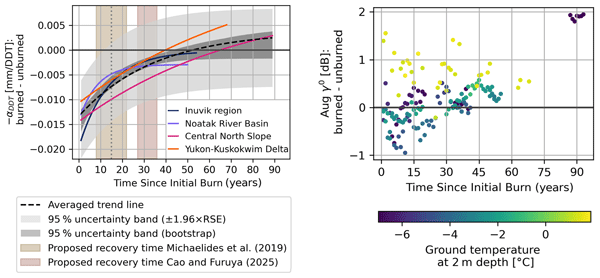
Figures 4 and 5: These are interesting and useful figures for thinking about the different site-specific responses to postfire. In Figure 4 rows b and c, it might be illustrative to overlay the exponential and damped oscillation results on the same axes, as it appears that these two models lie almost completely within each others’ uncertainty range, which would suggest that both models have the same explanatory power for the data (the models are practically indistinguishable). Similarly, I suspect that were uncertainty bounds included on Figures 5b and 5c, there would likely be no statistically significant difference between either the exponential or damped oscillator results, nor statistically significant differences in trend lines between the different study regions. Furthermore, including uncertainty bounds on figure 5a would be appropriate to assess the degree to which there is a statistically significant difference in trend line across any of these study regions. The intersection of the range of uncertainty bounds with the x-axis would allow for a direct interpretation of the proposed recovery time from this manuscript in comparison with the proposed recovery times from Michaelides et al. 2019 and Cao and Furuya 2025. From a quick visual inspection of the uncertainty bounds in Figure 4, the proposed recovery time from this result is broader than the envelopes of both Michaelides and Cao, and the Michaelides and Cao recovery times would fall within the uncertainty of the recovery times from this result. Lastly, I believe that the 27-36 year time span from Cao and Furuya reported in this figure is incorrect for discussing annual deformation rates. Cao and Furuya report a permafrost aggradational phase beginning after 10-15 years post fire, resulting in a cumulative return to prefire displacement after 27-36 years, which is comparable to the 66+-5 year recovery process invoked in Michaelides et al. 2019 (although of differing amounts due to different study regions). The period of time for which Cao and Furuya observe negative seasonal subsidence lasts from 0-10 years +-5 years postfire (see Figure 10 in Cao and Furuya 2025). This is the appropriate time range that should be reported on Figure 5a in the present study, as it corresponds to when the deformation rate switches sign and uplift (i.e., permafrost aggradation) begins.
Section 5.1.2: Page 17 line 317: “The exponential function in this region, and similarly in other regions, shows deviations from the function reported by Michaelides et al. (2019) for the Yukon-Kuskokwim Delta (Figure 5b).” – Can the authors be more precise here? Perhaps state that the exponential model from this result has a larger decay constant, resulting in a more rapid inferred recovery response.
Section 5.1.2: Page 17 line 326: “All regions, particularly for the oscillation functions, exhibit high R2 values for the fits and are statistically significant (p-values ≥0.05, see Figure 6).” -investigation of Figure 7 shows that, in fact, the exponential model overall results in higher R2 values and lower p-values than the damped oscillator model (although both models have very similar overall results, which relates to my earlier point about model indistinguishability).
Section 5.5: It is not evident what the significance of this result is, or how it relates to the broader results presented. I would recommend either expanding this section (as well as the description in the methods to assess the degree to which these different geophysical observables can be directly compared), or remove this section.
Section 5.6: Line 377: “The larger spread of deformation values derived from the LiDAR DTM may result from its higher spatial resolution, even though the data were downsampled for this comparison.” – I’m not convinced that this is a valid interpretation.
Section 5.6: Line 377: “Moreover, the spatial distribution of pronounced subsidence observed in the DTMs broadly aligns with subsidence patterns derived from PALSAR-2, as illustrated in Figure 9.” – I similarly am not convinced of this.
Figures 9 and 10: I am unconvinced that the InSAR and DTM results are showing consistent spatial patterns and magnitudes, or comparable statistics.
Section 6.2: I recommend reporting uncertainty ranges for all year values discussed in this section. For example, rather than “when averaged across all regions, subsidence values progressively converged toward those of the surrounding unburned reference areas, reaching alignment after approximately 50 years” , the authors should report after approximately 50 +-X years. Similarly, a quick investigation of Michaelides et al. 2019 reveals that they report a seasonal subsidence recovery of 15 +-7 years, and Cao and Furuya 2025 reports 10-15 years (which correspond to the shading reported in figure 5a, although see my other comments about 10-15 vs 27-36 in Cao).
Line 423: “The recovery time of seasonal subsidence was indicated at approximately 27 to 36 years in Cao and Furuya”: - I am not sure that this is correct. In reading Cao and Furuya, they report increased subsidence within the first 10 years postfire that gradually declines, and a period of aggradation between 15-30 years. This would suggest that Cao and Furuya observe a recovery time of seasonal subsidence on the order of 10-15 years as stated in their conclusion section, and that the 27-36 year figure is more appropriately associated with annual signals and cumulative displacement (i.e., due to permafrost aggradation, comparable to what is discussed in Michaelides et al. 2019). See for example figure 10 in Cao and Furuya, where the annual displacement rate (i.e., seasonal subsidence rate) crosses zero around 11 years postfire.
Citation: https://doi.org/10.5194/egusphere-2025-6205-RC2 -
AC2: 'Reply on RC2', Barbara Widhalm, 25 Mar 2026
We appreciate the reviewer’s valuable input and provide our replies below:
A substantial component of this manuscript concerns the comparison of postfire results derived in this study to two prior studies: Michaelides et al. 2019 and Cao and Furuya 2025. The present study compares two different models employed in these prior studies to estimate postfire recovery (an exponential model in Michaelides, and a damped oscillator model in Cao), and also discusses recovery time scales estimated in these prior models. This type of comparative analysis is very valuable. However, I would recommend a more detailed discussion of the different assumptions in the Michaelides, Cao, and present study, as all three implement different methods for estimating postfire permafrost response, and estimate related, but subtly different geophysical estimates. This difference makes this not a simple case of an ‘Apples to Apples’ comparison between these three methods. For example, Michaelides et al. 2019 observes a period of increasing seasonal subsidence within the first 5 years postfire which then decreases, returning to ‘pre-fire’ seasonal subsidence signals within 15+-7 years. In parallel, they note an interannual deformation rate signal that is positive for approximately 25 years post fire, and then becomes negative, which they argue is consistent with a permafrost degradation and aggradation cycle that takes 66 +-5 years. Cao and Furuya observe an initial degradation period characterized by elevated seasonal subsidence that gradually slows over the first decade post fire, an aggradational uplift stage from 15-30 years postfire, and a stabilization phase from 30-40 years and beyond postfire. These two studies estimate slightly different quantities, but observe broadly similar trends (immediate increase of seasonal subsidence and return to pre-fire values within 10-15 years post fire, uplift that initiates between 15-30 years post fire, and gradual stabilization).
- Reply: We would like to clarify that, to our understanding, the referee’s interpretation mixes seasonal and annual deformation quantities in a way that does not reflect the definitions used in the original studies or in our manuscript. In Michaelides et al. (2019), the quantity referred to as the “interannual deformation rate” in this comment or as “subsidence trend” in Michaelides et al. (2019) is explicitly expressed in cm/yr. This is directly equivalent to what we call the annual deformation rate in our manuscript. The fitted functional equation used by Michaelides et al. to describe this annual deformation rate (their Figure 6) is therefore directly comparable to our annual deformation rate results shown in Figure 5b. Thus, our comparison between annual deformation rates is consistent and applicable. Similarly, in Cao and Furuya (2025), the deformation shown in their Figure 10, which the referee refers to as “seasonal subsidence”, is in fact also an annual deformation rate and referred to as such in their paper with units of mm/yr. We used their function as presented in Cao and Furuya in Figure 10, rescaled to cm/yr, for the comparison shown in our Figure 5c. All three studies report annual deformation rates that are directly comparable. Only in the case of seasonal subsidence did we compare different observables: our −αDDT (seasonal deformation rate in the DDT domain) versus the absolute seasonal subsidence reported in Michaelides (Figure 6 bottom) and Cao & Furuya (Figure 9b). For this part of the analysis, we did not compare to fitted functions, but to the time of recovery, which is expected to coincide because the absolute deformations are inherently reflected in the deformation rates. To emphasize this, we suggest following addition to the discussion section at line 412:
- “These findings differ from previous results on seasonal subsidence (Michaelides et al., 2019; Cao and Furuya, 2025). Although these studies investigated seasonal subsidence rather than the seasonal deformation rate used in our study, comparing the recovery time remains valid because both quantities are expected to correspond to the same recovery timescale, as absolute seasonal deformation is inherently reflected in the seasonal deformation rates.”
The present study presents a different method for estimating seasonal deformation/displacement and annual/interannual displacement, and further normalizes seasonal deformation by degree days of thaw as done in a prior study. The motivation for this normalization in this study is absent but needed, particularly as it makes direct comparison to the Michaelides and Cao studies less direct. Estimated recovery times in this study are reported without uncertainty ranges; I suspect that the underlying uncertainties as shown in Figures 4 and 5 would result in broad uncertainty ranges that encompass the recovery estimates and ranges in Michaelides and Cao, and result in model indistinguishability between the exponential and damped harmonic oscillator models. Further, I believe at least one recovery time estimated in Cao is misused in the present study, resulting in an inaccurate comparison between these studies.
- Reply: Our responses to these comments are provided below where we address the specific comments.
Specific comments can be found below, organized in roughly chronological order and with reference made to page and line numbers:
Page 3 line 75: “Specifically the concept of expressing rates with respect to degree days of thaw has been shown of added value in permafrost environments.” – This is vague. Can the authors elaborate on this point? What is the added value that this method provides, and how might its use in the context of post fire monitoring be valuable? This motivation is needed, particularly as this choice diverges from the standard approach of expressing rates in units of cm/year, which complicates comparison with the Michaelides et al. 2019 and Cao and Furuya 20245 studies, both of which use this standard convention.
- Reply: We suggest to add the following text at line 76 for elaboration:
- “As absolute seasonal deformation values depend on the year-specific amount of seasonal heating, expressing seasonal deformation rates in the degree day of thaw domain reduces the influence of interannual variability and accounts for differences arising from the timing of the first acquisition date relative to thaw onset. The use of degree days of thaw rather than day of year has therefore been proposed for analyzing seasonal deformation to improve comparability between years (Bartsch et al. 2019), and further facilitates comparisons across regions.”
Page 3 line 78: “The use of SAR backscatter data to study changes after wildfires in tundra regions is limited…” : Technically, the Clayton et al. 2025 and Wig et al. 2025 studies also fall under this category, as the VWC products that were analyzed in these studies are generated from a scattering model that leverages P-band polarimetric backscatter from the ABoVE campaign (details can be found here: https://doi.org/10.1029/2022EA002453 )
- Reply: We suggest the following addition to line 89 to clarify this:
- “While these studies analyze SAR backscatter directly, the studies by Clayton et al. (2025) and Wig et al. (2025) likewise rely on backscatter-derived information by analyzing VWC products, which are generated from P-band polarimetric backscatter collected during the ABoVE campaign (Chen et al. 2023).”
Page 4 line 96: “Specifically the concept of thaw season rates with respect to degree days of thaw (indicating soil moisture) has been applied.” : This comment is related to a prior comment of mine. It is still not clear from the manuscript what the precise advantage of normalizing thaw season rates with respect to degree days of thaw is, much less how this indicates soil moisture. Perhaps these details are explained in Widhalm et al. 2025, but the authors should not assume familiarity with this work on the part of readers, and should instead explain and motivate this use in this study.
- Reply: In addition to the revision proposed in our response to the previous comment concerning Page 3 line 75, we suggest the following change to line 75:
- The linkage between soil moisture and thaw season deformation rates as derived from C-band SAR has been quantified by Widhalm et al. (2025), “who showed that higher seasonal subsidence rates in Arctic lowland permafrost regions were associated with higher near-surface soil moisture compared to drier conditions, a pattern previously suggested to be associated with greater ground-ice content and the higher thermal conductivity characteristic of wetter areas (Antonova et al. 2018).”
Unless I have missed it, there is no discussion regarding interferometric phase referencing or the selection of reference points, a necessary step before displacement time series can be derived. This must be described in the manuscript.
- Reply: We refer to our reply to Referee #1, where we suggested the following addition:
- “Reference points were selected at airstrips for the Central North Slope and Yukon-Kuskokwim Delta, similar to Bartsch et al. (2019) and at low-lying bedrock areas, considered to be stable, for the Inuvik region and Noatak River Basin.”
Table 1 has inconsistent elements: For example, the Detected Increase column lists increases in backscatter in dB, but the entry for Bartsch et al. 2020 merely says ‘higher backscatter in winter’. Is there a corresponding average increase in dB to be reported so that this entry is consistent with the others? Simillarly, the time period column has seemingly different standards – some list recovery time scales, others list the amount of time in between the fire event and the observations. This should be standardized.
- Reply: In Bartsch et al. (2020), no explicit backscatter values are reported for the fire scars. However, we suggest providing inferred backscatter values based on the vegetation heights derived from backscatter shown in their figure, using the corresponding equation that relates backscatter to vegetation height. We further propose to adapt Table 1 as follows:
Region Band Season Detected increase Post-fire recovery Years post fire Zhou et al. (2019) Anaktuvuk River Fire C all seasons max 5.5 dB 5 years 10-year period L max 4.4 dB > 10 years Yi et al. (2022) Anaktuvuk River Fire C thaw season 0.5 dB - 10 years winter season 1 dB L, P thaw season 3-4 dB Jenkins et al. (2014) Anaktuvuk River Fire,
Uvgoon Creek Fire,
DCKN178 FireC thaw season 3 dB 4-5 years 3–17-year periods Bartsch et al. (2020) Yukon-Kuskokwim Delta C winter season ~4 dB - ~45 years Figure 2: There may not be a straightforward way to do this given the density of fire scars in the YKD, but it is currently impossible to determine which year labels correspond to which fire scar for the majority of fire scars in the YKD. Perhaps the fire scar polygons could be color-coded by age as well?
- Reply: We agree to applying the recommended color-coding.
Figure 2: Recommend increasing font size for all labels to help with legibility issues.
- Reply: We agree to applying the recommended changes.
Page 10 Line 228: “To mitigate the effects of large-scale atmospheric disturbances, a spatial filter (filter radius∼20 km) was employed, and the results were subsequently geocoded.” Can the authors elaborate on the type of spatial filter employed? Is this a smoothing filter, a high pass filter, etc? Does the radius imply a circular kernel, or a Gaussian kernel? Were other common InSAR tropospheric correction approaches such as PyAPS, GACOS, etc attempted? If not, why not?
- Reply: We decided against using GACOS because the weather model relies on the ECMWF model at 0.1° spatial and 6 h temporal resolution, which is relatively coarse and sparse resprectively. Instead, applying spatial filtering allows us to better capture low-frequency variations caused by atmospheric disturbances at the time of the acquisitions. For additional information regarding the spatial filter, we propose the following clarification:
- “To mitigate the effects of large-scale atmospheric disturbances, a low-frequency correction was performed by applying a linear least-squares type spatial filter, as implemented in the GAMMA software, using a neighborhood radius of approximately 20 km to estimate and remove long-wavelength atmospheric path delays. The filtered results were then geocoded for further analysis.”
According to Equation 1 and the accompanying text, d_i represents the cumulative (i.e., absolute) displacement during a thaw season. However, there is no discussion of how the authors convert the time series of unwrapped interferometric phase (line 227) into a time series of cumulative displacement. Was, for example, the SBAS algorithm used, or some other method? This is a critical missing detail, as without this information and all accompanying design choices that went into the inversion necessary to convert relative unwrapped phase into an absolute time series of ground displacement, it is impossible to rigorously assess any results that depend upon these cumulative displacement estimates.
- Reply: For the derivation of , an SBAS approach was applied. We used the method described by Charles Werner (2012), implemented in the GAMMA Remote Sensing software, which calculates a phase time-series from a set of multi-reference unwrapped continuous interferograms using an extension of the SVD based Least-Squares inversion. We suggest the following clarification for line 227:
- The phase time series was then derived from the masked interferograms, “using a multi-reference small baseline approach (Berardino et al., 2002; Werner et al. 2012),” and converted to vertical displacements, assuming all motion occurred in the vertical direction.
Line 245: “only those with sufficient coherence resulting in minimal unwrapping errors were selected.” – Can the authors be more precise? How was this quantitatively (or qualitatively) determined? Where unwrapping errors estimates in some way, for example using the phase closure or bridging method? Was there an observed coherence threshold that needed to be met to preserve phase unambiguity in the unwrapped estimates?
- Reply: Unwrapping errors were assessed visually, and only interferograms exhibiting minimal unwrapping errors within the study areas were selected. No formal error estimation using phase closure or bridging methods was performed. As stated in the manuscript, interferograms were masked was applied based on mean coherence (threshold 0.8) and mean filtered correlation coefficient (threshold 0.5). This combination of visual inspection and coherence-based masking helps to ensure the overall quality of the unwrapping and to minimize errors. We suggest the following addition to clarify the use of visual inspection:
- Only interferograms exhibiting minimal unwrapping errors, “as determined by visual inspection (e.g., as done in Chen et al. (2020), Eshqi Molan et al. (2018)) ,” were selected.
Section 4.4: How were ABoVE seasonal subsidence results used for validation of your deformation rate estimates, given that these are two different observables with different units (e.g., cm for seasonal subsidence, mm/DDT for deformation rates)? A more thorough discussion of this, any assumptions made, and any limitations of this validation approach is warranted.
- Reply: As suggested by Referee #1, we propose to reposition this comparison as a qualitative consistency check. In response to this comment, we suggest the following adaptations:
- “Because the ABoVE seasonal deformation product is expressed in absolute values, while −αDDT represents the deformation rate in mm/DDT, these two observables are compared in a qualitative consistency assessment. This comparison highlights whether regions with higher absolute seasonal deformation in the ABoVE product correspond to higher subsidence rates in −α Spatial variations in −αDDT arising from local differences in DDT values are expected to be small when considering individual study areas of limited size, making the qualitative comparison between the two datasets justified.”
Figures 4 and 5: These are interesting and useful figures for thinking about the different site-specific responses to postfire. In Figure 4 rows b and c, it might be illustrative to overlay the exponential and damped oscillation results on the same axes, as it appears that these two models lie almost completely within each others’ uncertainty range, which would suggest that both models have the same explanatory power for the data (the models are practically indistinguishable). Similarly, I suspect that were uncertainty bounds included on Figures 5b and 5c, there would likely be no statistically significant difference between either the exponential or damped oscillator results, nor statistically significant differences in trend lines between the different study regions. Furthermore, including uncertainty bounds on figure 5a would be appropriate to assess the degree to which there is a statistically significant difference in trend line across any of these study regions. The intersection of the range of uncertainty bounds with the x-axis would allow for a direct interpretation of the proposed recovery time from this manuscript in comparison with the proposed recovery times from Michaelides et al. 2019 and Cao and Furuya 2025. From a quick visual inspection of the uncertainty bounds in Figure 4, the proposed recovery time from this result is broader than the envelopes of both Michaelides and Cao, and the Michaelides and Cao recovery times would fall within the uncertainty of the recovery times from this result. Lastly, I believe that the 27-36 year time span from Cao and Furuya reported in this figure is incorrect for discussing annual deformation rates. Cao and Furuya report a permafrost aggradational phase beginning after 10-15 years post fire, resulting in a cumulative return to prefire displacement after 27-36 years, which is comparable to the 66+-5 year recovery process invoked in Michaelides et al. 2019 (although of differing amounts due to different study regions). The period of time for which Cao and Furuya observe negative seasonal subsidence lasts from 0-10 years +-5 years postfire (see Figure 10 in Cao and Furuya 2025). This is the appropriate time range that should be reported on Figure 5a in the present study, as it corresponds to when the deformation rate switches sign and uplift (i.e., permafrost aggradation) begins.
- Reply: We decided against overlaying the exponential and damped oscillation results, as in some cases they would overlap almost completely and appear as a single result. We do, however, suggest the following addition to the manuscript to emphasize this overlap:
- “Overall, the two models produce very similar results in most regions, lying largely within each other’s uncertainty ranges, indicating limited distinguishability between the exponential and damped oscillator models and suggesting that both models have comparable predictive ability.”
- Concerning Figure 5, we also decided against including the uncertainty bounds, as doing so would excessively overload the figure. We propose to explore options for a different presentation type. We furthermore agree to revise the phrasing to reflect the statistical significance of differences in trend lines between the regions and previous studies.
- Concerning the addressed recovery time of 26–27 years: this timespan does not refer to the annual deformation rate, as suggested, but rather to the seasonal deformation, which we address in Figure 5a. This value was derived based on Cao and Furuya (last paragraph of their Section 3.3 and their Figure 9). This is distinct from the annual deformation rates, which we analyze in our Figures 5b and 5c.
Section 5.1.2: Page 17 line 317: “The exponential function in this region, and similarly in other regions, shows deviations from the function reported by Michaelides et al. (2019) for the Yukon-Kuskokwim Delta (Figure 5b).” – Can the authors be more precise here? Perhaps state that the exponential model from this result has a larger decay constant, resulting in a more rapid inferred recovery response.
- Reply: In line with this suggestion, we propose the following addition:
- “In all regions, the fitted exponential models in our study exhibit larger decay constants, reflecting a shorter recovery timescale, than reported by Michaelides et al. (2019).”
Section 5.1.2: Page 17 line 326: “All regions, particularly for the oscillation functions, exhibit high R2 values for the fits and are statistically significant (p-values ≥0.05, see Figure 6).” -investigation of Figure 7 shows that, in fact, the exponential model overall results in higher R2 values and lower p-values than the damped oscillator model (although both models have very similar overall results, which relates to my earlier point about model indistinguishability).
- Reply: Thanks for spotting this inconsistency. We note that indeed in one region the exponential model yields higher R² values, and that overall the exponential model consistently produces lower p-values. We therefore propose the following adaptation:
- “All regions exhibit high R² values for the fits, both for the exponential and the oscillation functions, and are statistically significant (p-values ≥ 0.05, see Figure 6). Overall, the two models produce very similar results in most regions, lying largely within each other’s uncertainty ranges, indicating limited distinguishability between the exponential and damped oscillator models and suggesting that both models have comparable predictive ability.”
Section 5.5: It is not evident what the significance of this result is, or how it relates to the broader results presented. I would recommend either expanding this section (as well as the description in the methods to assess the degree to which these different geophysical observables can be directly compared), or remove this section.
- Reply: We agree to expand this section and as suggested above, we propose to revise the corresponding methods section (Section 4.4). In addition, we proposed further changes to the discussion section to Referee #1. Furthermore, we suggest the following addition in the results section 5.5:
- “Although the ABoVE product represents absolute seasonal subsidence and −αDDT expresses the seasonal deformation rate, the comparison shows that larger absolute ABoVE subsidence values correspond to more negative −αDDT values, indicating higher subsidence rates. This relationship is consistent within each study region where sufficient sample sizes are available and provides a qualitative indication of consistency between the two deformation metrics.”
Section 5.6: Line 377: “The larger spread of deformation values derived from the LiDAR DTM may result from its higher spatial resolution, even though the data were downsampled for this comparison.” – I’m not convinced that this is a valid interpretation.
- Reply: As proposed by Referee #1, we suggest attributing the larger spread to systematic differences between the respective approaches.
Section 5.6: Line 377: “Moreover, the spatial distribution of pronounced subsidence observed in the DTMs broadly aligns with subsidence patterns derived from PALSAR-2, as illustrated in Figure 9.” – I similarly am not convinced of this.
- Reply: The patterns are indeed difficult to identify in the way currently presented. We therefore suggest updating Figure 9 to highlight areas of high and low ΔDTM as polygons overlaid on the InSAR-derived subsidence. This visualization is intended to emphasize the spatial correspondence observed in certain areas between the most pronounced DTM-derived deformation zones and the PALSAR-2 deformation patterns. We further suggest to replace “broadly” with “in parts”.
Figures 9 and 10: I am unconvinced that the InSAR and DTM results are showing consistent spatial patterns and magnitudes, or comparable statistics.
- Reply: In our manuscript, we report the median values, which show approximate agreement, particularly when compared to the timestep closer to the fire event. We further emphasized that the ΔDTM data exhibit a larger spread (line 377), and as detailed above we suggest updating the text to indicate that the correspondence with InSAR results is observed ‘in parts’. This partial correspondence is further supported by the linear trend in the value distributions shown in Figure 10b, as already noted in the manuscript (line 382).
Section 6.2: I recommend reporting uncertainty ranges for all year values discussed in this section. For example, rather than “when averaged across all regions, subsidence values progressively converged toward those of the surrounding unburned reference areas, reaching alignment after approximately 50 years” , the authors should report after approximately 50 +-X years. Similarly, a quick investigation of Michaelides et al. 2019 reveals that they report a seasonal subsidence recovery of 15 +-7 years, and Cao and Furuya 2025 reports 10-15 years (which correspond to the shading reported in figure 5a, although see my other comments about 10-15 vs 27-36 in Cao).
- Reply: We agree and suggest revising the uncertainty representation and subsequent phrasing, including evaluating the spread of the averages.
Line 423: “The recovery time of seasonal subsidence was indicated at approximately 27 to 36 years in Cao and Furuya”: - I am not sure that this is correct. In reading Cao and Furuya, they report increased subsidence within the first 10 years postfire that gradually declines, and a period of aggradation between 15-30 years. This would suggest that Cao and Furuya observe a recovery time of seasonal subsidence on the order of 10-15 years as stated in their conclusion section, and that the 27-36 year figure is more appropriately associated with annual signals and cumulative displacement (i.e., due to permafrost aggradation, comparable to what is discussed in Michaelides et al. 2019). See for example figure 10 in Cao and Furuya, where the annual displacement rate (i.e., seasonal subsidence rate) crosses zero around 11 years postfire.
- Reply: Please see our comment on Figures 4 and 5 above. We would like to emphasize again that, both in our manuscript and in Cao and Furuya, annual displacement rate and seasonal subsidence rate are not synonymous. As illustrated in Cao and Furuya (Figure 9b), the response of the freezing and thawing season displacements to fire differs from the response observed in the annual displacement rates (Figures 9a and 10).
References:
Antonova, S.; Sudhaus, H.; Strozzi, T.; Zwieback, S.; Kääb, A.; Heim, B.; Langer, M.; Bornemann, N.; Boike, J. Thaw Subsidence of a Yedoma Landscape in Northern Siberia, Measured In Situ and Estimated from TerraSAR-X Interferometry. Remote Sens. 2018, 10, 494. https://doi.org/10.3390/rs10040494
Bartsch, A.; Leibman, M.; Strozzi, T.; Khomutov, A.; Widhalm, B.; Babkina, E.; Mullanurov, D.; Ermokhina, K.; Kroisleitner, C.; Bergstedt, H. Seasonal Progression of Ground Displacement Identified with Satellite Radar Interferometry and the Impact of Unusually Warm Conditions on Permafrost at the Yamal Peninsula in 2016. Remote Sens. 2019, 11, 1865. https://doi.org/10.3390/rs11161865
Berardino, P.; Fornaro, G.; Lanari, R.; Sansosti, E. A new algorithm for surface deformation monitoring based on small baseline differential SAR interferograms. IEEE Trans. Geosci. Remote Sens. 2002, 40, 2375–2383.
Chen, J.; Wu, Y.; O'Connor, M.; Cardenas, M. B.; Schaefer, K.; Michaelides, R.; Kling, G. Active Layer Freeze-Thaw and Water Storage Dynamics in Permafrost Environments Inferred from InSAR. Remote Sens. Environ. 2020, 248, 112007. https://doi.org/10.1016/j.rse.2020.112007
Eshqi Molan, Y.; Kim, J.-W.; Lu, Z.; Wylie, B.; Zhu, Z. Modeling Wildfire-Induced Permafrost Deformation in an Alaskan Boreal Forest Using InSAR Observations. Remote Sens. 2018, 10, 405. https://doi.org/10.3390/rs10030405
Werner, C.; Wegmüller, U.; Strozzi, T. Deformation time-series of the Lost-Hills oil field using a multi-baseline interferometric SAR inversion algorithm with finite difference smoothing constraints. In Proceedings of the AGU Fall Meeting, San Francisco, CA, USA, 3–7 December 2012.
Citation: https://doi.org/10.5194/egusphere-2025-6205-AC2
-
AC2: 'Reply on RC2', Barbara Widhalm, 25 Mar 2026
-
EC1: 'Comment on egusphere-2025-6205', Krystyna Kozioł, 19 Mar 2026
Dear Authors and Reviewers,
many thanks for your contributions to the interactive discussion stage. Since Reviewer recommendations differ, I believe the Authors should have an opportunity to address the concerns of Reviewer 2 (the other set of comments was already addressed). Please mind that the answer may outline detailed (including line-by-line) corrections to be applied in the manuscript, yet the manuscript file itself will not be requested at that stage. The main purpose of the response is to outline a strategy for corrections and their feasibility. Another decision stage will follow after the responses have been provided.
Kind regards,
Krystyna KoziolCitation: https://doi.org/10.5194/egusphere-2025-6205-EC1 -
EC2: 'Reply on EC1', Krystyna Kozioł, 25 Mar 2026
Dear Authors and Reviewers,
many thanks for your efforts to improve the manuscript and for the multiple discussion points raised and elaborated. In light with the clear strategy outlined for corrections of the manuscript, I would ask that the Authors provide such corrected version for further review.
However, a very important point raised by both sides of the discussion is clarifying terminology and using it consistently. I would particularly ask that the terminology of annual/interannual displacement and deformation rates as compared to seasonal subsidence trends and rates is very clearly discussed and consistently used. Clarifying and justifying any discrepancy to pre-existing term use in the literature should also be considered in the revision.
Again, many thanks for your time invested in this process.
Kind regards,
Krystyna KoziolCitation: https://doi.org/10.5194/egusphere-2025-6205-EC2
-
EC2: 'Reply on EC1', Krystyna Kozioł, 25 Mar 2026
Peer review completion


Interactive discussion
Status: closed
-
RC1: 'Comment on egusphere-2025-6205', Anonymous Referee #1, 19 Feb 2026
General comments:
This manuscript investigates the long‑term dynamics of permafrost in fire scars using a space‑for‑time approach at several representative locations across the North American permafrost region. I highly appreciate the attempt to extend the spatial scope beyond previous studies using same approaches in order to highlight interregional differences. It is also a clear strength of the work that InSAR data from different wavelengths, backscatter intensity, and various environmental factors are comprehensively compared and cross‑validated. The background and methodology are generally well motivated, and the necessary information is presented in a concise and accessible way.
However, some of the interpretations of key results, particularly those related to annual deformation and seasonal backscatter behavior, appear to rely on implicit assumptions that are not clearly stated. This raises concerns about attributing the observed patterns solely to temperature or climatic conditions. In several places, relative differences are discussed as if they were absolute signals, or regional contrasts are interpreted primarily in terms of fire‑scar properties without fully accounting for differences in the reference (unburned) areas. I therefore recommend that the authors revisit and refine the interpretation of these results, taking into account the points raised in the comments below.
1. Interpretation of annual deformation and “uplift”
I am concerned about the interpretation of the annual deformation differences as “uplift” within the fire scars. By definition, author’s metric is the difference between the fire scar and its unburned surroundings, so a positive value can also arise when the fire scar simply subsides less than the surrounding area, rather than actually uplifting in an absolute sense. Figure A4 (a) shows that the unburned surroundings themselves exhibit subsidence signals, which makes this distinction important. This implicit “positive deformation difference = uplift” assumption also seems to underlie the discussion in Section 6.3, including the conclusion that the apparent uplift signal in the Yukon–Kuskokwim Delta is related to its warmer conditions.
To avoid over‑interpretation, I suggest (i) clearly distinguishing between relative differences with respect to the surrounding areas and relative differences with respect to the reference points, (ii) more explicitly describing the reason of selecting reference points in each region, and (iii) explaining how annual changes in the unburned surrounding areas may affect the inferred trends.
2. Interpretation of backscatter differences and climate effects
I have some concerns about the way the seasonal backscatter differences (Δγ0) are interpreted solely as a climate‑driven response of the fire scars. The contrasts between summer-winter Δγ0 in IN and in the YKD (Figure 4f) are discussed as reflecting the response of fire scars to warmer versus colder climatic conditions. However, the reference γ0 in the surrounding undisturbed areas is expected to vary between regions due to differences in vegetation type and surface conditions. Indeed, Figures A5 and A6 show that the γ0 levels of the unburned surroundings are not uniform across regions. Consequently, the interregional differences in the seasonal contrast of Δγ0 may not only reflect how fire scars respond to climate, but also how they respond relative to different types of surrounding reference areas. In Section 6.4 (around lines 493–494), the differing temporal trends in warm versus cold regions are likewise attributed primarily to the properties of the fire scars.
Overall, it seems problematic to interpret the seasonal contrast in Δγ0 purely as a response of the fire scars to temperature conditions, without more explicitly considering the role of region‑specific reference backscatter levels.
Specific comments:
L14-18: In the abstract, the authors only state the cause of increased summer backscatter in warmer regions. It remains unclear why initial backscatter decreases in the colder regions. I think the abstract should briefly mention the authors’ interpretation of this contrasting behavior, rather than only describing the pattern.
L370: Figure 8 demonstrates that the deformation patterns broadly correspond, but because the units of the two quantities differ, I find the figure to be a rather weak basis for the statement that it “supports the validity of the results” (around line 396 in Discussion). I would suggest repositioning this comparison as a qualitative consistency check of deformation patterns, or alternatively converting the ABoVE subsidence values to -αDDT for a more direct comparison.
L378-379: I do not fully understand why a broad spread would persist although the higher‑resolution DTM data have been downsampled. Could this broad spread rather be attributed to systematic differences between the InSAR and ΔDTM approaches?
L391-392: The number of selected fire scars is reported in the manuscript, but there is no information on their individual areas. From Figures A1 - A4, it appears that some very small fire scars and a few very large fire scars dominate the sample. If the areas of the selected fire scars are biased toward a specific size range, then relying solely on the R² values in Table A8 for statistical assessment may be problematic.
L416: This comparison seems to rely on the assumption that the seasonal deformation behavior of the reference regions remains constant over the long term. Do you have any data showing that the seasonal deformation in the reference regions is indeed stable, or is this assumption simply imposed?
L448: Is the wet condition in the depressions only a short‑lived feature immediately after snowmelt, or does it persist throughout the thawing season?
L449: Do you have any evidence that the CCI Permafrost thermal model realistically represents fire‑induced changes in soil and surface conditions at the scale of individual fire scars? Also, the resolution of the ground temperature information is 0.01°. At this scale, individual fire scars and their 5 km surroundings are often contained within only a few grid cells. Therefore, I think it is inappropriate to conclude, based on this model product alone, that ground temperature differences between fire scars and the surrounding undisturbed areas are small.
L526: The wording in the first sentence is ambiguous. You should remind the reader what “all regions” refers to in the context of this study.
Figure A3-A4, A5-A7: The lines indicating the extent of the fire scars are too thick, and in sub-plot (d) in particular it is difficult to discern the deformation values. Could you thin the lines, or, for large fire scars, show only an outer outline instead?
Technical corrections:
L171: “2024)))” should be “2024))” Figure A2 caption has same issue.
L395-396: Should refer to Figure 8 here.
L462: alanlyzed should be analyzed
L481: “5d” should be “4d”
L529: “about only about” should be “only about”
-
AC1: 'Reply on RC1', Barbara Widhalm, 12 Mar 2026
Many thanks for your feedback and valuable comments! Please find our response below:
- Interpretation of annual deformation and “uplift”
I am concerned about the interpretation of the annual deformation differences as “uplift” within the fire scars. By definition, author’s metric is the difference between the fire scar and its unburned surroundings, so a positive value can also arise when the fire scar simply subsides less than the surrounding area, rather than actually uplifting in an absolute sense. Figure A4 (a) shows that the unburned surroundings themselves exhibit subsidence signals, which makes this distinction important. This implicit “positive deformation difference = uplift” assumption also seems to underlie the discussion in Section 6.3, including the conclusion that the apparent uplift signal in the Yukon–Kuskokwim Delta is related to its warmer conditions.
To avoid over‑interpretation, I suggest (i) clearly distinguishing between relative differences with respect to the surrounding areas and relative differences with respect to the reference points, (ii) more explicitly describing the reason of selecting reference points in each region, and (iii) explaining how annual changes in the unburned surrounding areas may affect the inferred trends.
- Reply: We agree to emphasize that ‘heave’ is meant relative to the unburned surroundings. We further suggest following addition to Section 6.1 at L402:
- Furthermore, the spatial filtering applied to the InSAR results reduces not only large-scale atmospheric and ionospheric artifacts but also removes deformation signals with spatial scales larger than the filter radius. This filtering centers the mean deformation around zero (Bartsch et al., 2024). In this context, the use of unburned reference areas allows the interpretation to focus on deformation within the fire scars relative to their undisturbed surroundings, rather than on potentially biased absolute values. This relative approach also helps to account for interannual fluctuations, since deformation trends in the burn scars are evaluated against prevailing conditions in the unburned surroundings, making the inferred trends more robust to annual regional variations.
- We furthermore suggest to include following description for reference point selection in the methods section:
- Reference points were selected at airstrips for the Central North Slope and Yukon-Kuskokwim Delta, similar to Bartsch et al. (2019) and at low-lying bedrock areas, considered to be stable, for the Inuvik region and Noatak River Basin.
- Interpretation of backscatter differences and climate effects
I have some concerns about the way the seasonal backscatter differences (Δγ0) are interpreted solely as a climate‑driven response of the fire scars. The contrasts between summer-winter Δγ0 in IN and in the YKD (Figure 4f) are discussed as reflecting the response of fire scars to warmer versus colder climatic conditions. However, the reference γ0 in the surrounding undisturbed areas is expected to vary between regions due to differences in vegetation type and surface conditions. Indeed, Figures A5 and A6 show that the γ0 levels of the unburned surroundings are not uniform across regions. Consequently, the interregional differences in the seasonal contrast of Δγ0 may not only reflect how fire scars respond to climate, but also how they respond relative to different types of surrounding reference areas. In Section 6.4 (around lines 493–494), the differing temporal trends in warm versus cold regions are likewise attributed primarily to the properties of the fire scars.
Overall, it seems problematic to interpret the seasonal contrast in Δγ0 purely as a response of the fire scars to temperature conditions, without more explicitly considering the role of region‑specific reference backscatter levels.
- Reply: We found no apparent influence on the direction of the derived trends, as the warmest region showed similar surrounding reference backscatter values as two of the colder regions, while the second coldest region featured comparably higher values. Nevertheless, we suggest to add the following to address this:
- Section 5.2, L343: The prevailing backscatter level of the surrounding region does not appear to influence the direction of the trends, as Yukon–Kuskokwim Delta values differ only minimally from those of the colder Noatak River Basin and Central North Slope, whereas the Inuvik region, the second coldest study region, exhibits surrounding backscatter values more than 1 dB higher than the other regions (Figure A5).
- Section 5.3, L355: Similar to the summer backscatter data, the trend directions appear to be independent of the surrounding backscatter level, as the warmest region, the Yukon-Kuskokwim Delta shows winter backscatter values that more closely resemble those of the colder Noatak River Basin and Central North Slope, whereas the second-coldest region, Inuvik, exhibits notably higher winter backscatter values (Figure A6).
- Section 6.4, L481: These patterns appear to be independent of the prevailing backscatter level of the surrounding areas, and thus of vegetation type and surface conditions (Figure A5).
- L492: Although there may be other factors that influence backscatter trends, many of the fire scars investigated in our study do indicate a connection between fire scar backscatter and ground temperatures (Figure 7c), independent of the initial backscatter levels (Figure A5).
Specific comments:
L14-18: In the abstract, the authors only state the cause of increased summer backscatter in warmer regions. It remains unclear why initial backscatter decreases in the colder regions. I think the abstract should briefly mention the authors’ interpretation of this contrasting behavior, rather than only describing the pattern.
- Reply: We suggest the following addition to the interpretation of the observed lower backscatter:
- …, likely driven predominantly by the effect of initial vegetation loss.
L370: Figure 8 demonstrates that the deformation patterns broadly correspond, but because the units of the two quantities differ, I find the figure to be a rather weak basis for the statement that it “supports the validity of the results” (around line 396 in Discussion). I would suggest repositioning this comparison as a qualitative consistency check of deformation patterns, or alternatively converting the ABoVE subsidence values to -αDDT for a more direct comparison.
- Reply: We agree to rephrasing this comparison as a qualitative consistency check
- Old: We assessed this by comparing thaw season deformation rate results to ABoVE InSAR L-band seasonal subsidence products, which confirmed linear trends in the value distributions, supporting the validity of the results.
- New: We assessed this by comparing thaw season deformation rate results to ABoVE InSAR L-band seasonal subsidence products (Figure 8), providing a qualitative consistency check of deformation patterns, with the observed linear trends in the value distributions supporting the overall consistency of the results.
L378-379: I do not fully understand why a broad spread would persist although the higher‑resolution DTM data have been downsampled. Could this broad spread rather be attributed to systematic differences between the InSAR and ΔDTM approaches?
- Reply: We agree that this could be attributed to systematic differences of the respective approaches and suggest the following change:
- The larger spread of deformation values derived from the LiDAR DTM may result from systematic differences between the InSAR and the ΔDTM approach, rather than from the DTM’s higher spatial resolution, as the data were downsampled to the same resolution for this comparison.
L391-392: The number of selected fire scars is reported in the manuscript, but there is no information on their individual areas. From Figures A1 - A4, it appears that some very small fire scars and a few very large fire scars dominate the sample. If the areas of the selected fire scars are biased toward a specific size range, then relying solely on the R² values in Table A8 for statistical assessment may be problematic.
- Reply: We agree that the R² values may be biased. We therefore propose binning the fire scar sizes into 50 km² increments and computing the corresponding median values of the std values, in order to reduce this bias in the std vs. size relationship. The resulting R² values are higher, but the dependency remains generally weak. We suggest to update Table A8 and L392:
- The dependency of the standard deviation values of the investigated parameters on fire scar size was examined after binning the fire scar sizes into 50 km² increments and using median standard deviations to account for the bias toward smaller size ranges. While winter backscatter exhibited comparatively higher R² values (0.33, Table A8), the standard deviation values of the investigated parameters generally showed little dependency on fire scar size, although the standard deviations themselves remained non-negligible.
-
Mean std of fire scars R²: std vs. size (50 km2 bins) Thaw season deformation rate 0.011 [mm/DDT] 0.087 Annual deformation rate 0.698 [cm/yr] 0.225 Summer backscatter 1.827 [dB] 0.097 Winter backscatter 1.819 [dB] 0.330 Backscatter difference: summer - winter 2.465 [dB] 0.033
L416: This comparison seems to rely on the assumption that the seasonal deformation behavior of the reference regions remains constant over the long term. Do you have any data showing that the seasonal deformation in the reference regions is indeed stable, or is this assumption simply imposed?
- Reply: The sentence states: ‚comparison of reference regions under the same recording conditions‘. It does not rely on stable seasonal deformations. The values provide comparisons to undisturbed conditions, independent of changes from year to year, which is favourable compared to constant values, as it takes yearly fluctuations into account.
L448: Is the wet condition in the depressions only a short‑lived feature immediately after snowmelt, or does it persist throughout the thawing season?
- Reply: We assume that the wet conditions in the depressions could prolong soil moisture beyond the immediate post-snowmelt period. However, in situ measurements are needed to confirm this. We propose the following addition:
- Whether these wetter conditions persist throughout the thawing season or are confined to the immediate post-snowmelt period remains to be confirmed by in situ measurements.
L449: Do you have any evidence that the CCI Permafrost thermal model realistically represents fire‑induced changes in soil and surface conditions at the scale of individual fire scars? Also, the resolution of the ground temperature information is 0.01°. At this scale, individual fire scars and their 5 km surroundings are often contained within only a few grid cells. Therefore, I think it is inappropriate to conclude, based on this model product alone, that ground temperature differences between fire scars and the surrounding undisturbed areas are small.
- Reply: Our assumption was that the CCI ground temperature does not reflect fire-induced changes. The purpose was to demonstrate that the temperature values used for the comparisons were not affected by the occurrence of a fire. We suggest the following addition to clarify this:
- …, indicating that the CCI ground temperature values used in our comparisons are unaffected by fire.
L526: The wording in the first sentence is ambiguous. You should remind the reader what “all regions” refers to in the context of this study.
- Reply: We agree and suggest to change this to ‘all investigated North American Arctic tundra regions’.
Figure A3-A4, A5-A7: The lines indicating the extent of the fire scars are too thick, and in sub-plot (d) in particular it is difficult to discern the deformation values. Could you thin the lines, or, for large fire scars, show only an outer outline instead?
- Reply: We agree to apply the suggested adaptations.
References:
Bartsch, A.; Leibman, M.; Strozzi, T.; Khomutov, A.; Widhalm, B.; Babkina, E.; Mullanurov, D.; Ermokhina, K.; Kroisleitner, C.; Bergstedt, H. Seasonal Progression of Ground Displacement Identified with Satellite Radar Interferometry and the Impact of Unusually Warm Conditions on Permafrost at the Yamal Peninsula in 2016. Remote Sens. 2019, 11, 1865. https://doi.org/10.3390/rs11161865
Citation: https://doi.org/10.5194/egusphere-2025-6205-AC1
-
AC1: 'Reply on RC1', Barbara Widhalm, 12 Mar 2026
-
RC2: 'Comment on egusphere-2025-6205', Anonymous Referee #2, 14 Mar 2026
This study aims to better characterize the impact of wildfires on permafrost landscapes by investigating a series of wildfire events using a chronosequence (‘space-for-time’) approach. They investigate L-band and C-band InSAR retrievals of seasonal and annual deformation, and C-band backscatter values. They find elevated seasonal subsidence for up to 40-70 years post-fire in fire affected landscapes, and elevated annual subsidence is detectable for 5-10 years post-fire. Elevated backscatter in summer months is attributed to increased soil moisture. The discuss several observed regional trends in thaw season subsidence and SAR backscatter.
This is a very interesting research question with important implications for tundra systems, and the use of multiple frequencies and both phase and backscatter is meritorious. However, as currently written, there are several technical questions that I have as a reviewer that prevent me from making a holistic assessment of the proposed work. I have enumerated this issues below, and believe that they must be taken into account before this manuscript can be considerd for publication. As a result, I recommend that the manuscript be rejected in its present form, and a revised version with these comments taken into account be reconsidered for publication.
A substantial component of this manuscript concerns the comparison of postfire results derived in this study to two prior studies: Michaelides et al. 2019 and Cao and Furuya 2025. The present study compares two different models employed in these prior studies to estimate postfire recovery (an exponential model in Michaelides, and a damped oscillator model in Cao), and also discusses recovery time scales estimated in these prior models. This type of comparative analysis is very valuable. However, I would recommend a more detailed discussion of the different assumptions in the Michaelides, Cao, and present study, as all three implement different methods for estimating postfire permafrost response, and estimate related, but subtly different geophysical estimates. This difference makes this not a simple case of an ‘Apples to Apples’ comparison between these three methods. For example, Michaelides et al. 2019 observes a period of increasing seasonal subsidence within the first 5 years postfire which then decreases, returning to ‘pre-fire’ seasonal subsidence signals within 15+-7 years. In parallel, they note an interannual deformation rate signal that is positive for approximately 25 years post fire, and then becomes negative, which they argue is consistent with a permafrost degradation and aggradation cycle that takes 66 +-5 years. Cao and Furuya observe an initial degradation period characterized by elevated seasonal subsidence that gradually slows over the first decade post fire, an aggradational uplift stage from 15-30 years postfire, and a stabilization phase from 30-40 years and beyond postfire. These two studies estimate slightly different quantities, but observe broadly similar trends (immediate increase of seasonal subsidence and return to pre-fire values within 10-15 years post fire, uplift that initiates between 15-30 years post fire, and gradual stabilization).
The present study presents a different method for estimating seasonal deformation/displacement and annual/interannual displacement, and further normalizes seasonal deformation by degree days of thaw as done in a prior study. The motivation for this normalization in this study is absent but needed, particularly as it makes direct comparison to the Michaelides and Cao studies less direct. Estimated recovery times in this study are reported without uncertainty ranges; I suspect that the underlying uncertainties as shown in Figures 4 and 5 would result in broad uncertainty ranges that encompass the recovery estimates and ranges in Michaelides and Cao, and result in model indistinguishability between the exponential and damped harmonic oscillator models. Further, I believe at least one recovery time estimated in Cao is misused in the present study, resulting in an inaccurate comparison between these studies.
Specific comments can be found below, organized in roughly chronological order and with reference made to page and line numbers:
Page 3 line 75: “Specifically the concept of expressing rates with respect to degree days of thaw has been shown of added value in permafrost environments.” – This is vague. Can the authors elaborate on this point? What is the added value that this method provides, and how might its use in the context of post fire monitoring be valuable? This motivation is needed, particularly as this choice diverges from the standard approach of expressing rates in units of cm/year, which complicates comparison with the Michaelides et al. 2019 and Cao and Furuya 20245 studies, both of which use this standard convention.
Page 3 line 78: “The use of SAR backscatter data to study changes after wildfires in tundra regions is limited…” : Technically, the Clayton et al. 2025 and Wig et al. 2025 studies also fall under this category, as the VWC products that were analyzed in these studies are generated from a scattering model that leverages P-band polarimetric backscatter from the ABoVE campaign (details can be found here: https://doi.org/10.1029/2022EA002453 )
Page 4 line 96: “Specifically the concept of thaw season rates with respect to degree days of thaw (indicating soil moisture) has been applied.” : This comment is related to a prior comment of mine. It is still not clear from the manuscript what the precise advantage of normalizing thaw season rates with respect to degree days of thaw is, much less how this indicates soil moisture. Perhaps these details are explained in Widhalm et al. 2025, but the authors should not assume familiarity with this work on the part of readers, and should instead explain and motivate this use in this study.
Unless I have missed it, there is no discussion regarding interferometric phase referencing or the selection of reference points, a necessary step before displacement time series can be derived. This must be described in the manuscript.
Table 1 has inconsistent elements: For example, the Detected Increase column lists increases in backscatter in dB, but the entry for Bartsch et al. 2020 merely says ‘higher backscatter in winter’. Is there a corresponding average increase in dB to be reported so that this entry is consistent with the others? Simillarly, the time period column has seemingly different standards – some list recovery time scales, others list the amount of time in between the fire event and the observations. This should be standardized.
Figure 2: There may not be a straightforward way to do this given the density of fire scars in the YKD, but it is currently impossible to determine which year labels correspond to which fire scar for the majority of fire scars in the YKD. Perhaps the fire scar polygons could be color-coded by age as well?
Figure 2: Recommend increasing font size for all labels to help with legibility issues.
Page 10 Line 228: “To mitigate the effects of large-scale atmospheric disturbances, a spatial filter (filter radius∼20 km) was employed, and the results were subsequently geocoded.” Can the authors elaborate on the type of spatial filter employed? Is this a smoothing filter, a high pass filter, etc? Does the radius imply a circular kernel, or a Gaussian kernel? Were other common InSAR tropospheric correction approaches such as PyAPS, GACOS, etc attempted? If not, why not?
According to Equation 1 and the accompanying text, d_i represents the cumulative (i.e., absolute) displacement during a thaw season. However, there is no discussion of how the authors convert the time series of unwrapped interferometric phase (line 227) into a time series of cumulative displacement. Was, for example, the SBAS algorithm used, or some other method? This is a critical missing detail, as without this information and all accompanying design choices that went into the inversion necessary to convert relative unwrapped phase into an absolute time series of ground displacement, it is impossible to rigorously assess any results that depend upon these cumulative displacement estimates.
Line 245: “only those with sufficient coherence resulting in minimal unwrapping errors were selected.” – Can the authors be more precise? How was this quantitatively (or qualitatively) determined? Where unwrapping errors estimates in some way, for example using the phase closure or bridging method? Was there an observed coherence threshold that needed to be met to preserve phase unambiguity in the unwrapped estimates?
Section 4.4: How were ABoVE seasonal subsidence results used for validation of your deformation rate estimates, given that these are two different observables with different units (e.g., cm for seasonal subsidence, mm/DDT for deformation rates)? A more thorough discussion of this, any assumptions made, and any limitations of this validation approach is warranted.
Figures 4 and 5: These are interesting and useful figures for thinking about the different site-specific responses to postfire. In Figure 4 rows b and c, it might be illustrative to overlay the exponential and damped oscillation results on the same axes, as it appears that these two models lie almost completely within each others’ uncertainty range, which would suggest that both models have the same explanatory power for the data (the models are practically indistinguishable). Similarly, I suspect that were uncertainty bounds included on Figures 5b and 5c, there would likely be no statistically significant difference between either the exponential or damped oscillator results, nor statistically significant differences in trend lines between the different study regions. Furthermore, including uncertainty bounds on figure 5a would be appropriate to assess the degree to which there is a statistically significant difference in trend line across any of these study regions. The intersection of the range of uncertainty bounds with the x-axis would allow for a direct interpretation of the proposed recovery time from this manuscript in comparison with the proposed recovery times from Michaelides et al. 2019 and Cao and Furuya 2025. From a quick visual inspection of the uncertainty bounds in Figure 4, the proposed recovery time from this result is broader than the envelopes of both Michaelides and Cao, and the Michaelides and Cao recovery times would fall within the uncertainty of the recovery times from this result. Lastly, I believe that the 27-36 year time span from Cao and Furuya reported in this figure is incorrect for discussing annual deformation rates. Cao and Furuya report a permafrost aggradational phase beginning after 10-15 years post fire, resulting in a cumulative return to prefire displacement after 27-36 years, which is comparable to the 66+-5 year recovery process invoked in Michaelides et al. 2019 (although of differing amounts due to different study regions). The period of time for which Cao and Furuya observe negative seasonal subsidence lasts from 0-10 years +-5 years postfire (see Figure 10 in Cao and Furuya 2025). This is the appropriate time range that should be reported on Figure 5a in the present study, as it corresponds to when the deformation rate switches sign and uplift (i.e., permafrost aggradation) begins.
Section 5.1.2: Page 17 line 317: “The exponential function in this region, and similarly in other regions, shows deviations from the function reported by Michaelides et al. (2019) for the Yukon-Kuskokwim Delta (Figure 5b).” – Can the authors be more precise here? Perhaps state that the exponential model from this result has a larger decay constant, resulting in a more rapid inferred recovery response.
Section 5.1.2: Page 17 line 326: “All regions, particularly for the oscillation functions, exhibit high R2 values for the fits and are statistically significant (p-values ≥0.05, see Figure 6).” -investigation of Figure 7 shows that, in fact, the exponential model overall results in higher R2 values and lower p-values than the damped oscillator model (although both models have very similar overall results, which relates to my earlier point about model indistinguishability).
Section 5.5: It is not evident what the significance of this result is, or how it relates to the broader results presented. I would recommend either expanding this section (as well as the description in the methods to assess the degree to which these different geophysical observables can be directly compared), or remove this section.
Section 5.6: Line 377: “The larger spread of deformation values derived from the LiDAR DTM may result from its higher spatial resolution, even though the data were downsampled for this comparison.” – I’m not convinced that this is a valid interpretation.
Section 5.6: Line 377: “Moreover, the spatial distribution of pronounced subsidence observed in the DTMs broadly aligns with subsidence patterns derived from PALSAR-2, as illustrated in Figure 9.” – I similarly am not convinced of this.
Figures 9 and 10: I am unconvinced that the InSAR and DTM results are showing consistent spatial patterns and magnitudes, or comparable statistics.
Section 6.2: I recommend reporting uncertainty ranges for all year values discussed in this section. For example, rather than “when averaged across all regions, subsidence values progressively converged toward those of the surrounding unburned reference areas, reaching alignment after approximately 50 years” , the authors should report after approximately 50 +-X years. Similarly, a quick investigation of Michaelides et al. 2019 reveals that they report a seasonal subsidence recovery of 15 +-7 years, and Cao and Furuya 2025 reports 10-15 years (which correspond to the shading reported in figure 5a, although see my other comments about 10-15 vs 27-36 in Cao).
Line 423: “The recovery time of seasonal subsidence was indicated at approximately 27 to 36 years in Cao and Furuya”: - I am not sure that this is correct. In reading Cao and Furuya, they report increased subsidence within the first 10 years postfire that gradually declines, and a period of aggradation between 15-30 years. This would suggest that Cao and Furuya observe a recovery time of seasonal subsidence on the order of 10-15 years as stated in their conclusion section, and that the 27-36 year figure is more appropriately associated with annual signals and cumulative displacement (i.e., due to permafrost aggradation, comparable to what is discussed in Michaelides et al. 2019). See for example figure 10 in Cao and Furuya, where the annual displacement rate (i.e., seasonal subsidence rate) crosses zero around 11 years postfire.
Citation: https://doi.org/10.5194/egusphere-2025-6205-RC2 -
AC2: 'Reply on RC2', Barbara Widhalm, 25 Mar 2026
We appreciate the reviewer’s valuable input and provide our replies below:
A substantial component of this manuscript concerns the comparison of postfire results derived in this study to two prior studies: Michaelides et al. 2019 and Cao and Furuya 2025. The present study compares two different models employed in these prior studies to estimate postfire recovery (an exponential model in Michaelides, and a damped oscillator model in Cao), and also discusses recovery time scales estimated in these prior models. This type of comparative analysis is very valuable. However, I would recommend a more detailed discussion of the different assumptions in the Michaelides, Cao, and present study, as all three implement different methods for estimating postfire permafrost response, and estimate related, but subtly different geophysical estimates. This difference makes this not a simple case of an ‘Apples to Apples’ comparison between these three methods. For example, Michaelides et al. 2019 observes a period of increasing seasonal subsidence within the first 5 years postfire which then decreases, returning to ‘pre-fire’ seasonal subsidence signals within 15+-7 years. In parallel, they note an interannual deformation rate signal that is positive for approximately 25 years post fire, and then becomes negative, which they argue is consistent with a permafrost degradation and aggradation cycle that takes 66 +-5 years. Cao and Furuya observe an initial degradation period characterized by elevated seasonal subsidence that gradually slows over the first decade post fire, an aggradational uplift stage from 15-30 years postfire, and a stabilization phase from 30-40 years and beyond postfire. These two studies estimate slightly different quantities, but observe broadly similar trends (immediate increase of seasonal subsidence and return to pre-fire values within 10-15 years post fire, uplift that initiates between 15-30 years post fire, and gradual stabilization).
- Reply: We would like to clarify that, to our understanding, the referee’s interpretation mixes seasonal and annual deformation quantities in a way that does not reflect the definitions used in the original studies or in our manuscript. In Michaelides et al. (2019), the quantity referred to as the “interannual deformation rate” in this comment or as “subsidence trend” in Michaelides et al. (2019) is explicitly expressed in cm/yr. This is directly equivalent to what we call the annual deformation rate in our manuscript. The fitted functional equation used by Michaelides et al. to describe this annual deformation rate (their Figure 6) is therefore directly comparable to our annual deformation rate results shown in Figure 5b. Thus, our comparison between annual deformation rates is consistent and applicable. Similarly, in Cao and Furuya (2025), the deformation shown in their Figure 10, which the referee refers to as “seasonal subsidence”, is in fact also an annual deformation rate and referred to as such in their paper with units of mm/yr. We used their function as presented in Cao and Furuya in Figure 10, rescaled to cm/yr, for the comparison shown in our Figure 5c. All three studies report annual deformation rates that are directly comparable. Only in the case of seasonal subsidence did we compare different observables: our −αDDT (seasonal deformation rate in the DDT domain) versus the absolute seasonal subsidence reported in Michaelides (Figure 6 bottom) and Cao & Furuya (Figure 9b). For this part of the analysis, we did not compare to fitted functions, but to the time of recovery, which is expected to coincide because the absolute deformations are inherently reflected in the deformation rates. To emphasize this, we suggest following addition to the discussion section at line 412:
- “These findings differ from previous results on seasonal subsidence (Michaelides et al., 2019; Cao and Furuya, 2025). Although these studies investigated seasonal subsidence rather than the seasonal deformation rate used in our study, comparing the recovery time remains valid because both quantities are expected to correspond to the same recovery timescale, as absolute seasonal deformation is inherently reflected in the seasonal deformation rates.”
The present study presents a different method for estimating seasonal deformation/displacement and annual/interannual displacement, and further normalizes seasonal deformation by degree days of thaw as done in a prior study. The motivation for this normalization in this study is absent but needed, particularly as it makes direct comparison to the Michaelides and Cao studies less direct. Estimated recovery times in this study are reported without uncertainty ranges; I suspect that the underlying uncertainties as shown in Figures 4 and 5 would result in broad uncertainty ranges that encompass the recovery estimates and ranges in Michaelides and Cao, and result in model indistinguishability between the exponential and damped harmonic oscillator models. Further, I believe at least one recovery time estimated in Cao is misused in the present study, resulting in an inaccurate comparison between these studies.
- Reply: Our responses to these comments are provided below where we address the specific comments.
Specific comments can be found below, organized in roughly chronological order and with reference made to page and line numbers:
Page 3 line 75: “Specifically the concept of expressing rates with respect to degree days of thaw has been shown of added value in permafrost environments.” – This is vague. Can the authors elaborate on this point? What is the added value that this method provides, and how might its use in the context of post fire monitoring be valuable? This motivation is needed, particularly as this choice diverges from the standard approach of expressing rates in units of cm/year, which complicates comparison with the Michaelides et al. 2019 and Cao and Furuya 20245 studies, both of which use this standard convention.
- Reply: We suggest to add the following text at line 76 for elaboration:
- “As absolute seasonal deformation values depend on the year-specific amount of seasonal heating, expressing seasonal deformation rates in the degree day of thaw domain reduces the influence of interannual variability and accounts for differences arising from the timing of the first acquisition date relative to thaw onset. The use of degree days of thaw rather than day of year has therefore been proposed for analyzing seasonal deformation to improve comparability between years (Bartsch et al. 2019), and further facilitates comparisons across regions.”
Page 3 line 78: “The use of SAR backscatter data to study changes after wildfires in tundra regions is limited…” : Technically, the Clayton et al. 2025 and Wig et al. 2025 studies also fall under this category, as the VWC products that were analyzed in these studies are generated from a scattering model that leverages P-band polarimetric backscatter from the ABoVE campaign (details can be found here: https://doi.org/10.1029/2022EA002453 )
- Reply: We suggest the following addition to line 89 to clarify this:
- “While these studies analyze SAR backscatter directly, the studies by Clayton et al. (2025) and Wig et al. (2025) likewise rely on backscatter-derived information by analyzing VWC products, which are generated from P-band polarimetric backscatter collected during the ABoVE campaign (Chen et al. 2023).”
Page 4 line 96: “Specifically the concept of thaw season rates with respect to degree days of thaw (indicating soil moisture) has been applied.” : This comment is related to a prior comment of mine. It is still not clear from the manuscript what the precise advantage of normalizing thaw season rates with respect to degree days of thaw is, much less how this indicates soil moisture. Perhaps these details are explained in Widhalm et al. 2025, but the authors should not assume familiarity with this work on the part of readers, and should instead explain and motivate this use in this study.
- Reply: In addition to the revision proposed in our response to the previous comment concerning Page 3 line 75, we suggest the following change to line 75:
- The linkage between soil moisture and thaw season deformation rates as derived from C-band SAR has been quantified by Widhalm et al. (2025), “who showed that higher seasonal subsidence rates in Arctic lowland permafrost regions were associated with higher near-surface soil moisture compared to drier conditions, a pattern previously suggested to be associated with greater ground-ice content and the higher thermal conductivity characteristic of wetter areas (Antonova et al. 2018).”
Unless I have missed it, there is no discussion regarding interferometric phase referencing or the selection of reference points, a necessary step before displacement time series can be derived. This must be described in the manuscript.
- Reply: We refer to our reply to Referee #1, where we suggested the following addition:
- “Reference points were selected at airstrips for the Central North Slope and Yukon-Kuskokwim Delta, similar to Bartsch et al. (2019) and at low-lying bedrock areas, considered to be stable, for the Inuvik region and Noatak River Basin.”
Table 1 has inconsistent elements: For example, the Detected Increase column lists increases in backscatter in dB, but the entry for Bartsch et al. 2020 merely says ‘higher backscatter in winter’. Is there a corresponding average increase in dB to be reported so that this entry is consistent with the others? Simillarly, the time period column has seemingly different standards – some list recovery time scales, others list the amount of time in between the fire event and the observations. This should be standardized.
- Reply: In Bartsch et al. (2020), no explicit backscatter values are reported for the fire scars. However, we suggest providing inferred backscatter values based on the vegetation heights derived from backscatter shown in their figure, using the corresponding equation that relates backscatter to vegetation height. We further propose to adapt Table 1 as follows:
Region Band Season Detected increase Post-fire recovery Years post fire Zhou et al. (2019) Anaktuvuk River Fire C all seasons max 5.5 dB 5 years 10-year period L max 4.4 dB > 10 years Yi et al. (2022) Anaktuvuk River Fire C thaw season 0.5 dB - 10 years winter season 1 dB L, P thaw season 3-4 dB Jenkins et al. (2014) Anaktuvuk River Fire,
Uvgoon Creek Fire,
DCKN178 FireC thaw season 3 dB 4-5 years 3–17-year periods Bartsch et al. (2020) Yukon-Kuskokwim Delta C winter season ~4 dB - ~45 years Figure 2: There may not be a straightforward way to do this given the density of fire scars in the YKD, but it is currently impossible to determine which year labels correspond to which fire scar for the majority of fire scars in the YKD. Perhaps the fire scar polygons could be color-coded by age as well?
- Reply: We agree to applying the recommended color-coding.
Figure 2: Recommend increasing font size for all labels to help with legibility issues.
- Reply: We agree to applying the recommended changes.
Page 10 Line 228: “To mitigate the effects of large-scale atmospheric disturbances, a spatial filter (filter radius∼20 km) was employed, and the results were subsequently geocoded.” Can the authors elaborate on the type of spatial filter employed? Is this a smoothing filter, a high pass filter, etc? Does the radius imply a circular kernel, or a Gaussian kernel? Were other common InSAR tropospheric correction approaches such as PyAPS, GACOS, etc attempted? If not, why not?
- Reply: We decided against using GACOS because the weather model relies on the ECMWF model at 0.1° spatial and 6 h temporal resolution, which is relatively coarse and sparse resprectively. Instead, applying spatial filtering allows us to better capture low-frequency variations caused by atmospheric disturbances at the time of the acquisitions. For additional information regarding the spatial filter, we propose the following clarification:
- “To mitigate the effects of large-scale atmospheric disturbances, a low-frequency correction was performed by applying a linear least-squares type spatial filter, as implemented in the GAMMA software, using a neighborhood radius of approximately 20 km to estimate and remove long-wavelength atmospheric path delays. The filtered results were then geocoded for further analysis.”
According to Equation 1 and the accompanying text, d_i represents the cumulative (i.e., absolute) displacement during a thaw season. However, there is no discussion of how the authors convert the time series of unwrapped interferometric phase (line 227) into a time series of cumulative displacement. Was, for example, the SBAS algorithm used, or some other method? This is a critical missing detail, as without this information and all accompanying design choices that went into the inversion necessary to convert relative unwrapped phase into an absolute time series of ground displacement, it is impossible to rigorously assess any results that depend upon these cumulative displacement estimates.
- Reply: For the derivation of , an SBAS approach was applied. We used the method described by Charles Werner (2012), implemented in the GAMMA Remote Sensing software, which calculates a phase time-series from a set of multi-reference unwrapped continuous interferograms using an extension of the SVD based Least-Squares inversion. We suggest the following clarification for line 227:
- The phase time series was then derived from the masked interferograms, “using a multi-reference small baseline approach (Berardino et al., 2002; Werner et al. 2012),” and converted to vertical displacements, assuming all motion occurred in the vertical direction.
Line 245: “only those with sufficient coherence resulting in minimal unwrapping errors were selected.” – Can the authors be more precise? How was this quantitatively (or qualitatively) determined? Where unwrapping errors estimates in some way, for example using the phase closure or bridging method? Was there an observed coherence threshold that needed to be met to preserve phase unambiguity in the unwrapped estimates?
- Reply: Unwrapping errors were assessed visually, and only interferograms exhibiting minimal unwrapping errors within the study areas were selected. No formal error estimation using phase closure or bridging methods was performed. As stated in the manuscript, interferograms were masked was applied based on mean coherence (threshold 0.8) and mean filtered correlation coefficient (threshold 0.5). This combination of visual inspection and coherence-based masking helps to ensure the overall quality of the unwrapping and to minimize errors. We suggest the following addition to clarify the use of visual inspection:
- Only interferograms exhibiting minimal unwrapping errors, “as determined by visual inspection (e.g., as done in Chen et al. (2020), Eshqi Molan et al. (2018)) ,” were selected.
Section 4.4: How were ABoVE seasonal subsidence results used for validation of your deformation rate estimates, given that these are two different observables with different units (e.g., cm for seasonal subsidence, mm/DDT for deformation rates)? A more thorough discussion of this, any assumptions made, and any limitations of this validation approach is warranted.
- Reply: As suggested by Referee #1, we propose to reposition this comparison as a qualitative consistency check. In response to this comment, we suggest the following adaptations:
- “Because the ABoVE seasonal deformation product is expressed in absolute values, while −αDDT represents the deformation rate in mm/DDT, these two observables are compared in a qualitative consistency assessment. This comparison highlights whether regions with higher absolute seasonal deformation in the ABoVE product correspond to higher subsidence rates in −α Spatial variations in −αDDT arising from local differences in DDT values are expected to be small when considering individual study areas of limited size, making the qualitative comparison between the two datasets justified.”
Figures 4 and 5: These are interesting and useful figures for thinking about the different site-specific responses to postfire. In Figure 4 rows b and c, it might be illustrative to overlay the exponential and damped oscillation results on the same axes, as it appears that these two models lie almost completely within each others’ uncertainty range, which would suggest that both models have the same explanatory power for the data (the models are practically indistinguishable). Similarly, I suspect that were uncertainty bounds included on Figures 5b and 5c, there would likely be no statistically significant difference between either the exponential or damped oscillator results, nor statistically significant differences in trend lines between the different study regions. Furthermore, including uncertainty bounds on figure 5a would be appropriate to assess the degree to which there is a statistically significant difference in trend line across any of these study regions. The intersection of the range of uncertainty bounds with the x-axis would allow for a direct interpretation of the proposed recovery time from this manuscript in comparison with the proposed recovery times from Michaelides et al. 2019 and Cao and Furuya 2025. From a quick visual inspection of the uncertainty bounds in Figure 4, the proposed recovery time from this result is broader than the envelopes of both Michaelides and Cao, and the Michaelides and Cao recovery times would fall within the uncertainty of the recovery times from this result. Lastly, I believe that the 27-36 year time span from Cao and Furuya reported in this figure is incorrect for discussing annual deformation rates. Cao and Furuya report a permafrost aggradational phase beginning after 10-15 years post fire, resulting in a cumulative return to prefire displacement after 27-36 years, which is comparable to the 66+-5 year recovery process invoked in Michaelides et al. 2019 (although of differing amounts due to different study regions). The period of time for which Cao and Furuya observe negative seasonal subsidence lasts from 0-10 years +-5 years postfire (see Figure 10 in Cao and Furuya 2025). This is the appropriate time range that should be reported on Figure 5a in the present study, as it corresponds to when the deformation rate switches sign and uplift (i.e., permafrost aggradation) begins.
- Reply: We decided against overlaying the exponential and damped oscillation results, as in some cases they would overlap almost completely and appear as a single result. We do, however, suggest the following addition to the manuscript to emphasize this overlap:
- “Overall, the two models produce very similar results in most regions, lying largely within each other’s uncertainty ranges, indicating limited distinguishability between the exponential and damped oscillator models and suggesting that both models have comparable predictive ability.”
- Concerning Figure 5, we also decided against including the uncertainty bounds, as doing so would excessively overload the figure. We propose to explore options for a different presentation type. We furthermore agree to revise the phrasing to reflect the statistical significance of differences in trend lines between the regions and previous studies.
- Concerning the addressed recovery time of 26–27 years: this timespan does not refer to the annual deformation rate, as suggested, but rather to the seasonal deformation, which we address in Figure 5a. This value was derived based on Cao and Furuya (last paragraph of their Section 3.3 and their Figure 9). This is distinct from the annual deformation rates, which we analyze in our Figures 5b and 5c.
Section 5.1.2: Page 17 line 317: “The exponential function in this region, and similarly in other regions, shows deviations from the function reported by Michaelides et al. (2019) for the Yukon-Kuskokwim Delta (Figure 5b).” – Can the authors be more precise here? Perhaps state that the exponential model from this result has a larger decay constant, resulting in a more rapid inferred recovery response.
- Reply: In line with this suggestion, we propose the following addition:
- “In all regions, the fitted exponential models in our study exhibit larger decay constants, reflecting a shorter recovery timescale, than reported by Michaelides et al. (2019).”
Section 5.1.2: Page 17 line 326: “All regions, particularly for the oscillation functions, exhibit high R2 values for the fits and are statistically significant (p-values ≥0.05, see Figure 6).” -investigation of Figure 7 shows that, in fact, the exponential model overall results in higher R2 values and lower p-values than the damped oscillator model (although both models have very similar overall results, which relates to my earlier point about model indistinguishability).
- Reply: Thanks for spotting this inconsistency. We note that indeed in one region the exponential model yields higher R² values, and that overall the exponential model consistently produces lower p-values. We therefore propose the following adaptation:
- “All regions exhibit high R² values for the fits, both for the exponential and the oscillation functions, and are statistically significant (p-values ≥ 0.05, see Figure 6). Overall, the two models produce very similar results in most regions, lying largely within each other’s uncertainty ranges, indicating limited distinguishability between the exponential and damped oscillator models and suggesting that both models have comparable predictive ability.”
Section 5.5: It is not evident what the significance of this result is, or how it relates to the broader results presented. I would recommend either expanding this section (as well as the description in the methods to assess the degree to which these different geophysical observables can be directly compared), or remove this section.
- Reply: We agree to expand this section and as suggested above, we propose to revise the corresponding methods section (Section 4.4). In addition, we proposed further changes to the discussion section to Referee #1. Furthermore, we suggest the following addition in the results section 5.5:
- “Although the ABoVE product represents absolute seasonal subsidence and −αDDT expresses the seasonal deformation rate, the comparison shows that larger absolute ABoVE subsidence values correspond to more negative −αDDT values, indicating higher subsidence rates. This relationship is consistent within each study region where sufficient sample sizes are available and provides a qualitative indication of consistency between the two deformation metrics.”
Section 5.6: Line 377: “The larger spread of deformation values derived from the LiDAR DTM may result from its higher spatial resolution, even though the data were downsampled for this comparison.” – I’m not convinced that this is a valid interpretation.
- Reply: As proposed by Referee #1, we suggest attributing the larger spread to systematic differences between the respective approaches.
Section 5.6: Line 377: “Moreover, the spatial distribution of pronounced subsidence observed in the DTMs broadly aligns with subsidence patterns derived from PALSAR-2, as illustrated in Figure 9.” – I similarly am not convinced of this.
- Reply: The patterns are indeed difficult to identify in the way currently presented. We therefore suggest updating Figure 9 to highlight areas of high and low ΔDTM as polygons overlaid on the InSAR-derived subsidence. This visualization is intended to emphasize the spatial correspondence observed in certain areas between the most pronounced DTM-derived deformation zones and the PALSAR-2 deformation patterns. We further suggest to replace “broadly” with “in parts”.
Figures 9 and 10: I am unconvinced that the InSAR and DTM results are showing consistent spatial patterns and magnitudes, or comparable statistics.
- Reply: In our manuscript, we report the median values, which show approximate agreement, particularly when compared to the timestep closer to the fire event. We further emphasized that the ΔDTM data exhibit a larger spread (line 377), and as detailed above we suggest updating the text to indicate that the correspondence with InSAR results is observed ‘in parts’. This partial correspondence is further supported by the linear trend in the value distributions shown in Figure 10b, as already noted in the manuscript (line 382).
Section 6.2: I recommend reporting uncertainty ranges for all year values discussed in this section. For example, rather than “when averaged across all regions, subsidence values progressively converged toward those of the surrounding unburned reference areas, reaching alignment after approximately 50 years” , the authors should report after approximately 50 +-X years. Similarly, a quick investigation of Michaelides et al. 2019 reveals that they report a seasonal subsidence recovery of 15 +-7 years, and Cao and Furuya 2025 reports 10-15 years (which correspond to the shading reported in figure 5a, although see my other comments about 10-15 vs 27-36 in Cao).
- Reply: We agree and suggest revising the uncertainty representation and subsequent phrasing, including evaluating the spread of the averages.
Line 423: “The recovery time of seasonal subsidence was indicated at approximately 27 to 36 years in Cao and Furuya”: - I am not sure that this is correct. In reading Cao and Furuya, they report increased subsidence within the first 10 years postfire that gradually declines, and a period of aggradation between 15-30 years. This would suggest that Cao and Furuya observe a recovery time of seasonal subsidence on the order of 10-15 years as stated in their conclusion section, and that the 27-36 year figure is more appropriately associated with annual signals and cumulative displacement (i.e., due to permafrost aggradation, comparable to what is discussed in Michaelides et al. 2019). See for example figure 10 in Cao and Furuya, where the annual displacement rate (i.e., seasonal subsidence rate) crosses zero around 11 years postfire.
- Reply: Please see our comment on Figures 4 and 5 above. We would like to emphasize again that, both in our manuscript and in Cao and Furuya, annual displacement rate and seasonal subsidence rate are not synonymous. As illustrated in Cao and Furuya (Figure 9b), the response of the freezing and thawing season displacements to fire differs from the response observed in the annual displacement rates (Figures 9a and 10).
References:
Antonova, S.; Sudhaus, H.; Strozzi, T.; Zwieback, S.; Kääb, A.; Heim, B.; Langer, M.; Bornemann, N.; Boike, J. Thaw Subsidence of a Yedoma Landscape in Northern Siberia, Measured In Situ and Estimated from TerraSAR-X Interferometry. Remote Sens. 2018, 10, 494. https://doi.org/10.3390/rs10040494
Bartsch, A.; Leibman, M.; Strozzi, T.; Khomutov, A.; Widhalm, B.; Babkina, E.; Mullanurov, D.; Ermokhina, K.; Kroisleitner, C.; Bergstedt, H. Seasonal Progression of Ground Displacement Identified with Satellite Radar Interferometry and the Impact of Unusually Warm Conditions on Permafrost at the Yamal Peninsula in 2016. Remote Sens. 2019, 11, 1865. https://doi.org/10.3390/rs11161865
Berardino, P.; Fornaro, G.; Lanari, R.; Sansosti, E. A new algorithm for surface deformation monitoring based on small baseline differential SAR interferograms. IEEE Trans. Geosci. Remote Sens. 2002, 40, 2375–2383.
Chen, J.; Wu, Y.; O'Connor, M.; Cardenas, M. B.; Schaefer, K.; Michaelides, R.; Kling, G. Active Layer Freeze-Thaw and Water Storage Dynamics in Permafrost Environments Inferred from InSAR. Remote Sens. Environ. 2020, 248, 112007. https://doi.org/10.1016/j.rse.2020.112007
Eshqi Molan, Y.; Kim, J.-W.; Lu, Z.; Wylie, B.; Zhu, Z. Modeling Wildfire-Induced Permafrost Deformation in an Alaskan Boreal Forest Using InSAR Observations. Remote Sens. 2018, 10, 405. https://doi.org/10.3390/rs10030405
Werner, C.; Wegmüller, U.; Strozzi, T. Deformation time-series of the Lost-Hills oil field using a multi-baseline interferometric SAR inversion algorithm with finite difference smoothing constraints. In Proceedings of the AGU Fall Meeting, San Francisco, CA, USA, 3–7 December 2012.
Citation: https://doi.org/10.5194/egusphere-2025-6205-AC2
-
AC2: 'Reply on RC2', Barbara Widhalm, 25 Mar 2026
-
EC1: 'Comment on egusphere-2025-6205', Krystyna Kozioł, 19 Mar 2026
Dear Authors and Reviewers,
many thanks for your contributions to the interactive discussion stage. Since Reviewer recommendations differ, I believe the Authors should have an opportunity to address the concerns of Reviewer 2 (the other set of comments was already addressed). Please mind that the answer may outline detailed (including line-by-line) corrections to be applied in the manuscript, yet the manuscript file itself will not be requested at that stage. The main purpose of the response is to outline a strategy for corrections and their feasibility. Another decision stage will follow after the responses have been provided.
Kind regards,
Krystyna KoziolCitation: https://doi.org/10.5194/egusphere-2025-6205-EC1 -
EC2: 'Reply on EC1', Krystyna Kozioł, 25 Mar 2026
Dear Authors and Reviewers,
many thanks for your efforts to improve the manuscript and for the multiple discussion points raised and elaborated. In light with the clear strategy outlined for corrections of the manuscript, I would ask that the Authors provide such corrected version for further review.
However, a very important point raised by both sides of the discussion is clarifying terminology and using it consistently. I would particularly ask that the terminology of annual/interannual displacement and deformation rates as compared to seasonal subsidence trends and rates is very clearly discussed and consistently used. Clarifying and justifying any discrepancy to pre-existing term use in the literature should also be considered in the revision.
Again, many thanks for your time invested in this process.
Kind regards,
Krystyna KoziolCitation: https://doi.org/10.5194/egusphere-2025-6205-EC2
-
EC2: 'Reply on EC1', Krystyna Kozioł, 25 Mar 2026
Peer review completion
Journal article(s) based on this preprint
Viewed
| HTML | XML | Total | BibTeX | EndNote | |
|---|---|---|---|---|---|
| 1,496 | 1,189 | 167 | 2,852 | 118 | 130 |
- HTML: 1,496
- PDF: 1,189
- XML: 167
- Total: 2,852
- BibTeX: 118
- EndNote: 130
Viewed (geographical distribution)
| Country | # | Views | % |
|---|
| Total: | 0 |
| HTML: | 0 |
| PDF: | 0 |
| XML: | 0 |
- 1
Barbara Widhalm

Annett Bartsch
Benjamin Jones
The requested preprint has a corresponding peer-reviewed final revised paper. You are encouraged to refer to the final revised version.
- Preprint
(31620 KB) - Metadata XML