
the Creative Commons Attribution 4.0 License.
the Creative Commons Attribution 4.0 License.
 | 14 Oct 2025
Passive acoustic monitoring from profiling floats as a pathway to scalable autonomous observations of global surface wind
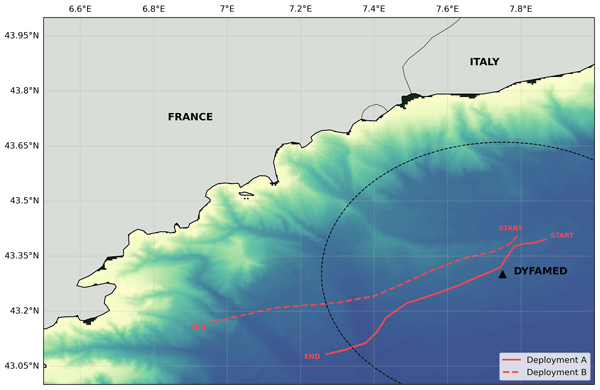
Abstract. Wind forcing plays a pivotal role in driving upper-ocean physical and biogeochemical processes, yet direct wind observations remain sparse in many regions of the global ocean. While passive acoustic techniques have been used to estimate wind speed from moored and mobile platforms, their application to profiling floats has been demonstrated only in limited cases and remains largely unexplored. Here, we report on the first deployment of a profiling float equipped with a passive acoustic sensor, aimed at detecting wind-driven surface signals from depth. The float was deployed in the northwestern Mediterranean Sea near the DYFAMED meteorological buoy from February to April 2025, operating at parking depths of 500–1000 m. We demonstrate that wind speed can be successfully retrieved from subsurface ambient noise using established acoustic algorithms, with float-derived estimates showing good agreement with collocated surface observations from the DYFAMED buoy. To evaluate the potential for broader application, we simulate a remote deployment scenario by refitting the acoustic model of Nystuen et al. (2015) using ERA5 reanalysis as a proxy for surface wind. Refitting the model to ERA5 data demonstrates that the float–acoustic–wind relationship is generalizable in moderate conditions, but high-wind regimes remain systematically biased—especially above 10 m s-1. Finally, we apply a residual learning framework to correct these estimates using a limited subset of DYFAMED wind data, simulating conditions where only brief surface observations—such as those from a ship during float deployment—are available. The corrected wind time series achieved a 37 % reduction in RMSE and improved the coefficient of determination (R2) from 0.85 to 0.91, demonstrating the effectiveness of combining reanalysis with sparse in-situ fitting. This framework enables the retrieval of fine-scale wind variability not captured by reanalysis alone, supporting a scalable strategy for float-based wind monitoring in data-sparse ocean regions—with important implications for quantifying air–sea exchanges, improving biogeochemical flux estimates, and advancing global climate observations.
Competing interests: NKE instrumentation is a private company which commercialized the acoustic float, in which AD and CS are employed. The acoustic float is based on the PROVOR CTS5 platform and on an acoustic sensor developed and commercialized by NKE instrumentation with a partnership agreement with LOV. All other co-authors declare no competing interests.
Publisher's note: Copernicus Publications remains neutral with regard to jurisdictional claims made in the text, published maps, institutional affiliations, or any other geographical representation in this paper. While Copernicus Publications makes every effort to include appropriate place names, the final responsibility lies with the authors. Views expressed in the text are those of the authors and do not necessarily reflect the views of the publisher.-
Notice on discussion status
The requested preprint has a corresponding peer-reviewed final revised paper. You are encouraged to refer to the final revised version.
-
Preprint
(4443 KB)
-
The requested preprint has a corresponding peer-reviewed final revised paper. You are encouraged to refer to the final revised version.
- Preprint
(4443 KB) - Metadata XML
- BibTeX
- EndNote
- Final revised paper


Journal article(s) based on this preprint
Interactive discussion
Status: closed
-
RC1: 'Comment on egusphere-2025-4174', Anonymous Referee #1, 07 Nov 2025
- AC1: 'Reply on RC1', Louise Delaigue, 25 Nov 2025
-
RC2: 'Comment on egusphere-2025-4174', Anonymous Referee #2, 17 Nov 2025
The manuscript presents a novel deployment of a profiling float equipped with a passive acoustic sensor for estimating surface wind speed from subsurface ambient noise. The work is timely and relevant, especially for the Ocean Sound EOV and emerging multisensor BGC-Argo platforms. The authors provide an extensive evaluation of several established acoustic wind models, propose a combined reanalysis–residual correction framework, and assess the performance of their approach using a deployment near the DYFAMED site. Overall, the paper is well written and contains substantial technical detail. The results indicate promising capability for autonomous wind sensing from profiling floats. However, several aspects require clarification, tightening, or additional evidence before the paper can be recommended for publication. I outline the main points below.
Major issues
- Length and focus of the Introduction: The Introduction covers too many tangential topics and becomes diffuse. Several paragraphs repeat similar background points (e.g., wind relevance, WOTAN history, BGC-Argo capabilities). The core motivation of the study - why wind sensing on modern profiling floats matters and what gap is being addressed - would be clearer with a more concise and focused introduction. Some reduction would improve readability.
- Novelty requires clearer articulation: Previous studies (Riser et al., Yang et al., Ma et al.) have demonstrated wind estimation using float-mounted acoustic sensors, though with more limited onboard processing and telemetry. The manuscript mentions this but does not explicitly define what is distinct about the system used here and what the scientific advance is. The paper would benefit from a short statement clearly outlining the new elements (e.g., full third-octave spectra transmission, integration into CTS5 BGC-Argo, post-processing flexibility, residual-learning framework).
- Methodological thresholds need justification: Several choices (40 km DYFAMED radius, 99th percentile transient filter, 3-hour smoothing window, 10 km AIS radius + RMSE anomaly rule) appear somewhat arbitrary. Some are based on previous work, but the conditions differ enough that sensitivity analysis is warranted. I suggest authors should explain why these specific thresholds were chosen and demonstrate that the results are not overly sensitive to them. For example, 40 km spatial filter - justified by Cauchy et al. (2018), but the conditions differ (glider vs float, different months, bathymetry). 99th percentile transient noise removal - is this threshold too aggressive? Could it remove real high-wind events? The 10 km AIS radius and RMSE-based anomaly filter is somewhat circular, because RMSE is computed relative to the same reference (DYFAMED) used for filtering. Please consider additional sensitivity tests, or clearer justification acknowledging limitations.
- Depth-correction assumptions: The β(h,f) correction is mathematically complex. However, it is applied only once from the first CTD profile, yet temperature–salinity changed over ~60 days. Authors state conditions were “relatively stable,” but this should be shown quantitatively (ΔT, ΔS, Δc sound speed). Please provide evidence that using only one correction introduces < X dB error. I suggest adding a small analysis showing that variability in T/S over the deployment would not meaningfully change β, or revise the text to state this is a limitation.
- ERA5-based model fitting and validation: While the ERA5-calibrated model performs reasonably in moderate winds, the validation relies entirely on the same buoy used later for residual correction. This risks circularity. The conclusion that the method resolves high-frequency wind variability “not captured by ERA5” is plausible but not demonstrated quantitatively. A more rigorous validation strategy (e.g., cross-validation, leave-one-event-out) would strengthen the claims.
- The residual learning section requires more detail: The machine-learning component is incompletely described. Important aspects (feature selection, hyperparameters, training sample size, prevention of overfitting) are missing. Even if the intention is not to emphasize the ML model itself, some transparency is needed to assess whether the improvements are robust.
- Discussion and Results are blended; consider restructuring: Much of Section 3 reads as discussion rather than results, particularly, sections 3.2 and 3.3 read more like discussion. The Results section should first present the findings objectively and interpretation should follow separately. I suggest moving more speculative content (e.g., “future deployments,” “few-shot learning”) to Discussion.
Minor Issues
- The abstract could be tightened; several sentences repeat key points.
- Fig. 8 is dense and difficult to interpret at first reading.
- Some notations vary across equations (e.g., TOL vs SPL).
- A few acronyms are not defined at first appearance. (e.g., DYFAMED defined at line 141 but appeared several times prior).
- Several long sentences could be shortened for clarity.
- Line 164 & 167 third-octave → one-third octave?
Citation: https://doi.org/10.5194/egusphere-2025-4174-RC2 -
AC2: 'Reply on RC2', Louise Delaigue, 25 Nov 2025
We thank the reviewer for their thoughtful and constructive comments. Our detailed responses and corresponding revisions are provided in the attached PDF file.
-
RC3: 'Reply on AC2', Anonymous Referee #2, 26 Nov 2025
I am satisfied with authors' responses. I have no further comments.
Citation: https://doi.org/10.5194/egusphere-2025-4174-RC3 -
AC3: 'Reply on RC3', Louise Delaigue, 10 Dec 2025
We thank the reviewer for their time in reading both the manuscript and our response.
Citation: https://doi.org/10.5194/egusphere-2025-4174-AC3
-
AC3: 'Reply on RC3', Louise Delaigue, 10 Dec 2025
-
RC3: 'Reply on AC2', Anonymous Referee #2, 26 Nov 2025
Peer review completion


Post-review adjustments


Interactive discussion
Status: closed
-
RC1: 'Comment on egusphere-2025-4174', Anonymous Referee #1, 07 Nov 2025
The manuscript represents an outstanding contribution to scientific progress by demonstrating a scalable, autonomous system for wind speed estimation using profiling floats and passive acoustic monitoring (PAM).
The core novelty is the successful deployment and retrieval of wind data from deep parking depths (500–1000 m) and the development of a residual learning framework. This framework is critical because it addresses the core limitation of acoustic wind retrieval in remote regions: the lack of local calibration data. By combining global reanalysis (ERA5) with sparse in-situ observations to correct systematic biases, the authors achieved a major quantitative improvement: a 37% reduction in RMSE and an increase in R^2 from 0.85 to 0.91. This work provides a practical path to integrate wind forcing observations with the BGC-Argo float array.
The scientific approach and applied methods are valid and well-justified. The use of established empirical models (like Nystuen et al., 2015) and the innovative application of the XGBoost algorithm for residual learning are appropriate for handling the non-linear relationship between acoustics and wind. The necessary preprocessing steps, such as depth correction and noise mitigation, are included.
The discussion is appropriate and balanced, explicitly acknowledging the systematic bias of the ERA5-fitted model in high-wind regimes (>10 m/s) and the need for the residual correction. It accurately situates the findings within the framework of prior moored and mobile PAM research.
The authors present the scientific results and conclusions in a clear, concise, and well-structured manner. The manuscript adheres to a standard, logical flow, and the technical language is precise. The figures are of high quality and clearly show the main findings, especially when comparing the unoptimized, ERA5-fitted, and ML-corrected time series (Figure 8) and the scatter plots (Figure 6 Tables clearly present all necessary methodological details, including frequency band integration times and model requirements.
Given the groundbreaking nature of the results and the high overall quality, the manuscript should be accepted subject to minor revisions.
The "minor revisions" category is suggested to meet the need for a clearer explanation of the current validation strategy. Suggested minor revisions focus on enhancing the discussion (Section 3.3.1, paragraph 5) and the conclusions by explicitly stating that while the framework works, the performance metrics may represent the upper bound of expected accuracy due to using the same short-duration deployment for both training and validation. Expand the need for future work to validate the model's generalizability using spatially or temporally distinct training-validation splits to confirm the framework's robustness for global, remote deployment.
Citation: https://doi.org/10.5194/egusphere-2025-4174-RC1 - AC1: 'Reply on RC1', Louise Delaigue, 25 Nov 2025
-
RC2: 'Comment on egusphere-2025-4174', Anonymous Referee #2, 17 Nov 2025
The manuscript presents a novel deployment of a profiling float equipped with a passive acoustic sensor for estimating surface wind speed from subsurface ambient noise. The work is timely and relevant, especially for the Ocean Sound EOV and emerging multisensor BGC-Argo platforms. The authors provide an extensive evaluation of several established acoustic wind models, propose a combined reanalysis–residual correction framework, and assess the performance of their approach using a deployment near the DYFAMED site. Overall, the paper is well written and contains substantial technical detail. The results indicate promising capability for autonomous wind sensing from profiling floats. However, several aspects require clarification, tightening, or additional evidence before the paper can be recommended for publication. I outline the main points below.
Major issues
- Length and focus of the Introduction: The Introduction covers too many tangential topics and becomes diffuse. Several paragraphs repeat similar background points (e.g., wind relevance, WOTAN history, BGC-Argo capabilities). The core motivation of the study - why wind sensing on modern profiling floats matters and what gap is being addressed - would be clearer with a more concise and focused introduction. Some reduction would improve readability.
- Novelty requires clearer articulation: Previous studies (Riser et al., Yang et al., Ma et al.) have demonstrated wind estimation using float-mounted acoustic sensors, though with more limited onboard processing and telemetry. The manuscript mentions this but does not explicitly define what is distinct about the system used here and what the scientific advance is. The paper would benefit from a short statement clearly outlining the new elements (e.g., full third-octave spectra transmission, integration into CTS5 BGC-Argo, post-processing flexibility, residual-learning framework).
- Methodological thresholds need justification: Several choices (40 km DYFAMED radius, 99th percentile transient filter, 3-hour smoothing window, 10 km AIS radius + RMSE anomaly rule) appear somewhat arbitrary. Some are based on previous work, but the conditions differ enough that sensitivity analysis is warranted. I suggest authors should explain why these specific thresholds were chosen and demonstrate that the results are not overly sensitive to them. For example, 40 km spatial filter - justified by Cauchy et al. (2018), but the conditions differ (glider vs float, different months, bathymetry). 99th percentile transient noise removal - is this threshold too aggressive? Could it remove real high-wind events? The 10 km AIS radius and RMSE-based anomaly filter is somewhat circular, because RMSE is computed relative to the same reference (DYFAMED) used for filtering. Please consider additional sensitivity tests, or clearer justification acknowledging limitations.
- Depth-correction assumptions: The β(h,f) correction is mathematically complex. However, it is applied only once from the first CTD profile, yet temperature–salinity changed over ~60 days. Authors state conditions were “relatively stable,” but this should be shown quantitatively (ΔT, ΔS, Δc sound speed). Please provide evidence that using only one correction introduces < X dB error. I suggest adding a small analysis showing that variability in T/S over the deployment would not meaningfully change β, or revise the text to state this is a limitation.
- ERA5-based model fitting and validation: While the ERA5-calibrated model performs reasonably in moderate winds, the validation relies entirely on the same buoy used later for residual correction. This risks circularity. The conclusion that the method resolves high-frequency wind variability “not captured by ERA5” is plausible but not demonstrated quantitatively. A more rigorous validation strategy (e.g., cross-validation, leave-one-event-out) would strengthen the claims.
- The residual learning section requires more detail: The machine-learning component is incompletely described. Important aspects (feature selection, hyperparameters, training sample size, prevention of overfitting) are missing. Even if the intention is not to emphasize the ML model itself, some transparency is needed to assess whether the improvements are robust.
- Discussion and Results are blended; consider restructuring: Much of Section 3 reads as discussion rather than results, particularly, sections 3.2 and 3.3 read more like discussion. The Results section should first present the findings objectively and interpretation should follow separately. I suggest moving more speculative content (e.g., “future deployments,” “few-shot learning”) to Discussion.
Minor Issues
- The abstract could be tightened; several sentences repeat key points.
- Fig. 8 is dense and difficult to interpret at first reading.
- Some notations vary across equations (e.g., TOL vs SPL).
- A few acronyms are not defined at first appearance. (e.g., DYFAMED defined at line 141 but appeared several times prior).
- Several long sentences could be shortened for clarity.
- Line 164 & 167 third-octave → one-third octave?
Citation: https://doi.org/10.5194/egusphere-2025-4174-RC2 -
AC2: 'Reply on RC2', Louise Delaigue, 25 Nov 2025
We thank the reviewer for their thoughtful and constructive comments. Our detailed responses and corresponding revisions are provided in the attached PDF file.
-
RC3: 'Reply on AC2', Anonymous Referee #2, 26 Nov 2025
I am satisfied with authors' responses. I have no further comments.
Citation: https://doi.org/10.5194/egusphere-2025-4174-RC3 -
AC3: 'Reply on RC3', Louise Delaigue, 10 Dec 2025
We thank the reviewer for their time in reading both the manuscript and our response.
Citation: https://doi.org/10.5194/egusphere-2025-4174-AC3
-
AC3: 'Reply on RC3', Louise Delaigue, 10 Dec 2025
-
RC3: 'Reply on AC2', Anonymous Referee #2, 26 Nov 2025
Peer review completion
Post-review adjustments
Journal article(s) based on this preprint
Viewed
| HTML | XML | Total | BibTeX | EndNote | |
|---|---|---|---|---|---|
| 1,158 | 632 | 136 | 1,926 | 72 | 84 |
- HTML: 1,158
- PDF: 632
- XML: 136
- Total: 1,926
- BibTeX: 72
- EndNote: 84
Viewed (geographical distribution)
| Country | # | Views | % |
|---|
| Total: | 0 |
| HTML: | 0 |
| PDF: | 0 |
| XML: | 0 |
- 1
Louise Delaigue

Pierre Cauchy
Dorian Cazau
Julien Bonnel
Sara Pensieri
Roberto Bozzano
Anatole Gros-Martial
Christophe Schaeffer
Arnaud David
Paco Stil
Antoine Poteau
Catherine Schmechtig
Edouard Leymarie
Hervé Claustre
The requested preprint has a corresponding peer-reviewed final revised paper. You are encouraged to refer to the final revised version.
- Preprint
(4443 KB) - Metadata XML
The manuscript represents an outstanding contribution to scientific progress by demonstrating a scalable, autonomous system for wind speed estimation using profiling floats and passive acoustic monitoring (PAM).
The core novelty is the successful deployment and retrieval of wind data from deep parking depths (500–1000 m) and the development of a residual learning framework. This framework is critical because it addresses the core limitation of acoustic wind retrieval in remote regions: the lack of local calibration data. By combining global reanalysis (ERA5) with sparse in-situ observations to correct systematic biases, the authors achieved a major quantitative improvement: a 37% reduction in RMSE and an increase in R^2 from 0.85 to 0.91. This work provides a practical path to integrate wind forcing observations with the BGC-Argo float array.
The scientific approach and applied methods are valid and well-justified. The use of established empirical models (like Nystuen et al., 2015) and the innovative application of the XGBoost algorithm for residual learning are appropriate for handling the non-linear relationship between acoustics and wind. The necessary preprocessing steps, such as depth correction and noise mitigation, are included.
The discussion is appropriate and balanced, explicitly acknowledging the systematic bias of the ERA5-fitted model in high-wind regimes (>10 m/s) and the need for the residual correction. It accurately situates the findings within the framework of prior moored and mobile PAM research.
The authors present the scientific results and conclusions in a clear, concise, and well-structured manner. The manuscript adheres to a standard, logical flow, and the technical language is precise. The figures are of high quality and clearly show the main findings, especially when comparing the unoptimized, ERA5-fitted, and ML-corrected time series (Figure 8) and the scatter plots (Figure 6 Tables clearly present all necessary methodological details, including frequency band integration times and model requirements.
Given the groundbreaking nature of the results and the high overall quality, the manuscript should be accepted subject to minor revisions.
The "minor revisions" category is suggested to meet the need for a clearer explanation of the current validation strategy. Suggested minor revisions focus on enhancing the discussion (Section 3.3.1, paragraph 5) and the conclusions by explicitly stating that while the framework works, the performance metrics may represent the upper bound of expected accuracy due to using the same short-duration deployment for both training and validation. Expand the need for future work to validate the model's generalizability using spatially or temporally distinct training-validation splits to confirm the framework's robustness for global, remote deployment.