
the Creative Commons Attribution 4.0 License.
the Creative Commons Attribution 4.0 License.
 | 03 Jun 2025
A mathematical framework for quantifying physical damage over time from concurrent and consecutive hazards
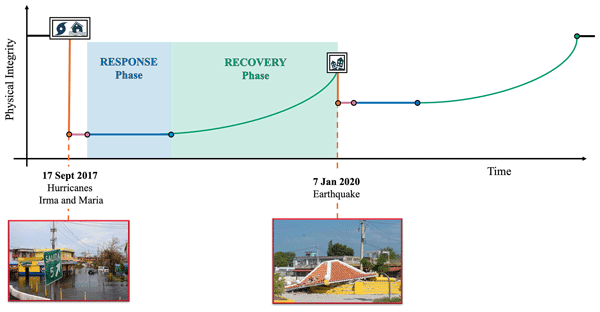
Abstract. Space and time play a crucial role in multi-hazard impact assessment. When two or more natural hazards occur at the same location simultaneously or within a short time frame, the physical integrity of assets and infrastructures can be compromised and the resulting damage can be greater than the one generated by individual hazards occurring in isolation. The current literature highlights the lack of quantitative standardised frameworks for multi-hazard impact assessment. This research presents a generalised mathematical framework for quantitatively assessing multi-hazard physical damage on exposed assets, such as buildings or critical infrastructures, over time. The proposed framework covers both concurrent and consecutive hazards, by modelling: (i) the increased damage resulting from the combined impact of two or more concurrent hazards that overlap in space and time, and (ii) the effects of cumulative damage on asset vulnerability and the recovery dynamics in case of consecutive hazards that overlap in space. The framework is applied to a real-world case study in Puerto Rico, including the concurrent wind and flood impacts generated by the passage of Hurricane Maria, as well as the consecutive impacts caused by the subsequent seismic sequence of 2019–2020. Based on simulations performed on a building portfolio, we found that neglecting residual damages caused by the hurricane when assessing the impacts of the subsequent earthquake would lead to a significant underestimation of the overall damage experienced by the assets. By providing a generalised formalisation to perform quantitative multi-hazard impact assessment, able to account for amplification phenomena and recovery dynamics, the framework can offer scientists and decision-makers a comprehensive and deeper understanding of the impacts caused by compound and consecutive events.
-
Notice on discussion status
The requested preprint has a corresponding peer-reviewed final revised paper. You are encouraged to refer to the final revised version.
-
Preprint
(13426 KB)
-
The requested preprint has a corresponding peer-reviewed final revised paper. You are encouraged to refer to the final revised version.
- Preprint
(13426 KB) - Metadata XML
- BibTeX
- EndNote
- Final revised paper


Journal article(s) based on this preprint
Interactive discussion
Status: closed
-
RC1: 'Comment on egusphere-2025-2379', Anonymous Referee #1, 18 Aug 2025
-
AC1: 'Reply on RC1', Silvia De Angeli, 17 Nov 2025
We thank the reviewer for emphasizing the relevance of our topic and for providing constructive feedback to enhance our work.
We appreciate their acknowledgment of the merit in our systematic approach to multi-hazard risk assessment. In the revised manuscript, we will carefully address all major concerns and suggestions, particularly those regarding the framing of our contribution and the discussion of the approach’s operational scope and limitations.
Specifically, we will take into account their observation regarding the mathematical contribution, which they consider an extension of existing formulations. In the revised manuscript, we will accordingly reduce the emphasis on the formal mathematical component and clarify that the theoretical framework primarily serves as the foundation for the development of a computational tool implemented in Python.
We will also better highlight the actual value added by our work, which lies in the operational integration of components that are often treated separately in the literature, such as multi-hazard interactions, recovery dynamics, and time-evolving vulnerability, thus addressing a key gap: the lack of dynamic models capable of jointly representing multiple phases of damage and recovery. Furthermore, we will emphasize that the proposed tool can be applied both for forensic analyses and forward-looking assessments.
In this way, we aim to provide a more balanced framing of our contribution, clearly outlining its novelty, applicability, and limitations.
In the attached document, we will address the reviewer feedback and provide a detailed, point-by-point response to their concerns.
-
AC1: 'Reply on RC1', Silvia De Angeli, 17 Nov 2025
-
RC2: 'Comment on egusphere-2025-2379', Anonymous Referee #2, 26 Sep 2025
Dear Authors,
Thank you very much for submitting your article. Apologies for the delay in my review. I had to read it a couple of times to make a proper judgment.
While I do think the paper is very well written, it does lack a clear novelty. I understand this comes across as negative, but I would like to explain below why I believe that the paper in its current form is (in my opinion), not novel enough to be published in NHESS.
First of all, I think that the term ‘mathematical framework’ feels a bit of a stretch. They are somewhat simple equations that are merely a mathematical formulation of the recovery curves as presented by De Ruiter et al. (2019) in the paper “Why we can no longer ignore consecutive disasters”. As such (and also been mentioned in the abstract) I think the formulas that are presented are a generalized formulation, rather than a mathematical framework.
And I think that also links to the lack of novelty of this study. While nicely written up, what is actually new in this formulation? Is the novelty that not too many paper wrote this up in this way? Perhaps. But then I would still expect much more clear examples with a clear time dimension included that shows how this really works. Or is the key element of this work the code behind this study? But would it perhaps not have been better to submit this to a journal like Journal for Open Source Software (JOSS), to emphasize the open source availability of the modelling framework, instead of pushing this into “a new mathematical framework”. I do also like this random event generator in the github repo. Can indeed be nice to play around with stress testing assets in a specific area in a multi-hazard concept. But I don’t think I read that really in the paper?
Now, from the Puerto Rico case study example, it is really not clear how actually the recovery response is modelled. It is also highlighted in the discussion that many unknowns are still there with respect to the recovery dynamics. But how are those recovery dynamics actually incorporated in the modelling as presented here. I see it from the mathematical formulations, but not in the application? There does not seem to be a time dimension included, but just an implementation on the fragility curves in a multi-hazard setting?
The code that is presented behind this paper looks nice, and is cleanly written up. There I can see that (I think) in run_framework.py that the recovery curve indeed determines the starting state of the assets when the new hazard hits. However, this is not really clear from the Puerto Rico example.
With reference to the fragility curves, because there is no clear implementation of this recovery aspect in the application, there does not seem to be much novelty in the fragility curves. It is almost a directly implementation from HAZUS?
And to continue on this crucial point of the time component, here those non-physical asset damages are really becoming a key element. Dynamic modelling of the recovery process (which is a key element of the mathematical framework as presented here) goes really beyond the physical asset damages. And specially beyond what the example now shows with the “simple” multi-hazard or the modification of the fragility curves with different state dependencies.
I think many of my points are also summed in section 4.1 and section 4.2. For example, I would expect that a paper with this title would show mathematical formulations that move away from this simplification. This also links to the key points mentioned in the “Better understanding and modelling recovery dynamics” and “Evaluation dynamic exposure over time”. I understand that the equations as presented in this paper could perhaps provide a starting point to all of this, but I feel like some of these elements should be included already to warrant publication on a leading journal in the field, such as NHESS.
So to conclude: I think the paper is published with the idea to publish the python code. I do not think that the theory presented in this paper (and the case study results) are very exciting by themselves, and are not necessarily very novel. However, the code that is presented contains a bunch of nice elements, that I have not really seen in, for example, the DamageScanner or Delft-FIAT. There might be elements of this code in CLIMADA, but that one is sometimes a bit hard to understand what’s all in there. As such, I propose to rather focus on writing an article, to a suitable journal, that mostly focuses on the publication of the code.
Citation: https://doi.org/10.5194/egusphere-2025-2379-RC2 -
AC2: 'Reply on RC2', Silvia De Angeli, 17 Nov 2025
We thank the reviewer for their careful reading of our manuscript and for providing constructive feedback. We understand the concern regarding the perceived lack of theoretical novelty. We would like to clarify that the main scientific contribution of our work lies less in the introduction of new mathematical formulations and more in the operational integration of elements that are usually treated separately in the literature, such as multi-hazard interactions, recovery dynamics, and multi-hazard vulnerability, within a single, modular Python-based tool.
In the revised manuscript, we will explicitly frame the novelty of our work in terms of methodological and operational advances for multi-hazard impact assessment, rather than as a purely formal mathematical development. We also believe that NHESS is an appropriate venue for this contribution, as the focus of the paper is on advancing methods for multi-hazard risk assessment, supported by an open and reproducible software implementation, rather than on software publication per se.
In the attached document, we will address all the reviewer feedback and provide a detailed, point-by-point response to their concerns.
-
AC2: 'Reply on RC2', Silvia De Angeli, 17 Nov 2025
Peer review completion


Interactive discussion
Status: closed
-
RC1: 'Comment on egusphere-2025-2379', Anonymous Referee #1, 18 Aug 2025
Summary
This manuscript presents a mathematical framework for assessing multi-hazard risks that explicitly incorporates recovery dynamics and the temporal evolution of asset vulnerability. The authors argue that their primary contribution is a generalised mathematical formalization of multi-hazard risk quantification, with particular emphasis on modeling how concurrent and consecutive hazard events affect vulnerability to subsequent events. They demonstrate their approach using a case study of hurricanes and earthquakes in Puerto Rico, showing how hurricane damage modifies earthquake vulnerability over time.Overall, this addresses an important gap in disaster risk assessment, which typically treats hazards independently without considering temporal interactions. However, while the systematic approach to multi-hazard impact assessment has merit, the current framing oversells the contribution while underselling significant limitations. The authors should address fundamental questions about operational utility and reposition their work to reflect its actual capabilities and constraints more accurately. Therefore, I recommend major revision of this manuscript.Major Concerns
Core Contribution and Scientific ValueMy primary concern relates to the fundamental claims about the manuscript's contribution and its practical utility. The authors position their work as providing a "generalised mathematical framework" for multi-hazard risk assessment, but this claim requires careful examination.Mathematical Formalization: The mathematical framework presented is essentially a straightforward extension of existing single-hazard approaches, where total damage becomes a function of multiple hazards and recovery states. While the authors present this as novel, the mathematical formulation represents a straightforward extension. The real challenges in multi-hazard assessment lie not in the mathematical abstraction but in the empirical quantification of recovery functions, hazard dependencies, and vulnerability transitions over time - as the authors rightly state in sections 4.1 and 4.2.Operational Utility Limitations: More critically, the framework suffers from a fundamental limitation that severely constrains its practical applicability. The Puerto Rico case study illustrates this problem clearly. The authors demonstrate how Hurricane Maria affected earthquake vulnerability by using post-hurricane damage data to calibrate vulnerability adjustments. However, this approach is inherently backward-looking and requires empirical damage data that would not be available for forward-looking risk assessments.Consider a practical scenario: if a hurricane were to strike Puerto Rico tomorrow, practitioners using this framework would need to wait for post-hurricane damage assessments before they could adjust earthquake vulnerability functions. This severely limits the framework's utility for operational risk management, emergency planning, or prospective risk assessment. The authors do not adequately address how practitioners would estimate vulnerability changes in real-time or predictive applications without extensive post-event calibration data.Misalignment of Claimed vs. Actual Contributions:The manuscript lists several important developments as "limitations" (section 4.1) or "future research directions" (section 4.2) that would actually constitute the real scientific advances needed in multi-hazard assessment. These include empirically-derived vulnerability transition functions, standardized recovery curves based on extensive post-disaster data, and predictive models for hazard-induced vulnerability changes. Only after solving these challenges would a general mathematical framework provide meaningful operational value.Specifically, I was excited to see the authors propose an approach to adjust vulnerability curves to account for pre-existing damage conditions (lines 394-396). Such an approach represents a potentially valuable contribution to the field. However, the implementation still relies entirely on post-event calibration data, making it neither operational for forward-looking assessments nor generalizable across different contexts without extensive empirical datasets.In conclusion, current framework appears most suited for retrospective analysis and systematic post-disaster impact assessment rather than the forward-looking risk management applications that the authors suggest. This represents a significant gap between the claimed contribution and the demonstrated capabilities.Language and Presentation
The manuscript suffers from clarity and communication issues that hinder comprehension of the technical content. The writing style relies on unnecessarily complex sentence structures that obscure rather than illuminate key concepts. Many sentences contain multiple subordinate clauses that could be simplified without losing technical precision.Additionally, the manuscript exhibits significant redundancy, with core concepts repeated across sections without advancing the argument or providing new information. For example, the distinction between "concurrent and consecutive hazards" is mentioned repeatedly in the abstract, introduction, and methodology sections without substantive development of how the framework addresses each case differently.The technical exposition would benefit from more precise language and clearer logical flow. Terms like "generalised framework" are used extensively without clear definition of what makes the approach "general" compared to existing methods.Recommendations for Improvement
The manuscript addresses an important problem in disaster risk science, but it requires substantial revision to align claims with demonstrated capabilities. The authors should consider reframing their contribution more modestly and honestly. Rather than claiming a key contribution in operational multi-hazard assessment, they could position their work as a systematic methodology for post-disaster impact assessment or as a research template for understanding multi-hazard interactions in well-documented cases.The framework has genuine value as a foundation for systematic vulnerability state tracking and post-disaster learning, but the authors should acknowledge its current limitations for predictive applications. Future work should focus on developing the empirical foundations needed to make such a framework operationally useful, including physics-based vulnerability transition models and standardized recovery parameters that can be estimated without extensive post-event data.The language and presentation issues require comprehensive editing to improve clarity and eliminate redundancy.Minor comments
L30: "hazard" in brackets?L 48: "underlined" seems to be a word choice error. Consider "highlighted", "identified", "outlined", "emphasized".Line 105: "occurs integrally at the beginning" is unclear - suggest "occurs entirely at the beginning" or "occurs instantaneously at the beginning" to clarify that all damage happens at once rather than gradually.L 110: To my knowledge, figures should be referenced in sequential order (Fig. 1, then Fig. 2, then Fig. 3, etc.) as they appear in the text. Fig. 3 is introduce before Fig. 1 and 2.L 118, 128: Avoid describing figure elements by color ("blue line", "green line"). Use descriptive labels instead for accessibility and clarity (e.g., "the horizontal line representing the response phase"). Related and for figures in general: Ensure all figure elements are clearly labeled in the legend. Figure 3 legend: "The second event in temporal order" is redundant - "second event" already implies temporal sequence. Suggest removing "in temporal order" throughout.L 179: Remove "fortunate" - scientific writing should avoid value judgments.L 279: Typo in "build" back betterL 407, Table 2: The values in Table 2 seem to be in USD, not "thousand USD". Please double check. Also check the formatting of the values in Table 2. Table 2/Figure 7: Both show the same results. Consider moving one of the two elements to the supplementary material. L 408: Line X: The damage-to-loss conversion methodology needs brief explanation rather than just a citation. Readers should understand the key assumptions without consulting external sources.L 409: "Predefined loss ratios" needs clarification - predefined by whom, based on what data, and are they appropriate for Puerto Rico conditions? Specify the source and empirical basis.L 415: The claim of "clear non-linear trend" needs quantitative support. How was non-linearity assessed? Provide statistical analysis (R², trend coefficients) rather than visual inspection and isolated examples.L 421/423: "1,700 thousand" "1,742 thousand" is confusing and not scientific. Replace with scientific notation or standard units.Throughout: Use standard terminology "slow-onset hazards" rather than "long-onset hazards" to align with established disaster risk literature (e.g., UNDRR, IPCC terminology).Citation: https://doi.org/10.5194/egusphere-2025-2379-RC1 -
AC1: 'Reply on RC1', Silvia De Angeli, 17 Nov 2025
We thank the reviewer for emphasizing the relevance of our topic and for providing constructive feedback to enhance our work.
We appreciate their acknowledgment of the merit in our systematic approach to multi-hazard risk assessment. In the revised manuscript, we will carefully address all major concerns and suggestions, particularly those regarding the framing of our contribution and the discussion of the approach’s operational scope and limitations.
Specifically, we will take into account their observation regarding the mathematical contribution, which they consider an extension of existing formulations. In the revised manuscript, we will accordingly reduce the emphasis on the formal mathematical component and clarify that the theoretical framework primarily serves as the foundation for the development of a computational tool implemented in Python.
We will also better highlight the actual value added by our work, which lies in the operational integration of components that are often treated separately in the literature, such as multi-hazard interactions, recovery dynamics, and time-evolving vulnerability, thus addressing a key gap: the lack of dynamic models capable of jointly representing multiple phases of damage and recovery. Furthermore, we will emphasize that the proposed tool can be applied both for forensic analyses and forward-looking assessments.
In this way, we aim to provide a more balanced framing of our contribution, clearly outlining its novelty, applicability, and limitations.
In the attached document, we will address the reviewer feedback and provide a detailed, point-by-point response to their concerns.
-
AC1: 'Reply on RC1', Silvia De Angeli, 17 Nov 2025
-
RC2: 'Comment on egusphere-2025-2379', Anonymous Referee #2, 26 Sep 2025
Dear Authors,
Thank you very much for submitting your article. Apologies for the delay in my review. I had to read it a couple of times to make a proper judgment.
While I do think the paper is very well written, it does lack a clear novelty. I understand this comes across as negative, but I would like to explain below why I believe that the paper in its current form is (in my opinion), not novel enough to be published in NHESS.
First of all, I think that the term ‘mathematical framework’ feels a bit of a stretch. They are somewhat simple equations that are merely a mathematical formulation of the recovery curves as presented by De Ruiter et al. (2019) in the paper “Why we can no longer ignore consecutive disasters”. As such (and also been mentioned in the abstract) I think the formulas that are presented are a generalized formulation, rather than a mathematical framework.
And I think that also links to the lack of novelty of this study. While nicely written up, what is actually new in this formulation? Is the novelty that not too many paper wrote this up in this way? Perhaps. But then I would still expect much more clear examples with a clear time dimension included that shows how this really works. Or is the key element of this work the code behind this study? But would it perhaps not have been better to submit this to a journal like Journal for Open Source Software (JOSS), to emphasize the open source availability of the modelling framework, instead of pushing this into “a new mathematical framework”. I do also like this random event generator in the github repo. Can indeed be nice to play around with stress testing assets in a specific area in a multi-hazard concept. But I don’t think I read that really in the paper?
Now, from the Puerto Rico case study example, it is really not clear how actually the recovery response is modelled. It is also highlighted in the discussion that many unknowns are still there with respect to the recovery dynamics. But how are those recovery dynamics actually incorporated in the modelling as presented here. I see it from the mathematical formulations, but not in the application? There does not seem to be a time dimension included, but just an implementation on the fragility curves in a multi-hazard setting?
The code that is presented behind this paper looks nice, and is cleanly written up. There I can see that (I think) in run_framework.py that the recovery curve indeed determines the starting state of the assets when the new hazard hits. However, this is not really clear from the Puerto Rico example.
With reference to the fragility curves, because there is no clear implementation of this recovery aspect in the application, there does not seem to be much novelty in the fragility curves. It is almost a directly implementation from HAZUS?
And to continue on this crucial point of the time component, here those non-physical asset damages are really becoming a key element. Dynamic modelling of the recovery process (which is a key element of the mathematical framework as presented here) goes really beyond the physical asset damages. And specially beyond what the example now shows with the “simple” multi-hazard or the modification of the fragility curves with different state dependencies.
I think many of my points are also summed in section 4.1 and section 4.2. For example, I would expect that a paper with this title would show mathematical formulations that move away from this simplification. This also links to the key points mentioned in the “Better understanding and modelling recovery dynamics” and “Evaluation dynamic exposure over time”. I understand that the equations as presented in this paper could perhaps provide a starting point to all of this, but I feel like some of these elements should be included already to warrant publication on a leading journal in the field, such as NHESS.
So to conclude: I think the paper is published with the idea to publish the python code. I do not think that the theory presented in this paper (and the case study results) are very exciting by themselves, and are not necessarily very novel. However, the code that is presented contains a bunch of nice elements, that I have not really seen in, for example, the DamageScanner or Delft-FIAT. There might be elements of this code in CLIMADA, but that one is sometimes a bit hard to understand what’s all in there. As such, I propose to rather focus on writing an article, to a suitable journal, that mostly focuses on the publication of the code.
Citation: https://doi.org/10.5194/egusphere-2025-2379-RC2 -
AC2: 'Reply on RC2', Silvia De Angeli, 17 Nov 2025
We thank the reviewer for their careful reading of our manuscript and for providing constructive feedback. We understand the concern regarding the perceived lack of theoretical novelty. We would like to clarify that the main scientific contribution of our work lies less in the introduction of new mathematical formulations and more in the operational integration of elements that are usually treated separately in the literature, such as multi-hazard interactions, recovery dynamics, and multi-hazard vulnerability, within a single, modular Python-based tool.
In the revised manuscript, we will explicitly frame the novelty of our work in terms of methodological and operational advances for multi-hazard impact assessment, rather than as a purely formal mathematical development. We also believe that NHESS is an appropriate venue for this contribution, as the focus of the paper is on advancing methods for multi-hazard risk assessment, supported by an open and reproducible software implementation, rather than on software publication per se.
In the attached document, we will address all the reviewer feedback and provide a detailed, point-by-point response to their concerns.
-
AC2: 'Reply on RC2', Silvia De Angeli, 17 Nov 2025
Peer review completion
Journal article(s) based on this preprint
Viewed
| HTML | XML | Total | BibTeX | EndNote | |
|---|---|---|---|---|---|
| 6,039 | 2,740 | 256 | 9,035 | 206 | 283 |
- HTML: 6,039
- PDF: 2,740
- XML: 256
- Total: 9,035
- BibTeX: 206
- EndNote: 283
Viewed (geographical distribution)
| Country | # | Views | % |
|---|
| Total: | 0 |
| HTML: | 0 |
| PDF: | 0 |
| XML: | 0 |
- 1
Cited


Alessandro Borre

Daria Ottonelli
Eva Trasforini
Tatiana Ghizzoni
Giacomo Zoppi
Giorgio Boni
Silvia De Angeli
The requested preprint has a corresponding peer-reviewed final revised paper. You are encouraged to refer to the final revised version.
- Preprint
(13426 KB) - Metadata XML
Summary
Major Concerns
Core Contribution and Scientific Value
Language and Presentation
Recommendations for Improvement
Minor comments