
the Creative Commons Attribution 4.0 License.
the Creative Commons Attribution 4.0 License.
 | 05 Feb 2026
Characteristics of tropical clouds with strong updrafts revealed by Doppler velocity measurements from EarthCARE/CPR
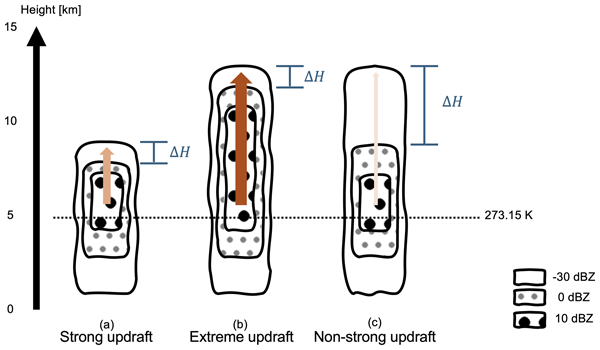
Abstract. Updrafts within clouds are important for the climate system, yet global assessments have traditionally relied on indirect proxies. The EarthCARE satellite's 94 GHz Cloud Profiling Radar (CPR) provides the first global, spaceborne Doppler velocity (Vd) profiles of clouds, enabling direct constraints on convective updraft intensity beyond proxy-based diagnostics. We analyze CPR cloud-property products over the tropics and extract convectively driven columns. We define MaxVd as the maximum upward Vd within the subfreezing portion of each column. Columns with MaxVd > 2.5 m s⁻¹ are classified as strong-updraft (SU) columns. They exhibit systematically higher echo-top heights at 0 and 10 dBZ than weaker-updraft columns, linking microphysics to dynamics. The probability of SU occurrence strongly depends on the separation between the cloud top and the 0 dBZ echo top, defined as ΔH. A small ΔH robustly identifies SU, including relatively low-topped systems. Spatiotemporally, SU occurrence is enhanced over land, with notably higher values at the 14:00 local-time overpass than at 02:00. In contrast, oceanic regions have a smaller SU fraction and exhibit a weaker difference between the two overpass times. These SU enhancements primarily reflect a shift toward horizontally compact, small-ΔH systems rather than higher cloud tops alone. Doppler folding preferentially occurs in small-ΔH structures, with maxima during the continental afternoon, providing a qualitative tracer of extreme updrafts. The combined constraints from Doppler-derived updraft intensity and echo structure offer a process-oriented benchmark for evaluating the coupling between convective dynamics and microphysics in numerical models.
Competing interests: At least one of the (co-)authors is a guest member of the editorial board of Atmospheric Chemistry and Physics for the special issue "Early results from EarthCARE (AMT/ACP/GMD inter-journal SI)". The peer-review process was guided by an independent editor, and the authors also have no other competing interests to declare.
Publisher's note: Copernicus Publications remains neutral with regard to jurisdictional claims made in the text, published maps, institutional affiliations, or any other geographical representation in this paper. While Copernicus Publications makes every effort to include appropriate place names, the final responsibility lies with the authors. Views expressed in the text are those of the authors and do not necessarily reflect the views of the publisher.-
Notice on discussion status
The requested preprint has a corresponding peer-reviewed final revised paper. You are encouraged to refer to the final revised version.
-
Preprint
(3670 KB)
-
The requested preprint has a corresponding peer-reviewed final revised paper. You are encouraged to refer to the final revised version.
- Preprint
(3670 KB) - Metadata XML
- BibTeX
- EndNote
- Final revised paper


Journal article(s) based on this preprint
Interactive discussion
Status: closed
-
RC1: 'Comment on egusphere-2026-659', Anonymous Referee #1, 25 Feb 2026
- AC1: 'Reply on RC1', Hotta Haruka, 25 May 2026
-
RC2: 'Comment on egusphere-2026-659', Anonymous Referee #2, 25 Feb 2026
This paper analyzes strong updrafts identified in nine months of cloud-profiling radar measurements taken the EarthCARE retrievals. The paper is well written and satisfies with the journal's goal to publish work that provides new insights into atmospheric physics. One significant outcome of this paper is the ability to extend the conclusions here to data from other satellite missions, like CloudSat.
I recommend this for publication, and have minor suggestions to improve the clarity of the paper:
- L9: Stating that this data "[enables] direct constraints on convective updraft intensity" is too strong of a statement when there are several limitations to consider when we use this data. The velocity of very strong updrafts cannot be measured, for example. I suggest replacing this with something like "enabling spaceborne measurements" to emphasize the novelty of the data. Broadly, I suggest softening this statement.
- L211-222: "Columns whose 3 km–averaged Vd profiles exhibit discrete vertical jumps with magnitudes exceeding the Nyquist velocity are flagged as folded (as described in Sect. 2.3) and are shaded in grey in Fig. 1d." Is the shading you refer to shown at CPR column index ~300 and ~500. If so, this is very hard to see, so I suggest revising this figure for clarity. The shading is also mentioned in the caption (L193).
- Why does the orange quality-controlled line in Fig. 1 have points missing? Are those points flagged as Nyquist folded?
- Section 2.4 (and elsewhere). Does "non-folded" refer to samples for which convection was identified and its velocity profile passes your folding test? When there is no updraft/downdraft, is the column still non-folded? Maybe this is implied for people who work with doppler radar. Should we interpret the top panel in Fig. 2 as the distribution of MaxVd conditioned on the convection being detected and the column being non-folded?
- Fig 7a The title has a typo: Numer -> NumberCitation: https://doi.org/10.5194/egusphere-2026-659-RC2 - AC2: 'Reply on RC2', Hotta Haruka, 25 May 2026
-
RC3: 'Comment on egusphere-2026-659', Anonymous Referee #3, 13 Mar 2026
This study analyses EarthCARE CPR observations to investigate the statistical relation between Doppler velocity and existing indices of convective intensity such as cloud-top height and echo-top height (0 dBZ or 10 dBZ). It is concluded that delta H = cloud-top height minus 0-dBZ height is a robust proxy of updraft strength. Region-to-region comparison consistently supports this conclusion. The findings appear to be focused on a confirmation of the widely-known climatology of convective systems (ocean-land contrast in convective intensity etc.) rather than an exploration of previously unknown aspects. This paper nonetheless convincingly underscores the utility of EarthCARE for better understanding the convective dynamics and microphysics. I have several suggestions that would hopefully help the authors improve the paper, but otherwise the paper is well worth publishing in ACP.
Major comment ---
As the authors are aware, a major technical limitation of EarthCARE CPR is the velocity folding, hindering measuring very intense convection with a Vd exceeding the Nyquist velocity (~5 m/s). I think that Section 3.3 would benefit from an additional plot or two demonstrating the extent to which vigorous convection is made inaccessible by the Vd folding.
1) In Figure 10, color scale is saturated in reddish pixels especially near the top-right corner: the values can be 0.2 or possibly as high as, say, 0.5 but I can't tell. If the number is close to 0.5, that would mean that aliasing occurs almost as often as it doesn't. The color scale can be adjusted to avoid saturation, or alternatively a similar PDF plot could be added with the folding occurrence normalized by the unfolding occurrence (instead of the total) to better emphasize the domains with a high occurrence of folding.
2) I would like to see a CFAD for Vd-folded columns only. How would it compare with Figure 3, in particular the SU CFAD?Specific points ---
l.25: "determines" might be a little too strong a word here. Something like "accounts partly for" may sound better. The maximum height of convection depends on many factors including environmental stability (LNB) and entrainment rate. Updraft certainly correlates with the maximum height but is not the sole reason for it.l.30: For the same reason as above, "...are controlled by" could be toned down to "...related to the strength of" or something like that.
l.156: Where does the threshold of -19 dBZ come from? Would you be able to add a reference?
l.204: Multi-layered clouds in Figure 1 look confined to x=100-120 rather than "column indices 80-180" as indicated. I am wondering why a large portion of the cloud layer between x=80 and 260, which seems to clear all the filtering criteria, is missing in Figure 1c except for sparsely survived columns.
l.212: To my eyes, a convective tower around x=60-80 is obviously affected by velocity folding but is not marked as grey. The filtered MaxVd there exhibits a sudden jump, which I am afraid might be an aliased artifact that failed to be filtered out for some reason. Do you have any comment on this?
ll.235-239: I agree that the targeted life stages and de-aliasing/averaging operations are among the reasons why Vd is much smaller than the typical updraft velocities as known in the literature. That said, it seems to me that a more essential reason may be that Vd is not updraft velocity itself. Vd can be far lower in magnitude than updraft, or even negative (falling) within an ascending cloud air, in the presence of large precipitating ice. The Z-weighted terminal velocity depends heavily on large particles and even a limited amount of large particles could have an overwhelming effect. You can see how Vd differs from updraft velocity even above the freezing level in Figures 2-4 of Heymsfield et al. (2010).
l.270: "strong updraft loft large hydrometeors" may be only a part of the story. A strong updraft may also promote the production (deposition) of ice particles and a subsequent growth by aggregation or riming at a higher altitude than a weaker updraft.
l.296: "Relation" may be a better word for "interplay" in this context?
ll.370-373: I would suggest that you consider to mention Jeyaratnam et al. (2021, https://doi.org/10.1029/2020GL090675) as well. Their Figure 4 looks consistent with the present result.
Reference: The reference list can be improved for readability by applying a hanging indent. The publisher will take care of it anyway but it will be easy for authors to do that.
Citation: https://doi.org/10.5194/egusphere-2026-659-RC3 - AC3: 'Reply on RC3', Hotta Haruka, 25 May 2026
Peer review completion


Interactive discussion
Status: closed
-
RC1: 'Comment on egusphere-2026-659', Anonymous Referee #1, 25 Feb 2026
The paper investigates the characteristics of tropical convective clouds in light of the novel Doppler velocity measurements from EarthCARE/CPR. The topic is of great interest for the cloud dynamics community. Results are well presented and introduce the first global climatology of convective motions (of course with the limitations of the CPR measurements). I would suggest a clear statement in the abstract that the SU (strong convection) cases actually are not surely representing the strongest updrafts measured by EC (which viceversa will corresponds to the folded cases). This has to come clear even to readers who are not EC-CPR experts. I have then some specific comments.
1) "We exploit EarthCARE’s Doppler capability to analyze vertical velocity w even in clouds with weak radar echoes". Not sure what the authors mean. What Reflectivities are we talking about? I would avoid vague statements.
2) Line154-155: "To correct for ε_pointing, we apply a bias correction based on the assumption that the Doppler velocity averaged horizontally over 100 km at the surface is zero ". I am not so sure about this. Ocean surface is fine for Doppler calibration but not the same can be said for the land (see Bernat et al., 2025 paper on mispointing).
3) Folding and averaging of Vd: it is not clear to me what has been done. The authors mention "first-pass dealiasing applied following Hagihara et al. ", maybe it would be good to include details here. Afterwards, how is the averaging of Vd over 3 km windows performed?(are these simple Vd averages?Are you averaging in the lag-1 correlation space)? What happens if there are multiple scattering contaminated pixels in the averaging region?
4) Definition of MaxVd: "We then define MaxVd, the column-maximum Doppler velocity, as the largest Vd within the portion of the 3-km– and 200-m–averaged profile that is colder than 273.15 K for columns that are not flagged as folded." Not sure this is the right definition. I suppose you are searching for a maximum in the entire column among the the 3-km– and 200-m–averaged Vd values?
5) "The main results are insensitive to reasonable variations in these parameters". A little bit too vague. Can we be more specific? I suppose that if we start averaging too much we may end up with serious issues. Also if the averaging has been done in the velocity space, aliasing issues can come into play (and tend to bias averaged velocities towards zero values)
6) "the native 1 km × 200 m Doppler-velocity field": I thought the native was 500m x 100m
7) Fig1:
a) Fig1c: I do not see any flagging to multiple scattering. I would expect there is something around pixel 500.
b) Panel d: difference between orange and blue line. Of course going to 3 km scale significantly reduce the Vd intensity (convective cores are typically much smaller than 3 km). Again if averaging is done in the Vd space this may be an "artificial" effect due to folding. Indeed I strongly disagree with the statement at line 218-219 "while preserving the location and relative magnitude of embedded updraft cores" (in fact the difference between the blue and orange line shows exactly that!). All the dsicussion at line 235-238 in fact mention that. Airborne measurements are typically representative of averages at much shorter scales!
c)"Grey shading denotes columns flagged as being affected by residual velocity folding": I am surprised not to see any at around index 75.8) Sect3.2 and after. All Tables and percentages are defined with respect to the number of QC 3-km columns, correct?
This could be improved. In fact in some cases you get percentages up to 9% which is definetely too high!! We would like to know how frequent these convective clouds are (thus with respect to all 3-km columns). Also it is probably better to put together in the same Table results for SU and EU (extreme updraft corresponding to velocity folding, I would introduce some terminology there). I would actually term SU ==> MU (moderate updrafts) and Doppler foldings ==> SU (strong updrafts).9) Line 601-602: "As a result, we cannot yet directly evaluate echo-top
height climatologies at 20–40 dBZ derived from the TRMM and GPM precipitation radars". Well the Ku-band 20-40 dBZ levels are certainly detected by EC but non-Rayleigh effects are substantially reducing those levels (in addition to attenuation). The recent paper by Chase et al., A Multifrequency Spaceborne Radar Perspective of Deep Convection should be mentioned here.
Citation: https://doi.org/10.5194/egusphere-2026-659-RC1 - AC1: 'Reply on RC1', Hotta Haruka, 25 May 2026
-
RC2: 'Comment on egusphere-2026-659', Anonymous Referee #2, 25 Feb 2026
This paper analyzes strong updrafts identified in nine months of cloud-profiling radar measurements taken the EarthCARE retrievals. The paper is well written and satisfies with the journal's goal to publish work that provides new insights into atmospheric physics. One significant outcome of this paper is the ability to extend the conclusions here to data from other satellite missions, like CloudSat.
I recommend this for publication, and have minor suggestions to improve the clarity of the paper:
- L9: Stating that this data "[enables] direct constraints on convective updraft intensity" is too strong of a statement when there are several limitations to consider when we use this data. The velocity of very strong updrafts cannot be measured, for example. I suggest replacing this with something like "enabling spaceborne measurements" to emphasize the novelty of the data. Broadly, I suggest softening this statement.
- L211-222: "Columns whose 3 km–averaged Vd profiles exhibit discrete vertical jumps with magnitudes exceeding the Nyquist velocity are flagged as folded (as described in Sect. 2.3) and are shaded in grey in Fig. 1d." Is the shading you refer to shown at CPR column index ~300 and ~500. If so, this is very hard to see, so I suggest revising this figure for clarity. The shading is also mentioned in the caption (L193).
- Why does the orange quality-controlled line in Fig. 1 have points missing? Are those points flagged as Nyquist folded?
- Section 2.4 (and elsewhere). Does "non-folded" refer to samples for which convection was identified and its velocity profile passes your folding test? When there is no updraft/downdraft, is the column still non-folded? Maybe this is implied for people who work with doppler radar. Should we interpret the top panel in Fig. 2 as the distribution of MaxVd conditioned on the convection being detected and the column being non-folded?
- Fig 7a The title has a typo: Numer -> NumberCitation: https://doi.org/10.5194/egusphere-2026-659-RC2 - AC2: 'Reply on RC2', Hotta Haruka, 25 May 2026
-
RC3: 'Comment on egusphere-2026-659', Anonymous Referee #3, 13 Mar 2026
This study analyses EarthCARE CPR observations to investigate the statistical relation between Doppler velocity and existing indices of convective intensity such as cloud-top height and echo-top height (0 dBZ or 10 dBZ). It is concluded that delta H = cloud-top height minus 0-dBZ height is a robust proxy of updraft strength. Region-to-region comparison consistently supports this conclusion. The findings appear to be focused on a confirmation of the widely-known climatology of convective systems (ocean-land contrast in convective intensity etc.) rather than an exploration of previously unknown aspects. This paper nonetheless convincingly underscores the utility of EarthCARE for better understanding the convective dynamics and microphysics. I have several suggestions that would hopefully help the authors improve the paper, but otherwise the paper is well worth publishing in ACP.
Major comment ---
As the authors are aware, a major technical limitation of EarthCARE CPR is the velocity folding, hindering measuring very intense convection with a Vd exceeding the Nyquist velocity (~5 m/s). I think that Section 3.3 would benefit from an additional plot or two demonstrating the extent to which vigorous convection is made inaccessible by the Vd folding.
1) In Figure 10, color scale is saturated in reddish pixels especially near the top-right corner: the values can be 0.2 or possibly as high as, say, 0.5 but I can't tell. If the number is close to 0.5, that would mean that aliasing occurs almost as often as it doesn't. The color scale can be adjusted to avoid saturation, or alternatively a similar PDF plot could be added with the folding occurrence normalized by the unfolding occurrence (instead of the total) to better emphasize the domains with a high occurrence of folding.
2) I would like to see a CFAD for Vd-folded columns only. How would it compare with Figure 3, in particular the SU CFAD?Specific points ---
l.25: "determines" might be a little too strong a word here. Something like "accounts partly for" may sound better. The maximum height of convection depends on many factors including environmental stability (LNB) and entrainment rate. Updraft certainly correlates with the maximum height but is not the sole reason for it.l.30: For the same reason as above, "...are controlled by" could be toned down to "...related to the strength of" or something like that.
l.156: Where does the threshold of -19 dBZ come from? Would you be able to add a reference?
l.204: Multi-layered clouds in Figure 1 look confined to x=100-120 rather than "column indices 80-180" as indicated. I am wondering why a large portion of the cloud layer between x=80 and 260, which seems to clear all the filtering criteria, is missing in Figure 1c except for sparsely survived columns.
l.212: To my eyes, a convective tower around x=60-80 is obviously affected by velocity folding but is not marked as grey. The filtered MaxVd there exhibits a sudden jump, which I am afraid might be an aliased artifact that failed to be filtered out for some reason. Do you have any comment on this?
ll.235-239: I agree that the targeted life stages and de-aliasing/averaging operations are among the reasons why Vd is much smaller than the typical updraft velocities as known in the literature. That said, it seems to me that a more essential reason may be that Vd is not updraft velocity itself. Vd can be far lower in magnitude than updraft, or even negative (falling) within an ascending cloud air, in the presence of large precipitating ice. The Z-weighted terminal velocity depends heavily on large particles and even a limited amount of large particles could have an overwhelming effect. You can see how Vd differs from updraft velocity even above the freezing level in Figures 2-4 of Heymsfield et al. (2010).
l.270: "strong updraft loft large hydrometeors" may be only a part of the story. A strong updraft may also promote the production (deposition) of ice particles and a subsequent growth by aggregation or riming at a higher altitude than a weaker updraft.
l.296: "Relation" may be a better word for "interplay" in this context?
ll.370-373: I would suggest that you consider to mention Jeyaratnam et al. (2021, https://doi.org/10.1029/2020GL090675) as well. Their Figure 4 looks consistent with the present result.
Reference: The reference list can be improved for readability by applying a hanging indent. The publisher will take care of it anyway but it will be easy for authors to do that.
Citation: https://doi.org/10.5194/egusphere-2026-659-RC3 - AC3: 'Reply on RC3', Hotta Haruka, 25 May 2026
Peer review completion
Journal article(s) based on this preprint
Viewed
| HTML | XML | Total | BibTeX | EndNote | |
|---|---|---|---|---|---|
| 1,588 | 637 | 137 | 2,362 | 282 | 363 |
- HTML: 1,588
- PDF: 637
- XML: 137
- Total: 2,362
- BibTeX: 282
- EndNote: 363
Viewed (geographical distribution)
| Country | # | Views | % |
|---|
| Total: | 0 |
| HTML: | 0 |
| PDF: | 0 |
| XML: | 0 |
- 1

Kentaroh Suzuki
Maki Kikuchi
Shunsuke Aoki
Takuji Kubota
The requested preprint has a corresponding peer-reviewed final revised paper. You are encouraged to refer to the final revised version.
- Preprint
(3670 KB) - Metadata XML
The paper investigates the characteristics of tropical convective clouds in light of the novel Doppler velocity measurements from EarthCARE/CPR. The topic is of great interest for the cloud dynamics community. Results are well presented and introduce the first global climatology of convective motions (of course with the limitations of the CPR measurements). I would suggest a clear statement in the abstract that the SU (strong convection) cases actually are not surely representing the strongest updrafts measured by EC (which viceversa will corresponds to the folded cases). This has to come clear even to readers who are not EC-CPR experts. I have then some specific comments.
1) "We exploit EarthCARE’s Doppler capability to analyze vertical velocity w even in clouds with weak radar echoes". Not sure what the authors mean. What Reflectivities are we talking about? I would avoid vague statements.
2) Line154-155: "To correct for ε_pointing, we apply a bias correction based on the assumption that the Doppler velocity averaged horizontally over 100 km at the surface is zero ". I am not so sure about this. Ocean surface is fine for Doppler calibration but not the same can be said for the land (see Bernat et al., 2025 paper on mispointing).
3) Folding and averaging of Vd: it is not clear to me what has been done. The authors mention "first-pass dealiasing applied following Hagihara et al. ", maybe it would be good to include details here. Afterwards, how is the averaging of Vd over 3 km windows performed?(are these simple Vd averages?Are you averaging in the lag-1 correlation space)? What happens if there are multiple scattering contaminated pixels in the averaging region?
4) Definition of MaxVd: "We then define MaxVd, the column-maximum Doppler velocity, as the largest Vd within the portion of the 3-km– and 200-m–averaged profile that is colder than 273.15 K for columns that are not flagged as folded." Not sure this is the right definition. I suppose you are searching for a maximum in the entire column among the the 3-km– and 200-m–averaged Vd values?
5) "The main results are insensitive to reasonable variations in these parameters". A little bit too vague. Can we be more specific? I suppose that if we start averaging too much we may end up with serious issues. Also if the averaging has been done in the velocity space, aliasing issues can come into play (and tend to bias averaged velocities towards zero values)
6) "the native 1 km × 200 m Doppler-velocity field": I thought the native was 500m x 100m
7) Fig1:
a) Fig1c: I do not see any flagging to multiple scattering. I would expect there is something around pixel 500.
b) Panel d: difference between orange and blue line. Of course going to 3 km scale significantly reduce the Vd intensity (convective cores are typically much smaller than 3 km). Again if averaging is done in the Vd space this may be an "artificial" effect due to folding. Indeed I strongly disagree with the statement at line 218-219 "while preserving the location and relative magnitude of embedded updraft cores" (in fact the difference between the blue and orange line shows exactly that!). All the dsicussion at line 235-238 in fact mention that. Airborne measurements are typically representative of averages at much shorter scales!
c)"Grey shading denotes columns flagged as being affected by residual velocity folding": I am surprised not to see any at around index 75.
8) Sect3.2 and after. All Tables and percentages are defined with respect to the number of QC 3-km columns, correct?
This could be improved. In fact in some cases you get percentages up to 9% which is definetely too high!! We would like to know how frequent these convective clouds are (thus with respect to all 3-km columns). Also it is probably better to put together in the same Table results for SU and EU (extreme updraft corresponding to velocity folding, I would introduce some terminology there). I would actually term SU ==> MU (moderate updrafts) and Doppler foldings ==> SU (strong updrafts).
9) Line 601-602: "As a result, we cannot yet directly evaluate echo-top
height climatologies at 20–40 dBZ derived from the TRMM and GPM precipitation radars". Well the Ku-band 20-40 dBZ levels are certainly detected by EC but non-Rayleigh effects are substantially reducing those levels (in addition to attenuation). The recent paper by Chase et al., A Multifrequency Spaceborne Radar Perspective of Deep Convection should be mentioned here.