
the Creative Commons Attribution 4.0 License.
the Creative Commons Attribution 4.0 License.
 | 10 Feb 2026
A Simple Dynamical System for Representing Climate Tipping Points with Hysteresis
Abstract. The risk that the climate system may contain tipping points remains a concern. First, a level of global warming may be reached at which relatively small additional warming could cause major parts of the Earth system to transition to a new state. Depending on the location and specific Earth system component, this could disproportionately impact large sectors of society. Second, the Earth system component may exhibit hysteresis effects, and so if global temperatures are subsequently lowered after triggering a jump in state, a return to earlier conditions may not occur until warming is substantially reduced. Earth System Models (ESMs) are numerical frameworks that operate at fine spatial scales, designed to estimate how all components of the climate system will evolve in response to changes in atmospheric greenhouse gas concentrations caused by human activity. Many ESM projections suggest that various parts of the climate system are capable of tipping. Yet ESMs are computationally demanding and have therefore been operated only over a small range of scenarios. Very few "overshoot" simulations with ESMs exist, where climate change is reversed, resulting in limited understanding of hysteresis effects following a tipping event.
Advances in nonlinear mathematics include the development of equation sets, known as dynamical systems, that depend on a bifurcation parameter. These equations can effectively reproduce tipping points, jumps in state and hysteresis as the bifurcation parameter changes. Mapping the broad behaviour of the components of ESM projections onto these simpler models could offer many advantages, including the characterisation of such climate models and a method extrapolate their projections to a wider range of forcing scenarios. The bifurcation parameters in dynamical systems may represent changing forcings, such as an increasing warming level that leads to a tipping event. Progress has been made in mapping components of the Earth system onto large-scale variables for representation as dynamical systems. Most advances to date have focused on understanding whether tipping events can be avoided if systems possess substantial inertia, allowing climate change to temporarily exceed thresholds that might otherwise trigger major nonlinear change. However, potential hysteresis effects in the context of climate change are less well represented in equation form. Achieving such a mathematical formulation requires a dynamic system to describe a climate system component not only at the point of tipping but also for substantial periods before and after. This behaviour corresponds to a bifurcation parameter that first increases and then decreases, with the modelled behaviours differing significantly during the return phase.
To support such necessary developments, we present a parameter-sparse dynamical system model that can exhibit hysteresis following a tipping occurrence, offering the potential for characterising Earth system components with this feature. We place particular emphasis on presenting in full the algebra needed to map known or modelled key attributes of a system that can tip onto the simplified dynamical system equation. We drive the equation with a time-evolving forcing representing an ``overshoot'' trajectory of global warming that exceeds a threshold for potential tipping. Calculations are performed over a range of system inertia values, illustrating a threshold inertia above which full tipping and hysteresis can be avoided. We use scale analysis to relate this threshold to those reported in existing climate research on behaviour near potential tipping points.
We hope that the framework we present offers a simple-to-use equation structure to quantify tipping points in the climate system, including a more complete description of behaviours both before and after tipping, with the latter potentially involving substantial hysteresis.
-
Notice on discussion status
The requested preprint has a corresponding peer-reviewed final revised paper. You are encouraged to refer to the final revised version.
-
Preprint
(622 KB)
-
The requested preprint has a corresponding peer-reviewed final revised paper. You are encouraged to refer to the final revised version.
- Preprint
(622 KB) - Metadata XML
- BibTeX
- EndNote
- Final revised paper


Journal article(s) based on this preprint
Interactive discussion
Status: closed
- RC1: 'Comment on egusphere-2026-550', Anonymous Referee #1, 02 Mar 2026
-
RC2: 'Comment on egusphere-2026-550', Anonymous Referee #2, 10 Mar 2026
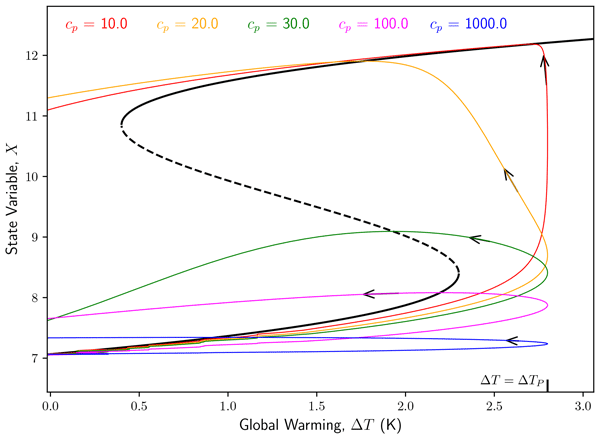
The authors present a study of a simplified dynamical system displaying tipping points, with the claim that it can be calibrated to represent some aspects of the behaviour of more complex Earth Systems Models under global warming. The explicit aim is to include effects of 'inertia' and 'hysteresis'. Only one of the hysteresis branches is explored (the return path to the base state is not considered).
The paper is written more as the lecture notes of an elementary course on dynamics and bifurcations than as a research paper. The main result is in Fig. 4: fast crossing of a tipping point and return back of a control parameter does not trigger a jump in the system state, in contrast with the behavior for a slow crossing. This result is very well known. In fact, the authors check that the time scales agree with the result of Ritchie et al 2019, thus confirming that the behaviour has been studied in detail before. Thus, the only part that can be useful for the community is the parametrization of this simplified model in terms of quantities that in principle can be measured from a larger climate model. The manipulations leading to this parametrization are elementary, and do not deserve the many pages devoted to it. But there are more important caveats:
- The manuscript model, Eq. (1) is just the normal form of the codimension-2 cusp bifurcation. It can be argued that any dynamical system with only fold bifurcations can be generically brought to that form. But in general the change in variables needed for that is nonlinear, not the simple linear scaling used here for mu and X. The consequence is that the basins of attraction of the upper and lower stable-solution branches would be quite asymmetric, an important fact neglected in the present approach.
- Only fold bifurcations are taken into account. This excludes possibilities already observed in existing climatic models, such as oscillatory instabilities, homoclinic bifurcations, crisis and other global bifurcations, etc.
Anyway, I would accept that all the above criticisms would become irrelevant if the authors would be able to demonstrate their main claim: that this approach allows to map different complex climate models into a single framework, thus allowing comparison among them. The authors have not demonstrated this, and it seems difficult to do since, as recognized by the authors, most existing studies only consider short simulations not always exploring beyond a bifurcation point. I invite the authors to really follow their proposal and compare outputs from different complex models to show really that their approach is powerful (and in this case the straightforwardness of the calculations will be a welcomed feature). Until they do something like this I do not find the manuscript relevant to the community and I can not recommend the paper for publication.
Citation: https://doi.org/10.5194/egusphere-2026-550-RC2 - AC1: 'Comment on egusphere-2026-550', Chris Huntingford, 12 May 2026
Peer review completion


Interactive discussion
Status: closed
- RC1: 'Comment on egusphere-2026-550', Anonymous Referee #1, 02 Mar 2026
-
RC2: 'Comment on egusphere-2026-550', Anonymous Referee #2, 10 Mar 2026
The authors present a study of a simplified dynamical system displaying tipping points, with the claim that it can be calibrated to represent some aspects of the behaviour of more complex Earth Systems Models under global warming. The explicit aim is to include effects of 'inertia' and 'hysteresis'. Only one of the hysteresis branches is explored (the return path to the base state is not considered).
The paper is written more as the lecture notes of an elementary course on dynamics and bifurcations than as a research paper. The main result is in Fig. 4: fast crossing of a tipping point and return back of a control parameter does not trigger a jump in the system state, in contrast with the behavior for a slow crossing. This result is very well known. In fact, the authors check that the time scales agree with the result of Ritchie et al 2019, thus confirming that the behaviour has been studied in detail before. Thus, the only part that can be useful for the community is the parametrization of this simplified model in terms of quantities that in principle can be measured from a larger climate model. The manipulations leading to this parametrization are elementary, and do not deserve the many pages devoted to it. But there are more important caveats:
- The manuscript model, Eq. (1) is just the normal form of the codimension-2 cusp bifurcation. It can be argued that any dynamical system with only fold bifurcations can be generically brought to that form. But in general the change in variables needed for that is nonlinear, not the simple linear scaling used here for mu and X. The consequence is that the basins of attraction of the upper and lower stable-solution branches would be quite asymmetric, an important fact neglected in the present approach.
- Only fold bifurcations are taken into account. This excludes possibilities already observed in existing climatic models, such as oscillatory instabilities, homoclinic bifurcations, crisis and other global bifurcations, etc.
Anyway, I would accept that all the above criticisms would become irrelevant if the authors would be able to demonstrate their main claim: that this approach allows to map different complex climate models into a single framework, thus allowing comparison among them. The authors have not demonstrated this, and it seems difficult to do since, as recognized by the authors, most existing studies only consider short simulations not always exploring beyond a bifurcation point. I invite the authors to really follow their proposal and compare outputs from different complex models to show really that their approach is powerful (and in this case the straightforwardness of the calculations will be a welcomed feature). Until they do something like this I do not find the manuscript relevant to the community and I can not recommend the paper for publication.
Citation: https://doi.org/10.5194/egusphere-2026-550-RC2 - AC1: 'Comment on egusphere-2026-550', Chris Huntingford, 12 May 2026
Peer review completion
Journal article(s) based on this preprint
Viewed
| HTML | XML | Total | BibTeX | EndNote | |
|---|---|---|---|---|---|
| 1,673 | 767 | 101 | 2,541 | 168 | 208 |
- HTML: 1,673
- PDF: 767
- XML: 101
- Total: 2,541
- BibTeX: 168
- EndNote: 208
Viewed (geographical distribution)
| Country | # | Views | % |
|---|
| Total: | 0 |
| HTML: | 0 |
| PDF: | 0 |
| XML: | 0 |
- 1

Paul D. L. Ritchie
Joseph Clarke
The requested preprint has a corresponding peer-reviewed final revised paper. You are encouraged to refer to the final revised version.
- Preprint
(622 KB) - Metadata XML
Comments in the PDF above