
the Creative Commons Attribution 4.0 License.
the Creative Commons Attribution 4.0 License.
 | 23 Jan 2026
Aerosol Scavenging in DC3 and SEAC4RS Deep Convective Storms
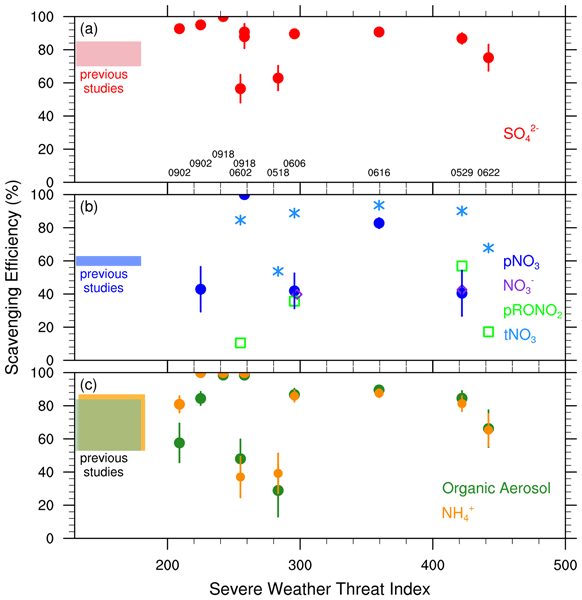
Abstract. Convective storms frequently occur over the central US during the late spring and summer impacting upper tropospheric composition, which in turn affects the radiative forcing of the climate system. Two important processes in deep convection are vertical transport and removal of trace gases and aerosols by microphysical scavenging. We calculate scavenging efficiencies of speciated aerosol mass concentrations based primarily on aircraft observations from the Deep Convective Clouds and Chemistry (DC3) and the Studies of Emissions, Atmospheric Composition, Clouds and Climate Coupling by Regional Surveys (SEAC4RS) field experiments combined with process-scale modeling. Sulfate and ammonium scavenging efficiencies are generally greater than 75 % for all storms analyzed. Particulate nitrate scavenging efficiencies are moderate (~40 %). In some cases, the particulate nitrate concentrations are larger in the storm outflow region compared to the inflow region. Further analysis shows the role of entrainment of mid-tropospheric particulate nitrate layers and lightning production of nitrogen oxides in affecting the particulate nitrate outflow concentrations. Organic aerosol scavenging efficiencies are greater than 75 % in severe storms, comparable to sulfate and ammonium, but ~50 % for weak and moderate storms. Production of organic acids in cloud water is shown to contribute to organic aerosol mass in the outflow regions for the mid-day storms sampled, which may explain why those storms have lower apparent scavenging efficiencies. These results, which highlight the complex interactions between dynamics, physics, and chemistry in thunderstorms, can be used by chemistry transport models as a way to evaluate convective storm processing of aerosols.
Competing interests: At least one of the (co-)authors is a member of the editorial board of Atmospheric Chemistry and Physics. The peer-review process was guided by an independent editor, and the authors also have no other competing interests to declare.
Publisher's note: Copernicus Publications remains neutral with regard to jurisdictional claims made in the text, published maps, institutional affiliations, or any other geographical representation in this paper. While Copernicus Publications makes every effort to include appropriate place names, the final responsibility lies with the authors. Views expressed in the text are those of the authors and do not necessarily reflect the views of the publisher.-
Notice on discussion status
The requested preprint has a corresponding peer-reviewed final revised paper. You are encouraged to refer to the final revised version.
-
Preprint
(2417 KB)
-
Supplement
(3632 KB)
-
The requested preprint has a corresponding peer-reviewed final revised paper. You are encouraged to refer to the final revised version.
- Preprint
(2417 KB) - Metadata XML
-
Supplement
(3632 KB) - BibTeX
- EndNote
- Final revised paper


Journal article(s) based on this preprint
Interactive discussion
Status: closed
-
RC1: 'Comment on egusphere-2025-6552', Anonymous Referee #1, 25 Feb 2026
- AC1: 'Reply on RC1', Mary Barth, 24 Apr 2026
-
RC2: 'Comment on egusphere-2025-6552', Anonymous Referee #2, 27 Mar 2026
This paper describes aerosol scavenging in deep convective storms based on DC3 and SEAC4RC field measurements and the entrainment model simulations. The deep convective cloud scavenging efficiencies of sulfate, nitrate, ammonium, and organic aerosols are calculated, and physical and chemical processes affecting the scavenging efficiency analyzed. The results provide valuable information and dataset for further investigating the spatiotemporal distributions of aerosols in the upper troposphere. The paper is well written in general and can be accepted for publication in ACP subject to minor revisions.
Comments in detail
In this study, the scavenging efficiencies (SEs) of sulfate, ammonium, and nitrate aerosols are calculated based on aircraft observations combined with parcel model simulations. The results show that organic nitrate SEs (~40%) are lower than sulfate and ammonium SEs (75%), and the causes of difference are attributed to the entrainment of mid-tropospheric nitrate layers formed from lightning-produced nitrogen oxides. These results appear to be sensible/reasonable from the field observation of view. On the other hand, scavenging here should be referred to wet deposition of aerosols via nucleation, impaction and Brownian diffusion, as mentioned in this paper. This wet scavenging process is clearly defined and treated separately from the lightning production of nitrogen oxides in regional or global chemistry model. The questions are:
- Could the term ‘scavenging efficiency’ and calculation method still be used appropriately in the case that there are much more aerosols entrained from mid-troposphere than from the inflow region?
- Should nitrate have a same SE level as sulfate and ammonium if there were no nitrate mid-troposphere layer or lightning nitrogen oxide source in the model simulation?
It might not realistic to address these issues by performing additional modeling work. But adding some discussions in the conclusions might be helpful for guiding future modeling research.
Citation: https://doi.org/10.5194/egusphere-2025-6552-RC2 - AC2: 'Reply on RC2', Mary Barth, 24 Apr 2026
-
EC1: 'Comment on egusphere-2025-6552', Jianzhong Ma, 27 Mar 2026
Publisher’s note: the content of this comment was removed on 30 March 2026 since the comment was posted by mistake.
Citation: https://doi.org/10.5194/egusphere-2025-6552-EC1 -
RC3: 'Comment on egusphere-2025-6552', Anonymous Referee #3, 27 Mar 2026
The article “Aerosol Scavenging in DC3 and SEAC4 RS Deep Convective Storms” by Barth et al., interpret scavenging efficiencies of speciated mass concentrations of aerosols for investigations performed during DC3 and SEAC4RS field experiments on different storms. The studies are in line with the investigations performed by the research group. The results highlight the importance of multi and intercorrelation of dynamics, physics, and chemistry used to interpret processes occurring during thunderstorms. This study add important information on more robust quantification of aerosol scavenging by studying more convective storm than existing research which was limited to a maximum of 3 storms.
Major comments:
Please add information about the dependency on pressure of instrument calibrations. Aircraft measurements handle with vertical distributions and an accurate measurement needs knowledge on the influence of pressure and temperature on measurements. If the instruments were ground base calibrated and measurements were performed at high altitude it could affect the measurements, please comment.
Even if the study consider zero initial concentration of organic acids it is evident that these concentrations can not be zero. Please comment based on the existing field measurements studies which stated various concentrations of organic acids in the atmosphere, how the model could be affected.
Figure 5S represents the scatter plot of pNO3 and the NO3 - fraction of NO3 - + HNO3 for 6 different cases. Excluding the extreme purple dot the outflow linearity change drastically and data became more representative in terms of linearity. Please discuss how this potential exclusion would affect the results.
May you better explain why the aerosols scavenging efficiency differ for all of them (sulfate, ammonium, etc.) during the 18 May 2012 and 2 June 2012 events? It could be an effect of experiment failure?
Minor comments:
Line 129: better add „using i- to n- ratios of butane and pentane isomers”
Line 148: Faloona et al., 2004 is missing from reference list. Please check all the references in this sub-section. Most probably references from Supplementary information should be added in the list of main article
Line 379-381: please revise the sentence
Line 389: Isn’t there „West”?
Line 542: „hydroxyacetone”
Line 562-563: please add „;” for reference literature separation
Figure 2 (06 June 2012) pNO3 x 5 is missing
Please add a short note to table 2S to explain the reason of outflow time representation in the form of e.g. 25:50:00.
Please be consistent with the cases representation form „12 June” or „12 June 2012”
Citation: https://doi.org/10.5194/egusphere-2025-6552-RC3 - AC3: 'Reply on RC3', Mary Barth, 24 Apr 2026
Peer review completion


Interactive discussion
Status: closed
-
RC1: 'Comment on egusphere-2025-6552', Anonymous Referee #1, 25 Feb 2026
This manuscript derives composition-specific aerosol scavenging efficiencies (SE) through the analysis of ten storms from the Deep Convective Clouds and Chemistry (DC3) and the Studies of Emissions, Atmospheric Composition, Clouds and Climate Coupling by Regional Surveys (SEAC4RS) field experiments combined with process-scale modeling. The manuscript addresses an important problem—quantifying composition-dependent aerosol scavenging in deep convection—and provides a valuable observational dataset. The results presented can be used directly for evaluating cloud-scale chemistry transport model representation of aerosol scavenging.
The article is written clearly and would be a good contribution to ACP. However, the authors need to address the following comments before I can recommend publication in ACP.
Major comments:
The largest concern is the limited evaluation of uncertainty in entrainment rates and its propagation into scavenging efficiency (SE). Given that SE is directly dependent on the entrainment, a quantitative uncertainty analysis (e.g., sensitivity tests or error propagation) would substantially strengthen the robustness of the conclusions.
- Entrainment rates vary substantially among cases (Table S2), and different tracers were used to diagnose entrainment in different storms. While this is understandable given observational constraints, a more explicit discussion of the comparability of entrainment rates derived from different tracers would strengthen confidence in the results.
- It would be helpful to show the vertical profiles of the tracers used to derive entrainment alongside the corresponding aerosol vertical profiles, to assess how similar their vertical structures are and how sensitive the entrainment correction may be to profile heterogeneity.
- More importantly, the manuscript does not quantify how uncertainty in entrainment rates and in the clear-air and outflow aerosol profiles propagates into SE uncertainty. In Table S2, only cases with multiple outflow legs include standard deviations, while other cases appear to lack uncertainty bounds.
The discussion focuses primarily on chemical processes and entrainment of mid-free-tropospheric aerosol layers in interpreting SE variability. However, the dynamical controls on scavenging are less clearly developed. Although SE is shown as a function of the SWEAT index, the analysis does not fully explore how dynamical factors (e.g., convective intensity and updraft strength) may influence the observed chemical and scavenging signatures. The connection between storm dynamics and composition-dependent SE could be developed further, particularly in the Conclusions section.
Minor comments:
Tick directions are inconsistent across figures. For example, Fig. 4 and Fig. 6 have inward ticks, while other figures use outward ticks. Please standardize formatting.
Figure 2: It would be helpful to include the sample size (e.g., number of seconds of sampling) within each 1-km bin for the clear-air vertical profiles. Additionally, the method used to define the inflow aerosol concentration below cloud base should be clarified. Was the bin closest to cloud base used, or was an average taken across all sub-cloud layers?
Line 381: It would strengthen the discussion to provide references and typical magnitudes for below-cloud scavenging efficiency for comparison.
The Conclusions section would benefit from a brief, explicit statement of the main limitations of the study (e.g., entrainment uncertainty, tracer dependence, simplified chemical interpretation).
Citation: https://doi.org/10.5194/egusphere-2025-6552-RC1 - AC1: 'Reply on RC1', Mary Barth, 24 Apr 2026
-
RC2: 'Comment on egusphere-2025-6552', Anonymous Referee #2, 27 Mar 2026
This paper describes aerosol scavenging in deep convective storms based on DC3 and SEAC4RC field measurements and the entrainment model simulations. The deep convective cloud scavenging efficiencies of sulfate, nitrate, ammonium, and organic aerosols are calculated, and physical and chemical processes affecting the scavenging efficiency analyzed. The results provide valuable information and dataset for further investigating the spatiotemporal distributions of aerosols in the upper troposphere. The paper is well written in general and can be accepted for publication in ACP subject to minor revisions.
Comments in detail
In this study, the scavenging efficiencies (SEs) of sulfate, ammonium, and nitrate aerosols are calculated based on aircraft observations combined with parcel model simulations. The results show that organic nitrate SEs (~40%) are lower than sulfate and ammonium SEs (75%), and the causes of difference are attributed to the entrainment of mid-tropospheric nitrate layers formed from lightning-produced nitrogen oxides. These results appear to be sensible/reasonable from the field observation of view. On the other hand, scavenging here should be referred to wet deposition of aerosols via nucleation, impaction and Brownian diffusion, as mentioned in this paper. This wet scavenging process is clearly defined and treated separately from the lightning production of nitrogen oxides in regional or global chemistry model. The questions are:
- Could the term ‘scavenging efficiency’ and calculation method still be used appropriately in the case that there are much more aerosols entrained from mid-troposphere than from the inflow region?
- Should nitrate have a same SE level as sulfate and ammonium if there were no nitrate mid-troposphere layer or lightning nitrogen oxide source in the model simulation?
It might not realistic to address these issues by performing additional modeling work. But adding some discussions in the conclusions might be helpful for guiding future modeling research.
Citation: https://doi.org/10.5194/egusphere-2025-6552-RC2 - AC2: 'Reply on RC2', Mary Barth, 24 Apr 2026
-
EC1: 'Comment on egusphere-2025-6552', Jianzhong Ma, 27 Mar 2026
Publisher’s note: the content of this comment was removed on 30 March 2026 since the comment was posted by mistake.
Citation: https://doi.org/10.5194/egusphere-2025-6552-EC1 -
RC3: 'Comment on egusphere-2025-6552', Anonymous Referee #3, 27 Mar 2026
The article “Aerosol Scavenging in DC3 and SEAC4 RS Deep Convective Storms” by Barth et al., interpret scavenging efficiencies of speciated mass concentrations of aerosols for investigations performed during DC3 and SEAC4RS field experiments on different storms. The studies are in line with the investigations performed by the research group. The results highlight the importance of multi and intercorrelation of dynamics, physics, and chemistry used to interpret processes occurring during thunderstorms. This study add important information on more robust quantification of aerosol scavenging by studying more convective storm than existing research which was limited to a maximum of 3 storms.
Major comments:
Please add information about the dependency on pressure of instrument calibrations. Aircraft measurements handle with vertical distributions and an accurate measurement needs knowledge on the influence of pressure and temperature on measurements. If the instruments were ground base calibrated and measurements were performed at high altitude it could affect the measurements, please comment.
Even if the study consider zero initial concentration of organic acids it is evident that these concentrations can not be zero. Please comment based on the existing field measurements studies which stated various concentrations of organic acids in the atmosphere, how the model could be affected.
Figure 5S represents the scatter plot of pNO3 and the NO3 - fraction of NO3 - + HNO3 for 6 different cases. Excluding the extreme purple dot the outflow linearity change drastically and data became more representative in terms of linearity. Please discuss how this potential exclusion would affect the results.
May you better explain why the aerosols scavenging efficiency differ for all of them (sulfate, ammonium, etc.) during the 18 May 2012 and 2 June 2012 events? It could be an effect of experiment failure?
Minor comments:
Line 129: better add „using i- to n- ratios of butane and pentane isomers”
Line 148: Faloona et al., 2004 is missing from reference list. Please check all the references in this sub-section. Most probably references from Supplementary information should be added in the list of main article
Line 379-381: please revise the sentence
Line 389: Isn’t there „West”?
Line 542: „hydroxyacetone”
Line 562-563: please add „;” for reference literature separation
Figure 2 (06 June 2012) pNO3 x 5 is missing
Please add a short note to table 2S to explain the reason of outflow time representation in the form of e.g. 25:50:00.
Please be consistent with the cases representation form „12 June” or „12 June 2012”
Citation: https://doi.org/10.5194/egusphere-2025-6552-RC3 - AC3: 'Reply on RC3', Mary Barth, 24 Apr 2026
Peer review completion
Journal article(s) based on this preprint
Model code and software
Extended AIM Aerosol Thermodynamics Model Simon L. Clegg et al. https://www.aim.env.uea.ac.uk/aim/aim.php
Viewed
| HTML | XML | Total | Supplement | BibTeX | EndNote | |
|---|---|---|---|---|---|---|
| 1,367 | 732 | 169 | 2,268 | 356 | 142 | 231 |
- HTML: 1,367
- PDF: 732
- XML: 169
- Total: 2,268
- Supplement: 356
- BibTeX: 142
- EndNote: 231
Viewed (geographical distribution)
| Country | # | Views | % |
|---|
| Total: | 0 |
| HTML: | 0 |
| PDF: | 0 |
| XML: | 0 |
- 1
Cited


Mary C. Barth

Pedro Campuzano-Jost
Gustavo Cuchiara
Ajay Parottil
Jose L. Jimenez
Miguel Ricardo A. Hilario
Genevieve Rose Lorenzo
Armin Sorooshian
The requested preprint has a corresponding peer-reviewed final revised paper. You are encouraged to refer to the final revised version.
- Preprint
(2417 KB) - Metadata XML
-
Supplement
(3632 KB) - BibTeX
- EndNote
- Final revised paper
This manuscript derives composition-specific aerosol scavenging efficiencies (SE) through the analysis of ten storms from the Deep Convective Clouds and Chemistry (DC3) and the Studies of Emissions, Atmospheric Composition, Clouds and Climate Coupling by Regional Surveys (SEAC4RS) field experiments combined with process-scale modeling. The manuscript addresses an important problem—quantifying composition-dependent aerosol scavenging in deep convection—and provides a valuable observational dataset. The results presented can be used directly for evaluating cloud-scale chemistry transport model representation of aerosol scavenging.
The article is written clearly and would be a good contribution to ACP. However, the authors need to address the following comments before I can recommend publication in ACP.
Major comments:
The largest concern is the limited evaluation of uncertainty in entrainment rates and its propagation into scavenging efficiency (SE). Given that SE is directly dependent on the entrainment, a quantitative uncertainty analysis (e.g., sensitivity tests or error propagation) would substantially strengthen the robustness of the conclusions.
The discussion focuses primarily on chemical processes and entrainment of mid-free-tropospheric aerosol layers in interpreting SE variability. However, the dynamical controls on scavenging are less clearly developed. Although SE is shown as a function of the SWEAT index, the analysis does not fully explore how dynamical factors (e.g., convective intensity and updraft strength) may influence the observed chemical and scavenging signatures. The connection between storm dynamics and composition-dependent SE could be developed further, particularly in the Conclusions section.
Minor comments:
Tick directions are inconsistent across figures. For example, Fig. 4 and Fig. 6 have inward ticks, while other figures use outward ticks. Please standardize formatting.
Figure 2: It would be helpful to include the sample size (e.g., number of seconds of sampling) within each 1-km bin for the clear-air vertical profiles. Additionally, the method used to define the inflow aerosol concentration below cloud base should be clarified. Was the bin closest to cloud base used, or was an average taken across all sub-cloud layers?
Line 381: It would strengthen the discussion to provide references and typical magnitudes for below-cloud scavenging efficiency for comparison.
The Conclusions section would benefit from a brief, explicit statement of the main limitations of the study (e.g., entrainment uncertainty, tracer dependence, simplified chemical interpretation).