
the Creative Commons Attribution 4.0 License.
the Creative Commons Attribution 4.0 License.
 | 28 Jan 2026
Intraseasonal Variability and Eddy-Induced Structural Modulation of the North Pacific Intermediate Water Revealed by Multi-Mooring Observations
Abstract. The North Pacific Intermediate Water (NPIW) plays a crucial role in modulating oceanic thermohaline circulation and biogeochemical processes. However, limited continuous observations have hindered the understanding of its short-term variability and structural response to mesoscale processes. This study investigates the intraseasonal structural variability of the NPIW and its modulation by mesoscale eddies, based on long-term mooring observations from three sites (M1–M3) across the western Pacific. The thickness of the NPIW displays substantial intraseasonal variability, dominated by an approximately 80-day period that is coherent among all mooring sites. Unlike previous studies that mainly focused on temperature and salinity anomalies, this work introduces NPIW thickness as a new structural diagnostic parameter to capture the vertical compression and expansion of the intermediate layer induced by eddy activity. The analysis identifies a strong inverse correlation between layer thickness and isopycnal-averaged salinity, demonstrating that anticyclonic (cyclonic) eddies correspond to thinner (thicker) and more saline (fresher) intermediate layers. Spatial composites further reveal that thickness variability is most pronounced near the western boundary, which may be associated with locally complex water mass exchange and mixing driven by eddies. These findings provide the first quantitative evidence of intraseasonal variability in NPIW thickness and highlight its role as a key indicator for diagnosing mesoscale–intermediate layer interactions in the North Pacific.
-
Notice on discussion status
The requested preprint has a corresponding peer-reviewed final revised paper. You are encouraged to refer to the final revised version.
-
Preprint
(4327 KB)
-
The requested preprint has a corresponding peer-reviewed final revised paper. You are encouraged to refer to the final revised version.
- Preprint
(4327 KB) - Metadata XML
- BibTeX
- EndNote
- Final revised paper


Journal article(s) based on this preprint
Interactive discussion
Status: closed
-
RC1: 'Comment on egusphere-2025-6538', Anonymous Referee #1, 03 Feb 2026
The comment was uploaded in the form of a supplement: https://egusphere.copernicus.org/preprints/2026/egusphere-2025-6538/egusphere-2025-6538-RC1-supplement.pdfCitation: https://doi.org/
10.5194/egusphere-2025-6538-RC1 -
AC1: 'Reply on RC1', ren qiang, 24 May 2026
Dear Professor
We sincerely thank you for your careful evaluation and constructive comments provided earlier in the review process. We apologize for the delay in our response. Since the comments from the other reviewers were received in late April and early May, we revised the manuscript after considering all comments together, so that overlapping issues could be addressed consistently and comprehensively. We greatly appreciate your valuable suggestions, which have helped improve the clarity and scientific rigor of the manuscript.
We have consolidated the comments from the Editor and all reviewers and provided point-by-point responses with corresponding revisions in the manuscript. The attached ZIP file includes the integrated response file and the revised manuscript. We would greatly appreciate it if you could kindly review the materials. We sincerely thank you again for your careful evaluation and constructive suggestions.
Ren Qiang
-
AC1: 'Reply on RC1', ren qiang, 24 May 2026
-
RC2: 'Comment on egusphere-2025-6538', Anonymous Referee #2, 28 Apr 2026
The comment was uploaded in the form of a supplement: https://egusphere.copernicus.org/preprints/2026/egusphere-2025-6538/egusphere-2025-6538-RC2-supplement.pdf
-
AC2: 'Reply on RC2', ren qiang, 24 May 2026
Dear Professor,
We sincerely thank you for your careful evaluation of our manuscript and for providing constructive and insightful comments. Your suggestions have been very valuable in helping us improve the manuscript.
We have carefully consolidated the comments from the Editor and all reviewers and addressed them in a point-by-point manner. The attached ZIP file includes the integrated response file and the revised manuscript with corresponding revisions. We would greatly appreciate it if you could kindly review the materials. Thank you again for your valuable time and constructive suggestions.
Ren Qiang
-
AC2: 'Reply on RC2', ren qiang, 24 May 2026
-
RC3: 'Comment on egusphere-2025-6538', Anonymous Referee #3, 13 May 2026
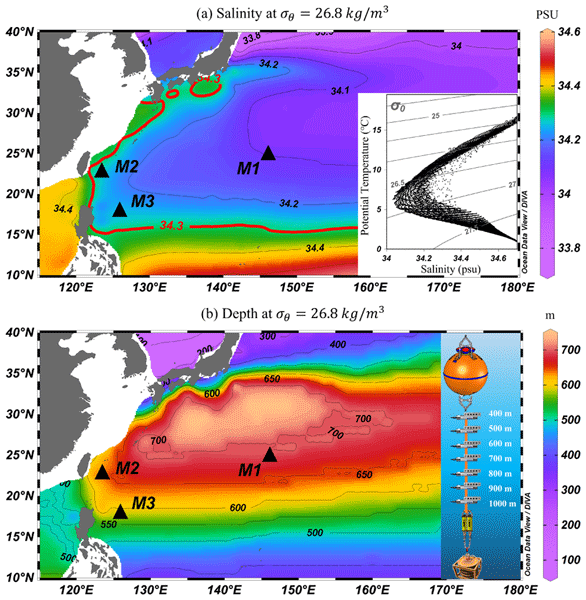
This manuscript investigates the intraseasonal variability of the North Pacific Intermediate Water (NPIW) using multi-mooring observations. Considering the limited availability of long-term in situ measurements in the intermediate ocean, the dataset presented here is valuable and provides useful observational constraints on subsurface variability. The analyses are generally reasonable and the results contribute to a better understanding of NPIW variability. The introduction of NPIW thickness as a structural indicator is particularly interesting and represents a useful extension beyond traditional thermohaline analyses. This perspective helps to better interpret the response of intermediate water to mesoscale processes. But I have a few comments regarding clarity of definitions, and methodological description that should be addressed.Main Comments:1. The definition of NPIW could be clarified. Different criteria are used in the manuscript (e.g., 34.3 psu isohaline vs. salinity minimum). It would be helpful to briefly explain why 34.3 psu is chosen to define thickness. Is this threshold robust across regions? Would similar results be obtained with a slightly different value? A short discussion would improve clarity.2. In the Data and Methods section, three moorings are used. A schematic showing the vertical configuration of CTD sensors would be very helpful. This would allow readers to better evaluate whether the vertical resolution is sufficient. In addition, please provide a bit more detail on data processing (e.g., interpolation and filtering methods).3. In Section 3.2, the salinity variability at M1 (34.12–34.16 psu) is much smaller than at M2 and M3. A brief explanation would be useful. This could be related to regional hydrographic conditions or differences in dynamical influence.4. The variability is mainly attributed to mesoscale eddies, which is reasonable. However, it would strengthen the paper to briefly discuss other possible contributors. For example, could remotely forced signals (e.g., Rossby waves) also play a role at similar timescales? A short discussion would help justify the interpretation.5. The discussion would benefit from a clearer assessment of the relative roles of vertical displacement (isopycnal heaving) and horizontal advection/mixing in driving the observed NPIW variability. In particular, can the authors further clarify under what conditions (or at which mooring sites) each mechanism is dominant? Additionally, are there observational indicators (e.g., phase relationships, vertical coherence, or spatial patterns) that could help distinguish between these processes?Specific Comments:1. The line color in Fig. 4b is inconsistent with Fig. 4a. Please revise for consistency.2. In Fig. 3, the salinity shading at M1 appears discontinuous. This may be due to the sparse vertical resolution of the CTDs, which might not fully capture the salinity minimum. In this case, the averaged line may be misleading. It is suggested to reconsider or remove the averaged salinity line for clarity.3. Line 438: the symbol “/” better replaced with “and”Citation: https://doi.org/
10.5194/egusphere-2025-6538-RC3 -
AC3: 'Reply on RC3', ren qiang, 24 May 2026
Dear Professor,
We sincerely thank you for your careful evaluation of our manuscript and for providing constructive and insightful comments. Your suggestions have been very valuable in helping us improve the manuscript.
We have carefully consolidated the comments from the Editor and all reviewers and addressed them in a point-by-point manner. The attached ZIP file includes the integrated response file and the revised manuscript with corresponding revisions. We would greatly appreciate it if you could kindly review the materials. Thank you again for your valuable time and constructive suggestions.
Ren Qiang
-
AC3: 'Reply on RC3', ren qiang, 24 May 2026
-
RC4: 'Comment on egusphere-2025-6538', Anonymous Referee #4, 24 May 2026
I have carefully read the revised manuscript and the authors' responses to the previous reviewers. First, I would like to commend the authors on presenting a highly valuable and interesting dataset. Long-term, high-frequency mooring observations of the North Pacific Intermediate Water (NPIW) are rare. The manuscript has been improved during the revision process (at least on 25th May); however, I believe there are still a few critical points that need to be addressed to further strengthen the scientific validity and depth of the discussion.
Below are my major comments, which build upon and extend some of the concerns raised in the previous review round.1. Quantitative Comparison with CMEMS Data (Related to the general validation of reanalysis data and Reviewer 2's concerns regarding analytical rigor)
In the revised manuscript, the authors added T-S scatter plots using CMEMS data (Figure 7d-f) to validate its consistency with the in-situ observations. While this is a good addition to demonstrate qualitative agreement (e.g., the positive correlation between SLA and temperature/salinity), it currently lacks a quantitative comparison of the variation amplitudes. For instance, the mooring at M2 observed large salinity fluctuations (e.g., a standard deviation of 0.7 psu). The authors should quantitatively discuss how well the CMEMS data reproduces the actual magnitude of these variations. Comparing the amplitude or variance between the observations and the CMEMS data would provide a more rigorous justification for using the reanalysis data to explain the physical mechanisms in Section 4.3.
2. 3D Structure of Eddies and Phase Relationships using CMEMS Data (Directly related to Reviewer 1's comment on 3D lens-shaped structures and Reviewer 3's comment on using phase relationships to distinguish mechanisms)
In response to Reviewer 1 (regarding 3D eddy structures) and Reviewer 3 (who perceptively asked if "phase relationships" could help distinguish between vertical displacement and horizontal advection/mixing), the authors stated that their 1D mooring observations limit such 3D or quantitative separations. While this is true for the mooring data alone, the authors incorporate 3D CMEMS reanalysis data in Section 4.3, meaning this limitation no longer fully applies. Currently, Figures 12-14 only show 2D horizontal composite maps at specific depth ranges. To convincingly demonstrate the structural modulation by eddies, the authors should utilize the 3D nature of the CMEMS data to present vertical cross-sections (zonal and/or meridional composites) across the eddy center. Furthermore, by investigating the time lags relative to the SSHA peaks (e.g., creating cross-sectional composites before, during, and after the passage of SSHA peaks), the authors could effectively examine the phase differences between isopycnal heaving and the lateral intrusion of high-salinity waters. Addressing this would directly answer Reviewer 3's excellent point and allow for a much more conclusive, quantitative discussion on the mechanisms driving the anomalies at different sites.3. Implications of Non-overlapping Observation Periods (A crucial point largely overlooked in the previous review round) The observation periods for the three moorings do not overlap: M3 (2016-2017), M1 (2017-2018), and M2 (2019-2020).
The manuscript currently attributes the differences in NPIW variability among the sites entirely to spatial heterogeneity (i.e., open ocean vs. western boundary). However, because the measurements were taken in completely different years, there is a strong possibility that interannual variability (e.g., different climate phases, background hydrographic shifts, or year-to-year differences in regional eddy kinetic energy) also contributes to the observed differences. While this does not negate the study's general findings regarding the eddy-induced modulation, the potential influence of interannual variability due to the asynchronous observation periods must be explicitly acknowledged and discussed in the Discussion section to ensure scientific rigor.Citation: https://doi.org/10.5194/egusphere-2025-6538-RC4 -
AC4: 'Reply on RC4', ren qiang, 28 May 2026
Dear Professor,
We sincerely thank you for the careful reading of our revised manuscript and for the constructive and insightful comments. We greatly appreciate your recognition of the value of the long-term, high-frequency mooring observations of the NPIW and the improvements made in the previous revision. The additional comments are very helpful for further strengthening the quantitative rigor, physical interpretation, and scientific balance of the manuscript.
Please refer to the attached zip file for your suggested revisions and manuscript edits.
We sincerely thank you for your review again.
Ren Qiang
-
AC4: 'Reply on RC4', ren qiang, 28 May 2026
Peer review completion


Interactive discussion
Status: closed
-
RC1: 'Comment on egusphere-2025-6538', Anonymous Referee #1, 03 Feb 2026
The comment was uploaded in the form of a supplement: https://egusphere.copernicus.org/preprints/2026/egusphere-2025-6538/egusphere-2025-6538-RC1-supplement.pdf
-
AC1: 'Reply on RC1', ren qiang, 24 May 2026
Dear Professor
We sincerely thank you for your careful evaluation and constructive comments provided earlier in the review process. We apologize for the delay in our response. Since the comments from the other reviewers were received in late April and early May, we revised the manuscript after considering all comments together, so that overlapping issues could be addressed consistently and comprehensively. We greatly appreciate your valuable suggestions, which have helped improve the clarity and scientific rigor of the manuscript.
We have consolidated the comments from the Editor and all reviewers and provided point-by-point responses with corresponding revisions in the manuscript. The attached ZIP file includes the integrated response file and the revised manuscript. We would greatly appreciate it if you could kindly review the materials. We sincerely thank you again for your careful evaluation and constructive suggestions.
Ren Qiang
-
AC1: 'Reply on RC1', ren qiang, 24 May 2026
-
RC2: 'Comment on egusphere-2025-6538', Anonymous Referee #2, 28 Apr 2026
The comment was uploaded in the form of a supplement: https://egusphere.copernicus.org/preprints/2026/egusphere-2025-6538/egusphere-2025-6538-RC2-supplement.pdf
-
AC2: 'Reply on RC2', ren qiang, 24 May 2026
Dear Professor,
We sincerely thank you for your careful evaluation of our manuscript and for providing constructive and insightful comments. Your suggestions have been very valuable in helping us improve the manuscript.
We have carefully consolidated the comments from the Editor and all reviewers and addressed them in a point-by-point manner. The attached ZIP file includes the integrated response file and the revised manuscript with corresponding revisions. We would greatly appreciate it if you could kindly review the materials. Thank you again for your valuable time and constructive suggestions.
Ren Qiang
-
AC2: 'Reply on RC2', ren qiang, 24 May 2026
-
RC3: 'Comment on egusphere-2025-6538', Anonymous Referee #3, 13 May 2026
This manuscript investigates the intraseasonal variability of the North Pacific Intermediate Water (NPIW) using multi-mooring observations. Considering the limited availability of long-term in situ measurements in the intermediate ocean, the dataset presented here is valuable and provides useful observational constraints on subsurface variability. The analyses are generally reasonable and the results contribute to a better understanding of NPIW variability. The introduction of NPIW thickness as a structural indicator is particularly interesting and represents a useful extension beyond traditional thermohaline analyses. This perspective helps to better interpret the response of intermediate water to mesoscale processes. But I have a few comments regarding clarity of definitions, and methodological description that should be addressed.Main Comments:1. The definition of NPIW could be clarified. Different criteria are used in the manuscript (e.g., 34.3 psu isohaline vs. salinity minimum). It would be helpful to briefly explain why 34.3 psu is chosen to define thickness. Is this threshold robust across regions? Would similar results be obtained with a slightly different value? A short discussion would improve clarity.2. In the Data and Methods section, three moorings are used. A schematic showing the vertical configuration of CTD sensors would be very helpful. This would allow readers to better evaluate whether the vertical resolution is sufficient. In addition, please provide a bit more detail on data processing (e.g., interpolation and filtering methods).3. In Section 3.2, the salinity variability at M1 (34.12–34.16 psu) is much smaller than at M2 and M3. A brief explanation would be useful. This could be related to regional hydrographic conditions or differences in dynamical influence.4. The variability is mainly attributed to mesoscale eddies, which is reasonable. However, it would strengthen the paper to briefly discuss other possible contributors. For example, could remotely forced signals (e.g., Rossby waves) also play a role at similar timescales? A short discussion would help justify the interpretation.5. The discussion would benefit from a clearer assessment of the relative roles of vertical displacement (isopycnal heaving) and horizontal advection/mixing in driving the observed NPIW variability. In particular, can the authors further clarify under what conditions (or at which mooring sites) each mechanism is dominant? Additionally, are there observational indicators (e.g., phase relationships, vertical coherence, or spatial patterns) that could help distinguish between these processes?Specific Comments:1. The line color in Fig. 4b is inconsistent with Fig. 4a. Please revise for consistency.2. In Fig. 3, the salinity shading at M1 appears discontinuous. This may be due to the sparse vertical resolution of the CTDs, which might not fully capture the salinity minimum. In this case, the averaged line may be misleading. It is suggested to reconsider or remove the averaged salinity line for clarity.3. Line 438: the symbol “/” better replaced with “and”Citation: https://doi.org/
10.5194/egusphere-2025-6538-RC3 -
AC3: 'Reply on RC3', ren qiang, 24 May 2026
Dear Professor,
We sincerely thank you for your careful evaluation of our manuscript and for providing constructive and insightful comments. Your suggestions have been very valuable in helping us improve the manuscript.
We have carefully consolidated the comments from the Editor and all reviewers and addressed them in a point-by-point manner. The attached ZIP file includes the integrated response file and the revised manuscript with corresponding revisions. We would greatly appreciate it if you could kindly review the materials. Thank you again for your valuable time and constructive suggestions.
Ren Qiang
-
AC3: 'Reply on RC3', ren qiang, 24 May 2026
-
RC4: 'Comment on egusphere-2025-6538', Anonymous Referee #4, 24 May 2026
I have carefully read the revised manuscript and the authors' responses to the previous reviewers. First, I would like to commend the authors on presenting a highly valuable and interesting dataset. Long-term, high-frequency mooring observations of the North Pacific Intermediate Water (NPIW) are rare. The manuscript has been improved during the revision process (at least on 25th May); however, I believe there are still a few critical points that need to be addressed to further strengthen the scientific validity and depth of the discussion.
Below are my major comments, which build upon and extend some of the concerns raised in the previous review round.1. Quantitative Comparison with CMEMS Data (Related to the general validation of reanalysis data and Reviewer 2's concerns regarding analytical rigor)
In the revised manuscript, the authors added T-S scatter plots using CMEMS data (Figure 7d-f) to validate its consistency with the in-situ observations. While this is a good addition to demonstrate qualitative agreement (e.g., the positive correlation between SLA and temperature/salinity), it currently lacks a quantitative comparison of the variation amplitudes. For instance, the mooring at M2 observed large salinity fluctuations (e.g., a standard deviation of 0.7 psu). The authors should quantitatively discuss how well the CMEMS data reproduces the actual magnitude of these variations. Comparing the amplitude or variance between the observations and the CMEMS data would provide a more rigorous justification for using the reanalysis data to explain the physical mechanisms in Section 4.3.
2. 3D Structure of Eddies and Phase Relationships using CMEMS Data (Directly related to Reviewer 1's comment on 3D lens-shaped structures and Reviewer 3's comment on using phase relationships to distinguish mechanisms)
In response to Reviewer 1 (regarding 3D eddy structures) and Reviewer 3 (who perceptively asked if "phase relationships" could help distinguish between vertical displacement and horizontal advection/mixing), the authors stated that their 1D mooring observations limit such 3D or quantitative separations. While this is true for the mooring data alone, the authors incorporate 3D CMEMS reanalysis data in Section 4.3, meaning this limitation no longer fully applies. Currently, Figures 12-14 only show 2D horizontal composite maps at specific depth ranges. To convincingly demonstrate the structural modulation by eddies, the authors should utilize the 3D nature of the CMEMS data to present vertical cross-sections (zonal and/or meridional composites) across the eddy center. Furthermore, by investigating the time lags relative to the SSHA peaks (e.g., creating cross-sectional composites before, during, and after the passage of SSHA peaks), the authors could effectively examine the phase differences between isopycnal heaving and the lateral intrusion of high-salinity waters. Addressing this would directly answer Reviewer 3's excellent point and allow for a much more conclusive, quantitative discussion on the mechanisms driving the anomalies at different sites.3. Implications of Non-overlapping Observation Periods (A crucial point largely overlooked in the previous review round) The observation periods for the three moorings do not overlap: M3 (2016-2017), M1 (2017-2018), and M2 (2019-2020).
The manuscript currently attributes the differences in NPIW variability among the sites entirely to spatial heterogeneity (i.e., open ocean vs. western boundary). However, because the measurements were taken in completely different years, there is a strong possibility that interannual variability (e.g., different climate phases, background hydrographic shifts, or year-to-year differences in regional eddy kinetic energy) also contributes to the observed differences. While this does not negate the study's general findings regarding the eddy-induced modulation, the potential influence of interannual variability due to the asynchronous observation periods must be explicitly acknowledged and discussed in the Discussion section to ensure scientific rigor.Citation: https://doi.org/10.5194/egusphere-2025-6538-RC4 -
AC4: 'Reply on RC4', ren qiang, 28 May 2026
Dear Professor,
We sincerely thank you for the careful reading of our revised manuscript and for the constructive and insightful comments. We greatly appreciate your recognition of the value of the long-term, high-frequency mooring observations of the NPIW and the improvements made in the previous revision. The additional comments are very helpful for further strengthening the quantitative rigor, physical interpretation, and scientific balance of the manuscript.
Please refer to the attached zip file for your suggested revisions and manuscript edits.
We sincerely thank you for your review again.
Ren Qiang
-
AC4: 'Reply on RC4', ren qiang, 28 May 2026
Peer review completion
Journal article(s) based on this preprint
Viewed
| HTML | XML | Total | BibTeX | EndNote | |
|---|---|---|---|---|---|
| 796 | 354 | 112 | 1,262 | 77 | 112 |
- HTML: 796
- PDF: 354
- XML: 112
- Total: 1,262
- BibTeX: 77
- EndNote: 112
Viewed (geographical distribution)
| Country | # | Views | % |
|---|
| Total: | 0 |
| HTML: | 0 |
| PDF: | 0 |
| XML: | 0 |
- 1
Qiang Ren
Yansong Liu
Shumin Tu
Wei Huang
Feng Nan
Ran Wang
Xinyuan Diao
Jianfeng Wang
Xinchuang Liu
Zifei Chen

Fei Yu
The requested preprint has a corresponding peer-reviewed final revised paper. You are encouraged to refer to the final revised version.
- Preprint
(4327 KB) - Metadata XML