
the Creative Commons Attribution 4.0 License.
the Creative Commons Attribution 4.0 License.
 | 26 Nov 2025
High-frequency O2-CO2 records reveal intensity of river metabolism and lateral exchange in the Danube Delta
Abstract. Due to their intense terrestrial-aquatic linkages and intense ecosystem metabolism, many river deltas are aquatic hot spots for carbon dioxide (CO2) emissions to the atmosphere. A patchwork of wetlands, lakes, channels, and river reaches often complicates the analysis of CO2 sources such as ecosystem respiration or lateral transfer. Sensing techniques offer the opportunity of measuring the paired CO2-O2 concentrations at high temporal resolution for periods from days to months. Such time-series allow quantifying diurnal and seasonal cycles of river metabolism and lateral exchange. This study documents paired O2-CO2 measurements at 15-minute time resolution obtained from deployment of sensor packages in river reaches and channels of the Danube Delta in Romania during a total observation period of three years. We show how to combine results from covariance analysis with insights from averaged 24-hour diurnal cycles. The time series reveal two orders of magnitude variability in daily CO2 fluctuations along the main Danube reaches with typical maxima in the early morning and minima in the afternoon. The amplitude of monthly averaged daily cycles was 2–2.5 times larger in delta channels compared to the river reaches and the parameter for metabolic intensity reacted on average four times more sensitive to changes in water temperature and cloud cover within the delta compared to the main river. Inflow of O2-depleted and CO2-rich wetland water to the downstream river stations was most intense during spring floods with estimated mixing rations of up to 5–20 % depending on the station. Stoichiometry of O2- CO2 changes pointed to strong contributions of methane oxidation and/or nitrification in 40 % of the analysed summer data, which was also evident from the frequently observed oxygen deficiency. During June–July, a monitored lake system and an adjacent channel showed clear evidence for calcite precipitation and a switch to photosynthetic uptake of HCO3-. The study illustrates the benefits of a combining covariance analysis with 24-hours averaging for identifying the timing, intensity and type of processes in river metabolism and lateral exchange.
-
Notice on discussion status
The requested preprint has a corresponding peer-reviewed final revised paper. You are encouraged to refer to the final revised version.
-
Preprint
(3768 KB)
-
The requested preprint has a corresponding peer-reviewed final revised paper. You are encouraged to refer to the final revised version.
- Preprint
(3768 KB) - Metadata XML
- BibTeX
- EndNote
- Final revised paper


Journal article(s) based on this preprint
Interactive discussion
Status: closed
-
CC1: 'Comment on egusphere-2025-5756', Jacob Diamond, 08 Dec 2025
-
AC1: 'Reply on CC1', Bernhard Wehrli, 02 Mar 2026
We thank for this independent comment which added highly valuable suggestions for the review process. . In the following sections we copied the original comments in bold and added our answers in plain text.
This is a very nice dataset and the manuscript is well-written. Being biased to my own work and that of my co-authors, I have two comments to the authors that can improve their interpretation of the data:
Thank you for the positive remarks and the suggestions for improving the interpretation of the data.
1) The more accurate way to get inference on look at O2-CO2 curves is as O2-DIC curves. This is especially true in high alkalinity systems like you have. Temperature and carbonate-equilibria have a large effect on the interpretation of these curves. For more detail you can see:
a) all the analysis Diamond, J. S., Truong, A. N., Abril, G., Bertuzzo, E., Chanudet, V., Lamouroux, R., & Moatar, F. (2025). Inorganic carbon dynamics and their relation to autotrophic community regime shift over three decades in a large, alkaline river. Limnology and Oceanography, 70(5), 1122-1136.
b) a bit hidden, but seen Supplementary Figure S20 in: Diamond, J. S., & Bertuzzo, E. (2025). A coupled O2‐CO2 model for joint estimation of stream metabolism, O‐C stoichiometry, and inorganic carbon fluxes. Journal of Geophysical Research: Biogeosciences, 130(4), e2024JG008401.Thank you for your perspective DIC versus CO2. In the revised version we will use these references in a brief discussion of the merits and drawbacks of both approaches. As mentioned in our response to Reviewer 1, we agree that the DIC method eliminates effects of buffering, which is important for calculating dissolved inorganic carbon budgets. Plotting DIC comes with two drawbacks:
- The reference level for calculating changes in DIC is arbitrary, whereas exCO2 is anchored in the same way as exO2 at the gas-exchange equilibrium with the atmosphere.
- DIC-O2 plots alone offer no information for the importance of CO2-gas exchange.
Your comments and the reviews showed us that we could improve our paper by discussing regional CO2 emission rates based on the existing O2-CO2 analysis. To make best use of our DIC data we will amend Table 1 with DIC amplitudes in addition to CO2 amplitudes to address buffer effects and we will plot Figure 8 as DIC versus time, because the DIC drops are a direct indicator for calcite precipitation.
2) You claim in the abstract and in the discussion that there is clear evidence of calcite precipitation and autotrophic HCO3 uptake. I do not agree that this is clearly shown in the results. I recommend reading in detail (and the supplementary information) our paper (a) above, which elaborates a means to test for calcite precipitation and HCO3 uptake using data that you already have.
We realize that the discussions of calcite precipitation and autotrophic uptake of bicarbonate need more careful analyses. Thank you for the reference, we will develop the arguments following your paper.
Finally, while it may not be an objective of the paper, it would seem to be a natural extension of this work to estimate metabolism and air-water CO2 flux using your data.Thank you for this suggestion. Following the reviewers comments, we will refocus the revised version and organize the results and discussion along the topics of river metabolism, lateral exchange and estimated average CO2 emissions.
Citation: https://doi.org/10.5194/egusphere-2025-5756-AC1
-
AC1: 'Reply on CC1', Bernhard Wehrli, 02 Mar 2026
-
RC1: 'Comment on egusphere-2025-5756', Anonymous Referee #1, 26 Dec 2025
This manuscript uses high frequency DO data coupled with high frequency CO2 (derived from pH and alkalinity) to evaluate controls on metabolic processes in the Danube Estuary. This work get at two big questions in limnology: metabolic processes at interface zones like estuaries and deltas. It is much harder (for me at least) to conceptually consider metabolism in a delta versus a single-thread river channel and this paper has great potential to address this problem. This paper also examines the difference between metabolism of DO and CO2 and uses these differences to infer processes; I like this approach very much.
The paper has two main areas to improve upon.
1. The paper needs a stronger narrative structure. The end of the introduction does not specify clear goals or questions. The results section displays a lot of data, and the discussion section brings in a lot of new methods and analyses, and most of the figures. Indeed, the discussion seemed like an alternative results section. I suggest this paper needs to follow a much tighter narrative where the intro ends with a set of discrete questions or objectives, the results answers those questions with data, and the discussion interprets, with no new analyses. It will mean a shorter, more focused and more readable paper. Any data that do not address this narrative can safely be put in the SI. I understand the difficulty of interpreting these sorts of data: years of data from multiple sites and multiple data streams enables a lot of insights about an ecosystem. But addressing all of those insights makes for a difficult to read paper.
Specific evidence to this point was that the results section cites only two figures: Fig 3 and Fig 4. The discussion cites Fig 5, 6, 7, 8. All of the results in the paper should show up in the results section, and show only the results needed to answer the specific set of the authors' questions; delete all the rest.
2. A core of the paper examines the relationship between DO and CO2 following the Vachon approach. I like the Vachon approach, but I would not use CO2. Instead I would relate O2 with DIC (at equilibrium). The reason is because buffering causes the slope of the DO:CO2 to increase greatly as the CO2 runs out. This point is evident in figure 2A showing the slope of the cloud steepening at it approaches equilibrium CO2. The solution is simple: use DIC. Because the authors estimated CO2 based on pH and alkalinity, it will be a simple matter to estimate DIC instead (at CO2 equilibrium, so there is still a zero on the plot) and plot that. Shangguan et al. 2025 detail the reasons why to use DIC and not CO2. In short it takes the effect of buffering out of the shape of the CO2-DO cloud so the parameters can be interpreted biologically vs chemically.
Specific comments
63 leaf cover
74. Many sensor datasets are years, not months
84. Make the goals (whether they be questions, hypotheses, objectives) clear in a stand alone paragraph at the end of the intro. That list will then define the parallel structure of the results and discussion. This section as written does not clearly define what the study wanted to know, although line 97 indicated some potential questions.
104 817,000
161. Very nice to have a continuous predictor of alkalinity.
228 µM or µmol L-1?
237 methods in results
250. Here is an example of providing data for which the question was not clear to me. What is the finding and what was the question?
267. Here is a key sentence. Yes, in an ideal case. But instead buffering in part defines the relative change in CO2 and DO in water. By plotting DIC, then this sentence gets closer to being correct.
272. Correlation analysis needs to be in the methods.
275 This slope does not relate well to ecosystem stoichiometry when pCO2 approaches atmospheric equilibrium
281 George
295. Not sure what is meant by "leaving its marks"
303. State that difference here in the topic sentence of the paragraph
Fig 4. Are the slope values stated anywhere?
329. 7 y ago does not seem recent
340. New findings in the discussion. In fact most of this paragraph is describing a new, set of results and should be in the results section (if indeed it is one of the core questions in the paper)
371. Effects of flooding is new results in discussion.
420. Methods in discussion, followed by new results
495. I would cite Aho et al. LO Letters (2021)
537 What is "complementary perspective for a system"?
653. The O2 and CO2 data were very easy to find and look over, thanks to the authors for that. Is there a plan to release the sensor data to enable replicating the results of this study, i.e. temperature, conductivity , pH ?
Citation: https://doi.org/10.5194/egusphere-2025-5756-RC1 -
AC2: 'Reply on RC1', Bernhard Wehrli, 02 Mar 2026
We greatly appreciate the time and effort invested in reviewing our manuscript and we thank all reviewers for their constructive and insightful comments. In the following sections, the reviewers’ comments are reproduced in bold, while our responses are provided in plain text.
This manuscript uses high frequency DO data coupled with high frequency CO2 (derived from pH and alkalinity) to evaluate controls on metabolic processes in the Danube Estuary. This work get at two big questions in limnology: metabolic processes at interface zones like estuaries and deltas. It is much harder (for me at least) to conceptually consider metabolism in a delta versus a single-thread river channel and this paper has great potential to address this problem. This paper also examines the difference between metabolism of DO and CO2 and uses these differences to infer processes; I like this approach very much.
We appreciate the reviewer’s positive assessment that the manuscript addresses important questions of limnology and has strong potential to contribute to the understanding of processes governing river metabolism.The paper has two main areas to improve upon.
1. The paper needs a stronger narrative structure. The end of the introduction does not specify clear goals or questions. The results section displays a lot of data, and the discussion section brings in a lot of new methods and analyses, and most of the figures. Indeed, the discussion seemed like an alternative results section. I suggest this paper needs to follow a much tighter narrative where the intro ends with a set of discrete questions or objectives, the results answers those questions with data, and the discussion interprets, with no new analyses. It will mean a shorter, more focused and more readable paper. Any data that do not address this narrative can safely be put in the SI. I understand the difficulty of interpreting these sorts of data: years of data from multiple sites and multiple data streams enables a lot of insights about an ecosystem. But addressing all of those insights makes for a difficult to read paper.We understand that the reviewer missed clearly defined questions. Although our introduction ends on Line 97 with a short list of research questions (“We addressed the questions …”) it seems that the section was not clear enough to guide the reader through the paper. We will therefore rewrite the last section of the introduction to provide a concise list of research questions which are dove-tailed to the narrative and structure of the paper. Our study focuses on the quantitative comparison lateral inflow and the intensity of river metabolism and its effect of excess CO2 and O2 deficits in different parts of the Delta. We realize that our choice of calculating CO2 instead of DIC was not well motivated. In revising the paper, we will therefore make use of the detailed CO2 data to estimate average emission rates. The research questions will be defined as follows:
- How does the intensity of river metabolism differ between the open waters of the delta and the upstream Danube River?
- How significant is the contribution of lateral inflows to the O2 and CO2 dynamics in the river branches and channels of the delta?
- What are the combined effects of lateral inflows from wetlands and carbon mineralization on CO2 emission rates in the delta region?
We thank the reviewer for the suggestion to shorten and revise the manuscript into a format where only results are presented that relate to the main questions and where discussion will not introduce new analyses. Therefore, the manuscript will be reorganized to document and discuss the main topics of intensity and pathways of river metabolism, of the importance of lateral inflow, and as a new section, the average CO2 emission rates. To keep the focus, we will significantly shorten section 3.2 on covariance analysis and section 4.2. on flooding and flood recession. We are confident that such a revision will improve readability.
Specific evidence to this point was that the results section cites only two figures: Fig 3 and Fig 4. The discussion cites Fig 5, 6, 7, 8. All of the results in the paper should show up in the results section, and show only the results needed to answer the specific set of the authors' questions; delete all the rest.
To follow a more standard format and separate Results from Discussion we will present Tables 1 and 4 and Figures 3, 4, 5, 7 and 8 in the Results section.
Tables 2 and 3 as well as Figure 6 will be omitted, Figure 8 will show calculated DIC instead of conductivity.
2. A core of the paper examines the relationship between DO and CO2 following the Vachon approach. I like the Vachon approach, but I would not use CO2. Instead I would relate O2 with DIC (at equilibrium). The reason is because buffering causes the slope of the DO:CO2 to increase greatly as the CO2 runs out. This point is evident in figure 2A showing the slope of the cloud steepening at it approaches equilibrium CO2. The solution is simple: use DIC. Because the authors estimated CO2 based on pH and alkalinity, it will be a simple matter to estimate DIC instead (at CO2 equilibrium, so there is still a zero on the plot) and plot that. Shangguan et al. 2025 detail the reasons why to use DIC and not CO2. In short it takes the effect of buffering out of the shape of the CO2-DO cloud so the parameters can be interpreted biologically vs chemically.
Thank you for pointing out the merits of using changes in DIC as an alternative to exCO2 (Shangguan et al., 2025). The DIC method eliminates effects of buffering which is important to calculate dissolved inorganic carbon budgets. Plotting DIC comes with two drawbacks:
- The reference level for calculating changes in DIC is arbitrary.
- O2-DIC plots alone offer no information for the importance of CO2-gas exchange. In the revised version, we will address these strengths and weaknesses of a DIC and CO2 based analysis. In revising the manuscript, we will proceed as follows:
- We did the DIC-O2 analyses and based on the results we will briefly share the main difference in the context of the detailed analysis of Shangguan et al. 2025. In the methods section we will explain why the main results will be presented as O2-CO2 plots.
- For a comparison, we will amend Table 1 with DIC amplitudes in addition to exCO2 amplitudes to address buffer effects.
- Following your suggestion, we will plot Figure 8 as DIC versus time, because the DIC drops are a strong indication for calcite precipitation.
With these changes, we will make best use of the strengths of the two methods based on exCO2 and the DIC values.
Specific comments
63 leaf cover
Corrected
74. Many sensor datasets are years, not monthsWhile long-term sensor datasets spanning multiple years do exist, in our experience the reliability of high-frequency aquatic sensor data strongly depends on regular maintenance and recalibration performed at monthly (or even shorter) intervals. Biofouling, sensor drift, membrane aging, and changes in environmental conditions can progressively affect sensor response, leading to biases that may remain undetected without routine servicing and quality control. Therefore, although the temporal coverage of a dataset may extend over years, its accuracy and interpretability depend on frequent maintenance cycles that effectively segment the dataset into shorter periods of verified data quality. This consideration is particularly important in dynamic shallow-water environments such as those investigated in this study.
84. Make the goals (whether they be questions, hypotheses, objectives) clear in a stand alone paragraph at the end of the intro. That list will then define the parallel structure of the results and discussion. This section as written does not clearly define what the study wanted to know, although line 97 indicated some potential questions.We thank the reviewer for the specific request. As described above, we will rewrite the last section of the introduction and provide list of clearer questions that serves as a road map to the results and discussion section.
104 817,000
We will change the style for large numbers and use it consistently.
161. Very nice to have a continuous predictor of alkalinity.Thank you, following reviewer 2 we will also add R^2 values.
228 µM or µmol L-1?
We use the chemical notation, mM, throughout the m.s.
237 methods in results
We will shift the timing details to methods section.
250. Here is an example of providing data for which the question was not clear to me. What is the finding and what was the question?Thank you for this example. In short, the question here is: Are the channels of the delta acting merely as a conduit for Danube River water or are they behaving as reactors for processing biomass from terrestrial biomes? The data show that metabolic intensity is significantly higher in the channels and lakes compared to the main branches of the Danube River.
267. Here is a key sentence. Yes, in an ideal case. But instead buffering in part defines the relative change in CO2 and DO in water. By plotting DIC, then this sentence gets closer to being correct.Thank you for flagging this sentence. We agree that the statement refers to an ideal case, but even a DIC plot is often far from this ideal case. Buffering is not the only factor that changes the idealized 1:1 ratio of O2:CO2. Both DIC and CO2 will be affected by processes such gas exchange, methane oxidation, sulfate reduction, or calcite precipitation. As outlined above, we prefer combining both methods CO2 and DIC in the revised version of the manuscript.
272 Correlation analysis needs to be in the methods.
Agreed. We will transfer this section to methods.
275 This slope does not relate well to ecosystem stoichiometry when pCO2 approaches atmospheric equilibriumAgreed, but only 3 out of the 14 examples shown in Figure 4 cases were close to equilibrium. To provide more reliable ecosystem stoichiometries we will recalculate Figure 7 as exO2 vs DIC and list the slopes in Table D2.
281 GeorgeCorrected
295. Not sure what is meant by "leaving its marks"Explained in line 285 – the “increased offset in high CO2 is a strong indication for lateral inflow” – We will rephrase the sentence as “In the covariance data from June 2016, the inflow of water from the Delta wetlands is characterized in all three downstream stations of the Danube by significant offsets and high exCO2 values (Fig. 4)”.
- State that difference here in the topic sentence of the paragraph
Thank you for the suggestion. We will rephrase the topic sentence like “In contrast to the rather uniform covariance plots at the four Danube stations, the three delta stations show very different behavior between June and November (Figure 4). Here is a summary of the characteristics and potential drivers for these local differences: “
Fig 4. Are the slope values stated anywhere?Yes, they are displayed in the Appendix - Table D1. We will add the reference to this table in the caption of Fig 4.
329. 7 y ago does not seem recentFair enough – we will delete “recent”.
340. New findings in the discussion. In fact most of this paragraph is describing a new, set of results and should be in the results section (if indeed it is one of the core questions in the paper)Agreed, we will move this section and Figure 5 to results.
371. Effects of flooding is new results in discussion.We will delete Table 3 and Figure 7 to keep the narrative focused as the reviewer suggested.
420. Methods in discussion, followed by new resultsWill be integrated as exO2 vs DIC plots into methods and results.
495. I would cite Aho et al. LO Letters (2021)Agreed, we will add this citation.
537 What is "complementary perspective for a system"?In the theory of knowledge complementarity means that one way of looking at a system may not be enough. But our phrasing seems to be too philosophical, so we will just explain why using both approaches is useful. We will delete the sentence, because the last sentence compares the two approaches adequately.
653. The O2 and CO2 data were very easy to find and look over, thanks to the authors for that. Is there a plan to release the sensor data to enable replicating the results of this study, i.e. temperature, conductivity , pH ?
Yes, we will update the data repository to include the relevant sensor data.
Citation: https://doi.org/10.5194/egusphere-2025-5756-AC2
-
AC2: 'Reply on RC1', Bernhard Wehrli, 02 Mar 2026
-
RC2: 'Comment on egusphere-2025-5756', Ji-Hyung Park, 10 Feb 2026
Please note that this review has been provided directly by the Associate Editor to expedite the review process delayed by an overdue reviewer.
General comments
The manuscript presents high-resolution, paired O2-CO2 measurements in river reaches and channels of the Danube Delta spanning three years. Given the scarcity of O2-CO2 measurements in estuaries and deltas of large rivers, these invaluable monitoring data offer rare insight into river metabolism and CO2 dynamics in the large river delta, as highlighted by a two-order-of-magnitude difference in diel CO2 amplitudes. While the findings from this well-designed study are novel and invite further study, the current version shows some weakness in methodology and structuring that must be addressed.
1. Key hypotheses and messages
As another reviewer noted, explicitly articulating the key hypotheses and weaving a consistent narrative throughout the manuscript would significantly strengthen its impact. Please articulate the hypothesis hidden in the Discussion (L 374-376) in the Abstract and Introduction. Furthermore, as detailed in the minor comments below, additional site-specific information (Methods) and expanded discussion are required to explain why certain Danube branches are more sensitive to lateral flows from adjacent wetlands and lakes.
Drawing from my own experience with CO2 measurements in the lower Ganges (Haque et al.), I highly value this rare dataset. The limited existing literature tends to suggest relatively low-amplitude CO2 fluctuations in the lower reaches of large rivers. However, your study demonstrates a pronounced influence from deltaic wetlands. This novel finding merits a clearer articulation of its significance, specifically regarding your underlying hypotheses and the implications for carbon fluxes at regional to global scales.
2. DIC calculation
Both the initial and community reviewers indicated the limitations of CO2 data in high-alkalinity systems. While I recognize that adding new measurements to this already comprehensive manuscript would be challenging, calculating DIC to complement the CO2 data would directly address these concerns.
3. Alkalinity estimation
Given the pivotal role of alkalinity in estimating CO2, the empirical relationship used here has not been adequately justified. Please provide a citation or theoretical basis for this approach (refer also to a recent Biogeosciences paper that employed a similar approach: https://bg.copernicus.org/articles/22/4923/2025/). Please articulate statistical significance in the following:
L 93 “a correlation of conductivity with alkalinity” and Appendix B:
L 161-163: Please provide an R2 value.
Specific comments
- Lines (L) 43-44 “strong contributions of methane oxidation and/or nitrification”: The O2-CO2 plot can only indicate potential sinks of O2. Please reformulate the sentence.
- L 39-40: Don’t you need to mention (and later discuss the limitation of this approach) that the two types of water were monitored separately in two different phases?
- L 46-48: This seems too general as a concluding remark. Please articulate the key implications in relation to the underlying hypotheses mentioned above.
- L 88 “wetland water”: Do you mean “wetland discharge (drainage)”?
- L 90: “commercially available multiprobe sensors (YSI EXO2?)”
- L 104 and throughout the manuscript: Please correct the apostrophe used in numbers (817’000).
- L 122-125: Given the importance of wetlands as a primary source of CO2 in the delta, it would be helpful if you provide more detailed information on the area and basic ecosystem characteristics (like wetland types and dominant vegetation).
- L 124 “lead”: led
- L 178 “data-cleanup”: Do you mean “data processing” or “data filtering”?
- L 223: “supersaturation with respect to atmospheric CO2 equilibrium”
- L 224-225 (Fig. 3): Showing examples from a mainstem site (e.g., Tulcea), together with the displayed delta site, would help readers compare the general patterns of the two monitoring groups.
- L 230-232: Isn’t it noteworthy that fluctuations at Chilia were relatively small compared to those of the other near-shore Danube sites? Later discussion (of limited wetland influences ?) would be help readers figure out the observed inter-branch differences.
- L 272: Just to double check: Pearson’s rho or r?
- L 310: Indicating distance from the adjacent lakes would be helpful.
- L 321: What about differences between the three near-shore sites?
- L 336-339: Please elaborate more as to how these branches drain different source areas in terms of riverine CO2?
- L 365: How is the trophic status of the lake? And are phytoplankton blooms rare or frequent?
- L 451: Was the relationship with water temperature significant for all sites?
- L 480: Specifying methane and DO levels would be helpful.
- L 522: I wondered what implications of the “lateral inflow of O2-depleted and CO2 oversaturated water from adjacent wetlands” you would like to highlight as a key take-home message. For example, any implication in terms of regional- or global-scale carbon fluxes?
- Tables & figures: Please pay attention to the initial “upper-case” letters of the first words, like “P”arameter and “T”ime of day
Citation: https://doi.org/10.5194/egusphere-2025-5756-RC2 -
AC3: 'Reply on RC2', Bernhard Wehrli, 02 Mar 2026
We thank the editor for this constructive review which helped expediting the review process. In the following sections we copied the editor's comments in bold and added our answers in plain text.
General comments
The manuscript presents high-resolution, paired O2-CO2 measurements in river reaches and channels of the Danube Delta spanning three years. Given the scarcity of O2-CO2 measurements in estuaries and deltas of large rivers, these invaluable monitoring data offer rare insight into river metabolism and CO2 dynamics in the large river delta, as highlighted by a two-order-of-magnitude difference in diel CO2 amplitudes. While the findings from this well-designed study are novel and invite further study, the current version shows some weakness in methodology and structuring that must be addressed.
Thank you for the positive remarks regarding value of the data, the study design and the novelty of this research.
- Key hypotheses and messages
As another reviewer noted, explicitly articulating the key hypotheses and weaving a consistent narrative throughout the manuscript would significantly strengthen its impact. Please articulate the hypothesis hidden in the Discussion (L 374-376) in the Abstract and Introduction. Furthermore, as detailed in the minor comments below, additional site-specific information (Methods) and expanded discussion are required to explain why certain Danube branches are more sensitive to lateral flows from adjacent wetlands and lakes.
Drawing from my own experience with CO2 measurements in the lower Ganges (Haque et al.), I highly value this rare dataset. The limited existing literature tends to suggest relatively low-amplitude CO2 fluctuations in the lower reaches of large rivers. However, your study demonstrates a pronounced influence from deltaic wetlands. This novel finding merits a clearer articulation of its significance, specifically regarding your underlying hypotheses and the implications for carbon fluxes at regional to global scales.
Thank you for the constructive remarks and suggestions on how to improve abstract and introduction by inserting the key hypotheses and research questions of the study. We realize that we did not adequately justify the choice of CO2 over DIC in our analysis and we missed the opportunity to estimate average CO2 emission rates and their regional differences. In response to both reviews, we will therefore outline the following main hypotheses
- The intensity of river metabolism will increase significantly when river water enters the slow flow paths along the network of channels and lakes in the delta.
- Lateral discharge of wetland water into the river reaches and delta channels will significantly increase the excess in CO2 and deficits in O2 concentrations compared to atmospheric equilibrium.
- The combined effects of more intense mineralization rates and lateral inflow from the vegetated wetlands will increase the average CO2 emission rates of delta channels and downstream stations of the Danube.
Following the suggestions of Reviewer 1 we will also rewrite the last section of the introduction to outline the main research questions that serve as a road map for the results and discussion sections:
- How does the intensity of river metabolism differ between the open waters of the delta and the upstream Danube River?
- How significant is the contribution of lateral inflows to the O2 and CO2 dynamics in the river branches and channels of the delta?
- What are the combined effects of lateral inflows from wetlands and carbon mineralization on CO2 emission rates in the delta region?
We will add more site-specific information to the methods part to facilitate the discussion of the contrasting results at the different monitoring stations. As mentioned in our reply to Reviewer 1, we will focus the manuscript more clearly on 1) the intensity and pathways of river metabolism, 2) on the effects of lateral inflows and 3) on regional differences of average CO2 emission rates. The last section will allow us to address the implications of intense deltaic processes for regional and global carbon fluxes.
- DIC calculation
Both the initial and community reviewers indicated the limitations of CO2 data in high-alkalinity systems. While I recognize that adding new measurements to this already comprehensive manuscript would be challenging, calculating DIC to complement the CO2 data would directly address these concerns.
As outlined in our response to Reviewer 1, we will add DIC amplitudes to Table 1 and and replot Figure 8 as a time series of DIC-values instead as showing raw conductivities. By omitting Tables 2 and 3 and Figure 6 and significantly shortening sections 3.2 (covariance) and 4.2 ( flooding and flood recession), we can address the merits and limitations of plotting CO2 or DIC versus O2 without expanding the size of the manuscript.
- Alkalinity estimation
Given the pivotal role of alkalinity in estimating CO2, the empirical relationship used here has not been adequately justified. Please provide a citation or theoretical basis for this approach (refer also to a recent Biogeosciences paper that employed a similar approach: https://bg.copernicus.org/articles/22/4923/2025/). Please articulate statistical significance in the following:
L 93 “a correlation of conductivity with alkalinity” and Appendix B:
L 161-163: Please provide an R2 value.
We agree and we will add more methodological background, statistical significance, and R^2 values. Thank you for pointing to the Nguyen et al. (2025) paper, which we will cite together with others like Raymond et al. Nature (2013), DOI: 10.1038/nature12760 , who used the same method.
Specific comments:
Lines (L) 43-44 “strong contributions of methane oxidation and/or nitrification”: The O2-CO2 plot can only indicate potential sinks of O2. Please reformulate the sentence.
Agreed, we will modify the sentence “changes pointed to strong additional oxygen sinks like oxidation of dissolved methane”.
L 39-40: Don’t you need to mention (and later discuss the limitation of this approach) that the two types of water were monitored separately in two different phases?
Agreed. We will specify the deployment times on line 35 “deployment of sensor packages in river reaches during to subsequent years and a later deployment within the delta during a third year” and we will be careful to mention the different time spans in comparisons between river reaches and delta.
L 46-48: This seems too general as a concluding remark. Please articulate the key implications in relation to the underlying hypotheses mentioned above.
Agreed, we will rewrite the concluding remark to address the main hypotheses that highly productive delta wetlands add CO2 -rich water and fuel intense aquatic respiration leading to higher CO2 emission rates.
L 88 “wetland water”: Do you mean “wetland discharge (drainage)”?
Yes, “wetland discharge to the canal system” is an adequate description.
L 90: “commercially available multiprobe sensors (YSI EXO2?)”
Thank you for the suggestion, which explains the abbreviation.
L 104 and throughout the manuscript: Please correct the apostrophe used in numbers (817’000).
Apologies for the wrong style, we will check and correct the number format.
L 122-125: Given the importance of wetlands as a primary source of CO2 in the delta, it would be helpful if you provide more detailed information on the area and basic ecosystem characteristics (like wetland types and dominant vegetation).
Agreed, we will add a short description of wetland types and the distribution of vegetation based on the cited report by Oosterberg et al. 2000 and more recent assessments like Török et al (2017) DOI: 10.2175/106143016x14733681696248
L 124 “lead”: led
Corrected.
L 178 “data-cleanup”: Do you mean “data processing” or “data filtering”?
We believe that “data filtering” is a more precise term for removing conductivity spikes.”
L 223: “supersaturation with respect to atmospheric CO2 equilibrium”
Agreed, your suggested phrasing is more precise. Corrected.
L 224-225 (Fig. 3): Showing examples from a mainstem site (e.g., Tulcea), together with the displayed delta site, would help readers compare the general patterns of the two monitoring groups.
We like this idea and we will add Tulcea data to produce a figure with four panels.
L 230-232: Isn’t it noteworthy that fluctuations at Chilia were relatively small compared to those of the other near-shore Danube sites? Later discussion (of limited wetland influences ?) would be help readers figure out the observed inter-branch differences.
Chilia is not an extreme case: There is a clear pattern in terms of fluctuations St. George > Chilia > Sulina. We will address probable drivers for this pattern in the revised discussion section on lateral inflows.
L 272: Just to double check: Pearson’s rho or r?
We calculated rho = covariance(u,v,)/s(u).s(v) where s stands for the standard deviation.
L 310: Indicating distance from the adjacent lakes would be helpful.
Unfortunately, for this complex aquatic system, proximity is not a direct indicator for hydrological connectivity in the Danube Delta, but we agree that the role of the hydrological regime needs to be better explained. Puiu-Rosu station was directly measuring lake outflow, while the Balanova station received a mixed discharge from the lake and the reed complex close by. Busurca, on the other hand, is almost free of lake influence, which can be quantified by the distance to the next lake complex. We will document sources and distance of different water types more transparently and add a section to the discussion where we compare the sites as two end members of lake water (Puiu-Rosu) and wetland-drainage (Busurca) plus a mixed regime (Balanova).
L 321: What about differences between the three near-shore sites?
Good point, see comment L230-232: There is a clear pattern in terms of fluctuations St. George > Chilia > Sulina. We will address probable drivers for this pattern in the revised discussion section on lateral inflows to the main river branches.
L 336-339: Please elaborate more as to how these branches drain different source areas in terms of riverine CO2?
We agree that this context is missing, and we will add the information accordingly. Briefly, the Chilia branch receives additional water from a Ukrainian sub catchment to the North with shallow lakes which has a similar size as the delta area between Chilia and St. George. We expect that this drainage will add a shallow lake-water signature, but there is no available data. The St. George branch is different, because the sub catchment to the South drains towards the Razim-Sinoe lagoon complex, so that most of the additional water comes from the nearby wetlands of the delta.
L 365: How is the trophic status of the lake? And are phytoplankton blooms rare or frequent?
The lakes are eutrophic and show frequent phytoplankton blooms. Cyanobacteria play a significant role. We will add relevant references to the site description in the methods section and slightly expand our discussion in the context of these limnological studies:
Florescu et al. (2022) The plankton assemblages as potential bioindicators in the environmental conditions of Danube Delta, Biologia 77, 105-114, DOI: 10.1007/s11756-021-00899-3.
Moza et al. (2021): Geographical and temporal patterns of cyanobacterial assemblages in the Danube Delta lake complexes. Hydrobiologia 848, 753-771, DOI: 10.1007/s10750-020-04466-w.
L 451: Was the relationship with water temperature significant for all sites?
Yes, and we will add significance levels to the revised version of Table 4.
L 480: Specifying methane and DO levels would be helpful.
Agreed, we will add the observed CH4 and O2 concentrations from our previous study, Maier et al. (2022).
L 522: I wondered what implications of the “lateral inflow of O2-depleted and CO2 oversaturated water from adjacent wetlands” you would like to highlight as a key take-home message. For example, any implication in terms of regional- or global-scale carbon fluxes?
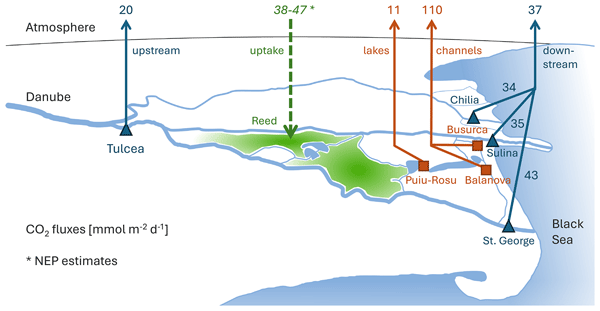
Thank you for this excellent suggestion. The effect of riparian wetlands on CO2 and O2 dynamics has been neglected in many global estimates of riverine CO2 emissions. Our study in the Danube Delta shows that the small fraction (~10%) of the runoff that is diverted through delta contributes a significant fraction of aquatic CO2 emissions in the region. In the discussion part, we will include a new section with a rough estimate for these additional emissions for the Danube Delta and compare the outcome to available studies.
Tables & figures: Please pay attention to the initial “upper-case” letters of the first words, like “P”arameter and “T”ime of day
Yes, we will change the labels in figures and tables to initial upper case.
Citation: https://doi.org/10.5194/egusphere-2025-5756-AC3
Peer review completion


Interactive discussion
Status: closed
-
CC1: 'Comment on egusphere-2025-5756', Jacob Diamond, 08 Dec 2025
This is a very nice dataset and the manuscript is well-written. Being biased to my own work and that of my co-authors, I have two comments to the authors that can improve their interpretation of the data:
1) The more accurate way to get inference on look at O2-CO2 curves is as O2-DIC curves. This is especially true in high alkalinity systems like you have. Temperature and carbonate-equilibria have a large effect on the interpretation of these curves. For more detail you can see:
a) all the analysis Diamond, J. S., Truong, A. N., Abril, G., Bertuzzo, E., Chanudet, V., Lamouroux, R., & Moatar, F. (2025). Inorganic carbon dynamics and their relation to autotrophic community regime shift over three decades in a large, alkaline river. Limnology and Oceanography, 70(5), 1122-1136.
b) a bit hidden, but seen Supplementary Figure S20 in: Diamond, J. S., & Bertuzzo, E. (2025). A coupled O2‐CO2 model for joint estimation of stream metabolism, O‐C stoichiometry, and inorganic carbon fluxes. Journal of Geophysical Research: Biogeosciences, 130(4), e2024JG008401.
2) You claim in the abstract and in the discussion that there is clear evidence of calcite precipitation and autotrophic HCO3 uptake. I do not agree that this is clearly shown in the results. I recommend reading in detail (and the supplementary information) our paper (a) above, which elaborates a means to test for calcite precipitation and HCO3 uptake using data that you already have.
Finally, while it may not be an objective of the paper, it would seem to be a natural extension of this work to estimate metabolism and air-water CO2 flux using your data.
Regards,
Jake DiamondCitation: https://doi.org/10.5194/egusphere-2025-5756-CC1 -
AC1: 'Reply on CC1', Bernhard Wehrli, 02 Mar 2026
We thank for this independent comment which added highly valuable suggestions for the review process. . In the following sections we copied the original comments in bold and added our answers in plain text.
This is a very nice dataset and the manuscript is well-written. Being biased to my own work and that of my co-authors, I have two comments to the authors that can improve their interpretation of the data:
Thank you for the positive remarks and the suggestions for improving the interpretation of the data.
1) The more accurate way to get inference on look at O2-CO2 curves is as O2-DIC curves. This is especially true in high alkalinity systems like you have. Temperature and carbonate-equilibria have a large effect on the interpretation of these curves. For more detail you can see:
a) all the analysis Diamond, J. S., Truong, A. N., Abril, G., Bertuzzo, E., Chanudet, V., Lamouroux, R., & Moatar, F. (2025). Inorganic carbon dynamics and their relation to autotrophic community regime shift over three decades in a large, alkaline river. Limnology and Oceanography, 70(5), 1122-1136.
b) a bit hidden, but seen Supplementary Figure S20 in: Diamond, J. S., & Bertuzzo, E. (2025). A coupled O2‐CO2 model for joint estimation of stream metabolism, O‐C stoichiometry, and inorganic carbon fluxes. Journal of Geophysical Research: Biogeosciences, 130(4), e2024JG008401.Thank you for your perspective DIC versus CO2. In the revised version we will use these references in a brief discussion of the merits and drawbacks of both approaches. As mentioned in our response to Reviewer 1, we agree that the DIC method eliminates effects of buffering, which is important for calculating dissolved inorganic carbon budgets. Plotting DIC comes with two drawbacks:
- The reference level for calculating changes in DIC is arbitrary, whereas exCO2 is anchored in the same way as exO2 at the gas-exchange equilibrium with the atmosphere.
- DIC-O2 plots alone offer no information for the importance of CO2-gas exchange.
Your comments and the reviews showed us that we could improve our paper by discussing regional CO2 emission rates based on the existing O2-CO2 analysis. To make best use of our DIC data we will amend Table 1 with DIC amplitudes in addition to CO2 amplitudes to address buffer effects and we will plot Figure 8 as DIC versus time, because the DIC drops are a direct indicator for calcite precipitation.
2) You claim in the abstract and in the discussion that there is clear evidence of calcite precipitation and autotrophic HCO3 uptake. I do not agree that this is clearly shown in the results. I recommend reading in detail (and the supplementary information) our paper (a) above, which elaborates a means to test for calcite precipitation and HCO3 uptake using data that you already have.
We realize that the discussions of calcite precipitation and autotrophic uptake of bicarbonate need more careful analyses. Thank you for the reference, we will develop the arguments following your paper.
Finally, while it may not be an objective of the paper, it would seem to be a natural extension of this work to estimate metabolism and air-water CO2 flux using your data.Thank you for this suggestion. Following the reviewers comments, we will refocus the revised version and organize the results and discussion along the topics of river metabolism, lateral exchange and estimated average CO2 emissions.
Citation: https://doi.org/10.5194/egusphere-2025-5756-AC1
-
AC1: 'Reply on CC1', Bernhard Wehrli, 02 Mar 2026
-
RC1: 'Comment on egusphere-2025-5756', Anonymous Referee #1, 26 Dec 2025
This manuscript uses high frequency DO data coupled with high frequency CO2 (derived from pH and alkalinity) to evaluate controls on metabolic processes in the Danube Estuary. This work get at two big questions in limnology: metabolic processes at interface zones like estuaries and deltas. It is much harder (for me at least) to conceptually consider metabolism in a delta versus a single-thread river channel and this paper has great potential to address this problem. This paper also examines the difference between metabolism of DO and CO2 and uses these differences to infer processes; I like this approach very much.
The paper has two main areas to improve upon.
1. The paper needs a stronger narrative structure. The end of the introduction does not specify clear goals or questions. The results section displays a lot of data, and the discussion section brings in a lot of new methods and analyses, and most of the figures. Indeed, the discussion seemed like an alternative results section. I suggest this paper needs to follow a much tighter narrative where the intro ends with a set of discrete questions or objectives, the results answers those questions with data, and the discussion interprets, with no new analyses. It will mean a shorter, more focused and more readable paper. Any data that do not address this narrative can safely be put in the SI. I understand the difficulty of interpreting these sorts of data: years of data from multiple sites and multiple data streams enables a lot of insights about an ecosystem. But addressing all of those insights makes for a difficult to read paper.
Specific evidence to this point was that the results section cites only two figures: Fig 3 and Fig 4. The discussion cites Fig 5, 6, 7, 8. All of the results in the paper should show up in the results section, and show only the results needed to answer the specific set of the authors' questions; delete all the rest.
2. A core of the paper examines the relationship between DO and CO2 following the Vachon approach. I like the Vachon approach, but I would not use CO2. Instead I would relate O2 with DIC (at equilibrium). The reason is because buffering causes the slope of the DO:CO2 to increase greatly as the CO2 runs out. This point is evident in figure 2A showing the slope of the cloud steepening at it approaches equilibrium CO2. The solution is simple: use DIC. Because the authors estimated CO2 based on pH and alkalinity, it will be a simple matter to estimate DIC instead (at CO2 equilibrium, so there is still a zero on the plot) and plot that. Shangguan et al. 2025 detail the reasons why to use DIC and not CO2. In short it takes the effect of buffering out of the shape of the CO2-DO cloud so the parameters can be interpreted biologically vs chemically.
Specific comments
63 leaf cover
74. Many sensor datasets are years, not months
84. Make the goals (whether they be questions, hypotheses, objectives) clear in a stand alone paragraph at the end of the intro. That list will then define the parallel structure of the results and discussion. This section as written does not clearly define what the study wanted to know, although line 97 indicated some potential questions.
104 817,000
161. Very nice to have a continuous predictor of alkalinity.
228 µM or µmol L-1?
237 methods in results
250. Here is an example of providing data for which the question was not clear to me. What is the finding and what was the question?
267. Here is a key sentence. Yes, in an ideal case. But instead buffering in part defines the relative change in CO2 and DO in water. By plotting DIC, then this sentence gets closer to being correct.
272. Correlation analysis needs to be in the methods.
275 This slope does not relate well to ecosystem stoichiometry when pCO2 approaches atmospheric equilibrium
281 George
295. Not sure what is meant by "leaving its marks"
303. State that difference here in the topic sentence of the paragraph
Fig 4. Are the slope values stated anywhere?
329. 7 y ago does not seem recent
340. New findings in the discussion. In fact most of this paragraph is describing a new, set of results and should be in the results section (if indeed it is one of the core questions in the paper)
371. Effects of flooding is new results in discussion.
420. Methods in discussion, followed by new results
495. I would cite Aho et al. LO Letters (2021)
537 What is "complementary perspective for a system"?
653. The O2 and CO2 data were very easy to find and look over, thanks to the authors for that. Is there a plan to release the sensor data to enable replicating the results of this study, i.e. temperature, conductivity , pH ?
Citation: https://doi.org/10.5194/egusphere-2025-5756-RC1 -
AC2: 'Reply on RC1', Bernhard Wehrli, 02 Mar 2026
We greatly appreciate the time and effort invested in reviewing our manuscript and we thank all reviewers for their constructive and insightful comments. In the following sections, the reviewers’ comments are reproduced in bold, while our responses are provided in plain text.
This manuscript uses high frequency DO data coupled with high frequency CO2 (derived from pH and alkalinity) to evaluate controls on metabolic processes in the Danube Estuary. This work get at two big questions in limnology: metabolic processes at interface zones like estuaries and deltas. It is much harder (for me at least) to conceptually consider metabolism in a delta versus a single-thread river channel and this paper has great potential to address this problem. This paper also examines the difference between metabolism of DO and CO2 and uses these differences to infer processes; I like this approach very much.
We appreciate the reviewer’s positive assessment that the manuscript addresses important questions of limnology and has strong potential to contribute to the understanding of processes governing river metabolism.The paper has two main areas to improve upon.
1. The paper needs a stronger narrative structure. The end of the introduction does not specify clear goals or questions. The results section displays a lot of data, and the discussion section brings in a lot of new methods and analyses, and most of the figures. Indeed, the discussion seemed like an alternative results section. I suggest this paper needs to follow a much tighter narrative where the intro ends with a set of discrete questions or objectives, the results answers those questions with data, and the discussion interprets, with no new analyses. It will mean a shorter, more focused and more readable paper. Any data that do not address this narrative can safely be put in the SI. I understand the difficulty of interpreting these sorts of data: years of data from multiple sites and multiple data streams enables a lot of insights about an ecosystem. But addressing all of those insights makes for a difficult to read paper.We understand that the reviewer missed clearly defined questions. Although our introduction ends on Line 97 with a short list of research questions (“We addressed the questions …”) it seems that the section was not clear enough to guide the reader through the paper. We will therefore rewrite the last section of the introduction to provide a concise list of research questions which are dove-tailed to the narrative and structure of the paper. Our study focuses on the quantitative comparison lateral inflow and the intensity of river metabolism and its effect of excess CO2 and O2 deficits in different parts of the Delta. We realize that our choice of calculating CO2 instead of DIC was not well motivated. In revising the paper, we will therefore make use of the detailed CO2 data to estimate average emission rates. The research questions will be defined as follows:
- How does the intensity of river metabolism differ between the open waters of the delta and the upstream Danube River?
- How significant is the contribution of lateral inflows to the O2 and CO2 dynamics in the river branches and channels of the delta?
- What are the combined effects of lateral inflows from wetlands and carbon mineralization on CO2 emission rates in the delta region?
We thank the reviewer for the suggestion to shorten and revise the manuscript into a format where only results are presented that relate to the main questions and where discussion will not introduce new analyses. Therefore, the manuscript will be reorganized to document and discuss the main topics of intensity and pathways of river metabolism, of the importance of lateral inflow, and as a new section, the average CO2 emission rates. To keep the focus, we will significantly shorten section 3.2 on covariance analysis and section 4.2. on flooding and flood recession. We are confident that such a revision will improve readability.
Specific evidence to this point was that the results section cites only two figures: Fig 3 and Fig 4. The discussion cites Fig 5, 6, 7, 8. All of the results in the paper should show up in the results section, and show only the results needed to answer the specific set of the authors' questions; delete all the rest.
To follow a more standard format and separate Results from Discussion we will present Tables 1 and 4 and Figures 3, 4, 5, 7 and 8 in the Results section.
Tables 2 and 3 as well as Figure 6 will be omitted, Figure 8 will show calculated DIC instead of conductivity.
2. A core of the paper examines the relationship between DO and CO2 following the Vachon approach. I like the Vachon approach, but I would not use CO2. Instead I would relate O2 with DIC (at equilibrium). The reason is because buffering causes the slope of the DO:CO2 to increase greatly as the CO2 runs out. This point is evident in figure 2A showing the slope of the cloud steepening at it approaches equilibrium CO2. The solution is simple: use DIC. Because the authors estimated CO2 based on pH and alkalinity, it will be a simple matter to estimate DIC instead (at CO2 equilibrium, so there is still a zero on the plot) and plot that. Shangguan et al. 2025 detail the reasons why to use DIC and not CO2. In short it takes the effect of buffering out of the shape of the CO2-DO cloud so the parameters can be interpreted biologically vs chemically.
Thank you for pointing out the merits of using changes in DIC as an alternative to exCO2 (Shangguan et al., 2025). The DIC method eliminates effects of buffering which is important to calculate dissolved inorganic carbon budgets. Plotting DIC comes with two drawbacks:
- The reference level for calculating changes in DIC is arbitrary.
- O2-DIC plots alone offer no information for the importance of CO2-gas exchange. In the revised version, we will address these strengths and weaknesses of a DIC and CO2 based analysis. In revising the manuscript, we will proceed as follows:
- We did the DIC-O2 analyses and based on the results we will briefly share the main difference in the context of the detailed analysis of Shangguan et al. 2025. In the methods section we will explain why the main results will be presented as O2-CO2 plots.
- For a comparison, we will amend Table 1 with DIC amplitudes in addition to exCO2 amplitudes to address buffer effects.
- Following your suggestion, we will plot Figure 8 as DIC versus time, because the DIC drops are a strong indication for calcite precipitation.
With these changes, we will make best use of the strengths of the two methods based on exCO2 and the DIC values.
Specific comments
63 leaf cover
Corrected
74. Many sensor datasets are years, not monthsWhile long-term sensor datasets spanning multiple years do exist, in our experience the reliability of high-frequency aquatic sensor data strongly depends on regular maintenance and recalibration performed at monthly (or even shorter) intervals. Biofouling, sensor drift, membrane aging, and changes in environmental conditions can progressively affect sensor response, leading to biases that may remain undetected without routine servicing and quality control. Therefore, although the temporal coverage of a dataset may extend over years, its accuracy and interpretability depend on frequent maintenance cycles that effectively segment the dataset into shorter periods of verified data quality. This consideration is particularly important in dynamic shallow-water environments such as those investigated in this study.
84. Make the goals (whether they be questions, hypotheses, objectives) clear in a stand alone paragraph at the end of the intro. That list will then define the parallel structure of the results and discussion. This section as written does not clearly define what the study wanted to know, although line 97 indicated some potential questions.We thank the reviewer for the specific request. As described above, we will rewrite the last section of the introduction and provide list of clearer questions that serves as a road map to the results and discussion section.
104 817,000
We will change the style for large numbers and use it consistently.
161. Very nice to have a continuous predictor of alkalinity.Thank you, following reviewer 2 we will also add R^2 values.
228 µM or µmol L-1?
We use the chemical notation, mM, throughout the m.s.
237 methods in results
We will shift the timing details to methods section.
250. Here is an example of providing data for which the question was not clear to me. What is the finding and what was the question?Thank you for this example. In short, the question here is: Are the channels of the delta acting merely as a conduit for Danube River water or are they behaving as reactors for processing biomass from terrestrial biomes? The data show that metabolic intensity is significantly higher in the channels and lakes compared to the main branches of the Danube River.
267. Here is a key sentence. Yes, in an ideal case. But instead buffering in part defines the relative change in CO2 and DO in water. By plotting DIC, then this sentence gets closer to being correct.Thank you for flagging this sentence. We agree that the statement refers to an ideal case, but even a DIC plot is often far from this ideal case. Buffering is not the only factor that changes the idealized 1:1 ratio of O2:CO2. Both DIC and CO2 will be affected by processes such gas exchange, methane oxidation, sulfate reduction, or calcite precipitation. As outlined above, we prefer combining both methods CO2 and DIC in the revised version of the manuscript.
272 Correlation analysis needs to be in the methods.
Agreed. We will transfer this section to methods.
275 This slope does not relate well to ecosystem stoichiometry when pCO2 approaches atmospheric equilibriumAgreed, but only 3 out of the 14 examples shown in Figure 4 cases were close to equilibrium. To provide more reliable ecosystem stoichiometries we will recalculate Figure 7 as exO2 vs DIC and list the slopes in Table D2.
281 GeorgeCorrected
295. Not sure what is meant by "leaving its marks"Explained in line 285 – the “increased offset in high CO2 is a strong indication for lateral inflow” – We will rephrase the sentence as “In the covariance data from June 2016, the inflow of water from the Delta wetlands is characterized in all three downstream stations of the Danube by significant offsets and high exCO2 values (Fig. 4)”.
- State that difference here in the topic sentence of the paragraph
Thank you for the suggestion. We will rephrase the topic sentence like “In contrast to the rather uniform covariance plots at the four Danube stations, the three delta stations show very different behavior between June and November (Figure 4). Here is a summary of the characteristics and potential drivers for these local differences: “
Fig 4. Are the slope values stated anywhere?Yes, they are displayed in the Appendix - Table D1. We will add the reference to this table in the caption of Fig 4.
329. 7 y ago does not seem recentFair enough – we will delete “recent”.
340. New findings in the discussion. In fact most of this paragraph is describing a new, set of results and should be in the results section (if indeed it is one of the core questions in the paper)Agreed, we will move this section and Figure 5 to results.
371. Effects of flooding is new results in discussion.We will delete Table 3 and Figure 7 to keep the narrative focused as the reviewer suggested.
420. Methods in discussion, followed by new resultsWill be integrated as exO2 vs DIC plots into methods and results.
495. I would cite Aho et al. LO Letters (2021)Agreed, we will add this citation.
537 What is "complementary perspective for a system"?In the theory of knowledge complementarity means that one way of looking at a system may not be enough. But our phrasing seems to be too philosophical, so we will just explain why using both approaches is useful. We will delete the sentence, because the last sentence compares the two approaches adequately.
653. The O2 and CO2 data were very easy to find and look over, thanks to the authors for that. Is there a plan to release the sensor data to enable replicating the results of this study, i.e. temperature, conductivity , pH ?
Yes, we will update the data repository to include the relevant sensor data.
Citation: https://doi.org/10.5194/egusphere-2025-5756-AC2
-
AC2: 'Reply on RC1', Bernhard Wehrli, 02 Mar 2026
-
RC2: 'Comment on egusphere-2025-5756', Ji-Hyung Park, 10 Feb 2026
Please note that this review has been provided directly by the Associate Editor to expedite the review process delayed by an overdue reviewer.
General comments
The manuscript presents high-resolution, paired O2-CO2 measurements in river reaches and channels of the Danube Delta spanning three years. Given the scarcity of O2-CO2 measurements in estuaries and deltas of large rivers, these invaluable monitoring data offer rare insight into river metabolism and CO2 dynamics in the large river delta, as highlighted by a two-order-of-magnitude difference in diel CO2 amplitudes. While the findings from this well-designed study are novel and invite further study, the current version shows some weakness in methodology and structuring that must be addressed.
1. Key hypotheses and messages
As another reviewer noted, explicitly articulating the key hypotheses and weaving a consistent narrative throughout the manuscript would significantly strengthen its impact. Please articulate the hypothesis hidden in the Discussion (L 374-376) in the Abstract and Introduction. Furthermore, as detailed in the minor comments below, additional site-specific information (Methods) and expanded discussion are required to explain why certain Danube branches are more sensitive to lateral flows from adjacent wetlands and lakes.
Drawing from my own experience with CO2 measurements in the lower Ganges (Haque et al.), I highly value this rare dataset. The limited existing literature tends to suggest relatively low-amplitude CO2 fluctuations in the lower reaches of large rivers. However, your study demonstrates a pronounced influence from deltaic wetlands. This novel finding merits a clearer articulation of its significance, specifically regarding your underlying hypotheses and the implications for carbon fluxes at regional to global scales.
2. DIC calculation
Both the initial and community reviewers indicated the limitations of CO2 data in high-alkalinity systems. While I recognize that adding new measurements to this already comprehensive manuscript would be challenging, calculating DIC to complement the CO2 data would directly address these concerns.
3. Alkalinity estimation
Given the pivotal role of alkalinity in estimating CO2, the empirical relationship used here has not been adequately justified. Please provide a citation or theoretical basis for this approach (refer also to a recent Biogeosciences paper that employed a similar approach: https://bg.copernicus.org/articles/22/4923/2025/). Please articulate statistical significance in the following:
L 93 “a correlation of conductivity with alkalinity” and Appendix B:
L 161-163: Please provide an R2 value.
Specific comments
- Lines (L) 43-44 “strong contributions of methane oxidation and/or nitrification”: The O2-CO2 plot can only indicate potential sinks of O2. Please reformulate the sentence.
- L 39-40: Don’t you need to mention (and later discuss the limitation of this approach) that the two types of water were monitored separately in two different phases?
- L 46-48: This seems too general as a concluding remark. Please articulate the key implications in relation to the underlying hypotheses mentioned above.
- L 88 “wetland water”: Do you mean “wetland discharge (drainage)”?
- L 90: “commercially available multiprobe sensors (YSI EXO2?)”
- L 104 and throughout the manuscript: Please correct the apostrophe used in numbers (817’000).
- L 122-125: Given the importance of wetlands as a primary source of CO2 in the delta, it would be helpful if you provide more detailed information on the area and basic ecosystem characteristics (like wetland types and dominant vegetation).
- L 124 “lead”: led
- L 178 “data-cleanup”: Do you mean “data processing” or “data filtering”?
- L 223: “supersaturation with respect to atmospheric CO2 equilibrium”
- L 224-225 (Fig. 3): Showing examples from a mainstem site (e.g., Tulcea), together with the displayed delta site, would help readers compare the general patterns of the two monitoring groups.
- L 230-232: Isn’t it noteworthy that fluctuations at Chilia were relatively small compared to those of the other near-shore Danube sites? Later discussion (of limited wetland influences ?) would be help readers figure out the observed inter-branch differences.
- L 272: Just to double check: Pearson’s rho or r?
- L 310: Indicating distance from the adjacent lakes would be helpful.
- L 321: What about differences between the three near-shore sites?
- L 336-339: Please elaborate more as to how these branches drain different source areas in terms of riverine CO2?
- L 365: How is the trophic status of the lake? And are phytoplankton blooms rare or frequent?
- L 451: Was the relationship with water temperature significant for all sites?
- L 480: Specifying methane and DO levels would be helpful.
- L 522: I wondered what implications of the “lateral inflow of O2-depleted and CO2 oversaturated water from adjacent wetlands” you would like to highlight as a key take-home message. For example, any implication in terms of regional- or global-scale carbon fluxes?
- Tables & figures: Please pay attention to the initial “upper-case” letters of the first words, like “P”arameter and “T”ime of day
Citation: https://doi.org/10.5194/egusphere-2025-5756-RC2 -
AC3: 'Reply on RC2', Bernhard Wehrli, 02 Mar 2026
We thank the editor for this constructive review which helped expediting the review process. In the following sections we copied the editor's comments in bold and added our answers in plain text.
General comments
The manuscript presents high-resolution, paired O2-CO2 measurements in river reaches and channels of the Danube Delta spanning three years. Given the scarcity of O2-CO2 measurements in estuaries and deltas of large rivers, these invaluable monitoring data offer rare insight into river metabolism and CO2 dynamics in the large river delta, as highlighted by a two-order-of-magnitude difference in diel CO2 amplitudes. While the findings from this well-designed study are novel and invite further study, the current version shows some weakness in methodology and structuring that must be addressed.
Thank you for the positive remarks regarding value of the data, the study design and the novelty of this research.
- Key hypotheses and messages
As another reviewer noted, explicitly articulating the key hypotheses and weaving a consistent narrative throughout the manuscript would significantly strengthen its impact. Please articulate the hypothesis hidden in the Discussion (L 374-376) in the Abstract and Introduction. Furthermore, as detailed in the minor comments below, additional site-specific information (Methods) and expanded discussion are required to explain why certain Danube branches are more sensitive to lateral flows from adjacent wetlands and lakes.
Drawing from my own experience with CO2 measurements in the lower Ganges (Haque et al.), I highly value this rare dataset. The limited existing literature tends to suggest relatively low-amplitude CO2 fluctuations in the lower reaches of large rivers. However, your study demonstrates a pronounced influence from deltaic wetlands. This novel finding merits a clearer articulation of its significance, specifically regarding your underlying hypotheses and the implications for carbon fluxes at regional to global scales.
Thank you for the constructive remarks and suggestions on how to improve abstract and introduction by inserting the key hypotheses and research questions of the study. We realize that we did not adequately justify the choice of CO2 over DIC in our analysis and we missed the opportunity to estimate average CO2 emission rates and their regional differences. In response to both reviews, we will therefore outline the following main hypotheses
- The intensity of river metabolism will increase significantly when river water enters the slow flow paths along the network of channels and lakes in the delta.
- Lateral discharge of wetland water into the river reaches and delta channels will significantly increase the excess in CO2 and deficits in O2 concentrations compared to atmospheric equilibrium.
- The combined effects of more intense mineralization rates and lateral inflow from the vegetated wetlands will increase the average CO2 emission rates of delta channels and downstream stations of the Danube.
Following the suggestions of Reviewer 1 we will also rewrite the last section of the introduction to outline the main research questions that serve as a road map for the results and discussion sections:
- How does the intensity of river metabolism differ between the open waters of the delta and the upstream Danube River?
- How significant is the contribution of lateral inflows to the O2 and CO2 dynamics in the river branches and channels of the delta?
- What are the combined effects of lateral inflows from wetlands and carbon mineralization on CO2 emission rates in the delta region?
We will add more site-specific information to the methods part to facilitate the discussion of the contrasting results at the different monitoring stations. As mentioned in our reply to Reviewer 1, we will focus the manuscript more clearly on 1) the intensity and pathways of river metabolism, 2) on the effects of lateral inflows and 3) on regional differences of average CO2 emission rates. The last section will allow us to address the implications of intense deltaic processes for regional and global carbon fluxes.
- DIC calculation
Both the initial and community reviewers indicated the limitations of CO2 data in high-alkalinity systems. While I recognize that adding new measurements to this already comprehensive manuscript would be challenging, calculating DIC to complement the CO2 data would directly address these concerns.
As outlined in our response to Reviewer 1, we will add DIC amplitudes to Table 1 and and replot Figure 8 as a time series of DIC-values instead as showing raw conductivities. By omitting Tables 2 and 3 and Figure 6 and significantly shortening sections 3.2 (covariance) and 4.2 ( flooding and flood recession), we can address the merits and limitations of plotting CO2 or DIC versus O2 without expanding the size of the manuscript.
- Alkalinity estimation
Given the pivotal role of alkalinity in estimating CO2, the empirical relationship used here has not been adequately justified. Please provide a citation or theoretical basis for this approach (refer also to a recent Biogeosciences paper that employed a similar approach: https://bg.copernicus.org/articles/22/4923/2025/). Please articulate statistical significance in the following:
L 93 “a correlation of conductivity with alkalinity” and Appendix B:
L 161-163: Please provide an R2 value.
We agree and we will add more methodological background, statistical significance, and R^2 values. Thank you for pointing to the Nguyen et al. (2025) paper, which we will cite together with others like Raymond et al. Nature (2013), DOI: 10.1038/nature12760 , who used the same method.
Specific comments:
Lines (L) 43-44 “strong contributions of methane oxidation and/or nitrification”: The O2-CO2 plot can only indicate potential sinks of O2. Please reformulate the sentence.
Agreed, we will modify the sentence “changes pointed to strong additional oxygen sinks like oxidation of dissolved methane”.
L 39-40: Don’t you need to mention (and later discuss the limitation of this approach) that the two types of water were monitored separately in two different phases?
Agreed. We will specify the deployment times on line 35 “deployment of sensor packages in river reaches during to subsequent years and a later deployment within the delta during a third year” and we will be careful to mention the different time spans in comparisons between river reaches and delta.
L 46-48: This seems too general as a concluding remark. Please articulate the key implications in relation to the underlying hypotheses mentioned above.
Agreed, we will rewrite the concluding remark to address the main hypotheses that highly productive delta wetlands add CO2 -rich water and fuel intense aquatic respiration leading to higher CO2 emission rates.
L 88 “wetland water”: Do you mean “wetland discharge (drainage)”?
Yes, “wetland discharge to the canal system” is an adequate description.
L 90: “commercially available multiprobe sensors (YSI EXO2?)”
Thank you for the suggestion, which explains the abbreviation.
L 104 and throughout the manuscript: Please correct the apostrophe used in numbers (817’000).
Apologies for the wrong style, we will check and correct the number format.
L 122-125: Given the importance of wetlands as a primary source of CO2 in the delta, it would be helpful if you provide more detailed information on the area and basic ecosystem characteristics (like wetland types and dominant vegetation).
Agreed, we will add a short description of wetland types and the distribution of vegetation based on the cited report by Oosterberg et al. 2000 and more recent assessments like Török et al (2017) DOI: 10.2175/106143016x14733681696248
L 124 “lead”: led
Corrected.
L 178 “data-cleanup”: Do you mean “data processing” or “data filtering”?
We believe that “data filtering” is a more precise term for removing conductivity spikes.”
L 223: “supersaturation with respect to atmospheric CO2 equilibrium”
Agreed, your suggested phrasing is more precise. Corrected.
L 224-225 (Fig. 3): Showing examples from a mainstem site (e.g., Tulcea), together with the displayed delta site, would help readers compare the general patterns of the two monitoring groups.
We like this idea and we will add Tulcea data to produce a figure with four panels.
L 230-232: Isn’t it noteworthy that fluctuations at Chilia were relatively small compared to those of the other near-shore Danube sites? Later discussion (of limited wetland influences ?) would be help readers figure out the observed inter-branch differences.
Chilia is not an extreme case: There is a clear pattern in terms of fluctuations St. George > Chilia > Sulina. We will address probable drivers for this pattern in the revised discussion section on lateral inflows.
L 272: Just to double check: Pearson’s rho or r?
We calculated rho = covariance(u,v,)/s(u).s(v) where s stands for the standard deviation.
L 310: Indicating distance from the adjacent lakes would be helpful.
Unfortunately, for this complex aquatic system, proximity is not a direct indicator for hydrological connectivity in the Danube Delta, but we agree that the role of the hydrological regime needs to be better explained. Puiu-Rosu station was directly measuring lake outflow, while the Balanova station received a mixed discharge from the lake and the reed complex close by. Busurca, on the other hand, is almost free of lake influence, which can be quantified by the distance to the next lake complex. We will document sources and distance of different water types more transparently and add a section to the discussion where we compare the sites as two end members of lake water (Puiu-Rosu) and wetland-drainage (Busurca) plus a mixed regime (Balanova).
L 321: What about differences between the three near-shore sites?
Good point, see comment L230-232: There is a clear pattern in terms of fluctuations St. George > Chilia > Sulina. We will address probable drivers for this pattern in the revised discussion section on lateral inflows to the main river branches.
L 336-339: Please elaborate more as to how these branches drain different source areas in terms of riverine CO2?
We agree that this context is missing, and we will add the information accordingly. Briefly, the Chilia branch receives additional water from a Ukrainian sub catchment to the North with shallow lakes which has a similar size as the delta area between Chilia and St. George. We expect that this drainage will add a shallow lake-water signature, but there is no available data. The St. George branch is different, because the sub catchment to the South drains towards the Razim-Sinoe lagoon complex, so that most of the additional water comes from the nearby wetlands of the delta.
L 365: How is the trophic status of the lake? And are phytoplankton blooms rare or frequent?
The lakes are eutrophic and show frequent phytoplankton blooms. Cyanobacteria play a significant role. We will add relevant references to the site description in the methods section and slightly expand our discussion in the context of these limnological studies:
Florescu et al. (2022) The plankton assemblages as potential bioindicators in the environmental conditions of Danube Delta, Biologia 77, 105-114, DOI: 10.1007/s11756-021-00899-3.
Moza et al. (2021): Geographical and temporal patterns of cyanobacterial assemblages in the Danube Delta lake complexes. Hydrobiologia 848, 753-771, DOI: 10.1007/s10750-020-04466-w.
L 451: Was the relationship with water temperature significant for all sites?
Yes, and we will add significance levels to the revised version of Table 4.
L 480: Specifying methane and DO levels would be helpful.
Agreed, we will add the observed CH4 and O2 concentrations from our previous study, Maier et al. (2022).
L 522: I wondered what implications of the “lateral inflow of O2-depleted and CO2 oversaturated water from adjacent wetlands” you would like to highlight as a key take-home message. For example, any implication in terms of regional- or global-scale carbon fluxes?
Thank you for this excellent suggestion. The effect of riparian wetlands on CO2 and O2 dynamics has been neglected in many global estimates of riverine CO2 emissions. Our study in the Danube Delta shows that the small fraction (~10%) of the runoff that is diverted through delta contributes a significant fraction of aquatic CO2 emissions in the region. In the discussion part, we will include a new section with a rough estimate for these additional emissions for the Danube Delta and compare the outcome to available studies.
Tables & figures: Please pay attention to the initial “upper-case” letters of the first words, like “P”arameter and “T”ime of day
Yes, we will change the labels in figures and tables to initial upper case.
Citation: https://doi.org/10.5194/egusphere-2025-5756-AC3
Peer review completion
Journal article(s) based on this preprint
Data sets
CO2-O2 time series Danube Delta 2016-2018 Bernhard Wehrli, Cristian R. Teodoru, and Marie-Sophie Maier https://doi.org/10.3929/ethz-c-000786936
Model code and software
CO2-O2-stat Bernhard Wehrli https://github.com/bernhardwehrli/CO2-O2-stat
Viewed
| HTML | XML | Total | BibTeX | EndNote | |
|---|---|---|---|---|---|
| 1,868 | 583 | 216 | 2,667 | 86 | 95 |
- HTML: 1,868
- PDF: 583
- XML: 216
- Total: 2,667
- BibTeX: 86
- EndNote: 95
Viewed (geographical distribution)
| Country | # | Views | % |
|---|
| Total: | 0 |
| HTML: | 0 |
| PDF: | 0 |
| XML: | 0 |
- 1
Marie-Sophie Maier
Bernhard Wehrli

Cristian R. Teodoru
The requested preprint has a corresponding peer-reviewed final revised paper. You are encouraged to refer to the final revised version.
- Preprint
(3768 KB) - Metadata XML
This is a very nice dataset and the manuscript is well-written. Being biased to my own work and that of my co-authors, I have two comments to the authors that can improve their interpretation of the data:
1) The more accurate way to get inference on look at O2-CO2 curves is as O2-DIC curves. This is especially true in high alkalinity systems like you have. Temperature and carbonate-equilibria have a large effect on the interpretation of these curves. For more detail you can see:
a) all the analysis Diamond, J. S., Truong, A. N., Abril, G., Bertuzzo, E., Chanudet, V., Lamouroux, R., & Moatar, F. (2025). Inorganic carbon dynamics and their relation to autotrophic community regime shift over three decades in a large, alkaline river. Limnology and Oceanography, 70(5), 1122-1136.
b) a bit hidden, but seen Supplementary Figure S20 in: Diamond, J. S., & Bertuzzo, E. (2025). A coupled O2‐CO2 model for joint estimation of stream metabolism, O‐C stoichiometry, and inorganic carbon fluxes. Journal of Geophysical Research: Biogeosciences, 130(4), e2024JG008401.
2) You claim in the abstract and in the discussion that there is clear evidence of calcite precipitation and autotrophic HCO3 uptake. I do not agree that this is clearly shown in the results. I recommend reading in detail (and the supplementary information) our paper (a) above, which elaborates a means to test for calcite precipitation and HCO3 uptake using data that you already have.
Finally, while it may not be an objective of the paper, it would seem to be a natural extension of this work to estimate metabolism and air-water CO2 flux using your data.
Regards,
Jake Diamond