
the Creative Commons Attribution 4.0 License.
the Creative Commons Attribution 4.0 License.
 | 03 Nov 2025
Exploring the Potential of LPJmL-5 to Simulate Vegetation Responses to (Multi-Year) Droughts
Abstract. Climate change is expected to increase the frequency and severity of Multi-Year Droughts (MYDs), but their impacts on vegetation remain poorly understood. While satellite records offer valuable insights, they cover only recent decades, limiting the number of MYDs available for analysis. Dynamic global vegetation models (DGVMs), such as LPJmL-5, can help overcome this limitation by simulating vegetation dynamics over longer timescales. However, their ability to capture drought impacts has not yet been systematically evaluated. In this study, we benchmark LPJmL-5 against MODIS-derived gross primary production (GPP) to assess how well it captures vegetation responses to drought. We find that LPJmL-5 reproduces GPP reasonably well in some regions, but improvements can still be made in the Southern Hemisphere and for croplands. During MYDs, LPJmL-5 captures the key temporal and spatial GPP drought dynamics observed in MODIS. However, the model tends to overestimate vegetation response at the onset of MYDs and shows some rapid recovery behaviour, resulting in muted overall drought impacts. Vegetation responses also vary by type: croplands show relatively good agreement, while boreal and temperate vegetation underestimate positive and negative impacts, respectively. These discrepancies appear to be linked to simplified model representations of vegetation stress and mortality, which limit long-term vegetation loss. Our results highlight the need to improve how LPJmL-5 simulates vegetation stress and recovery, especially under prolonged drought conditions, in order to better capture ecosystem vulnerability in a changing climate.
-
Notice on discussion status
The requested preprint has a corresponding peer-reviewed final revised paper. You are encouraged to refer to the final revised version.
-
Preprint
(7825 KB)
-
Supplement
(4819 KB)
-
The requested preprint has a corresponding peer-reviewed final revised paper. You are encouraged to refer to the final revised version.
- Preprint
(7825 KB) - Metadata XML
-
Supplement
(4819 KB) - BibTeX
- EndNote
- Final revised paper


Journal article(s) based on this preprint
Interactive discussion
Status: closed
-
RC1: 'Comment on egusphere-2025-4966', Anonymous Referee #1, 02 Dec 2025
-
AC1: 'Reply on RC1', Denise Ruijsch, 15 Dec 2025
We thank the reviewer for the detailed comments regarding the use of SPEI and MODIS GPP.
1. SPEI is a widely used to characterize drought conditions particularly because it is standardized and as such always relates to the local climatic context (see Slette et al. 2019). However, this also poses some issues as outlined in Zang et al., (2020). The main argument of Zang et al., is that negative SPEI (e.g. -1 to -2; often characterized as moderate drought) does not necessarily always coincide with "actual" water shortage as determined by the amount of evapotranspiration subtracted from the precipitation. This seems to be the case especially in wet regions of the world such as the tropics or the boreal forest. The consequence is that SPEI may indicate drought conditions when in reality ample water is available (as determined for example by the Maximum Climatic Water Deficit commonly used in tropical regions).
We thank the reviewer for highlighting this important point regarding SPEI and its interpretation in wet regions. In our study, we use the term “drought” to refer to periods of below-average water availability relative to the local climate. This reflects a relative deviation from normal conditions. To address the reviewer’s point, we will examine whether soil moisture is low during the multi-year drought periods identified in this study. This will help confirm whether the droughts indicated by SPEI correspond to actual stress experienced by the ecosystem.
2. The second issue is the use of MODIS GPP as a stand-in for "observed GPP". Satellite-derived GPP is as much a model as it is based on satellite observations. In the case of MODIS GPP, GPP is calculated by an algorithm using remotely sensed FPAR, a land cover classification, a parameter for the conversion efficiency of PAR, and some climate inputs (Tmean, VPD). Consequently, it is not really accurate to consider satellite-derived GPP from MODIS as "observed". This obviously does not invalidate the comparison with simulated GPP from LPJmL-5, however, it does warrant some further discussion and potentially the use of an alternative product (e.g. SIF) to strengthen the message of this study.
For the use of MODIS GPP, we agree that it is a model-derived product based on satellite observations and not a direct observation of GPP. We will clarify this in the manuscript and expand the discussion on the limitations of satellite-derived GPP.
Regarding land cover, LPJmL-5 was run with prescribed land cover, including crop distributions, which ensures that the land-cover types used by LPJmL-5 match those of MODIS. Further details on the differences between prescribed and dynamic land cover in LPJmL-5 are provided in Supplement Section S4.
Finally, we have already explored the consistency across MODIS vegetation indices in our comparison of GPP and EVI in Supplement Section S2. Also, Ruijsch et al. (2025) analysed the correlation between GPP, EVI, and LAI during multi-year droughts. Both analyses show broadly similar patterns across the different vegetation indices. To further strengthen the study, we will extend this comparison by including SIF.
Citation: https://doi.org/10.5194/egusphere-2025-4966-AC1
-
AC1: 'Reply on RC1', Denise Ruijsch, 15 Dec 2025
-
RC2: 'Comment on egusphere-2025-4966', Anonymous Referee #2, 15 Dec 2025
This study presents a comprehensive set of analyses; however, its scientific motivation and added value remain unclear. The work mainly consists of descriptive comparisons between LPJmL-5–simulated GPP and MODIS-derived GPP in terms of mean states, variability, drought anomalies, and responses to SPEI across multiple timescales. Such comparisons, by themselves, do not address a clearly defined scientific question, nor do they provide new insight into vegetation responses to drought beyond documenting discrepancies between two fundamentally different GPP products.
Importantly, MODIS GPP is itself a model-based, remotely sensed product rather than a direct observation. As a result, differences between LPJmL-5 and MODIS GPP cannot be straightforwardly interpreted as model deficiencies or ecological mechanisms. As currently presented, the results primarily show that the two products differ substantially, but it remains unclear how these differences advance understanding of ecosystem drought responses or meaningfully address the stated limitation of short satellite records.
Although the authors argue that DGVMs can overcome the temporal limitations of satellite observations, the study does not demonstrate that LPJmL-5 provides additional or improved insight into vegetation responses to long-term or multi-year droughts. No independent evaluation at longer timescales is provided, nor is it shown that the model improves the representation of drought processes or stress regulation. Consequently, the claimed advantage of using LPJmL-5 to assess long-term ecosystem vulnerability is not sufficiently supported.
Overall, the study lacks a clear hypothesis, mechanistic advancement, or demonstrated improvement in modeling drought impacts. Without evidence that LPJmL-5 adds robust, independent information beyond existing GPP products, the analysis remains largely diagnostic and does not justify the broader conclusions drawn.
Some specific comments
1- I question whether the comparison between LPJmL-5 GPP and MODIS GPP is meaningful in the first place, given that the two products differ substantially in spatial resolution, temporal aggregation, and conceptual formulation. LPJmL-5 operates at a coarse grid scale and simulates GPP through process-based parameterizations, whereas MODIS GPP is a remote sensing–based product with its own empirical assumptions and limitations. Under these circumstances, differences between the two cannot be unambiguously attributed to vegetation response characteristics.
Moreover, the choice of MODIS GPP as the sole benchmark appears arbitrary. Using an alternative satellite-based product with different resolution and algorithms (e.g., VPM GPP at 500 m and 8-day resolution) would likely lead to different comparison outcomes. This raises a fundamental question that the study does not address: what exactly do these inter-product differences represent, and on what basis can one conclude that one product provides a more correct or ecologically meaningful representation of drought response than another?
2-Although the use of SPEI-12 is common in studies of multi-year droughts (MYDs), its role as an optimal or sufficient drought indicator has not been systematically validated. Importantly, different ecosystems exhibit markedly different sensitivities to drought at various temporal scales. For instance, croplands and grassland ecosystems typically respond more strongly to short-term moisture anomalies (e.g., SPEI-1 to SPEI-6), whereas the strong smoothing inherent in SPEI-12 may obscure critical short-duration drought signals, potentially leading to biased interpretations of ecological responses. In addition, longer aggregation periods can delay the detection of drought onset and termination, which may affect the characterization of drought event dynamics.
Another concern is a drought event identified from an index such as SPEI only captures the potential drought stress on vegetation relative to the long-term normal period and may not necessarily reflect the actual water deficit of an event.
3- The comparison presented in Figures 4 and 5 does not provide a valid basis for any inference about ecosystem drought resistance. The observed differences between LPJmL-5 and MODIS GPP primarily reflect systematic discrepancies in GPP construction, temporal sensitivity, and model structure, rather than differences in vegetation response or regulation in an ecological sense. In particular, LPJmL-5 does not include any explicit parameterization or calibration targeting ecosystem resistance, buffering capacity, or drought regulation, making it conceptually unjustified to interpret shorter response timescales as reduced drought resistance.
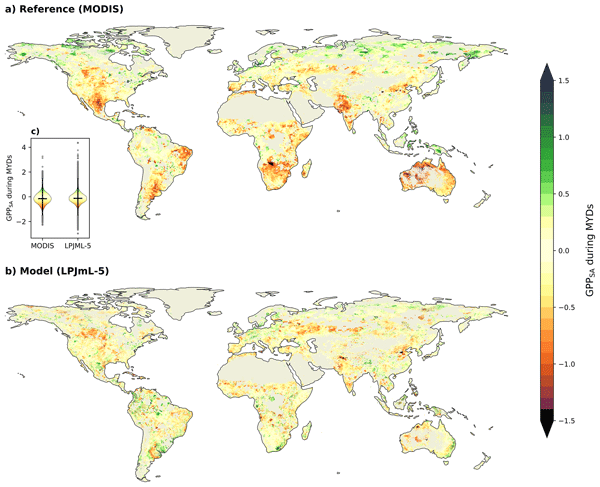
Figure 4 explicitly demonstrates that the model produces sharper and more immediate GPP declines during dry periods, which is a direct consequence of the model’s tight coupling between soil moisture and photosynthesis. This behavior reflects model design choices rather than ecosystem properties, and therefore cannot be interpreted as evidence of altered resistance or response dynamics. Without explicitly separating response speed, response magnitude or demonstrating that these metrics are meaningfully constrained by observations, the presented analysis does not support any ecological conclusions regarding drought resistance. As currently formulated, this comparison is fundamentally methodological and cannot substantiate claims about ecosystem response mechanisms.Citation: https://doi.org/10.5194/egusphere-2025-4966-RC2 -
AC2: 'Reply on RC2', Denise Ruijsch, 08 Jan 2026
This study presents a comprehensive set of analyses; however, its scientific motivation and added value remain unclear. The work mainly consists of descriptive comparisons between LPJmL-5–simulated GPP and MODIS-derived GPP in terms of mean states, variability, drought anomalies, and responses to SPEI across multiple timescales. Such comparisons, by themselves, do not address a clearly defined scientific question, nor do they provide new insight into vegetation responses to drought beyond documenting discrepancies between two fundamentally different GPP products.
Importantly, MODIS GPP is itself a model-based, remotely sensed product rather than a direct observation. As a result, differences between LPJmL-5 and MODIS GPP cannot be straightforwardly interpreted as model deficiencies or ecological mechanisms. As currently presented, the results primarily show that the two products differ substantially, but it remains unclear how these differences advance understanding of ecosystem drought responses or meaningfully address the stated limitation of short satellite records.
Although the authors argue that DGVMs can overcome the temporal limitations of satellite observations, the study does not demonstrate that LPJmL-5 provides additional or improved insight into vegetation responses to long-term or multi-year droughts. No independent evaluation at longer timescales is provided, nor is it shown that the model improves the representation of drought processes or stress regulation. Consequently, the claimed advantage of using LPJmL-5 to assess long-term ecosystem vulnerability is not sufficiently supported.
Overall, the study lacks a clear hypothesis, mechanistic advancement, or demonstrated improvement in modeling drought impacts. Without evidence that LPJmL-5 adds robust, independent information beyond existing GPP products, the analysis remains largely diagnostic and does not justify the broader conclusions drawn.We thank the reviewer for review and raising these important concerns. We acknowledge that we did not clarify the scientific motivation and intended contribution of this study enough. The primary aim of this work is not to derive new ecological mechanisms of drought response, but to evaluate whether a widely used DGVM (LPJmL-5) can reproduce satellite based drought response patterns well enough to support its application in multi-year drought studies beyond the satellite era. We have revised the introduction to include this motivation better:
“However, before DGVMs can be used to study MYD impacts over longer historical periods or for future scenarios, it is essential to evaluate whether their simulated vegetation responses are consistent with observation-constrained signals. In this study, we focus on assessing the ability of LPJmL-5 to reproduce satellite-derived drought response patterns for both MYDs and normal droughts (NDs; droughts lasting less than a year). The goal is to determine whether LPJmL-5 can serve as a reliable tool for studying vegetation responses to multi-year droughts beyond the period covered by satellite observations.”
Below we respond to the specific comments in detail.
1- I question whether the comparison between LPJmL-5 GPP and MODIS GPP is meaningful in the first place, given that the two products differ substantially in spatial resolution, temporal aggregation, and conceptual formulation. LPJmL-5 operates at a coarse grid scale and simulates GPP through process-based parameterizations, whereas MODIS GPP is a remote sensing–based product with its own empirical assumptions and limitations. Under these circumstances, differences between the two cannot be unambiguously attributed to vegetation response characteristics. Moreover, the choice of MODIS GPP as the sole benchmark appears arbitrary. Using an alternative satellite-based product with different resolution and algorithms (e.g., VPM GPP at 500 m and 8-day resolution) would likely lead to different comparison outcomes. This raises a fundamental question that the study does not address: what exactly do these inter-product differences represent, and on what basis can one conclude that one product provides a more correct or ecologically meaningful representation of drought response than another?
We thank the reviewer for raising this concern. We agree that LPJmL-5 and MODIS GPP differ in spatial resolution, temporal aggregation, and conceptual formulation, and that these differences reflect how the products are constructed rather than ecosystem processes.
The aim of this study is not to identify a “correct” product or interpret differences as ecosystem properties, but to investigate model behavior relative to a satellite reference. GPP was selected as a common variable for comparison with DGVM output, and the MODIS product was used because it provides satellite-derived, global coverage. However, we agree that MODIS GPP is a model-derived product based on satellite observations and is not a direct observation of GPP.
To address this concern, we evaluated its consistency with other satellite products (EVI and LAI), finding strong correlations and similar spatial multi-year drought anomaly patterns (also see previous study where this comparison was done: Supplement S2 and Ruijsch et al., 2025 (https://doi.org/10.1029/2025JG008992)). This supports the use of MODIS GPP as a benchmark, while we will of course still acknowledging its limitations.
We will clarify this rationale in the manuscript and expand the discussion of the limitations of satellite-derived GPP. In addition, we will include a new Methods subsection describing the choice for selecting MODIS GPP, its underlying calculation, and how it is used to evaluate LPJmL-5 simulated GPP. The following text has been added to the Methods section:
“In this study, we evaluated LPJmL5 against the GPP. Although MODIS GPP is widely used, it is not purely observational, but derived using the MOD17 light-use efficiency algorithm and relies on inputs such as MODIS FPAR, meteorological drivers, and land-cover classification (Running and Zhao, 2021). Therefore, before using it as a validation dataset, we assessed how well MODIS GPP represents vegetation productivity (Supplements S3).”
To further strengthen the analysis, we will extend the comparison by incorporating solar-induced fluorescence (SIF) as an additional satellite-based product, as suggested by Reviewer 1. The following text has been added to the Methods section:
“We compared MODIS GPP with two satellite products that are more directly observation-based: the Enhanced Vegetation Index (EVI) and solar-induced fluorescence (SIF). Both comparisons showed strong and statistically significant relationships, particularly outside tropical regions, indicating that MODIS GPP captures large-scale variability in vegetation productivity. Other validation studies report similar limitations, with reduced performance mainly in tropical ecosystems. A full description of these analyses is provided in Supplements S3. Together, these results support the use of MODIS GPP as a validation product for LPJmL5, while acknowledging that uncertainties are larger in tropical regions. “
2-Although the use of SPEI-12 is common in studies of multi-year droughts (MYDs), its role as an optimal or sufficient drought indicator has not been systematically validated. Importantly, different ecosystems exhibit markedly different sensitivities to drought at various temporal scales. For instance, croplands and grassland ecosystems typically respond more strongly to short-term moisture anomalies (e.g., SPEI-1 to SPEI-6), whereas the strong smoothing inherent in SPEI-12 may obscure critical short-duration drought signals, potentially leading to biased interpretations of ecological responses. In addition, longer aggregation periods can delay the detection of drought onset and termination, which may affect the characterization of drought event dynamics. Another concern is a drought event identified from an index such as SPEI only captures the potential drought stress on vegetation relative to the long-term normal period and may not necessarily reflect the actual water deficit of an event.
We thank the reviewer for highlighting this point. We agree that SPEI-12 smooths over short-term droughts and may not capture ecosystem responses that occur at shorter timescales. To address this, we have already evaluated vegetation responses across SPEI timescales from 1 to 24 months using the extreme-based method (Section 2.4, L124-136). This allows us to assess both short-term and long-term vegetation responses and ensures that faster-responding ecosystems are not overlooked.
SPEI-12 was chosen for the multi-year drought (MYD) defintion because it captures long-term moisture deficits, removes seasonal effects, and ensures that brief wet periods do not split up longer drought events. The rationale for selecting SPEI-12 over shorter SPEI timescales is further discussed in Ruijsch et al. (2025) (https://doi.org/10.1029/2025JG008992). To strengthen this choice, we will also evaluate whether drought events identified by SPEI-12 correspond to low soil moisture in the model, which would confirm that the vegetation indeed experiences water stress.
3- The comparison presented in Figures 4 and 5 does not provide a valid basis for any inference about ecosystem drought resistance. The observed differences between LPJmL-5 and MODIS GPP primarily reflect systematic discrepancies in GPP construction, temporal sensitivity, and model structure, rather than differences in vegetation response or regulation in an ecological sense. In particular, LPJmL-5 does not include any explicit parameterization or calibration targeting ecosystem resistance, buffering capacity, or drought regulation, making it conceptually unjustified to interpret shorter response timescales as reduced drought resistance. Figure 4 explicitly demonstrates that the model produces sharper and more immediate GPP declines during dry periods, which is a direct consequence of the model’s tight coupling between soil moisture and photosynthesis. This behavior reflects model design choices rather than ecosystem properties, and therefore cannot be interpreted as evidence of altered resistance or response dynamics. Without explicitly separating response speed, response magnitude or demonstrating that these metrics are meaningfully constrained by observations, the presented analysis does not support any ecological conclusions regarding drought resistance. As currently formulated, this comparison is fundamentally methodological and cannot substantiate claims about ecosystem response mechanisms.
We thank the reviewer for this clarification. We agree that LPJmL-5 does not explicitly parameterize ecosystem drought resistance, buffering capacity, or stress regulation, and that shorter response timescales cannot be interpreted as evidence of altered ecosystem resistance.
Our intent in Figures 4 and 5 was to compare model behavior to MODIS, not to infer ecosystem traits. In the revised manuscript, we will remove or rephrase language such as “underestimate drought resistance” and instead describe these patterns as model limitations in reproducing MODIS drought responses.
To address the reviewer’s concerns, we will revise the manuscript as follows:
- Introduction: We will clarify this study’s goal and motivation, explicitly stating that the focus is on assessing model performance relative to satellite-derived GPP.
- Methods:
- MODIS GPP: We will add a new subsection explaining why MODIS GPP was chosen, how it is calculated, and how it serves as a benchmark for LPJmL-5. We will also add a comparison to other observational products (EVI and LAI) and acknowledge its limitations.
- LPJmL-5 drought mechanisms: We will include a section about processes in LPJmL-5 that govern drought responses, such as water stress functions, phenology, and mortality, to clarify what drives model behavior during dry periods.
- Results:
- We will describe differences between LPJmL-5 and satellite-derived GPP without drawing ecological conclusions.
- Discussion:
- We will include a paragraph noting that MODIS GPP itself is a model-based product, and that differences between MODIS and LPJmL-5 reflect differences in assumptions and methodology.
- We will discuss how missing or simplified processes in LPJmL-5 may contribute to the observed differences.
Citation: https://doi.org/10.5194/egusphere-2025-4966-AC2
-
AC2: 'Reply on RC2', Denise Ruijsch, 08 Jan 2026
Peer review completion


Interactive discussion
Status: closed
-
RC1: 'Comment on egusphere-2025-4966', Anonymous Referee #1, 02 Dec 2025
Ruijsch et al., present an in-depth evaluation of the ability of LPJmL-5 to simulate the impact of multi-year droughts on vegetation across the globe. Such an evaluation is much needed as the incidence of prolonged droughts is on the rise globally. The ability of DVMs to accurately simulate vegetation responses to drought is extremely important and global evaluation of this ability is largely lacking. The authors communicate their results well both through the text and the figures. In particular I would like to highlight Figure 4 as a I find the overlay of SPEI and GPP very informative.
That being said, I do unfortunately believe that this work requires some major improvements related to 1.) the identification of droughts using SPEI and 2.) the use of satellite-derived MODIS GPP.
1. SPEI is a widely used to characterize drought conditions particularly because it is standardized and as such always relates to the local climatic context (see Slette et al. 2019). However, this also poses some issues as outlined in Zang et al., (2020). The main argument of Zang et al., is that negative SPEI (e.g. -1 to -2; often characterized as moderate drought) does not necessarily always coincide with "actual" water shortage as determined by the amount of evapotranspiration subtracted from the precipitation. This seems to be the case especially in wet regions of the world such as the tropics or the boreal forest. The consequence is that SPEI may indicate drought conditions when in reality ample water is available (as determined for example by the Maximum Climatic Water Deficit commonly used in tropical regions).
To alleviate this issue which could potentially result in overestimation of droughts, I would suggest to use a second (potentially non-standardized) drought indicator to ensure that droughts are being accurately captured.
Please see Zang et al., (2020) for more detail: https://doi.org/10.1111/gcb.14809
2. The second issue is the use of MODIS GPP as a stand-in for "observed GPP". Satellite-derived GPP is as much a model as it is based on satellite observations. In the case of MODIS GPP, GPP is calculated by an algorithm using remotely sensed FPAR, a land cover classification, a parameter for the conversion efficiency of PAR, and some climate inputs (Tmean, VPD). Consequently, it is not really accurate to consider satellite-derived GPP from MODIS as "observed". This obviously does not invalidate the comparison with simulated GPP from LPJmL-5, however, it does warrant some further discussion and potentially the use of an alternative product (e.g. SIF) to strengthen the message of this study.
Some concrete issues that need to be addressed in regards to the use of MODIS GPP are:
1. How does the landcover type used by MODIS GPP differ from the landcover type used by LPJmL-5 on a gridcell basis? Could discrepancies between the two landcover products be the cause of some of the mismatch seen between modeled and satellite-derived GPP (e.g. the relatively poor performance of crops)?
2. Both LPJmL and MODIS GPP rely on climate inputs. To what degree does this pose an issue if both products model GPP, at least partially, on the same or similar inputs? Related to this, how would a mismatch between the climate inputs for LPJmL and MODIS affect results? For example, the climate data used for LPJmL indicates a drought in a given gridcell in a given time-period but the MODIS climate input does not? Will this skew results?
3. Yang et al., (2022) highlighted a divergence between DVM simulated GPP and satellite-derived GPP, especially in tropical regions of the southern hemisphere. They identified the uncertainty in tropical LAI data to be a major contributing factor. In particular, they highlighted that: "NOAA satellite orbit changes and MODIS sensor degradation might cause long-term satellite-derived LAI products inconsistent with each other. Xie et al. (2019) also suggested that satellite-derived LAI datasets can cause uncertainties in GPP estimations through model structure and the complexity of the terrain".
As stated before, I do not think this entirely invalidates the results of this study. Rather, I believe this study would be greatly strengthened by 1.) including a secondary remote sensing GPP proxy such as e.g. SIF and 2.) a thorough discussion of the limitations of satellite-derived GPP in the discussion section of this study.Citation: https://doi.org/10.5194/egusphere-2025-4966-RC1 -
AC1: 'Reply on RC1', Denise Ruijsch, 15 Dec 2025
We thank the reviewer for the detailed comments regarding the use of SPEI and MODIS GPP.
1. SPEI is a widely used to characterize drought conditions particularly because it is standardized and as such always relates to the local climatic context (see Slette et al. 2019). However, this also poses some issues as outlined in Zang et al., (2020). The main argument of Zang et al., is that negative SPEI (e.g. -1 to -2; often characterized as moderate drought) does not necessarily always coincide with "actual" water shortage as determined by the amount of evapotranspiration subtracted from the precipitation. This seems to be the case especially in wet regions of the world such as the tropics or the boreal forest. The consequence is that SPEI may indicate drought conditions when in reality ample water is available (as determined for example by the Maximum Climatic Water Deficit commonly used in tropical regions).
We thank the reviewer for highlighting this important point regarding SPEI and its interpretation in wet regions. In our study, we use the term “drought” to refer to periods of below-average water availability relative to the local climate. This reflects a relative deviation from normal conditions. To address the reviewer’s point, we will examine whether soil moisture is low during the multi-year drought periods identified in this study. This will help confirm whether the droughts indicated by SPEI correspond to actual stress experienced by the ecosystem.
2. The second issue is the use of MODIS GPP as a stand-in for "observed GPP". Satellite-derived GPP is as much a model as it is based on satellite observations. In the case of MODIS GPP, GPP is calculated by an algorithm using remotely sensed FPAR, a land cover classification, a parameter for the conversion efficiency of PAR, and some climate inputs (Tmean, VPD). Consequently, it is not really accurate to consider satellite-derived GPP from MODIS as "observed". This obviously does not invalidate the comparison with simulated GPP from LPJmL-5, however, it does warrant some further discussion and potentially the use of an alternative product (e.g. SIF) to strengthen the message of this study.
For the use of MODIS GPP, we agree that it is a model-derived product based on satellite observations and not a direct observation of GPP. We will clarify this in the manuscript and expand the discussion on the limitations of satellite-derived GPP.
Regarding land cover, LPJmL-5 was run with prescribed land cover, including crop distributions, which ensures that the land-cover types used by LPJmL-5 match those of MODIS. Further details on the differences between prescribed and dynamic land cover in LPJmL-5 are provided in Supplement Section S4.
Finally, we have already explored the consistency across MODIS vegetation indices in our comparison of GPP and EVI in Supplement Section S2. Also, Ruijsch et al. (2025) analysed the correlation between GPP, EVI, and LAI during multi-year droughts. Both analyses show broadly similar patterns across the different vegetation indices. To further strengthen the study, we will extend this comparison by including SIF.
Citation: https://doi.org/10.5194/egusphere-2025-4966-AC1
-
AC1: 'Reply on RC1', Denise Ruijsch, 15 Dec 2025
-
RC2: 'Comment on egusphere-2025-4966', Anonymous Referee #2, 15 Dec 2025
This study presents a comprehensive set of analyses; however, its scientific motivation and added value remain unclear. The work mainly consists of descriptive comparisons between LPJmL-5–simulated GPP and MODIS-derived GPP in terms of mean states, variability, drought anomalies, and responses to SPEI across multiple timescales. Such comparisons, by themselves, do not address a clearly defined scientific question, nor do they provide new insight into vegetation responses to drought beyond documenting discrepancies between two fundamentally different GPP products.
Importantly, MODIS GPP is itself a model-based, remotely sensed product rather than a direct observation. As a result, differences between LPJmL-5 and MODIS GPP cannot be straightforwardly interpreted as model deficiencies or ecological mechanisms. As currently presented, the results primarily show that the two products differ substantially, but it remains unclear how these differences advance understanding of ecosystem drought responses or meaningfully address the stated limitation of short satellite records.
Although the authors argue that DGVMs can overcome the temporal limitations of satellite observations, the study does not demonstrate that LPJmL-5 provides additional or improved insight into vegetation responses to long-term or multi-year droughts. No independent evaluation at longer timescales is provided, nor is it shown that the model improves the representation of drought processes or stress regulation. Consequently, the claimed advantage of using LPJmL-5 to assess long-term ecosystem vulnerability is not sufficiently supported.
Overall, the study lacks a clear hypothesis, mechanistic advancement, or demonstrated improvement in modeling drought impacts. Without evidence that LPJmL-5 adds robust, independent information beyond existing GPP products, the analysis remains largely diagnostic and does not justify the broader conclusions drawn.
Some specific comments
1- I question whether the comparison between LPJmL-5 GPP and MODIS GPP is meaningful in the first place, given that the two products differ substantially in spatial resolution, temporal aggregation, and conceptual formulation. LPJmL-5 operates at a coarse grid scale and simulates GPP through process-based parameterizations, whereas MODIS GPP is a remote sensing–based product with its own empirical assumptions and limitations. Under these circumstances, differences between the two cannot be unambiguously attributed to vegetation response characteristics.
Moreover, the choice of MODIS GPP as the sole benchmark appears arbitrary. Using an alternative satellite-based product with different resolution and algorithms (e.g., VPM GPP at 500 m and 8-day resolution) would likely lead to different comparison outcomes. This raises a fundamental question that the study does not address: what exactly do these inter-product differences represent, and on what basis can one conclude that one product provides a more correct or ecologically meaningful representation of drought response than another?
2-Although the use of SPEI-12 is common in studies of multi-year droughts (MYDs), its role as an optimal or sufficient drought indicator has not been systematically validated. Importantly, different ecosystems exhibit markedly different sensitivities to drought at various temporal scales. For instance, croplands and grassland ecosystems typically respond more strongly to short-term moisture anomalies (e.g., SPEI-1 to SPEI-6), whereas the strong smoothing inherent in SPEI-12 may obscure critical short-duration drought signals, potentially leading to biased interpretations of ecological responses. In addition, longer aggregation periods can delay the detection of drought onset and termination, which may affect the characterization of drought event dynamics.
Another concern is a drought event identified from an index such as SPEI only captures the potential drought stress on vegetation relative to the long-term normal period and may not necessarily reflect the actual water deficit of an event.
3- The comparison presented in Figures 4 and 5 does not provide a valid basis for any inference about ecosystem drought resistance. The observed differences between LPJmL-5 and MODIS GPP primarily reflect systematic discrepancies in GPP construction, temporal sensitivity, and model structure, rather than differences in vegetation response or regulation in an ecological sense. In particular, LPJmL-5 does not include any explicit parameterization or calibration targeting ecosystem resistance, buffering capacity, or drought regulation, making it conceptually unjustified to interpret shorter response timescales as reduced drought resistance.
Figure 4 explicitly demonstrates that the model produces sharper and more immediate GPP declines during dry periods, which is a direct consequence of the model’s tight coupling between soil moisture and photosynthesis. This behavior reflects model design choices rather than ecosystem properties, and therefore cannot be interpreted as evidence of altered resistance or response dynamics. Without explicitly separating response speed, response magnitude or demonstrating that these metrics are meaningfully constrained by observations, the presented analysis does not support any ecological conclusions regarding drought resistance. As currently formulated, this comparison is fundamentally methodological and cannot substantiate claims about ecosystem response mechanisms.Citation: https://doi.org/10.5194/egusphere-2025-4966-RC2 -
AC2: 'Reply on RC2', Denise Ruijsch, 08 Jan 2026
This study presents a comprehensive set of analyses; however, its scientific motivation and added value remain unclear. The work mainly consists of descriptive comparisons between LPJmL-5–simulated GPP and MODIS-derived GPP in terms of mean states, variability, drought anomalies, and responses to SPEI across multiple timescales. Such comparisons, by themselves, do not address a clearly defined scientific question, nor do they provide new insight into vegetation responses to drought beyond documenting discrepancies between two fundamentally different GPP products.
Importantly, MODIS GPP is itself a model-based, remotely sensed product rather than a direct observation. As a result, differences between LPJmL-5 and MODIS GPP cannot be straightforwardly interpreted as model deficiencies or ecological mechanisms. As currently presented, the results primarily show that the two products differ substantially, but it remains unclear how these differences advance understanding of ecosystem drought responses or meaningfully address the stated limitation of short satellite records.
Although the authors argue that DGVMs can overcome the temporal limitations of satellite observations, the study does not demonstrate that LPJmL-5 provides additional or improved insight into vegetation responses to long-term or multi-year droughts. No independent evaluation at longer timescales is provided, nor is it shown that the model improves the representation of drought processes or stress regulation. Consequently, the claimed advantage of using LPJmL-5 to assess long-term ecosystem vulnerability is not sufficiently supported.
Overall, the study lacks a clear hypothesis, mechanistic advancement, or demonstrated improvement in modeling drought impacts. Without evidence that LPJmL-5 adds robust, independent information beyond existing GPP products, the analysis remains largely diagnostic and does not justify the broader conclusions drawn.We thank the reviewer for review and raising these important concerns. We acknowledge that we did not clarify the scientific motivation and intended contribution of this study enough. The primary aim of this work is not to derive new ecological mechanisms of drought response, but to evaluate whether a widely used DGVM (LPJmL-5) can reproduce satellite based drought response patterns well enough to support its application in multi-year drought studies beyond the satellite era. We have revised the introduction to include this motivation better:
“However, before DGVMs can be used to study MYD impacts over longer historical periods or for future scenarios, it is essential to evaluate whether their simulated vegetation responses are consistent with observation-constrained signals. In this study, we focus on assessing the ability of LPJmL-5 to reproduce satellite-derived drought response patterns for both MYDs and normal droughts (NDs; droughts lasting less than a year). The goal is to determine whether LPJmL-5 can serve as a reliable tool for studying vegetation responses to multi-year droughts beyond the period covered by satellite observations.”
Below we respond to the specific comments in detail.
1- I question whether the comparison between LPJmL-5 GPP and MODIS GPP is meaningful in the first place, given that the two products differ substantially in spatial resolution, temporal aggregation, and conceptual formulation. LPJmL-5 operates at a coarse grid scale and simulates GPP through process-based parameterizations, whereas MODIS GPP is a remote sensing–based product with its own empirical assumptions and limitations. Under these circumstances, differences between the two cannot be unambiguously attributed to vegetation response characteristics. Moreover, the choice of MODIS GPP as the sole benchmark appears arbitrary. Using an alternative satellite-based product with different resolution and algorithms (e.g., VPM GPP at 500 m and 8-day resolution) would likely lead to different comparison outcomes. This raises a fundamental question that the study does not address: what exactly do these inter-product differences represent, and on what basis can one conclude that one product provides a more correct or ecologically meaningful representation of drought response than another?
We thank the reviewer for raising this concern. We agree that LPJmL-5 and MODIS GPP differ in spatial resolution, temporal aggregation, and conceptual formulation, and that these differences reflect how the products are constructed rather than ecosystem processes.
The aim of this study is not to identify a “correct” product or interpret differences as ecosystem properties, but to investigate model behavior relative to a satellite reference. GPP was selected as a common variable for comparison with DGVM output, and the MODIS product was used because it provides satellite-derived, global coverage. However, we agree that MODIS GPP is a model-derived product based on satellite observations and is not a direct observation of GPP.
To address this concern, we evaluated its consistency with other satellite products (EVI and LAI), finding strong correlations and similar spatial multi-year drought anomaly patterns (also see previous study where this comparison was done: Supplement S2 and Ruijsch et al., 2025 (https://doi.org/10.1029/2025JG008992)). This supports the use of MODIS GPP as a benchmark, while we will of course still acknowledging its limitations.
We will clarify this rationale in the manuscript and expand the discussion of the limitations of satellite-derived GPP. In addition, we will include a new Methods subsection describing the choice for selecting MODIS GPP, its underlying calculation, and how it is used to evaluate LPJmL-5 simulated GPP. The following text has been added to the Methods section:
“In this study, we evaluated LPJmL5 against the GPP. Although MODIS GPP is widely used, it is not purely observational, but derived using the MOD17 light-use efficiency algorithm and relies on inputs such as MODIS FPAR, meteorological drivers, and land-cover classification (Running and Zhao, 2021). Therefore, before using it as a validation dataset, we assessed how well MODIS GPP represents vegetation productivity (Supplements S3).”
To further strengthen the analysis, we will extend the comparison by incorporating solar-induced fluorescence (SIF) as an additional satellite-based product, as suggested by Reviewer 1. The following text has been added to the Methods section:
“We compared MODIS GPP with two satellite products that are more directly observation-based: the Enhanced Vegetation Index (EVI) and solar-induced fluorescence (SIF). Both comparisons showed strong and statistically significant relationships, particularly outside tropical regions, indicating that MODIS GPP captures large-scale variability in vegetation productivity. Other validation studies report similar limitations, with reduced performance mainly in tropical ecosystems. A full description of these analyses is provided in Supplements S3. Together, these results support the use of MODIS GPP as a validation product for LPJmL5, while acknowledging that uncertainties are larger in tropical regions. “
2-Although the use of SPEI-12 is common in studies of multi-year droughts (MYDs), its role as an optimal or sufficient drought indicator has not been systematically validated. Importantly, different ecosystems exhibit markedly different sensitivities to drought at various temporal scales. For instance, croplands and grassland ecosystems typically respond more strongly to short-term moisture anomalies (e.g., SPEI-1 to SPEI-6), whereas the strong smoothing inherent in SPEI-12 may obscure critical short-duration drought signals, potentially leading to biased interpretations of ecological responses. In addition, longer aggregation periods can delay the detection of drought onset and termination, which may affect the characterization of drought event dynamics. Another concern is a drought event identified from an index such as SPEI only captures the potential drought stress on vegetation relative to the long-term normal period and may not necessarily reflect the actual water deficit of an event.
We thank the reviewer for highlighting this point. We agree that SPEI-12 smooths over short-term droughts and may not capture ecosystem responses that occur at shorter timescales. To address this, we have already evaluated vegetation responses across SPEI timescales from 1 to 24 months using the extreme-based method (Section 2.4, L124-136). This allows us to assess both short-term and long-term vegetation responses and ensures that faster-responding ecosystems are not overlooked.
SPEI-12 was chosen for the multi-year drought (MYD) defintion because it captures long-term moisture deficits, removes seasonal effects, and ensures that brief wet periods do not split up longer drought events. The rationale for selecting SPEI-12 over shorter SPEI timescales is further discussed in Ruijsch et al. (2025) (https://doi.org/10.1029/2025JG008992). To strengthen this choice, we will also evaluate whether drought events identified by SPEI-12 correspond to low soil moisture in the model, which would confirm that the vegetation indeed experiences water stress.
3- The comparison presented in Figures 4 and 5 does not provide a valid basis for any inference about ecosystem drought resistance. The observed differences between LPJmL-5 and MODIS GPP primarily reflect systematic discrepancies in GPP construction, temporal sensitivity, and model structure, rather than differences in vegetation response or regulation in an ecological sense. In particular, LPJmL-5 does not include any explicit parameterization or calibration targeting ecosystem resistance, buffering capacity, or drought regulation, making it conceptually unjustified to interpret shorter response timescales as reduced drought resistance. Figure 4 explicitly demonstrates that the model produces sharper and more immediate GPP declines during dry periods, which is a direct consequence of the model’s tight coupling between soil moisture and photosynthesis. This behavior reflects model design choices rather than ecosystem properties, and therefore cannot be interpreted as evidence of altered resistance or response dynamics. Without explicitly separating response speed, response magnitude or demonstrating that these metrics are meaningfully constrained by observations, the presented analysis does not support any ecological conclusions regarding drought resistance. As currently formulated, this comparison is fundamentally methodological and cannot substantiate claims about ecosystem response mechanisms.
We thank the reviewer for this clarification. We agree that LPJmL-5 does not explicitly parameterize ecosystem drought resistance, buffering capacity, or stress regulation, and that shorter response timescales cannot be interpreted as evidence of altered ecosystem resistance.
Our intent in Figures 4 and 5 was to compare model behavior to MODIS, not to infer ecosystem traits. In the revised manuscript, we will remove or rephrase language such as “underestimate drought resistance” and instead describe these patterns as model limitations in reproducing MODIS drought responses.
To address the reviewer’s concerns, we will revise the manuscript as follows:
- Introduction: We will clarify this study’s goal and motivation, explicitly stating that the focus is on assessing model performance relative to satellite-derived GPP.
- Methods:
- MODIS GPP: We will add a new subsection explaining why MODIS GPP was chosen, how it is calculated, and how it serves as a benchmark for LPJmL-5. We will also add a comparison to other observational products (EVI and LAI) and acknowledge its limitations.
- LPJmL-5 drought mechanisms: We will include a section about processes in LPJmL-5 that govern drought responses, such as water stress functions, phenology, and mortality, to clarify what drives model behavior during dry periods.
- Results:
- We will describe differences between LPJmL-5 and satellite-derived GPP without drawing ecological conclusions.
- Discussion:
- We will include a paragraph noting that MODIS GPP itself is a model-based product, and that differences between MODIS and LPJmL-5 reflect differences in assumptions and methodology.
- We will discuss how missing or simplified processes in LPJmL-5 may contribute to the observed differences.
Citation: https://doi.org/10.5194/egusphere-2025-4966-AC2
-
AC2: 'Reply on RC2', Denise Ruijsch, 08 Jan 2026
Peer review completion
Journal article(s) based on this preprint
Viewed
| HTML | XML | Total | Supplement | BibTeX | EndNote | |
|---|---|---|---|---|---|---|
| 2,077 | 1,320 | 203 | 3,600 | 465 | 153 | 167 |
- HTML: 2,077
- PDF: 1,320
- XML: 203
- Total: 3,600
- Supplement: 465
- BibTeX: 153
- EndNote: 167
Viewed (geographical distribution)
| Country | # | Views | % |
|---|
| Total: | 0 |
| HTML: | 0 |
| PDF: | 0 |
| XML: | 0 |
- 1

Sandra Margrit Hauswirth
Hester Biemans
Niko Wanders
The requested preprint has a corresponding peer-reviewed final revised paper. You are encouraged to refer to the final revised version.
- Preprint
(7825 KB) - Metadata XML
-
Supplement
(4819 KB) - BibTeX
- EndNote
- Final revised paper
Ruijsch et al., present an in-depth evaluation of the ability of LPJmL-5 to simulate the impact of multi-year droughts on vegetation across the globe. Such an evaluation is much needed as the incidence of prolonged droughts is on the rise globally. The ability of DVMs to accurately simulate vegetation responses to drought is extremely important and global evaluation of this ability is largely lacking. The authors communicate their results well both through the text and the figures. In particular I would like to highlight Figure 4 as a I find the overlay of SPEI and GPP very informative.
That being said, I do unfortunately believe that this work requires some major improvements related to 1.) the identification of droughts using SPEI and 2.) the use of satellite-derived MODIS GPP.
1. SPEI is a widely used to characterize drought conditions particularly because it is standardized and as such always relates to the local climatic context (see Slette et al. 2019). However, this also poses some issues as outlined in Zang et al., (2020). The main argument of Zang et al., is that negative SPEI (e.g. -1 to -2; often characterized as moderate drought) does not necessarily always coincide with "actual" water shortage as determined by the amount of evapotranspiration subtracted from the precipitation. This seems to be the case especially in wet regions of the world such as the tropics or the boreal forest. The consequence is that SPEI may indicate drought conditions when in reality ample water is available (as determined for example by the Maximum Climatic Water Deficit commonly used in tropical regions).
To alleviate this issue which could potentially result in overestimation of droughts, I would suggest to use a second (potentially non-standardized) drought indicator to ensure that droughts are being accurately captured.
Please see Zang et al., (2020) for more detail: https://doi.org/10.1111/gcb.14809
2. The second issue is the use of MODIS GPP as a stand-in for "observed GPP". Satellite-derived GPP is as much a model as it is based on satellite observations. In the case of MODIS GPP, GPP is calculated by an algorithm using remotely sensed FPAR, a land cover classification, a parameter for the conversion efficiency of PAR, and some climate inputs (Tmean, VPD). Consequently, it is not really accurate to consider satellite-derived GPP from MODIS as "observed". This obviously does not invalidate the comparison with simulated GPP from LPJmL-5, however, it does warrant some further discussion and potentially the use of an alternative product (e.g. SIF) to strengthen the message of this study.
Some concrete issues that need to be addressed in regards to the use of MODIS GPP are:
1. How does the landcover type used by MODIS GPP differ from the landcover type used by LPJmL-5 on a gridcell basis? Could discrepancies between the two landcover products be the cause of some of the mismatch seen between modeled and satellite-derived GPP (e.g. the relatively poor performance of crops)?
2. Both LPJmL and MODIS GPP rely on climate inputs. To what degree does this pose an issue if both products model GPP, at least partially, on the same or similar inputs? Related to this, how would a mismatch between the climate inputs for LPJmL and MODIS affect results? For example, the climate data used for LPJmL indicates a drought in a given gridcell in a given time-period but the MODIS climate input does not? Will this skew results?
3. Yang et al., (2022) highlighted a divergence between DVM simulated GPP and satellite-derived GPP, especially in tropical regions of the southern hemisphere. They identified the uncertainty in tropical LAI data to be a major contributing factor. In particular, they highlighted that: "NOAA satellite orbit changes and MODIS sensor degradation might cause long-term satellite-derived LAI products inconsistent with each other. Xie et al. (2019) also suggested that satellite-derived LAI datasets can cause uncertainties in GPP estimations through model structure and the complexity of the terrain".
As stated before, I do not think this entirely invalidates the results of this study. Rather, I believe this study would be greatly strengthened by 1.) including a secondary remote sensing GPP proxy such as e.g. SIF and 2.) a thorough discussion of the limitations of satellite-derived GPP in the discussion section of this study.