
the Creative Commons Attribution 4.0 License.
the Creative Commons Attribution 4.0 License.
 | 21 Oct 2024
Silurian syn- and post-collision granitic magmatism in the western section of the North Qinling Orogen: Implications for collisional orogenic processes
Abstract. The Liqiao and Xianping plutons can provide crucial evidence for the collision-orogeny process of the Proto-Tethys Ocean in the western section of the North Qinling Orogen. In this study, we present petrological, zircon U-Pb geochronological, geochemical, and zircon Lu-Hf isotopic data for these plutons. Both the Liqiao and Xianping plutons are characterized as high-K, calc-alkaline, metaluminous to weakly peraluminous granites, with ages of 429 Ma and 421 Ma, respectively. The Liqiao pluton was classified as I-type granite, displaying positive εHf(t) values ranging from -0.1 to +3.4, and high Mg# values from 37.86 to 48.25. We interpret this to indicate that it was generated by the partial melting of juvenile felsic lower crust, with a contribution from mantle-derived material. In contrast, the Xianping pluton exhibited lower Mg# values (20.40 to 35.11) and negative εHf(t) values (-18.0 to -13.9), consistent with the geochemical characteristics of highly fractionated I-type granite. This suggests that the Xianping pluton formed through the partial melting and extensive fractional crystallization of ancient felsic crust. We propose that the Liqiao pluton originated in a syn-collisional setting, while the Xianping pluton formed in a post-collisional environment. Both plutons are products of the collisional orogeny between the Yangtze Block and the North Qinling Orogen, which were associated with the closure of the Wushan-Shangdan Ocean, the northern of the Proto-Tethys Ocean.
-
Notice on discussion status
The requested preprint has a corresponding peer-reviewed final revised paper. You are encouraged to refer to the final revised version.
-
Preprint
(4949 KB)
-
Supplement
(480 KB)
-
The requested preprint has a corresponding peer-reviewed final revised paper. You are encouraged to refer to the final revised version.
- Preprint
(4949 KB) - Metadata XML
-
Supplement
(480 KB) - BibTeX
- EndNote
- Final revised paper


Journal article(s) based on this preprint
Interactive discussion
Status: closed
-
RC1: 'Comment on egusphere-2024-2100', Mark Allen, 23 Oct 2024
-
AC1: 'Reply on RC1', Hao Lin, 04 Nov 2024
I am deeply grateful to Mark Allen for your thoughtful comments on this article, as well as for the invaluable advice you have shared. Your feedback has been extremely constructive and instrumental in enhancing our work. We have addressed all the points that we found insightful, which will undoubtedly strengthen our paper. Our detailed responses to each of the reviewer's comments and suggestions are included in the attached file.
-
AC10: 'Reply on RC1', Hao Lin, 13 Jul 2026
This paper analyses samples from the Liqiao and Xianping plutons in the Qinling orogenic belt. The geochronology and geochemistry studies are good, and make a case for the plutons having similar chemistry - I-type granite, with ages of 429 Ma and 421 Ma respectively. But, at present there is a bit of a “so what?” feel to the paper – the results are not a surprise, and the tectonic interpretation has problems which I’ll cover later in the review.
The regional review is okay, but any and all attempts to summarise the geology of the Qinling are open to criticism simply because we don’t yet have a unified understanding of the range and its evolution.
Response: I am deeply grateful to Mark Allen for your thoughtful comments on this article, as well as for the invaluable advice you have shared. Your feedback has been extremely constructive and instrumental in enhancing our work. We have addressed all the points that we found insightful, which will undoubtedly strengthen our paper. Our detailed responses to your comments and suggestions are shown below.
Citation: https://doi.org/10.5194/egusphere-2024-2100-AC10 -
AC11: 'Reply on RC1', Hao Lin, 13 Jul 2026
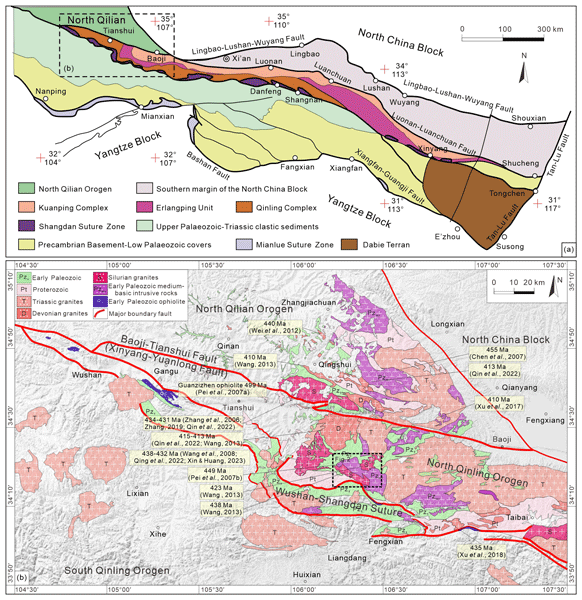
Have another go at drafting figures 1a and 1b – the boundaries don’t quite match between the two parts. Also, be clearer about the correlations that are intended. There is a broad match of colours between the Qilian/Qaidam/Kunlun regions to the west and the units of the Qinling, but it is not clear what is meant to be correlated and what is not. The Qinling map can be improved to add more of the important tectonic units, such as the Erlangping Unit and the Shangdan Suture Zone – both of these are wide enough to be marked on Figure 1, and they are important in the regional tectonic evolution.
Response: We have modified figures 1. The study area of this paper is the western section of the North Qinling Orogen. The Kuanping Unit, Erlangping Unit and Shangdan Suture zone have been added to figure 1a.
-
AC12: 'Reply on RC1', Hao Lin, 13 Jul 2026
There are few comments or criticisms to make on the geochronology and geochemistry parts of the paper. They are done well in my view. It would be good to have more description of the field relations and contacts. Are the samples foliated in any way? This is not mentioned, so presumably not, but there are hints of grain alignments in figures 3b and 3f.
Response: The original structures observed in Xianping pluton are believed to have been formed during magmatic crystallisation process. During the process of magmatic crystallisation, the magma at the edge of the Xianping pluton remains thermoplastic due to the influence of its melt. The upwelling magma, along with the pressure of surrounding rocks, results in the formation of local shear, leading to mylonitization of surrounding rocks, the minerals are flattened and elongated. This causes the minerals to become flattened and elongated, and it also leads to the formation of augen structures and banded structures.
Citation: https://doi.org/10.5194/egusphere-2024-2100-AC12 -
AC13: 'Reply on RC1', Hao Lin, 13 Jul 2026
The tectonic interpretation needs more thought, but I don’t expect full agreement with everything I suggest here.
First, please define what you mean by “syn-collision” and “post-collision” – this is central to the paper as the phrases appear in the title. But, it is not clear what is meant by each term. Also think about “orogeny”. Collisions can last for 10s of millions of years, and orogenies for even longer as they typically include a phase of pre-colllisional, oceanic, subduction. The India-Eurasia and Arabia-Eurasia examples show us that plate convergence can last for 10s of millions of year after initial continental collision. Presumably all the magmatism and deformation associated with this overall convergence is still “syn-collisional”. But, during this time the overriding plate can experience episodes of extension (See Tibet), tectonic escape (Anatolia) and possibly slab break-off, or delamination – all while convergence continues. So, how can we define “post-collisional”? I’ll argue that the term should be kept for processes and events that take place after overall plate convergence has stopped, and should relate to a different tectonic cycle and setting. I think “post-collisional” commonly gets applied to magmatism and deformation that is very much part of the orogeny and continued convergence. See Şengör’s papers for more discussion of these issues, e.g. “Plate tectonics and orogenic research after 25 years: Synopsis of a Tethyan perspective”.
Response: We have defined the “syn-collision” and “post-collision” in section 6.3. The orogeny is typically used to describe a range of geological processes, including the magmatism of island and continental arcs, oceanic subduction and closure, continents collision and subduction, slab rollback during the syn-collision, delamination and orogenic collapse during the post-collision (Song et al., 2015; Xu et al., 2021; Zhang and Hou 2015; Zheng et al., 2015, 2022; Zhu et al., 2022). The initiation of continental collision occurs when two continents converge and the oceanic crust between them is fully subducted, and the demise of this oceanic crust can be inferred from the ages of the high-pressure (HP) metamorphic rocks, arc volcanic rocks, and youngest ophiolites (Song et al., 2015). The syn-collision is characterized by a continental collision and subduction process. Despite the ocean having closed, subduction is not terminated, this is because it requires a significant amount of time for one continent to be subducted beneath another and achieve ultra-high-pressure (UHP) metamorphic conditions. During the process of continental collision and subduction, both the previously subducted oceanic crust and the continental crust undergo decompression melting as they are exhumed and the crust thickens, and accompanied by partial melting of crustal material to produce tonalites and peraluminous granites, without input of mantle materials (Chen et al., 2013; Liu et al., 2014; Song et al., 2014). Additionally, crustal melts derived from the deep subducted continental crust during exhumation could metasomatize the overlying lithospheric mantle, leading to the formation of mafic magmas (Zhao et al., 2012). The post-collisional is used to describe magmatism that occurs after the major collisional event, which typically marks the end of orogeny. It occured in the relaxation phase following the main orogeny, characterized by the large-scale horizontal movement of plate boundaries in the early phase and, in the late phase, by the delamination and collapse of orogeny, extension of the lithosphere, and crust-mantle interactions, such as the post-collisional magmas in the North Qaidam UHP metamorphic belt (Wu et al., 2014; Wang et al., 2014).
Citation: https://doi.org/10.5194/egusphere-2024-2100-AC13 -
AC14: 'Reply on RC1', Hao Lin, 13 Jul 2026
In this paper, there are two similar plutons in terms of chemistry and timing (only 8 Myr) apart, and yet one is assigned to a “syn-collisional” setting and the other to a “post-collisional” setting. The older Liqiao pluton is shown in figure 13a and being linked to slab break-off, the younger Xianping pluton is shown in figure 13b as being linked to delamination. Note that there is not independent evidence for either of these popular tectonic processes having taken place at these times. Given that the broadly I-type chemistry of both plutons is typical of Andean-type subduction zones, it is a simpler interpretation to assume that both plutons took place in this tectonic setting, without the need for further complications. There is an obvious objection to this scenario, in that there is evidence for collision that pre-dates both plutons, e.g. UHP metamorphism of continental protoliths in other parts of the North Qinling. But, these events can be accommodated by models where collision of microcontinents along the Proto-Tethyan margin did not terminate subduction. See Allen et al (2023) and Li Sanzhong et al (2018) for alternative scenarios, that are not simply the 2D cross-sections typically adopted by studies of local parts of the Central China Orogenic Belt. There are surely other and better models waiting to be developed.
Response: We agree with your model where collision of microcontinents along the Proto-Tethyan margin did not terminate subduction. The Qinling Complex in the western section of the North Qinling Orogeny underwent late Silurian (433−424 Ma) granulite-facies metamorphism with a clockwise P-T path, and followed by 411−402 Ma amphibolite-facies or retrograde overprinting metamorphism, suggesting that the granulite-facies rocks may have been formed by the continent-continent collisional orogeny in the Paleozoic (Guo et al., 2022; Mao et al., 2017, 2018). In contrast, the ages of granulite-facies metamorphism in the Qinling Complex, located in the eastern part of the North Qinling Orogeny is mainly concentrated between 430 and 450 Ma (Liu et al., 2013; Xiang et al., 2014; Zhang et al., 2009, 2011). The zircon U-Pb age of the Liqiao pluton is 429 Ma, coinciding with the timeframe of magmatism during the second pulse, specifically the slab break-off (Ren et al., 2021; Qin et al., 2022). This aligns with the granulite-facies metamorphism period at 433-424 Ma (Mao et al., 2017, 2018), suggesting that the Liqiao pluton likely formed during the slab break-off phase of the syn-collisional process. Pay attention, the collision of Yangtze Block and North Qinling Orogeny along the Wushan-Shangdan Ocean margin might not terminate subduction (Li et al., 2018b, 2018c; Allen et al., 2023). The zircon U-Pb age of the Xianping pluton is 421 Ma, coinciding with the post-collisional orogenic process within the error range (420-409 Ma; Ren et al., 2021; Qin et al., 2022). It is also close to the timeframe limit of the amphibolite-facies or retrograde overprinting metamorphism from 411 to 402 Ma, suggesting that the Xianping pluton was formed during the post-collisional stage.
Citation: https://doi.org/10.5194/egusphere-2024-2100-AC14 -
AC15: 'Reply on RC1', Hao Lin, 13 Jul 2026
I don’t fully understand Figure 13. If the labelled accretionary complex in the south relates to the oceanic plate subduction, what is the unlabelled continental tract immediately to its north and to the south of the remnant slab shown in 13a? How and why does this remnant slab disappear in the delamination event shown in 13b? As noted above, there seems to be no independent evidence for either slab break-off or delamination at the times and places shown. Given the simplicity of the chemistry of the I-type granites in the study, why are they not evidence for active oceanic subduction at this time – similar to the widespread magmatism of ~430-420 Ma in many other parts of the Central China Orogenic Belt.
Response: We have modified figures 13. Both of the Liqiao pluton and Xianping pluton represent periods of collisional orogeny. We have already responded to the discussion of the Liqiao and Xianping pluton tectonic setting in the previous comment.
-
AC16: 'Reply on RC1', Hao Lin, 13 Jul 2026
References:
A couple of test references at the start of this section need to be deleted.
Response: We have deleted the references at the start of this section.
“Mark” et al should be “Allen” et al – here and in the main text.
Response: We have fixed this error.
Figures:
Clear and appropriate. The tectonic cartoons need a re-think, as described above.
Response: We have modified figures 13.
Citation: https://doi.org/10.5194/egusphere-2024-2100-AC16
-
AC1: 'Reply on RC1', Hao Lin, 04 Nov 2024
-
CC1: 'Comment on egusphere-2024-2100', Jiangfeng Qin, 06 Apr 2025
Comment on egusphere-2024-2100
The manuscript presents a valuable analysis of two granite types in the North Qinling Orogenic Belt (NQOB), contributing new insights into the tectonic evolution of this region. The study has the potential to advance understanding of the NQOB’s tectonic evolution, but requires tighter integration of field data, petrographic observations, and tectonic models. In addition, several critical issues require clarification and revision to strengthen the scientific rigor and clarity of the work. In summary, I recommend that this paper can be accepted by Solid Earth with moderate revisions. Below are detailed comments and suggestions:
- Sub-sections 2.1 and 2.2 lack clear differentiation in content, leading to redundancy. For instance, both subsections focus on regional geology without distinct thematic separation.
Suggestion: Merge these subsections into a single cohesive section titled "Geological Setting" to streamline the narrative and avoid repetition.
- Key geological units mentioned in the text (e.g., Baihua Complex, Qinlingdabao Pluton) are absent in Figure 2. This mismatch creates confusion for readers attempting to correlate textual descriptions with spatial context.Revise Figure 2 to include labels for all referenced geological units.Add a detailed figure caption explaining abbreviations and geological boundaries. Alternatively, provide a separate map or inset highlighting the specific plutons discussed.
3.The manuscript lacks critical field observations (e.g., intrusive contacts, cross-cutting relationships) and petrographic details (e.g., feldspar zoning, quartz texture, zircon morphology). These omissions weaken the foundation for petrogenetic interpretations.
Include field photographs or sketches illustrating intrusive relationships and structural features.
Add a dedicated subsection describing mineralogical characteristics (e.g., feldspar composition, zircon CL images) to support genetic classifications.
Expand on zircon trace element data (e.g., Th/U ratios, REE patterns) to clarify magmatic processes (e.g., fractional crystallization vs. crustal assimilation).
- The authors interpret the two I-type granites as syn-collisional and post-collisional, respectively, but fail to provide robust evidence for this distinction (e.g., geochemical discriminants, isotopic signatures, or regional structural constraints).Clarify the criteria used to define syn- vs. post-collisional settings. For example:Cite geochemical proxies (e.g., Sr/Y vs. Y diagrams, adakitic signatures) or isotopic evidence (e.g., εHf(t) trends). Reference regional tectonic events (e.g., metamorphic ages, deformation phases) to align magmatism with collisional timelines.If evidence is equivocal, propose alternative models (e.g., transitional phases or post-collisional extension triggered by slab breakoff).
- The schematic diagram raises several questions:Block Identity: The unlabeled block between the Yangtze Craton and NQOB is ambiguously termed a "microcontinental block." Clarify its identity (e.g., Erlangping Block?) and provide geological references."Subduction-Related Igneous Rocks": Specify whether these refer to volcanic arcs, intrusions, or both. Slab Delamination Process: The depicted slab geometry lacks critical details (e.g., detachment depth, angle of subduction). Add annotations (e.g., arrows for slab rollback) or cross-sections to illustrate the proposed mechanism. Missing Lithospheric Boundary: The interface between crust and mantle is unclear. Label the Moho or lithosphere-asthenosphere boundary.
Citation: https://doi.org/10.5194/egusphere-2024-2100-CC1 -
AC9: 'Reply on CC1', Hao Lin, 13 Jul 2026
We greatly appreciate your constructive comments and suggestions. We will respond to your suggestions and opinions one by one:
- We have simplified and combined Sections 2.1 and 2.2.
- Key geological units mentioned in the text (e.g., Baihua Complex, Qinlingdabao Pluton) are exist in Figure 2.
- In the future, we will expand our research to include additional related studies, such as zircon trace‑element analyses.
- We have defined the “syn-collision” and “post-collision” in section 6.3.
- We have modified Figure 13.
Finally, we would like to express our sincere gratitude once again for your valuable comments and suggestions.
Citation: https://doi.org/10.5194/egusphere-2024-2100-AC9
-
RC2: 'Comment on egusphere-2024-2100', Massimo Coltorti, 18 Jun 2026
I read with great interest the manus of Lin et al.'s. I agree with my colleagues that the manuscript may be a useful contribution to understanding the evolutionary history of this part of China. However, I believe that the manuscript needs to be substantially rewritten and reorganized before final publication.
Even before addressing the scientific aspects, the text needs to be proofread by a native speaker. Many sentences are incomprehensible due to inappropriate syntax.
The number of acronyms should be reduced and standardized. It's extremely difficult for readers without a thorough knowledge of the geology of the area to understand which one is being referred to, especially when different acronyms identify the same object (e.g. NQO indicates Northern Qilian Orogen, but NQLO, as far as I can tell, also indicates the Northern Qilian Orogen).
As already noted, the division of the Geological Background into 2.1 and 2.2 seems inconsistent. It would be better to simplify it and combine it into a single chapter. I, for one, would be very interested in learning about the Paleozoic evolution of this part of the world, but I confess that I found it very difficult to follow and, above all, to see how it reflected the topic addressed in the manus.
I also agree with Mark that defining two granites that differ by only 8 Ma, out of 400, as syn- and post-collisional is rather risky, even taking into account that the age interval recorded by the zircons of the two granitic intrusions is partially overlapping (LP, 417-435, average 429; XP, 408-432, average 421). One zircon from XP syenogranite giving an age of 426+ 5.33 (see Fig. 4d). The two models believed to be responsible for the genesis of the two plutons are also hypothesized but no solid evidence is provided that these events actually occurred. Moreover, the two inferred models for the genesis of the two plutons are hypothesized but no solid evidence is provided that these events actually occurred in such a short time span.
I would also recommend placing the petrology section before the geochronology, immediately after the petrographic description. By the way, regarding petrography, Fig. 3 reports hornblende, which is not mentioned in the description of the accessory phases of the Liqiao pluton. And with regard to petrography, it would be interesting to verify whether compositionally the XP syenogranite can derive from fractionation of the LP granite. And following this line of reasoning, whether there could be any connection with the medium-basic (intermediate?) intrusive rocks surrounding the two granites (see Fig. 2), although older in age.
The text also contains many errors that we call minor, but which, taken together, contribute to making the reading more difficult and the work less prestigious. For example, the diagram by Peccerillo & Taylor (1976) does not have any Mugearite series, but a Shoshonitic one!
Summarizing, I feel there is still a long way to go to transform this interesting manuscript into a valid and robust contribution to the geological knowledge of this very important part of the Eurasian continent.
Citation: https://doi.org/10.5194/egusphere-2024-2100-RC2 -
AC2: 'Reply on RC2', Hao Lin, 13 Jul 2026
I read with great interest the manus of Lin et al.'s. I agree with my colleagues that the manuscript may be a useful contribution to understanding the evolutionary history of this part of China. However, I believe that the manuscript needs to be substantially rewritten and reorganized before final publication. Even before addressing the scientific aspects, the text needs to be proofread by a native speaker. Many sentences are incomprehensible due to inappropriate syntax.
Response: We are sincerely grateful for your insightful and constructive comments. In response, we have substantially rewritten and restructured the manuscript. The entire text has also been carefully proofread to eliminate grammatical errors and to ensure fluency and coherence throughout.
Citation: https://doi.org/10.5194/egusphere-2024-2100-AC2 -
AC3: 'Reply on RC2', Hao Lin, 13 Jul 2026
The number of acronyms should be reduced and standardized. It's extremely difficult for readers without a thorough knowledge of the geology of the area to understand which one is being referred to, especially when different acronyms identify the same object (e.g. NQO indicates Northern Qilian Orogen, but NQLO, as far as I can tell, also indicates the Northern Qilian Orogen).
Response: We greatly appreciate your constructive comments and suggestions. In this study, NQO refers to the North Qinling Orogen, while NQLO refers to the North Qilian Orogen. We have standardized all acronyms in the manuscript and minimized their usage. Three widely adopted acronyms for tectonic units are retained, namely CCOB (Central China Orogenic Belt), NCB (North China Block), and YB (Yangtze Block). Two acronyms for granitic plutons are also preserved, including LP (Liqiao pluton) and XP (Xianping pluton). Additionally, two acronyms for granitic plutons are preserved: LP (Liqiao pluton) and XP (Xianping pluton). All other acronyms including QO, NQO, NQLO, MS, WSS, and WSO have been replaced with their full unabbreviated forms throughout the text.
Citation: https://doi.org/10.5194/egusphere-2024-2100-AC3 -
AC4: 'Reply on RC2', Hao Lin, 13 Jul 2026
As already noted, the division of the Geological Background into 2.1 and 2.2 seems inconsistent. It would be better to simplify it and combine it into a single chapter. I, for one, would be very interested in learning about the Paleozoic evolution of this part of the world, but I confess that I found it very difficult to follow and, above all, to see how it reflected the topic addressed in the manus.
Response: Thank you very much for your attention to the research on the Paleozoic evolution of the western section of the North Qinling Orogen. We apologize for any confusion caused by the unclear description of the geological setting in this manuscript. In response to your valuable comments, we have simplified and combined Sections 2.1 and 2.2, so that the revised content can facilitate your understanding of the tectonic evolution of this region. The revised text is as follows:
The western section of the North Qinling Orogen is limited in the Tethys tectonic domain, the Paleo-Asian Ocean tectonic domain, and the Pacific tectonic domain (Pei et al., 2009). It is located in the middle section of the CCOB (Zhang et al., 2001; Dong et al., 2022a; Fig. 1a). It is bounded by the North Qilian Orogen and NCB to the north, and the South Qinling tectonic belt to the south (Fig. 1b), which has developed an active continental margin trench-arc-basin system in the Early Paleozoic (Pei et al., 2009; Dong et al., 2011a; Zhang et al., 2011; Dong and Santosh, 2016). The exposed strata in this area range from the Paleoproterozoic to the Early Paleozoic (Pei et al., 2009). The Precambrian crystalline basement is composed by Paleoproterozoic Qinling Group, which was composed by felsic gneisses, aluminous gneiss and marble-calc-silicate (Pei et al., 2009; Diwu et al., 2014). Previous zircon U-Pb dating indicate that it was formed in 2298 to 1867 Ma (Zhang et al., 2001). The high-pressure and ultra-high-pressure (HP-UHP) metamorphic rock are exposed in the Qinling Group, which are the products of exhumation of continental crust experienced subduction-deep subduction during the Early Paleozoic (Gong et al., 2016; Liu et al., 2020). The previous studies of the Kuanping Group have mainly focused on the central and eastern parts of the North Qinling Orogen, and have reported Meso-Neoproterozoic ages from 1974 to 813 Ma for the meta-volcanic rocks which with normal-type mid-ocean ridge basalt (N-MORB) affinities, and it was considered to represent oceanic crust (Xue et al., 1996; Zhang et al., 2001; He et al., 2007a; Pei et al., 2009; Diwu et al., 2010; Gao et al., 2015; Dong et al., 2014, 2015, 2021; Zeng et al., 2023). The ophiolite with Late Cambrian N-MORB type basic volcanic rocks developed in the Guanzizhen area, which extends eastward to the Liqiao area and westward to the Wushan-Yuanyangzhen area, representing the material record of ancient oceanic crust (Pei et al., 2004, 2007a; Dong et al., 2008). In the Late Cambrian-Early Ordovician, the Wushan-Shangdan Ocean (represented by the Guanzizhen-Wushan ophiolite) was subducted from south to north, and formed the island arc-forearc basin represented by the Liziyuan Group metamorphic sedimentary-volcanic rocks (Pei et al., 2006; Yang et al., 2018b). The Paleozoic Liziyuan Group are composed by metamorphic clastic rocks and carbonates sedimentary facies and metamorphic basalt, metamorphic basalt andesites, and metamorphic andesites volcanic facies (Pei et al., 2006). With the continued subduction of the Wushan-Shangdan Ocean, the metavolcanic rocks of the Caotangou Group and the corresponding volcaniclastic and shallowly metamorphosed clastic rocks, which are typical of island arc, were formed in the Middle-Late Ordovician (Yan et al., 2007; Zhu et al., 2008; Pei et al., 2009; Xu et al., 2014; Xie et al., 2020). The Ordovician Caotangou Group was composed by metamorphic volcanic-sediment, and it was divided into the lower Honghuapu Formation, the middle Zhangjiazhuang Formation, and the upper Longwanggou Formation (Song et al., 1991; Sun and Dong, 1995; Pei et al., 2009; Chen et al., 2019). Concurrently, intermediate-basic igneous complex of Liushuigou and Baihua were formed (Pei et al., 2007b; Gao et al., 2012), as well as subduction-type pluton such as Tangzang quartz diorite, Honghuapu tonalite, Yangjiazhuang quartz diorite, and Sanchahe quartz diorite (Chen et al., 2002, 2008; Wang et al., 2006; Ren et al., 2018; Qin et al., 2022). The tectonic background began to transition to the continental-continental or arc-continental collision orogeny after the subduction of the ancient oceanic crust and developed Caledonian collision-type pluton such as Dangchuan granite, and entered into an extension environment until the end of the orogeny in the Late Silurian-Early Devonian (Wang et al., 2008; Wang, 2013; Ren et al., 2018, 2021; Qin et al., 2022; Xin and Huang, 2023).
Citation: https://doi.org/10.5194/egusphere-2024-2100-AC4 -
AC5: 'Reply on RC2', Hao Lin, 13 Jul 2026
I also agree with Mark that defining two granites that differ by only 8 Ma, out of 400, as syn- and post-collisional is rather risky, even taking into account that the age interval recorded by the zircons of the two granitic intrusions is partially overlapping (LP, 417-435, average 429; XP, 408-432, average 421). One zircon from XP syenogranite giving an age of 426+ 5.33 (see Fig. 4d). The two models believed to be responsible for the genesis of the two plutons are also hypothesized but no solid evidence is provided that these events actually occurred. Moreover, the two inferred models for the genesis of the two plutons are hypothesized but no solid evidence is provided that these events actually occurred in such a short time span.
Response: We agree with Mark’s model where collision of microcontinents along the Proto-Tethyan margin did not terminate subduction. The Qinling Complex in the western section of the North Qinling Orogeny underwent late Silurian (433−424 Ma) granulite-facies metamorphism with a clockwise P-T path, and followed by 411−402 Ma amphibolite-facies or retrograde overprinting metamorphism, suggesting that the granulite-facies rocks may have been formed by the continent-continent collisional orogeny in the Paleozoic (Guo et al., 2022; Mao et al., 2017, 2018). In contrast, the ages of granulite-facies metamorphism in the Qinling Complex, located in the eastern part of the North Qinling Orogeny is mainly concentrated between 430 and 450 Ma (Liu et al., 2013; Xiang et al., 2014; Zhang et al., 2009, 2011). The zircon U-Pb age of the Liqiao pluton is 429 Ma, coinciding with the timeframe of magmatism during the second pulse, specifically the slab break-off (Ren et al., 2021; Qin et al., 2022). This aligns with the granulite-facies metamorphism period at 433-424 Ma (Mao et al., 2017, 2018), suggesting that the LP was likely formed during the intermediate stage of slab break-off in the syn-collisional process. Pay attention, the collision of Yangtze Block and North Qinling Orogeny along the Wushan-Shangdan Ocean margin might not terminate subduction (Li et al., 2018b, 2018c; Allen et al., 2023). The zircon U-Pb age of the Xianping pluton is 421 Ma, coinciding with the post-collisional orogenic process within the error range (420-409 Ma; Ren et al., 2021; Qin et al., 2022). It is also close to the timeframe limit of the amphibolite-facies or retrograde overprinting metamorphism from 411 to 402 Ma, suggesting that the XP was formed during the early stage of the post-collisional phase.
Based on our study of the tectonic evolution of the western section of the North Qinling Orogen we consider that slab break-off occurred during the syn-collisional stage (438–423 Ma), whereas delamination took place during the post-collisional stage (421–409 Ma). Our geochronological data indicate that the Liqiao pluton (429 Ma) was emplaced during the middle stage of syn-collisional processes, while the Xianping pluton (421 Ma) formed in the early post-collisional stage. Therefore, although the U-Pb ages of the two plutons differ by approximately 8 Ma, it cannot be taken as evidence that slab break-off and delamination occurred within a short interval of 8 Ma.
Citation: https://doi.org/10.5194/egusphere-2024-2100-AC5 -
AC6: 'Reply on RC2', Hao Lin, 13 Jul 2026
I would also recommend placing the petrology section before the geochronology, immediately after the petrographic description. By the way, regarding petrography, Fig. 3 reports hornblende, which is not mentioned in the description of the accessory phases of the Liqiao pluton. And with regard to petrography, it would be interesting to verify whether compositionally the XP syenogranite can derive from fractionation of the LP granite. And following this line of reasoning, whether there could be any connection with the medium-basic (intermediate?) intrusive rocks surrounding the two granites (see Fig. 2), although older in age.
Response: We thank the reviewer for the constructive suggestions. In accordance with the reviewer's comments, we have revised the manuscript accordingly. The specific modifications are summarized as follows:
(1) The sample-related contents originally presented in Section 4.1 have been relocated to Chapter 3 and renumbered as Section 3.3 to improve the logical flow of the manuscript.
(2) Additional petrographic descriptions concerning hornblende have been incorporated into the petrography subsection of the Liqiao pluton.
(3) The Xianping syenogranite can´t derive from fractionation of the Liqiao granite. This inference is critically supported by zircon Hf isotopic data: the Liqiao granites have positive εHf(t) values of -0.1 to +3.4 with corresponding two-stage model ages of 1197 to 1411 Ma., whereas the Xianping granites have negative εHf(t) values of -18.5 to -13.6 with corresponding two-stage model ages of 2259 to 2560 Ma. These differences indicate that the Liqiao pluton and Xianping pluton formed by different process. Accordingly, we have refined the discussion in the petrogenesis section: the Liqiao pluton was formed by partial melting of juvenile felsic crust with the involvement of mantle-derived material., whereas the Xianping pluton was formed by partial melting and highly fractional crystallization of the ancient felsic crust.
(4) The Baihua intermediate-basic igneous complex, which occurs adjacent to the Liqiao and Xianping plutons, has a zircon U-Pb age of 450 to 444 Ma. It was formed in an island-arc tectonic setting (Pei et al., 2005, 2007b, 2009).
Citation: https://doi.org/10.5194/egusphere-2024-2100-AC6 -
AC7: 'Reply on RC2', Hao Lin, 13 Jul 2026
The text also contains many errors that we call minor, but which, taken together, contribute to making the reading more difficult and the work less prestigious. For example, the diagram by Peccerillo & Taylor (1976) does not have any Mugearite series, but a Shoshonitic one!
Response: We have carefully reviewed the full manuscript and revised all minor errors as detailed below:
(1) Corrected the term "Mugearite" to "Shoshonitic" in Figure 6c;
(2) Fixed the incorrect citation references in the captions of Fig. 6b and Fig. 6c.
(3) We have reformatted and reorganized all figures and tables throughout the manuscript to improve their presentation and clarity.
Citation: https://doi.org/10.5194/egusphere-2024-2100-AC7 -
AC8: 'Reply on RC2', Hao Lin, 13 Jul 2026
Summarizing, I feel there is still a long way to go to transform this interesting manuscript into a valid and robust contribution to the geological knowledge of this very important part of the Eurasian continent.
Response: We sincerely appreciate your candid and professional insights. The direction you have pointed out is most pertinent, and we will carefully address these shortcomings in our future work to further strengthen the substance and clarity of this manuscript. Thank you once again for your invaluable comments.
Citation: https://doi.org/10.5194/egusphere-2024-2100-AC8
-
AC2: 'Reply on RC2', Hao Lin, 13 Jul 2026
-
EC1: 'Comment on egusphere-2024-2100', Andrea Di Muro, 21 Jun 2026
Dear Dr. Lin,
I’m glad to announce you that, after an unusually long struggle, we succeeded in getting a second review of your research paper.
Both reviewers agree on the potential significance of your research results, but they identify a main critical point in your interpretation proposing the occurrence of two distinct tectonic settings for samples whose ages almost overlap. I find very important you provide a more thorough set of evidences to support your model.
Moreover, it is important you clarify the geological background and improve the overall quality of the data presentation and discussion.
If you agree in following in detail the suggestions and answer the queries of the two reviewers, I’ll be glad to consider your manuscript for final publication.
With my best regards,
Andrea Di Muro
SE Executive Editor
Citation: https://doi.org/10.5194/egusphere-2024-2100-EC1 -
AC17: 'Reply on EC1', Hao Lin, 13 Jul 2026
Dear Andrea Di Muro, SE Executive Editor,
We would like to express our sincere gratitude for your valuable time and effort in reviewing our manuscript, as well as for your recognition of our research and your constructive suggestions. We fully agree with the critical issues you have raised, and we deeply recognize that there is room for improvement in our interpretations of the tectonic setting, the presentation of the geological background, and the data display.
We have addressed each of the reviewers' comments thoroughly and point by point, and have supplemented more detailed evidence and analyses to make our arguments more robust and convincing. We look forward to submitting a substantially improved version of our manuscript for your further consideration.
Thank you again for your time, patience, and invaluable guidance.
Yours sincerely,
Dr. Lin, on behalf of all co-authors
Citation: https://doi.org/10.5194/egusphere-2024-2100-AC17
-
AC17: 'Reply on EC1', Hao Lin, 13 Jul 2026
Peer review completion


Interactive discussion
Status: closed
-
RC1: 'Comment on egusphere-2024-2100', Mark Allen, 23 Oct 2024
Review of Silurian syn- and post-collision granitic magmatism in the western section of the North Qinling Orogen: Implications for collisional orogenic processes
By Lin et al.
This paper analyses samples from the Liqiao and Xianping plutons in the Qinling orogenic belt. The geochronology and geochemistry studies are good, and make a case for the plutons having similar chemistry - I-type granite, with ages of 429 Ma and 421 Ma respectively. But, at present there is a bit of a “so what?” feel to the paper – the results are not a surprise, and the tectonic interpretation has problems which I’ll cover later in the review.
The regional review is okay, but any and all attempts to summarise the geology of the Qinling are open to criticism simply because we don’t yet have a unified understanding of the range and its evolution.
Have another go at drafting figures 1a and 1b – the boundaries don’t quite match between the two parts. Also, be clearer about the correlations that are intended. There is a broad match of colours between the Qilian/Qaidam/Kunlun regions to the west and the units of the Qinling, but it is not clear what is meant to be correlated and what is not. The Qinling map can be improved to add more of the important tectonic units, such as the Erlangping Unit and the Shangdan Suture Zone – both of these are wide enough to be marked on Figure 1, and they are important in the regional tectonic evolution.
There are few comments or criticisms to make on the geochronology and geochemistry parts of the paper. They are done well in my view. It would be good to have more description of the field relations and contacts. Are the samples foliated in any way? This is not mentioned, so presumably not, but there are hints of grain alignments in figures 3b and 3f.
The tectonic interpretation needs more thought, but I don’t expect full agreement with everything I suggest here.
First, please define what you mean by “syn-collision” and “post-collision” – this is central to the paper as the phrases appear in the title. But, it is not clear what is meant by each term. Also think about “orogeny”. Collisions can last for 10s of millions of years, and orogenies for even longer as they typically include a phase of pre-colllisional, oceanic, subduction. The India-Eurasia and Arabia-Eurasia examples show us that plate convergence can last for 10s of millions of year after initial continental collision. Presumably all the magmatism and deformation associated with this overall convergence is still “syn-collisional”. But, during this time the overriding plate can experience episodes of extension (See Tibet), tectonic escape (Anatolia) and possibly slab break-off, or delamination – all while convergence continues. So, how can we define “post-collisional”? I’ll argue that the term should be kept for processes and events that take place after overall plate convergence has stopped, and should relate to a different tectonic cycle and setting. I think “post-collisional” commonly gets applied to magmatism and deformation that is very much part of the orogeny and continued convergence. See Şengör’s papers for more discussion of these issues, e.g. “Plate tectonics and orogenic research after 25 years: Synopsis of a Tethyan perspective”. In this paper, there are two similar plutons in terms of chemistry and timing (only 8 Myr) apart, and yet one is assigned to a “syn-collisional” setting and the other to a “post-collisional” setting. The older Liqiao pluton is shown in figure 13a and being linked to slab break-off, the younger Xianping pluton is shown in figure 13b as being linked to delamination. Note that there is not independent evidence for either of these popular tectonic processes having taken place at these times. Given that the broadly I-type chemistry of both plutons is typical of Andean-type subduction zones, it is a simpler interpretation to assume that both plutons took place in this tectonic setting, without the need for further complications. There is an obvious objection to this scenario, in that there is evidence for collision that pre-dates both plutons, e.g. UHP metamorphism of continental protoliths in other parts of the North Qinling. But, these events can be accommodated by models where collision of microcontinents along the Proto-Tethyan margin did not terminate subduction. See Allen et al (2023) and Li Sanzhong et al (2018) for alternative scenarios, that are not simply the 2D cross-sections typically adopted by studies of local parts of the Central China Orogenic Belt. There are surely other and better models waiting to be developed.
I don’t fully understand Figure 13. If the labelled accretionary complex in the south relates to the oceanic plate subduction, what is the unlabelled continental tract immediately to its north and to the south of the remnant slab shown in 13a? How and why does this remnant slab disappear in the delamination event shown in 13b? As noted above, there seems to be no independent evidence for either slab break-off or delamination at the times and places shown. Given the simplicity of the chemistry of the I-type granites in the study, why are they not evidence for active oceanic subduction at this time – similar to the widespread magmatism of ~430-420 Ma in many other parts of the Central China Orogenic Belt.
References:
A couple of test references at the start of this section need to be deleted.
“Mark” et al should be “Allen” et al – here and in the main text.
Figures:
Clear and appropriate. The tectonic cartoons need a re-think, as described above.
Citation: https://doi.org/10.5194/egusphere-2024-2100-RC1 -
AC1: 'Reply on RC1', Hao Lin, 04 Nov 2024
I am deeply grateful to Mark Allen for your thoughtful comments on this article, as well as for the invaluable advice you have shared. Your feedback has been extremely constructive and instrumental in enhancing our work. We have addressed all the points that we found insightful, which will undoubtedly strengthen our paper. Our detailed responses to each of the reviewer's comments and suggestions are included in the attached file.
-
AC10: 'Reply on RC1', Hao Lin, 13 Jul 2026
This paper analyses samples from the Liqiao and Xianping plutons in the Qinling orogenic belt. The geochronology and geochemistry studies are good, and make a case for the plutons having similar chemistry - I-type granite, with ages of 429 Ma and 421 Ma respectively. But, at present there is a bit of a “so what?” feel to the paper – the results are not a surprise, and the tectonic interpretation has problems which I’ll cover later in the review.
The regional review is okay, but any and all attempts to summarise the geology of the Qinling are open to criticism simply because we don’t yet have a unified understanding of the range and its evolution.
Response: I am deeply grateful to Mark Allen for your thoughtful comments on this article, as well as for the invaluable advice you have shared. Your feedback has been extremely constructive and instrumental in enhancing our work. We have addressed all the points that we found insightful, which will undoubtedly strengthen our paper. Our detailed responses to your comments and suggestions are shown below.
Citation: https://doi.org/10.5194/egusphere-2024-2100-AC10 -
AC11: 'Reply on RC1', Hao Lin, 13 Jul 2026
Have another go at drafting figures 1a and 1b – the boundaries don’t quite match between the two parts. Also, be clearer about the correlations that are intended. There is a broad match of colours between the Qilian/Qaidam/Kunlun regions to the west and the units of the Qinling, but it is not clear what is meant to be correlated and what is not. The Qinling map can be improved to add more of the important tectonic units, such as the Erlangping Unit and the Shangdan Suture Zone – both of these are wide enough to be marked on Figure 1, and they are important in the regional tectonic evolution.
Response: We have modified figures 1. The study area of this paper is the western section of the North Qinling Orogen. The Kuanping Unit, Erlangping Unit and Shangdan Suture zone have been added to figure 1a.
-
AC12: 'Reply on RC1', Hao Lin, 13 Jul 2026
There are few comments or criticisms to make on the geochronology and geochemistry parts of the paper. They are done well in my view. It would be good to have more description of the field relations and contacts. Are the samples foliated in any way? This is not mentioned, so presumably not, but there are hints of grain alignments in figures 3b and 3f.
Response: The original structures observed in Xianping pluton are believed to have been formed during magmatic crystallisation process. During the process of magmatic crystallisation, the magma at the edge of the Xianping pluton remains thermoplastic due to the influence of its melt. The upwelling magma, along with the pressure of surrounding rocks, results in the formation of local shear, leading to mylonitization of surrounding rocks, the minerals are flattened and elongated. This causes the minerals to become flattened and elongated, and it also leads to the formation of augen structures and banded structures.
Citation: https://doi.org/10.5194/egusphere-2024-2100-AC12 -
AC13: 'Reply on RC1', Hao Lin, 13 Jul 2026
The tectonic interpretation needs more thought, but I don’t expect full agreement with everything I suggest here.
First, please define what you mean by “syn-collision” and “post-collision” – this is central to the paper as the phrases appear in the title. But, it is not clear what is meant by each term. Also think about “orogeny”. Collisions can last for 10s of millions of years, and orogenies for even longer as they typically include a phase of pre-colllisional, oceanic, subduction. The India-Eurasia and Arabia-Eurasia examples show us that plate convergence can last for 10s of millions of year after initial continental collision. Presumably all the magmatism and deformation associated with this overall convergence is still “syn-collisional”. But, during this time the overriding plate can experience episodes of extension (See Tibet), tectonic escape (Anatolia) and possibly slab break-off, or delamination – all while convergence continues. So, how can we define “post-collisional”? I’ll argue that the term should be kept for processes and events that take place after overall plate convergence has stopped, and should relate to a different tectonic cycle and setting. I think “post-collisional” commonly gets applied to magmatism and deformation that is very much part of the orogeny and continued convergence. See Şengör’s papers for more discussion of these issues, e.g. “Plate tectonics and orogenic research after 25 years: Synopsis of a Tethyan perspective”.
Response: We have defined the “syn-collision” and “post-collision” in section 6.3. The orogeny is typically used to describe a range of geological processes, including the magmatism of island and continental arcs, oceanic subduction and closure, continents collision and subduction, slab rollback during the syn-collision, delamination and orogenic collapse during the post-collision (Song et al., 2015; Xu et al., 2021; Zhang and Hou 2015; Zheng et al., 2015, 2022; Zhu et al., 2022). The initiation of continental collision occurs when two continents converge and the oceanic crust between them is fully subducted, and the demise of this oceanic crust can be inferred from the ages of the high-pressure (HP) metamorphic rocks, arc volcanic rocks, and youngest ophiolites (Song et al., 2015). The syn-collision is characterized by a continental collision and subduction process. Despite the ocean having closed, subduction is not terminated, this is because it requires a significant amount of time for one continent to be subducted beneath another and achieve ultra-high-pressure (UHP) metamorphic conditions. During the process of continental collision and subduction, both the previously subducted oceanic crust and the continental crust undergo decompression melting as they are exhumed and the crust thickens, and accompanied by partial melting of crustal material to produce tonalites and peraluminous granites, without input of mantle materials (Chen et al., 2013; Liu et al., 2014; Song et al., 2014). Additionally, crustal melts derived from the deep subducted continental crust during exhumation could metasomatize the overlying lithospheric mantle, leading to the formation of mafic magmas (Zhao et al., 2012). The post-collisional is used to describe magmatism that occurs after the major collisional event, which typically marks the end of orogeny. It occured in the relaxation phase following the main orogeny, characterized by the large-scale horizontal movement of plate boundaries in the early phase and, in the late phase, by the delamination and collapse of orogeny, extension of the lithosphere, and crust-mantle interactions, such as the post-collisional magmas in the North Qaidam UHP metamorphic belt (Wu et al., 2014; Wang et al., 2014).
Citation: https://doi.org/10.5194/egusphere-2024-2100-AC13 -
AC14: 'Reply on RC1', Hao Lin, 13 Jul 2026
In this paper, there are two similar plutons in terms of chemistry and timing (only 8 Myr) apart, and yet one is assigned to a “syn-collisional” setting and the other to a “post-collisional” setting. The older Liqiao pluton is shown in figure 13a and being linked to slab break-off, the younger Xianping pluton is shown in figure 13b as being linked to delamination. Note that there is not independent evidence for either of these popular tectonic processes having taken place at these times. Given that the broadly I-type chemistry of both plutons is typical of Andean-type subduction zones, it is a simpler interpretation to assume that both plutons took place in this tectonic setting, without the need for further complications. There is an obvious objection to this scenario, in that there is evidence for collision that pre-dates both plutons, e.g. UHP metamorphism of continental protoliths in other parts of the North Qinling. But, these events can be accommodated by models where collision of microcontinents along the Proto-Tethyan margin did not terminate subduction. See Allen et al (2023) and Li Sanzhong et al (2018) for alternative scenarios, that are not simply the 2D cross-sections typically adopted by studies of local parts of the Central China Orogenic Belt. There are surely other and better models waiting to be developed.
Response: We agree with your model where collision of microcontinents along the Proto-Tethyan margin did not terminate subduction. The Qinling Complex in the western section of the North Qinling Orogeny underwent late Silurian (433−424 Ma) granulite-facies metamorphism with a clockwise P-T path, and followed by 411−402 Ma amphibolite-facies or retrograde overprinting metamorphism, suggesting that the granulite-facies rocks may have been formed by the continent-continent collisional orogeny in the Paleozoic (Guo et al., 2022; Mao et al., 2017, 2018). In contrast, the ages of granulite-facies metamorphism in the Qinling Complex, located in the eastern part of the North Qinling Orogeny is mainly concentrated between 430 and 450 Ma (Liu et al., 2013; Xiang et al., 2014; Zhang et al., 2009, 2011). The zircon U-Pb age of the Liqiao pluton is 429 Ma, coinciding with the timeframe of magmatism during the second pulse, specifically the slab break-off (Ren et al., 2021; Qin et al., 2022). This aligns with the granulite-facies metamorphism period at 433-424 Ma (Mao et al., 2017, 2018), suggesting that the Liqiao pluton likely formed during the slab break-off phase of the syn-collisional process. Pay attention, the collision of Yangtze Block and North Qinling Orogeny along the Wushan-Shangdan Ocean margin might not terminate subduction (Li et al., 2018b, 2018c; Allen et al., 2023). The zircon U-Pb age of the Xianping pluton is 421 Ma, coinciding with the post-collisional orogenic process within the error range (420-409 Ma; Ren et al., 2021; Qin et al., 2022). It is also close to the timeframe limit of the amphibolite-facies or retrograde overprinting metamorphism from 411 to 402 Ma, suggesting that the Xianping pluton was formed during the post-collisional stage.
Citation: https://doi.org/10.5194/egusphere-2024-2100-AC14 -
AC15: 'Reply on RC1', Hao Lin, 13 Jul 2026
I don’t fully understand Figure 13. If the labelled accretionary complex in the south relates to the oceanic plate subduction, what is the unlabelled continental tract immediately to its north and to the south of the remnant slab shown in 13a? How and why does this remnant slab disappear in the delamination event shown in 13b? As noted above, there seems to be no independent evidence for either slab break-off or delamination at the times and places shown. Given the simplicity of the chemistry of the I-type granites in the study, why are they not evidence for active oceanic subduction at this time – similar to the widespread magmatism of ~430-420 Ma in many other parts of the Central China Orogenic Belt.
Response: We have modified figures 13. Both of the Liqiao pluton and Xianping pluton represent periods of collisional orogeny. We have already responded to the discussion of the Liqiao and Xianping pluton tectonic setting in the previous comment.
-
AC16: 'Reply on RC1', Hao Lin, 13 Jul 2026
References:
A couple of test references at the start of this section need to be deleted.
Response: We have deleted the references at the start of this section.
“Mark” et al should be “Allen” et al – here and in the main text.
Response: We have fixed this error.
Figures:
Clear and appropriate. The tectonic cartoons need a re-think, as described above.
Response: We have modified figures 13.
Citation: https://doi.org/10.5194/egusphere-2024-2100-AC16
-
AC1: 'Reply on RC1', Hao Lin, 04 Nov 2024
-
CC1: 'Comment on egusphere-2024-2100', Jiangfeng Qin, 06 Apr 2025
Comment on egusphere-2024-2100
The manuscript presents a valuable analysis of two granite types in the North Qinling Orogenic Belt (NQOB), contributing new insights into the tectonic evolution of this region. The study has the potential to advance understanding of the NQOB’s tectonic evolution, but requires tighter integration of field data, petrographic observations, and tectonic models. In addition, several critical issues require clarification and revision to strengthen the scientific rigor and clarity of the work. In summary, I recommend that this paper can be accepted by Solid Earth with moderate revisions. Below are detailed comments and suggestions:
- Sub-sections 2.1 and 2.2 lack clear differentiation in content, leading to redundancy. For instance, both subsections focus on regional geology without distinct thematic separation.
Suggestion: Merge these subsections into a single cohesive section titled "Geological Setting" to streamline the narrative and avoid repetition.
- Key geological units mentioned in the text (e.g., Baihua Complex, Qinlingdabao Pluton) are absent in Figure 2. This mismatch creates confusion for readers attempting to correlate textual descriptions with spatial context.Revise Figure 2 to include labels for all referenced geological units.Add a detailed figure caption explaining abbreviations and geological boundaries. Alternatively, provide a separate map or inset highlighting the specific plutons discussed.
3.The manuscript lacks critical field observations (e.g., intrusive contacts, cross-cutting relationships) and petrographic details (e.g., feldspar zoning, quartz texture, zircon morphology). These omissions weaken the foundation for petrogenetic interpretations.
Include field photographs or sketches illustrating intrusive relationships and structural features.
Add a dedicated subsection describing mineralogical characteristics (e.g., feldspar composition, zircon CL images) to support genetic classifications.
Expand on zircon trace element data (e.g., Th/U ratios, REE patterns) to clarify magmatic processes (e.g., fractional crystallization vs. crustal assimilation).
- The authors interpret the two I-type granites as syn-collisional and post-collisional, respectively, but fail to provide robust evidence for this distinction (e.g., geochemical discriminants, isotopic signatures, or regional structural constraints).Clarify the criteria used to define syn- vs. post-collisional settings. For example:Cite geochemical proxies (e.g., Sr/Y vs. Y diagrams, adakitic signatures) or isotopic evidence (e.g., εHf(t) trends). Reference regional tectonic events (e.g., metamorphic ages, deformation phases) to align magmatism with collisional timelines.If evidence is equivocal, propose alternative models (e.g., transitional phases or post-collisional extension triggered by slab breakoff).
- The schematic diagram raises several questions:Block Identity: The unlabeled block between the Yangtze Craton and NQOB is ambiguously termed a "microcontinental block." Clarify its identity (e.g., Erlangping Block?) and provide geological references."Subduction-Related Igneous Rocks": Specify whether these refer to volcanic arcs, intrusions, or both. Slab Delamination Process: The depicted slab geometry lacks critical details (e.g., detachment depth, angle of subduction). Add annotations (e.g., arrows for slab rollback) or cross-sections to illustrate the proposed mechanism. Missing Lithospheric Boundary: The interface between crust and mantle is unclear. Label the Moho or lithosphere-asthenosphere boundary.
Citation: https://doi.org/10.5194/egusphere-2024-2100-CC1 -
AC9: 'Reply on CC1', Hao Lin, 13 Jul 2026
We greatly appreciate your constructive comments and suggestions. We will respond to your suggestions and opinions one by one:
- We have simplified and combined Sections 2.1 and 2.2.
- Key geological units mentioned in the text (e.g., Baihua Complex, Qinlingdabao Pluton) are exist in Figure 2.
- In the future, we will expand our research to include additional related studies, such as zircon trace‑element analyses.
- We have defined the “syn-collision” and “post-collision” in section 6.3.
- We have modified Figure 13.
Finally, we would like to express our sincere gratitude once again for your valuable comments and suggestions.
Citation: https://doi.org/10.5194/egusphere-2024-2100-AC9
-
RC2: 'Comment on egusphere-2024-2100', Massimo Coltorti, 18 Jun 2026
I read with great interest the manus of Lin et al.'s. I agree with my colleagues that the manuscript may be a useful contribution to understanding the evolutionary history of this part of China. However, I believe that the manuscript needs to be substantially rewritten and reorganized before final publication.
Even before addressing the scientific aspects, the text needs to be proofread by a native speaker. Many sentences are incomprehensible due to inappropriate syntax.
The number of acronyms should be reduced and standardized. It's extremely difficult for readers without a thorough knowledge of the geology of the area to understand which one is being referred to, especially when different acronyms identify the same object (e.g. NQO indicates Northern Qilian Orogen, but NQLO, as far as I can tell, also indicates the Northern Qilian Orogen).
As already noted, the division of the Geological Background into 2.1 and 2.2 seems inconsistent. It would be better to simplify it and combine it into a single chapter. I, for one, would be very interested in learning about the Paleozoic evolution of this part of the world, but I confess that I found it very difficult to follow and, above all, to see how it reflected the topic addressed in the manus.
I also agree with Mark that defining two granites that differ by only 8 Ma, out of 400, as syn- and post-collisional is rather risky, even taking into account that the age interval recorded by the zircons of the two granitic intrusions is partially overlapping (LP, 417-435, average 429; XP, 408-432, average 421). One zircon from XP syenogranite giving an age of 426+ 5.33 (see Fig. 4d). The two models believed to be responsible for the genesis of the two plutons are also hypothesized but no solid evidence is provided that these events actually occurred. Moreover, the two inferred models for the genesis of the two plutons are hypothesized but no solid evidence is provided that these events actually occurred in such a short time span.
I would also recommend placing the petrology section before the geochronology, immediately after the petrographic description. By the way, regarding petrography, Fig. 3 reports hornblende, which is not mentioned in the description of the accessory phases of the Liqiao pluton. And with regard to petrography, it would be interesting to verify whether compositionally the XP syenogranite can derive from fractionation of the LP granite. And following this line of reasoning, whether there could be any connection with the medium-basic (intermediate?) intrusive rocks surrounding the two granites (see Fig. 2), although older in age.
The text also contains many errors that we call minor, but which, taken together, contribute to making the reading more difficult and the work less prestigious. For example, the diagram by Peccerillo & Taylor (1976) does not have any Mugearite series, but a Shoshonitic one!
Summarizing, I feel there is still a long way to go to transform this interesting manuscript into a valid and robust contribution to the geological knowledge of this very important part of the Eurasian continent.
Citation: https://doi.org/10.5194/egusphere-2024-2100-RC2 -
AC2: 'Reply on RC2', Hao Lin, 13 Jul 2026
I read with great interest the manus of Lin et al.'s. I agree with my colleagues that the manuscript may be a useful contribution to understanding the evolutionary history of this part of China. However, I believe that the manuscript needs to be substantially rewritten and reorganized before final publication. Even before addressing the scientific aspects, the text needs to be proofread by a native speaker. Many sentences are incomprehensible due to inappropriate syntax.
Response: We are sincerely grateful for your insightful and constructive comments. In response, we have substantially rewritten and restructured the manuscript. The entire text has also been carefully proofread to eliminate grammatical errors and to ensure fluency and coherence throughout.
Citation: https://doi.org/10.5194/egusphere-2024-2100-AC2 -
AC3: 'Reply on RC2', Hao Lin, 13 Jul 2026
The number of acronyms should be reduced and standardized. It's extremely difficult for readers without a thorough knowledge of the geology of the area to understand which one is being referred to, especially when different acronyms identify the same object (e.g. NQO indicates Northern Qilian Orogen, but NQLO, as far as I can tell, also indicates the Northern Qilian Orogen).
Response: We greatly appreciate your constructive comments and suggestions. In this study, NQO refers to the North Qinling Orogen, while NQLO refers to the North Qilian Orogen. We have standardized all acronyms in the manuscript and minimized their usage. Three widely adopted acronyms for tectonic units are retained, namely CCOB (Central China Orogenic Belt), NCB (North China Block), and YB (Yangtze Block). Two acronyms for granitic plutons are also preserved, including LP (Liqiao pluton) and XP (Xianping pluton). Additionally, two acronyms for granitic plutons are preserved: LP (Liqiao pluton) and XP (Xianping pluton). All other acronyms including QO, NQO, NQLO, MS, WSS, and WSO have been replaced with their full unabbreviated forms throughout the text.
Citation: https://doi.org/10.5194/egusphere-2024-2100-AC3 -
AC4: 'Reply on RC2', Hao Lin, 13 Jul 2026
As already noted, the division of the Geological Background into 2.1 and 2.2 seems inconsistent. It would be better to simplify it and combine it into a single chapter. I, for one, would be very interested in learning about the Paleozoic evolution of this part of the world, but I confess that I found it very difficult to follow and, above all, to see how it reflected the topic addressed in the manus.
Response: Thank you very much for your attention to the research on the Paleozoic evolution of the western section of the North Qinling Orogen. We apologize for any confusion caused by the unclear description of the geological setting in this manuscript. In response to your valuable comments, we have simplified and combined Sections 2.1 and 2.2, so that the revised content can facilitate your understanding of the tectonic evolution of this region. The revised text is as follows:
The western section of the North Qinling Orogen is limited in the Tethys tectonic domain, the Paleo-Asian Ocean tectonic domain, and the Pacific tectonic domain (Pei et al., 2009). It is located in the middle section of the CCOB (Zhang et al., 2001; Dong et al., 2022a; Fig. 1a). It is bounded by the North Qilian Orogen and NCB to the north, and the South Qinling tectonic belt to the south (Fig. 1b), which has developed an active continental margin trench-arc-basin system in the Early Paleozoic (Pei et al., 2009; Dong et al., 2011a; Zhang et al., 2011; Dong and Santosh, 2016). The exposed strata in this area range from the Paleoproterozoic to the Early Paleozoic (Pei et al., 2009). The Precambrian crystalline basement is composed by Paleoproterozoic Qinling Group, which was composed by felsic gneisses, aluminous gneiss and marble-calc-silicate (Pei et al., 2009; Diwu et al., 2014). Previous zircon U-Pb dating indicate that it was formed in 2298 to 1867 Ma (Zhang et al., 2001). The high-pressure and ultra-high-pressure (HP-UHP) metamorphic rock are exposed in the Qinling Group, which are the products of exhumation of continental crust experienced subduction-deep subduction during the Early Paleozoic (Gong et al., 2016; Liu et al., 2020). The previous studies of the Kuanping Group have mainly focused on the central and eastern parts of the North Qinling Orogen, and have reported Meso-Neoproterozoic ages from 1974 to 813 Ma for the meta-volcanic rocks which with normal-type mid-ocean ridge basalt (N-MORB) affinities, and it was considered to represent oceanic crust (Xue et al., 1996; Zhang et al., 2001; He et al., 2007a; Pei et al., 2009; Diwu et al., 2010; Gao et al., 2015; Dong et al., 2014, 2015, 2021; Zeng et al., 2023). The ophiolite with Late Cambrian N-MORB type basic volcanic rocks developed in the Guanzizhen area, which extends eastward to the Liqiao area and westward to the Wushan-Yuanyangzhen area, representing the material record of ancient oceanic crust (Pei et al., 2004, 2007a; Dong et al., 2008). In the Late Cambrian-Early Ordovician, the Wushan-Shangdan Ocean (represented by the Guanzizhen-Wushan ophiolite) was subducted from south to north, and formed the island arc-forearc basin represented by the Liziyuan Group metamorphic sedimentary-volcanic rocks (Pei et al., 2006; Yang et al., 2018b). The Paleozoic Liziyuan Group are composed by metamorphic clastic rocks and carbonates sedimentary facies and metamorphic basalt, metamorphic basalt andesites, and metamorphic andesites volcanic facies (Pei et al., 2006). With the continued subduction of the Wushan-Shangdan Ocean, the metavolcanic rocks of the Caotangou Group and the corresponding volcaniclastic and shallowly metamorphosed clastic rocks, which are typical of island arc, were formed in the Middle-Late Ordovician (Yan et al., 2007; Zhu et al., 2008; Pei et al., 2009; Xu et al., 2014; Xie et al., 2020). The Ordovician Caotangou Group was composed by metamorphic volcanic-sediment, and it was divided into the lower Honghuapu Formation, the middle Zhangjiazhuang Formation, and the upper Longwanggou Formation (Song et al., 1991; Sun and Dong, 1995; Pei et al., 2009; Chen et al., 2019). Concurrently, intermediate-basic igneous complex of Liushuigou and Baihua were formed (Pei et al., 2007b; Gao et al., 2012), as well as subduction-type pluton such as Tangzang quartz diorite, Honghuapu tonalite, Yangjiazhuang quartz diorite, and Sanchahe quartz diorite (Chen et al., 2002, 2008; Wang et al., 2006; Ren et al., 2018; Qin et al., 2022). The tectonic background began to transition to the continental-continental or arc-continental collision orogeny after the subduction of the ancient oceanic crust and developed Caledonian collision-type pluton such as Dangchuan granite, and entered into an extension environment until the end of the orogeny in the Late Silurian-Early Devonian (Wang et al., 2008; Wang, 2013; Ren et al., 2018, 2021; Qin et al., 2022; Xin and Huang, 2023).
Citation: https://doi.org/10.5194/egusphere-2024-2100-AC4 -
AC5: 'Reply on RC2', Hao Lin, 13 Jul 2026
I also agree with Mark that defining two granites that differ by only 8 Ma, out of 400, as syn- and post-collisional is rather risky, even taking into account that the age interval recorded by the zircons of the two granitic intrusions is partially overlapping (LP, 417-435, average 429; XP, 408-432, average 421). One zircon from XP syenogranite giving an age of 426+ 5.33 (see Fig. 4d). The two models believed to be responsible for the genesis of the two plutons are also hypothesized but no solid evidence is provided that these events actually occurred. Moreover, the two inferred models for the genesis of the two plutons are hypothesized but no solid evidence is provided that these events actually occurred in such a short time span.
Response: We agree with Mark’s model where collision of microcontinents along the Proto-Tethyan margin did not terminate subduction. The Qinling Complex in the western section of the North Qinling Orogeny underwent late Silurian (433−424 Ma) granulite-facies metamorphism with a clockwise P-T path, and followed by 411−402 Ma amphibolite-facies or retrograde overprinting metamorphism, suggesting that the granulite-facies rocks may have been formed by the continent-continent collisional orogeny in the Paleozoic (Guo et al., 2022; Mao et al., 2017, 2018). In contrast, the ages of granulite-facies metamorphism in the Qinling Complex, located in the eastern part of the North Qinling Orogeny is mainly concentrated between 430 and 450 Ma (Liu et al., 2013; Xiang et al., 2014; Zhang et al., 2009, 2011). The zircon U-Pb age of the Liqiao pluton is 429 Ma, coinciding with the timeframe of magmatism during the second pulse, specifically the slab break-off (Ren et al., 2021; Qin et al., 2022). This aligns with the granulite-facies metamorphism period at 433-424 Ma (Mao et al., 2017, 2018), suggesting that the LP was likely formed during the intermediate stage of slab break-off in the syn-collisional process. Pay attention, the collision of Yangtze Block and North Qinling Orogeny along the Wushan-Shangdan Ocean margin might not terminate subduction (Li et al., 2018b, 2018c; Allen et al., 2023). The zircon U-Pb age of the Xianping pluton is 421 Ma, coinciding with the post-collisional orogenic process within the error range (420-409 Ma; Ren et al., 2021; Qin et al., 2022). It is also close to the timeframe limit of the amphibolite-facies or retrograde overprinting metamorphism from 411 to 402 Ma, suggesting that the XP was formed during the early stage of the post-collisional phase.
Based on our study of the tectonic evolution of the western section of the North Qinling Orogen we consider that slab break-off occurred during the syn-collisional stage (438–423 Ma), whereas delamination took place during the post-collisional stage (421–409 Ma). Our geochronological data indicate that the Liqiao pluton (429 Ma) was emplaced during the middle stage of syn-collisional processes, while the Xianping pluton (421 Ma) formed in the early post-collisional stage. Therefore, although the U-Pb ages of the two plutons differ by approximately 8 Ma, it cannot be taken as evidence that slab break-off and delamination occurred within a short interval of 8 Ma.
Citation: https://doi.org/10.5194/egusphere-2024-2100-AC5 -
AC6: 'Reply on RC2', Hao Lin, 13 Jul 2026
I would also recommend placing the petrology section before the geochronology, immediately after the petrographic description. By the way, regarding petrography, Fig. 3 reports hornblende, which is not mentioned in the description of the accessory phases of the Liqiao pluton. And with regard to petrography, it would be interesting to verify whether compositionally the XP syenogranite can derive from fractionation of the LP granite. And following this line of reasoning, whether there could be any connection with the medium-basic (intermediate?) intrusive rocks surrounding the two granites (see Fig. 2), although older in age.
Response: We thank the reviewer for the constructive suggestions. In accordance with the reviewer's comments, we have revised the manuscript accordingly. The specific modifications are summarized as follows:
(1) The sample-related contents originally presented in Section 4.1 have been relocated to Chapter 3 and renumbered as Section 3.3 to improve the logical flow of the manuscript.
(2) Additional petrographic descriptions concerning hornblende have been incorporated into the petrography subsection of the Liqiao pluton.
(3) The Xianping syenogranite can´t derive from fractionation of the Liqiao granite. This inference is critically supported by zircon Hf isotopic data: the Liqiao granites have positive εHf(t) values of -0.1 to +3.4 with corresponding two-stage model ages of 1197 to 1411 Ma., whereas the Xianping granites have negative εHf(t) values of -18.5 to -13.6 with corresponding two-stage model ages of 2259 to 2560 Ma. These differences indicate that the Liqiao pluton and Xianping pluton formed by different process. Accordingly, we have refined the discussion in the petrogenesis section: the Liqiao pluton was formed by partial melting of juvenile felsic crust with the involvement of mantle-derived material., whereas the Xianping pluton was formed by partial melting and highly fractional crystallization of the ancient felsic crust.
(4) The Baihua intermediate-basic igneous complex, which occurs adjacent to the Liqiao and Xianping plutons, has a zircon U-Pb age of 450 to 444 Ma. It was formed in an island-arc tectonic setting (Pei et al., 2005, 2007b, 2009).
Citation: https://doi.org/10.5194/egusphere-2024-2100-AC6 -
AC7: 'Reply on RC2', Hao Lin, 13 Jul 2026
The text also contains many errors that we call minor, but which, taken together, contribute to making the reading more difficult and the work less prestigious. For example, the diagram by Peccerillo & Taylor (1976) does not have any Mugearite series, but a Shoshonitic one!
Response: We have carefully reviewed the full manuscript and revised all minor errors as detailed below:
(1) Corrected the term "Mugearite" to "Shoshonitic" in Figure 6c;
(2) Fixed the incorrect citation references in the captions of Fig. 6b and Fig. 6c.
(3) We have reformatted and reorganized all figures and tables throughout the manuscript to improve their presentation and clarity.
Citation: https://doi.org/10.5194/egusphere-2024-2100-AC7 -
AC8: 'Reply on RC2', Hao Lin, 13 Jul 2026
Summarizing, I feel there is still a long way to go to transform this interesting manuscript into a valid and robust contribution to the geological knowledge of this very important part of the Eurasian continent.
Response: We sincerely appreciate your candid and professional insights. The direction you have pointed out is most pertinent, and we will carefully address these shortcomings in our future work to further strengthen the substance and clarity of this manuscript. Thank you once again for your invaluable comments.
Citation: https://doi.org/10.5194/egusphere-2024-2100-AC8
-
AC2: 'Reply on RC2', Hao Lin, 13 Jul 2026
-
EC1: 'Comment on egusphere-2024-2100', Andrea Di Muro, 21 Jun 2026
Dear Dr. Lin,
I’m glad to announce you that, after an unusually long struggle, we succeeded in getting a second review of your research paper.
Both reviewers agree on the potential significance of your research results, but they identify a main critical point in your interpretation proposing the occurrence of two distinct tectonic settings for samples whose ages almost overlap. I find very important you provide a more thorough set of evidences to support your model.
Moreover, it is important you clarify the geological background and improve the overall quality of the data presentation and discussion.
If you agree in following in detail the suggestions and answer the queries of the two reviewers, I’ll be glad to consider your manuscript for final publication.
With my best regards,
Andrea Di Muro
SE Executive Editor
Citation: https://doi.org/10.5194/egusphere-2024-2100-EC1 -
AC17: 'Reply on EC1', Hao Lin, 13 Jul 2026
Dear Andrea Di Muro, SE Executive Editor,
We would like to express our sincere gratitude for your valuable time and effort in reviewing our manuscript, as well as for your recognition of our research and your constructive suggestions. We fully agree with the critical issues you have raised, and we deeply recognize that there is room for improvement in our interpretations of the tectonic setting, the presentation of the geological background, and the data display.
We have addressed each of the reviewers' comments thoroughly and point by point, and have supplemented more detailed evidence and analyses to make our arguments more robust and convincing. We look forward to submitting a substantially improved version of our manuscript for your further consideration.
Thank you again for your time, patience, and invaluable guidance.
Yours sincerely,
Dr. Lin, on behalf of all co-authors
Citation: https://doi.org/10.5194/egusphere-2024-2100-AC17
-
AC17: 'Reply on EC1', Hao Lin, 13 Jul 2026
Peer review completion
Journal article(s) based on this preprint
Viewed
| HTML | XML | Total | Supplement | BibTeX | EndNote | |
|---|---|---|---|---|---|---|
| 5,438 | 2,287 | 2,038 | 9,763 | 490 | 400 | 474 |
- HTML: 5,438
- PDF: 2,287
- XML: 2,038
- Total: 9,763
- Supplement: 490
- BibTeX: 400
- EndNote: 474
Viewed (geographical distribution)
| Country | # | Views | % |
|---|
| Total: | 0 |
| HTML: | 0 |
| PDF: | 0 |
| XML: | 0 |
- 1
Cited


Hao Lin
Zuochen Li
Xianzhi Pei
Shaowei Zhao
Meng Wang
Hai Zhou
Feng Gao
Mao Wang
Li Qin
The requested preprint has a corresponding peer-reviewed final revised paper. You are encouraged to refer to the final revised version.
- Preprint
(4949 KB) - Metadata XML
-
Supplement
(480 KB) - BibTeX
- EndNote
- Final revised paper
Review of Silurian syn- and post-collision granitic magmatism in the western section of the North Qinling Orogen: Implications for collisional orogenic processes
By Lin et al.
This paper analyses samples from the Liqiao and Xianping plutons in the Qinling orogenic belt. The geochronology and geochemistry studies are good, and make a case for the plutons having similar chemistry - I-type granite, with ages of 429 Ma and 421 Ma respectively. But, at present there is a bit of a “so what?” feel to the paper – the results are not a surprise, and the tectonic interpretation has problems which I’ll cover later in the review.
The regional review is okay, but any and all attempts to summarise the geology of the Qinling are open to criticism simply because we don’t yet have a unified understanding of the range and its evolution.
Have another go at drafting figures 1a and 1b – the boundaries don’t quite match between the two parts. Also, be clearer about the correlations that are intended. There is a broad match of colours between the Qilian/Qaidam/Kunlun regions to the west and the units of the Qinling, but it is not clear what is meant to be correlated and what is not. The Qinling map can be improved to add more of the important tectonic units, such as the Erlangping Unit and the Shangdan Suture Zone – both of these are wide enough to be marked on Figure 1, and they are important in the regional tectonic evolution.
There are few comments or criticisms to make on the geochronology and geochemistry parts of the paper. They are done well in my view. It would be good to have more description of the field relations and contacts. Are the samples foliated in any way? This is not mentioned, so presumably not, but there are hints of grain alignments in figures 3b and 3f.
The tectonic interpretation needs more thought, but I don’t expect full agreement with everything I suggest here.
First, please define what you mean by “syn-collision” and “post-collision” – this is central to the paper as the phrases appear in the title. But, it is not clear what is meant by each term. Also think about “orogeny”. Collisions can last for 10s of millions of years, and orogenies for even longer as they typically include a phase of pre-colllisional, oceanic, subduction. The India-Eurasia and Arabia-Eurasia examples show us that plate convergence can last for 10s of millions of year after initial continental collision. Presumably all the magmatism and deformation associated with this overall convergence is still “syn-collisional”. But, during this time the overriding plate can experience episodes of extension (See Tibet), tectonic escape (Anatolia) and possibly slab break-off, or delamination – all while convergence continues. So, how can we define “post-collisional”? I’ll argue that the term should be kept for processes and events that take place after overall plate convergence has stopped, and should relate to a different tectonic cycle and setting. I think “post-collisional” commonly gets applied to magmatism and deformation that is very much part of the orogeny and continued convergence. See Şengör’s papers for more discussion of these issues, e.g. “Plate tectonics and orogenic research after 25 years: Synopsis of a Tethyan perspective”. In this paper, there are two similar plutons in terms of chemistry and timing (only 8 Myr) apart, and yet one is assigned to a “syn-collisional” setting and the other to a “post-collisional” setting. The older Liqiao pluton is shown in figure 13a and being linked to slab break-off, the younger Xianping pluton is shown in figure 13b as being linked to delamination. Note that there is not independent evidence for either of these popular tectonic processes having taken place at these times. Given that the broadly I-type chemistry of both plutons is typical of Andean-type subduction zones, it is a simpler interpretation to assume that both plutons took place in this tectonic setting, without the need for further complications. There is an obvious objection to this scenario, in that there is evidence for collision that pre-dates both plutons, e.g. UHP metamorphism of continental protoliths in other parts of the North Qinling. But, these events can be accommodated by models where collision of microcontinents along the Proto-Tethyan margin did not terminate subduction. See Allen et al (2023) and Li Sanzhong et al (2018) for alternative scenarios, that are not simply the 2D cross-sections typically adopted by studies of local parts of the Central China Orogenic Belt. There are surely other and better models waiting to be developed.
I don’t fully understand Figure 13. If the labelled accretionary complex in the south relates to the oceanic plate subduction, what is the unlabelled continental tract immediately to its north and to the south of the remnant slab shown in 13a? How and why does this remnant slab disappear in the delamination event shown in 13b? As noted above, there seems to be no independent evidence for either slab break-off or delamination at the times and places shown. Given the simplicity of the chemistry of the I-type granites in the study, why are they not evidence for active oceanic subduction at this time – similar to the widespread magmatism of ~430-420 Ma in many other parts of the Central China Orogenic Belt.
References:
A couple of test references at the start of this section need to be deleted.
“Mark” et al should be “Allen” et al – here and in the main text.
Figures:
Clear and appropriate. The tectonic cartoons need a re-think, as described above.