
the Creative Commons Attribution 4.0 License.
the Creative Commons Attribution 4.0 License.
 | 24 Feb 2026
Diurnal sea breeze worsens coastal air quality and complicates monitoring of background North Atlantic air
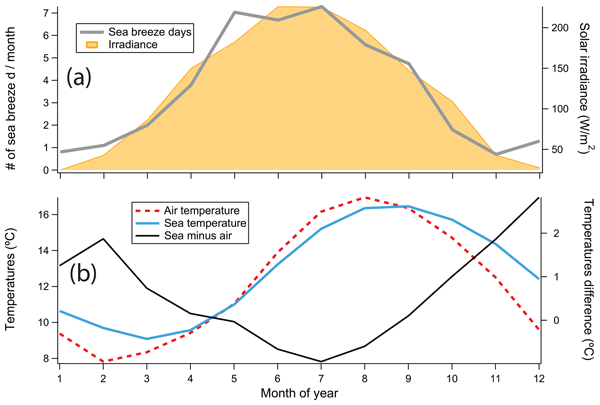
Abstract. In coastal environments, land and sea absorb and release heat at different rates due to their differing thermal properties. The resultant regular fluctuation in winds from onshore during the day to offshore at night, termed the diurnal sea breeze effect, can have a strong but uncertain impact on coastal air quality. In this study, from 10 years of observations from the Penlee Point Atmospheric Observatory on the northeast Atlantic coast, we identified 428 diurnal sea breeze events. Such events were most prevalent in spring and summer, when sea temperature is cooler than air temperature over land, wind speeds are relatively low, and the solar irradiance is strong. Observed surface concentrations of trace gases (O3, NOx, CH4, CO2) as well as aerosols (total aerosol number, PM2.5, PM10) were all elevated in the daytime during sea breeze events, increasing air quality regulation exceedance. Sea breeze generally coincided with the highest Ox (O3+NOx) levels in this environment (mean daytime mixing ratio around 45 ppb), likely due to poor pollutant dispersion at night and inflow of air with high O3 during the day from the marine atmosphere. The occurrence of diurnal sea breeze also confounds the representativeness of coastal observations for background North Atlantic atmosphere – excluding sea breeze events reduces the diurnal amplitudes in O3 and CH4 and also modifies their seasonal variations during southwesterly wind conditions.
-
Notice on discussion status
The requested preprint has a corresponding peer-reviewed final revised paper. You are encouraged to refer to the final revised version.
-
Preprint
(2449 KB)
-
The requested preprint has a corresponding peer-reviewed final revised paper. You are encouraged to refer to the final revised version.
- Preprint
(2449 KB) - Metadata XML
- BibTeX
- EndNote
- Final revised paper


Journal article(s) based on this preprint
Interactive discussion
Status: closed
-
RC1: 'Comment on egusphere-2026-780', Anonymous Referee #1, 19 Mar 2026
- AC1: 'Reply on RC1', Mingxi Yang, 08 May 2026
-
RC2: 'Comment on egusphere-2026-780', Anonymous Referee #2, 24 Mar 2026
The manuscript by Yang et al. reports a comprehensive long-term study of sea breeze effect on urban air quality. The study is fairly well developed, but I am not convinced that it deserves publication in ACP due to the lack of fundamental advances. Sea breeze is a too well-established phenomenon while its impact on air quality is mostly qualitatively established without numeric indicators or predictive value. I would suggest that the paper is published in Atmospheric Pollution Research or similar journals unless it is significantly more developed and advanced.
Line 17. The main result is "elevated concentrations"? There must be a quantitative result.
Line 61. There should be a more transparent account of data overlap, e.g. Table or better time line (Graph).
The geographical setting of the site together with the sea breeze directions would add contextual clarity.
Line 100. Was it challenging when tried various tests or just by the visuals?
Figure 2 and all. All Figures lack uncertainties to judge statistical significance which is also never quoted.
Line 185. To better account of total oxidants is to add normalized O3 and NOx instead of absolute, because O3 is typically higher than NOx almost all the time. Also, NOx is a sum of NO (rapidly reacting with O3) and NO2 (reaction product), so short-lived NO is better excluded. Instead, correlation of O3 vs NO would also be informative.
Figure 6. Same normalization problem as there is no difference in a and b due to NOx being 10% of O3.
Line 214. Oxidized, not destroyed.
Line 224. No need for mentioning "unknown" when suggesting fairly established reason of new particle formation from mostly iodine along the entire SW coast and around Plymouth or indeed shipping emissions if the pattern supported by ship frequency.
Figure 7. Ox pattern becomes more complex when O3 concentration becomes similar to NOx. Hence, normalization is preferred.
Line 255. Intuition must not inform definition of a background site, research must. It should be rephrased. It would very short-sighted if someone made the decision on the representativeness based on wind direction alone. Air mass trajectory analysis or anthropogenic indicators like black carbon should accompany definition of a background site.
Line 291. Can ~20% more pollution be called severe? Conclusions do not have a single number qualifier.
Citation: https://doi.org/10.5194/egusphere-2026-780-RC2 - AC2: 'Reply on RC2', Mingxi Yang, 08 May 2026
Peer review completion


Interactive discussion
Status: closed
-
RC1: 'Comment on egusphere-2026-780', Anonymous Referee #1, 19 Mar 2026
This manuscript presents a valuable long-term observational analysis of diurnal sea-breeze (DSB) effects at Penlee Point, using 10 years of coastal measurements and identifying 428 DSB days. The paper connects mesoscale coastal meteorology with both air-quality exceedance and the representativeness of a background marine monitoring site. The central result is that DSB days are associated with higher daytime concentrations of multiple pollutants and altered interpretation of southwest-sector “background” air.
Detailed comments are provided in the attached file.
- AC1: 'Reply on RC1', Mingxi Yang, 08 May 2026
-
RC2: 'Comment on egusphere-2026-780', Anonymous Referee #2, 24 Mar 2026
The manuscript by Yang et al. reports a comprehensive long-term study of sea breeze effect on urban air quality. The study is fairly well developed, but I am not convinced that it deserves publication in ACP due to the lack of fundamental advances. Sea breeze is a too well-established phenomenon while its impact on air quality is mostly qualitatively established without numeric indicators or predictive value. I would suggest that the paper is published in Atmospheric Pollution Research or similar journals unless it is significantly more developed and advanced.
Line 17. The main result is "elevated concentrations"? There must be a quantitative result.
Line 61. There should be a more transparent account of data overlap, e.g. Table or better time line (Graph).
The geographical setting of the site together with the sea breeze directions would add contextual clarity.
Line 100. Was it challenging when tried various tests or just by the visuals?
Figure 2 and all. All Figures lack uncertainties to judge statistical significance which is also never quoted.
Line 185. To better account of total oxidants is to add normalized O3 and NOx instead of absolute, because O3 is typically higher than NOx almost all the time. Also, NOx is a sum of NO (rapidly reacting with O3) and NO2 (reaction product), so short-lived NO is better excluded. Instead, correlation of O3 vs NO would also be informative.
Figure 6. Same normalization problem as there is no difference in a and b due to NOx being 10% of O3.
Line 214. Oxidized, not destroyed.
Line 224. No need for mentioning "unknown" when suggesting fairly established reason of new particle formation from mostly iodine along the entire SW coast and around Plymouth or indeed shipping emissions if the pattern supported by ship frequency.
Figure 7. Ox pattern becomes more complex when O3 concentration becomes similar to NOx. Hence, normalization is preferred.
Line 255. Intuition must not inform definition of a background site, research must. It should be rephrased. It would very short-sighted if someone made the decision on the representativeness based on wind direction alone. Air mass trajectory analysis or anthropogenic indicators like black carbon should accompany definition of a background site.
Line 291. Can ~20% more pollution be called severe? Conclusions do not have a single number qualifier.
Citation: https://doi.org/10.5194/egusphere-2026-780-RC2 - AC2: 'Reply on RC2', Mingxi Yang, 08 May 2026
Peer review completion
Journal article(s) based on this preprint
Viewed
| HTML | XML | Total | BibTeX | EndNote | |
|---|---|---|---|---|---|
| 1,080 | 578 | 105 | 1,763 | 103 | 167 |
- HTML: 1,080
- PDF: 578
- XML: 105
- Total: 1,763
- BibTeX: 103
- EndNote: 167
Viewed (geographical distribution)
| Country | # | Views | % |
|---|
| Total: | 0 |
| HTML: | 0 |
| PDF: | 0 |
| XML: | 0 |
- 1

Thomas G. Bell
Ian Brooks
Frances Hopkins
Jani Pewter
Katie Read
Timothy J. Smyth
The requested preprint has a corresponding peer-reviewed final revised paper. You are encouraged to refer to the final revised version.
- Preprint
(2449 KB) - Metadata XML
This manuscript presents a valuable long-term observational analysis of diurnal sea-breeze (DSB) effects at Penlee Point, using 10 years of coastal measurements and identifying 428 DSB days. The paper connects mesoscale coastal meteorology with both air-quality exceedance and the representativeness of a background marine monitoring site. The central result is that DSB days are associated with higher daytime concentrations of multiple pollutants and altered interpretation of southwest-sector “background” air.
Detailed comments are provided in the attached file.