
the Creative Commons Attribution 4.0 License.
the Creative Commons Attribution 4.0 License.
 | 04 Feb 2026
Dynamics of the Asian Summer Monsoon Anticyclone: Insights from Potential Vorticity Tendency Diagnostics
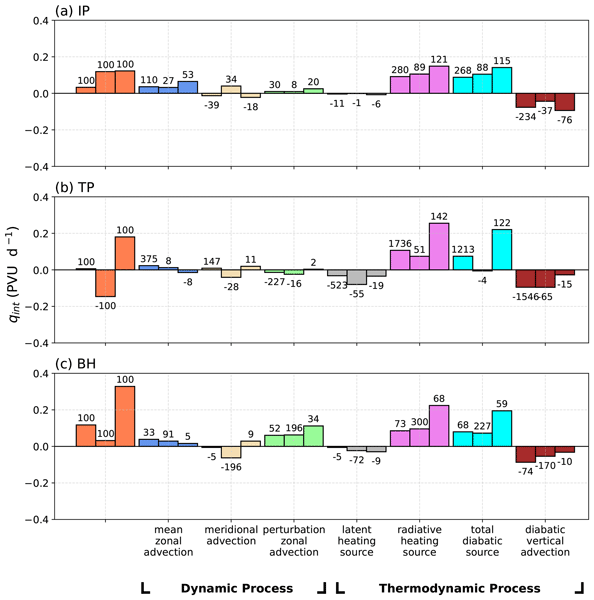
Abstract. The Asian Summer Monsoon Anticyclone (ASMA) is a dominant circulation in the upper troposphere and lower stratosphere (UTLS) during boreal summer and exhibits pronounced temporal and spatial variability. While its time-mean structure and climatological characteristics are well documented, the mechanisms governing its temporal evolution, particularly its eastward and westward propagation, episodic eddy-shedding events, and the emergence of multimodal behavior are remaining incompletely understood. Using multiple reanalysis datasets (JRA-3Q, ERA5, MERRA-2) from 2000–2020, this study analyzes the dynamic structures of the ASMA, the analysis shows that the ASMA exhibits a trimodal structure with centers over the Iranian Plateau, Tibetan Plateau, and western Pacific, identified via a multi-center vortex tracking algorithm applied to the 370 K isentropic surface to distinguish persistent and transient anticyclones. Further results show that mean zonal and meridional advection are the primary drivers of potential vorticity (PV) tendency, while total diabatic heating that plays a crucial modulating role in ASMA evolution. A key contribution of this work lies in the formulation and application of an ASMA-specific PV tendency diagnostic, which builds upon established PV budget and enables a more rigorous quantification of the respective roles of dynamical and thermodynamical processes in the anticyclone's intensification and zonal propagation across its three modes. This diagnostic decomposes total PV tendency into dynamic components (e.g., horizontal and vertical advection) and thermodynamic components (e.g., latent heating and background radiation), enabling the separation of the combined effects of anticyclone propagation and intensification by capturing a characteristic tripole pattern of PV tendency. Compared to conventional methods, this new diagnostic provides a more rigorous and precise quantification of the physical processes governing the ASMA's zonal movements and overall development, thereby advancing our scientific understanding of the ASMA's variability and underlying mechanisms in the UTLS region.
-
Notice on discussion status
The requested preprint has a corresponding peer-reviewed final revised paper. You are encouraged to refer to the final revised version.
-
Preprint
(31924 KB)
-
Supplement
(507 KB)
-
The requested preprint has a corresponding peer-reviewed final revised paper. You are encouraged to refer to the final revised version.
- Preprint
(31924 KB) - Metadata XML
-
Supplement
(507 KB) - BibTeX
- EndNote
- Final revised paper


Journal article(s) based on this preprint
Interactive discussion
Status: closed
-
RC1: 'Comment on egusphere-2026-558', Anonymous Referee #1, 15 Mar 2026
-
AC1: 'Reply on RC1', Ninghui Li, 08 Apr 2026
The comment was uploaded in the form of a supplement: https://egusphere.copernicus.org/preprints/2026/egusphere-2026-558/egusphere-2026-558-AC1-supplement.pdf
-
AC3: 'Reply on RC1', Ninghui Li, 22 Jun 2026
The comment was uploaded in the form of a supplement: https://egusphere.copernicus.org/preprints/2026/egusphere-2026-558/egusphere-2026-558-AC3-supplement.pdf
-
AC1: 'Reply on RC1', Ninghui Li, 08 Apr 2026
-
RC2: 'Comment on egusphere-2026-558', Anonymous Referee #2, 17 Apr 2026
Please find the comments in the attachment.
-
AC2: 'Reply on RC2', Ninghui Li, 28 May 2026
The comment was uploaded in the form of a supplement: https://egusphere.copernicus.org/preprints/2026/egusphere-2026-558/egusphere-2026-558-AC2-supplement.pdf
-
AC4: 'Reply on RC2', Ninghui Li, 22 Jun 2026
The comment was uploaded in the form of a supplement: https://egusphere.copernicus.org/preprints/2026/egusphere-2026-558/egusphere-2026-558-AC4-supplement.pdf
-
AC2: 'Reply on RC2', Ninghui Li, 28 May 2026
Peer review completion


Interactive discussion
Status: closed
-
RC1: 'Comment on egusphere-2026-558', Anonymous Referee #1, 15 Mar 2026
The study by Li et al. investigates the dynamics of the Asian monsoon upper-level anticyclone (ASMA) based on three different reanalysis datasets (JRA-3Q, ERA5, MERRA-2) and using vortex tracking and PV tendency diagnostics. It is argued that the ASMA exhibits a trimodal structure, with ASMA centers frequently occurring over the Iranian and Tibetan Plateaus and the Western Pacific, respectively. The analysis further shows that mean horizontal advection is the primary driver of the PV tendency in the ASMA region, with additional modulations due to diabatic heating.
I find the topic of the study, understanding ASMA dynamics, very relevant and clearly within the scope of the journal. However, I see two major issues with the current manuscript, regarding (1) the overall comprehensibility and fluency of the main text and (2) the comprehensibility and clarity of the method description (as further explained below). Because of these issues I'm not able to follow and fully understand the study based on the current manuscript version, and can't provide a full review and asssess the scientific value at this time. Therefore, I recommend rejection but encourage resubmission after the paper had been carefully revised.
In the following, I give a few specific examples which led me to this recommendation. These examples primarily come from the earlier sections of the paper, but in my opinion, the descriptions in the later sections also lack clarity. Therefore, the authors should not only address the following examples but also carefully review the entire paper before resubmission.
1.) Comprehensibility and fluency of the main text:
Overall, I see several places where the wording needs to be improved. A few examples are provided below, but there are many additional issues throughout the paper which make it very difficult to read and understand what is actually meant. I would recommend a thorough language edit, e.g. by the native English speakers among the co-authors. Here a selection of a few examples:
L5: Split the sentence "Using multiple ..." into two.
L8: I don't fully understand the "... while ... that ..." construction in this sentence.
L46: I think the grammar in the sentence "... eddy-shedding behavior that the ..." is not correct.
L56: diagnosticS
L102: Either "zero-wind contours are" or "zero-wind contour is", not a mixture of both.
L106: "Montgomery stream function" or "... potential".
L115: Same.
Fig. 1, caption: grid point closesT
L120: Sentence structure in "... search window that ..."
L124: centerS
L126: Think there should be an "and" after "anticyclonic" and a "the" before "Northern".
L127: must be of / characterized by ...
L144: "local rate of change" of what?
L144: I don't understand the construct "isentropic density of pressure p with potential temperature"
L151: Similarly for the sentence "Also, the Psi has a relationship with p and has a formula by Exner function..."
L154: Sentence incomplete: "Based on the momentum and continuity equations on the isentropic surface."
L155: Sentence structure confusing.
L159: What is meant by "the quantity conserved adiabatic-frictionless flow"?
L188: Rethink the wording in "due to the wind blowing different values of PV ...".2.) Comprehensibility and clarity of the method description:
I found the methods section extremely difficult to understand, likely due to the lack of text fluency mentioned earlier, as well as an unclear structure and ambiguities in the description of formulas and mathematical symbols. This made it challenging to fully grasp the methodology, and consequently, hindered my ability to assess the rest of the paper. I strongly recommend improving the methods section to enhance clarity. Below are a few examples where I struggled to understand the content:
L87ff: The levels used for the analysis should be also described.
L91: How is latent heating explicitly calculated? It would be good to describe that in detail here and also present the respective formula and show the resulting distribution.
Section 3.1: The entire description of the "vortex tracking" is difficult to follow and understand. I suggest to include a bullet point list of the individual steps, in addition to the other specific points below.
Eq. 1 and following paragraph: I don't fully understand the notation here. i is the index of the grid point. The zero-wind contour not necessarily passes through the grid points - so why should any grid point lie on the contour? Hence, to me "s_i is the distance along the contour, e.g. from point x(i-1) to x(i)..." seems not well-defined. Maybe I misunderstand something here? Please clarify, and perhaps include the x(i), s_i, ... also into Fig. 1 to enhance clarity.
L133: After having read the "Vortex tracking" section I'm still unsure how the tracking of vortices was exactly done. Please describe clearly how the vortices diagnosed at different times are related to identify connected tracks.
L153: I think R_d should be the gas constant not specific heat?
L158: The (Joseph, 1981) is surely not the original paper to cite here. Similarly for the citations in L162.
Eq. 7: What is the Q on the right-hand side of the equation exactly? The text says "Q is total diabatic heating". In most text books, Q denotes the diabatic heating rate, with units K/day. But this can not be meant here, as the units wouldn't match. The PV tendency equation should include a diabatic forcing term including also derivatives of the diabatic heating rate and I guess this term is meant here with Q - but this is not said. This is just one example of the inconsistent notation that appears throughout the paper, making it nearly impossible for the reader to fully understand the methodology.
Eq. 8: Why is the vertical advection term not expanded into mean plus fluctuation?
L184ff: Clearly explain at the beginning of this paragraph that and why isentropic coordinates are considered in the following (e.g. their advantages for the analysis). Then explain the differences to the pressure coordinate version of the equations. Furthermore, why is the isentropic version of the PV tendency equation not given in its version decomposed into mean state and fluctuation?
L185: "Therefore, the second term ..." comes after Eq. 8 without further explanation. Therefore, the reader thinks that the second term in Eq 8 is meant. However, I guess what is indeed meant is the second term in Eq. 6... ? Similarly for "expression" in L186 it is not clear which expression.
L279ff: Here, one example from the later parts of the paper. L280 states that q_dev is the "minimum PV inside each box", while L286 states that "q_int and q_prop are the PV tendencies". As Eq. 11 relates both, there seems to be a mismatch to me: Is it PV or PV tendency here?
Citation: https://doi.org/10.5194/egusphere-2026-558-RC1 -
AC1: 'Reply on RC1', Ninghui Li, 08 Apr 2026
The comment was uploaded in the form of a supplement: https://egusphere.copernicus.org/preprints/2026/egusphere-2026-558/egusphere-2026-558-AC1-supplement.pdf
-
AC3: 'Reply on RC1', Ninghui Li, 22 Jun 2026
The comment was uploaded in the form of a supplement: https://egusphere.copernicus.org/preprints/2026/egusphere-2026-558/egusphere-2026-558-AC3-supplement.pdf
-
AC1: 'Reply on RC1', Ninghui Li, 08 Apr 2026
-
RC2: 'Comment on egusphere-2026-558', Anonymous Referee #2, 17 Apr 2026
Please find the comments in the attachment.
-
AC2: 'Reply on RC2', Ninghui Li, 28 May 2026
The comment was uploaded in the form of a supplement: https://egusphere.copernicus.org/preprints/2026/egusphere-2026-558/egusphere-2026-558-AC2-supplement.pdf
-
AC4: 'Reply on RC2', Ninghui Li, 22 Jun 2026
The comment was uploaded in the form of a supplement: https://egusphere.copernicus.org/preprints/2026/egusphere-2026-558/egusphere-2026-558-AC4-supplement.pdf
-
AC2: 'Reply on RC2', Ninghui Li, 28 May 2026
Peer review completion
Journal article(s) based on this preprint
Viewed
| HTML | XML | Total | Supplement | BibTeX | EndNote | |
|---|---|---|---|---|---|---|
| 1,179 | 748 | 126 | 2,053 | 298 | 258 | 302 |
- HTML: 1,179
- PDF: 748
- XML: 126
- Total: 2,053
- Supplement: 298
- BibTeX: 258
- EndNote: 302
Viewed (geographical distribution)
| Country | # | Views | % |
|---|
| Total: | 0 |
| HTML: | 0 |
| PDF: | 0 |
| XML: | 0 |
- 1
Ninghui Li
Jonathon S. Wright

Philip Rupp
Alison Ming
Shenglong Zhang
Jie Gao
The requested preprint has a corresponding peer-reviewed final revised paper. You are encouraged to refer to the final revised version.
- Preprint
(31924 KB) - Metadata XML
-
Supplement
(507 KB) - BibTeX
- EndNote
- Final revised paper
The study by Li et al. investigates the dynamics of the Asian monsoon upper-level anticyclone (ASMA) based on three different reanalysis datasets (JRA-3Q, ERA5, MERRA-2) and using vortex tracking and PV tendency diagnostics. It is argued that the ASMA exhibits a trimodal structure, with ASMA centers frequently occurring over the Iranian and Tibetan Plateaus and the Western Pacific, respectively. The analysis further shows that mean horizontal advection is the primary driver of the PV tendency in the ASMA region, with additional modulations due to diabatic heating.
I find the topic of the study, understanding ASMA dynamics, very relevant and clearly within the scope of the journal. However, I see two major issues with the current manuscript, regarding (1) the overall comprehensibility and fluency of the main text and (2) the comprehensibility and clarity of the method description (as further explained below). Because of these issues I'm not able to follow and fully understand the study based on the current manuscript version, and can't provide a full review and asssess the scientific value at this time. Therefore, I recommend rejection but encourage resubmission after the paper had been carefully revised.
In the following, I give a few specific examples which led me to this recommendation. These examples primarily come from the earlier sections of the paper, but in my opinion, the descriptions in the later sections also lack clarity. Therefore, the authors should not only address the following examples but also carefully review the entire paper before resubmission.
1.) Comprehensibility and fluency of the main text:
Overall, I see several places where the wording needs to be improved. A few examples are provided below, but there are many additional issues throughout the paper which make it very difficult to read and understand what is actually meant. I would recommend a thorough language edit, e.g. by the native English speakers among the co-authors. Here a selection of a few examples:
L5: Split the sentence "Using multiple ..." into two.
L8: I don't fully understand the "... while ... that ..." construction in this sentence.
L46: I think the grammar in the sentence "... eddy-shedding behavior that the ..." is not correct.
L56: diagnosticS
L102: Either "zero-wind contours are" or "zero-wind contour is", not a mixture of both.
L106: "Montgomery stream function" or "... potential".
L115: Same.
Fig. 1, caption: grid point closesT
L120: Sentence structure in "... search window that ..."
L124: centerS
L126: Think there should be an "and" after "anticyclonic" and a "the" before "Northern".
L127: must be of / characterized by ...
L144: "local rate of change" of what?
L144: I don't understand the construct "isentropic density of pressure p with potential temperature"
L151: Similarly for the sentence "Also, the Psi has a relationship with p and has a formula by Exner function..."
L154: Sentence incomplete: "Based on the momentum and continuity equations on the isentropic surface."
L155: Sentence structure confusing.
L159: What is meant by "the quantity conserved adiabatic-frictionless flow"?
L188: Rethink the wording in "due to the wind blowing different values of PV ...".
2.) Comprehensibility and clarity of the method description:
I found the methods section extremely difficult to understand, likely due to the lack of text fluency mentioned earlier, as well as an unclear structure and ambiguities in the description of formulas and mathematical symbols. This made it challenging to fully grasp the methodology, and consequently, hindered my ability to assess the rest of the paper. I strongly recommend improving the methods section to enhance clarity. Below are a few examples where I struggled to understand the content:
L87ff: The levels used for the analysis should be also described.
L91: How is latent heating explicitly calculated? It would be good to describe that in detail here and also present the respective formula and show the resulting distribution.
Section 3.1: The entire description of the "vortex tracking" is difficult to follow and understand. I suggest to include a bullet point list of the individual steps, in addition to the other specific points below.
Eq. 1 and following paragraph: I don't fully understand the notation here. i is the index of the grid point. The zero-wind contour not necessarily passes through the grid points - so why should any grid point lie on the contour? Hence, to me "s_i is the distance along the contour, e.g. from point x(i-1) to x(i)..." seems not well-defined. Maybe I misunderstand something here? Please clarify, and perhaps include the x(i), s_i, ... also into Fig. 1 to enhance clarity.
L133: After having read the "Vortex tracking" section I'm still unsure how the tracking of vortices was exactly done. Please describe clearly how the vortices diagnosed at different times are related to identify connected tracks.
L153: I think R_d should be the gas constant not specific heat?
L158: The (Joseph, 1981) is surely not the original paper to cite here. Similarly for the citations in L162.
Eq. 7: What is the Q on the right-hand side of the equation exactly? The text says "Q is total diabatic heating". In most text books, Q denotes the diabatic heating rate, with units K/day. But this can not be meant here, as the units wouldn't match. The PV tendency equation should include a diabatic forcing term including also derivatives of the diabatic heating rate and I guess this term is meant here with Q - but this is not said. This is just one example of the inconsistent notation that appears throughout the paper, making it nearly impossible for the reader to fully understand the methodology.
Eq. 8: Why is the vertical advection term not expanded into mean plus fluctuation?
L184ff: Clearly explain at the beginning of this paragraph that and why isentropic coordinates are considered in the following (e.g. their advantages for the analysis). Then explain the differences to the pressure coordinate version of the equations. Furthermore, why is the isentropic version of the PV tendency equation not given in its version decomposed into mean state and fluctuation?
L185: "Therefore, the second term ..." comes after Eq. 8 without further explanation. Therefore, the reader thinks that the second term in Eq 8 is meant. However, I guess what is indeed meant is the second term in Eq. 6... ? Similarly for "expression" in L186 it is not clear which expression.
L279ff: Here, one example from the later parts of the paper. L280 states that q_dev is the "minimum PV inside each box", while L286 states that "q_int and q_prop are the PV tendencies". As Eq. 11 relates both, there seems to be a mismatch to me: Is it PV or PV tendency here?