
the Creative Commons Attribution 4.0 License.
the Creative Commons Attribution 4.0 License.
 | 04 Feb 2026
Seasonal prediction of springtime tornado activity in the United States using a hybrid model
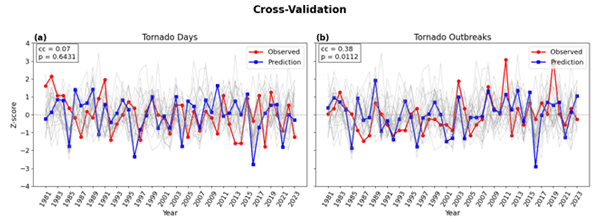
Abstract. Tornado activity in the contiguous United States (CONUS) causes fatalities and financial losses every spring, motivating attempts to skillfully predict springtime tornadoes. Such predictions would facilitate decision-making and resource management for both public and private stakeholders. Using ERA5 reanalysis, we identify five April–May weather regimes (WRs) from 1981–2023, some of which strongly modulate tornado activity. ECMWF seasonal forecasts initialized on April-1st are applied to predict WR frequency, including persistent and non-persistent WRs (lasting ≥5 and <5 consecutive days, respectively). The WR information are incorporated into a hybrid model to predict April–May CONUS tornado activity, including tornado outbreaks (days with > 10 EF-1+ tornadoes). Prediction skill is evaluated using leave-one-year-out cross-validation. Predicted and observed tornado outbreak frequencies are significantly correlated (cc=0.4). Outbreak predictions are more skillful during the positive phase of the Arctic Oscillation (AO) and Pacific North American pattern (PNA), with a proportion correct of 0.75 and 0.71, respectively. This implies that low-frequency climate modes can be used to identify forecasts of opportunity. SSTs over the North Pacific and North Atlantic may help explain the predictability of tornado activity but further work needs to be done to confirm those results. Our study demonstrates the potential for skillful prediction of spring tornado outbreaks using WR forecasts and should be prioritized in future work.
-
Notice on discussion status
The requested preprint has a corresponding peer-reviewed final revised paper. You are encouraged to refer to the final revised version.
-
Preprint
(1749 KB)
-
Supplement
(565 KB)
-
The requested preprint has a corresponding peer-reviewed final revised paper. You are encouraged to refer to the final revised version.
- Preprint
(1749 KB) - Metadata XML
-
Supplement
(565 KB) - BibTeX
- EndNote
- Final revised paper


Journal article(s) based on this preprint
Interactive discussion
Status: closed
-
RC1: 'Comment on egusphere-2026-536', Anonymous Referee #1, 11 Feb 2026
The comment was uploaded in the form of a supplement: https://egusphere.copernicus.org/preprints/2026/egusphere-2026-536/egusphere-2026-536-RC1-supplement.pdfCitation: https://doi.org/
10.5194/egusphere-2026-536-RC1 - AC1: 'Reply on RC1', Matthew Graber, 28 Apr 2026
-
RC2: 'Comment on egusphere-2026-536', Anonymous Referee #2, 22 Mar 2026
The comment was uploaded in the form of a supplement: https://egusphere.copernicus.org/preprints/2026/egusphere-2026-536/egusphere-2026-536-RC2-supplement.pdf
- AC2: 'Reply on RC2', Matthew Graber, 28 Apr 2026
Peer review completion


Interactive discussion
Status: closed
-
RC1: 'Comment on egusphere-2026-536', Anonymous Referee #1, 11 Feb 2026
The comment was uploaded in the form of a supplement: https://egusphere.copernicus.org/preprints/2026/egusphere-2026-536/egusphere-2026-536-RC1-supplement.pdf
- AC1: 'Reply on RC1', Matthew Graber, 28 Apr 2026
-
RC2: 'Comment on egusphere-2026-536', Anonymous Referee #2, 22 Mar 2026
The comment was uploaded in the form of a supplement: https://egusphere.copernicus.org/preprints/2026/egusphere-2026-536/egusphere-2026-536-RC2-supplement.pdf
- AC2: 'Reply on RC2', Matthew Graber, 28 Apr 2026
Peer review completion
Journal article(s) based on this preprint
Data sets
ERA5 hourly data on pressure levels from 1940 to present Hans Hersbach et al. https://doi.org/10.24381/cds.bd0915c6
ERA5 hourly data on single levels from 1940 to present Hans Hersbach et al. https://doi.org/10.24381/cds.adbb2d47
Severe Weather Database Files (1950-2024) Storm Prediction Center https://www.spc.noaa.gov/wcm/#data
ECMWF Seasonal Forecasts Copernicus Climate Change Service 2018 https://doi.org/10.24381/cds.50ed0a73
ERSST Huang et al. https://doi.org/10.1175/JCLI-D-16-0836.1
Model code and software
Springtime Prediction Code Matthew Graber https://github.com/Matt0604/Springtime-Prediction-Manuscript
Viewed
| HTML | XML | Total | Supplement | BibTeX | EndNote | |
|---|---|---|---|---|---|---|
| 1,931 | 1,705 | 137 | 3,773 | 285 | 271 | 393 |
- HTML: 1,931
- PDF: 1,705
- XML: 137
- Total: 3,773
- Supplement: 285
- BibTeX: 271
- EndNote: 393
Viewed (geographical distribution)
| Country | # | Views | % |
|---|
| Total: | 0 |
| HTML: | 0 |
| PDF: | 0 |
| XML: | 0 |
- 1
Matthew Graber

Robert J. Trapp
The requested preprint has a corresponding peer-reviewed final revised paper. You are encouraged to refer to the final revised version.
- Preprint
(1749 KB) - Metadata XML
-
Supplement
(565 KB) - BibTeX
- EndNote
- Final revised paper