
the Creative Commons Attribution 4.0 License.
the Creative Commons Attribution 4.0 License.
 | 03 Mar 2026
A unified Hapke-HSR + MARMIT-2 soil radiative transfer model for reflectance simulation under varying moisture conditions
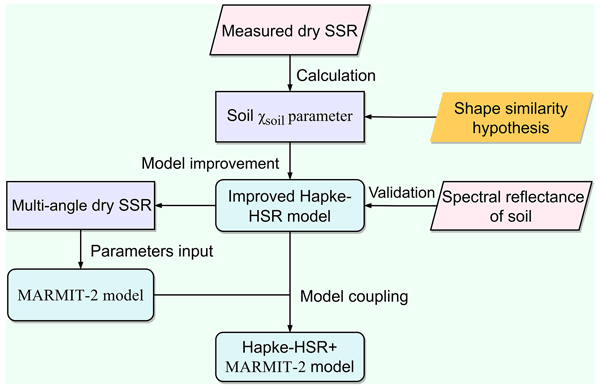
Abstract. Soil radiative transfer models (RTMs) provide a physical basis for interpreting surface reflectance and retrieving land-surface parameters. However, most existing soil RTMs represent either the spectral-directional scattering behavior of dry soils or the moisture-induced absorption effects of wet soils, and a physically consistent formulation capable of jointly describing both processes remains limited. In this study, we develop a unified soil RTM by refining the Hapke-based hyperspectral reflectance model (Hapke-HSR) using dry soil reflectance and dynamically coupling it with the improved multilayer RTM of soil reflectance (MARMIT-2). The proposed Hapke- HSR + MARMIT-2 model explicitly represents the interaction between particle scattering and moisture-dependent absorption and refraction processes, enabling joint spectral-directional simulation of soil reflectance under varying soil moisture conditions. The model is systematically evaluated using eight independent soil spectral databases spanning a wide range of textures and moisture levels. Results show that the Hapke-HSR + MARMIT-2 model consistently improves simulation accuracy and stability relative to the individual Hapke-HSR and MARMIT-2 models, with particularly pronounced gains at high soil moisture regimes (SMC ≥ 30 %). Across all datasets, the proposed model achieves higher performance (R2 = 0.993, RMSE = 0.007) than MARMIT-2 (R2 = 0.983, RMSE = 0.012) and Hapke-HSR (R2 = 0.909, RMSE = 0.028). The proposed framework provides a physically interpretable and extensible basis for soil reflectance modeling and offers a robust foundation for future developments in multiangular hyperspectral remote sensing and land-surface parameter inversion.
-
Notice on discussion status
The requested preprint has a corresponding peer-reviewed final revised paper. You are encouraged to refer to the final revised version.
-
Preprint
(2519 KB)
-
The requested preprint has a corresponding peer-reviewed final revised paper. You are encouraged to refer to the final revised version.
- Preprint
(2519 KB) - Metadata XML
- BibTeX
- EndNote
- Final revised paper


Journal article(s) based on this preprint
Interactive discussion
Status: closed
-
RC1: 'Comment on egusphere-2026-344', Anonymous Referee #1, 27 Mar 2026
-
AC1: 'Reply on RC1', Anxin Ding, 23 Apr 2026
We sincerely thank the reviewer for the careful and constructive comments on our manuscript.
In response, we have thoroughly revised the manuscript to address all comments. The main revisions include clarifying the novelty and scientific contribution of the proposed framework, improving the description of the model coupling strategy and parameter estimation, strengthening the discussion of model applicability and limitations, and expanding comparisons with existing approaches. A detailed, point-by-point response to all reviewer comments is provided in the attached supplement, where all revisions are clearly indicated.
We believe that these revisions have significantly improved the clarity and overall quality of the manuscript, and we sincerely hope that the revised version meets the reviewer’s expectations.
-
AC1: 'Reply on RC1', Anxin Ding, 23 Apr 2026
-
RC2: 'Comment on egusphere-2026-344', Anonymous Referee #2, 10 Apr 2026
This study introduces a soil radiative transfer framework designed to reproduce soil reflectance behavior under varying SMC conditions. The subject is of clear importance to the remote sensing field. The manuscript is logically organized, and the evaluation using diverse datasets indicates that the proposed approach has strong potential. That said, several aspects require further clarification before the work can be fully appreciated. With these revisions, the manuscript is expected to reach the standard required for publication.
Comments to the Authors
1. Lines, 90-94, and 211-216. The manuscript emphasizes parameter b within the Hapke-HSR framework, yet the procedure used to determine its optimal value is not sufficiently described. Moreover, although parameter c also contributes to shaping the phase function, its role is not adequately addressed. A clearer explanation of how these parameters are treated would improve the transparency of the modeling approach.
2. Lines, 117-118. The parameters C3 and C4 introduced in Eq. (17) require further clarification. Providing additional details on their physical interpretation and derivation process would help readers better understand their function within the model.
3. In the Table 3. To enhance clarity, it would be beneficial to summarize the parameter settings of the Hapke-HSR model, the MARMIT-2 model, and their coupled formulation. In particular, explicitly categorizing parameters into fixed, prescribed inputs, and those subject to retrieval would improve consistency and readability throughout the manuscript.
4. In the Figure 4, it is not easy to see the difference among different models. Could you explain the difference? The authors only showed the results for these two samples in Table 4.
5. In the Figure 9. The model is evaluated using multiple datasets, which demonstrates its potential. However, additional commentary on the variability of model performance across these datasets would provide deeper insight into its robustness and limitations.
6. The current manuscript mainly presents results from forward simulations. Given that the Introduction emphasize the role of soil reflectance in canopy reflectance and vegetation parameter retrieval, it may be helpful to include a brief discussion or additional comparison to further illustrate this connection.
Minor comments:
1. Line 268. How to define the range of high SMC?
2. Please keep consistency in the terminology used for soil models, soil reflectance models, and soil radiative transfer models.
3. Table 3, how to determine the ranges of model parameters? Please add some references.
4. The description of the Hapke-HSR model and its improved version is very confusing. Please explain it.
Citation: https://doi.org/10.5194/egusphere-2026-344-RC2 -
AC2: 'Reply on RC2', Anxin Ding, 23 Apr 2026
We sincerely thank the reviewer for the positive assessment of our manuscript. We greatly appreciate the recognition of the importance of the topic, the logical organization, and the strong potential of the proposed framework.
We also thank the reviewer for the valuable suggestions regarding aspects that require further clarification. In response, we have carefully revised the manuscript to address all comments and to improve the clarity of the methodology, parameter description, model coupling strategy, and discussion of model applicability. A detailed, point-by-point response to all comments from this reviewer is provided in the attached supplement, where all revisions are clearly indicated.
We believe that these revisions have strengthened the manuscript and improved its overall quality, and we sincerely hope that the revised version meets the reviewer’s expectations.
-
AC2: 'Reply on RC2', Anxin Ding, 23 Apr 2026
Peer review completion


Interactive discussion
Status: closed
-
RC1: 'Comment on egusphere-2026-344', Anonymous Referee #1, 27 Mar 2026
The manuscript proposes a coupled soil radiative transfer model by integrating the improved Hapke-HSR model with the MARMIT-2 model to simulate soil spectral reflectance under varying moisture conditions. The topic is relevant, and the study demonstrates promising results across multiple datasets. The manuscript shows clear novelty, with a well-organized structure and generally good writing quality. I recommend publication after major revisions. I encourage the authors to address the following comments.
1. Although the proposed coupled model shows promising performance, the novelty of the study could be further clarified. It is recommended to explicitly highlight the key innovations of the proposed approach in comparison with existing models (e.g., Hapke or MARMIT-2) in the Introduction, to strengthen the overall contribution of the manuscript.
2. Several models are listed in Table 1; however, it is not entirely clear why the Hapke-HSR and MARMIT-2 models were selected for coupling instead of other possible combinations (e.g., BSM with Hapke-HSR). A brief justification for this choice would improve the clarity of the study design.
3. The manuscript should provide clearer references or methodological explanations regarding how the optimal values of parameters such as B0, h, b′, c, and c′ are determined. In addition, since both b and c influence the BRDF shape in the Hapke model, it would be helpful to clarify why the discussion primarily focuses on parameter b.
4. In the current manuscript, the distinction between input parameters and retrieved parameters is not always clear, particularly in some tables. It is recommended to clearly differentiate these parameter types and ensure consistent terminology throughout the manuscript.
5. The study is mainly conducted under a fixed observation geometry. It would be beneficial to further discuss how this assumption may influence the model results, as well as the applicability of the model under different viewing and illumination conditions.
6. Although the validation results are generally convincing, the study could be further strengthened by including comparisons with additional models (e.g., GSV or similar approaches), or by providing more discussion on the differences between the proposed model and existing methods.
7. The coupling strategy between the improved Hapke-HSR model and the MARMIT-2 model is not entirely clear. It would be useful to clarify whether the parameters (b, M, δ, L, ε) are retrieved sequentially or simultaneously, and to provide a clearer description of the integration workflow.
8. In the Discussion, the manuscript attributes the decrease in model accuracy (when using averaged χsoil) mainly to differences in soil types. However, soil properties (e.g., organic carbon content, texture) can vary significantly even within the same soil type and may strongly affect spectral absorption. It is suggested to consider incorporating soil property variability or grouping spectrally similar soils when defining χsoil, which may further improve model performance.
Citation: https://doi.org/10.5194/egusphere-2026-344-RC1 -
AC1: 'Reply on RC1', Anxin Ding, 23 Apr 2026
We sincerely thank the reviewer for the careful and constructive comments on our manuscript.
In response, we have thoroughly revised the manuscript to address all comments. The main revisions include clarifying the novelty and scientific contribution of the proposed framework, improving the description of the model coupling strategy and parameter estimation, strengthening the discussion of model applicability and limitations, and expanding comparisons with existing approaches. A detailed, point-by-point response to all reviewer comments is provided in the attached supplement, where all revisions are clearly indicated.
We believe that these revisions have significantly improved the clarity and overall quality of the manuscript, and we sincerely hope that the revised version meets the reviewer’s expectations.
-
AC1: 'Reply on RC1', Anxin Ding, 23 Apr 2026
-
RC2: 'Comment on egusphere-2026-344', Anonymous Referee #2, 10 Apr 2026
This study introduces a soil radiative transfer framework designed to reproduce soil reflectance behavior under varying SMC conditions. The subject is of clear importance to the remote sensing field. The manuscript is logically organized, and the evaluation using diverse datasets indicates that the proposed approach has strong potential. That said, several aspects require further clarification before the work can be fully appreciated. With these revisions, the manuscript is expected to reach the standard required for publication.
Comments to the Authors
1. Lines, 90-94, and 211-216. The manuscript emphasizes parameter b within the Hapke-HSR framework, yet the procedure used to determine its optimal value is not sufficiently described. Moreover, although parameter c also contributes to shaping the phase function, its role is not adequately addressed. A clearer explanation of how these parameters are treated would improve the transparency of the modeling approach.
2. Lines, 117-118. The parameters C3 and C4 introduced in Eq. (17) require further clarification. Providing additional details on their physical interpretation and derivation process would help readers better understand their function within the model.
3. In the Table 3. To enhance clarity, it would be beneficial to summarize the parameter settings of the Hapke-HSR model, the MARMIT-2 model, and their coupled formulation. In particular, explicitly categorizing parameters into fixed, prescribed inputs, and those subject to retrieval would improve consistency and readability throughout the manuscript.
4. In the Figure 4, it is not easy to see the difference among different models. Could you explain the difference? The authors only showed the results for these two samples in Table 4.
5. In the Figure 9. The model is evaluated using multiple datasets, which demonstrates its potential. However, additional commentary on the variability of model performance across these datasets would provide deeper insight into its robustness and limitations.
6. The current manuscript mainly presents results from forward simulations. Given that the Introduction emphasize the role of soil reflectance in canopy reflectance and vegetation parameter retrieval, it may be helpful to include a brief discussion or additional comparison to further illustrate this connection.
Minor comments:
1. Line 268. How to define the range of high SMC?
2. Please keep consistency in the terminology used for soil models, soil reflectance models, and soil radiative transfer models.
3. Table 3, how to determine the ranges of model parameters? Please add some references.
4. The description of the Hapke-HSR model and its improved version is very confusing. Please explain it.
Citation: https://doi.org/10.5194/egusphere-2026-344-RC2 -
AC2: 'Reply on RC2', Anxin Ding, 23 Apr 2026
We sincerely thank the reviewer for the positive assessment of our manuscript. We greatly appreciate the recognition of the importance of the topic, the logical organization, and the strong potential of the proposed framework.
We also thank the reviewer for the valuable suggestions regarding aspects that require further clarification. In response, we have carefully revised the manuscript to address all comments and to improve the clarity of the methodology, parameter description, model coupling strategy, and discussion of model applicability. A detailed, point-by-point response to all comments from this reviewer is provided in the attached supplement, where all revisions are clearly indicated.
We believe that these revisions have strengthened the manuscript and improved its overall quality, and we sincerely hope that the revised version meets the reviewer’s expectations.
-
AC2: 'Reply on RC2', Anxin Ding, 23 Apr 2026
Peer review completion
Journal article(s) based on this preprint
Viewed
| HTML | XML | Total | BibTeX | EndNote | |
|---|---|---|---|---|---|
| 849 | 327 | 78 | 1,254 | 63 | 125 |
- HTML: 849
- PDF: 327
- XML: 78
- Total: 1,254
- BibTeX: 63
- EndNote: 125
Viewed (geographical distribution)
| Country | # | Views | % |
|---|
| Total: | 0 |
| HTML: | 0 |
| PDF: | 0 |
| XML: | 0 |
- 1
Anxin Ding
Ziti Jiao
Alexander A. Kokhanovsky
Hanyu Shi
Rui Xie
The requested preprint has a corresponding peer-reviewed final revised paper. You are encouraged to refer to the final revised version.
- Preprint
(2519 KB) - Metadata XML
The manuscript proposes a coupled soil radiative transfer model by integrating the improved Hapke-HSR model with the MARMIT-2 model to simulate soil spectral reflectance under varying moisture conditions. The topic is relevant, and the study demonstrates promising results across multiple datasets. The manuscript shows clear novelty, with a well-organized structure and generally good writing quality. I recommend publication after major revisions. I encourage the authors to address the following comments.
1. Although the proposed coupled model shows promising performance, the novelty of the study could be further clarified. It is recommended to explicitly highlight the key innovations of the proposed approach in comparison with existing models (e.g., Hapke or MARMIT-2) in the Introduction, to strengthen the overall contribution of the manuscript.
2. Several models are listed in Table 1; however, it is not entirely clear why the Hapke-HSR and MARMIT-2 models were selected for coupling instead of other possible combinations (e.g., BSM with Hapke-HSR). A brief justification for this choice would improve the clarity of the study design.
3. The manuscript should provide clearer references or methodological explanations regarding how the optimal values of parameters such as B0, h, b′, c, and c′ are determined. In addition, since both b and c influence the BRDF shape in the Hapke model, it would be helpful to clarify why the discussion primarily focuses on parameter b.
4. In the current manuscript, the distinction between input parameters and retrieved parameters is not always clear, particularly in some tables. It is recommended to clearly differentiate these parameter types and ensure consistent terminology throughout the manuscript.
5. The study is mainly conducted under a fixed observation geometry. It would be beneficial to further discuss how this assumption may influence the model results, as well as the applicability of the model under different viewing and illumination conditions.
6. Although the validation results are generally convincing, the study could be further strengthened by including comparisons with additional models (e.g., GSV or similar approaches), or by providing more discussion on the differences between the proposed model and existing methods.
7. The coupling strategy between the improved Hapke-HSR model and the MARMIT-2 model is not entirely clear. It would be useful to clarify whether the parameters (b, M, δ, L, ε) are retrieved sequentially or simultaneously, and to provide a clearer description of the integration workflow.
8. In the Discussion, the manuscript attributes the decrease in model accuracy (when using averaged χsoil) mainly to differences in soil types. However, soil properties (e.g., organic carbon content, texture) can vary significantly even within the same soil type and may strongly affect spectral absorption. It is suggested to consider incorporating soil property variability or grouping spectrally similar soils when defining χsoil, which may further improve model performance.