
the Creative Commons Attribution 4.0 License.
the Creative Commons Attribution 4.0 License.
 | 31 Mar 2026
Evaluation of a Coupled Regional Reanalysis for the Mediterranean Region Covering the period 1993–2024
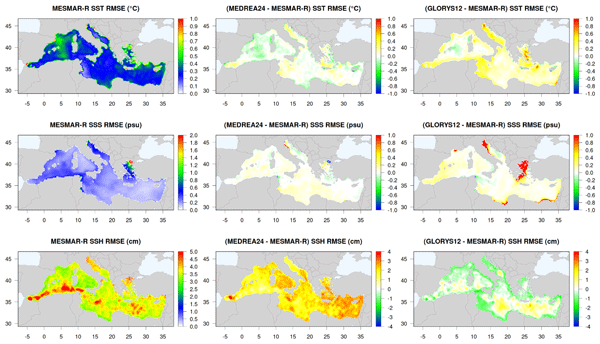
Abstract. Regional reanalyses provide physically consistent reconstructions of past climate, offering a powerful tool for understanding the processes that shape regional responses to climate change. Here, we introduce MESMAR-R, a newly developed coupled atmosphere-ocean-hydrology reanalysis for the Mediterranean region. The system couples state-of-the-art numerical models with data assimilation in both the ocean and the atmosphere, producing a dynamically coherent reconstruction of the 1993–2024 period. MESMAR-R shows strong performance in the ocean, particularly for sea level, sea-surface salinity, and upper-layer temperature, confirming its skill in the layers most relevant for air–sea interactions. The atmospheric component performs reasonably well given its simplified assimilation based on three-dimensional nudging, yielding basin-scale fields comparable to state-of-the-art reanalyses and maintaining internally consistent coupled air-sea interactions. Sensitivity experiments show that data assimilation in both the ocean and atmosphere is essential for optimal performance: coupling alone does not necessarily improve reanalysis skill, but its benefits are relevant for salinity and surface fluxes and amplify when complemented by data assimilation. The ocean and atmospheric trends reconstructed by MESMAR-R are physically coherent and consistent with observations, reproducing basin-wide salinification, thermo-halo compensation in steric sea level, mass-driven sea-level rise, and pronounced near-surface atmospheric warming and drying. MESMAR-R therefore provides a unique, balanced reconstruction of past Mediterranean climate, suitable for investigating coupled air–sea processes, compound events, marine extremes, and other phenomena where dynamically consistent atmosphere–ocean interactions are essential.
Competing interests: At least one of the (co-)authors is a member of the editorial board of Ocean Science. The peer-review process was guided by an independent editor, and the authors also have no other competing interests to declare.
Publisher's note: Copernicus Publications remains neutral with regard to jurisdictional claims made in the text, published maps, institutional affiliations, or any other geographical representation in this paper. While Copernicus Publications makes every effort to include appropriate place names, the final responsibility lies with the authors. Views expressed in the text are those of the authors and do not necessarily reflect the views of the publisher.-
Notice on discussion status
The requested preprint has a corresponding peer-reviewed final revised paper. You are encouraged to refer to the final revised version.
-
Preprint
(4193 KB)
-
The requested preprint has a corresponding peer-reviewed final revised paper. You are encouraged to refer to the final revised version.
- Preprint
(4193 KB) - Metadata XML
- BibTeX
- EndNote
- Final revised paper


Journal article(s) based on this preprint
Interactive discussion
Status: closed
-
RC1: 'Comment on egusphere-2026-1549', XIAOLIN YU, 22 Jun 2026
- AC1: 'Reply on RC1', Andrea Storto, 27 Jul 2026
-
RC2: 'Comment on egusphere-2026-1549', Anonymous Referee #2, 23 Jun 2026
The article reports on a new coupled reanalysis for a regional Mediterranean system allowing mesoscale processes. The scientific motivation of this work is well posed. I believe that this paper certainly merits being published after some minor revisions. Mainly, I would propose introducing a reasonable discussion of the data assimilation methods employed in the coupled framework in addition to the references provided.
Specific comments :
- Line 8 : please introduce properly the acronym MESMAR-R.
- Line 106: please provide additional reasoning why the fluxes are computed in the atmosphere and not in the ocean model employed higher horizontal resolution. Such discussion may be interesting for readers.
- Line 119: why the spectral nudging technique has been used and not a data assimilation method like in the ocean component?
Citation: https://doi.org/10.5194/egusphere-2026-1549-RC2 - AC2: 'Reply on RC2', Andrea Storto, 27 Jul 2026
-
RC3: 'Comment on egusphere-2026-1549', Alma Carolina Castillo-Trujillo, 29 Jun 2026
- AC3: 'Reply on RC3', Andrea Storto, 27 Jul 2026
Peer review completion


Interactive discussion
Status: closed
-
RC1: 'Comment on egusphere-2026-1549', XIAOLIN YU, 22 Jun 2026
- AC1: 'Reply on RC1', Andrea Storto, 27 Jul 2026
-
RC2: 'Comment on egusphere-2026-1549', Anonymous Referee #2, 23 Jun 2026
The article reports on a new coupled reanalysis for a regional Mediterranean system allowing mesoscale processes. The scientific motivation of this work is well posed. I believe that this paper certainly merits being published after some minor revisions. Mainly, I would propose introducing a reasonable discussion of the data assimilation methods employed in the coupled framework in addition to the references provided.
Specific comments :
- Line 8 : please introduce properly the acronym MESMAR-R.
- Line 106: please provide additional reasoning why the fluxes are computed in the atmosphere and not in the ocean model employed higher horizontal resolution. Such discussion may be interesting for readers.
- Line 119: why the spectral nudging technique has been used and not a data assimilation method like in the ocean component?
Citation: https://doi.org/10.5194/egusphere-2026-1549-RC2 - AC2: 'Reply on RC2', Andrea Storto, 27 Jul 2026
-
RC3: 'Comment on egusphere-2026-1549', Alma Carolina Castillo-Trujillo, 29 Jun 2026
- AC3: 'Reply on RC3', Andrea Storto, 27 Jul 2026
Peer review completion
Journal article(s) based on this preprint
Data sets
MESMAR-R: A Coupled Regional Reanalysis for the Mediterranean Region Covering the period 1993-2024 [Data set] A. Storto et al. https://doi.org/10.5281/zenodo.17829847
Model code and software
MESMAR v1: a new regional 749 coupled climate model for downscaling, predictability, and data assimilation studies in the Mediterranean region A. Storto https://doi.org/10.5281/zenodo.7898938
Viewed
| HTML | XML | Total | BibTeX | EndNote | |
|---|---|---|---|---|---|
| 393 | 171 | 31 | 595 | 43 | 42 |
- HTML: 393
- PDF: 171
- XML: 31
- Total: 595
- BibTeX: 43
- EndNote: 42
Viewed (geographical distribution)
| Country | # | Views | % |
|---|
| Total: | 0 |
| HTML: | 0 |
| PDF: | 0 |
| XML: | 0 |
- 1

Vincenzo de Toma
The requested preprint has a corresponding peer-reviewed final revised paper. You are encouraged to refer to the final revised version.
- Preprint
(4193 KB) - Metadata XML
See the attachment