
the Creative Commons Attribution 4.0 License.
the Creative Commons Attribution 4.0 License.
 | 07 Apr 2026
A Physics-based Framework to Infer Firn Properties on Antarctic Ice Shelves from ASCAT Observations
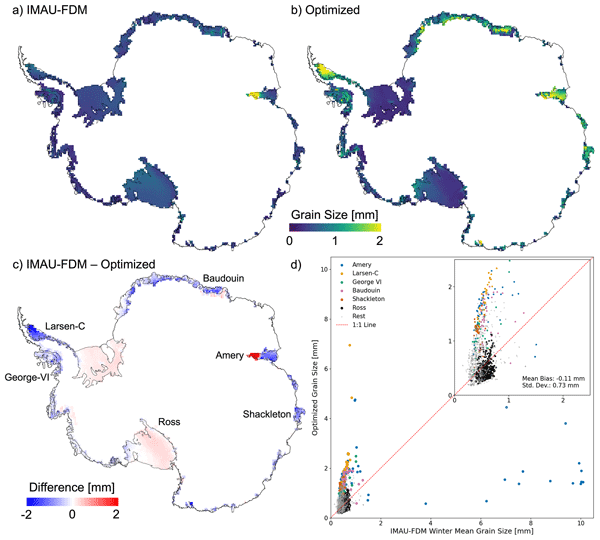
Abstract. The stability of Antarctic ice shelves is closely linked to the properties of the firn layer, which regulates meltwater retention and influences ice shelf vulnerability to hydrofracturing. Firn Densification Models (FDMs) provide valuable insights into the firn structure, but key properties such as grain size are often parameterized using simple approximations, leading to significant uncertainties, especially in regions lacking in-situ validation. Here, we leverage 15 years (2007–2021) of active microwave observations from the C-band Advanced Scatterometer (ASCAT) to infer an effective firn grain-size parameter across Antarctic ice shelves. Within this framework, we use the Institute for Marine and Atmospheric Research Utrecht Firn Densification Model (IMAU-FDM) to prescribe the state of the firn layer (layer thickness, density, temperature, and liquid water content) and couple it with the Snow Microwave Radiative Transfer (SMRT) model to simulate radar backscatter. Grain size is treated as an unknown microstructural parameter and is optimized by minimizing the misfit between FDM–SMRT simulations and ASCAT observations. The framework is further used to examine how the sensitivity of ASCAT backscatter varies across firn regimes, and how this influences the interpretation of backscatter in terms of FAC. Our results show broad consistency between optimized effective grain size and IMAU-FDM estimates in high-Firn Air Content (FAC) regions, where ASCAT backscatter is most sensitive to interannual variability in grain size. In contrast, larger discrepancies emerge in intermediate- to low-FAC regions, particularly on the Amery Ice Shelf, where ice saturation in the firn (pore-space depletion) influences grain growth. The sensitivity experiments indicate that inversion constraints are regime-dependent, with the strongest sensitivity to grain size in intermediate firn regimes and weaker constraints in strongly depleted firn. Furthermore, by statistically reducing grain-size-driven scatter after inversion, we present a proof of concept for a more interpretable backscatter–FAC relationship. These findings provide a basis for improving firn model parameterization and advancing large-scale monitoring of firn evolution across Antarctic ice shelves in a warming climate.
-
Notice on discussion status
The requested preprint has a corresponding peer-reviewed final revised paper. You are encouraged to refer to the final revised version.
-
Preprint
(16646 KB)
-
The requested preprint has a corresponding peer-reviewed final revised paper. You are encouraged to refer to the final revised version.
- Preprint
(16646 KB) - Metadata XML
- BibTeX
- EndNote
- Final revised paper


Journal article(s) based on this preprint
Interactive discussion
Status: closed
-
RC1: 'Comment on egusphere-2026-1263', Shashi Kumar, 24 Apr 2026
- AC1: 'Reply on RC1', Shashwat Shukla, 20 May 2026
-
RC2: 'Important Contribution Requiring Revision', Anonymous Referee #2, 24 Apr 2026
I debated between major and minor for this paper, but ultimately decided on minor.
I believe the research objective is extremely important. Using ASCAT data to constrain grain size evolution on Antarctic ice shelves addresses a real gap in firn modeling. The knowledge gained about how grain size influences microwave backscatter would genuinely help progress related research on firn permeability and meltwater retention.
That said, there are substantive issues to address. The single-layer grain-size assumption needs more discussion given vertical processes like refreezing. The FAC retrieval ambiguity at low backscatter values requires clarification. Several methodological aspects such as temporal aggregation choices, computational feasibility, and some interpretive framing etc can be strengthened.
The basic idea of the conducted research is good and the contributions are valuable. However, I strongly recommend addressing the reviews in the subsequent revisions before it accepting it for the publication.
Please find attached my detailed comments.
- AC2: 'Reply on RC2', Shashwat Shukla, 20 May 2026
Peer review completion


Interactive discussion
Status: closed
-
RC1: 'Comment on egusphere-2026-1263', Shashi Kumar, 24 Apr 2026
The manuscript is well prepared and presents a valuable contribution to the field. I have a few minor suggestions that should be incorporated into the revised version to further enhance its clarity, rigor, and overall impact.
- The manuscript would benefit from stating even more consistently, particularly in the Abstract, Introduction, and Conclusions, that the retrieved grain size represents an effective ASCAT-conditioned parameter. Likewise, the FAC-related analysis should be explicitly framed as a proof of concept rather than an operational retrieval product.
- Section 3 contains all the necessary methodological details; however, the overall workflow could be presented more clearly. In particular, it would be helpful to state explicitly, ideally at the beginning of the Methods section or in a brief schematic overview, that firn stratigraphy (including density, temperature, liquid water content, and layering) is prescribed from IMAU-FDM; that the inversion estimates only a single column-integrated grain-size parameter; and that the ANOVA and grain-size standardization are applied as post-inversion diagnostic analyses. This clarification would greatly improve the transparency of the methodological framework without altering the underlying approach.
- The manuscript appropriately notes that the excellent agreement between the optimized FDM-SMRT backscatter and ASCAT should be interpreted as internal consistency within the adopted modelling framework, rather than as an independent validation. Given the strength of the reported fit, however, this important caveat should be highlighted more prominently in the main Results section and/or in the caption of Appendix Figure A1, so that readers encounter this interpretive context alongside the performance metrics.
- The manuscript correctly acknowledges that the ANOVA should be interpreted as a conditional diagnostic within the adopted framework, since the optimized grain size is itself derived from ASCAT observations. However, some instances of the term “explained variance” may inadvertently imply a stronger degree of independence or causality than intended. To enhance interpretive precision, I recommend consistently adopting terminology such as “variance partitioning within the adopted framework” in Section 3.4, Section 4.4, and Appendix B, and, where appropriate, in the corresponding figure captions. This refinement would strengthen the rigor of interpretation without requiring additional analyses.
- One of the manuscript’s key strengths is its clear recognition of the conditions under which the inversion is more or less informative. For example, grain-size identifiability appears stronger in certain regimes and weaker over shallow-slope plateau regions, while unmodelled near-surface processes may become increasingly important in dry, high-FAC environments. Similarly, the FAC-related interpretation is appropriately presented as a proof of concept. To further enhance clarity for readers, I recommend adding a concise synthesis paragraph, either at the end of the Results section or at the beginning of the Limitations section, summarizing where confidence in the retrieval is relatively high, where it is lower, and the physical reasons underlying these differences. This would improve accessibility and interpretability without altering the scientific content.
Citation: https://doi.org/10.5194/egusphere-2026-1263-RC1 - AC1: 'Reply on RC1', Shashwat Shukla, 20 May 2026
-
RC2: 'Important Contribution Requiring Revision', Anonymous Referee #2, 24 Apr 2026
I debated between major and minor for this paper, but ultimately decided on minor.
I believe the research objective is extremely important. Using ASCAT data to constrain grain size evolution on Antarctic ice shelves addresses a real gap in firn modeling. The knowledge gained about how grain size influences microwave backscatter would genuinely help progress related research on firn permeability and meltwater retention.
That said, there are substantive issues to address. The single-layer grain-size assumption needs more discussion given vertical processes like refreezing. The FAC retrieval ambiguity at low backscatter values requires clarification. Several methodological aspects such as temporal aggregation choices, computational feasibility, and some interpretive framing etc can be strengthened.
The basic idea of the conducted research is good and the contributions are valuable. However, I strongly recommend addressing the reviews in the subsequent revisions before it accepting it for the publication.
Please find attached my detailed comments.
- AC2: 'Reply on RC2', Shashwat Shukla, 20 May 2026
Peer review completion
Journal article(s) based on this preprint
Viewed
| HTML | XML | Total | BibTeX | EndNote | |
|---|---|---|---|---|---|
| 374 | 199 | 39 | 612 | 40 | 33 |
- HTML: 374
- PDF: 199
- XML: 39
- Total: 612
- BibTeX: 40
- EndNote: 33
Viewed (geographical distribution)
| Country | # | Views | % |
|---|
| Total: | 0 |
| HTML: | 0 |
| PDF: | 0 |
| XML: | 0 |
- 1

Bert Wouters
Sanne Veldhuijsen
Sophie de Roda Husman
Weiran Li
Stef Lhermitte
The requested preprint has a corresponding peer-reviewed final revised paper. You are encouraged to refer to the final revised version.
- Preprint
(16646 KB) - Metadata XML
The manuscript is well prepared and presents a valuable contribution to the field. I have a few minor suggestions that should be incorporated into the revised version to further enhance its clarity, rigor, and overall impact.