
the Creative Commons Attribution 4.0 License.
the Creative Commons Attribution 4.0 License.
 | 11 Mar 2026
CRUX-1.0: An automatic GHG and Ozone observation system for inland Antarctica Plateau
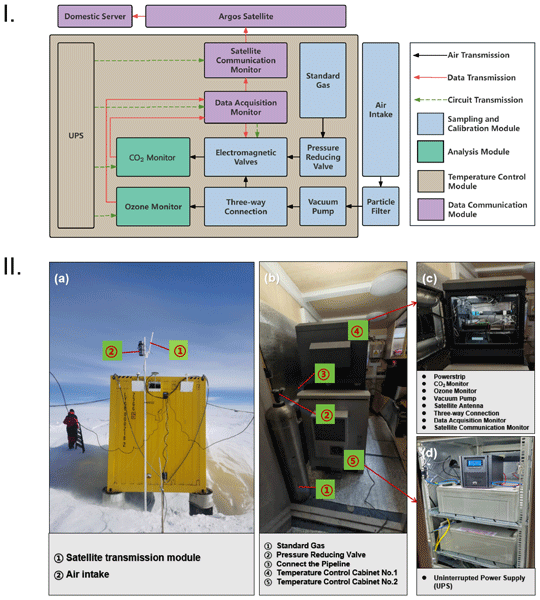
Abstract. Antarctic inland regions, as critical hubs for global climate change monitoring, suffer from a lack of reliable long-term greenhouse gas (GHG) observation systems due to extreme low temperatures, strong winds, and limited logistical/energy support. To address this gap, the CRUX-1.0 automatic observation system was developed and deployed at Taishan Station (inland Antarctic Plateau) during the 39th and 40th CHINARE expeditions, targeting simultaneous monitoring of CO2 and surface ozone (O3). Integrating four core subsystems – analysis, calibration, temperature control, and data communication – the system is specifically engineered for harsh polar environments with low power consumption (<350 W) and autonomous operation capability. The operational analysis based on A one month continuous field experiment showed its stable performance: CO2 measurements achieved a coefficient of variation (CV) <6 % (nearing 0 % post-calibration), while O3 measurements maintained a CV <5.6 %. The average concentrations (CO2: 420.3 ± 1.5 ppm; O3: 20.1 ± 0.8 ppb) closely aligned with regional background levels and South Pole Station data, confirming high reliability. With its robust adaptability, CRUX-1.0 could be extended to other polar or high-altitude regions, further enhancing the global atmospheric monitoring network's coverage and capability.
-
Notice on discussion status
The requested preprint has a corresponding peer-reviewed final revised paper. You are encouraged to refer to the final revised version.
-
Preprint
(14198 KB)
-
The requested preprint has a corresponding peer-reviewed final revised paper. You are encouraged to refer to the final revised version.
- Preprint
(14198 KB) - Metadata XML
- BibTeX
- EndNote
- Final revised paper


Journal article(s) based on this preprint
Interactive discussion
Status: closed
-
RC1: 'Comment on egusphere-2026-1227', Anonymous Referee #1, 23 Apr 2026
-
AC1: 'Reply on RC1', Biao Tian, 05 Jun 2026
The comment was uploaded in the form of a supplement: https://egusphere.copernicus.org/preprints/2026/egusphere-2026-1227/egusphere-2026-1227-AC1-supplement.pdf
-
AC1: 'Reply on RC1', Biao Tian, 05 Jun 2026
-
RC2: 'Comment on egusphere-2026-1227', Hossein Maazallahi, 25 Apr 2026
Enclosed, please find my comments on the manuscript.
-
AC2: 'Reply on RC2', Biao Tian, 05 Jun 2026
The comment was uploaded in the form of a supplement: https://egusphere.copernicus.org/preprints/2026/egusphere-2026-1227/egusphere-2026-1227-AC2-supplement.pdf
-
AC2: 'Reply on RC2', Biao Tian, 05 Jun 2026
-
RC3: 'Comment on egusphere-2026-1227', Anonymous Referee #3, 26 Apr 2026
This manuscript proposes a low-power autonomous greenhouse gas and ozone observation system for the Antarctic inland plateau, offering important practical value. The system has been successfully deployed on the Antarctic ice sheet, and its observations show good agreement with reference station data. The study falls within the scope of AMT and helps fill an important observational gap in the Antarctic region, with data that are highly relevant for polar greenhouse gas monitoring. I find the manuscript interesting overall and agree with the comments of the other two reviewers. However, the manuscript should place greater emphasis on data calibration, as improving data reliability should be central to the study and would enhance its scientific value for the broader research community. In addition, substantial revisions are still required regarding the scientific framework, the depth of mechanism discussion, the quality of figures and tables, and adherence to journal formatting requirements. These are some of my specific suggestions.
- In abstract: “extreme low temperatures” is “extremely low temperatures”
- Line 26: “A” is “a” or “a one-month continuous”
- Lines 27-28: “<6%” vs “<5.6%”: the precision is inconsistent (one is an integer, while the other is reported to one decimal place). Similar issues should be addressed throughout the entire manuscript.
- Lines 172–223: The manuscript does not explain the basis for selecting South Pole, Barrow, Mauna Loa, and Jungfraujoch as reference stations. The authors should clarify the selection criteria and explicitly describe how these sites support the study’s global comparability analysis, in order to strengthen the rationale of the comparative design. In addition, Figure 6 includes data from Barrow, Mauna Loa, and Jungfraujoch, which represent a mix of background and more anthropogenically influenced environments. The rationale for combining these different site types requires further explanation. Otherwise, it remains unclear why other background stations (e.g., Svalbard and Waliguan) or additional urban datasets were not considered.
- Lines 290–300: The calibration duration is marked as "every 11 hours and 5 minutes" here, but stated as "every 11 hours and 10 minutes" in Section 4.1 (Line 385). Please verify and unify this value to ensure parameter consistency.
- Lines 407–436: The manuscript mentions the coefficient of variation of cabinet temperature (16%–20%). Please explain whether this temperature fluctuation affects the CO₂/O₃ measurement results.
- All figures and tables in the manuscript need to be redrawn in accordance with AMT’s figure and table standards.
- Figure 1: Missing north arrow and scale bar; please supplement them to comply with AMT’s figure specifications.
- Figures 3–6: Missing complete axis units and poor legend contrast; please optimize them to improve readability.
- In Figure 4, the authors should examine whether air temperature affects the instrument temperature, and whether there is any heterogeneous variation between the two.
- Lines 391–406: The current instrument performance evaluation only employs standard deviation and coefficient of variation (CV). It is suggested to supplement the key indicators mandated by WMO/GAW standards, to strengthen quantitative validation and better demonstrate the reliability of the observed data.
- Abbreviations (Full text): All abbreviations (CRUX, UPS, ARGOS, CV, CHINARE) must be marked with their full names when first appearing.
- Lines 241–255: Supplement the details of snow blockage prevention measures for the air intake under blowing snow conditions to improve the description of the sampling system’s environmental adaptability.
- Lines 407–436: Replace "non-negligible defect" with "minor limitation" to conform to academic expression and make the statement more rigorous.
- In the conclusions, the authors acknowledge that unattended polar observations still face common technical challenges, including temperature control precision, long-term energy supply, multi-parameter coordinated monitoring, and dynamic calibration. To ensure data continuity and completeness, the authors should propose further solutions for this observation system, rather than limiting the discussion to the one-month dataset.
- References (Page 12 and thereafter): Inconsistencies exist in journal abbreviations, author names, and DOI formats. Please standardize them in accordance with AMT’s reference format to ensure uniformity.
- Polish the language, split some overly long sentences (e.g., in the abstract and discussion sections), and revise a small number of non-native expressions to improve clarity and fluency.
Citation: https://doi.org/10.5194/egusphere-2026-1227-RC3 -
AC3: 'Reply on RC3', Biao Tian, 05 Jun 2026
The comment was uploaded in the form of a supplement: https://egusphere.copernicus.org/preprints/2026/egusphere-2026-1227/egusphere-2026-1227-AC3-supplement.pdf
Peer review completion


Interactive discussion
Status: closed
-
RC1: 'Comment on egusphere-2026-1227', Anonymous Referee #1, 23 Apr 2026
This study developed the self-developed CRUX-1.0 observation system for synchronous observation of CO₂ and surface O₃ in the Antarctic inland plateau, and verified its performance at Taishan Station. This research fills the key technological gap in polar unattended atmospheric monitoring, and presents solid engineering design and observation results. The system design is fully adapted to the extreme low-temperature and low-power consumption environment. The one-month field test shows high data continuity, and the manuscript generally meets the publication requirements of AMT. However, revisions and improvements are still needed in methodological standardization, consistency of technical parameters, details of quantitative verification, and compliance with WMO/GAW standards.
- Introduction (Page 2 | Lines 87–100): The description of the "3 kW preliminary prototype" is vague. It is recommended to clarify its design flaws and power consumption allocation to further strengthen the necessity of developing CRUX-1.0 and improve the logic of the research background.
- 1.2 Calibration (Page 6 | Lines 290–300): There is an inconsistency in parameters. The calibration duration is marked as "every 11 hours and 5 minutes" here, but stated as "every 11 hours and 10 minutes" in Section 4.1 (Page 8 | Line 385). Please verify and unify this value, and briefly explain the basis for selecting the calibration frequency and duration to ensure parameter consistency.
- 3 Temperature Control (Page 7 | Lines 331–360): It is recommended to supplement the key performance parameters—temperature control accuracy and response time, which can further improve the demonstration of system reliability.
- 2 Accuracy Assessment (Page 8 | Lines 391–406): At present, only standard deviation and coefficient of variation (CV) are used to evaluate instrument performance. It is recommended to supplement the key indicators required by WMO/GAW standards, such as zero drift, span drift, and accuracy, to further improve the quantitative verification and enhance the demonstration of data reliability.
- 1 Performance Comparison (Page 9 | Lines 407–436): The manuscript mentions the coefficient of variation of cabinet temperature (16%–20%). It is recommended to supplement the quantitative correlation analysis between temperature fluctuation and CO₂/O₃ measurement drift, and briefly explain whether this temperature fluctuation affects the measurement results.
- Data Communication (Page 7 | Lines 361–375): Supplement the data transmission interval/frequency of the ARGOS satellite module to improve the technical documentation and the integrity of the system description.
- Data Availability (Page 12 | Lines 521–530): Supplement the public data repository/DOI plan to comply with AMT’s open data policy and improve the compliance of the manuscript.
- References (Page 12 and thereafter): Journal abbreviations, author names and DOI formats are inconsistent. Please unify them in accordance with AMT’s reference guidelines to ensure consistency.
Citation: https://doi.org/10.5194/egusphere-2026-1227-RC1 -
AC1: 'Reply on RC1', Biao Tian, 05 Jun 2026
The comment was uploaded in the form of a supplement: https://egusphere.copernicus.org/preprints/2026/egusphere-2026-1227/egusphere-2026-1227-AC1-supplement.pdf
-
RC2: 'Comment on egusphere-2026-1227', Hossein Maazallahi, 25 Apr 2026
Enclosed, please find my comments on the manuscript.
-
AC2: 'Reply on RC2', Biao Tian, 05 Jun 2026
The comment was uploaded in the form of a supplement: https://egusphere.copernicus.org/preprints/2026/egusphere-2026-1227/egusphere-2026-1227-AC2-supplement.pdf
-
AC2: 'Reply on RC2', Biao Tian, 05 Jun 2026
-
RC3: 'Comment on egusphere-2026-1227', Anonymous Referee #3, 26 Apr 2026
This manuscript proposes a low-power autonomous greenhouse gas and ozone observation system for the Antarctic inland plateau, offering important practical value. The system has been successfully deployed on the Antarctic ice sheet, and its observations show good agreement with reference station data. The study falls within the scope of AMT and helps fill an important observational gap in the Antarctic region, with data that are highly relevant for polar greenhouse gas monitoring. I find the manuscript interesting overall and agree with the comments of the other two reviewers. However, the manuscript should place greater emphasis on data calibration, as improving data reliability should be central to the study and would enhance its scientific value for the broader research community. In addition, substantial revisions are still required regarding the scientific framework, the depth of mechanism discussion, the quality of figures and tables, and adherence to journal formatting requirements. These are some of my specific suggestions.
- In abstract: “extreme low temperatures” is “extremely low temperatures”
- Line 26: “A” is “a” or “a one-month continuous”
- Lines 27-28: “<6%” vs “<5.6%”: the precision is inconsistent (one is an integer, while the other is reported to one decimal place). Similar issues should be addressed throughout the entire manuscript.
- Lines 172–223: The manuscript does not explain the basis for selecting South Pole, Barrow, Mauna Loa, and Jungfraujoch as reference stations. The authors should clarify the selection criteria and explicitly describe how these sites support the study’s global comparability analysis, in order to strengthen the rationale of the comparative design. In addition, Figure 6 includes data from Barrow, Mauna Loa, and Jungfraujoch, which represent a mix of background and more anthropogenically influenced environments. The rationale for combining these different site types requires further explanation. Otherwise, it remains unclear why other background stations (e.g., Svalbard and Waliguan) or additional urban datasets were not considered.
- Lines 290–300: The calibration duration is marked as "every 11 hours and 5 minutes" here, but stated as "every 11 hours and 10 minutes" in Section 4.1 (Line 385). Please verify and unify this value to ensure parameter consistency.
- Lines 407–436: The manuscript mentions the coefficient of variation of cabinet temperature (16%–20%). Please explain whether this temperature fluctuation affects the CO₂/O₃ measurement results.
- All figures and tables in the manuscript need to be redrawn in accordance with AMT’s figure and table standards.
- Figure 1: Missing north arrow and scale bar; please supplement them to comply with AMT’s figure specifications.
- Figures 3–6: Missing complete axis units and poor legend contrast; please optimize them to improve readability.
- In Figure 4, the authors should examine whether air temperature affects the instrument temperature, and whether there is any heterogeneous variation between the two.
- Lines 391–406: The current instrument performance evaluation only employs standard deviation and coefficient of variation (CV). It is suggested to supplement the key indicators mandated by WMO/GAW standards, to strengthen quantitative validation and better demonstrate the reliability of the observed data.
- Abbreviations (Full text): All abbreviations (CRUX, UPS, ARGOS, CV, CHINARE) must be marked with their full names when first appearing.
- Lines 241–255: Supplement the details of snow blockage prevention measures for the air intake under blowing snow conditions to improve the description of the sampling system’s environmental adaptability.
- Lines 407–436: Replace "non-negligible defect" with "minor limitation" to conform to academic expression and make the statement more rigorous.
- In the conclusions, the authors acknowledge that unattended polar observations still face common technical challenges, including temperature control precision, long-term energy supply, multi-parameter coordinated monitoring, and dynamic calibration. To ensure data continuity and completeness, the authors should propose further solutions for this observation system, rather than limiting the discussion to the one-month dataset.
- References (Page 12 and thereafter): Inconsistencies exist in journal abbreviations, author names, and DOI formats. Please standardize them in accordance with AMT’s reference format to ensure uniformity.
- Polish the language, split some overly long sentences (e.g., in the abstract and discussion sections), and revise a small number of non-native expressions to improve clarity and fluency.
Citation: https://doi.org/10.5194/egusphere-2026-1227-RC3 -
AC3: 'Reply on RC3', Biao Tian, 05 Jun 2026
The comment was uploaded in the form of a supplement: https://egusphere.copernicus.org/preprints/2026/egusphere-2026-1227/egusphere-2026-1227-AC3-supplement.pdf
Peer review completion
Journal article(s) based on this preprint
Viewed
| HTML | XML | Total | BibTeX | EndNote | |
|---|---|---|---|---|---|
| 848 | 446 | 88 | 1,382 | 70 | 109 |
- HTML: 848
- PDF: 446
- XML: 88
- Total: 1,382
- BibTeX: 70
- EndNote: 109
Viewed (geographical distribution)
| Country | # | Views | % |
|---|
| Total: | 0 |
| HTML: | 0 |
| PDF: | 0 |
| XML: | 0 |
- 1
Biao Tian

Kongju Zhu
Xu Yao
Yixi Zhao
Wenqian Zhang
Diyi Yang
Weijun Sun
Yining Yu
Shoudong Zhao
Yige Cui
Chuanjin Li
Jie Tang
Cunde Xiao
Renhe Zhang
The requested preprint has a corresponding peer-reviewed final revised paper. You are encouraged to refer to the final revised version.
- Preprint
(14198 KB) - Metadata XML
This study developed the self-developed CRUX-1.0 observation system for synchronous observation of CO₂ and surface O₃ in the Antarctic inland plateau, and verified its performance at Taishan Station. This research fills the key technological gap in polar unattended atmospheric monitoring, and presents solid engineering design and observation results. The system design is fully adapted to the extreme low-temperature and low-power consumption environment. The one-month field test shows high data continuity, and the manuscript generally meets the publication requirements of AMT. However, revisions and improvements are still needed in methodological standardization, consistency of technical parameters, details of quantitative verification, and compliance with WMO/GAW standards.