
the Creative Commons Attribution 4.0 License.
the Creative Commons Attribution 4.0 License.
 | 19 Jan 2026
Constraining the atmospheric hydrogen oxidation and soil sinks using HFC-152a
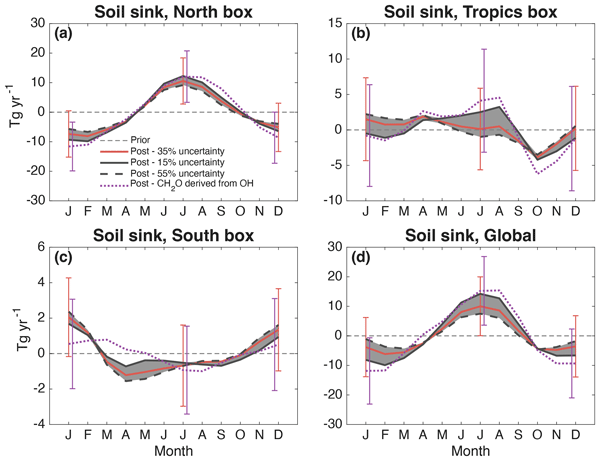
Abstract. As the hydrogen (H2) economy expands, there is growing interest in understanding the atmospheric lifetime of H2, which affects its impact on atmospheric chemistry and climate. While some global H2 is destroyed via reaction with the hydroxyl radical (OH), most is lost to microbial activity in soils. However, the sources and sinks of H2 are still uncertain on global and local scales. This study focuses on how monthly resolved observations of HFC-152a can help to constrain the seasonal OH cycle and the H2 budget, particularly the seasonal range and phase of H2 oxidation and soil loss. Seasonal observations of HFC-152a are used to constrain OH through a Bayesian inversion in a three-box model comprising the Northern, Tropics, and Southern regions over 2010–2022. In the North, a seasonal range of the soil sink of 18–21 ± 8 Tg year-1 is found, peaking in July–August, while the OH loss seasonal range is 8 ± 1 Tg year-1, peaking in July. The South has much less land and so displays a smaller soil sink seasonal range of 2–3 ± 2.5 Tg year-1, peaking in January–March. The OH loss in the South has a seasonal range of 7 ± 1 Tg year-1, peaking in January. The OH and soil sink loss in the Tropics is more consistent across all months, but with larger uncertainty. The results presented here will be a useful comparison for H2 cycles in fully integrated chemistry climate models.
-
Notice on discussion status
The requested preprint has a corresponding peer-reviewed final revised paper. You are encouraged to refer to the final revised version.
-
Preprint
(828 KB)
-
Supplement
(3266 KB)
-
The requested preprint has a corresponding peer-reviewed final revised paper. You are encouraged to refer to the final revised version.
- Preprint
(828 KB) - Metadata XML
-
Supplement
(3266 KB) - BibTeX
- EndNote
- Final revised paper


Journal article(s) based on this preprint
Interactive discussion
Status: closed
-
RC1: 'Comment on egusphere-2025-6461', Anonymous Referee #1, 20 Feb 2026
-
AC1: 'Reply on RC1', Kane Stone, 11 May 2026
The comment was uploaded in the form of a supplement: https://egusphere.copernicus.org/preprints/2026/egusphere-2025-6461/egusphere-2025-6461-AC1-supplement.pdf
-
AC1: 'Reply on RC1', Kane Stone, 11 May 2026
-
RC2: 'Comment on egusphere-2025-6461', Anonymous Referee #2, 04 Mar 2026
This study aims to provide observational constraints on the seasonality of the H2 soil sink, the most uncertain term in the H2 budget.
First, the authors use a box model constrained by HFC-152a observations to optimize the seasonality of OH.
Then this optimized OH field and H2 observations are used to optimize the different parts of the H2 budget (H2 emissions, H2 chemical production, H2 soil sink).The approach is interesting, and the manuscript is well-suited for publication in ACP once the following comments are addressed.
Main comments
1. The box model used in this study includes only 3 boxes, with the Northernmost box spanning the 20-90N range.
The magnitude but also the seasonality of H2 exhibits significant meridional variations in this region (e.g., Tardito Chaudhri (2025), Paulot (2024)).
This suggests that the choice of the box boundary may have a significant impact on the optimization. The authors allude to it in line 275 but more discussion and analysis are needed.
For instance, the authors could use the H2 concentration simulated by a global model with H2 deposition (see Sand (2023), Brown (2025) but any sensible pattern would work) to demonstrate that the 3-box model framework
can recover the deposition velocity used in the aformentioned model if given the simulated H2 concentration at MHD2. Line 260-265 What is the implied seasonality of the deposition velocity of H2? How does it compare with the (few) observations in the NH and to global models (e.g., Brown (2025), Paulot (2024), …)? =
Does the retrieval provide information on the interannual variability of vd(H2)?
3. The title should be revised to more clearly convey the focus of the manuscript on the “seasonal amplitude” of the H2 sink (rather than its magnitude)4. Fig. 4. shows that the amplitude of the optimized seasonal cycle of the land sink is not significantly different from the prior (no seasonality).
It’s not clear whether this is because the information content provided by the measurements is insufficient in these regions or because the seasonality is weak.
In other words, how much lower is the posterior uncertainty relative to the prior?5. Line 257. “It is important to emphasize that the prior soil sink is constant over the course of a year, so that the seasonal information that is retrieved is not constrained to the choice of prior”
Do you mean that your choice of prior has little to no impact on your solution? The authors should discuss this in more details. How would a different soil sink apriori and soil sink apriori uncertainty impact the results?
Additional justification for the 35% error in soil first order loss (see TC3) would also be helpful given the large observed seasonal variation of vd(H2) (see HFR data from Meredith et al. for instance)Technical comments
1. Line 101: It’s not clear why a 20% increase is applied to SMO.
2. Line 113. What is the interannual variability in HFC-152a emissions
3. Line 150. Can you be more explicit? If I understand well, you assume a first order loss proportional to the land area. However, in Table 1, it is stated that the 35% error is applied to the absolute magnitude of the soil sink. Do you mean H2 lifetime wrt soil sink?
4. Fig. S1. should include the range of H2 observations across NOAA observations. The spread should be discussed when assessing the choice of the MHD station to represent the 20-90N band.
Please include a map of the locations of the NOAA and AGAGE sites5. Fig. S3. I believe a “+” is missing between jch2o and kch2o
6. Line 172. “retrieved with cross-correlation between OH established in the prior covariance to ensure correct chemical production seasonality”
I am not sure to understand what you mean here. Please rephrase.
7. Line 190: what is the impact of using a longer temporal correlation for non-biomass burning emissions?8. Line 190: what is the assumption for the soil sink temporal correlation? If it’s neglected, wouldn’t this lead the optimization to favor adjusting the soil sink to capture the seasonal variability?
Citation: https://doi.org/10.5194/egusphere-2025-6461-RC2 -
AC2: 'Reply on RC2', Kane Stone, 11 May 2026
The comment was uploaded in the form of a supplement: https://egusphere.copernicus.org/preprints/2026/egusphere-2025-6461/egusphere-2025-6461-AC2-supplement.pdf
-
AC2: 'Reply on RC2', Kane Stone, 11 May 2026
Peer review completion


Interactive discussion
Status: closed
-
RC1: 'Comment on egusphere-2025-6461', Anonymous Referee #1, 20 Feb 2026
-
AC1: 'Reply on RC1', Kane Stone, 11 May 2026
The comment was uploaded in the form of a supplement: https://egusphere.copernicus.org/preprints/2026/egusphere-2025-6461/egusphere-2025-6461-AC1-supplement.pdf
-
AC1: 'Reply on RC1', Kane Stone, 11 May 2026
-
RC2: 'Comment on egusphere-2025-6461', Anonymous Referee #2, 04 Mar 2026
This study aims to provide observational constraints on the seasonality of the H2 soil sink, the most uncertain term in the H2 budget.
First, the authors use a box model constrained by HFC-152a observations to optimize the seasonality of OH.
Then this optimized OH field and H2 observations are used to optimize the different parts of the H2 budget (H2 emissions, H2 chemical production, H2 soil sink).The approach is interesting, and the manuscript is well-suited for publication in ACP once the following comments are addressed.
Main comments
1. The box model used in this study includes only 3 boxes, with the Northernmost box spanning the 20-90N range.
The magnitude but also the seasonality of H2 exhibits significant meridional variations in this region (e.g., Tardito Chaudhri (2025), Paulot (2024)).
This suggests that the choice of the box boundary may have a significant impact on the optimization. The authors allude to it in line 275 but more discussion and analysis are needed.
For instance, the authors could use the H2 concentration simulated by a global model with H2 deposition (see Sand (2023), Brown (2025) but any sensible pattern would work) to demonstrate that the 3-box model framework
can recover the deposition velocity used in the aformentioned model if given the simulated H2 concentration at MHD2. Line 260-265 What is the implied seasonality of the deposition velocity of H2? How does it compare with the (few) observations in the NH and to global models (e.g., Brown (2025), Paulot (2024), …)? =
Does the retrieval provide information on the interannual variability of vd(H2)?
3. The title should be revised to more clearly convey the focus of the manuscript on the “seasonal amplitude” of the H2 sink (rather than its magnitude)4. Fig. 4. shows that the amplitude of the optimized seasonal cycle of the land sink is not significantly different from the prior (no seasonality).
It’s not clear whether this is because the information content provided by the measurements is insufficient in these regions or because the seasonality is weak.
In other words, how much lower is the posterior uncertainty relative to the prior?5. Line 257. “It is important to emphasize that the prior soil sink is constant over the course of a year, so that the seasonal information that is retrieved is not constrained to the choice of prior”
Do you mean that your choice of prior has little to no impact on your solution? The authors should discuss this in more details. How would a different soil sink apriori and soil sink apriori uncertainty impact the results?
Additional justification for the 35% error in soil first order loss (see TC3) would also be helpful given the large observed seasonal variation of vd(H2) (see HFR data from Meredith et al. for instance)Technical comments
1. Line 101: It’s not clear why a 20% increase is applied to SMO.
2. Line 113. What is the interannual variability in HFC-152a emissions
3. Line 150. Can you be more explicit? If I understand well, you assume a first order loss proportional to the land area. However, in Table 1, it is stated that the 35% error is applied to the absolute magnitude of the soil sink. Do you mean H2 lifetime wrt soil sink?
4. Fig. S1. should include the range of H2 observations across NOAA observations. The spread should be discussed when assessing the choice of the MHD station to represent the 20-90N band.
Please include a map of the locations of the NOAA and AGAGE sites5. Fig. S3. I believe a “+” is missing between jch2o and kch2o
6. Line 172. “retrieved with cross-correlation between OH established in the prior covariance to ensure correct chemical production seasonality”
I am not sure to understand what you mean here. Please rephrase.
7. Line 190: what is the impact of using a longer temporal correlation for non-biomass burning emissions?8. Line 190: what is the assumption for the soil sink temporal correlation? If it’s neglected, wouldn’t this lead the optimization to favor adjusting the soil sink to capture the seasonal variability?
Citation: https://doi.org/10.5194/egusphere-2025-6461-RC2 -
AC2: 'Reply on RC2', Kane Stone, 11 May 2026
The comment was uploaded in the form of a supplement: https://egusphere.copernicus.org/preprints/2026/egusphere-2025-6461/egusphere-2025-6461-AC2-supplement.pdf
-
AC2: 'Reply on RC2', Kane Stone, 11 May 2026
Peer review completion
Journal article(s) based on this preprint
Viewed
| HTML | XML | Total | Supplement | BibTeX | EndNote | |
|---|---|---|---|---|---|---|
| 1,313 | 500 | 137 | 1,950 | 232 | 99 | 247 |
- HTML: 1,313
- PDF: 500
- XML: 137
- Total: 1,950
- Supplement: 232
- BibTeX: 99
- EndNote: 247
Viewed (geographical distribution)
| Country | # | Views | % |
|---|
| Total: | 0 |
| HTML: | 0 |
| PDF: | 0 |
| XML: | 0 |
- 1

Candice Chen
Susan Solomon
Luke M. Western
Paul B. Krummel
Gabrielle Pétron
Jens Mühle
Simon O’Doherty
The requested preprint has a corresponding peer-reviewed final revised paper. You are encouraged to refer to the final revised version.
- Preprint
(828 KB) - Metadata XML
-
Supplement
(3266 KB) - BibTeX
- EndNote
- Final revised paper
Please see attached PDF for comments.