
the Creative Commons Attribution 4.0 License.
the Creative Commons Attribution 4.0 License.
 | 02 Feb 2026
Composite Sharpening by Vortex Symmetrization and Normalization of Tropical Cyclones
Abstract. Cyclone composites are a powerful tool for investigating the mean characteristics of tropical and extratropical cyclones, offering insights into the mechanisms driving storm development. Traditional composite methods align cyclone centers to capture persistent patterns but they tend to smooth out small-scale features.
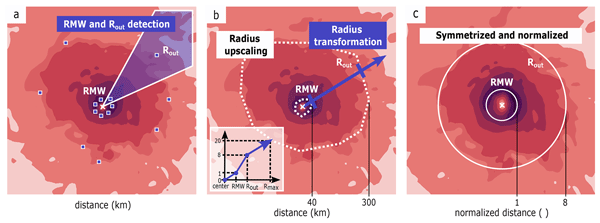
We introduce a novel compositing framework, the SYmmetrized-Normalized Cyclone (SyNC) compositing, designed to address the structural variety of tropical cyclones (TCs). This method symmetrizes storms to axisymmetric vortices and normalizes them according to their eyewall location and the size of the TC. By accurately detecting the eyewalls and the horizontal extents of TCs, the SyNC method enables detailed storm structural analysis. The method is applied to simulated TCs with the weather and climate model ICON, which show strong agreement with the observed wind–pressure relationships. ICON reveals the ability to simulate even most intense storms, while overestimating the frequency of major hurricanes. A large structural variability and asymmetries are found across all simulated storm intensities, agreeing with observations and emphasizing the importance of SyNC composites.
The vortex alignment of the SyNC framework successfully sharpens composite fields, preserving small-scale features such as super-gradient winds, subsidence within the eye, eyewall updrafts, and localized diabatic heating and cooling related to cloud microphysics. It also reduces within-group variance, thereby increasing statistical power and enabling the detection of differences between TC groups that would be missed using traditional center-based compositing. Limitations of the SyNC composites include reduced applicability during early storm stages, when tangential winds have not yet formed a Rankine-like vortex, and potential data extrapolation during normalization in small storms. Nonetheless, the method proves robust for weakly organized storms and is particularly beneficial for analyzing circulation-related and cloud microphysics-related fields. Overall, the SyNC compositing method provides a cyclone-relative framework that improves the accuracy of TC composite analysis, thereby facilitating the investigation and understanding of storm development.
-
Notice on discussion status
The requested preprint has a corresponding peer-reviewed final revised paper. You are encouraged to refer to the final revised version.
-
Preprint
(7055 KB)
-
The requested preprint has a corresponding peer-reviewed final revised paper. You are encouraged to refer to the final revised version.
- Preprint
(7055 KB) - Metadata XML
- BibTeX
- EndNote
- Final revised paper


Journal article(s) based on this preprint
Interactive discussion
Status: closed
-
CEC1: 'Comment on egusphere-2025-6186', Astrid Kerkweg, 11 Mar 2026
- AC1: 'Reply on RC1', Andrina Caratsch, 05 May 2026
-
RC1: 'Comment on egusphere-2025-6186', Anonymous Referee #1, 23 Mar 2026
Please find my comments in the attached files, with apologies for the late review.
In this paper, the authors introduce a new methodology meant to improve the compositing approaches often used in the study of cyclones' structure. Their suggestion is to normalize the cyclones according to their size before averaging their structure. Their method appears as a relevant improvement of the usual centered-only approach, especially in the era of km-scale modelling when models are expected to better resolve cyclones' structures (which, surprisingly, is not mentionned as a motivation?). Their approach is rigorous and the improvement they bring is clearly demonstrated. The subject of the paper is also very well suited for the journal, so I think the study deserves to be published in GMD. However, the manuscript needs important revisions, as detailed below.
- AC1: 'Reply on RC1', Andrina Caratsch, 05 May 2026
-
RC2: 'Comment on egusphere-2025-6186', Anonymous Referee #2, 01 Apr 2026
Apologies for the lengthy time to complete my review. Please see the attached document.
-
AC2: 'Reply on RC2', Andrina Caratsch, 05 May 2026
Publisher’s note: the content of this comment was removed on 7 May 2026 since the comment was posted by mistake.
Citation: https://doi.org/10.5194/egusphere-2025-6186-AC2 - AC1: 'Reply on RC1', Andrina Caratsch, 05 May 2026
-
AC2: 'Reply on RC2', Andrina Caratsch, 05 May 2026
-
RC3: 'Comment on egusphere-2025-6186', Anonymous Referee #3, 10 Apr 2026
The comment was uploaded in the form of a supplement: https://egusphere.copernicus.org/preprints/2026/egusphere-2025-6186/egusphere-2025-6186-RC3-supplement.pdf
- AC1: 'Reply on RC1', Andrina Caratsch, 05 May 2026
-
EC1: 'Editor comment on egusphere-2025-6186', Wojciech W. Grabowski, 20 May 2026
Dear Authors. before I accept the paper I have the following technical request. Throughout the text, you use the word "resolution" many times. But in some places, it really means "horizontal grid length". For instance, lines 7, 44, 45, etc. It is correct when "resolution" is used in a general sense, like for instance in line 20 and in several other places. However, when you specifically mean grid length (like in line 7: "...5 km horizontal resolutions."), the word "resolution" needs to be replaced by "horizontal grid length". Please do the search for the word "resolution" and replace it with the phrase "horizontal grid length" in all places where a specific number is given (like line 7 in the abstract. Thank you very much for your cooperation. WG.
Citation: https://doi.org/10.5194/egusphere-2025-6186-EC1 -
AC3: 'Reply on EC1', Andrina Caratsch, 21 May 2026
Dear Mr. Grabowski,
Thank you for pointing this out. We have revised the wording in the manuscript accordingly.
Best regards,
Andrina CaratschCitation: https://doi.org/10.5194/egusphere-2025-6186-AC3
-
AC3: 'Reply on EC1', Andrina Caratsch, 21 May 2026
Peer review completion


Post-review adjustments


Interactive discussion
Status: closed
-
CEC1: 'Comment on egusphere-2025-6186', Astrid Kerkweg, 11 Mar 2026
Dear authors,
as GMD requires the permanent archiving of the model code versions used in the publication, please do not only cite the webpage icon-model.org but also cite the DOI which is assigned to the official ICON releases.
ICON partnership (DWD; MPI-M; DKRZ; KIT; C2SM) (2024). ICON release 2024.10. World Data Center for Climate (WDCC) at DKRZ. https://doi.org/10.35089/WDCC/IconRelease2024.10
Greetings, Astrid Kerkweg (GMD Executive Editor)
Citation: https://doi.org/10.5194/egusphere-2025-6186-CEC1 - AC1: 'Reply on RC1', Andrina Caratsch, 05 May 2026
-
RC1: 'Comment on egusphere-2025-6186', Anonymous Referee #1, 23 Mar 2026
Please find my comments in the attached files, with apologies for the late review.
In this paper, the authors introduce a new methodology meant to improve the compositing approaches often used in the study of cyclones' structure. Their suggestion is to normalize the cyclones according to their size before averaging their structure. Their method appears as a relevant improvement of the usual centered-only approach, especially in the era of km-scale modelling when models are expected to better resolve cyclones' structures (which, surprisingly, is not mentionned as a motivation?). Their approach is rigorous and the improvement they bring is clearly demonstrated. The subject of the paper is also very well suited for the journal, so I think the study deserves to be published in GMD. However, the manuscript needs important revisions, as detailed below.
- AC1: 'Reply on RC1', Andrina Caratsch, 05 May 2026
-
RC2: 'Comment on egusphere-2025-6186', Anonymous Referee #2, 01 Apr 2026
Apologies for the lengthy time to complete my review. Please see the attached document.
-
AC2: 'Reply on RC2', Andrina Caratsch, 05 May 2026
Publisher’s note: the content of this comment was removed on 7 May 2026 since the comment was posted by mistake.
Citation: https://doi.org/10.5194/egusphere-2025-6186-AC2 - AC1: 'Reply on RC1', Andrina Caratsch, 05 May 2026
-
AC2: 'Reply on RC2', Andrina Caratsch, 05 May 2026
-
RC3: 'Comment on egusphere-2025-6186', Anonymous Referee #3, 10 Apr 2026
The comment was uploaded in the form of a supplement: https://egusphere.copernicus.org/preprints/2026/egusphere-2025-6186/egusphere-2025-6186-RC3-supplement.pdf
- AC1: 'Reply on RC1', Andrina Caratsch, 05 May 2026
-
EC1: 'Editor comment on egusphere-2025-6186', Wojciech W. Grabowski, 20 May 2026
Dear Authors. before I accept the paper I have the following technical request. Throughout the text, you use the word "resolution" many times. But in some places, it really means "horizontal grid length". For instance, lines 7, 44, 45, etc. It is correct when "resolution" is used in a general sense, like for instance in line 20 and in several other places. However, when you specifically mean grid length (like in line 7: "...5 km horizontal resolutions."), the word "resolution" needs to be replaced by "horizontal grid length". Please do the search for the word "resolution" and replace it with the phrase "horizontal grid length" in all places where a specific number is given (like line 7 in the abstract. Thank you very much for your cooperation. WG.
Citation: https://doi.org/10.5194/egusphere-2025-6186-EC1 -
AC3: 'Reply on EC1', Andrina Caratsch, 21 May 2026
Dear Mr. Grabowski,
Thank you for pointing this out. We have revised the wording in the manuscript accordingly.
Best regards,
Andrina CaratschCitation: https://doi.org/10.5194/egusphere-2025-6186-AC3
-
AC3: 'Reply on EC1', Andrina Caratsch, 21 May 2026
Peer review completion
Post-review adjustments
Journal article(s) based on this preprint
Data sets
Data for publication "Composite Sharpening by Vortex Symmetrization and Normalization of Tropical Cyclones" A. Caratsch et al. https://doi.org/10.5281/zenodo.17865089
Model code and software
Scripts for publication "Composite Sharpening by Vortex Symmetrization and Normalization of Tropical Cyclones" A. Caratsch et al. https://doi.org/10.5281/zenodo.17853183
Viewed
| HTML | XML | Total | BibTeX | EndNote | |
|---|---|---|---|---|---|
| 1,087 | 707 | 121 | 1,915 | 143 | 122 |
- HTML: 1,087
- PDF: 707
- XML: 121
- Total: 1,915
- BibTeX: 143
- EndNote: 122
Viewed (geographical distribution)
| Country | # | Views | % |
|---|
| Total: | 0 |
| HTML: | 0 |
| PDF: | 0 |
| XML: | 0 |
- 1
Andrina Caratsch

Sylvaine Ferrachat
Ulrike Lohmann
The requested preprint has a corresponding peer-reviewed final revised paper. You are encouraged to refer to the final revised version.
- Preprint
(7055 KB) - Metadata XML
Dear authors,
as GMD requires the permanent archiving of the model code versions used in the publication, please do not only cite the webpage icon-model.org but also cite the DOI which is assigned to the official ICON releases.
ICON partnership (DWD; MPI-M; DKRZ; KIT; C2SM) (2024). ICON release 2024.10. World Data Center for Climate (WDCC) at DKRZ. https://doi.org/10.35089/WDCC/IconRelease2024.10
Greetings, Astrid Kerkweg (GMD Executive Editor)