
the Creative Commons Attribution 4.0 License.
the Creative Commons Attribution 4.0 License.
 | 05 Jan 2026
Ground-based total ozone column measurements in the Huggins and Chappuis bands using Direct-Sun DOAS observations
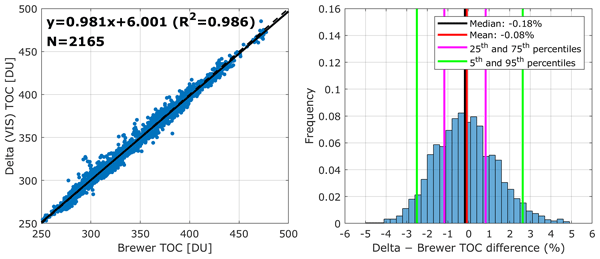
Abstract. Accurate routine monitoring of the Total Ozone Column (TOC) is essential for understanding ozone temporal variability, assessing long-term trends and supporting satellite validation. In this work, we present TOC retrievals in both ultraviolet (Huggins bands) and visible (Chappuis bands) spectral regions using direct-sun Differential Optical Absorption Spectroscopy (DS-DOAS). We use the Delta UV–VIS DOAS system, recently designed and operated at the Laboratory of Atmospheric Physics in Thessaloniki, Greece. A dedicated retrieval algorithm was developed that includes the calibration of a measured reference DS spectrum using the Langley plot and Bootstrap Estimation approaches. The analysis suggests that TOCs derived from the visible channel for the first time in Thessaloniki are highly consistent with those from the ultraviolet channel, with a median difference of –0.44 % and Pearson's correlation coefficient R = 0.97. The Delta TOC retrievals were compared with two collocated instruments, Brewer and Pandora, yielding very good agreement in both spectral regions (R > 0.98), with median biases –0.18 % and –0.63 % for the VIS and 0.08 % and –0.32 % for the UV channel compared to the Brewer and Pandora, respectively. The seasonal and diurnal variabilities of total ozone were captured consistently from all three instruments, confirming the robustness of the retrievals. Enhanced aerosol loads, such as those observed during an extreme wildfire event, introduced significant deviations in the VIS TOC comparisons with the reference instruments, while the comparisons in the UV remained largely unaffected. The findings of this study confirm the capability of Delta to provide accurate and consistent TOC retrievals in both UV and VIS spectral bands. The successful exploitation of the Chappuis bands extends the applicability of DS-DOAS to conditions where UV sensitivity is limited, such as at high solar zenith angles, thereby extending the continuity of ozone monitoring from ground-based systems and providing a complementary approach to traditional UV-based TOC retrievals.
Competing interests: At least one of the (co-)authors is a member of the editorial board of Atmospheric Measurement Techniques.
Publisher's note: Copernicus Publications remains neutral with regard to jurisdictional claims made in the text, published maps, institutional affiliations, or any other geographical representation in this paper. While Copernicus Publications makes every effort to include appropriate place names, the final responsibility lies with the authors. Views expressed in the text are those of the authors and do not necessarily reflect the views of the publisher.-
Notice on discussion status
The requested preprint has a corresponding peer-reviewed final revised paper. You are encouraged to refer to the final revised version.
-
Preprint
(2479 KB)
-
Supplement
(575 KB)
-
The requested preprint has a corresponding peer-reviewed final revised paper. You are encouraged to refer to the final revised version.
- Preprint
(2479 KB) - Metadata XML
-
Supplement
(575 KB) - BibTeX
- EndNote
- Final revised paper


Journal article(s) based on this preprint
Interactive discussion
Status: closed
-
RC1: 'Comment on egusphere-2025-5627', Anonymous Referee #1, 21 Jan 2026
- AC3: 'Reply on RC1', Dimitrios Karagkiozidis, 24 Mar 2026
-
RC2: 'Comment on egusphere-2025-5627', Anonymous Referee #3, 26 Jan 2026
Review of the manuscript: “Ground-based total ozone column measurements in the Huggins and Chappuis bands using Direct-Sun DOAS observations”
by Karagkiozidis et al.This manuscript presents total ozone column (TOC) retrievals from a ground-based direct-sun DOAS instrument operating in Thessaloniki, Greece. Ozone columns are retrieved independently in the Huggins (UV) and Chappuis (VIS) absorption bands and are evaluated against co-located Brewer and Pandora observations. The study demonstrates very good agreement between the DOAS-derived TOC and the reference instruments and discusses the influence of aerosol loading on the VIS retrievals.
Overall, the paper addresses a relevant topic within the scope of AMT and related Copernicus journals. The extension of direct-sun DOAS TOC retrievals into the Chappuis band is of practical interest, particularly under conditions where UV-based retrievals are limited. The manuscript is generally well structured, scientifically sound, and clearly written.
I recommend publication after minor revisions, mainly to clarify methodological aspects and to strengthen the physical interpretation of some results.
Minor Comments:
- Temperature effects and vertical ozone distribution
The treatment of ozone effective temperature in the UV retrievals is briefly discussed, but the potential influence of vertically inhomogeneous ozone distributions (e.g. enhanced tropospheric or UTLS ozone) is not fully addressed. Since tropospheric ozone resides at significantly higher temperatures than the stratospheric ozone maximum, it would be useful to comment on how such conditions could affect the UV retrievals and whether they could contribute to residual biases between instruments. - Chappuis-band retrieval advantages and limitations
The manuscript could more explicitly emphasize that Chappuis-band ozone absorption is only weakly temperature dependent, which is an inherent advantage compared to UV-based TOC retrievals. At the same time, the discussion of aerosol sensitivity could be expanded to better separate radiative transfer effects (e.g. path length changes) from true ozone-related effects. - Aerosol impact interpretation
In the discussion of high-AOD conditions, the manuscript suggests changes in air mass factor as a possible explanation for observed deviations. Given that most aerosols are confined to the lower troposphere where ozone concentrations are relatively small, it would be helpful to clarify whether the observed effects are driven primarily by tropospheric ozone, by spectral fitting artefacts, or by radiative effects not fully captured by the AMF formulation. - GCOS ECV requirements
The performance of the presented total column ozone retrievals could be more explicitly discussed in the context of the GCOS ECV requirements for ozone (GCOS-245, 2022), which specify target uncertainty and stability levels for climate applications. The reported agreement of the UV retrievals with Brewer and Pandora measurements is generally consistent with the GCOS goal uncertainty of ~1 %, while the VIS retrievals meet this level primarily under low-aerosol conditions. A brief statement placing the results within the GCOS goal/breakthrough/threshold framework would strengthen the climate relevance of the study.
Technical and editorial corrections
- Some sentences, particularly in the Introduction and Methodology sections, are rather long and could be simplified for readability.
- Acronyms and technical terms (e.g. “I₀-correction”) should be defined at first occurrence.
- Figure 7, 8, 14: X-axes labels are cut, please fix.
- Ensure consistent notation and terminology for ozone columns (e.g. TOC vs. total ozone column) throughout the manuscript.
- Line 16: “Delta TOC” is used without defining what this is.
- Line 22: This time “Delta” is used.
- Line 39: I wouldn’t say that the Dobsons were “superseded” by the Brewers, this statement is not quite accurate scientifically or historically. It is true that in many networks, Brewers have become the primary operational instrument, while Dobsons continue to provide critical long-term reference measurements.
- Line 194: “44°C” should be “ -44°C”
- Line 523: “suffers by straylight” -> suffers from straylight
Citation: https://doi.org/10.5194/egusphere-2025-5627-RC2 - AC1: 'Reply on RC2', Dimitrios Karagkiozidis, 24 Mar 2026
- Temperature effects and vertical ozone distribution
-
RC3: 'Comment on egusphere-2025-5627', Alberto Redondas, 27 Jan 2026
Manuscript: Ground-based total ozone column measurements in the Huggins and Chappuis bands using Direct-Sun DOAS observations ID: egusphere-2025-5627
This manuscript presents direct-sun DOAS total ozone column (TOC) retrievals in both the UV (Huggins) and visible (Chappuis) spectral regions using the Delta UV–VIS DOAS system in Thessaloniki. The work is relevant for the AMT community, particularly as it explores the feasibility and performance of visible-band direct-sun ozone retrievals, which remain less established than traditional UV techniques. The manuscript is generally well written, and the reported agreement with collocated Brewer and Pandora observations is good. The study has the potential to make a valuable contribution to atmospheric measurement techniques, especially if methodological choices, calibration assumptions, and statistical aspects are documented more transparently. The comments below are therefore mainly requests for clarification, additional documentation, and improved transparency rather than indications of major methodological errors.
For transparency, I wish to inform the editor and authors that I am actively involved in ozone calibration and intercomparison activities related to Brewer. I believe this background is relevant to the comments provided.
In Section 3.4, the manuscript applies the Bootstrap Estimation (BE) method to derive the ozone reference slant column, representing a novel extension of an approach that has primarily been developed and applied for NO₂ retrievals (e.g. Cede et al., 2006; Herman et al., 2009). Given the fundamentally different vertical distribution, variability, and tropospheric contribution of total ozone compared to NO₂, this application would benefit from more explicit justification and validation. At present, BE results are shown mainly for the VIS channel (Fig. 4b), while the corresponding UV results are not presented (line 349), and no sensitivity analysis is provided regarding the choice of percentile or AMF binning. Including the UV BE results and a brief sensitivity assessment would strengthen confidence in the robustness of the BE approach when applied to ozone.
It is difficult to follow the different dataset lengths of the UV and VIS channels described in Sections 2 and 3. The manuscript would benefit from a summary table indicating the operating periods of each channel together with the main instrumental modifications. While the authors assume that the instrument remained stable over the analysis period, no supporting evidence is provided. Although it is stated that lamp spectra are used for accurate wavelength calibration (line 140), no results are shown demonstrating regular monitoring or otherwise documenting the long-term stability of the spectrograph.
Although EuBrewNet is cited in Section 2, EuBrewNet ozone data are not used in the analysis presented in Section 4. Including EuBrewNet data—particularly the Version 2 total ozone product—would be a valuable addition, as Version 2 (Rimmer et al 2018) employs updated ozone absorption cross sections consistent with those used in the Pandora and Delta retrievals and applies a similar treatment of effective ozone height and effective temperature. In addition, it should be clarified whether the Brewer data used in the study include the straylight correction introduced during the 2021 calibration (WMO 2024, GAW Report No. 301, p. 43) and implemented on Eubrewnet processing.
The manuscript refers to Pandora “version 1.8.49” in Section 2; however, this designation corresponds to the processor version rather than to a specific ozone product definition. For clarity and reproducibility, it would be helpful to explicitly state which Pandora ozone product is used (e.g. OUT2) and to briefly summarize the key retrieval assumptions relevant for comparison, such as the spectral window, ozone cross sections, and treatment of effective ozone temperature, with reference to the appropriate PGN documentation. The calibration of Pandora instrument is not commented.
The UV channel inherits the absolute calibration from the VIS channel through the use of a common reference slant column, as described in Section 3.4. While this approach is acceptable, the manuscript would benefit from explicitly stating this assumption and from demonstrating that UV-based calibration estimates are consistent with the VIS-derived value, which is not shown in the current version. In this context, providing Figure 4c (UV Bootstrap Estimation), analogous to Fig. 4b, would significantly improve the work.
The manuscript states in Section 3.3 that the Ring effect is not included in the DOAS fitting because direct-sun spectra are used. While this assumption is generally reasonable, a brief justification or sensitivity assessment would improve clarity, particularly in light of the discussion of thin cloud contamination and potential stray-light effects in Section 4. Clarifying whether inclusion of a Ring pseudo-cross section has a negligible impact under the observed measurement conditions would strengthen the methodological description.
For completeness, it may be helpful to further explore potential stray-light effects by presenting the differences between Delta and the reference instruments as a function of the ozone slant column (SCD), used here as an indicator of high absorption conditions. Such a representation could provide additional insight into whether residual stray-light effects contribute to the observed differences, particularly under high SZA or high aerosol conditions, and would complement the existing comparison plots shown in Figures 6–9.
The manuscript compares Delta with Brewer and Pandora separately in Section 4. Including a short Brewer–Pandora comparison, or referencing established agreement at the site, would provide useful context for interpreting the Delta validation and for assessing the consistency of the reference instruments themselves.
Throughout Section 4, intercomparison results are presented without reporting the number of collocated measurements (N), which is essential for assessing the statistical significance and robustness of the reported correlations and biases. Correlation coefficients and RMS values are given for several comparisons (e.g. Delta–Brewer, Delta–Pandora, UV–VIS) without specifying N, and qualitative statements about higher or lower numbers of collocations are not supported by quantitative values. Reporting N in the text and figure captions, and where appropriate providing confidence intervals for key metrics, would substantially improve transparency and interpretability.
In relation to the calibration methodology described in Section 3.4 and the comparison results presented in Section 4, it would be useful to include uncertainty information for the Delta TOC retrievals. A concise discussion or table summarizing the main sources of uncertainty—such as DOAS fitting residuals, determination of the reference slant column (LE and BE), AMF/effective height assumptions, and sensitivity to atmospheric conditions (e.g. aerosols or thin clouds)—together with indicative uncertainty ranges, would improve the quantitative interpretation of the results shown in Figures 6–9.
Table 1 summarizes the DOAS fit settings used in the analysis; however, several key terms are not sufficiently defined in the manuscript. In particular, the meaning and implementation of the I₀ correction, the intensity offset term, and whether the absorption cross sections are orthogonalized are not clearly explained. Providing brief clarifications of these elements—either in the table caption or in the accompanying text—would improve transparency and reproducibility.
Figure 4 would benefit from clearer labeling and explanation. It is not immediately evident whether the data shown correspond to the VIS or UV channel, particularly in panel (b). In addition, panel (a) refers to a specific clear-sky day used for the Langley analysis, but this day is not explicitly identified in the figure or clearly linked to the data shown in panel (b). The caption should explicitly state the spectral channel shown in each panel and identify the specific day used for the Langley extrapolation.
Minor points:
the use of MLS–GMI climatology for the effective height in lines 305–320 could be briefly justified, as Gröbner et al. (2021) uses local ozonesonde profiles.
Figure 7, please clarify how the Brewer slant column is calculated (e.g. SCD = TOC × AMF, and which AMF is used);
Figure 9 appears largely redundant with Figure 8 and could potentially be merged;
Figure 10; Include UV data, is not shown on the paper and can illustrate the different periods used on the paper.
line 182 (WMO 2024), please confirm whether updated stray-light corrections reported in recent Brewer calibration reports were applied to the Brewer 005 data used in this study.
Citation: https://doi.org/10.5194/egusphere-2025-5627-RC3 - AC2: 'Reply on RC3', Dimitrios Karagkiozidis, 24 Mar 2026
Peer review completion


Interactive discussion
Status: closed
-
RC1: 'Comment on egusphere-2025-5627', Anonymous Referee #1, 21 Jan 2026
Review of the manuscript “Ground-based total ozone column measurements in the Huggins and Chappuis bands using Direct-Sun DOAS observations” by Karagkiozidis et al.
The manuscript describes measurements of total column ozone using a DOAS system from direct solar irradiance measurements in Thessaloniki, Greece. The retrieved ozone values are validated by comparison to two collocated instruments, a Brewer spectrophotometer and a Pandora system. The retrievals are performed both in the UV and VIS spectral regions and show consistent results with the collocated reference instruments, with the exception of the VIS retrievals during high aerosol contamination.
The manuscript is well written, the structure is clear and the results and conclusions follow from the discussions.
The figures are mostly informative and useful for the understanding of the arguments. Possibly the need for the SCD figures along with the corresponding TOC scatter plots are somewhat redundant, but I see the point of showing that the magnitude of ozone absorption has no systematic impact on the retrieval.
A point that needs to be clarified is the concept of “I0-correction” which is used without definition on line 266 and Table 1. While it may be familiar to the DOAS community, it is not a common term to the wider community.
The paper could also highlight the advantage of the TOC retrieval in the Chappuis band of not being sensitive to the stratospheric temperature in contrast to the Huggins band retrievals, which are an issue for TOC retrievals in the UV by some instruments (e.g. Dobson and Pandora, see for example publications by Gröbner et al., 2021 amt-14-3319-2021 and Xiaoyi et al., 2016 amt-9-5747-2016).
In that respect, in Section 3.2 where the ozone layer temperature is discussed, I wonder how the tropospheric contribution of ozone could impact the retrieval due to its significantly different temperature than the stratospheric component?
In section 3.2, two methods are discussed for the TOC retrieval. As briefly mentioned in the conclusion, one could also attempt a third method which would consist in using a reference top of the atmospheric reference solar spectrum, and retrieve the TOC from calibrated spectral measurements, as in Egli et al., 2022, amt-15-1917-2022. The advantage of this method would be that the reference spectrum obviously does not contain any residual ozone, and the method does not rely on zero-airmass extrapolations which require exceptionally stable conditions to produce reliable results, usually only found at high altitude, low latitude stations.
In section 4.4 on the AOD impact on the ozone retrieval in the VIS, AMF is used as a possible influencing factor. I am not sure if that argument is valid, since the AOD is predominantly in the low troposphere, where there is no ozone, so any path enhancement due to aerosol scattering would only have an effect due to the tropospheric ozone in that layer. Did the authors consider that?
Citation: https://doi.org/10.5194/egusphere-2025-5627-RC1 - AC3: 'Reply on RC1', Dimitrios Karagkiozidis, 24 Mar 2026
-
RC2: 'Comment on egusphere-2025-5627', Anonymous Referee #3, 26 Jan 2026
Review of the manuscript: “Ground-based total ozone column measurements in the Huggins and Chappuis bands using Direct-Sun DOAS observations”
by Karagkiozidis et al.This manuscript presents total ozone column (TOC) retrievals from a ground-based direct-sun DOAS instrument operating in Thessaloniki, Greece. Ozone columns are retrieved independently in the Huggins (UV) and Chappuis (VIS) absorption bands and are evaluated against co-located Brewer and Pandora observations. The study demonstrates very good agreement between the DOAS-derived TOC and the reference instruments and discusses the influence of aerosol loading on the VIS retrievals.
Overall, the paper addresses a relevant topic within the scope of AMT and related Copernicus journals. The extension of direct-sun DOAS TOC retrievals into the Chappuis band is of practical interest, particularly under conditions where UV-based retrievals are limited. The manuscript is generally well structured, scientifically sound, and clearly written.
I recommend publication after minor revisions, mainly to clarify methodological aspects and to strengthen the physical interpretation of some results.
Minor Comments:
- Temperature effects and vertical ozone distribution
The treatment of ozone effective temperature in the UV retrievals is briefly discussed, but the potential influence of vertically inhomogeneous ozone distributions (e.g. enhanced tropospheric or UTLS ozone) is not fully addressed. Since tropospheric ozone resides at significantly higher temperatures than the stratospheric ozone maximum, it would be useful to comment on how such conditions could affect the UV retrievals and whether they could contribute to residual biases between instruments. - Chappuis-band retrieval advantages and limitations
The manuscript could more explicitly emphasize that Chappuis-band ozone absorption is only weakly temperature dependent, which is an inherent advantage compared to UV-based TOC retrievals. At the same time, the discussion of aerosol sensitivity could be expanded to better separate radiative transfer effects (e.g. path length changes) from true ozone-related effects. - Aerosol impact interpretation
In the discussion of high-AOD conditions, the manuscript suggests changes in air mass factor as a possible explanation for observed deviations. Given that most aerosols are confined to the lower troposphere where ozone concentrations are relatively small, it would be helpful to clarify whether the observed effects are driven primarily by tropospheric ozone, by spectral fitting artefacts, or by radiative effects not fully captured by the AMF formulation. - GCOS ECV requirements
The performance of the presented total column ozone retrievals could be more explicitly discussed in the context of the GCOS ECV requirements for ozone (GCOS-245, 2022), which specify target uncertainty and stability levels for climate applications. The reported agreement of the UV retrievals with Brewer and Pandora measurements is generally consistent with the GCOS goal uncertainty of ~1 %, while the VIS retrievals meet this level primarily under low-aerosol conditions. A brief statement placing the results within the GCOS goal/breakthrough/threshold framework would strengthen the climate relevance of the study.
Technical and editorial corrections
- Some sentences, particularly in the Introduction and Methodology sections, are rather long and could be simplified for readability.
- Acronyms and technical terms (e.g. “I₀-correction”) should be defined at first occurrence.
- Figure 7, 8, 14: X-axes labels are cut, please fix.
- Ensure consistent notation and terminology for ozone columns (e.g. TOC vs. total ozone column) throughout the manuscript.
- Line 16: “Delta TOC” is used without defining what this is.
- Line 22: This time “Delta” is used.
- Line 39: I wouldn’t say that the Dobsons were “superseded” by the Brewers, this statement is not quite accurate scientifically or historically. It is true that in many networks, Brewers have become the primary operational instrument, while Dobsons continue to provide critical long-term reference measurements.
- Line 194: “44°C” should be “ -44°C”
- Line 523: “suffers by straylight” -> suffers from straylight
Citation: https://doi.org/10.5194/egusphere-2025-5627-RC2 - AC1: 'Reply on RC2', Dimitrios Karagkiozidis, 24 Mar 2026
- Temperature effects and vertical ozone distribution
-
RC3: 'Comment on egusphere-2025-5627', Alberto Redondas, 27 Jan 2026
Manuscript: Ground-based total ozone column measurements in the Huggins and Chappuis bands using Direct-Sun DOAS observations ID: egusphere-2025-5627
This manuscript presents direct-sun DOAS total ozone column (TOC) retrievals in both the UV (Huggins) and visible (Chappuis) spectral regions using the Delta UV–VIS DOAS system in Thessaloniki. The work is relevant for the AMT community, particularly as it explores the feasibility and performance of visible-band direct-sun ozone retrievals, which remain less established than traditional UV techniques. The manuscript is generally well written, and the reported agreement with collocated Brewer and Pandora observations is good. The study has the potential to make a valuable contribution to atmospheric measurement techniques, especially if methodological choices, calibration assumptions, and statistical aspects are documented more transparently. The comments below are therefore mainly requests for clarification, additional documentation, and improved transparency rather than indications of major methodological errors.
For transparency, I wish to inform the editor and authors that I am actively involved in ozone calibration and intercomparison activities related to Brewer. I believe this background is relevant to the comments provided.
In Section 3.4, the manuscript applies the Bootstrap Estimation (BE) method to derive the ozone reference slant column, representing a novel extension of an approach that has primarily been developed and applied for NO₂ retrievals (e.g. Cede et al., 2006; Herman et al., 2009). Given the fundamentally different vertical distribution, variability, and tropospheric contribution of total ozone compared to NO₂, this application would benefit from more explicit justification and validation. At present, BE results are shown mainly for the VIS channel (Fig. 4b), while the corresponding UV results are not presented (line 349), and no sensitivity analysis is provided regarding the choice of percentile or AMF binning. Including the UV BE results and a brief sensitivity assessment would strengthen confidence in the robustness of the BE approach when applied to ozone.
It is difficult to follow the different dataset lengths of the UV and VIS channels described in Sections 2 and 3. The manuscript would benefit from a summary table indicating the operating periods of each channel together with the main instrumental modifications. While the authors assume that the instrument remained stable over the analysis period, no supporting evidence is provided. Although it is stated that lamp spectra are used for accurate wavelength calibration (line 140), no results are shown demonstrating regular monitoring or otherwise documenting the long-term stability of the spectrograph.
Although EuBrewNet is cited in Section 2, EuBrewNet ozone data are not used in the analysis presented in Section 4. Including EuBrewNet data—particularly the Version 2 total ozone product—would be a valuable addition, as Version 2 (Rimmer et al 2018) employs updated ozone absorption cross sections consistent with those used in the Pandora and Delta retrievals and applies a similar treatment of effective ozone height and effective temperature. In addition, it should be clarified whether the Brewer data used in the study include the straylight correction introduced during the 2021 calibration (WMO 2024, GAW Report No. 301, p. 43) and implemented on Eubrewnet processing.
The manuscript refers to Pandora “version 1.8.49” in Section 2; however, this designation corresponds to the processor version rather than to a specific ozone product definition. For clarity and reproducibility, it would be helpful to explicitly state which Pandora ozone product is used (e.g. OUT2) and to briefly summarize the key retrieval assumptions relevant for comparison, such as the spectral window, ozone cross sections, and treatment of effective ozone temperature, with reference to the appropriate PGN documentation. The calibration of Pandora instrument is not commented.
The UV channel inherits the absolute calibration from the VIS channel through the use of a common reference slant column, as described in Section 3.4. While this approach is acceptable, the manuscript would benefit from explicitly stating this assumption and from demonstrating that UV-based calibration estimates are consistent with the VIS-derived value, which is not shown in the current version. In this context, providing Figure 4c (UV Bootstrap Estimation), analogous to Fig. 4b, would significantly improve the work.
The manuscript states in Section 3.3 that the Ring effect is not included in the DOAS fitting because direct-sun spectra are used. While this assumption is generally reasonable, a brief justification or sensitivity assessment would improve clarity, particularly in light of the discussion of thin cloud contamination and potential stray-light effects in Section 4. Clarifying whether inclusion of a Ring pseudo-cross section has a negligible impact under the observed measurement conditions would strengthen the methodological description.
For completeness, it may be helpful to further explore potential stray-light effects by presenting the differences between Delta and the reference instruments as a function of the ozone slant column (SCD), used here as an indicator of high absorption conditions. Such a representation could provide additional insight into whether residual stray-light effects contribute to the observed differences, particularly under high SZA or high aerosol conditions, and would complement the existing comparison plots shown in Figures 6–9.
The manuscript compares Delta with Brewer and Pandora separately in Section 4. Including a short Brewer–Pandora comparison, or referencing established agreement at the site, would provide useful context for interpreting the Delta validation and for assessing the consistency of the reference instruments themselves.
Throughout Section 4, intercomparison results are presented without reporting the number of collocated measurements (N), which is essential for assessing the statistical significance and robustness of the reported correlations and biases. Correlation coefficients and RMS values are given for several comparisons (e.g. Delta–Brewer, Delta–Pandora, UV–VIS) without specifying N, and qualitative statements about higher or lower numbers of collocations are not supported by quantitative values. Reporting N in the text and figure captions, and where appropriate providing confidence intervals for key metrics, would substantially improve transparency and interpretability.
In relation to the calibration methodology described in Section 3.4 and the comparison results presented in Section 4, it would be useful to include uncertainty information for the Delta TOC retrievals. A concise discussion or table summarizing the main sources of uncertainty—such as DOAS fitting residuals, determination of the reference slant column (LE and BE), AMF/effective height assumptions, and sensitivity to atmospheric conditions (e.g. aerosols or thin clouds)—together with indicative uncertainty ranges, would improve the quantitative interpretation of the results shown in Figures 6–9.
Table 1 summarizes the DOAS fit settings used in the analysis; however, several key terms are not sufficiently defined in the manuscript. In particular, the meaning and implementation of the I₀ correction, the intensity offset term, and whether the absorption cross sections are orthogonalized are not clearly explained. Providing brief clarifications of these elements—either in the table caption or in the accompanying text—would improve transparency and reproducibility.
Figure 4 would benefit from clearer labeling and explanation. It is not immediately evident whether the data shown correspond to the VIS or UV channel, particularly in panel (b). In addition, panel (a) refers to a specific clear-sky day used for the Langley analysis, but this day is not explicitly identified in the figure or clearly linked to the data shown in panel (b). The caption should explicitly state the spectral channel shown in each panel and identify the specific day used for the Langley extrapolation.
Minor points:
the use of MLS–GMI climatology for the effective height in lines 305–320 could be briefly justified, as Gröbner et al. (2021) uses local ozonesonde profiles.
Figure 7, please clarify how the Brewer slant column is calculated (e.g. SCD = TOC × AMF, and which AMF is used);
Figure 9 appears largely redundant with Figure 8 and could potentially be merged;
Figure 10; Include UV data, is not shown on the paper and can illustrate the different periods used on the paper.
line 182 (WMO 2024), please confirm whether updated stray-light corrections reported in recent Brewer calibration reports were applied to the Brewer 005 data used in this study.
Citation: https://doi.org/10.5194/egusphere-2025-5627-RC3 - AC2: 'Reply on RC3', Dimitrios Karagkiozidis, 24 Mar 2026
Peer review completion
Journal article(s) based on this preprint
Viewed
| HTML | XML | Total | Supplement | BibTeX | EndNote | |
|---|---|---|---|---|---|---|
| 2,099 | 885 | 192 | 3,176 | 383 | 139 | 139 |
- HTML: 2,099
- PDF: 885
- XML: 192
- Total: 3,176
- Supplement: 383
- BibTeX: 139
- EndNote: 139
Viewed (geographical distribution)
| Country | # | Views | % |
|---|
| Total: | 0 |
| HTML: | 0 |
| PDF: | 0 |
| XML: | 0 |
- 1

Alkiviadis Bais
Katerina Garane
Michel Van Roozendael
Dimitris Nikolis
Manuel Roca
Dimitris Balis
The requested preprint has a corresponding peer-reviewed final revised paper. You are encouraged to refer to the final revised version.
- Preprint
(2479 KB) - Metadata XML
-
Supplement
(575 KB) - BibTeX
- EndNote
- Final revised paper
Review of the manuscript “Ground-based total ozone column measurements in the Huggins and Chappuis bands using Direct-Sun DOAS observations” by Karagkiozidis et al.
The manuscript describes measurements of total column ozone using a DOAS system from direct solar irradiance measurements in Thessaloniki, Greece. The retrieved ozone values are validated by comparison to two collocated instruments, a Brewer spectrophotometer and a Pandora system. The retrievals are performed both in the UV and VIS spectral regions and show consistent results with the collocated reference instruments, with the exception of the VIS retrievals during high aerosol contamination.
The manuscript is well written, the structure is clear and the results and conclusions follow from the discussions.
The figures are mostly informative and useful for the understanding of the arguments. Possibly the need for the SCD figures along with the corresponding TOC scatter plots are somewhat redundant, but I see the point of showing that the magnitude of ozone absorption has no systematic impact on the retrieval.
A point that needs to be clarified is the concept of “I0-correction” which is used without definition on line 266 and Table 1. While it may be familiar to the DOAS community, it is not a common term to the wider community.
The paper could also highlight the advantage of the TOC retrieval in the Chappuis band of not being sensitive to the stratospheric temperature in contrast to the Huggins band retrievals, which are an issue for TOC retrievals in the UV by some instruments (e.g. Dobson and Pandora, see for example publications by Gröbner et al., 2021 amt-14-3319-2021 and Xiaoyi et al., 2016 amt-9-5747-2016).
In that respect, in Section 3.2 where the ozone layer temperature is discussed, I wonder how the tropospheric contribution of ozone could impact the retrieval due to its significantly different temperature than the stratospheric component?
In section 3.2, two methods are discussed for the TOC retrieval. As briefly mentioned in the conclusion, one could also attempt a third method which would consist in using a reference top of the atmospheric reference solar spectrum, and retrieve the TOC from calibrated spectral measurements, as in Egli et al., 2022, amt-15-1917-2022. The advantage of this method would be that the reference spectrum obviously does not contain any residual ozone, and the method does not rely on zero-airmass extrapolations which require exceptionally stable conditions to produce reliable results, usually only found at high altitude, low latitude stations.
In section 4.4 on the AOD impact on the ozone retrieval in the VIS, AMF is used as a possible influencing factor. I am not sure if that argument is valid, since the AOD is predominantly in the low troposphere, where there is no ozone, so any path enhancement due to aerosol scattering would only have an effect due to the tropospheric ozone in that layer. Did the authors consider that?