
the Creative Commons Attribution 4.0 License.
the Creative Commons Attribution 4.0 License.
 | 05 Dec 2025
Thermohydraulic Experiments on Water Infiltration in Frozen Slopes: The Role of Macropores and Initial Water Content
Abstract. Infiltration of rainwater or snowmelt into frozen soil is strongly constrained by ice-blocked pore spaces, depending on the thermal and hydrological state. The resulting reduction in permeability promotes surface runoff, which can trigger erosion or debris flows. Preferential pathways such as macropores can locally bypass this barrier, yet their quantitative role has remained poorly constrained by experiments. Here, we present nine large-scale rainfall experiments in a tiltable soil box inside a controlled climate chamber, systematically varying initial water content and the presence or absence of an interconnected macropore network. The coarse textured soil was instrumented with a dense three-dimensional grid of temperature and volumetric water content sensors, complemented by continuous outflow monitoring of drainage and surface runoff. Frost depth was governed primarily by the antecedent thermal state and only weakly by the macropore network or initial water content. In contrast, infiltration/runoff partitioning depended strongly on initial water content and secondarily on the macropore network. Under low initial water content conditions, infiltration was dominated by matrix flow, whereas at high initial water content the frozen matrix became effectively impermeable and the macropore network enabled rapid bypass infiltration. Progressive refreezing and particle-assisted clogging reduced macropore functionality over time, shifting flow towards surface runoff. These results reveal the transient, non-linear role of macropore networks in frozen soils and provide a benchmark for testing dual-domain and non-equilibrium models relevant to process representation in alpine hydrology and slope stability.
-
Notice on discussion status
The requested preprint has a corresponding peer-reviewed final revised paper. You are encouraged to refer to the final revised version.
-
Preprint
(3220 KB)
-
The requested preprint has a corresponding peer-reviewed final revised paper. You are encouraged to refer to the final revised version.
- Preprint
(3220 KB) - Metadata XML
- BibTeX
- EndNote
- Final revised paper


Journal article(s) based on this preprint
Interactive discussion
Status: closed
-
RC1: 'Comment on egusphere-2025-5473', Anonymous Referee #1, 26 Dec 2025
- AC1: 'Reply on RC1', Julian Bauer, 12 Mar 2026
-
RC2: 'Comment on egusphere-2025-5473', Anonymous Referee #2, 13 Feb 2026
Summary
The authors present an excellent experimental study on the effects of macropores on the partitioning of rainfall between infiltration, runoff and drainage in frozen hillslopes. The hillslope-scale experiments are a significant advancement of past 1D soil column experiments, and allows investigation of more realistic multi-dimensional hillslope behavior. The results are not nearly as novel as the authors claim, almost all of the findings presented here have been shown in other studies (see below). However the results still provide valuable insight into the importance of antecedent soil moisture on preferential flow, as well as enhanced infiltration and bypass flow in frozen soils due to preferential flow, refreezing of infiltrated water in macropores and its effect on the temporal evolution of runoff generation in drainage in frozen soils.
A novel aspect is the direct observational evidence of freezing of water in macropores initiating from the pore-walls, corroborating the findings of Watanabe and Kugasaki (2017). We need more than one study to confirm this behavior, and this study does a great job of showing this in hillslopes, also corroborating the conceptual model put forward in Mohammed et al. (2018). The other major advancement in this study is providing a well-controlled dataset that will be extremely valuable for testing emerging dual-permeability models of water flow in frozen soils. I very much look forward to future modeling work with this dataset. This is a solid contribution and should be published. However, the authors need to walk back some of the strong language used in the manuscript, as this experimental work also suffers from many of the limitations of field studies, in that many of the preferential flow processes discussed are inferred rather than directly observed.
Preferential flow in frozen soil is still a pretty niche field compared to more mature fields in cold regions hydrology, but interest is growing due to increased consensus that it has significant control on water partitioning in frozen soils. There has been previous work that has shown many, if not all, of the findings in this work, yet the authors have not acknowledged many of these important studies. They appropriately mention the seminal experimental work of Watanabe and Kugisaki (2017) and Pittman et al. (2020), yet Holten et al. (2019) and Grant et al. (2019) have also shown many of these infiltration, preferential flow and refreezing dynamics. The authors need to acknowledge these works as their work builds upon these previous studies. Similarly, there have been pioneering field and modeling studies on hillslopes that have also shown almost all the findings of this work that the authors don’t acknowledge either, including Mohammed at al. (2019), Rey et al. (2021), Mohammed et al. (2021b), Hyman‐Rabeler and Loheide (2023), and Sanchez‐Rodriguez et al. (2025). They refer to a review paper like Walvoord and Kurylyk (2016) that has almost nothing to do with the work presented here and yet don’t mention Ireson et al. (2013). One might think that the authors have purposely left out references to these studies in this manuscript to seemingly enhance the perceived novelty of the work presented. The authors need to give credit where credit is due.
I believe with minor revisions, this will be an excellent contribution to the field of cold regions hydrology.
Minor Comments
L43: Should cite Larsbo et al. (2019) and Mohammed et al. (2021a) here, as these two were the first to include differences in freezing between macropores and the soil matrix in numerical models, using the conceptual model put forward in Mohammed et al. (2018).
L52: This sentence should reference works like Mohammed et al. (2021b) and Sanchez‐Rodriguez et al., (2025).
L67-68: Should also cite Mohammed et al. (2019) and Sanchez‐Rodriguez et al., (2025) here as well.
L100: Please report on the stability of the temperature range of the compressor used to main temperatures, i.e. show that the temperature control is actually stable during frozen conditions.
L102-104: What was the insulation material surrounding the soil box? The authors state that insulation “ensured that freezing initiates exclusively at the air-soil interface, akin to natural conditions”. It is not sufficient to just state this, you have to show it. What you should have done is place temperature sensors at the edges of the box and compare the thermal profiles at the center and edges of the box. You should use the thermal profiles of the probes S1-S5 to show that ambient temperature interference was actually minimized, and lateral thermal gradients are at least an order of magnitude smaller than vertical gradients. Nagare et al. (2012) and Mohammed et al. (2014) showed that passive insulation like that used here will always fail at some point, so you need to show that the set-up actually mimicked top-down thaw, as the thawing period is more important that the freezing period for these experiments. While I don’t necessarily think this is a major issue for this type of experiment, statements like this made with such certainty need to be backed up by data. Your figures 5-7 clearly show lateral thermal gradients with those curved lines showing frost depths, especially FN10.
L246-247: Again, here you mention The temperature and VWC distributions were found to be largely uniform across the soil body, with only minor spatial variations and weak boundary influences near the walls and bottom You’re asking the reader to take your word for this. See my suggestion above about comparing lateral versus vertical thermal gradients. This could be in the appendices.
Figure 3: Somewhat related to the previous comments above. I understand why the authors have averaged the VWC and temperature probe readings, I suspect that there are plans in the pipeline to model this experiment with dual-permeability model similar to Khanahmadi et al. (2026) but modified for freeze-thaw. However, it would be nice to see the profiles from the individual probe profiles. This, again, could go into the appendices.
L263: You state that ‘Concurrent VWC decreases in the upper 10-20 cm (> 0.5 %) indicate early redistribution of unfrozen water’… so where did this water go? All depths show either decreases or no change. Cryo-suction redistributes water to the freezing front, so was water redistributed to the shallow soil where no sensors were present? If you don’t have measurements to confirm, another reason could be that there was vapor loss as well, so you can’t say for sure that this loss was due to redistribution... especially in the coarse-grained soil used here.
L265-266: Downward redistribution during freezing goes against our current understanding of the effects of freezing on water migration (i.e. cryo-suction). This does not make sense, especially at drier conditions in coarse grained soil as the authors have used here.
L279: Again, do you have data to support this statement?
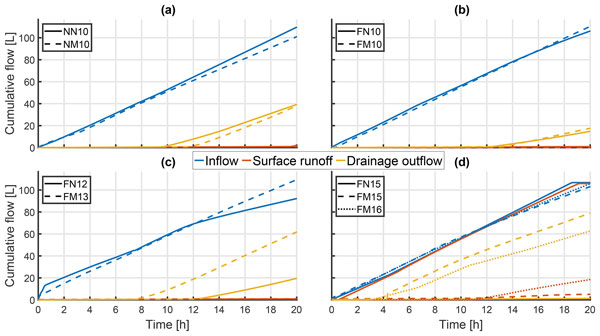
L287-289: These cumulative plots are great, but it would be nice to see some temporal fluxes in addition to the cumulative plots.
L317: ‘as evidence of’ should be replaced by ‘suggests’. The similarity in infiltration behavior, and differences in drainage volumes help support this inference of bypass flow as well, since it suggests that more water is stored in the matrix in the FN12 versus FM13.
L320: Not sure your data shows any differences or ‘acceleration’ in infiltration rates… it does suggest bypass flow though.
L335-336: ‘which enabled water to bypass frozen regions and resulted in earlier and more pronounced drainage’…I’m wondering if you could also show the VWC profiles at the onset of drainage in FM15 and FM16. My reasoning is that if the probes show no changes prior to the onset of drainage, that will significantly strengthen your argument of bypass flow through macropores.
L337: Replace ‘reflecting’ with ‘suggesting’. You don’t have direct evidence of this.
Figures 5, 6, and 7 clearly show edge effects and that your set-up did not produce exclusively top-down thaw. That being said, I don’t think this affects the interpretation of your results. I suggest the authors walk back their strong statements about the set-up’s ability to reproduce one-dimensional vertical freeze-thaw. This is another reason where showing the vertical versus lateral thermal gradients would be helpful… although from these figures I doubt the vertical gradients are at least an order of magnitude greater than the lateral thermal gradients.
L368-369: Soil shrinking or soil compaction/settling? I’m having a hard time seeing how the very coarse soils used in experiments would have that much shrinking? I would expect this to be more prevalent in fine grains soils.
L375: Are you sure this is due to advective heat transport? I don’t think your data allows you to make such a strong statement. See previous comments about edge effects. Soften your language please.
L402: Your figures are units of degrees Celsius, yet you discuss in Kelvins. While I know the changes are equivalent, you should be consistent, I suggest using degrees Celsius.
L427: Replace ‘demonstrate’ with ‘suggests’.
L434-435: The main reason why these results may differ from Pittman et al. (2020) is that soils used in these experiments had significant amounts of smectite and thus swelled significantly at high saturation which likely sealed many of the macropores. Similar observations were seen at the field site where these cores were taken from in Mohammed et al. (2019), at the site named Triple G (figure 5) where recharge through was frozen ground was observed in in MW2, but at 80 cm the soil slowly became saturated while under the zero-degree curtain and no further infiltration and groundwater recharge was observed until the soil profile thawed.
L461-463: This is also a very novel, direct observation of pore-blockage due to sediment deposition and promoting freezing in macropores. Very nice!
References:
Grant, K. N., Macrae, M. L., Rezanezhad, F., & Lam, W. V. (2019). Nutrient leaching in soil affected by fertilizer application and frozen ground. Vadose Zone Journal, 18(1), 1-13.
Ireson, A. M., Van Der Kamp, G., Ferguson, G., Nachshon, U., & Wheater, H. S. (2013). Hydrogeological processes in seasonally frozen northern latitudes: understanding, gaps and challenges. Hydrogeology Journal, 21(1), 53-66.
Khanahmadi, H., Bauer, J., Baselt, I., & Heinze, T. (2026). The influence of macropores on the thermal state of soil during infiltration in the absence of thermal equilibrium. Journal of Hydrology, 134983.
Holten, R., Larsbo, M., Jarvis, N., Stenrød, M., Almvik, M., & Eklo, O. M. (2019). Leaching of five pesticides of contrasting mobility through frozen and unfrozen soil. Vadose Zone Journal, 18(1), 1-10.
Hyman‐Rabeler, K. A., & Loheide, S. P. (2023). Drivers of variation in winter and spring groundwater recharge: Impacts of midwinter melt events and subsequent freezeback. Water Resources Research, 59(1), e2022WR032733.
Larsbo, M., Holten, R., Stenrød, M., Eklo, O. M., & Jarvis, N. (2019). A dual‐permeability approach for modeling soil water flow and heat transport during freezing and thawing. Vadose Zone Journal, 18(1), 1-11.
Mohammed, A. A., Schincariol, R. A., Nagare, R. M., & Quinton, W. L. (2014). Reproducing field-scale active layer thaw in the laboratory. Vadose Zone Journal, 13(8), vzj2014-01.
Mohammed, A. A., Pavlovskii, I., Cey, E. E., & Hayashi, M. (2019). Effects of preferential flow on snowmelt partitioning and groundwater recharge in frozen soils. Hydrology and Earth System Sciences, 23(12), 5017-5031.
Mohammed, A. A., Cey, E. E., Hayashi, M., Callaghan, M. V., Park, Y. J., Miller, K. L., & Frey, S. K. (2021a). Dual‐permeability modeling of preferential flow and snowmelt partitioning in frozen soils. Vadose Zone Journal, 20(2), e20101.
Mohammed, A. A., Cey, E. E., Hayashi, M., & Callaghan, M. V. (2021b). Simulating preferential flow and snowmelt partitioning in seasonally frozen hillslopes. Hydrological Processes, 35(8), e14277.
Nagare, R. M., Schincariol, R. A., Quinton, W. L., & Hayashi, M. (2012). Moving the field into the lab: Simulation of water and heat transport in subarctic peat. Permafrost and Periglacial Processes, 23(3), 237-243.
Rey, D. M., Hinckley, E. L. S., Walvoord, M. A., & Singha, K. (2021). Integrating observations and models to determine the effect of seasonally frozen ground on hydrologic partitioning in alpine hillslopes in the Colorado Rocky Mountains, USA. Hydrological Processes, 35(10), e14374.
Sanchez‐Rodriguez, I., Ireson, A., Brannen, R., & Brauner, H. (2025). Insights into freeze–thaw and infiltration in seasonally frozen soils from field observations. Vadose Zone Journal, 24(1), e20396.
Citation: https://doi.org/10.5194/egusphere-2025-5473-RC2 -
AC2: 'Reply on RC2', Julian Bauer, 12 Mar 2026
We thank the reviewer for the constructive and helpful comments.
Our detailed point-by-point responses are provided in the attached pdf document.
Best regards
Julian- AC3: 'Reply on AC2', Julian Bauer, 12 Mar 2026
-
AC2: 'Reply on RC2', Julian Bauer, 12 Mar 2026


Interactive discussion
Status: closed
-
RC1: 'Comment on egusphere-2025-5473', Anonymous Referee #1, 26 Dec 2025
The manuscript presents a carefully designed set of large-scale laboratory experiments investigating infiltration, runoff, and drainage in frozen slopes, with particular emphasis on the role of macropore networks and antecedent water content. The experimental setup is ambitious, the dataset is rich, and the effort to move beyond traditional column experiments toward a slope-scale configuration is appreciated. The topic is timely and relevant to cold-region hydrology and slope processes, and the paper has the potential to become a useful benchmark dataset for model testing. The manuscript is well-organized and prepared with clarity. Most of the methodological limitations are clearly outlined.
However, in its current form, the manuscript systematically over-interprets its results in favor of its hypothesis. Where the observations are robust, the conclusions are largely intuitive and confirm existing understanding; where the authors advance more interesting or non-intuitive interpretations, the supporting evidence is insufficiently constrained. Several claims conflate what is observed with what is inferred, and in some cases the causal chain between measurements and conclusions is not convincingly established.
For these reasons, I do not recommend acceptance in the current form. At the same time, I do not consider the work fundamentally flawed. A major revision is appropriate, provided that the authors substantially revise the interpretation, tighten the logic, and clearly delimit what can and cannot be concluded from the data.
Major comments
1) A recurring issue throughout the manuscript is the insufficient separation between “direct observations” and “interpretive statements”. This is particularly evident in claims regarding preferential bypass flow at intermediate initial water content, “threshold-type” behaviour around a specific volumetric water content, and macropore controlled advective heat transport.
In several places, statements are phrased as if the experiments "demonstrate" specific mechanisms, whereas the data are at best "consistent" with those mechanisms. Given the absence of direct diagnostics of flow paths (e.g. tracer tests, dye experiments, imaging), preferential flow remains an inference, not an observation. This distinction must be made explicit throughout the manuscript. Of course, some degree of interpretive uncertainty is inevitable in experiments of this type. my concern here is not ambiguity per se, but overstatement relative to that ambiguity.
I strongly encourage the authors to revise the text so that:
- observational results (fluxes, temperature fields, ΔVWC patterns) are clearly described as such, and
- mechanistic explanations are framed as hypotheses consistent with the observations, rather than as demonstrated processes.
Related to this point, several of the key interpretations rely on transient behaviour (e.g. early drainage onset, switching between drainage- and runoff-dominated regimes, and progressive loss of macropore effectiveness). These are inherently rate-related phenomena, yet the analysis is presented almost exclusively in cumulative (volume) form. While cumulative fluxes are informative for overall partitioning, complementary rate-based representations (e.g. time-resolved inflow, runoff, and drainage rates, and their balance) could provide a more quantitative basis for comparing scenarios and for assessing whether observed differences reflect transient dynamics or simply integrated effects. I present this as a suggestion rather than a requirement, but such analyses could help clarify several of the interpretations advanced in the manuscript.
2) The manuscript repeatedly refers to a “threshold” initial volumetric water content (around 12–13%) above which macropores become hydraulically important. While the qualitative distinction between low, intermediate, and high initial water content regimes is evident in the data, the use of the term threshold is a bit too strong.
Only a small number of discrete initial conditions are tested, and the inferred transition depends on soil texture, porosity, macropore geometry, freezing history, and experimental boundary conditions. As such, the data do not justify the identification of a sharp or general threshold, nor the presentation of a specific numerical value as physically meaningful beyond this setup.
The authors should:
- avoid presenting the observed transition as a universal or sharply defined threshold,
- clearly state that the reported values are setup-specific, and
- reframe the discussion in terms of regime behaviour rather than threshold behaviour.
More generally, the manuscript would benefit from a clearer discussion of transferability. The experiments are necessarily highly controlled, with a specific soil texture, porosity, macropore geometry, and freezing history. While such idealization is appropriate for process understanding, the current discussion does not sufficiently articulate which aspects of the observed behaviour are expected to be transferable to other soils, macropore configurations, or thermal regimes, and which are strictly setup-specific. Clarifying this distinction would help readers assess how the results should be interpreted beyond the particular experimental configuration studied here, and would strengthen the contribution of the paper.
3) The interpretation of earlier drainage onset in the intermediate water content macropore experiment as evidence of preferential bypass flow is not fully convincing in its current form. While the observation itself (earlier drainage relative to the non-macropore case) is clear, alternative explanations cannot be ruled out, including packing heterogeneity introduced during soil preparation, localised shrinkage or cracking during freezing and wetting, preferential flow along probe–soil interfaces, or differences in frost geometry not fully captured by averaged profiles. Specially given how small sometimes the differences are.
Given that the authors acknowledge artefacts in other experiments (e.g. near-surface sensor exposure and structural heterogeneity), the manuscript should explicitly discuss these alternative explanations and justify why preferential flow through the artificial macropore network is the most plausible interpretation. At minimum, the language should be softened to reflect the inferential nature of this conclusion.
4) The macropore network is central to the study, yet its mechanical and hydraulic integrity is not sufficiently explored. Important questions remain insufficiently addressed, including whether macropores remain open and hydraulically connected at the onset of irrigation (specifically relevant for such a coarse material), the extent to which macropore collapse or partial closure may occur during freezing and wetting, and how representative the chosen macropore diameter, orientation, and connectivity are relative to natural systems.
While the authors describe the network as a simplified analogue, the manuscript should more explicitly acknowledge that this configuration represents an upper-bound scenario for macropore influence and discuss the implications for transferability to natural soils.
5) Changes in volumetric water content during irrigation are interpreted in several places as evidence of infiltration, bypass flow, or macropore-driven transport. However, under partially frozen conditions, ΔVWC may reflect multiple processes, including liquid redistribution, phase change (melting or refreezing), and measurement artefacts near the freezing point.
Given the strong sensitivity of dielectric measurements near 0 °C and the reliance on relative rather than absolute changes, the manuscript should be more cautious in attributing ΔVWC patterns to specific hydraulic processes. Statements that rely heavily on ΔVWC fields should be revisited and, where necessary, qualified.
6) Several passages attribute downward migration of the freezing front during irrigation to advective heat transport associated with infiltration. As currently written, this interpretation is not always physically clear. Infiltrating water is warmer than the frozen soil, and advective heat transport would intuitively promote thawing rather than deeper freezing unless the coupled effects of phase change and latent heat release are explicitly considered. The authors should clarify the underlying energy balance and ensure that the explanation of freezing-front movement is physically consistent and clearly articulated.
Minor comments
- The potential influence of the measurement probes themselves on hydraulic and thermal behaviour should be commented on.
- Statements such as “minor spatial variations” or “no systematic effect” should be supported by quantitative measures, where possible.
In the end, I think the experimental work is solid and the dataset is valuable. However, substantial revision is required to bring the interpretation, framing, and strength of the claims into alignment with the evidence. If the authors substantially narrow their conclusions, clarify limitations, and better distinguish observation from inference, the manuscript could become a meaningful contribution suitable for publication in The Cryosphere.
Citation: https://doi.org/10.5194/egusphere-2025-5473-RC1 - AC1: 'Reply on RC1', Julian Bauer, 12 Mar 2026
-
RC2: 'Comment on egusphere-2025-5473', Anonymous Referee #2, 13 Feb 2026
Summary
The authors present an excellent experimental study on the effects of macropores on the partitioning of rainfall between infiltration, runoff and drainage in frozen hillslopes. The hillslope-scale experiments are a significant advancement of past 1D soil column experiments, and allows investigation of more realistic multi-dimensional hillslope behavior. The results are not nearly as novel as the authors claim, almost all of the findings presented here have been shown in other studies (see below). However the results still provide valuable insight into the importance of antecedent soil moisture on preferential flow, as well as enhanced infiltration and bypass flow in frozen soils due to preferential flow, refreezing of infiltrated water in macropores and its effect on the temporal evolution of runoff generation in drainage in frozen soils.
A novel aspect is the direct observational evidence of freezing of water in macropores initiating from the pore-walls, corroborating the findings of Watanabe and Kugasaki (2017). We need more than one study to confirm this behavior, and this study does a great job of showing this in hillslopes, also corroborating the conceptual model put forward in Mohammed et al. (2018). The other major advancement in this study is providing a well-controlled dataset that will be extremely valuable for testing emerging dual-permeability models of water flow in frozen soils. I very much look forward to future modeling work with this dataset. This is a solid contribution and should be published. However, the authors need to walk back some of the strong language used in the manuscript, as this experimental work also suffers from many of the limitations of field studies, in that many of the preferential flow processes discussed are inferred rather than directly observed.
Preferential flow in frozen soil is still a pretty niche field compared to more mature fields in cold regions hydrology, but interest is growing due to increased consensus that it has significant control on water partitioning in frozen soils. There has been previous work that has shown many, if not all, of the findings in this work, yet the authors have not acknowledged many of these important studies. They appropriately mention the seminal experimental work of Watanabe and Kugisaki (2017) and Pittman et al. (2020), yet Holten et al. (2019) and Grant et al. (2019) have also shown many of these infiltration, preferential flow and refreezing dynamics. The authors need to acknowledge these works as their work builds upon these previous studies. Similarly, there have been pioneering field and modeling studies on hillslopes that have also shown almost all the findings of this work that the authors don’t acknowledge either, including Mohammed at al. (2019), Rey et al. (2021), Mohammed et al. (2021b), Hyman‐Rabeler and Loheide (2023), and Sanchez‐Rodriguez et al. (2025). They refer to a review paper like Walvoord and Kurylyk (2016) that has almost nothing to do with the work presented here and yet don’t mention Ireson et al. (2013). One might think that the authors have purposely left out references to these studies in this manuscript to seemingly enhance the perceived novelty of the work presented. The authors need to give credit where credit is due.
I believe with minor revisions, this will be an excellent contribution to the field of cold regions hydrology.
Minor Comments
L43: Should cite Larsbo et al. (2019) and Mohammed et al. (2021a) here, as these two were the first to include differences in freezing between macropores and the soil matrix in numerical models, using the conceptual model put forward in Mohammed et al. (2018).
L52: This sentence should reference works like Mohammed et al. (2021b) and Sanchez‐Rodriguez et al., (2025).
L67-68: Should also cite Mohammed et al. (2019) and Sanchez‐Rodriguez et al., (2025) here as well.
L100: Please report on the stability of the temperature range of the compressor used to main temperatures, i.e. show that the temperature control is actually stable during frozen conditions.
L102-104: What was the insulation material surrounding the soil box? The authors state that insulation “ensured that freezing initiates exclusively at the air-soil interface, akin to natural conditions”. It is not sufficient to just state this, you have to show it. What you should have done is place temperature sensors at the edges of the box and compare the thermal profiles at the center and edges of the box. You should use the thermal profiles of the probes S1-S5 to show that ambient temperature interference was actually minimized, and lateral thermal gradients are at least an order of magnitude smaller than vertical gradients. Nagare et al. (2012) and Mohammed et al. (2014) showed that passive insulation like that used here will always fail at some point, so you need to show that the set-up actually mimicked top-down thaw, as the thawing period is more important that the freezing period for these experiments. While I don’t necessarily think this is a major issue for this type of experiment, statements like this made with such certainty need to be backed up by data. Your figures 5-7 clearly show lateral thermal gradients with those curved lines showing frost depths, especially FN10.
L246-247: Again, here you mention The temperature and VWC distributions were found to be largely uniform across the soil body, with only minor spatial variations and weak boundary influences near the walls and bottom You’re asking the reader to take your word for this. See my suggestion above about comparing lateral versus vertical thermal gradients. This could be in the appendices.
Figure 3: Somewhat related to the previous comments above. I understand why the authors have averaged the VWC and temperature probe readings, I suspect that there are plans in the pipeline to model this experiment with dual-permeability model similar to Khanahmadi et al. (2026) but modified for freeze-thaw. However, it would be nice to see the profiles from the individual probe profiles. This, again, could go into the appendices.
L263: You state that ‘Concurrent VWC decreases in the upper 10-20 cm (> 0.5 %) indicate early redistribution of unfrozen water’… so where did this water go? All depths show either decreases or no change. Cryo-suction redistributes water to the freezing front, so was water redistributed to the shallow soil where no sensors were present? If you don’t have measurements to confirm, another reason could be that there was vapor loss as well, so you can’t say for sure that this loss was due to redistribution... especially in the coarse-grained soil used here.
L265-266: Downward redistribution during freezing goes against our current understanding of the effects of freezing on water migration (i.e. cryo-suction). This does not make sense, especially at drier conditions in coarse grained soil as the authors have used here.
L279: Again, do you have data to support this statement?
L287-289: These cumulative plots are great, but it would be nice to see some temporal fluxes in addition to the cumulative plots.
L317: ‘as evidence of’ should be replaced by ‘suggests’. The similarity in infiltration behavior, and differences in drainage volumes help support this inference of bypass flow as well, since it suggests that more water is stored in the matrix in the FN12 versus FM13.
L320: Not sure your data shows any differences or ‘acceleration’ in infiltration rates… it does suggest bypass flow though.
L335-336: ‘which enabled water to bypass frozen regions and resulted in earlier and more pronounced drainage’…I’m wondering if you could also show the VWC profiles at the onset of drainage in FM15 and FM16. My reasoning is that if the probes show no changes prior to the onset of drainage, that will significantly strengthen your argument of bypass flow through macropores.
L337: Replace ‘reflecting’ with ‘suggesting’. You don’t have direct evidence of this.
Figures 5, 6, and 7 clearly show edge effects and that your set-up did not produce exclusively top-down thaw. That being said, I don’t think this affects the interpretation of your results. I suggest the authors walk back their strong statements about the set-up’s ability to reproduce one-dimensional vertical freeze-thaw. This is another reason where showing the vertical versus lateral thermal gradients would be helpful… although from these figures I doubt the vertical gradients are at least an order of magnitude greater than the lateral thermal gradients.
L368-369: Soil shrinking or soil compaction/settling? I’m having a hard time seeing how the very coarse soils used in experiments would have that much shrinking? I would expect this to be more prevalent in fine grains soils.
L375: Are you sure this is due to advective heat transport? I don’t think your data allows you to make such a strong statement. See previous comments about edge effects. Soften your language please.
L402: Your figures are units of degrees Celsius, yet you discuss in Kelvins. While I know the changes are equivalent, you should be consistent, I suggest using degrees Celsius.
L427: Replace ‘demonstrate’ with ‘suggests’.
L434-435: The main reason why these results may differ from Pittman et al. (2020) is that soils used in these experiments had significant amounts of smectite and thus swelled significantly at high saturation which likely sealed many of the macropores. Similar observations were seen at the field site where these cores were taken from in Mohammed et al. (2019), at the site named Triple G (figure 5) where recharge through was frozen ground was observed in in MW2, but at 80 cm the soil slowly became saturated while under the zero-degree curtain and no further infiltration and groundwater recharge was observed until the soil profile thawed.
L461-463: This is also a very novel, direct observation of pore-blockage due to sediment deposition and promoting freezing in macropores. Very nice!
References:
Grant, K. N., Macrae, M. L., Rezanezhad, F., & Lam, W. V. (2019). Nutrient leaching in soil affected by fertilizer application and frozen ground. Vadose Zone Journal, 18(1), 1-13.
Ireson, A. M., Van Der Kamp, G., Ferguson, G., Nachshon, U., & Wheater, H. S. (2013). Hydrogeological processes in seasonally frozen northern latitudes: understanding, gaps and challenges. Hydrogeology Journal, 21(1), 53-66.
Khanahmadi, H., Bauer, J., Baselt, I., & Heinze, T. (2026). The influence of macropores on the thermal state of soil during infiltration in the absence of thermal equilibrium. Journal of Hydrology, 134983.
Holten, R., Larsbo, M., Jarvis, N., Stenrød, M., Almvik, M., & Eklo, O. M. (2019). Leaching of five pesticides of contrasting mobility through frozen and unfrozen soil. Vadose Zone Journal, 18(1), 1-10.
Hyman‐Rabeler, K. A., & Loheide, S. P. (2023). Drivers of variation in winter and spring groundwater recharge: Impacts of midwinter melt events and subsequent freezeback. Water Resources Research, 59(1), e2022WR032733.
Larsbo, M., Holten, R., Stenrød, M., Eklo, O. M., & Jarvis, N. (2019). A dual‐permeability approach for modeling soil water flow and heat transport during freezing and thawing. Vadose Zone Journal, 18(1), 1-11.
Mohammed, A. A., Schincariol, R. A., Nagare, R. M., & Quinton, W. L. (2014). Reproducing field-scale active layer thaw in the laboratory. Vadose Zone Journal, 13(8), vzj2014-01.
Mohammed, A. A., Pavlovskii, I., Cey, E. E., & Hayashi, M. (2019). Effects of preferential flow on snowmelt partitioning and groundwater recharge in frozen soils. Hydrology and Earth System Sciences, 23(12), 5017-5031.
Mohammed, A. A., Cey, E. E., Hayashi, M., Callaghan, M. V., Park, Y. J., Miller, K. L., & Frey, S. K. (2021a). Dual‐permeability modeling of preferential flow and snowmelt partitioning in frozen soils. Vadose Zone Journal, 20(2), e20101.
Mohammed, A. A., Cey, E. E., Hayashi, M., & Callaghan, M. V. (2021b). Simulating preferential flow and snowmelt partitioning in seasonally frozen hillslopes. Hydrological Processes, 35(8), e14277.
Nagare, R. M., Schincariol, R. A., Quinton, W. L., & Hayashi, M. (2012). Moving the field into the lab: Simulation of water and heat transport in subarctic peat. Permafrost and Periglacial Processes, 23(3), 237-243.
Rey, D. M., Hinckley, E. L. S., Walvoord, M. A., & Singha, K. (2021). Integrating observations and models to determine the effect of seasonally frozen ground on hydrologic partitioning in alpine hillslopes in the Colorado Rocky Mountains, USA. Hydrological Processes, 35(10), e14374.
Sanchez‐Rodriguez, I., Ireson, A., Brannen, R., & Brauner, H. (2025). Insights into freeze–thaw and infiltration in seasonally frozen soils from field observations. Vadose Zone Journal, 24(1), e20396.
Citation: https://doi.org/10.5194/egusphere-2025-5473-RC2 -
AC2: 'Reply on RC2', Julian Bauer, 12 Mar 2026
We thank the reviewer for the constructive and helpful comments.
Our detailed point-by-point responses are provided in the attached pdf document.
Best regards
Julian- AC3: 'Reply on AC2', Julian Bauer, 12 Mar 2026
-
AC2: 'Reply on RC2', Julian Bauer, 12 Mar 2026
Peer review completion


Journal article(s) based on this preprint
Viewed
| HTML | XML | Total | BibTeX | EndNote | |
|---|---|---|---|---|---|
| 1,839 | 1,155 | 172 | 3,166 | 127 | 127 |
- HTML: 1,839
- PDF: 1,155
- XML: 172
- Total: 3,166
- BibTeX: 127
- EndNote: 127
Viewed (geographical distribution)
| Country | # | Views | % |
|---|
| Total: | 0 |
| HTML: | 0 |
| PDF: | 0 |
| XML: | 0 |
- 1
Julian Bauer
Sebastian Müller
Thomas Heinze
Homa Khanahmadi Bafghi
Ivo Baselt
The requested preprint has a corresponding peer-reviewed final revised paper. You are encouraged to refer to the final revised version.
- Preprint
(3220 KB) - Metadata XML
The manuscript presents a carefully designed set of large-scale laboratory experiments investigating infiltration, runoff, and drainage in frozen slopes, with particular emphasis on the role of macropore networks and antecedent water content. The experimental setup is ambitious, the dataset is rich, and the effort to move beyond traditional column experiments toward a slope-scale configuration is appreciated. The topic is timely and relevant to cold-region hydrology and slope processes, and the paper has the potential to become a useful benchmark dataset for model testing. The manuscript is well-organized and prepared with clarity. Most of the methodological limitations are clearly outlined.
However, in its current form, the manuscript systematically over-interprets its results in favor of its hypothesis. Where the observations are robust, the conclusions are largely intuitive and confirm existing understanding; where the authors advance more interesting or non-intuitive interpretations, the supporting evidence is insufficiently constrained. Several claims conflate what is observed with what is inferred, and in some cases the causal chain between measurements and conclusions is not convincingly established.
For these reasons, I do not recommend acceptance in the current form. At the same time, I do not consider the work fundamentally flawed. A major revision is appropriate, provided that the authors substantially revise the interpretation, tighten the logic, and clearly delimit what can and cannot be concluded from the data.
Major comments
1) A recurring issue throughout the manuscript is the insufficient separation between “direct observations” and “interpretive statements”. This is particularly evident in claims regarding preferential bypass flow at intermediate initial water content, “threshold-type” behaviour around a specific volumetric water content, and macropore controlled advective heat transport.
In several places, statements are phrased as if the experiments "demonstrate" specific mechanisms, whereas the data are at best "consistent" with those mechanisms. Given the absence of direct diagnostics of flow paths (e.g. tracer tests, dye experiments, imaging), preferential flow remains an inference, not an observation. This distinction must be made explicit throughout the manuscript. Of course, some degree of interpretive uncertainty is inevitable in experiments of this type. my concern here is not ambiguity per se, but overstatement relative to that ambiguity.
I strongly encourage the authors to revise the text so that:
Related to this point, several of the key interpretations rely on transient behaviour (e.g. early drainage onset, switching between drainage- and runoff-dominated regimes, and progressive loss of macropore effectiveness). These are inherently rate-related phenomena, yet the analysis is presented almost exclusively in cumulative (volume) form. While cumulative fluxes are informative for overall partitioning, complementary rate-based representations (e.g. time-resolved inflow, runoff, and drainage rates, and their balance) could provide a more quantitative basis for comparing scenarios and for assessing whether observed differences reflect transient dynamics or simply integrated effects. I present this as a suggestion rather than a requirement, but such analyses could help clarify several of the interpretations advanced in the manuscript.
2) The manuscript repeatedly refers to a “threshold” initial volumetric water content (around 12–13%) above which macropores become hydraulically important. While the qualitative distinction between low, intermediate, and high initial water content regimes is evident in the data, the use of the term threshold is a bit too strong.
Only a small number of discrete initial conditions are tested, and the inferred transition depends on soil texture, porosity, macropore geometry, freezing history, and experimental boundary conditions. As such, the data do not justify the identification of a sharp or general threshold, nor the presentation of a specific numerical value as physically meaningful beyond this setup.
The authors should:
More generally, the manuscript would benefit from a clearer discussion of transferability. The experiments are necessarily highly controlled, with a specific soil texture, porosity, macropore geometry, and freezing history. While such idealization is appropriate for process understanding, the current discussion does not sufficiently articulate which aspects of the observed behaviour are expected to be transferable to other soils, macropore configurations, or thermal regimes, and which are strictly setup-specific. Clarifying this distinction would help readers assess how the results should be interpreted beyond the particular experimental configuration studied here, and would strengthen the contribution of the paper.
3) The interpretation of earlier drainage onset in the intermediate water content macropore experiment as evidence of preferential bypass flow is not fully convincing in its current form. While the observation itself (earlier drainage relative to the non-macropore case) is clear, alternative explanations cannot be ruled out, including packing heterogeneity introduced during soil preparation, localised shrinkage or cracking during freezing and wetting, preferential flow along probe–soil interfaces, or differences in frost geometry not fully captured by averaged profiles. Specially given how small sometimes the differences are.
Given that the authors acknowledge artefacts in other experiments (e.g. near-surface sensor exposure and structural heterogeneity), the manuscript should explicitly discuss these alternative explanations and justify why preferential flow through the artificial macropore network is the most plausible interpretation. At minimum, the language should be softened to reflect the inferential nature of this conclusion.
4) The macropore network is central to the study, yet its mechanical and hydraulic integrity is not sufficiently explored. Important questions remain insufficiently addressed, including whether macropores remain open and hydraulically connected at the onset of irrigation (specifically relevant for such a coarse material), the extent to which macropore collapse or partial closure may occur during freezing and wetting, and how representative the chosen macropore diameter, orientation, and connectivity are relative to natural systems.
While the authors describe the network as a simplified analogue, the manuscript should more explicitly acknowledge that this configuration represents an upper-bound scenario for macropore influence and discuss the implications for transferability to natural soils.
5) Changes in volumetric water content during irrigation are interpreted in several places as evidence of infiltration, bypass flow, or macropore-driven transport. However, under partially frozen conditions, ΔVWC may reflect multiple processes, including liquid redistribution, phase change (melting or refreezing), and measurement artefacts near the freezing point.
Given the strong sensitivity of dielectric measurements near 0 °C and the reliance on relative rather than absolute changes, the manuscript should be more cautious in attributing ΔVWC patterns to specific hydraulic processes. Statements that rely heavily on ΔVWC fields should be revisited and, where necessary, qualified.
6) Several passages attribute downward migration of the freezing front during irrigation to advective heat transport associated with infiltration. As currently written, this interpretation is not always physically clear. Infiltrating water is warmer than the frozen soil, and advective heat transport would intuitively promote thawing rather than deeper freezing unless the coupled effects of phase change and latent heat release are explicitly considered. The authors should clarify the underlying energy balance and ensure that the explanation of freezing-front movement is physically consistent and clearly articulated.
Minor comments
In the end, I think the experimental work is solid and the dataset is valuable. However, substantial revision is required to bring the interpretation, framing, and strength of the claims into alignment with the evidence. If the authors substantially narrow their conclusions, clarify limitations, and better distinguish observation from inference, the manuscript could become a meaningful contribution suitable for publication in The Cryosphere.