
the Creative Commons Attribution 4.0 License.
the Creative Commons Attribution 4.0 License.
 | 07 Nov 2025
Sea ice melt drives vertical pCO2 variability modulating air-sea gas exchange
Abstract. Strong spatial and temporal gradients in salinity, temperature, and carbonate chemistry in Arctic coastal surface waters complicate the estimation of air-sea CO2 exchange, particularly during sea ice breakup. This study evaluates the applicability of the widely used bulk flux model under such conditions. The bulk approach assumes homogeneous surface conditions and linear vertical pCO2 gradients. However, our observations in a stratified Arctic fjord reveal pronounced vertical variability in pCO2 within the upper water column, including non-linear gradients near the air-sea interface. Micrometeorological measurements captured episodic upward CO2 fluxes even when waters 1 m and below were CO2-undersaturated. We hypothesize that transient, high-pCO2 layers at ~0.1 m depth intermittently decouple the atmospheric exchange from subsurface waters, reversing the expected flux direction. These findings highlight the importance of resolving near-surface variability during the transition from ice-covered to open water conditions. We recommend incorporating micrometeorological techniques and high-resolution vertical profiling in Arctic fjords to improve flux estimates of CO2 in this rapidly changing region.
-
Notice on discussion status
The requested preprint has a corresponding peer-reviewed final revised paper. You are encouraged to refer to the final revised version.
-
Preprint
(2590 KB)
-
Supplement
(1526 KB)
-
The requested preprint has a corresponding peer-reviewed final revised paper. You are encouraged to refer to the final revised version.
- Preprint
(2590 KB) - Metadata XML
-
Supplement
(1526 KB) - BibTeX
- EndNote
- Final revised paper


Journal article(s) based on this preprint
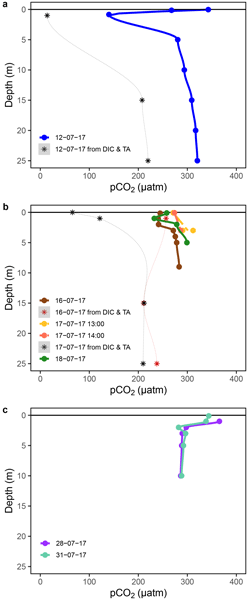
Sea ice melt adds less-saline water to the surface ocean. This creates vertical gradients in salinity, temperature, and partial pressures of carbon dioxide (pCO2). The concentration difference of pCO2 across the air-ocean boundary is used to estimate gas transfer. Thus, the depth that we measure will impact our estimates. Similar patterns were observed in multiple Arctic fjords years apart, suggesting these vertical gradients may be common during the spring melt season.
Interactive discussion
Status: closed
- CC1: 'Comment on egusphere-2025-5330', John Prytherch, 02 Dec 2025
-
AC1: 'Comment on egusphere-2025-5330', Henry Henson, 09 Dec 2025
We thank CC1 for their constructive technical insights and for engaging with the manuscript. We would like to take the opportunity to clarify that the main purpose of our study was to document pronounced near-surface stratification in carbonate system parameters during sea-ice breakup, and to discuss how this non-linear structure can influence the direction of air-sea CO2 exchange. The EC measurements were collected as supplementary evidence, and not as the primary quantitative constraint on flux magnitude.
We agree with the comment that water vapor cross-sensitivity represents a significant challenge for open-path NDIR EC CO2 measurements over the ocean, and that this likely inflates the magnitude of fluxes. We appreciate the correction that Landwehr et al. (2014) identified latent heat flux magnitude (|LE|), not RH, as the relevant diagnostic for residual bias. Following this reasoning, we can examine the subset of fluxes occurring under |LE| < ~7 W m-2, where Landwehr et al. report negligible cross-sensitivity. Indeed, over half of the OGM-approved EC CO2 fluxes occur below this threshold. This reduced-bias subset continues to demonstrate many instances of CO2 efflux. (A diagnostic plot of CO2 flux vs latent heat flux, annotated with ±7 W m-2 thresholds, is provided to illustrate this.) If, due to an abundance of caution, we perceive the precise magnitudes of these fluxes as uncertain, we can still interpret their directional sign as qualitatively consistent with the near-surface carbonate system structure seen in the independent profile measurements.
Regarding physical plausibility, the Young Sound Fjord system remains strongly stratified throughout July and into August (e.g., Henson et al., 2025) due to glacier/runoff inputs and fjord geometry, and therefore is not well mixed even after SIC declines. This stratification throughout spring and summer increases the likelihood that shallow waters can become decoupled from deeper layers and continue to demonstrate nonlinear gradients in the upper meters.
Finally, we fully agree that dried/closed-path EC systems are better suited for quantifying flux magnitudes. At the time of the field campaign, however, a closed-path system was not used. In order to extract meaning from the observations available, we attempt to interpret these data qualitatively rather than as quantitative flux determinations. This framing will be clarified in the revised manuscript. Still, recent closed-path EC observations in the Arctic (Blomquist et al., 2025) also show episodes of CO2 efflux during the ice-breakup transition, supporting the interpretation that such efflux is physically plausible even though our open-path magnitudes are uncertain. We have emphasized in the manuscript that closed-path approaches will be essential in future work to precisely constrain flux magnitudes.
We appreciate this discussion, which helps to clarify how the EC data should be framed relative to the carbonate system measurements.
-
AC2: 'Reply on AC1', Henry Henson, 09 Dec 2025
Correction: Butterworth et al. (2025) not Blomquist et al (2025)
See: https://doi.org/10.5194/tc-19-5317-2025Citation: https://doi.org/10.5194/egusphere-2025-5330-AC2
-
AC2: 'Reply on AC1', Henry Henson, 09 Dec 2025
-
RC1: 'Comment on egusphere-2025-5330', Yuanxu Dong, 16 Dec 2025
-
AC3: 'Reply on RC1', Henry Henson, 13 Mar 2026
Response to RC1 - Major comments
Author response:
We thank Reviewer #1 for their thorough and technically informed review. We appreciate their recognition of the value of the pCO2, temperature, and salinity profile measurements and their constructive feedback on clarifying assumptions, terminology, and methodological limitations.
We also thank the RC1 for their detailed assessment of the eddy covariance (EC) CO2 flux measurements and for highlighting the well documented challenges associated with water vapor cross sensitivity in undried open-path NDIR sensors over marine environments. We fully agree that this cross sensitivity represents a significant limitation for the quantitative interpretation of EC CO2 fluxes in this study. In response to this and related concerns raised during the review process, we have revised the manuscript to explicitly frame the EC CO2 flux observations as contextual evidence complementary to the seawater profiles, rather than as definitive quantitative constraints on flux magnitude.
We emphasize that the primary objective of this study is to document pronounced near-surface stratification in carbonate system parameters during sea-ice breakup and to examine how this vertical heterogeneity challenges the assumptions underlying standard bulk air-sea CO2 flux parameterizations. The high-resolution pCO2, temperature, and salinity profiles form the core observational result of the manuscript. The EC measurements are retained as complementary observations that illustrate the dynamic nature of air-sea exchange during this transition period, but the revised manuscript does not rely on them to infer absolute flux magnitudes or to validate bulk flux estimates.
Upon further review of the literature describing humidity-related biases, a comparative methodological study by Landwehr et al. (2014) demonstrated that water vapor cross sensitivity can result in order-of-magnitude biases in CO2 flux estimates from undried IRGAs. However, under conditions of low latent heat flux (|LE| < ~7 W m-2), they found agreement between sensors operating with dried and undried airstreams, concluding that humidity-related bias was negligible below this threshold. We therefore include former Fig. S7 in the main text as Fig. 8, with these thresholds indicated, to illustrate which portion of the EC dataset from Young Sound falls within this low latent heat flux regime. Within this subset (|LE| < ~7 W m-2), EC flux estimates exhibit both positive and negative values. While we cannot exclude residual systematic bias, this behavior is consistent with the expectation that near-surface stratification in the inorganic carbon system may support short-lived deviations from bulk-model flux expectations, including potential reversals in flux direction. However, robust verification of these dynamics and quantification of air-sea CO2 exchange during sea-ice breakup will require closed-path EC systems with dried air streams. This message is also now communicated more clearly in the revised manuscript.
Response to RC1 - Minor comments
We thank the reviewer for these helpful minor comments. All suggested clarifications, wording changes, and reference additions have been implemented in the revised manuscript as detailed below.
- Line 32: CO2 is now defined at first use in the abstract.
- Line 34: The wording has been revised to clarify that bulk models assume no vertical pCO2 gradients within the bulk seawater below the diffusive boundary layer.
- Lines 37-38: Clarified that the statement refers to waters at 1 m depth.
- Line 67: Added the suggested reference to Miller et al. (2019).
- Line 79: A reference to Wanninkhof et al. (2009) has been added.
- Line 85: “Many” has been replaced with “most.”
- Line 94: The sentence has been revised following the reviewer’s suggested wording for improved rigor and precision.
- Line 135: The figure caption has been updated to indicate that the schematic is adapted from Liss and Slater (1974) and Wanninkhof et al. (2009).
- Line 176: Bracket placement and punctuation have been corrected as suggested.
- Lines 212-213: The text has been revised to clarify how measurements were conducted in 2017 without recommending replication of this experimental setup. Additionally, we have added text to clearly state we cannot precisely constrain CO2 flux magnitudes.
- Lines 253-254: The missing reference to Sejr et al. (2011) has been added.
- Line 268: Figure S2 was already referenced earlier in the text (line 225 of the original manuscript).
- Line 452: We thank the reviewer for raising this point and agree that classical cool-skin effects (typically <0.2 K; Donlon et al., 2002) would not be expected to strongly influence bulk ΔpCO2 relative to the much larger chemical and thermal gradients observed in this study. We would like to clarify that the temperature adjustment applied here does not assume a classical cool skin. Instead, we derive a near-surface temperature that is frequently warmer than the temperature measured at 1 m depth due to melt-driven stratification and surface warming during ice breakup. The pCO2 measured at 1 m is therefore adjusted from in situ conditions to this derived skin temperature. Additionally, the derived skin temperature values were already present in Table 1. However, we recognize this was not clear. We have now made this more apparent by labelling these values in the table and including the text: † Denotes skin temperatures derived from heat fluxes. ‡Denotes pCO2 values estimated from measurements at 1 m depth and adjusted to derived skin temperatures.
Citation: https://doi.org/10.5194/egusphere-2025-5330-AC3
-
AC3: 'Reply on RC1', Henry Henson, 13 Mar 2026
-
RC2: 'Comment on egusphere-2025-5330', Anonymous Referee #2, 06 Feb 2026
-
AC4: 'Reply on RC2', Henry Henson, 13 Mar 2026
Response to RC2 - Major comments
We thank Reviewer #2 for their careful, constructive, and encouraging assessment of our manuscript. We appreciate their recognition that the high-resolution near-surface pCO2, salinity, and temperature profiles provide a compelling and chemically plausible explanation for how melt-driven stratification can bias bulk air-sea CO2 flux estimates during the sea-ice breakup period. We also thank the reviewer for their clear guidance on how the eddy covariance (EC) data should be framed to strengthen the manuscript.
We fully agree that the quantitative robustness of open-path EC CO2 fluxes in marine environments is limited by water vapor cross sensitivity. In response to these concerns, we have revised the manuscript as recommended by RC2 to explicitly acknowledge the EC limitations and reframe the EC observations as qualitative context rather than as definitive quantitative constraints.
In the revised manuscript, the primary conclusions are now based on the independently measured near-surface carbonate system structure, which robustly demonstrates strong vertical pCO2 heterogeneity during sea-ice breakup. This results in varying flux magnitudes depending upon the depth chosen in the bulk parameterization. The EC data are retained to illustrate the high variability of air-sea CO2 flux estimates during this period and discuss the possibility for oversaturation during seasonal sea-ice transition as a result of heightened stratification.
Response to RC2 - Specific comments
We thank the reviewer for the following specific and helpful comments, all of which have been addressed in the revised manuscript.
- Line 34 The text has been revised to clarify that bulk flux models assume no vertical pCO2 gradients within the bulk seawater below the diffusive boundary layer
- Lines 167 & 404 We have removed the discussion of potential physical disequilibrium after recognizing that it is not relevant for the conclusions of the manuscript. The mismatch between calculated and measured pCO2 noted by the reviewer is already described in the Methods section.
- Lines 206 & 495 In line with the reviewer’s recommendation, we have reframed the EC data as qualitative context supporting the possibility that air-sea exchange during ice breakup may differ in sign, while explicitly acknowledging that open-path cross sensitivity likely inflates flux magnitudes. The revised manuscript does not rely on EC data to establish quantitative flux constraints.
- Lines 450 We thank the reviewer for raising this point and agree that classical cool-skin effects (typically <0.2 K; Donlon et al., 2002) would not be expected to strongly influence bulk ΔpCO2 relative to the much larger chemical and thermal gradients observed in this study. We would like to clarify that the temperature adjustment applied here does not assume a classical cool skin. Instead, we derive a near-surface temperature from the measured heat fluxes that is frequently warmer than the temperature measured at 1 m depth due to melt-driven stratification and surface warming during ice breakup. The pCO2 measured at 1 m is then adjusted from in situ conditions to pCO2 at the derived skin temperature. Furthermore, the derived skin temperature values were already present in Table 1. However, we recognize that this was not obvious. We have now made this more apparent by labelling these values in the table and including the text: † Denotes skin temperatures derived from heat fluxes. ‡Denotes pCO2 values estimated from measurements at 1 m depth and adjusted to derived skin temperatures.
- Figure S7 (now Figure 8): As suggested, this figure has been moved to the main text and is now referenced when discussing the reliability and uncertainty of the EC flux estimates.
Citation: https://doi.org/10.5194/egusphere-2025-5330-AC4
-
AC4: 'Reply on RC2', Henry Henson, 13 Mar 2026
Peer review completion


Interactive discussion
Status: closed
-
CC1: 'Comment on egusphere-2025-5330', John Prytherch, 02 Dec 2025
The authors discuss the mismatch between their EC measurements and bulk estimates of the flux and suggest possible reasons: near-surface warming stratification, and/or carbonate system changes leading to elevated pCO2 in the unmeasured surface waters; and water-vapor cross-sensitivity-based measurement errors such as those frequently reported (and experienced myself) with NDIR sensors in marine conditions.
The authors suggest that the high fluxes are unlikely to be due to water-vapor cross-sensitivity due to inconsistencies in the relationship between CO2 concentration and relative humidity, because elevated CO2 fluxes occurred coincidentally with both positive and negative latent heat fluxes, and because the CO2 fluxes had a strong negative correlation with sensible heat fluxes.
I think that measurement error is the likeliest explanation for these elevated CO2 fluxes, based on 1) what the marine CO2 flux community has learned about water-vapor cross-sensitivity type errors in NDIR instruments, and 2) the magnitude and variation of the reported EC CO2 fluxes.
Landwehr et al 2014 (reference in manuscript) provide an effective summary of these water-vapor-based errors in EC CO2 flux measurements using NDIR sensors, highlighting 1) that the exact reason for the bias remains unclear, 2) that the error is present in measurements with undried air streams, whether using open- or closed-path type sensors, 3) the error is dependent on latent heat flux (not relative humidity), increasing in magnitude with increasing flux, 4) that in their tests, there was negligible error for latent heat fluxes below 7 W/m2 magnitude, and 5) that the error can vary in direction and strength in different experiments, and even just between different sensor units. A further point also highlighted by Landwehr et al is that while the error is not due to the use of open-path type instrumentation, a closed-path instrument allows the humidity and temperature-based error terms to be reduced, and for more accurate determination of temperature, humidity and pressure fluctuations in the measurement volume, uncertainties in all of which can be of similar or greater magnitude to the CO2 flux term.
These factors fit with the description of the measurements and conditions in the manuscript. In particular, in figure S7, there is a strong correlation between the magnitude of the CO2 fluxes and the magnitude of the latent heat fluxes measured with the same instrument.
In terms of the EC CO2 fluxes (Figure 3) there are 3 brief periods with very large and very variable flux measurements, 3 other brief periods with somewhat smaller fluxes, and almost no other flux measurements that pass their QC procedures.
For the 3 periods with very large EC fluxes, the mismatch between EC and bulk fluxes is very strong and the direction of the measured flux is often opposite that which would be expected from the shallowest pCO2 measurement. For example, a flux of 40 mmol / m2 / day, and a wind speed of 4 m/s (conservative estimates of the conditions on July 16, 23 and 24 from Figure 3) and the k relationship of Ho et al., 2006 would imply a surface pCO2 greater than 1400 ppm using the standard air-sea bulk relationship.
On each of the three days there is also high variation in the EC fluxes, with values varying in a few hours from approx. 10 to 70 mmol/m2/day on July 16, and from approx 0 to 100 mmol/m2/day on July 23 and 24. The wind speed variation at these times is perhaps 3 m/s. Such rapid changes in flux also make it unlikely that these are statistically stationary conditions as required for eddy covariance.
For these large fluxes to be real, then there must be either an extreme and rapidly varying, unmeasured gradient in pCO2 in the shallow waters, or a strong source of turbulence in addition to the wind-driven mixing, or other modification to the ‘standard’ air-sea exchange forcing. However, most of the ice breakup has happened prior to the flux measurements (it is 10% SIC on July 16) and the light to moderate winds through the study period would mix the upper waters, so both these explanations seem unlikely. As such my suspicion is that many of the CO2 flux measurements are in error due to the inadequacies of undried NDIR sensors in these environments.
Citation: https://doi.org/10.5194/egusphere-2025-5330-CC1 -
AC1: 'Comment on egusphere-2025-5330', Henry Henson, 09 Dec 2025
We thank CC1 for their constructive technical insights and for engaging with the manuscript. We would like to take the opportunity to clarify that the main purpose of our study was to document pronounced near-surface stratification in carbonate system parameters during sea-ice breakup, and to discuss how this non-linear structure can influence the direction of air-sea CO2 exchange. The EC measurements were collected as supplementary evidence, and not as the primary quantitative constraint on flux magnitude.
We agree with the comment that water vapor cross-sensitivity represents a significant challenge for open-path NDIR EC CO2 measurements over the ocean, and that this likely inflates the magnitude of fluxes. We appreciate the correction that Landwehr et al. (2014) identified latent heat flux magnitude (|LE|), not RH, as the relevant diagnostic for residual bias. Following this reasoning, we can examine the subset of fluxes occurring under |LE| < ~7 W m-2, where Landwehr et al. report negligible cross-sensitivity. Indeed, over half of the OGM-approved EC CO2 fluxes occur below this threshold. This reduced-bias subset continues to demonstrate many instances of CO2 efflux. (A diagnostic plot of CO2 flux vs latent heat flux, annotated with ±7 W m-2 thresholds, is provided to illustrate this.) If, due to an abundance of caution, we perceive the precise magnitudes of these fluxes as uncertain, we can still interpret their directional sign as qualitatively consistent with the near-surface carbonate system structure seen in the independent profile measurements.
Regarding physical plausibility, the Young Sound Fjord system remains strongly stratified throughout July and into August (e.g., Henson et al., 2025) due to glacier/runoff inputs and fjord geometry, and therefore is not well mixed even after SIC declines. This stratification throughout spring and summer increases the likelihood that shallow waters can become decoupled from deeper layers and continue to demonstrate nonlinear gradients in the upper meters.
Finally, we fully agree that dried/closed-path EC systems are better suited for quantifying flux magnitudes. At the time of the field campaign, however, a closed-path system was not used. In order to extract meaning from the observations available, we attempt to interpret these data qualitatively rather than as quantitative flux determinations. This framing will be clarified in the revised manuscript. Still, recent closed-path EC observations in the Arctic (Blomquist et al., 2025) also show episodes of CO2 efflux during the ice-breakup transition, supporting the interpretation that such efflux is physically plausible even though our open-path magnitudes are uncertain. We have emphasized in the manuscript that closed-path approaches will be essential in future work to precisely constrain flux magnitudes.
We appreciate this discussion, which helps to clarify how the EC data should be framed relative to the carbonate system measurements.
-
AC2: 'Reply on AC1', Henry Henson, 09 Dec 2025
Correction: Butterworth et al. (2025) not Blomquist et al (2025)
See: https://doi.org/10.5194/tc-19-5317-2025Citation: https://doi.org/10.5194/egusphere-2025-5330-AC2
-
AC2: 'Reply on AC1', Henry Henson, 09 Dec 2025
-
RC1: 'Comment on egusphere-2025-5330', Yuanxu Dong, 16 Dec 2025
-
AC3: 'Reply on RC1', Henry Henson, 13 Mar 2026
Response to RC1 - Major comments
Author response:
We thank Reviewer #1 for their thorough and technically informed review. We appreciate their recognition of the value of the pCO2, temperature, and salinity profile measurements and their constructive feedback on clarifying assumptions, terminology, and methodological limitations.
We also thank the RC1 for their detailed assessment of the eddy covariance (EC) CO2 flux measurements and for highlighting the well documented challenges associated with water vapor cross sensitivity in undried open-path NDIR sensors over marine environments. We fully agree that this cross sensitivity represents a significant limitation for the quantitative interpretation of EC CO2 fluxes in this study. In response to this and related concerns raised during the review process, we have revised the manuscript to explicitly frame the EC CO2 flux observations as contextual evidence complementary to the seawater profiles, rather than as definitive quantitative constraints on flux magnitude.
We emphasize that the primary objective of this study is to document pronounced near-surface stratification in carbonate system parameters during sea-ice breakup and to examine how this vertical heterogeneity challenges the assumptions underlying standard bulk air-sea CO2 flux parameterizations. The high-resolution pCO2, temperature, and salinity profiles form the core observational result of the manuscript. The EC measurements are retained as complementary observations that illustrate the dynamic nature of air-sea exchange during this transition period, but the revised manuscript does not rely on them to infer absolute flux magnitudes or to validate bulk flux estimates.
Upon further review of the literature describing humidity-related biases, a comparative methodological study by Landwehr et al. (2014) demonstrated that water vapor cross sensitivity can result in order-of-magnitude biases in CO2 flux estimates from undried IRGAs. However, under conditions of low latent heat flux (|LE| < ~7 W m-2), they found agreement between sensors operating with dried and undried airstreams, concluding that humidity-related bias was negligible below this threshold. We therefore include former Fig. S7 in the main text as Fig. 8, with these thresholds indicated, to illustrate which portion of the EC dataset from Young Sound falls within this low latent heat flux regime. Within this subset (|LE| < ~7 W m-2), EC flux estimates exhibit both positive and negative values. While we cannot exclude residual systematic bias, this behavior is consistent with the expectation that near-surface stratification in the inorganic carbon system may support short-lived deviations from bulk-model flux expectations, including potential reversals in flux direction. However, robust verification of these dynamics and quantification of air-sea CO2 exchange during sea-ice breakup will require closed-path EC systems with dried air streams. This message is also now communicated more clearly in the revised manuscript.
Response to RC1 - Minor comments
We thank the reviewer for these helpful minor comments. All suggested clarifications, wording changes, and reference additions have been implemented in the revised manuscript as detailed below.
- Line 32: CO2 is now defined at first use in the abstract.
- Line 34: The wording has been revised to clarify that bulk models assume no vertical pCO2 gradients within the bulk seawater below the diffusive boundary layer.
- Lines 37-38: Clarified that the statement refers to waters at 1 m depth.
- Line 67: Added the suggested reference to Miller et al. (2019).
- Line 79: A reference to Wanninkhof et al. (2009) has been added.
- Line 85: “Many” has been replaced with “most.”
- Line 94: The sentence has been revised following the reviewer’s suggested wording for improved rigor and precision.
- Line 135: The figure caption has been updated to indicate that the schematic is adapted from Liss and Slater (1974) and Wanninkhof et al. (2009).
- Line 176: Bracket placement and punctuation have been corrected as suggested.
- Lines 212-213: The text has been revised to clarify how measurements were conducted in 2017 without recommending replication of this experimental setup. Additionally, we have added text to clearly state we cannot precisely constrain CO2 flux magnitudes.
- Lines 253-254: The missing reference to Sejr et al. (2011) has been added.
- Line 268: Figure S2 was already referenced earlier in the text (line 225 of the original manuscript).
- Line 452: We thank the reviewer for raising this point and agree that classical cool-skin effects (typically <0.2 K; Donlon et al., 2002) would not be expected to strongly influence bulk ΔpCO2 relative to the much larger chemical and thermal gradients observed in this study. We would like to clarify that the temperature adjustment applied here does not assume a classical cool skin. Instead, we derive a near-surface temperature that is frequently warmer than the temperature measured at 1 m depth due to melt-driven stratification and surface warming during ice breakup. The pCO2 measured at 1 m is therefore adjusted from in situ conditions to this derived skin temperature. Additionally, the derived skin temperature values were already present in Table 1. However, we recognize this was not clear. We have now made this more apparent by labelling these values in the table and including the text: † Denotes skin temperatures derived from heat fluxes. ‡Denotes pCO2 values estimated from measurements at 1 m depth and adjusted to derived skin temperatures.
Citation: https://doi.org/10.5194/egusphere-2025-5330-AC3
-
AC3: 'Reply on RC1', Henry Henson, 13 Mar 2026
-
RC2: 'Comment on egusphere-2025-5330', Anonymous Referee #2, 06 Feb 2026
-
AC4: 'Reply on RC2', Henry Henson, 13 Mar 2026
Response to RC2 - Major comments
We thank Reviewer #2 for their careful, constructive, and encouraging assessment of our manuscript. We appreciate their recognition that the high-resolution near-surface pCO2, salinity, and temperature profiles provide a compelling and chemically plausible explanation for how melt-driven stratification can bias bulk air-sea CO2 flux estimates during the sea-ice breakup period. We also thank the reviewer for their clear guidance on how the eddy covariance (EC) data should be framed to strengthen the manuscript.
We fully agree that the quantitative robustness of open-path EC CO2 fluxes in marine environments is limited by water vapor cross sensitivity. In response to these concerns, we have revised the manuscript as recommended by RC2 to explicitly acknowledge the EC limitations and reframe the EC observations as qualitative context rather than as definitive quantitative constraints.
In the revised manuscript, the primary conclusions are now based on the independently measured near-surface carbonate system structure, which robustly demonstrates strong vertical pCO2 heterogeneity during sea-ice breakup. This results in varying flux magnitudes depending upon the depth chosen in the bulk parameterization. The EC data are retained to illustrate the high variability of air-sea CO2 flux estimates during this period and discuss the possibility for oversaturation during seasonal sea-ice transition as a result of heightened stratification.
Response to RC2 - Specific comments
We thank the reviewer for the following specific and helpful comments, all of which have been addressed in the revised manuscript.
- Line 34 The text has been revised to clarify that bulk flux models assume no vertical pCO2 gradients within the bulk seawater below the diffusive boundary layer
- Lines 167 & 404 We have removed the discussion of potential physical disequilibrium after recognizing that it is not relevant for the conclusions of the manuscript. The mismatch between calculated and measured pCO2 noted by the reviewer is already described in the Methods section.
- Lines 206 & 495 In line with the reviewer’s recommendation, we have reframed the EC data as qualitative context supporting the possibility that air-sea exchange during ice breakup may differ in sign, while explicitly acknowledging that open-path cross sensitivity likely inflates flux magnitudes. The revised manuscript does not rely on EC data to establish quantitative flux constraints.
- Lines 450 We thank the reviewer for raising this point and agree that classical cool-skin effects (typically <0.2 K; Donlon et al., 2002) would not be expected to strongly influence bulk ΔpCO2 relative to the much larger chemical and thermal gradients observed in this study. We would like to clarify that the temperature adjustment applied here does not assume a classical cool skin. Instead, we derive a near-surface temperature from the measured heat fluxes that is frequently warmer than the temperature measured at 1 m depth due to melt-driven stratification and surface warming during ice breakup. The pCO2 measured at 1 m is then adjusted from in situ conditions to pCO2 at the derived skin temperature. Furthermore, the derived skin temperature values were already present in Table 1. However, we recognize that this was not obvious. We have now made this more apparent by labelling these values in the table and including the text: † Denotes skin temperatures derived from heat fluxes. ‡Denotes pCO2 values estimated from measurements at 1 m depth and adjusted to derived skin temperatures.
- Figure S7 (now Figure 8): As suggested, this figure has been moved to the main text and is now referenced when discussing the reliability and uncertainty of the EC flux estimates.
Citation: https://doi.org/10.5194/egusphere-2025-5330-AC4
-
AC4: 'Reply on RC2', Henry Henson, 13 Mar 2026
Peer review completion
Journal article(s) based on this preprint
Sea ice melt adds less-saline water to the surface ocean. This creates vertical gradients in salinity, temperature, and partial pressures of carbon dioxide (pCO2). The concentration difference of pCO2 across the air-ocean boundary is used to estimate gas transfer. Thus, the depth that we measure will impact our estimates. Similar patterns were observed in multiple Arctic fjords years apart, suggesting these vertical gradients may be common during the spring melt season.
Data sets
High-resolution vertical pCO2 profiles from two Greenlandic fjords during sea-ice breakup H. C. Henson et al. https://doi.org/10.5281/zenodo.17471918
Viewed
| HTML | XML | Total | Supplement | BibTeX | EndNote | |
|---|---|---|---|---|---|---|
| 2,366 | 798 | 245 | 3,409 | 334 | 147 | 125 |
- HTML: 2,366
- PDF: 798
- XML: 245
- Total: 3,409
- Supplement: 334
- BibTeX: 147
- EndNote: 125
Viewed (geographical distribution)
| Country | # | Views | % |
|---|
| Total: | 0 |
| HTML: | 0 |
| PDF: | 0 |
| XML: | 0 |
- 1
Henry C. Henson

Dorte H. Søgaard
Bjarne Jensen
Kunuk Lennert
Tim Papakyriakou
Mikael K. Sejr
Jakob Sievers
Søren Rysgaard
Lise Lotte Sørensen
The requested preprint has a corresponding peer-reviewed final revised paper. You are encouraged to refer to the final revised version.
- Preprint
(2590 KB) - Metadata XML
-
Supplement
(1526 KB) - BibTeX
- EndNote
- Final revised paper
The authors discuss the mismatch between their EC measurements and bulk estimates of the flux and suggest possible reasons: near-surface warming stratification, and/or carbonate system changes leading to elevated pCO2 in the unmeasured surface waters; and water-vapor cross-sensitivity-based measurement errors such as those frequently reported (and experienced myself) with NDIR sensors in marine conditions.
The authors suggest that the high fluxes are unlikely to be due to water-vapor cross-sensitivity due to inconsistencies in the relationship between CO2 concentration and relative humidity, because elevated CO2 fluxes occurred coincidentally with both positive and negative latent heat fluxes, and because the CO2 fluxes had a strong negative correlation with sensible heat fluxes.
I think that measurement error is the likeliest explanation for these elevated CO2 fluxes, based on 1) what the marine CO2 flux community has learned about water-vapor cross-sensitivity type errors in NDIR instruments, and 2) the magnitude and variation of the reported EC CO2 fluxes.
Landwehr et al 2014 (reference in manuscript) provide an effective summary of these water-vapor-based errors in EC CO2 flux measurements using NDIR sensors, highlighting 1) that the exact reason for the bias remains unclear, 2) that the error is present in measurements with undried air streams, whether using open- or closed-path type sensors, 3) the error is dependent on latent heat flux (not relative humidity), increasing in magnitude with increasing flux, 4) that in their tests, there was negligible error for latent heat fluxes below 7 W/m2 magnitude, and 5) that the error can vary in direction and strength in different experiments, and even just between different sensor units. A further point also highlighted by Landwehr et al is that while the error is not due to the use of open-path type instrumentation, a closed-path instrument allows the humidity and temperature-based error terms to be reduced, and for more accurate determination of temperature, humidity and pressure fluctuations in the measurement volume, uncertainties in all of which can be of similar or greater magnitude to the CO2 flux term.
These factors fit with the description of the measurements and conditions in the manuscript. In particular, in figure S7, there is a strong correlation between the magnitude of the CO2 fluxes and the magnitude of the latent heat fluxes measured with the same instrument.
In terms of the EC CO2 fluxes (Figure 3) there are 3 brief periods with very large and very variable flux measurements, 3 other brief periods with somewhat smaller fluxes, and almost no other flux measurements that pass their QC procedures.
For the 3 periods with very large EC fluxes, the mismatch between EC and bulk fluxes is very strong and the direction of the measured flux is often opposite that which would be expected from the shallowest pCO2 measurement. For example, a flux of 40 mmol / m2 / day, and a wind speed of 4 m/s (conservative estimates of the conditions on July 16, 23 and 24 from Figure 3) and the k relationship of Ho et al., 2006 would imply a surface pCO2 greater than 1400 ppm using the standard air-sea bulk relationship.
On each of the three days there is also high variation in the EC fluxes, with values varying in a few hours from approx. 10 to 70 mmol/m2/day on July 16, and from approx 0 to 100 mmol/m2/day on July 23 and 24. The wind speed variation at these times is perhaps 3 m/s. Such rapid changes in flux also make it unlikely that these are statistically stationary conditions as required for eddy covariance.
For these large fluxes to be real, then there must be either an extreme and rapidly varying, unmeasured gradient in pCO2 in the shallow waters, or a strong source of turbulence in addition to the wind-driven mixing, or other modification to the ‘standard’ air-sea exchange forcing. However, most of the ice breakup has happened prior to the flux measurements (it is 10% SIC on July 16) and the light to moderate winds through the study period would mix the upper waters, so both these explanations seem unlikely. As such my suspicion is that many of the CO2 flux measurements are in error due to the inadequacies of undried NDIR sensors in these environments.