
the Creative Commons Attribution 4.0 License.
the Creative Commons Attribution 4.0 License.
 | 18 Sep 2025
Towards a semi-asynchronous method for hydrological modeling in climate change studies
Abstract. Hydrological impact assessments under climate change commonly rely on conventional modeling chains where climate projections are bias-corrected before being used in hydrological simulations. While this improves agreement with historical observations, it can introduce methodological uncertainties, reduce the diversity of climate ensembles, and smooth out extreme events. Asynchronous methods have been proposed as an alternative, allowing hydrological models to be calibrated directly with raw climate model outputs. However, fully asynchronous methods often fail to capture the timing of key hydrological processes, especially in snow-affected regions.
This study introduces and evaluates a semi-asynchronous calibration approach that incorporates a monthly temporal structure to address these limitations. Using the physically based WaSiM model, we compare the semi-asynchronous, fully asynchronous, and conventional methods across ten snow-influenced catchments in southern Quebec, Canada, under historical and future climate conditions.
The results show that while the fully asynchronous and semi-asynchronous methods perform well in preserving streamflow distributions and high-flow extremes, only the semi-asynchronous method succeeds in restoring the seasonal timing of key processes such as snowmelt and low flows. The semi-asynchronous method notably reduces intermodel variability in streamflow and snow water equivalent compared to the fully asynchronous approach. It also exhibits seasonal dynamics that closely align with observations and the conventional method, despite relying on uncorrected climate inputs. In contrast, the fully asynchronous method shows signs of desynchronization, with unrealistic snowmelt timing and elevated variability across projections. The conventional method, while more stable in the historical period, exhibits an increase in intermodel variability under future conditions, likely due to divergent magnitudes of projected change across climate models. The semi-asynchronous method presents a clear improvement over the fully asynchronous approach by restoring temporal coherence and improving the simulation of seasonal processes. It also reduces intermodel variability while maintaining the raw climate signal and preserving the distribution of streamflow.
Compared to the conventional method, which benefits from stable and consistent simulations but tends to dampen extremes through bias correction, the semi-asynchronous approach offers a compelling alternative. It strikes a different balance between realism, ensemble diversity, and the ability to represent extreme events, making it particularly valuable for future-oriented climate impact assessments.
This study highlights the potential of the semi-asynchronous method as an innovative and robust tool for hydrological modeling under climate change. As climate model simulations continue to improve and their biases are progressively reduced, the semi-asynchronous approach is poised to benefit significantly, enhancing its potential for future hydrological projections.
-
Notice on discussion status
The requested preprint has a corresponding peer-reviewed final revised paper. You are encouraged to refer to the final revised version.
-
Preprint
(4868 KB)
-
The requested preprint has a corresponding peer-reviewed final revised paper. You are encouraged to refer to the final revised version.
- Preprint
(4868 KB) - Metadata XML
- BibTeX
- EndNote
- Final revised paper


Journal article(s) based on this preprint
Interactive discussion
Status: closed
-
RC1: 'Comment on egusphere-2025-4450', Anonymous Referee #1, 02 Jan 2026
-
AC1: 'Reply on RC1', Frédéric Talbot, 15 Apr 2026
Dear Reviewer 1,
We appreciate your feedback and constructive suggestions on our manuscript.
Please find attached our detailed responses to each of your comments.
Thank you again for your time.
Best regards,
Frédéric Talbot, on behalf of all authors
-
AC1: 'Reply on RC1', Frédéric Talbot, 15 Apr 2026
-
RC2: 'Comment on egusphere-2025-4450', Anonymous Referee #2, 13 Mar 2026
General comments:
The authors introduce a novel approach for calibrating hydrological models used in climate change impact studies, and compare the simulation outcomes with the simulation outcomes of two other approaches. The new calibration approach (the semi-asynchronous calibration approach) is based on the existing fully-asynchronous calibration approach but focuses on minimizing differences in simulated and observed discharge distributions for each calendar month, instead of distributions for the full year. The results provide valuable insights and help advance the discussion on calibration methods applied in climate change impact studies.
Reasons for introducing the semi-asynchronous calibration approach are clearly mentioned and the three calibration approaches are extensively compared, by looking at differences in both reference and future periods and by looking at different hydroclimatic variables (not only streamflow). However, clarification of some statements, reconsideration or reflection on certain methodological choices, and more in-depth discussions are needed before the manuscript can be considered for publication.
Specific comments:
- In the abstract and conclusion, it is stated that the semi-asynchronous approach is offered as an compelling alternative for the conventional method (line 32 and line 688). However, lines 519 – 521 state that the semi-asynchronous method does not yet match the stability or reliability of the conventional method. It is suggested to add an explicit practical recommendation on a calibration method for future climate impact studies. In which cases would the semi-asynchronous method be advised?
- Line 178: “Despite these biases, all models were retained…”. A set of 18 climate models was used, despite the large biases for some climate models. It is suggested to reconsider this choice or reflect more extensively on this choice.
- Lines 249 – 254: Calibration and validation relies on the same observed distribution (26 years). Even though reasons and implications for this choice are described extensively in the manuscript, it is suggested to reconsider this choice. It is expected that an observed discharge distribution based on 13 years can still be a stable and representative reference, particularly because the focus is on the Q5, Q50 and Q95, which are expected to remain approximately when determined for shorter periods. In case a different discharge distribution for the calibration and validation period is used, this is more consistent with the conventional calibration method.
- Lines 262 – 266: It is mentioned that calibration and validation periods are separated based on total yearly precipitation from October to September to ensure an equal distribution of wet and dry years between both periods. Calibration is done on 13 years, validation on all 26 years. It is unclear which 13 years are selected; the 13 years with a total yearly precipitation closest to the mean, or the more extreme years? Next to that, please explain why the validation is based on all 26 years instead of the 13 years that are not used for calibration. This would methodologically be more consistent with the conventional method.
- Related to the comment above: In climate impact studies, it is common to do a differential split-sample test to test the performance of the model in climatically contrasting periods. It is recommended to do a differential split-sample test for the conventional method, as this can provide insights into the performance of the model outside calibration conditions.
- Lines 302 – 306: The RMSE value is computed for each calendar month. Please elaborate on the choice for a monthly scale, and not (for example) weakly or seasonal scale. It is suggested to analyse how discharge distributions change when changing from yearly to monthly scale.
- Lines 352 – 357 show RMSE values for the conventional method, but direct comparison with the RMSE values for the asynchronous methods is not entirely appropriate, as the conventional method uses a different objective function during calibration.
- Lines 378 – 399: Figure 4 shows that the conventional method tends to underperform in reproducing extreme events, mainly high flows. This may relate to the objective function that is selected: KGE for the conventional method, but RMSE for the asynchronous methods. Peak flows dominate the RMSE objective function, while the KGE focuses more on mean flows. It is suggested to check model performance when a model is calibrated using the conventional method but with a similar objective function (RMSE or NSE).
- Lines 399 – 432: Figure 5(c) shows large biases for modelling low flows, with the semi-asynchronous method having a bias of 95.4% (line 420). This could relate to the choice for the objective function as well. Even though this shortcoming of all three methods is mentioned, a more elaborate discussion on causes and implications of this is missing.
- Line 403 – 426: The absolute mean bias are given, which is the mean of the absolute median bias for each catchment. It is suggested to reconsider using this metric for comparison, as this metric is largely affected by outliers for specific catchments. A median of the absolute median biases could be more appropriate. Additionally, it is suggested to change ‘absolute mean bias’ to ‘mean absolute median bias’ to prevent confusion.
- Lines 605 – 621: The issue of equifinality is discussed, but mainly focuses on the lack of the fully-asynchronous method to synchronize certain events/processes. It is suggested to more elaborately discuss how equifinality could be an issue for the semi-asynchronous and conventional method as well. Could it be that calibrating 17 parameters of a physically-based hydrological model lead to overfitting in all three methods? (How) can results be generalized to different types of models, such as more conceptual or empirical models?
- Line 633: “The conventional method (…) shows an increase in intermodal variability in the future…”. It is unclear on which result this statement is based. Why would it be a weakness of the conventional method?
Technical corrections:
- Lines 13 – 17 & Lines 90 – 92: In the abstract and introduction, it is suggested to describe the semi-asynchronous calibration approach. Rather than mentioning ‘incorporating a monthly temporal structure’, it could help to explicitly mention ‘calibration on monthly observed discharge distributions’.
- Line 76: ‘Despite these challenges, they recommend using a pre-processing approach rather than post-processing for climate impact studies.’. This sentence may confuse the reader, as in the end the proposed semi-asynchronous calibration method uses post-processing.
- Line 82: ‘Albeit at the cost of reduced temporal synchronicity’. There is not temporal synchronicity at all for the fully-asynchronous approach. Suggested to remove ‘reduced’.
- Line 138: Information is given on the temporal resolution of the discharge data (daily measurements), but information on the spatial resolution is lacking. Is the discharge data available for the outlet point of the catchment only, or are multiple points in the catchment considered?
- Line 151: ‘Established relationships’. Suggested to add a reference.
- Lines 233: ‘Climate change studies were subsequently conducted using bias-corrected climate model data’. Suggested to change ‘studies’ to ‘simulations’.
- Line 295: The added value of the workflow diagram at the end of section 2.3.3 to the manuscript is unclear. Suggested to remove the diagram and only refer to Ricard et al. (2023), or consider moving the diagram to the beginning of section 2.3.3.
- Lines 344 – 357: Consider summarizing the KGE and RMSE values in a table for a quicker and more concise overview.
- Line 352 – 353: Units are missing.
- Line 460: Figure 6 is unclear. The explanation of the legend items ‘reference’, ‘future’ is missing. It is unclear if the bars and lines belong to precipitation or temperature or vice versa. Figure caption can be improved.
- Line 555: Figure 9. Units are missing.
- Line 586: ‘(…) irrespective of the methodological differences in how streamflow is simulated’. For both the fully-asynchronous and semi-asynchronous method, streamflow is simulated similarly (using the WaSiM model), but the calibration approach was different. Reconsider the formulation of this sentence.
- In general, some sections of the manuscript could be written more concisely. Some suggestions:
- Lines 27 – 30 are mostly a repetition of lines 20 – 24.
- Lines 114 – 119 are a repetition of lines 109 – 110.
- Lines 189 – 191 are a repetition of lines 186 – 187.
- Reconsider to remove the sentence in lines 313 - 315, as it does not add new information to the manuscript.
- Lines 486 – 488: ‘The left column…’ Consider adding these kind of descriptions in the table and figure captions instead of in the text for better readability.
- Section 4.1 is quite long. Consider writing this paragraph more concisely or add sub-headings for readability.
- Lines 691 – 698: This paragraph can be shortened or removed for conciseness.
- Reference list:
- Line 972: A doi link is missing.
- Line 988: The reference is to a pre-print, while a peer-reviewed final revised version is available as well.
Citation: https://doi.org/10.5194/egusphere-2025-4450-RC2 - AC2: 'Reply on RC2', Frédéric Talbot, 15 Apr 2026
Peer review completion


Interactive discussion
Status: closed
-
RC1: 'Comment on egusphere-2025-4450', Anonymous Referee #1, 02 Jan 2026
The paper of Talbot et al. addresses the topic of climate change hydrological projections, and specifically the issue of climate projections bias correction for hydrological modelling, by introducing a variation of the fully asynchronous calibration approach (in which hydrological models are calibrated directly with raw climate model outputs), whose main feature is constraining the calibration for each calendar month, rather than over the whole period.
The basic idea behind is conceptually simple, and the new approach is proposed as a “middle ground” between conventional methods based on climate output bias correction techniques and the fully asynchronous method. Results are interesting and deserve to contribute to the ongoing discussion on the addressed topic, but before publication, some major changes and/or clarifications are needed.
First of all, from a strictly mathematical point of view, a more detailed analysis is needed to examine the differences arising when using a single distribution rather than 12 distributions derived from the main distribution, highlighting their effects. This would strengthen the methodology significantly, along with other specific clarifications (e.g., why the calibration is constrained at a monthly scale rather than, e.g., seasonal or 15-day scales?).
Then, calibrations based on RMSE (Eqs. 2 and 3) are more strongly driven by higher streamflow values than those based on KGE (Eq. 1). Therefore, the comparison between the three approaches is compromised by the use of two different objective functions. I suggest, for at least one catchment, using the same objective function (RMSE) in all cases and checking the changes and their extent.
Another question concerns the extent to which global climate model output can be used in the calibration of a hydrological model without prior bias correction. I mean, some global models, in some cases, perform so poorly locally that they do not even reproduce seasonal patterns (e.g., wet winters and dry summers, or vice versa). Is it correct to use raw data in these cases? Some restrictions should be considered and proposed for practical applications.
Finally, two methodological choices should be better justified, even though I acknowledge they are not the main focus of the paper.
a) L135: the area covered by a single ERA5 cell is equal to 31x31=961 km2, which is bigger than most of the selected catchments. The choice of referring to ERA5 rather than ERA5-Land is weak and partly unclear. Please consider testing at least one catchment with the finer ERA5-Land dataset.
b) LL182-185: Using IDW to downscale from more than 1° to 1000 m resolution is a very rough approach! Given the paper's main objective, less recent climate downscaling experiments, but at a higher resolution, would have been preferable.
Below, I add some other minor comments. I hope my review can help improve the robustness of the research and the quality of the manuscript.
L90: The concept that the asynchronous method can hinder the temporal coherence in hydrological processes should be better framed and contextualised. Is it only a problem concerning snow melting?
L235: unclear. Why “raw data”? I understand the data were corrected using the MBC algorithm.
LL289-290: That’s true, but, on the other hand, the computational cost of the bias correction should be accounted for. Please elaborate on that (maybe the best place is Section 4.2).
LL352-353: Please add units to numbers.
LL399-426 and Tables D1-D3: Considering the absolute mean instead of the mean is incorrect. This way, the climate change signal cannot be properly understood. Furthermore, Figure 5 is not very clear in highlighting the different performances of the three methods, especially regarding projected changes, which, in my view, is the most important feature to assess (in other words, how much do the different methods influence the projected climate change signal?).
Fig. 6 is not clear. The caption should explain the meanings of the terms in the legend.
I suggest reversing the order of Appendices E and F, because Appendix F is mentioned first in the text (therefore, Appendix F should become Appendix E and vice versa). Anyway, the hydrographic network should also be shown alongside the DTM.
Fig. 9 (and related text). Looking at Absolute Differences, it seems that the behaviours of Fully-Asynchronous and Conventional methods are much closer than Semi-Asynchronous and Fully-Asynchronous. Please provide more details about that.
LL628-635: not completely clear to me. Does the conventional method really produce an increased intermodal variability in the future? Is this a weakness of the conventional method? Why? And is this a problem for maintaining the ensemble’s diversity?
LL691-699: This paragraph does not provide particularly novel information. I suggest removing it (or shortening it substantially) for conciseness.
LL732-737: This paragraph is a kind of repetition.
Finally, I could not find some articles cited in the text in the reference section (Senatore et al., 2022; Chae and Chung, 2024). An overall check would be useful.
Citation: https://doi.org/10.5194/egusphere-2025-4450-RC1 -
AC1: 'Reply on RC1', Frédéric Talbot, 15 Apr 2026
Dear Reviewer 1,
We appreciate your feedback and constructive suggestions on our manuscript.
Please find attached our detailed responses to each of your comments.
Thank you again for your time.
Best regards,
Frédéric Talbot, on behalf of all authors
-
AC1: 'Reply on RC1', Frédéric Talbot, 15 Apr 2026
-
RC2: 'Comment on egusphere-2025-4450', Anonymous Referee #2, 13 Mar 2026
General comments:
The authors introduce a novel approach for calibrating hydrological models used in climate change impact studies, and compare the simulation outcomes with the simulation outcomes of two other approaches. The new calibration approach (the semi-asynchronous calibration approach) is based on the existing fully-asynchronous calibration approach but focuses on minimizing differences in simulated and observed discharge distributions for each calendar month, instead of distributions for the full year. The results provide valuable insights and help advance the discussion on calibration methods applied in climate change impact studies.
Reasons for introducing the semi-asynchronous calibration approach are clearly mentioned and the three calibration approaches are extensively compared, by looking at differences in both reference and future periods and by looking at different hydroclimatic variables (not only streamflow). However, clarification of some statements, reconsideration or reflection on certain methodological choices, and more in-depth discussions are needed before the manuscript can be considered for publication.
Specific comments:
- In the abstract and conclusion, it is stated that the semi-asynchronous approach is offered as an compelling alternative for the conventional method (line 32 and line 688). However, lines 519 – 521 state that the semi-asynchronous method does not yet match the stability or reliability of the conventional method. It is suggested to add an explicit practical recommendation on a calibration method for future climate impact studies. In which cases would the semi-asynchronous method be advised?
- Line 178: “Despite these biases, all models were retained…”. A set of 18 climate models was used, despite the large biases for some climate models. It is suggested to reconsider this choice or reflect more extensively on this choice.
- Lines 249 – 254: Calibration and validation relies on the same observed distribution (26 years). Even though reasons and implications for this choice are described extensively in the manuscript, it is suggested to reconsider this choice. It is expected that an observed discharge distribution based on 13 years can still be a stable and representative reference, particularly because the focus is on the Q5, Q50 and Q95, which are expected to remain approximately when determined for shorter periods. In case a different discharge distribution for the calibration and validation period is used, this is more consistent with the conventional calibration method.
- Lines 262 – 266: It is mentioned that calibration and validation periods are separated based on total yearly precipitation from October to September to ensure an equal distribution of wet and dry years between both periods. Calibration is done on 13 years, validation on all 26 years. It is unclear which 13 years are selected; the 13 years with a total yearly precipitation closest to the mean, or the more extreme years? Next to that, please explain why the validation is based on all 26 years instead of the 13 years that are not used for calibration. This would methodologically be more consistent with the conventional method.
- Related to the comment above: In climate impact studies, it is common to do a differential split-sample test to test the performance of the model in climatically contrasting periods. It is recommended to do a differential split-sample test for the conventional method, as this can provide insights into the performance of the model outside calibration conditions.
- Lines 302 – 306: The RMSE value is computed for each calendar month. Please elaborate on the choice for a monthly scale, and not (for example) weakly or seasonal scale. It is suggested to analyse how discharge distributions change when changing from yearly to monthly scale.
- Lines 352 – 357 show RMSE values for the conventional method, but direct comparison with the RMSE values for the asynchronous methods is not entirely appropriate, as the conventional method uses a different objective function during calibration.
- Lines 378 – 399: Figure 4 shows that the conventional method tends to underperform in reproducing extreme events, mainly high flows. This may relate to the objective function that is selected: KGE for the conventional method, but RMSE for the asynchronous methods. Peak flows dominate the RMSE objective function, while the KGE focuses more on mean flows. It is suggested to check model performance when a model is calibrated using the conventional method but with a similar objective function (RMSE or NSE).
- Lines 399 – 432: Figure 5(c) shows large biases for modelling low flows, with the semi-asynchronous method having a bias of 95.4% (line 420). This could relate to the choice for the objective function as well. Even though this shortcoming of all three methods is mentioned, a more elaborate discussion on causes and implications of this is missing.
- Line 403 – 426: The absolute mean bias are given, which is the mean of the absolute median bias for each catchment. It is suggested to reconsider using this metric for comparison, as this metric is largely affected by outliers for specific catchments. A median of the absolute median biases could be more appropriate. Additionally, it is suggested to change ‘absolute mean bias’ to ‘mean absolute median bias’ to prevent confusion.
- Lines 605 – 621: The issue of equifinality is discussed, but mainly focuses on the lack of the fully-asynchronous method to synchronize certain events/processes. It is suggested to more elaborately discuss how equifinality could be an issue for the semi-asynchronous and conventional method as well. Could it be that calibrating 17 parameters of a physically-based hydrological model lead to overfitting in all three methods? (How) can results be generalized to different types of models, such as more conceptual or empirical models?
- Line 633: “The conventional method (…) shows an increase in intermodal variability in the future…”. It is unclear on which result this statement is based. Why would it be a weakness of the conventional method?
Technical corrections:
- Lines 13 – 17 & Lines 90 – 92: In the abstract and introduction, it is suggested to describe the semi-asynchronous calibration approach. Rather than mentioning ‘incorporating a monthly temporal structure’, it could help to explicitly mention ‘calibration on monthly observed discharge distributions’.
- Line 76: ‘Despite these challenges, they recommend using a pre-processing approach rather than post-processing for climate impact studies.’. This sentence may confuse the reader, as in the end the proposed semi-asynchronous calibration method uses post-processing.
- Line 82: ‘Albeit at the cost of reduced temporal synchronicity’. There is not temporal synchronicity at all for the fully-asynchronous approach. Suggested to remove ‘reduced’.
- Line 138: Information is given on the temporal resolution of the discharge data (daily measurements), but information on the spatial resolution is lacking. Is the discharge data available for the outlet point of the catchment only, or are multiple points in the catchment considered?
- Line 151: ‘Established relationships’. Suggested to add a reference.
- Lines 233: ‘Climate change studies were subsequently conducted using bias-corrected climate model data’. Suggested to change ‘studies’ to ‘simulations’.
- Line 295: The added value of the workflow diagram at the end of section 2.3.3 to the manuscript is unclear. Suggested to remove the diagram and only refer to Ricard et al. (2023), or consider moving the diagram to the beginning of section 2.3.3.
- Lines 344 – 357: Consider summarizing the KGE and RMSE values in a table for a quicker and more concise overview.
- Line 352 – 353: Units are missing.
- Line 460: Figure 6 is unclear. The explanation of the legend items ‘reference’, ‘future’ is missing. It is unclear if the bars and lines belong to precipitation or temperature or vice versa. Figure caption can be improved.
- Line 555: Figure 9. Units are missing.
- Line 586: ‘(…) irrespective of the methodological differences in how streamflow is simulated’. For both the fully-asynchronous and semi-asynchronous method, streamflow is simulated similarly (using the WaSiM model), but the calibration approach was different. Reconsider the formulation of this sentence.
- In general, some sections of the manuscript could be written more concisely. Some suggestions:
- Lines 27 – 30 are mostly a repetition of lines 20 – 24.
- Lines 114 – 119 are a repetition of lines 109 – 110.
- Lines 189 – 191 are a repetition of lines 186 – 187.
- Reconsider to remove the sentence in lines 313 - 315, as it does not add new information to the manuscript.
- Lines 486 – 488: ‘The left column…’ Consider adding these kind of descriptions in the table and figure captions instead of in the text for better readability.
- Section 4.1 is quite long. Consider writing this paragraph more concisely or add sub-headings for readability.
- Lines 691 – 698: This paragraph can be shortened or removed for conciseness.
- Reference list:
- Line 972: A doi link is missing.
- Line 988: The reference is to a pre-print, while a peer-reviewed final revised version is available as well.
Citation: https://doi.org/10.5194/egusphere-2025-4450-RC2 - AC2: 'Reply on RC2', Frédéric Talbot, 15 Apr 2026
Peer review completion
Journal article(s) based on this preprint
Viewed
| HTML | XML | Total | BibTeX | EndNote | |
|---|---|---|---|---|---|
| 7,898 | 920 | 179 | 8,997 | 152 | 162 |
- HTML: 7,898
- PDF: 920
- XML: 179
- Total: 8,997
- BibTeX: 152
- EndNote: 162
Viewed (geographical distribution)
| Country | # | Views | % |
|---|
| Total: | 0 |
| HTML: | 0 |
| PDF: | 0 |
| XML: | 0 |
- 1
Frédéric Talbot

Simon Ricard
Guillaume Drolet
Annie Poulin
Jean-Luc Martel
Richard Arsenault
Jean-Daniel Sylvain
The requested preprint has a corresponding peer-reviewed final revised paper. You are encouraged to refer to the final revised version.
- Preprint
(4868 KB) - Metadata XML
The paper of Talbot et al. addresses the topic of climate change hydrological projections, and specifically the issue of climate projections bias correction for hydrological modelling, by introducing a variation of the fully asynchronous calibration approach (in which hydrological models are calibrated directly with raw climate model outputs), whose main feature is constraining the calibration for each calendar month, rather than over the whole period.
The basic idea behind is conceptually simple, and the new approach is proposed as a “middle ground” between conventional methods based on climate output bias correction techniques and the fully asynchronous method. Results are interesting and deserve to contribute to the ongoing discussion on the addressed topic, but before publication, some major changes and/or clarifications are needed.
First of all, from a strictly mathematical point of view, a more detailed analysis is needed to examine the differences arising when using a single distribution rather than 12 distributions derived from the main distribution, highlighting their effects. This would strengthen the methodology significantly, along with other specific clarifications (e.g., why the calibration is constrained at a monthly scale rather than, e.g., seasonal or 15-day scales?).
Then, calibrations based on RMSE (Eqs. 2 and 3) are more strongly driven by higher streamflow values than those based on KGE (Eq. 1). Therefore, the comparison between the three approaches is compromised by the use of two different objective functions. I suggest, for at least one catchment, using the same objective function (RMSE) in all cases and checking the changes and their extent.
Another question concerns the extent to which global climate model output can be used in the calibration of a hydrological model without prior bias correction. I mean, some global models, in some cases, perform so poorly locally that they do not even reproduce seasonal patterns (e.g., wet winters and dry summers, or vice versa). Is it correct to use raw data in these cases? Some restrictions should be considered and proposed for practical applications.
Finally, two methodological choices should be better justified, even though I acknowledge they are not the main focus of the paper.
a) L135: the area covered by a single ERA5 cell is equal to 31x31=961 km2, which is bigger than most of the selected catchments. The choice of referring to ERA5 rather than ERA5-Land is weak and partly unclear. Please consider testing at least one catchment with the finer ERA5-Land dataset.
b) LL182-185: Using IDW to downscale from more than 1° to 1000 m resolution is a very rough approach! Given the paper's main objective, less recent climate downscaling experiments, but at a higher resolution, would have been preferable.
Below, I add some other minor comments. I hope my review can help improve the robustness of the research and the quality of the manuscript.
L90: The concept that the asynchronous method can hinder the temporal coherence in hydrological processes should be better framed and contextualised. Is it only a problem concerning snow melting?
L235: unclear. Why “raw data”? I understand the data were corrected using the MBC algorithm.
LL289-290: That’s true, but, on the other hand, the computational cost of the bias correction should be accounted for. Please elaborate on that (maybe the best place is Section 4.2).
LL352-353: Please add units to numbers.
LL399-426 and Tables D1-D3: Considering the absolute mean instead of the mean is incorrect. This way, the climate change signal cannot be properly understood. Furthermore, Figure 5 is not very clear in highlighting the different performances of the three methods, especially regarding projected changes, which, in my view, is the most important feature to assess (in other words, how much do the different methods influence the projected climate change signal?).
Fig. 6 is not clear. The caption should explain the meanings of the terms in the legend.
I suggest reversing the order of Appendices E and F, because Appendix F is mentioned first in the text (therefore, Appendix F should become Appendix E and vice versa). Anyway, the hydrographic network should also be shown alongside the DTM.
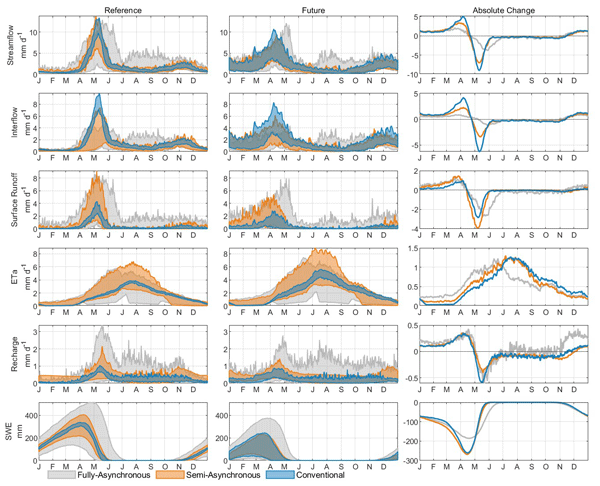
Fig. 9 (and related text). Looking at Absolute Differences, it seems that the behaviours of Fully-Asynchronous and Conventional methods are much closer than Semi-Asynchronous and Fully-Asynchronous. Please provide more details about that.
LL628-635: not completely clear to me. Does the conventional method really produce an increased intermodal variability in the future? Is this a weakness of the conventional method? Why? And is this a problem for maintaining the ensemble’s diversity?
LL691-699: This paragraph does not provide particularly novel information. I suggest removing it (or shortening it substantially) for conciseness.
LL732-737: This paragraph is a kind of repetition.
Finally, I could not find some articles cited in the text in the reference section (Senatore et al., 2022; Chae and Chung, 2024). An overall check would be useful.