
the Creative Commons Attribution 4.0 License.
the Creative Commons Attribution 4.0 License.
 | 15 Oct 2025
Tracking the Impact of Urban Air Masses on Convective Precipitation: A Multi-Member Modeling Study
Abstract. Urban emissions impact aerosol-cloud interactions and thereby modify precipitation patterns, yet their absolute effects remain uncertain due to internal atmospheric variability and limitations of conventional analysis methods. This study aims to further quantify the influence of urban aerosol fields on convective precipitation through explicit chemistry-cloud coupling. Using the coupled COSMO-DCEP-MUSCAT modeling system, we simulate two convective events passing the city of Leipzig, Germany, with five-member ensemble experiments comparing total emissions to zero urban emission scenarios. Cloud droplet activation is calculated from prognostic three-dimensional aerosol fields, providing a physically consistent representation of aerosol–cloud interactions. We use backward trajectory analysis to directly trace urban air masses from convective clouds back to the region of urban emission sources, enabling objective sampling of individual clouds and isolation of local emission effects. The results reveal case-dependent responses. Under moderate atmospheric instability, urban aerosols locally modify the cloud microphysics and precipitation without altering the overall structure of the convective system. Under stronger initial instability, the urban emissions intensify the precipitation, leading to stronger downdrafts, causing a premature system decay and shorter lifetime compared to the zero urban emission scenario. Ensemble analysis demonstrates that emission-induced changes are comparable in amount to internal variability, highlighting the need for multiple realizations and significance testing. The results of this study reveal that urban aerosol effects are highly case-dependent, challenging assumptions about uniform impacts. The same air pollution source can either delay, enhance or suppress convection depending on prevailing atmospheric conditions.
-
Notice on discussion status
The requested preprint has a corresponding peer-reviewed final revised paper. You are encouraged to refer to the final revised version.
-
Preprint
(4102 KB)
-
Supplement
(2942 KB)
-
The requested preprint has a corresponding peer-reviewed final revised paper. You are encouraged to refer to the final revised version.
- Preprint
(4102 KB) - Metadata XML
-
Supplement
(2942 KB) - BibTeX
- EndNote
- Final revised paper


Journal article(s) based on this preprint
Interactive discussion
Status: closed
-
RC1: 'Comment on egusphere-2025-4374', Anonymous Referee #1, 21 Nov 2025
- AC1: 'Reply on RC1', Friederike Keil, 27 Jan 2026
-
RC2: 'Comment on egusphere-2025-4374', Anonymous Referee #2, 06 Dec 2025
Review of manuscript:
“Tracking the impact of urban air masses on convective precipitation: A multi-member modeling study”
Authors: Friederike Keil et al.
General comment:
The manuscript background and motivation to study urban aerosol effects on convective precipitation and the underlying microphysics is presented well. The modeling effort is well thought out and highly detailed including many aerosol sources, a chemistry model, urban land surface effects, an ensemble method, and so forth. I do find that 1km grid spacing for the inner domain to be on the borderline with regards to resolving the details of convective cells. While the methodology is reasonably sound, I am largely concerned that the “urban enhancement in aerosol concentration” is not really an enhancement since you only see a 2-3% increase. This is a very small change in aerosol for urban enhancement when you consider the other urban aerosol studies you cited in the introduction. Likewise, the changes you see in several of the figures are incredibly small. A 10-20% change of a very small number is still a very small number. As such, I am left wondering if the results are worth publishing. While the analysis seems sound, the aerosol change and the impacts are small. If the aerosol change was truly “urban-ish” and the changes were still small, then that would be worth sharing to the community. Finally, I think it is difficult to draw significant conclusions regarding warm or cold phase invigoration with such a small change in aerosol and very small change in W over a very small area. I think these conclusions are overstated given these issues. Please see more detail in the comments below.
Specific comments:
1.Model description: Does the microphysics scheme in COSMO used here (Seifert and Beheng 2006b) use a saturation adjustment scheme? If so, this is likely a problem for trying to assess aerosol impacts on cloud microphysics. In low aerosol conditions, supersaturation should not be fully consumed in each timestep and should be carried within the cloud.
2.Line 196: How exactly do you vary the spinup lengths for the ensemble? Does this mean you vary the time of initialization or the period of analysis? It was a little unclear. I ask, because changing the initialization / model start time can sometime drastically alter how convective systems organize since the reanalysis data can have different degrees of truth at different times due to different amounts and quality of data input (soundings, surface stations, satellite obs, etc).
3.Lines 201-205: A comparison to precipitation is mentioned here but no reference to a figure or an analysis of this. It would be good to mention how this data will be used.
4.Figure 2: It is unclear what is being shown here. What is meant by “the mean of all aerosol species”? The mean of aerosol mass or number? Please clarify. And is the difference taken as Base – Nonurban? Finally +/- 3% seems like a rather small difference.
5.Lines 227-228: Does this imply that Fig. 2a is supposed to be showing a localized precipitation structure? The figure caption indicates we are seeing differences in aerosols. Please clarify this text and the associated figure 2.
6.Line 251: “differences in spatial and temporal resolution” between what things?
7.Lines 255-259: Not sure I agree that the precipitation systems are well simulated; particularly for Case I in which not much precipitation was simulated compared to that observed. However, I understand model limitations and the difficulty in simulating case studies.
8.Figure 3: What is happening regarding the wave-like structure to the precipitation from RADKLIM in Case II? Is this physical?
9.Line 334: A 3% enhancement in aerosol concentration hardly seems like an urban influence. At least some of the urban aerosol studies cited in the introduction showed that urban aerosol enhancements can increase aerosol number concentrations by an order of magnitude. So 3% seems quite small. Your comments on this would be helpful.
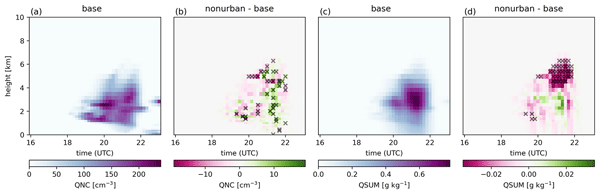
10.Figure 6: Both simulations seem very clean with very low cloud droplet concentrations, and there’s almost no difference in the droplet number. I would be hard pressed to call this an urban enhancement compared to the studies you cited earlier. Given on a 3% change in aerosol concentration enhancement, this is perhaps expected.
11.Line 388: Could you please includes a plot or two of the representative aerosol concentrations. Given your maximum droplet number of 45/cm3 (which is quite low and quite clean for a continental case) it would be good to know what fraction of aerosols are activating.
12.Line 403: It is unclear how Figure 10a indicates a convective system with a vertical extent reaching up to 13km. The feature in this figure panel tops out at 8-9km.
13.Line 405: It would be better to refer to the value of 1500 mg/m3 as a mass mixing ratio instead of a “total hydrometeor concentration”. Further, mass mixing ratios are typically reported in units of g/kg.
14.Line 412: What figure shows the higher number of rain drops? Also please use “rain drops” instead of “rain droplets”.
15.Line 414: A 10% increase in droplet number seems very small and is well below the change seen in most urban aerosol and convection studies. I still think it’s overstated to call this an urban enhancement, when very substantial urban enhancements are noted in the literature.
16.Lines 460-462: Another key difference from the multi-model simulations in Marinescu et al. (2021) is that the aerosol loading from Clean to Polluted in that study was close to an order of magnitude difference. Here your differences are only 2-3%. I find it difficult to say these are comparable.
Citation: https://doi.org/10.5194/egusphere-2025-4374-RC2 - AC2: 'Reply on RC2', Friederike Keil, 27 Jan 2026
Peer review completion


Interactive discussion
Status: closed
-
RC1: 'Comment on egusphere-2025-4374', Anonymous Referee #1, 21 Nov 2025
- AC1: 'Reply on RC1', Friederike Keil, 27 Jan 2026
-
RC2: 'Comment on egusphere-2025-4374', Anonymous Referee #2, 06 Dec 2025
Review of manuscript:
“Tracking the impact of urban air masses on convective precipitation: A multi-member modeling study”
Authors: Friederike Keil et al.
General comment:
The manuscript background and motivation to study urban aerosol effects on convective precipitation and the underlying microphysics is presented well. The modeling effort is well thought out and highly detailed including many aerosol sources, a chemistry model, urban land surface effects, an ensemble method, and so forth. I do find that 1km grid spacing for the inner domain to be on the borderline with regards to resolving the details of convective cells. While the methodology is reasonably sound, I am largely concerned that the “urban enhancement in aerosol concentration” is not really an enhancement since you only see a 2-3% increase. This is a very small change in aerosol for urban enhancement when you consider the other urban aerosol studies you cited in the introduction. Likewise, the changes you see in several of the figures are incredibly small. A 10-20% change of a very small number is still a very small number. As such, I am left wondering if the results are worth publishing. While the analysis seems sound, the aerosol change and the impacts are small. If the aerosol change was truly “urban-ish” and the changes were still small, then that would be worth sharing to the community. Finally, I think it is difficult to draw significant conclusions regarding warm or cold phase invigoration with such a small change in aerosol and very small change in W over a very small area. I think these conclusions are overstated given these issues. Please see more detail in the comments below.
Specific comments:
1.Model description: Does the microphysics scheme in COSMO used here (Seifert and Beheng 2006b) use a saturation adjustment scheme? If so, this is likely a problem for trying to assess aerosol impacts on cloud microphysics. In low aerosol conditions, supersaturation should not be fully consumed in each timestep and should be carried within the cloud.
2.Line 196: How exactly do you vary the spinup lengths for the ensemble? Does this mean you vary the time of initialization or the period of analysis? It was a little unclear. I ask, because changing the initialization / model start time can sometime drastically alter how convective systems organize since the reanalysis data can have different degrees of truth at different times due to different amounts and quality of data input (soundings, surface stations, satellite obs, etc).
3.Lines 201-205: A comparison to precipitation is mentioned here but no reference to a figure or an analysis of this. It would be good to mention how this data will be used.
4.Figure 2: It is unclear what is being shown here. What is meant by “the mean of all aerosol species”? The mean of aerosol mass or number? Please clarify. And is the difference taken as Base – Nonurban? Finally +/- 3% seems like a rather small difference.
5.Lines 227-228: Does this imply that Fig. 2a is supposed to be showing a localized precipitation structure? The figure caption indicates we are seeing differences in aerosols. Please clarify this text and the associated figure 2.
6.Line 251: “differences in spatial and temporal resolution” between what things?
7.Lines 255-259: Not sure I agree that the precipitation systems are well simulated; particularly for Case I in which not much precipitation was simulated compared to that observed. However, I understand model limitations and the difficulty in simulating case studies.
8.Figure 3: What is happening regarding the wave-like structure to the precipitation from RADKLIM in Case II? Is this physical?
9.Line 334: A 3% enhancement in aerosol concentration hardly seems like an urban influence. At least some of the urban aerosol studies cited in the introduction showed that urban aerosol enhancements can increase aerosol number concentrations by an order of magnitude. So 3% seems quite small. Your comments on this would be helpful.
10.Figure 6: Both simulations seem very clean with very low cloud droplet concentrations, and there’s almost no difference in the droplet number. I would be hard pressed to call this an urban enhancement compared to the studies you cited earlier. Given on a 3% change in aerosol concentration enhancement, this is perhaps expected.
11.Line 388: Could you please includes a plot or two of the representative aerosol concentrations. Given your maximum droplet number of 45/cm3 (which is quite low and quite clean for a continental case) it would be good to know what fraction of aerosols are activating.
12.Line 403: It is unclear how Figure 10a indicates a convective system with a vertical extent reaching up to 13km. The feature in this figure panel tops out at 8-9km.
13.Line 405: It would be better to refer to the value of 1500 mg/m3 as a mass mixing ratio instead of a “total hydrometeor concentration”. Further, mass mixing ratios are typically reported in units of g/kg.
14.Line 412: What figure shows the higher number of rain drops? Also please use “rain drops” instead of “rain droplets”.
15.Line 414: A 10% increase in droplet number seems very small and is well below the change seen in most urban aerosol and convection studies. I still think it’s overstated to call this an urban enhancement, when very substantial urban enhancements are noted in the literature.
16.Lines 460-462: Another key difference from the multi-model simulations in Marinescu et al. (2021) is that the aerosol loading from Clean to Polluted in that study was close to an order of magnitude difference. Here your differences are only 2-3%. I find it difficult to say these are comparable.
Citation: https://doi.org/10.5194/egusphere-2025-4374-RC2 - AC2: 'Reply on RC2', Friederike Keil, 27 Jan 2026
Peer review completion
Journal article(s) based on this preprint
Viewed
| HTML | XML | Total | Supplement | BibTeX | EndNote | |
|---|---|---|---|---|---|---|
| 1,981 | 1,623 | 217 | 3,821 | 474 | 298 | 244 |
- HTML: 1,981
- PDF: 1,623
- XML: 217
- Total: 3,821
- Supplement: 474
- BibTeX: 298
- EndNote: 244
Viewed (geographical distribution)
| Country | # | Views | % |
|---|
| Total: | 0 |
| HTML: | 0 |
| PDF: | 0 |
| XML: | 0 |
- 1
Friederike Keil

Markus Quante
Bernd Heinold
Volker Matthias
The requested preprint has a corresponding peer-reviewed final revised paper. You are encouraged to refer to the final revised version.
- Preprint
(4102 KB) - Metadata XML
-
Supplement
(2942 KB) - BibTeX
- EndNote
- Final revised paper
Please find my review in the attachment.