
the Creative Commons Attribution 4.0 License.
the Creative Commons Attribution 4.0 License.
 | 23 Sep 2025
The TIPMIP Earth system model experiment protocol: phase 1
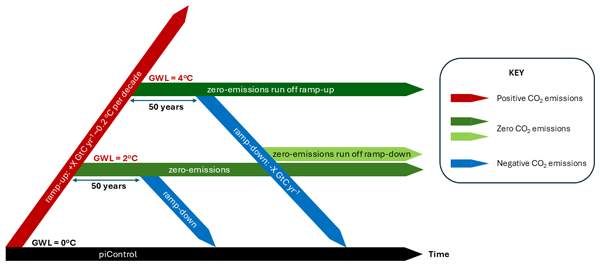
Abstract. We describe a new Earth system model (ESM) experiment protocol, as part of the international Tipping Points Modelling Intercomparison Project (TIPMIP) project. We propose this as a protocol for the Coupled Model Intercomparison Project 7 (CMIP7). The protocol requires ESMs to run in CO2-emission mode, with atmospheric CO2 a predicted variable. Forcing for the protocol consists solely of a constant emission of CO2, based on each model’s transient climate response to cumulative emissions of carbon dioxide (TCRE) value, to give a common global mean warming rate of 2 °C per century. This positive emission experiment is started from the pre-industrial state of a given model. When the ramp-up run first exceeds a specified level of global warming (2 °C and 4 °C) relative to the model’s pre-industrial global mean surface air temperature (GMSAT), CO2 emissions are set to zero and the positive emission run is branched into a zero-emission run. The zero-emission runs continue for 300 years. At 50 years into each zero-emission run, CO2 emissions are set to the negative of the positive emission rate and the model run until GMSAT cools below the original pre-industrial value. Additionally, when the negative emission run started from global warming level (GWL) = 4 °C first drops below GWL = 2 °C, a zero-emission run is branched off this, completing the set of experiments. Using this protocol, we are able to control the rate of global warming and cooling across participating models. TIPMIP experiments will support a range of analyses, including; an assessment of abrupt/rapid Earth system change, the long-term response to zero CO2 emissions, the response to negative CO2 emissions, the efficacy of negative emissions in driving cooling, and the reversibility of Earth system change under a pathway of positive (warming), zero (stabilization), and negative (cooling) CO2 emissions.
Competing interests: At least one of the (co-)authors is a member of the editorial board of Geoscientific Model Development. The peer-review process was guided by an independent editor, and the authors also have no other competing interests to declare.
Publisher's note: Copernicus Publications remains neutral with regard to jurisdictional claims made in the text, published maps, institutional affiliations, or any other geographical representation in this paper. While Copernicus Publications makes every effort to include appropriate place names, the final responsibility lies with the authors. Views expressed in the text are those of the authors and do not necessarily reflect the views of the publisher.-
Notice on discussion status
The requested preprint has a corresponding peer-reviewed final revised paper. You are encouraged to refer to the final revised version.
-
Preprint
(1327 KB)
-
The requested preprint has a corresponding peer-reviewed final revised paper. You are encouraged to refer to the final revised version.
- Preprint
(1327 KB) - Metadata XML
- BibTeX
- EndNote
- Final revised paper


Journal article(s) based on this preprint
Interactive discussion
Status: closed
-
RC1: 'Comment on egusphere-2025-3604', Anonymous Referee #1, 12 Nov 2025
- AC1: 'Reply on RC1', Hazel Jeffery, 09 Feb 2026
-
RC2: 'Comment on egusphere-2025-3604', Anonymous Referee #2, 17 Dec 2025
Jones et al. propose a new Earth system modeling protocol for CMIP7. The protocol includes a set of CO2 emission-driven simulations that reach specified global warming levels (GWLs) with a common global warming rate. When the specified global warming level is reached, CO2 emissions are set to zero and, after 50 years, to the negative of the positive emissions rate and the experiments is continued until a model’s global mean temperature drops below the pre-industrial value. The paper justifies the modeling protocol, lays out the science questions the protocol is set to answer and provides a proof of concept with an initial set of ESM model simulations.
The proposed framework is compelling for its simplicity but also has disadvantages, which stem from the desire to answer a range of different science questions that, ideally, would entail different modeling protocols. While simulated ESM GMSAT trajectories have a common warming rate until specified GWLs are reached, these trajectories can be expected to diverge after this point due to a range of different GMSAT responses to zero emissions (as shown in Fig. 3b). The ramp-down GMSAT trajectories can be expected to diverge even more due to models’ different GMSAT responses to net negative CO2 emissions. Therefore, the only factor that is effectively the same across simulated GMSAT trajectories is the initial warming rate and the global warming level reached. The authors justify this approach with different science questions they intend to address: exploring tipping point behavior at different global warming levels, while quantifying the zero emissions commitment at different GWLs and reversibility in response to net negative emissions. However, the tipping point science question would be better answered with a set common GMSAT trajectories (as could be obtained with the AERAMIP protocol), which would allow to clearly explore the risk of tipping as a function of GMSAT. The ZEC and reversibility questions, on the other hand, would be better explored in a framework with common emission trajectories that entail the same rate of CO2 emissions, the same level of cumulative emissions and the same rate of net negative emissions (as in flat10mip; Sanderson et al., 2025). With the current design, it is challenging to attribute differences in GMSAT response to model differences as opposed to differences in emissions trajectory. It would be helpful if the authors could discuss why they chose not to use the AEAMIP protocol to derive a set of common GMSAT trajectories for the tipping point exploration, acknowledge the challenges of the current modeling protocol for the attribution of differences in results, and discuss how they are planning to isolate the effect of different GMSAT and emission trajectory characteristics on outcomes.
The paper is generally well written but some sections feel lengthy and somewhat repetitive and could be streamlined. Also, citations often seem to be limited to the authors’ own work and should include a wider body of literature on TCRE, ZEC and reversibility (see specific suggestions below).
Specific comments:
(numbers refer to line numbers)
76: ‘net’ negative CO2 emissions (here and elsewhere).
92: It would be helpful if the Introduction could include an overview of the MIP landscape to provide context for the proposed modeling protocol. You do this in section 3.4 but part of it should be in the Introduction as well.
165: Include reference to Matthews et al, 2009 (first paper to introduce TCRE).
166: ‘equation 21’: describe or reproduce equation in the text.
185: what is year ‘A’?
187-188: there will still be a strong transient after 50 years of zero emissions, which will influence the downward GMSAT trajectory.
188-189: the ramp down GMSAT trajectory will likely not mirror the ramp up trajectory.
364: except that GMSAT trajectories under the TIPMIP protocol will not stabilize exactly.
366: Keller et al.: clarify that reference is for CMIP6 CDR-MIP.
379: why ’risk’?
420: Section 4 feels long and would benefit form more concise writing.
433: Refer to 2025 tipping point report.
635: meaning of ‘connectivity’ unclear.
658: ‘net’ negative CO2 emissions
691: Include additional references on sink reversal under net negative emissions e.g. Tokarska et al (2015) https://iopscience.iop.org/article/10.1088/1748-9326/10/9/094013
695: This paragraph does not seem to fit here.
705: Move paragraph to section 4.2?
Citation: https://doi.org/10.5194/egusphere-2025-3604-RC2 - AC2: 'Reply on RC2', Hazel Jeffery, 09 Feb 2026
Peer review completion


Interactive discussion
Status: closed
-
RC1: 'Comment on egusphere-2025-3604', Anonymous Referee #1, 12 Nov 2025
Thank you for inviting me to review the paper: “The TIPMIP Earth system model experiment protocol: phase 1” by Jones et al.
With climate science under intense scrutiny, papers like these are extremely important. Such a manuscript demonstrates that the research community is open and transparent.
The role of description or methodological papers is just that, to set out proposed frameworks for simulations. And in that sense, the manuscript does well and fulfils the intended purpose. However, to provide some context and reasoning, it might be worthwhile to add a couple of sentences (at the beginning and in the discussion) explaining why there is such a rapidly growing interest in “overshoot” forcings. I would argue that there are four main reasons for modelling such scenarios.
- Society is likely to find many aspects of substantial climate change difficult to manage, leading to an eventual strong push to lower global temperatures.
- Society has set thresholds for global warming that it aims to stabilise at, notably around 1.5 or 2.0 degrees above pre-industrial levels. Since we are close to these benchmarks, achieving them will most likely involve a period of “overshoot”.
- Studying the cooling period really helps understand the amount of negative emissions needed, raising challenges for others to question their feasibility (e.g., levels of geoengineering).
- If climate change triggers regional tipping points, then the second less-discussed issue is that of hysteresis. By definition, this might become an issue with “overshoot” scenarios, and so things are not reset for falling temperatures. The TIPMIP projections described might be useful to drive offline impact models believed to potentially exhibit hysteresis.
Although the paper is generally clear throughout, my main concern is that the key assumptions underlying how the scenarios are constructed are spread over a very large number of paragraphs. Is there a way to present everything together in an easier form. Possibilities could include an extra “text box”, a schematic, or some other display item. It took me quite some time to fully grasp the assumptions, as I had to jump back and forth within the manuscript. Here are the points that should really stand out:
- At the very top level, we set temperature profiles we wish our ESMs to follow. That includes ramp up, no warming, ramp down.
- We cannot invert ESMs, to get out precisely the emissions to track these profiles. Hence, we need to estimate the emissions that get as close as possible to temperature profiles.
- For the upward trajectory, we use the TCRE of each model.
- For the stable part, we assume no net emissions into the atmosphere (ZEC). And maybe mention this clearly, because for most models, CO2 drawdown balances additional warming towards equilibrium. Hence, why temperatures are stable.
- The ramp down assumes a negative value of emissions (i.e. “-X”) that were used in the ramp up.
I realise that the manuscript is mainly a presentation of protocol, but it might be worth adding a little more in the Discussion that [A] the analysis reconfirms with these ESMs that the ZEC is appropriate for Net Zero aims – getting net emissions down to zero does stabilise the climate. And [B], in the Allen et al. (2009) paper on TCRE, I think there was always an assumption that this was well-defined for positive emissions, specifically increasing temperatures. It is of much interest that the reversal also seems to give a good near-linear correspondence between -X and d_Temp / d_time, and of a similar ratio.
Small things
The paper can appear overly heavy on abbreviations (for instance, the left-hand column of Table 1). It may be worth reiterating at a few key points in the manuscript that these names are actually those associated with the metadata of the simulations themselves. Hence, their importance. One possibility is to put them in quotes, maybe?.
Please reiterate towards the end that the analysis is highly idealised. That is fine, and avoids more convoluted emissions scenarios (e.g. to match some sort of upturned parabola in global temperature). However, in reality, unless there is a massive global economic collapse, an instantaneous switch from business-as-usual to ZEC is unlikely.
Given the interest in Net Zero, then perhaps mention more strongly that this is often regarded as corresponding to the ZEC runs. Having these key buzzwords of phrases will enable more people to find this manuscript, and so appreciate that ESMs are now being configured for Overshoot and/or periods of Net Zero.
I am happy to see any further manuscript version.
Citation: https://doi.org/10.5194/egusphere-2025-3604-RC1 - AC1: 'Reply on RC1', Hazel Jeffery, 09 Feb 2026
-
RC2: 'Comment on egusphere-2025-3604', Anonymous Referee #2, 17 Dec 2025
Jones et al. propose a new Earth system modeling protocol for CMIP7. The protocol includes a set of CO2 emission-driven simulations that reach specified global warming levels (GWLs) with a common global warming rate. When the specified global warming level is reached, CO2 emissions are set to zero and, after 50 years, to the negative of the positive emissions rate and the experiments is continued until a model’s global mean temperature drops below the pre-industrial value. The paper justifies the modeling protocol, lays out the science questions the protocol is set to answer and provides a proof of concept with an initial set of ESM model simulations.
The proposed framework is compelling for its simplicity but also has disadvantages, which stem from the desire to answer a range of different science questions that, ideally, would entail different modeling protocols. While simulated ESM GMSAT trajectories have a common warming rate until specified GWLs are reached, these trajectories can be expected to diverge after this point due to a range of different GMSAT responses to zero emissions (as shown in Fig. 3b). The ramp-down GMSAT trajectories can be expected to diverge even more due to models’ different GMSAT responses to net negative CO2 emissions. Therefore, the only factor that is effectively the same across simulated GMSAT trajectories is the initial warming rate and the global warming level reached. The authors justify this approach with different science questions they intend to address: exploring tipping point behavior at different global warming levels, while quantifying the zero emissions commitment at different GWLs and reversibility in response to net negative emissions. However, the tipping point science question would be better answered with a set common GMSAT trajectories (as could be obtained with the AERAMIP protocol), which would allow to clearly explore the risk of tipping as a function of GMSAT. The ZEC and reversibility questions, on the other hand, would be better explored in a framework with common emission trajectories that entail the same rate of CO2 emissions, the same level of cumulative emissions and the same rate of net negative emissions (as in flat10mip; Sanderson et al., 2025). With the current design, it is challenging to attribute differences in GMSAT response to model differences as opposed to differences in emissions trajectory. It would be helpful if the authors could discuss why they chose not to use the AEAMIP protocol to derive a set of common GMSAT trajectories for the tipping point exploration, acknowledge the challenges of the current modeling protocol for the attribution of differences in results, and discuss how they are planning to isolate the effect of different GMSAT and emission trajectory characteristics on outcomes.
The paper is generally well written but some sections feel lengthy and somewhat repetitive and could be streamlined. Also, citations often seem to be limited to the authors’ own work and should include a wider body of literature on TCRE, ZEC and reversibility (see specific suggestions below).
Specific comments:
(numbers refer to line numbers)
76: ‘net’ negative CO2 emissions (here and elsewhere).
92: It would be helpful if the Introduction could include an overview of the MIP landscape to provide context for the proposed modeling protocol. You do this in section 3.4 but part of it should be in the Introduction as well.
165: Include reference to Matthews et al, 2009 (first paper to introduce TCRE).
166: ‘equation 21’: describe or reproduce equation in the text.
185: what is year ‘A’?
187-188: there will still be a strong transient after 50 years of zero emissions, which will influence the downward GMSAT trajectory.
188-189: the ramp down GMSAT trajectory will likely not mirror the ramp up trajectory.
364: except that GMSAT trajectories under the TIPMIP protocol will not stabilize exactly.
366: Keller et al.: clarify that reference is for CMIP6 CDR-MIP.
379: why ’risk’?
420: Section 4 feels long and would benefit form more concise writing.
433: Refer to 2025 tipping point report.
635: meaning of ‘connectivity’ unclear.
658: ‘net’ negative CO2 emissions
691: Include additional references on sink reversal under net negative emissions e.g. Tokarska et al (2015) https://iopscience.iop.org/article/10.1088/1748-9326/10/9/094013
695: This paragraph does not seem to fit here.
705: Move paragraph to section 4.2?
Citation: https://doi.org/10.5194/egusphere-2025-3604-RC2 - AC2: 'Reply on RC2', Hazel Jeffery, 09 Feb 2026
Peer review completion
Journal article(s) based on this preprint
Viewed
| HTML | XML | Total | BibTeX | EndNote | |
|---|---|---|---|---|---|
| 8,856 | 2,958 | 253 | 12,067 | 219 | 239 |
- HTML: 8,856
- PDF: 2,958
- XML: 253
- Total: 12,067
- BibTeX: 219
- EndNote: 239
Viewed (geographical distribution)
| Country | # | Views | % |
|---|
| Total: | 0 |
| HTML: | 0 |
| PDF: | 0 |
| XML: | 0 |
- 1
Cited


4 citations as recorded by crossref.
- CMIP7 data request: Earth system priorities and opportunities M. McPartland et al. https://doi.org/10.5194/gmd-19-2849-2026
- The Radiative Forcing Model Intercomparison Project (RFMIP2.0) for CMIP7 R. Kramer et al. https://doi.org/10.5194/gmd-19-4447-2026
- The representation of climate impacts in the FRIDAv2.1 Integrated Assessment Model C. Wells et al. https://doi.org/10.5194/gmd-19-1229-2026
- Response of ice sheets, sea-ice and sea level in climate stabilisation and reversibility simulations using a state-of-the-art Earth System Model R. Smith et al. https://doi.org/10.5194/esd-17-475-2026
Colin Jones

Isaline Bossert
Donovan P. Dennis
Hazel Jeffery
Chris D. Jones
Torben Koenigk
Sina Loriani
Benjamin Sanderson
Roland Séférian
Klaus Wyser
Shuting Yang
Manabu Abe
Sebastian Bathiany
Pascale Braconnot
Victor Brovkin
Friedrich A. Burger
Patrica Cadule
Frederic S. Castruccio
Gokhan Danabasoglu
Andrea Dittus
Jonathan F. Donges
Friederike Fröb
Thomas Frölicher
Goran Georgievski
Chuncheng Guo
Peter Lawrence
Paul Lerner
José Licón-Saláiz
Bette Otto-Bliesner
Anastasia Romanou
Elena Shevliakova
Yona Silvy
Didier Swingedouw
Jerry Tjiputra
Jeremy Walton
Andy Wiltshire
Ricarda Winkelmann
Richard Wood
Tokuta Yokohata
Tilo Ziehn
The requested preprint has a corresponding peer-reviewed final revised paper. You are encouraged to refer to the final revised version.
- Preprint
(1327 KB) - Metadata XML
Thank you for inviting me to review the paper: “The TIPMIP Earth system model experiment protocol: phase 1” by Jones et al.
With climate science under intense scrutiny, papers like these are extremely important. Such a manuscript demonstrates that the research community is open and transparent.
The role of description or methodological papers is just that, to set out proposed frameworks for simulations. And in that sense, the manuscript does well and fulfils the intended purpose. However, to provide some context and reasoning, it might be worthwhile to add a couple of sentences (at the beginning and in the discussion) explaining why there is such a rapidly growing interest in “overshoot” forcings. I would argue that there are four main reasons for modelling such scenarios.
Although the paper is generally clear throughout, my main concern is that the key assumptions underlying how the scenarios are constructed are spread over a very large number of paragraphs. Is there a way to present everything together in an easier form. Possibilities could include an extra “text box”, a schematic, or some other display item. It took me quite some time to fully grasp the assumptions, as I had to jump back and forth within the manuscript. Here are the points that should really stand out:
I realise that the manuscript is mainly a presentation of protocol, but it might be worth adding a little more in the Discussion that [A] the analysis reconfirms with these ESMs that the ZEC is appropriate for Net Zero aims – getting net emissions down to zero does stabilise the climate. And [B], in the Allen et al. (2009) paper on TCRE, I think there was always an assumption that this was well-defined for positive emissions, specifically increasing temperatures. It is of much interest that the reversal also seems to give a good near-linear correspondence between -X and d_Temp / d_time, and of a similar ratio.
Small things
The paper can appear overly heavy on abbreviations (for instance, the left-hand column of Table 1). It may be worth reiterating at a few key points in the manuscript that these names are actually those associated with the metadata of the simulations themselves. Hence, their importance. One possibility is to put them in quotes, maybe?.
Please reiterate towards the end that the analysis is highly idealised. That is fine, and avoids more convoluted emissions scenarios (e.g. to match some sort of upturned parabola in global temperature). However, in reality, unless there is a massive global economic collapse, an instantaneous switch from business-as-usual to ZEC is unlikely.
Given the interest in Net Zero, then perhaps mention more strongly that this is often regarded as corresponding to the ZEC runs. Having these key buzzwords of phrases will enable more people to find this manuscript, and so appreciate that ESMs are now being configured for Overshoot and/or periods of Net Zero.
I am happy to see any further manuscript version.