
the Creative Commons Attribution 4.0 License.
the Creative Commons Attribution 4.0 License.
 | 04 Sep 2025
Detection of Compound and Seesaw Hydrometeorological Extremes in New Zealand: A Copula-Based Approach
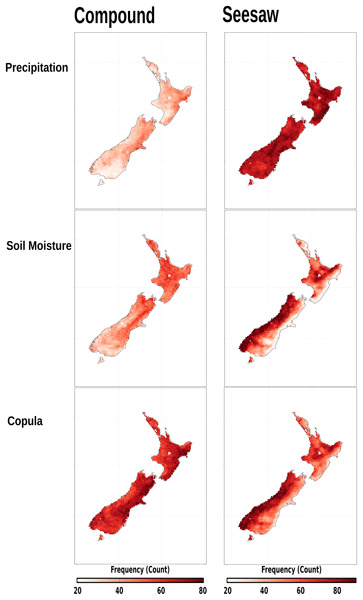
Abstract. Compound hot and dry and dry-to-wet seesaw events are hydrometeorological extremes that involve the propagation of water deficits through the hydrological cycle, driven by multiple interactions between precipitation, temperature and soil moisture. Here we demonstrate new understanding of such events gained by directly modelling these interactions using copulas rather than treating each variable separately. New Zealand makes for a useful case study, owing to the occurrence of relatively high-magnitude extremes across strong hydroclimatic gradients. Standardised indices are constructed for soil moisture, temperature and precipitation using ERA5-Land for 1950–2021. A conventional bivariate copula model is used to capture the joint variation between precipitation and soil moisture indices for seesaw events, with a more novel trivariate (vine) copula for modelling all three indices during compound events. Differences in compound event detection are strongest in eastern regions, where evapotranspiration is more important for dry phase development. The copula approach reveals more frequent/extreme occurrence of compound events compared to coincident extremes in separate variables: for a 1-in-100-year vine copula event the equivalent magnitude coincident soil moisture and temperature extreme is a 141-year event (171-year for the coincident precipitation-temperature event). Large differences in seesaw event detection also occur in the east: compared to a 1-in-100-year bivariate copula event the equivalent soil moisture extreme is less frequent (126 years) but the precipitation extreme more frequent (65 years). These results highlight the advances that a copula approach can provide in terms of better understanding the magnitude-frequency characteristics of compound and seesaw events, as well as their drivers – critically important for managing the impacts of these events, especially in the context of climate change.
-
Notice on discussion status
The requested preprint has a corresponding peer-reviewed final revised paper. You are encouraged to refer to the final revised version.
-
Preprint
(2333 KB)
-
Supplement
(1017 KB)
-
The requested preprint has a corresponding peer-reviewed final revised paper. You are encouraged to refer to the final revised version.
- Preprint
(2333 KB) - Metadata XML
-
Supplement
(1017 KB) - BibTeX
- EndNote
- Final revised paper


Journal article(s) based on this preprint
Interactive discussion
Status: closed
-
RC1: 'Comment on egusphere-2025-3592', Anonymous Referee #1, 02 Oct 2025
-
AC1: 'Reply on RC1', Daniel Kingston, 28 Nov 2025
We thank the reviewer for their comments and are pleased that they agree that the manuscript makes a valuable contribution. The reviewer makes many good points, which we largely agree with. Reviewer comments are replicated below (in italics), with a direct response provided adjacently.
General comments
- In the Introduction, it would be helpful if the authors placed more emphasis on describing the specific knowledge gap they are addressing and the objectives they want to meet. Specifically, the description of the objectives in the last paragraph of the Introduction is somewhat unclear and would benefit from clear structuring, e.g., by using numbering (1), (2), ... to indicate the specific objective.
- Thanks for this observation and suggestion. We propose to split the final paragraph in two at line 75. We will then re-write the remaining text as follows:
“ Bearing in mind the new understanding that can be generated by the use of copulas to directly integrate hot-cold with wet-dry dynamics, here we aim to determine what new understanding their application can provide for the characterisation of the hydrological cycle processes that underpin extreme hydrometeorological compound and seesaw event occurrence in New Zealand. In this context, the objectives of this study are to: (1) determine the difference in occurrence and characteristics of extreme hydrometeorological compound and seesaw events in New Zealand between copula-based methods and conventional coincident/consecutive approaches; (2) highlight the regional variation in compound and seesaw event quantification dependent on climatic setting, and (3) provide recommendations, where appropriate, as to the usage of detection methods for compound and seesaw events.”
- In the last paragraph of the Discussion, the authors briefly discuss the topic of selecting the indicators for hot-dry and seesaw event detection. As also shown in the Results, detection of hot-dry events is more sensitive to the indicators used compared to seesaw events, where no approach is somewhat superior to another. It would be beneficial if the authors would discuss more in detail the reasons for this discrepancy, possibly also in terms of the different copula indices (SMI and SBI) used for the two event types.
- The sensitivity of compound hot-dry events to dry indicators in comparison to seesaw events reflects the inclusion of temperature within the SMI (but not the SBI). Accordingly, the SMI captures a greater range of variables within the hydrological cycle, thus a single variable comparison will highlight a greater discrepancy. In contrast, single variable comparison to the bi-variate index highlights less of the hydrological cycle components, and less variation therein. A statement to this effect will be added in the last paragraph, while also still emphasising that no one method appears "superior" in the identification of seesaw events based on our findings.
- The Discussion partly reads like an introduction (especially section 4.1) or like a summary of the results (e.g., lines 506-512). In this regard, the Discussion may be shortened and more specifically focus on discussing the objectives outlined in the Introduction (see also first comment).
- Thank-you for this comment – in retrospect, we agree that parts of the discussion can be shortened, and more direct reference to the objectives can be added at various points.
- In terms of the specific passages highlighted by the reviewer, for section 4.1 lines 389-394 can be deleted, with the final statement of this section incorporated into the Conclusions.
- For the passage between lines 506-512 (and on re-reading, probably the wider section from lines 499-513) we still think some summary of the results is required for clarity but agree that it could be shorter. We propose the following instead, starting on line 499:
“The consistent finding that seesaw events on the South Island west coast are typically high frequency, short duration and low severity for each of the SBI, SSMI and SPI (Figures 6 and 7) is consistent with the findings for this region in the global-scale study of Rashid and Wahl (2022). Similarly, return periods are similar between the three indices – overall, indicating little difference in detection metrics across wet energy-limited regions such as this, and in stark contrast to these regions having the strongest differences between metrics for compound hot and dry events (Figures 3 and 7).
The strong differences in seesaw event characteristics across the transitional regime of the North Island east coast (long duration/high severity/low frequency for SSMI and SBI, vs. opposing characteristics for the SPI) are associated with notable slope rate differences between drought termination and wet onset (Figure 9). The slower responding soil moisture indicates much of the east coast as having a significantly quicker onset of wet phases (relative to drought cessation) (Fig. 9b). Consecutive SPI also reveals parts of the east coast as having quicker wet onset phases, although such differences are not significant. Contrasting this, the copula approach reveals weaker wet phase dominance across the east coast of both islands (Fig. 9c).
- Although the authors briefly mention the role of evapotranspiration in the Discussion section 4.2, a more thorough discussion on how seasonality in evapotranspiration influences the indices investigated (related to both compound and seesaw events) would be valuable.
- Thank-you for the suggestion. We agree that evapotranspiration can be an important process with respect to seesaw events, although without further analysis it is difficult to move beyond speculation here (and adding such a further analytical dimension is beyond the scope of what could be included here). However, we are happy to add further discussion of this variable at lines 514 and 534.
Minor comments
Line 62: This sentence may rather fit into the paragraph talking about copulas (Line 50 and following)
- This will be implemented
Line 79: “new insights” is a somewhat vague formulation and may be replaced with a more specific objective (see also first general comment)
- New insights will be replaced with a more detailed outline of what is accomplished. Specifically, this will be replaced with "By employing a joint probability framework to directly quantify the shared variability between hydrological cycle components, it is expected that differing return frequency and severity of compound and seesaw event occurrence in New Zealand will be shown that are dependent on drought quantification methods."
Line 107: It would be helpful for the reader if the authors would provide the equations for the respective calculated indices
- These will be added (brought over from supplementary material).
Line 159: When describing the Standardised Multivariate Index (SMI), it may be beneficial to shortly repeat the original variables (precipitation, …) contained in the copula data which are then represented by the index
- These will be added.
Line 193: The description of the averaging process at each grid cell is partly unclear (“taking the mean” of what exactly?) and a more thorough explanation would be valuable
- This was incorrectly stated. The correct method is: "The results at each grid cell were summarised by taking the mean across all days."
Line 206: The authors may provide a short explanation of why 14 days were chosen as a threshold length for the compound event duration
- Supplementary material will be included to show the sensitivity testing undertaken in defence of this 14-day selection.
Line 260: Here, the authors may briefly mention variations of the run theory metrics between the North and South Island (in terms of the coincident SSMI and STI approach), as is also displayed in Figure 3b and 3e
- We believe this discussion is covered by the subsequent lines (261-264), which discuss the variation across the North and South islands, including variation across the west coast of the South Island.
Line 363: “longer transition time” compared to which approaches? It becomes clear from Figure 8, but it would be beneficial to shortly mention the two other approaches in this sentence
- This will be changed to "Seesaw transitions (time from -1 to +1) show an overall longer transition time for SSMI based classifications compared to SPI and SBI based classifications (Fig. 8 b; transition time of 107 days)."
Line 423: This sentence is rather long and may be split
- This will be split into two.
Line 506: This paragraph may be moved to the Results section
- This will be moved and incorporated after line 380.
Line 548: The authors may consider renaming this section “Summary and conclusions”, as the text up until line 572 reads like a summary
- The heading will be changed to "Summary and Conclusions"
Line 581: This sentence is rather long and may be split
- This idea will be split into two.
Technical points
The figures would benefit from increasing the font sizes on the x- and y-axis and legends, particularly figures 2, 3, 6, 7
- These will be updated.
For an overview, a table with the indices (and their abbreviations) used and the respective approaches applied would be helpful for the reader
- This will be added.
Please ensure that headings follow a consecutive order (e.g., 2.5.2 appears two times) and do not repeat themselves (e.g., 2.3.1 Preliminary work on Vine Copula Structure and 2.3.2 Preliminary work on Vine Copula Structure)
- Thank you for identifying. This has been corrected.
In the Supplement, the authors may provide a reference list for the sources they cite, even if they already appear in the original manuscript’s reference list
- Thank you for the suggestion. This will be added.
For better coherence, it would be helpful to not repeat content in the Supplement that has already been written in the manuscript (and vice versa); this particularly relates to the Data and Methods sections. In general, I would recommend to shorten the sections describing the methods and refer the reader to the Supplement for more in-depth information, e.g., on the preliminary work conducted (sections 2.3.1 and 2.3.2)
- Preliminary work will be placed into the supplementary section. The multivariate index construction will also be shortened following the inclusion of formula as noted above (which in this case will be shifted from the supplementary into the main).
Citation: https://doi.org/10.5194/egusphere-2025-3592-AC1
-
AC1: 'Reply on RC1', Daniel Kingston, 28 Nov 2025
-
RC2: 'Comment on egusphere-2025-3592', Anonymous Referee #2, 04 Oct 2025
The manuscript presents an interesting and methodologically rigorous analysis of compound and seesaw hydro-meteorological extremes using a copula framework. The study is potentially impactful as it demonstrates the value of multivariate statistical approaches (copulas) in better characterizing the frequency, severity, and spatial distribution of extremes compared to traditional coincident/consecutive approaches. This work is especially relevant for climate risk management in agriculture, water resources, and hydropower, and it provides a transferable framework that could be applied in other regions. However, the manuscript would be significantly strengthened by additional sensitivity analyses and clarifications to ensure the robustness and broader applicability of the results. My detailed comments are below, which the authors may want to consider. Overall, I recommend a major revision for the manuscript.
General Comments
- The analysis focuses solely on New Zealand, a strong and relevant case study. However, to strengthen the generalizability of the findings, I suggest testing the methodology in at least one additional region with contrasting hydro-climatic conditions. Even a limited replication using ERA5-Land data would demonstrate whether the framework and event characteristics hold more broadly in the global context.
- All indices are constructed at a 30-day scale (monthly focus). However, compound/“seesaw” behavior may flip across scales; robustness across scales would boost confidence that results aren’t an artifact of the 30-day choice. Please assess the sensitivity of event detection to different accumulation periods (e.g., 15, 45, 90 days).
- Event definitions rely on −1/+1 thresholds and a 30-day buffer for transitions. Results could be sensitive to these choices. It would be useful to repeat the analyses with percentile-based thresholds or alternative buffers (e.g., 15 or 45 days) to demonstrate robustness.
- Including an additional drought index that incorporates evaporative demand (e.g., SPEI or PET-based metric) would strengthen conclusions about hot–dry compounding, particularly in transitional regions.
- Validation is focused on statistical consistency. Demonstrating added value through alignment with real-world impact proxies (e.g., hydro power inflows, agricultural losses) would enhance the applied relevance of the results.
- Results are presented per grid cell, but spatial clustering of extremes (event footprint, coherence across regions) is not explored. Such an analysis would enhance the understanding of regional impacts and risk management implications.
Other Comments
- “Hot and dry” vs. “compound hot-dry” – Please check the use of terminology with meaning and keep them consistent.
- Typo: “Charaacteristics” should be Characteristics (section 2.5.2 heading).
- One reference (Miller, B. B. and Carter, C., 2015) appears to be a test citation - please check.
- Line 400: placeholder Latin text remains in the Discussion; please revise or remove.
Citation: https://doi.org/10.5194/egusphere-2025-3592-RC2 -
AC2: 'Reply on RC2', Daniel Kingston, 28 Nov 2025
We thank the reviewer for their comments and are pleased that they consider this work to be potentially impactful, with applied relevance across a number of domains. We agree with many of the reviewer suggestions and have conducted/included some new analyses accordingly. While interesting, we feel strongly that some other suggestions would require too much additional work and reporting to adequately present and explain within the length restrictions of a single journal paper. We explain our thinking further and provide detail of what new analyses have been conducted, in the point-by-point response that follows. As context, the original reviewer comments are included in italics.
General Comments
The analysis focuses solely on New Zealand, a strong and relevant case study. However, to strengthen the generalizability of the findings, I suggest testing the methodology in at least one additional region with contrasting hydro-climatic conditions. Even a limited replication using ERA5-Land data would demonstrate whether the framework and event characteristics hold more broadly in the global context.
- Thank you for the suggestion. While we appreciate the added value that an additional region or limited step-up to the global-scale may bring to the manuscript, we also believe that the manuscript is at present quite extensive, and an additional region (or more) will make it difficult to draw out the main points relevant to NZ, and the methodology more broadly. Importantly, NZ actually offers just the contrasting hydro-climatic conditions that the reviewer mentions, as we already explain in the Introduction (lines 65-70). We propose to further strengthen this justification by also noting that NZ also covers a range of hydrological regimes (e.g. mountain-fed, hill-fed and spring-fed; Biggs et al., 2008).
All indices are constructed at a 30-day scale (monthly focus). However, compound/“seesaw” behaviour may flip across scales; robustness across scales would boost confidence that results aren’t an artifact of the 30-day choice. Please assess the sensitivity of event detection to different accumulation periods (e.g., 15, 45, 90 days).
- This is a good point raised by the reviewer. We had actually already performed the analysis for the 10- and 90-day periods as well, but were unable to include these for reasons of manuscript length. We propose instead to make brief mention of these sensitivity analyses in the Methods (lines 60 and 110), with the results presented as Supplementary material. Essentially, these results do not show anything that substantively calls into question the findings from our primary 30-day analyses. We will now acknowledge this in the main body of the manuscript.
Event definitions rely on −1/+1 thresholds and a 30-day buffer for transitions. Results could be sensitive to these choices. It would be useful to repeat the analyses with percentile-based thresholds or alternative buffers (e.g., 15 or 45 days) to demonstrate robustness.
- The use of +/- 1 ensures the relative transitions are captured across the broad climatic regimes of NZ (e.g. one standard deviation from the grid-cell specific climate). Buffer periods were set as the same temporal length as the index in use (e.g. SMI-30 becomes a 30-day buffer) to capture the rolling nature of the accumulation. As noted above, sensitivity testing on this accumulation period selection is captured under the use of differing accumulation periods (10 and 90 days), which are now to be included in the supplementary material.
Including an additional drought index that incorporates evaporative demand (e.g., SPEI or PET-based metric) would strengthen conclusions about hot–dry compounding, particularly in transitional regions.
- We feel that the inclusion of soil moisture, which directly incorporates the actual loss of moisture from the soil rather than a proxy metric offered by the SPEI- and PET-based method of atmospheric evaporative demand, offers a more accurate and physically-based representation of the dry component of hot-dry compound events. The use of PET-based methods would introduce new uncertainty to the analysis due to the calculation procedure chosen, as well as the increasingly limited physical relevance of evaporative demand as the land surface dries out. In contrast, the use of soil moisture (and by extension AET within the land model component) avoids these uncertainties. While a study of atmospheric evaporative demand during hot-dry compounding events may provide additional insight, particularly for transitional regimes, we believe that the statistical modelling of the direct relationship between actual evaporative fluxes, soil moisture and temperature (via the copula approach) performed here provides a more robust approach. Introducing an alternative approach (such as PET) would require major expansions to several sections of the manuscript, potentially undermining readability and the focus of the existing physically based work.
Validation is focused on statistical consistency. Demonstrating added value through alignment with real-world impact proxies (e.g., hydro power inflows, agricultural losses) would enhance the applied relevance of the results.
- Thanks for the suggestion. We agree that investigating alignment of the copula indices with impacts in specific sectors (such as hydropower or agricultural production) would make for a fascinating analysis. However, such an analysis would come with its own challenges, such as spatial scale and lack of spatial coherency of the necessary data in some instances, as well as limited availability of open-access data for these sectors. We are also wary of being able to adequately document a further type of analysis alongside the existing comparison of quantitative techniques. Nevertheless, we do see value in brief reference against relatively well-known and recent compound and seesaw events that have occurred in New Zealand, as specific and recognisable events for which it would be informative to compare index performance – these will be added accordingly.
Results are presented per grid cell, but spatial clustering of extremes (event footprint, coherence across regions) is not explored. Such an analysis would enhance the understanding of regional impacts and risk management implications.
- A spatial analysis (clustering) was performed on the index values themselves as part of our initial analyses and was used to inform both our Methods and Discussion (for instance, a clear east-west split was visible across the South Island, as well as some differentiation between the south-east vs north-east of the east coast). We propose adding a figure in the supplementary material showing the locations of these clusters, along with additional text in the main manuscript to clarify how these results reinforce the regional variation already described.
Other Comments
“Hot and dry” vs. “compound hot-dry” – Please check the use of terminology with meaning and keep them consistent.
- This will be kept consistent, thank you for identifying.
Typo: “Charaacteristics” should be Characteristics (section 2.5.2 heading).
- This will be corrected.
One reference (Miller, B. B. and Carter, C., 2015) appears to be a test citation - please check.
- Thank you for identifying, as this was not part of the original manuscript – we will correct accordingly.
Line 400: placeholder Latin text remains in the Discussion; please revise or remove.
- Thank you for identifying – we will correct accordingly.
Citation: https://doi.org/10.5194/egusphere-2025-3592-AC2
Peer review completion


Interactive discussion
Status: closed
-
RC1: 'Comment on egusphere-2025-3592', Anonymous Referee #1, 02 Oct 2025
Bennet et al. compare different approaches to detect compound and seesaw events across New Zealand, particularly focusing on the potential value of using multivariate copula-based approaches. They recommend using multivariate indices (incl. soil moisture metrics) for assessing compound hot-dry events, whereas the selection of indices for seesaw events may depend on the hydrological domain (i.e., drought type or dry phase) investigated. The manuscript is a valuable contribution to research on compound events and is for the most part well written. Nevertheless, it would benefit from some corrections outlined below, which the authors may want to consider. Overall, I would recommend publication subject to major revisions.
General comments
- In the Introduction, it would be helpful if the authors placed more emphasis on describing the specific knowledge gap they are addressing and the objectives they want to meet. Specifically, the description of the objectives in the last paragraph of the Introduction is somewhat unclear and would benefit from clear structuring, e.g., by using numbering (1), (2), ... to indicate the specific objective.
- In the last paragraph of the Discussion, the authors briefly discuss the topic of selecting the indicators for hot-dry and seesaw event detection. As also shown in the Results, detection of hot-dry events is more sensitive to the indicators used compared to seesaw events, where no approach is somewhat superior to another. It would be beneficial if the authors would discuss more in detail the reasons for this discrepancy, possibly also in terms of the different copula indices (SMI and SBI) used for the two event types.
- The Discussion partly reads like an introduction (especially section 4.1) or like a summary of the results (e.g., lines 506-512). In this regard, the Discussion may be shortened and more specifically focus on discussing the objectives outlined in the Introduction (see also first comment).
- Although the authors briefly mention the role of evapotranspiration in the Discussion section 4.2, a more thorough discussion on how seasonality in evapotranspiration influences the indices investigated (related to both compound and seesaw events) would be valuable.
Minor comments
Line 62: This sentence may rather fit into the paragraph talking about copulas (Line 50 and following)
Line 79: “new insights” is a somewhat vague formulation and may be replaced with a more specific objective (see also first general comment)
Line 107: It would be helpful for the reader if the authors would provide the equations for the respective calculated indices
Line 159: When describing the Standardised Multivariate Index (SMI), it may be beneficial to shortly repeat the original variables (precipitation, …) contained in the copula data which are then represented by the index
Line 193: The description of the averaging process at each grid cell is partly unclear (“taking the mean” of what exactly?) and a more thorough explanation would be valuable
Line 206: The authors may provide a short explanation of why 14 days were chosen as a threshold length for the compound event duration
Line 260: Here, the authors may briefly mention variations of the run theory metrics between the North and South Island (in terms of the coincident SSMI and STI approach), as is also displayed in Figure 3b and 3e
Line 363: “longer transition time” compared to which approaches? It becomes clear from Figure 8, but it would be beneficial to shortly mention the two other approaches in this sentence
Line 423: This sentence is rather long and may be split
Line 506: This paragraph may be moved to the Results section
Line 548: The authors may consider renaming this section “Summary and conclusions”, as the text up until line 572 reads like a summary
Line 581: This sentence is rather long and may be split
Technical points
- The figures would benefit from increasing the font sizes on the x- and y-axis and legends, particularly figures 2, 3, 6, 7
- For an overview, a table with the indices (and their abbreviations) used and the respective approaches applied would be helpful for the reader
- Please ensure that headings follow a consecutive order (e.g., 2.5.2 appears two times) and do not repeat themselves (e.g., 2.3.1 Preliminary work on Vine Copula Structure and 2.3.2 Preliminary work on Vine Copula Structure)
- In the Supplement, the authors may provide a reference list for the sources they cite, even if they already appear in the original manuscript’s reference list
- For better coherence, it would be helpful to not repeat content in the Supplement that has already been written in the manuscript (and vice versa); this particularly relates to the Data and Methods sections. In general, I would recommend to shorten the sections describing the methods and refer the reader to the Supplement for more in-depth information, e.g., on the preliminary work conducted (sections 2.3.1 and 2.3.2)
Citation: https://doi.org/10.5194/egusphere-2025-3592-RC1 -
AC1: 'Reply on RC1', Daniel Kingston, 28 Nov 2025
We thank the reviewer for their comments and are pleased that they agree that the manuscript makes a valuable contribution. The reviewer makes many good points, which we largely agree with. Reviewer comments are replicated below (in italics), with a direct response provided adjacently.
General comments
- In the Introduction, it would be helpful if the authors placed more emphasis on describing the specific knowledge gap they are addressing and the objectives they want to meet. Specifically, the description of the objectives in the last paragraph of the Introduction is somewhat unclear and would benefit from clear structuring, e.g., by using numbering (1), (2), ... to indicate the specific objective.
- Thanks for this observation and suggestion. We propose to split the final paragraph in two at line 75. We will then re-write the remaining text as follows:
“ Bearing in mind the new understanding that can be generated by the use of copulas to directly integrate hot-cold with wet-dry dynamics, here we aim to determine what new understanding their application can provide for the characterisation of the hydrological cycle processes that underpin extreme hydrometeorological compound and seesaw event occurrence in New Zealand. In this context, the objectives of this study are to: (1) determine the difference in occurrence and characteristics of extreme hydrometeorological compound and seesaw events in New Zealand between copula-based methods and conventional coincident/consecutive approaches; (2) highlight the regional variation in compound and seesaw event quantification dependent on climatic setting, and (3) provide recommendations, where appropriate, as to the usage of detection methods for compound and seesaw events.”
- In the last paragraph of the Discussion, the authors briefly discuss the topic of selecting the indicators for hot-dry and seesaw event detection. As also shown in the Results, detection of hot-dry events is more sensitive to the indicators used compared to seesaw events, where no approach is somewhat superior to another. It would be beneficial if the authors would discuss more in detail the reasons for this discrepancy, possibly also in terms of the different copula indices (SMI and SBI) used for the two event types.
- The sensitivity of compound hot-dry events to dry indicators in comparison to seesaw events reflects the inclusion of temperature within the SMI (but not the SBI). Accordingly, the SMI captures a greater range of variables within the hydrological cycle, thus a single variable comparison will highlight a greater discrepancy. In contrast, single variable comparison to the bi-variate index highlights less of the hydrological cycle components, and less variation therein. A statement to this effect will be added in the last paragraph, while also still emphasising that no one method appears "superior" in the identification of seesaw events based on our findings.
- The Discussion partly reads like an introduction (especially section 4.1) or like a summary of the results (e.g., lines 506-512). In this regard, the Discussion may be shortened and more specifically focus on discussing the objectives outlined in the Introduction (see also first comment).
- Thank-you for this comment – in retrospect, we agree that parts of the discussion can be shortened, and more direct reference to the objectives can be added at various points.
- In terms of the specific passages highlighted by the reviewer, for section 4.1 lines 389-394 can be deleted, with the final statement of this section incorporated into the Conclusions.
- For the passage between lines 506-512 (and on re-reading, probably the wider section from lines 499-513) we still think some summary of the results is required for clarity but agree that it could be shorter. We propose the following instead, starting on line 499:
“The consistent finding that seesaw events on the South Island west coast are typically high frequency, short duration and low severity for each of the SBI, SSMI and SPI (Figures 6 and 7) is consistent with the findings for this region in the global-scale study of Rashid and Wahl (2022). Similarly, return periods are similar between the three indices – overall, indicating little difference in detection metrics across wet energy-limited regions such as this, and in stark contrast to these regions having the strongest differences between metrics for compound hot and dry events (Figures 3 and 7).
The strong differences in seesaw event characteristics across the transitional regime of the North Island east coast (long duration/high severity/low frequency for SSMI and SBI, vs. opposing characteristics for the SPI) are associated with notable slope rate differences between drought termination and wet onset (Figure 9). The slower responding soil moisture indicates much of the east coast as having a significantly quicker onset of wet phases (relative to drought cessation) (Fig. 9b). Consecutive SPI also reveals parts of the east coast as having quicker wet onset phases, although such differences are not significant. Contrasting this, the copula approach reveals weaker wet phase dominance across the east coast of both islands (Fig. 9c).
- Although the authors briefly mention the role of evapotranspiration in the Discussion section 4.2, a more thorough discussion on how seasonality in evapotranspiration influences the indices investigated (related to both compound and seesaw events) would be valuable.
- Thank-you for the suggestion. We agree that evapotranspiration can be an important process with respect to seesaw events, although without further analysis it is difficult to move beyond speculation here (and adding such a further analytical dimension is beyond the scope of what could be included here). However, we are happy to add further discussion of this variable at lines 514 and 534.
Minor comments
Line 62: This sentence may rather fit into the paragraph talking about copulas (Line 50 and following)
- This will be implemented
Line 79: “new insights” is a somewhat vague formulation and may be replaced with a more specific objective (see also first general comment)
- New insights will be replaced with a more detailed outline of what is accomplished. Specifically, this will be replaced with "By employing a joint probability framework to directly quantify the shared variability between hydrological cycle components, it is expected that differing return frequency and severity of compound and seesaw event occurrence in New Zealand will be shown that are dependent on drought quantification methods."
Line 107: It would be helpful for the reader if the authors would provide the equations for the respective calculated indices
- These will be added (brought over from supplementary material).
Line 159: When describing the Standardised Multivariate Index (SMI), it may be beneficial to shortly repeat the original variables (precipitation, …) contained in the copula data which are then represented by the index
- These will be added.
Line 193: The description of the averaging process at each grid cell is partly unclear (“taking the mean” of what exactly?) and a more thorough explanation would be valuable
- This was incorrectly stated. The correct method is: "The results at each grid cell were summarised by taking the mean across all days."
Line 206: The authors may provide a short explanation of why 14 days were chosen as a threshold length for the compound event duration
- Supplementary material will be included to show the sensitivity testing undertaken in defence of this 14-day selection.
Line 260: Here, the authors may briefly mention variations of the run theory metrics between the North and South Island (in terms of the coincident SSMI and STI approach), as is also displayed in Figure 3b and 3e
- We believe this discussion is covered by the subsequent lines (261-264), which discuss the variation across the North and South islands, including variation across the west coast of the South Island.
Line 363: “longer transition time” compared to which approaches? It becomes clear from Figure 8, but it would be beneficial to shortly mention the two other approaches in this sentence
- This will be changed to "Seesaw transitions (time from -1 to +1) show an overall longer transition time for SSMI based classifications compared to SPI and SBI based classifications (Fig. 8 b; transition time of 107 days)."
Line 423: This sentence is rather long and may be split
- This will be split into two.
Line 506: This paragraph may be moved to the Results section
- This will be moved and incorporated after line 380.
Line 548: The authors may consider renaming this section “Summary and conclusions”, as the text up until line 572 reads like a summary
- The heading will be changed to "Summary and Conclusions"
Line 581: This sentence is rather long and may be split
- This idea will be split into two.
Technical points
The figures would benefit from increasing the font sizes on the x- and y-axis and legends, particularly figures 2, 3, 6, 7
- These will be updated.
For an overview, a table with the indices (and their abbreviations) used and the respective approaches applied would be helpful for the reader
- This will be added.
Please ensure that headings follow a consecutive order (e.g., 2.5.2 appears two times) and do not repeat themselves (e.g., 2.3.1 Preliminary work on Vine Copula Structure and 2.3.2 Preliminary work on Vine Copula Structure)
- Thank you for identifying. This has been corrected.
In the Supplement, the authors may provide a reference list for the sources they cite, even if they already appear in the original manuscript’s reference list
- Thank you for the suggestion. This will be added.
For better coherence, it would be helpful to not repeat content in the Supplement that has already been written in the manuscript (and vice versa); this particularly relates to the Data and Methods sections. In general, I would recommend to shorten the sections describing the methods and refer the reader to the Supplement for more in-depth information, e.g., on the preliminary work conducted (sections 2.3.1 and 2.3.2)
- Preliminary work will be placed into the supplementary section. The multivariate index construction will also be shortened following the inclusion of formula as noted above (which in this case will be shifted from the supplementary into the main).
Citation: https://doi.org/10.5194/egusphere-2025-3592-AC1
-
RC2: 'Comment on egusphere-2025-3592', Anonymous Referee #2, 04 Oct 2025
The manuscript presents an interesting and methodologically rigorous analysis of compound and seesaw hydro-meteorological extremes using a copula framework. The study is potentially impactful as it demonstrates the value of multivariate statistical approaches (copulas) in better characterizing the frequency, severity, and spatial distribution of extremes compared to traditional coincident/consecutive approaches. This work is especially relevant for climate risk management in agriculture, water resources, and hydropower, and it provides a transferable framework that could be applied in other regions. However, the manuscript would be significantly strengthened by additional sensitivity analyses and clarifications to ensure the robustness and broader applicability of the results. My detailed comments are below, which the authors may want to consider. Overall, I recommend a major revision for the manuscript.
General Comments
- The analysis focuses solely on New Zealand, a strong and relevant case study. However, to strengthen the generalizability of the findings, I suggest testing the methodology in at least one additional region with contrasting hydro-climatic conditions. Even a limited replication using ERA5-Land data would demonstrate whether the framework and event characteristics hold more broadly in the global context.
- All indices are constructed at a 30-day scale (monthly focus). However, compound/“seesaw” behavior may flip across scales; robustness across scales would boost confidence that results aren’t an artifact of the 30-day choice. Please assess the sensitivity of event detection to different accumulation periods (e.g., 15, 45, 90 days).
- Event definitions rely on −1/+1 thresholds and a 30-day buffer for transitions. Results could be sensitive to these choices. It would be useful to repeat the analyses with percentile-based thresholds or alternative buffers (e.g., 15 or 45 days) to demonstrate robustness.
- Including an additional drought index that incorporates evaporative demand (e.g., SPEI or PET-based metric) would strengthen conclusions about hot–dry compounding, particularly in transitional regions.
- Validation is focused on statistical consistency. Demonstrating added value through alignment with real-world impact proxies (e.g., hydro power inflows, agricultural losses) would enhance the applied relevance of the results.
- Results are presented per grid cell, but spatial clustering of extremes (event footprint, coherence across regions) is not explored. Such an analysis would enhance the understanding of regional impacts and risk management implications.
Other Comments
- “Hot and dry” vs. “compound hot-dry” – Please check the use of terminology with meaning and keep them consistent.
- Typo: “Charaacteristics” should be Characteristics (section 2.5.2 heading).
- One reference (Miller, B. B. and Carter, C., 2015) appears to be a test citation - please check.
- Line 400: placeholder Latin text remains in the Discussion; please revise or remove.
Citation: https://doi.org/10.5194/egusphere-2025-3592-RC2 -
AC2: 'Reply on RC2', Daniel Kingston, 28 Nov 2025
We thank the reviewer for their comments and are pleased that they consider this work to be potentially impactful, with applied relevance across a number of domains. We agree with many of the reviewer suggestions and have conducted/included some new analyses accordingly. While interesting, we feel strongly that some other suggestions would require too much additional work and reporting to adequately present and explain within the length restrictions of a single journal paper. We explain our thinking further and provide detail of what new analyses have been conducted, in the point-by-point response that follows. As context, the original reviewer comments are included in italics.
General Comments
The analysis focuses solely on New Zealand, a strong and relevant case study. However, to strengthen the generalizability of the findings, I suggest testing the methodology in at least one additional region with contrasting hydro-climatic conditions. Even a limited replication using ERA5-Land data would demonstrate whether the framework and event characteristics hold more broadly in the global context.
- Thank you for the suggestion. While we appreciate the added value that an additional region or limited step-up to the global-scale may bring to the manuscript, we also believe that the manuscript is at present quite extensive, and an additional region (or more) will make it difficult to draw out the main points relevant to NZ, and the methodology more broadly. Importantly, NZ actually offers just the contrasting hydro-climatic conditions that the reviewer mentions, as we already explain in the Introduction (lines 65-70). We propose to further strengthen this justification by also noting that NZ also covers a range of hydrological regimes (e.g. mountain-fed, hill-fed and spring-fed; Biggs et al., 2008).
All indices are constructed at a 30-day scale (monthly focus). However, compound/“seesaw” behaviour may flip across scales; robustness across scales would boost confidence that results aren’t an artifact of the 30-day choice. Please assess the sensitivity of event detection to different accumulation periods (e.g., 15, 45, 90 days).
- This is a good point raised by the reviewer. We had actually already performed the analysis for the 10- and 90-day periods as well, but were unable to include these for reasons of manuscript length. We propose instead to make brief mention of these sensitivity analyses in the Methods (lines 60 and 110), with the results presented as Supplementary material. Essentially, these results do not show anything that substantively calls into question the findings from our primary 30-day analyses. We will now acknowledge this in the main body of the manuscript.
Event definitions rely on −1/+1 thresholds and a 30-day buffer for transitions. Results could be sensitive to these choices. It would be useful to repeat the analyses with percentile-based thresholds or alternative buffers (e.g., 15 or 45 days) to demonstrate robustness.
- The use of +/- 1 ensures the relative transitions are captured across the broad climatic regimes of NZ (e.g. one standard deviation from the grid-cell specific climate). Buffer periods were set as the same temporal length as the index in use (e.g. SMI-30 becomes a 30-day buffer) to capture the rolling nature of the accumulation. As noted above, sensitivity testing on this accumulation period selection is captured under the use of differing accumulation periods (10 and 90 days), which are now to be included in the supplementary material.
Including an additional drought index that incorporates evaporative demand (e.g., SPEI or PET-based metric) would strengthen conclusions about hot–dry compounding, particularly in transitional regions.
- We feel that the inclusion of soil moisture, which directly incorporates the actual loss of moisture from the soil rather than a proxy metric offered by the SPEI- and PET-based method of atmospheric evaporative demand, offers a more accurate and physically-based representation of the dry component of hot-dry compound events. The use of PET-based methods would introduce new uncertainty to the analysis due to the calculation procedure chosen, as well as the increasingly limited physical relevance of evaporative demand as the land surface dries out. In contrast, the use of soil moisture (and by extension AET within the land model component) avoids these uncertainties. While a study of atmospheric evaporative demand during hot-dry compounding events may provide additional insight, particularly for transitional regimes, we believe that the statistical modelling of the direct relationship between actual evaporative fluxes, soil moisture and temperature (via the copula approach) performed here provides a more robust approach. Introducing an alternative approach (such as PET) would require major expansions to several sections of the manuscript, potentially undermining readability and the focus of the existing physically based work.
Validation is focused on statistical consistency. Demonstrating added value through alignment with real-world impact proxies (e.g., hydro power inflows, agricultural losses) would enhance the applied relevance of the results.
- Thanks for the suggestion. We agree that investigating alignment of the copula indices with impacts in specific sectors (such as hydropower or agricultural production) would make for a fascinating analysis. However, such an analysis would come with its own challenges, such as spatial scale and lack of spatial coherency of the necessary data in some instances, as well as limited availability of open-access data for these sectors. We are also wary of being able to adequately document a further type of analysis alongside the existing comparison of quantitative techniques. Nevertheless, we do see value in brief reference against relatively well-known and recent compound and seesaw events that have occurred in New Zealand, as specific and recognisable events for which it would be informative to compare index performance – these will be added accordingly.
Results are presented per grid cell, but spatial clustering of extremes (event footprint, coherence across regions) is not explored. Such an analysis would enhance the understanding of regional impacts and risk management implications.
- A spatial analysis (clustering) was performed on the index values themselves as part of our initial analyses and was used to inform both our Methods and Discussion (for instance, a clear east-west split was visible across the South Island, as well as some differentiation between the south-east vs north-east of the east coast). We propose adding a figure in the supplementary material showing the locations of these clusters, along with additional text in the main manuscript to clarify how these results reinforce the regional variation already described.
Other Comments
“Hot and dry” vs. “compound hot-dry” – Please check the use of terminology with meaning and keep them consistent.
- This will be kept consistent, thank you for identifying.
Typo: “Charaacteristics” should be Characteristics (section 2.5.2 heading).
- This will be corrected.
One reference (Miller, B. B. and Carter, C., 2015) appears to be a test citation - please check.
- Thank you for identifying, as this was not part of the original manuscript – we will correct accordingly.
Line 400: placeholder Latin text remains in the Discussion; please revise or remove.
- Thank you for identifying – we will correct accordingly.
Citation: https://doi.org/10.5194/egusphere-2025-3592-AC2
Peer review completion
Journal article(s) based on this preprint
Viewed
| HTML | XML | Total | Supplement | BibTeX | EndNote | |
|---|---|---|---|---|---|---|
| 14,123 | 1,013 | 240 | 15,376 | 843 | 301 | 229 |
- HTML: 14,123
- PDF: 1,013
- XML: 240
- Total: 15,376
- Supplement: 843
- BibTeX: 301
- EndNote: 229
Viewed (geographical distribution)
| Country | # | Views | % |
|---|
| Total: | 0 |
| HTML: | 0 |
| PDF: | 0 |
| XML: | 0 |
- 1
Cited


Morgan J. Bennet

Daniel G. Kingston
Nicolas J. Cullen
The requested preprint has a corresponding peer-reviewed final revised paper. You are encouraged to refer to the final revised version.
- Preprint
(2333 KB) - Metadata XML
-
Supplement
(1017 KB) - BibTeX
- EndNote
- Final revised paper
Bennet et al. compare different approaches to detect compound and seesaw events across New Zealand, particularly focusing on the potential value of using multivariate copula-based approaches. They recommend using multivariate indices (incl. soil moisture metrics) for assessing compound hot-dry events, whereas the selection of indices for seesaw events may depend on the hydrological domain (i.e., drought type or dry phase) investigated. The manuscript is a valuable contribution to research on compound events and is for the most part well written. Nevertheless, it would benefit from some corrections outlined below, which the authors may want to consider. Overall, I would recommend publication subject to major revisions.
General comments
Minor comments
Line 62: This sentence may rather fit into the paragraph talking about copulas (Line 50 and following)
Line 79: “new insights” is a somewhat vague formulation and may be replaced with a more specific objective (see also first general comment)
Line 107: It would be helpful for the reader if the authors would provide the equations for the respective calculated indices
Line 159: When describing the Standardised Multivariate Index (SMI), it may be beneficial to shortly repeat the original variables (precipitation, …) contained in the copula data which are then represented by the index
Line 193: The description of the averaging process at each grid cell is partly unclear (“taking the mean” of what exactly?) and a more thorough explanation would be valuable
Line 206: The authors may provide a short explanation of why 14 days were chosen as a threshold length for the compound event duration
Line 260: Here, the authors may briefly mention variations of the run theory metrics between the North and South Island (in terms of the coincident SSMI and STI approach), as is also displayed in Figure 3b and 3e
Line 363: “longer transition time” compared to which approaches? It becomes clear from Figure 8, but it would be beneficial to shortly mention the two other approaches in this sentence
Line 423: This sentence is rather long and may be split
Line 506: This paragraph may be moved to the Results section
Line 548: The authors may consider renaming this section “Summary and conclusions”, as the text up until line 572 reads like a summary
Line 581: This sentence is rather long and may be split
Technical points