
the Creative Commons Attribution 4.0 License.
the Creative Commons Attribution 4.0 License.
 | 24 Nov 2025
An Integrated Deep Learning Framework Enables Rapid Spatiotemporal Morphodynamic Predictions Toward Long-Term Simulations
Abstract. Physics-based morphodynamic modeling is essential for advancing river management science and understanding Earth's geomorphological evolution processes. However, their computational demands and long processing times hinder long-term applications. This paper introduces and tests a robust Deep Learning (DL) framework that opens the door to overcoming these challenges through integrating convolutional neural networks (CNNs) with long short-term memory algorithms (LSTM). This advancement facilitates rapid and continuous spatiotemporal predictions of hydrodynamic parameters and morphodynamic responses of flood events. Hydrodynamic predictions showed strong performance across the testing dataset, with mean RMSEs of 0.15 m and 0.04 m/s for water depth and flow velocity, respectively. Bed change predictions also demonstrated promising results, with normalized RMSE of 27 % and R2 of 0.93. This novel approach generates predictions 4700 times faster than traditional physics-based computational models, representing a paradigm shift in long-term river evolution simulations and pioneering new frontiers in fluvial morphodynamic modeling.
-
Notice on discussion status
The requested preprint has a corresponding peer-reviewed final revised paper. You are encouraged to refer to the final revised version.
-
Preprint
(5539 KB)
-
The requested preprint has a corresponding peer-reviewed final revised paper. You are encouraged to refer to the final revised version.
- Preprint
(5539 KB) - Metadata XML
- BibTeX
- EndNote
- Final revised paper


Journal article(s) based on this preprint
Interactive discussion
Status: closed
-
RC1: 'Comment on egusphere-2025-3368', Anonymous Referee #1, 22 Dec 2025
-
AC2: 'Reply on RC1', Mohamed Fathi Said, 03 Feb 2026
The comment was uploaded in the form of a supplement: https://egusphere.copernicus.org/preprints/2025/egusphere-2025-3368/egusphere-2025-3368-AC2-supplement.pdf
-
AC2: 'Reply on RC1', Mohamed Fathi Said, 03 Feb 2026
-
RC2: 'Comment on egusphere-2025-3368', Anonymous Referee #2, 30 Dec 2025
This paper explores the efficiency and accuracy of using Deep Learning (DL) for predicting of geomorphic (river bed) change, in comparison with using a 2D morphodynamic model. The paper is clearly written and for the most part the figures are understandable and illustrative. I have never seen a study like this before, and I think this is a solid contribution to the literature. It represents a first step into using DL for estimating bed change. The study is relatively limited in scope - at least it seems that way to me. That said, I think this is a great introduction, represents an entire study that others could build on, and it is worthy and ready for publication.
For reference, I have personally never used machine learning. I am an experienced numerical modeler but the traditional type. I am excited about the potential of studies like this. However, I am not in a position to review the details on the presentation of HDL-GM and whether "reasonable" choices were made in all cases.
Given this, I did wonder if there was rationale for the applying HDL-GM to 6 flood events. Was there a reason for 6? There is discussion of how error changes when doing continuous modeling, but was there a reason to stop at 6 events? Is it related to the simulation time required for HEC-RAS? Some discussion of how far forward we can predict would be appreciated by me. Even if we don't know, acknowledging this needs to be studied would be helpful for me. Similarly, I wondered why 11 events were used for training. Is there a relationship between the number of events used for training and the number of events that can be reasonably predicted?
Another thing I wondered was whether you could use a shorter reach for training but make predictions on a longer reach of river than was used for training. Is that fair? It could be a way to save some training time. Is this a no-no in geomorphology machine learning world?
The authors do discuss caveats and limitations, so it's not that those are missing. The points in the two above paragraphs were ones that came up for me as I read, but if the authors feel that addressing these is not useful, I defer to them.
Some detailed points that could help with readability/understanding:
L 134,135: What impact does the trapezoidal cross-section assumption make? I did not see a mention of river depth measurements, but wouldn't those be needed to create the cross-sections?
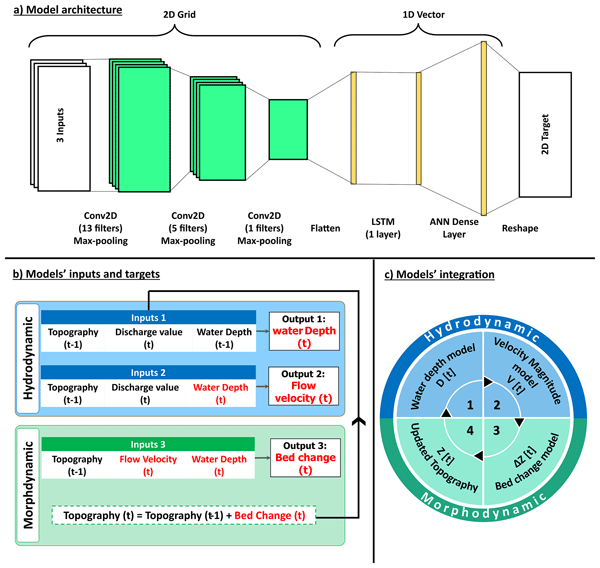
Figure 2C: This is a little confusing to me. In C, isn't it the topography at time t-1 that informs the water depth at time t? Based on this diagram, there is just a continual loop at time t. I think, that in the loop from slice 4 to 1, there is an increase in t. Maybe you could show that in the arrow between slice 4 and slice 1?
L 225-227: I think the reference dataset is from HEC-RAS and the simulated is from HDL-GM? Maybe you could say that directly, or clarify what they are if I am wrong.
Equations 1 - 3: I think R and S are bed elevation change. Can you say that explicitly?
Paragraph around line 245, about the EB testing: For the EB scenario, does every event start on the same initial topography? That is event 1 and event 2 are processed in parallel, but starting on the same topography?
Figure 3: Is absolute error the absolute value of R-S at a location? And the relative error is relative to what? I don't see equations for these values. Couldn't relative error exceed 100%? Is the color bar saturated at 100% but values go beyond 100%?
L 312: "95% error criterion indicates that 95% of the active cells exhibit an error below this value." What is "this value"?Citation: https://doi.org/10.5194/egusphere-2025-3368-RC2 -
AC1: 'Reply on RC2', Mohamed Fathi Said, 03 Feb 2026
The comment was uploaded in the form of a supplement: https://egusphere.copernicus.org/preprints/2025/egusphere-2025-3368/egusphere-2025-3368-AC1-supplement.pdf
-
AC1: 'Reply on RC2', Mohamed Fathi Said, 03 Feb 2026


Interactive discussion
Status: closed
-
RC1: 'Comment on egusphere-2025-3368', Anonymous Referee #1, 22 Dec 2025
Please refer to my comments in the supplementary file.
-
AC2: 'Reply on RC1', Mohamed Fathi Said, 03 Feb 2026
The comment was uploaded in the form of a supplement: https://egusphere.copernicus.org/preprints/2025/egusphere-2025-3368/egusphere-2025-3368-AC2-supplement.pdf
-
AC2: 'Reply on RC1', Mohamed Fathi Said, 03 Feb 2026
-
RC2: 'Comment on egusphere-2025-3368', Anonymous Referee #2, 30 Dec 2025
This paper explores the efficiency and accuracy of using Deep Learning (DL) for predicting of geomorphic (river bed) change, in comparison with using a 2D morphodynamic model. The paper is clearly written and for the most part the figures are understandable and illustrative. I have never seen a study like this before, and I think this is a solid contribution to the literature. It represents a first step into using DL for estimating bed change. The study is relatively limited in scope - at least it seems that way to me. That said, I think this is a great introduction, represents an entire study that others could build on, and it is worthy and ready for publication.
For reference, I have personally never used machine learning. I am an experienced numerical modeler but the traditional type. I am excited about the potential of studies like this. However, I am not in a position to review the details on the presentation of HDL-GM and whether "reasonable" choices were made in all cases.
Given this, I did wonder if there was rationale for the applying HDL-GM to 6 flood events. Was there a reason for 6? There is discussion of how error changes when doing continuous modeling, but was there a reason to stop at 6 events? Is it related to the simulation time required for HEC-RAS? Some discussion of how far forward we can predict would be appreciated by me. Even if we don't know, acknowledging this needs to be studied would be helpful for me. Similarly, I wondered why 11 events were used for training. Is there a relationship between the number of events used for training and the number of events that can be reasonably predicted?
Another thing I wondered was whether you could use a shorter reach for training but make predictions on a longer reach of river than was used for training. Is that fair? It could be a way to save some training time. Is this a no-no in geomorphology machine learning world?
The authors do discuss caveats and limitations, so it's not that those are missing. The points in the two above paragraphs were ones that came up for me as I read, but if the authors feel that addressing these is not useful, I defer to them.
Some detailed points that could help with readability/understanding:
L 134,135: What impact does the trapezoidal cross-section assumption make? I did not see a mention of river depth measurements, but wouldn't those be needed to create the cross-sections?
Figure 2C: This is a little confusing to me. In C, isn't it the topography at time t-1 that informs the water depth at time t? Based on this diagram, there is just a continual loop at time t. I think, that in the loop from slice 4 to 1, there is an increase in t. Maybe you could show that in the arrow between slice 4 and slice 1?
L 225-227: I think the reference dataset is from HEC-RAS and the simulated is from HDL-GM? Maybe you could say that directly, or clarify what they are if I am wrong.
Equations 1 - 3: I think R and S are bed elevation change. Can you say that explicitly?
Paragraph around line 245, about the EB testing: For the EB scenario, does every event start on the same initial topography? That is event 1 and event 2 are processed in parallel, but starting on the same topography?
Figure 3: Is absolute error the absolute value of R-S at a location? And the relative error is relative to what? I don't see equations for these values. Couldn't relative error exceed 100%? Is the color bar saturated at 100% but values go beyond 100%?
L 312: "95% error criterion indicates that 95% of the active cells exhibit an error below this value." What is "this value"?Citation: https://doi.org/10.5194/egusphere-2025-3368-RC2 -
AC1: 'Reply on RC2', Mohamed Fathi Said, 03 Feb 2026
The comment was uploaded in the form of a supplement: https://egusphere.copernicus.org/preprints/2025/egusphere-2025-3368/egusphere-2025-3368-AC1-supplement.pdf
-
AC1: 'Reply on RC2', Mohamed Fathi Said, 03 Feb 2026
Peer review completion


Journal article(s) based on this preprint
Viewed
| HTML | XML | Total | BibTeX | EndNote | |
|---|---|---|---|---|---|
| 798 | 537 | 97 | 1,432 | 57 | 51 |
- HTML: 798
- PDF: 537
- XML: 97
- Total: 1,432
- BibTeX: 57
- EndNote: 51
Viewed (geographical distribution)
| Country | # | Views | % |
|---|
| Total: | 0 |
| HTML: | 0 |
| PDF: | 0 |
| XML: | 0 |
- 1
Zihan Liu
Anjali M. Fernandes
Michael T. Hren
Dennis O. Terry, Jr.
C. Nataraj
Virginia Smith
The requested preprint has a corresponding peer-reviewed final revised paper. You are encouraged to refer to the final revised version.
- Preprint
(5539 KB) - Metadata XML
Please refer to my comments in the supplementary file.