
the Creative Commons Attribution 4.0 License.
the Creative Commons Attribution 4.0 License.
 | 11 Jul 2025
EXSoDOS 1.0: downscaling of weather extremes shifts for ensemble climate projections using ground-based measurements, reanalysis and stochastic modelling
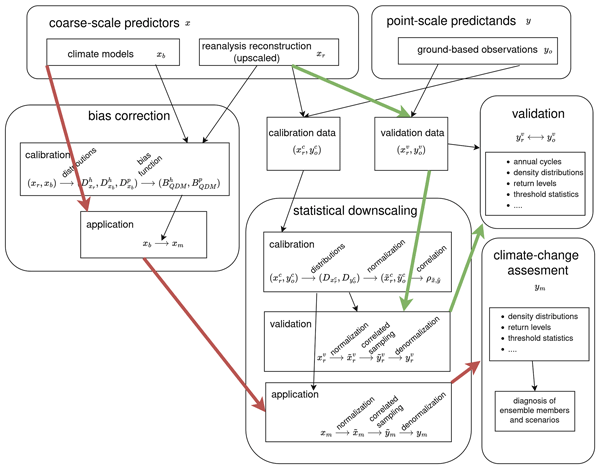
Abstract. Accurately representing the changes of local extreme weather events in climate projections is crucial for climate impact assessment and adaptation services. Climate models often struggle with capturing these events due to their coarse spatial resolution. Existing downscale products successfully reduce overall biases of past or future climateological variables, but the representation of variability and extreme events including their past and future shifts under climate change are still not addressed. A new stochastic model, EXSoDOS, addresses this gap by the DOwnScaling of weather EXtremes Shifts for ensemble climate projections using ground-based measurements, reanalysis, and global climate models. This is done by using a stochastic model that correlates coarse-scale gridded historical climate records with the point-scale measurements. Therefore, EXSoDOS combines ground-based data (either from the Global Historical Climatological Network or user-specified), ERA5 reanalysis, and global climate model (GCM) projections to downscale past and future daily climate records. We demonstrate EXSoDOS for 5 use cases, resp. daily minimum temperature in Belgium, daily maximum temperature in Azerbaijan, heat stress in India, wind velocity in Germany and precipitation in Mali. It is found that EXSoDOS is able to represent annual cycle variability, density distributions, and extreme events of return periods of up to 10 years, while they are all underrepresented by the raw GCM outputs. Observed tendencies towards more extremes between two past periods 1961–1990 and 1991–2020 are also better represented. Projections under the SSP585 scenario suggest amplified extremes in maximum temperature, precipitation, and heat stress by 2071–2100. Furthermore, downscaling affects the outcomes of shifting extremes under future climate change, which is evident in terms of both absolute and relative changes, as well as changes in return periods. While limitations of statistical downscaling persist, it is concluded that EXSoDOS offers a novel method for estimating past and future shifts in weather extremes for weather stations with a sufficient daily record of data of multiple decades.
-
Notice on discussion status
The requested preprint has a corresponding peer-reviewed final revised paper. You are encouraged to refer to the final revised version.
-
Preprint
(3806 KB)
-
Supplement
(140 KB)
-
The requested preprint has a corresponding peer-reviewed final revised paper. You are encouraged to refer to the final revised version.
- Preprint
(3806 KB) - Metadata XML
-
Supplement
(140 KB) - BibTeX
- EndNote
- Final revised paper


Journal article(s) based on this preprint
Interactive discussion
Status: closed
-
CC1: 'Comment on egusphere-2025-2214', Rasmus Benestad, 03 Sep 2025
-
AC1: 'Reply on CC1', Hendrik Wouters, 08 Sep 2025
We thank you for your interest in our work and your recommendations. We agree that your related studies should be referenced, and we will include them upon revision.
As you note, the methods in the cited papers are designed to downscale overall statistical descriptors such as probabilities of heavy rainfall, IDF curves, or heatwave probabilities, which are important to provide insights for climate change assessments. In contrast, the focus of our work is on generating sequential, downscaled daily time series of various meteorological variables representing extremes by correlating coarse-scale climate records with point-scale observations. Such continuous time series are essential for driving climate impact models sensitive to variability and extremes (e.g., crop models). We already acknowledge similar work on downscaling (see references at r32–48) which also includes dynamical downcaling by CORDEX. To our best knowledge, our claims about gaps and novelty mentioned here hold.
While the paper gives the necessary context on the type of downscaling addressed here, we admit that the mentioned phrases may lead to confusion. We will reformulate these sentences upon revision, and better clarify the distinction with to other types of downscaling.
We agree that it’s more correct to state that GCMs are not designed to represent local extremes as observed in measurements than stating that they underrepresent local extremes, as they are generally capable of representing of what they are designed for, namely climatological variables on large scales. We will reformulate the quoted sentence upon revision.
Finally, we note that Eyring et al. (2016) was cited only to provide context on global climate projections, not to point to downscaling products. We fully agree that AI downscaling can learn about existing statistical approaches, as we will also hightlight upon revision.
Citation: https://doi.org/10.5194/egusphere-2025-2214-AC1 -
CC4: 'Reply on AC1', Rasmus Benestad, 15 Oct 2025
I thank the authors for Hendrik Wouters response to my comment.
My concern is that downscaling sequences of daily weather data for a future climatic state is more complicated than downscaling statistical properties, such as parameters of statistical distributions. While a probability density function (pdf) provides some information about extremes in its tails, the day-by-day sequential approach is more designed for the more normal range represented by the bulk of the data. The day-by-day sequential approach was motivated by present day weather forecasting, for which it works reasonably well, but not really to study how the weather statistics is shifting with a changed climate. Predicting statistical properties is often easier than predicting a particular outcome, which also favours the downscaling of statistical parameters. Hence, it makes more senste trying to estimate how the statistics changes first, and then look at how statistical changes may play out. For instance statistical parameters can be used as input for weather generators to provide sequences of daily data that have same statistical properties as those provided by downscaling. Such an approach makes it possible to drive climate impact models sensitive to variability and extremes (e.g. heavy rainfall affecting the outbreak of diarrhoea as in https://www.springsproject.eu/).
Furthermore, in order to get the most robust results, it's useful to bring together empirical-statistical and dynamical downscaling as they are based on entirely dfferent sets of assumptions and come with different strengths and weakensses.
While I understand it's not possible to incorportat these thoughts into the paper, I hope that the authors look into and reflect on some of these issues in e.g. the discussion part. It may be useful for future work. I also think this may be of interest for those using AI/ML n downscaling in general.
Citation: https://doi.org/10.5194/egusphere-2025-2214-CC4
-
CC4: 'Reply on AC1', Rasmus Benestad, 15 Oct 2025
-
CC2: 'Reply on CC1', Boucary Dara, 08 Sep 2025
Nous vous remercions sincèrement pour vos commentaires détaillés et constructifs, qui nous aident à mieux situer nos travaux dans le contexte plus large de la recherche existante. Vous avez tout à fait raison de souligner que de nombreuses études antérieures ont déjà abordé les événements extrêmes et leur évolution future dans le contexte du changement climatique, par des approches statistiques et dynamiques, notamment dans le cadre de CORDEX. La formulation de notre résumé a pu donner l'impression que ces aspects n'avaient jamais été pris en compte, alors que notre intention était de faire référence plus spécifiquement aux zones hétérogènes correspondant à nos régions d'étude. Nous réviserons cette section afin de reconnaître explicitement ces contributions importantes, y compris celles que vous avez mentionnées (par exemple, sur les fortes précipitations et les vagues de chaleur). Nous prenons également note de vos observations sur la littérature concernant la réduction d'échelle statistique, en particulier les travaux menés par la communauté norvégienne. Nous allons approfondir notre revue de la littérature et ajuster certaines affirmations afin d'éviter toute affirmation excessive. Enfin, vos remarques sur la distinction entre les résultats des modèles numériques globaux et les observations locales sont particulièrement pertinentes. Nous intégrerons cette clarification afin de mieux cerner les limites et les objectifs de notre approche. Nous vous remercions encore une fois pour vos commentaires constructifs, qui nous aideront à améliorer considérablement la clarté et la portée de notre article.
Citation: https://doi.org/10.5194/egusphere-2025-2214-CC2 -
CC3: 'Reply on CC2', Boucary Dara, 08 Sep 2025
We sincerely thank you for your detailed and constructive comments, which help us to better situate our work within the broader context of existing research.
You are absolutely right to point out that many previous studies have already addressed extreme events and their future evolution in the context of climate change, through both statistical and dynamical approaches, notably within the CORDEX framework. The wording in our abstract may indeed have given the impression that these aspects had never been considered, whereas our intention was to refer more specifically to heterogeneous areas corresponding to our study regions. We will revise this section to explicitly acknowledge these important contributions, including those you mentioned (e.g., on heavy precipitation and heatwaves).
We also take careful note of your observations on the literature regarding statistical downscaling, in particular the work carried out by the Norwegian community. We will expand our literature review and adjust certain statements to avoid any exaggerated claims.
Finally, your remarks on the distinction between the outputs of global numerical models and local observations are particularly relevant. We will incorporate this clarification in order to better frame the limitations and objectives of our approach.
Once again, Thank you for your constructive comments, which will help us significantly improve the clarity and scope of our article.
Citation: https://doi.org/10.5194/egusphere-2025-2214-CC3
-
CC3: 'Reply on CC2', Boucary Dara, 08 Sep 2025
-
AC1: 'Reply on CC1', Hendrik Wouters, 08 Sep 2025
-
RC1: 'Comment on egusphere-2025-2214', Anonymous Referee #1, 13 Sep 2025
Review of Wouters et al. 2025
Overall, the paper is well written, and the statistical technique developed appears robust. However, there are several issues that need to be addressed before I can recommend this manuscript for publication.
Major Comments
The authors have chosen 5 sites to evaluate EXSoDOS and the manuscript clearly mentions why these cases were selected. However, in my opinion only five cases globally may be insufficient to fully assess the robustness of the approach. I recommend expanding the analysis to include 20–30 stations, with representation from additional regions. Specifically, it would be valuable to incorporate sites from North and South America, as well as Australia. Including a few stations located on islands and near the Southern Ocean would further strengthen the geographic diversity of the dataset. Within India, the current focus on Puri (a coastal city) could be complemented by selecting sites from different geographical settings, such as an inland city like Delhi or a location near the Himalayas.
Section 3.1: The current description lacks sufficient detail. While the authors state that there are differences between the four columns in Figure 3, these distinctions are difficult to visualize due to the way the figure is presented. I recommend enhancing the analysis by including one or two additional metrics and discussing the potential limitations of the Perkins distribution overlap score. Similarly, in Section 3.2, I suggest incorporating relevant statistical metrics (perhaps in the form of a table) to quantitatively assess aspects such as ‘increase’, ‘decrease’, ‘less extreme’, and ‘shift of distribution’.
The statistical framework presented in this manuscript is built upon several underlying assumptions. I recommend that the authors include a table listing all these assumptions, accompanied by brief descriptions for each.
Minor Comments
L22: “…generally underrepresented in climate projections.” Add 2-3 references.
L38: “finer resolution grids”. It might be good to mention the resolution.
L53: “…normalized and correlated with each other.” Kindly add one sentence with a short explanation.
L66: “EXSoDOS runs quickly…” Please add a metric here. Or maybe add “quickly (see later)…”
L87: Is there any reason for the 50:50 split? Citation to a previous literature might be helpful.
L140: How sensitive are the results to the choice for 2 additional months.
L149: Are there existing literatures which support the choice of an exponential profile?
L192: How sensitive are the results to the choice of ‘c’? Can the authors include a figure?
L213: I would like to see a figure/chart before and after detrending.
L305-320, 325-330: Kindly add a few more citations for each case.
Figure 3: Needs a legend.
Figures 3, 5, 6: I recommend using Kelvin as the unit of temperature.
Figure 5: Check units of ‘wind speed’ and ‘precipitation’
Figure 6, 7: Kindly consider using one common legend for the entire figure.
Citation: https://doi.org/10.5194/egusphere-2025-2214-RC1 -
AC2: 'Reply on RC2', Hendrik Wouters, 21 Dec 2025
The comment was uploaded in the form of a supplement: https://egusphere.copernicus.org/preprints/2025/egusphere-2025-2214/egusphere-2025-2214-AC2-supplement.pdf
-
AC2: 'Reply on RC2', Hendrik Wouters, 21 Dec 2025
-
RC2: 'Comment on egusphere-2025-2214', Anonymous Referee #2, 15 Oct 2025
This manuscript proposes a new stochastic model to improve the prediction accuracy of climate extremes. The methodology is innovative, and the manuscript is well-written and easy to follow. However, I believe the following issues should be addressed before publication on Geoscientific Model Development.
As the authors mentioned in Lines 213-215, the statistical relationship was assumed to remain unchanged under climate change. To test the robustness of the relationship, could the authors conduct cross-validation (e.g. 5-fold or leave-one-out) to evaluate the stability and generalizability of the statistical relationship?
In addition, I am concerned about the representativeness of the five stations selected (Section 2.6.1). Why the five cases were selected to show the general utility of the model? What are the Plant Functional Types of these stations? Understanding the PFTs could help assess whether the model performance is influenced by land-surface characteristics.
Citation: https://doi.org/10.5194/egusphere-2025-2214-RC2 -
AC2: 'Reply on RC2', Hendrik Wouters, 21 Dec 2025
The comment was uploaded in the form of a supplement: https://egusphere.copernicus.org/preprints/2025/egusphere-2025-2214/egusphere-2025-2214-AC2-supplement.pdf
-
AC2: 'Reply on RC2', Hendrik Wouters, 21 Dec 2025
-
RC3: 'Comment on egusphere-2025-2214', Anonymous Referee #3, 20 Oct 2025
This manuscript introduces EXSoDOS, a stochastic point-scale downscaling framework for representing changes in weather extremes however, several methodological assumptions, validation choices, and claims of novelty need strengthening before publication.
Major Comments :
The paper positions EXSoDOS as novel, yet its design is close to prior stochastic “perfect-prog” approaches (analog/binning, weather generators, recent station-scale frameworks). Please sharpen the novelty claim: Clarify what is conceptually new beyond the two-stage design and the pre-scaling trick; Add quantitative benchmarks against at least one strong baseline on the same stations/periods (e.g., BCSD-type with weather generator/analog; a Switanek-style variant without pre-scaling). Report distribution overlap, CRPS, and high-quantile loss (p ≥ 0.95).
You assume correlations are static under climate change and manage range shifts via detrending (temperature) and QDM. Please: Test correlation stability across eras (1961–1990 vs 1991–2020); Discuss how non-stationarity would bias tail estimates and provide indicators to detect failure; Consider a time-varying or regime/season-partitioned correlation experiment.
Validation up to ~5–10 years is reasonable given record length, but many users need 20–50-year guidance. Either demonstrate an EVT coupling (e.g., GPD) for tails or state explicit use-limits and uncertainty when extrapolating.
EXSoDOS is applied per station and per predictor, which does not preserve spatial dependence or compound hazards (e.g., hot-humid heat stress, rain-wind). Please expand the limitations and—ideally—include a small proof-of-concept using a copula or simple correlation-preserving extension. Provide guidance on when multi-site methods are required.
Beyond literature review, please include at least one head-to-head comparison with an established method (e.g., standard quantile mapping, ISIMIP approach) and discuss when EXSoDOS is preferable relative to CORDEX or CHELSA-W5E5 station-scale products.
Specify minimum record length and completeness thresholds for station data, missing-data handling, and whether calibration is seasonal vs annual. This will aid reproducibility and user adoption.
Minor Comments
Figures: Panels (e.g., Figs 6–7) are visually dense; consider small multiples per variable, clearer legends, and consistent units and station names (e.g., Spangdahlem vs Dahlem). Where bands are shown, label them explicitly as ensemble percentile envelopes (10–90%) to avoid confusion with confidence intervals.
Abbreviations: Spell out at first use (QDM, ERA5).
Text quality: Fix typos (e.g., “envionmental” → environmental; “algorythm” → algorithm) and standardize capitalization/diacritics.
Data coverage: When citing a GHCN “≥30-year” requirement, specify the QC filters applied.
Specific Questions for the Authors
Data-sparse regions: How does performance degrade with shorter or lower-quality station records? Any guidance on minimum data length by variable?
Sub-daily extremes: Can EXSoDOS be adapted to sub-daily metrics (e.g., hourly precipitation) and what changes would be required?
Circulation shifts: How would systematic circulation changes (e.g., jet latitude, monsoon onset) alter predictor–predictand correlations, and can your framework detect/adapt to such shifts?
Computational cost: How does runtime compare to alternative downscaling methods (e.g., analog generators, quantile-mapping ensembles) for N stations and M GCMs?
Citation: https://doi.org/10.5194/egusphere-2025-2214-RC3 -
AC2: 'Reply on RC2', Hendrik Wouters, 21 Dec 2025
The comment was uploaded in the form of a supplement: https://egusphere.copernicus.org/preprints/2025/egusphere-2025-2214/egusphere-2025-2214-AC2-supplement.pdf
-
AC2: 'Reply on RC2', Hendrik Wouters, 21 Dec 2025
Peer review completion


Interactive discussion
Status: closed
-
CC1: 'Comment on egusphere-2025-2214', Rasmus Benestad, 03 Sep 2025
Interesting paper. I have some thoughts and comments that I'd like to share.
In the abstract, there is the statement "Existing downscale products successfully reduce overall biases of past or future climateological variables, but the representation of variability and extreme events including their past and future shifts under climate change are still not addressed" which I don't think is a bit misleading. Have the authors examined all scientific publications and really can claim that there are no papers addressing "extreme events including their past and future shifts under climate change" or is it a bit premature? What about e.g. https://doi.org/10.5194/hess-29-45-2025 that presents downscaled information about heavy daily precipitation or https://doi.org/10.5194/ascmo-4-37-2018 addressing heatwaves? I also think that dynamical downscaling within CORDEX has addressed extremes.
I think that the claim "While limitations of statistical downscaling persist, it is concluded that EXSoDOS offers a novel method for estimating past and future shifts in weather extremes for weather stations with a sufficient daily record of data of multiple decades" is not justified when the paper has not examined the whole spectrum of empirical-statistical downscaling. It has for instance ignored the works from the Norwegian statistical community over several decades and has contributed to pioneering the downscaling of statistical properties.
Comment to "heavy precipitation, heavy wind, extreme heat (stress) and cold spells are generally underrepresented in climate projections" - it's important to keep in mind what the models are designed to represent. The numerical models such as GCMs do have a minimum skillful scale (doi:10.2151/jmsj.2015-042) and are not expected to produce the numbers that represent e.g. local rainfall caught in a rain gauge or local temperature measured by a thermometer. The number produced by a model and measured by an instruments usually represent different aspects of a condition. This paper could definitely improve by providing a better account on downsclaing and a more accurate context. Furthermore, efforts with AI/ML for downscaling have lots to learn from empirical-statistical downscaling in the past and I'd recomment reading up on the subject before making claims about the merit of AI/ML.
I dont think that the reference (Eyring et al., 2016) deals with downscaling, but it presents the global models. Thus the reference here may be a bit misleading. Again, the cited literature on empirical-statistical downscaling is very unimpressive and this makes the claims about the merit of the proposed method hyperbole.
Citation: https://doi.org/10.5194/egusphere-2025-2214-CC1 -
AC1: 'Reply on CC1', Hendrik Wouters, 08 Sep 2025
We thank you for your interest in our work and your recommendations. We agree that your related studies should be referenced, and we will include them upon revision.
As you note, the methods in the cited papers are designed to downscale overall statistical descriptors such as probabilities of heavy rainfall, IDF curves, or heatwave probabilities, which are important to provide insights for climate change assessments. In contrast, the focus of our work is on generating sequential, downscaled daily time series of various meteorological variables representing extremes by correlating coarse-scale climate records with point-scale observations. Such continuous time series are essential for driving climate impact models sensitive to variability and extremes (e.g., crop models). We already acknowledge similar work on downscaling (see references at r32–48) which also includes dynamical downcaling by CORDEX. To our best knowledge, our claims about gaps and novelty mentioned here hold.
While the paper gives the necessary context on the type of downscaling addressed here, we admit that the mentioned phrases may lead to confusion. We will reformulate these sentences upon revision, and better clarify the distinction with to other types of downscaling.
We agree that it’s more correct to state that GCMs are not designed to represent local extremes as observed in measurements than stating that they underrepresent local extremes, as they are generally capable of representing of what they are designed for, namely climatological variables on large scales. We will reformulate the quoted sentence upon revision.
Finally, we note that Eyring et al. (2016) was cited only to provide context on global climate projections, not to point to downscaling products. We fully agree that AI downscaling can learn about existing statistical approaches, as we will also hightlight upon revision.
Citation: https://doi.org/10.5194/egusphere-2025-2214-AC1 -
CC4: 'Reply on AC1', Rasmus Benestad, 15 Oct 2025
I thank the authors for Hendrik Wouters response to my comment.
My concern is that downscaling sequences of daily weather data for a future climatic state is more complicated than downscaling statistical properties, such as parameters of statistical distributions. While a probability density function (pdf) provides some information about extremes in its tails, the day-by-day sequential approach is more designed for the more normal range represented by the bulk of the data. The day-by-day sequential approach was motivated by present day weather forecasting, for which it works reasonably well, but not really to study how the weather statistics is shifting with a changed climate. Predicting statistical properties is often easier than predicting a particular outcome, which also favours the downscaling of statistical parameters. Hence, it makes more senste trying to estimate how the statistics changes first, and then look at how statistical changes may play out. For instance statistical parameters can be used as input for weather generators to provide sequences of daily data that have same statistical properties as those provided by downscaling. Such an approach makes it possible to drive climate impact models sensitive to variability and extremes (e.g. heavy rainfall affecting the outbreak of diarrhoea as in https://www.springsproject.eu/).
Furthermore, in order to get the most robust results, it's useful to bring together empirical-statistical and dynamical downscaling as they are based on entirely dfferent sets of assumptions and come with different strengths and weakensses.
While I understand it's not possible to incorportat these thoughts into the paper, I hope that the authors look into and reflect on some of these issues in e.g. the discussion part. It may be useful for future work. I also think this may be of interest for those using AI/ML n downscaling in general.
Citation: https://doi.org/10.5194/egusphere-2025-2214-CC4
-
CC4: 'Reply on AC1', Rasmus Benestad, 15 Oct 2025
-
CC2: 'Reply on CC1', Boucary Dara, 08 Sep 2025
Nous vous remercions sincèrement pour vos commentaires détaillés et constructifs, qui nous aident à mieux situer nos travaux dans le contexte plus large de la recherche existante. Vous avez tout à fait raison de souligner que de nombreuses études antérieures ont déjà abordé les événements extrêmes et leur évolution future dans le contexte du changement climatique, par des approches statistiques et dynamiques, notamment dans le cadre de CORDEX. La formulation de notre résumé a pu donner l'impression que ces aspects n'avaient jamais été pris en compte, alors que notre intention était de faire référence plus spécifiquement aux zones hétérogènes correspondant à nos régions d'étude. Nous réviserons cette section afin de reconnaître explicitement ces contributions importantes, y compris celles que vous avez mentionnées (par exemple, sur les fortes précipitations et les vagues de chaleur). Nous prenons également note de vos observations sur la littérature concernant la réduction d'échelle statistique, en particulier les travaux menés par la communauté norvégienne. Nous allons approfondir notre revue de la littérature et ajuster certaines affirmations afin d'éviter toute affirmation excessive. Enfin, vos remarques sur la distinction entre les résultats des modèles numériques globaux et les observations locales sont particulièrement pertinentes. Nous intégrerons cette clarification afin de mieux cerner les limites et les objectifs de notre approche. Nous vous remercions encore une fois pour vos commentaires constructifs, qui nous aideront à améliorer considérablement la clarté et la portée de notre article.
Citation: https://doi.org/10.5194/egusphere-2025-2214-CC2 -
CC3: 'Reply on CC2', Boucary Dara, 08 Sep 2025
We sincerely thank you for your detailed and constructive comments, which help us to better situate our work within the broader context of existing research.
You are absolutely right to point out that many previous studies have already addressed extreme events and their future evolution in the context of climate change, through both statistical and dynamical approaches, notably within the CORDEX framework. The wording in our abstract may indeed have given the impression that these aspects had never been considered, whereas our intention was to refer more specifically to heterogeneous areas corresponding to our study regions. We will revise this section to explicitly acknowledge these important contributions, including those you mentioned (e.g., on heavy precipitation and heatwaves).
We also take careful note of your observations on the literature regarding statistical downscaling, in particular the work carried out by the Norwegian community. We will expand our literature review and adjust certain statements to avoid any exaggerated claims.
Finally, your remarks on the distinction between the outputs of global numerical models and local observations are particularly relevant. We will incorporate this clarification in order to better frame the limitations and objectives of our approach.
Once again, Thank you for your constructive comments, which will help us significantly improve the clarity and scope of our article.
Citation: https://doi.org/10.5194/egusphere-2025-2214-CC3
-
CC3: 'Reply on CC2', Boucary Dara, 08 Sep 2025
-
AC1: 'Reply on CC1', Hendrik Wouters, 08 Sep 2025
-
RC1: 'Comment on egusphere-2025-2214', Anonymous Referee #1, 13 Sep 2025
Review of Wouters et al. 2025
Overall, the paper is well written, and the statistical technique developed appears robust. However, there are several issues that need to be addressed before I can recommend this manuscript for publication.
Major Comments
The authors have chosen 5 sites to evaluate EXSoDOS and the manuscript clearly mentions why these cases were selected. However, in my opinion only five cases globally may be insufficient to fully assess the robustness of the approach. I recommend expanding the analysis to include 20–30 stations, with representation from additional regions. Specifically, it would be valuable to incorporate sites from North and South America, as well as Australia. Including a few stations located on islands and near the Southern Ocean would further strengthen the geographic diversity of the dataset. Within India, the current focus on Puri (a coastal city) could be complemented by selecting sites from different geographical settings, such as an inland city like Delhi or a location near the Himalayas.
Section 3.1: The current description lacks sufficient detail. While the authors state that there are differences between the four columns in Figure 3, these distinctions are difficult to visualize due to the way the figure is presented. I recommend enhancing the analysis by including one or two additional metrics and discussing the potential limitations of the Perkins distribution overlap score. Similarly, in Section 3.2, I suggest incorporating relevant statistical metrics (perhaps in the form of a table) to quantitatively assess aspects such as ‘increase’, ‘decrease’, ‘less extreme’, and ‘shift of distribution’.
The statistical framework presented in this manuscript is built upon several underlying assumptions. I recommend that the authors include a table listing all these assumptions, accompanied by brief descriptions for each.
Minor Comments
L22: “…generally underrepresented in climate projections.” Add 2-3 references.
L38: “finer resolution grids”. It might be good to mention the resolution.
L53: “…normalized and correlated with each other.” Kindly add one sentence with a short explanation.
L66: “EXSoDOS runs quickly…” Please add a metric here. Or maybe add “quickly (see later)…”
L87: Is there any reason for the 50:50 split? Citation to a previous literature might be helpful.
L140: How sensitive are the results to the choice for 2 additional months.
L149: Are there existing literatures which support the choice of an exponential profile?
L192: How sensitive are the results to the choice of ‘c’? Can the authors include a figure?
L213: I would like to see a figure/chart before and after detrending.
L305-320, 325-330: Kindly add a few more citations for each case.
Figure 3: Needs a legend.
Figures 3, 5, 6: I recommend using Kelvin as the unit of temperature.
Figure 5: Check units of ‘wind speed’ and ‘precipitation’
Figure 6, 7: Kindly consider using one common legend for the entire figure.
Citation: https://doi.org/10.5194/egusphere-2025-2214-RC1 -
AC2: 'Reply on RC2', Hendrik Wouters, 21 Dec 2025
The comment was uploaded in the form of a supplement: https://egusphere.copernicus.org/preprints/2025/egusphere-2025-2214/egusphere-2025-2214-AC2-supplement.pdf
-
AC2: 'Reply on RC2', Hendrik Wouters, 21 Dec 2025
-
RC2: 'Comment on egusphere-2025-2214', Anonymous Referee #2, 15 Oct 2025
This manuscript proposes a new stochastic model to improve the prediction accuracy of climate extremes. The methodology is innovative, and the manuscript is well-written and easy to follow. However, I believe the following issues should be addressed before publication on Geoscientific Model Development.
As the authors mentioned in Lines 213-215, the statistical relationship was assumed to remain unchanged under climate change. To test the robustness of the relationship, could the authors conduct cross-validation (e.g. 5-fold or leave-one-out) to evaluate the stability and generalizability of the statistical relationship?
In addition, I am concerned about the representativeness of the five stations selected (Section 2.6.1). Why the five cases were selected to show the general utility of the model? What are the Plant Functional Types of these stations? Understanding the PFTs could help assess whether the model performance is influenced by land-surface characteristics.
Citation: https://doi.org/10.5194/egusphere-2025-2214-RC2 -
AC2: 'Reply on RC2', Hendrik Wouters, 21 Dec 2025
The comment was uploaded in the form of a supplement: https://egusphere.copernicus.org/preprints/2025/egusphere-2025-2214/egusphere-2025-2214-AC2-supplement.pdf
-
AC2: 'Reply on RC2', Hendrik Wouters, 21 Dec 2025
-
RC3: 'Comment on egusphere-2025-2214', Anonymous Referee #3, 20 Oct 2025
This manuscript introduces EXSoDOS, a stochastic point-scale downscaling framework for representing changes in weather extremes however, several methodological assumptions, validation choices, and claims of novelty need strengthening before publication.
Major Comments :
The paper positions EXSoDOS as novel, yet its design is close to prior stochastic “perfect-prog” approaches (analog/binning, weather generators, recent station-scale frameworks). Please sharpen the novelty claim: Clarify what is conceptually new beyond the two-stage design and the pre-scaling trick; Add quantitative benchmarks against at least one strong baseline on the same stations/periods (e.g., BCSD-type with weather generator/analog; a Switanek-style variant without pre-scaling). Report distribution overlap, CRPS, and high-quantile loss (p ≥ 0.95).
You assume correlations are static under climate change and manage range shifts via detrending (temperature) and QDM. Please: Test correlation stability across eras (1961–1990 vs 1991–2020); Discuss how non-stationarity would bias tail estimates and provide indicators to detect failure; Consider a time-varying or regime/season-partitioned correlation experiment.
Validation up to ~5–10 years is reasonable given record length, but many users need 20–50-year guidance. Either demonstrate an EVT coupling (e.g., GPD) for tails or state explicit use-limits and uncertainty when extrapolating.
EXSoDOS is applied per station and per predictor, which does not preserve spatial dependence or compound hazards (e.g., hot-humid heat stress, rain-wind). Please expand the limitations and—ideally—include a small proof-of-concept using a copula or simple correlation-preserving extension. Provide guidance on when multi-site methods are required.
Beyond literature review, please include at least one head-to-head comparison with an established method (e.g., standard quantile mapping, ISIMIP approach) and discuss when EXSoDOS is preferable relative to CORDEX or CHELSA-W5E5 station-scale products.
Specify minimum record length and completeness thresholds for station data, missing-data handling, and whether calibration is seasonal vs annual. This will aid reproducibility and user adoption.
Minor Comments
Figures: Panels (e.g., Figs 6–7) are visually dense; consider small multiples per variable, clearer legends, and consistent units and station names (e.g., Spangdahlem vs Dahlem). Where bands are shown, label them explicitly as ensemble percentile envelopes (10–90%) to avoid confusion with confidence intervals.
Abbreviations: Spell out at first use (QDM, ERA5).
Text quality: Fix typos (e.g., “envionmental” → environmental; “algorythm” → algorithm) and standardize capitalization/diacritics.
Data coverage: When citing a GHCN “≥30-year” requirement, specify the QC filters applied.
Specific Questions for the Authors
Data-sparse regions: How does performance degrade with shorter or lower-quality station records? Any guidance on minimum data length by variable?
Sub-daily extremes: Can EXSoDOS be adapted to sub-daily metrics (e.g., hourly precipitation) and what changes would be required?
Circulation shifts: How would systematic circulation changes (e.g., jet latitude, monsoon onset) alter predictor–predictand correlations, and can your framework detect/adapt to such shifts?
Computational cost: How does runtime compare to alternative downscaling methods (e.g., analog generators, quantile-mapping ensembles) for N stations and M GCMs?
Citation: https://doi.org/10.5194/egusphere-2025-2214-RC3 -
AC2: 'Reply on RC2', Hendrik Wouters, 21 Dec 2025
The comment was uploaded in the form of a supplement: https://egusphere.copernicus.org/preprints/2025/egusphere-2025-2214/egusphere-2025-2214-AC2-supplement.pdf
-
AC2: 'Reply on RC2', Hendrik Wouters, 21 Dec 2025
Peer review completion
Journal article(s) based on this preprint
Viewed
| HTML | XML | Total | Supplement | BibTeX | EndNote | |
|---|---|---|---|---|---|---|
| 12,885 | 1,360 | 309 | 14,554 | 385 | 273 | 263 |
- HTML: 12,885
- PDF: 1,360
- XML: 309
- Total: 14,554
- Supplement: 385
- BibTeX: 273
- EndNote: 263
Viewed (geographical distribution)
| Country | # | Views | % |
|---|
| Total: | 0 |
| HTML: | 0 |
| PDF: | 0 |
| XML: | 0 |
- 1
Hendrik Wouters

Jente Broeckx
Francisco Pereira
Boucary Dara
Afoussatou Diarra
Robin Houdmeyers
Dirk Lauwaet
The requested preprint has a corresponding peer-reviewed final revised paper. You are encouraged to refer to the final revised version.
- Preprint
(3806 KB) - Metadata XML
-
Supplement
(140 KB) - BibTeX
- EndNote
- Final revised paper
Interesting paper. I have some thoughts and comments that I'd like to share.
In the abstract, there is the statement "Existing downscale products successfully reduce overall biases of past or future climateological variables, but the representation of variability and extreme events including their past and future shifts under climate change are still not addressed" which I don't think is a bit misleading. Have the authors examined all scientific publications and really can claim that there are no papers addressing "extreme events including their past and future shifts under climate change" or is it a bit premature? What about e.g. https://doi.org/10.5194/hess-29-45-2025 that presents downscaled information about heavy daily precipitation or https://doi.org/10.5194/ascmo-4-37-2018 addressing heatwaves? I also think that dynamical downscaling within CORDEX has addressed extremes.
I think that the claim "While limitations of statistical downscaling persist, it is concluded that EXSoDOS offers a novel method for estimating past and future shifts in weather extremes for weather stations with a sufficient daily record of data of multiple decades" is not justified when the paper has not examined the whole spectrum of empirical-statistical downscaling. It has for instance ignored the works from the Norwegian statistical community over several decades and has contributed to pioneering the downscaling of statistical properties.
Comment to "heavy precipitation, heavy wind, extreme heat (stress) and cold spells are generally underrepresented in climate projections" - it's important to keep in mind what the models are designed to represent. The numerical models such as GCMs do have a minimum skillful scale (doi:10.2151/jmsj.2015-042) and are not expected to produce the numbers that represent e.g. local rainfall caught in a rain gauge or local temperature measured by a thermometer. The number produced by a model and measured by an instruments usually represent different aspects of a condition. This paper could definitely improve by providing a better account on downsclaing and a more accurate context. Furthermore, efforts with AI/ML for downscaling have lots to learn from empirical-statistical downscaling in the past and I'd recomment reading up on the subject before making claims about the merit of AI/ML.
I dont think that the reference (Eyring et al., 2016) deals with downscaling, but it presents the global models. Thus the reference here may be a bit misleading. Again, the cited literature on empirical-statistical downscaling is very unimpressive and this makes the claims about the merit of the proposed method hyperbole.