
the Creative Commons Attribution 4.0 License.
the Creative Commons Attribution 4.0 License.
 | 18 Feb 2025
Vegetation and climate changes at the Early-Late Pliocene Transition around the Mediterranean basin: A case from the Burdur Basin in Southwestern Anatolia
Abstract. The Pliocene (5.33–2.58 Ma), particularly the Early-Late Pliocene transition (~3.6 Ma), is a key period for understanding future climate change linked to increases in greenhouse gases. Around the Western Mediterranean basin, the Early-Late Pliocene transition was marked by the establishment of a Mediterranean climate with summer droughts, cool/wet winters and latitudinal gradients. However, environmental changes in the eastern part of the Mediterranean area during the Early-Late Pliocene transition have rarely been documented. Here, we propose to reconstruct the environmental and climate changes during the Early-Late Pliocene transition from the Lake Burdur sequence, located in Southwestern Türkiye. The aim of this study is to characterize the vegetation, lake dynamics, and water level changes based on pollen and Non-Pollen Palynomorph (NPP) proxies, to quantitatively reconstruct climate changes using a multimethod approach (Modern Analogue Technique, Weighted Averaging Partial Least Squares regression, Random Forest, and Boosted Regression Trees and Climatic Amplitude Method) and morphologically characterize the large pollen grains of Poaceae (Cerealia-type).
The results indicate that, during the Early-Late Pliocene transition at Burdur, the vegetation was dominated by steppes with Poaceae, Artemisia, and Amaranthaceae. Subsequently, arboreal taxa decreased and a alternation between steppe grasslands with deciduous Quercus and steppes dominated by Amaranthaceae became evident. Large Poaceae pollen grains (Cerealia-type) are recorded in the Burdur sequence, but their percentages are lower than those at Acıgöl, a nearby record dated to the Pleistocene. The morphological characteristics of these large Poaceae pollen grains from Burdur are similar to those of domesticated cereals from recent periods, preventing a clear distinction between wild and domesticated Poaceae pollen. The lacustrine ecosystem was characterized by semi-aquatic vegetation and freshwater algae, exhibiting alternating oligotrophic and eutrophic conditions. Climate reconstructions of Burdur show similar trends across different methods, with reconstructed values during the Early-Late transition being close to present-day values. Following a climatic optimum in precipitation and temperature, climate reconstructions indicate an alternation between cool, wet conditions and warmer, drier conditions during the Late Pliocene in Southwestern Anatolia. Around the Mediterranean Basin, climate reconstructions during the Early Pliocene show warmer conditions compared to modern values and a north-south gradient in terms of precipitation, with wetter conditions in the north in comparison to the south. The Late Pliocene is characterized by colder conditions, and more humid conditions in the Western Mediterranean, while Türkyie and Central Asia experienced more arid conditions.
-
Notice on discussion status
The requested preprint has a corresponding peer-reviewed final revised paper. You are encouraged to refer to the final revised version.
-
Preprint
(2172 KB)
-
Supplement
(156 KB)
-
The requested preprint has a corresponding peer-reviewed final revised paper. You are encouraged to refer to the final revised version.
- Preprint
(2172 KB) - Metadata XML
-
Supplement
(156 KB) - BibTeX
- EndNote
- Final revised paper


Journal article(s) based on this preprint
Interactive discussion
Status: closed
-
RC1: 'Comment on egusphere-2025-174', Anonymous Referee #1, 14 Mar 2025
-
AC1: 'Reply on RC1', Mary Robles, 13 May 2025
We thank the reviewers for their attentive reading and their accurate comments. As detailed in the point-by-point reply below, we have carefully addressed every point raised, added substantial new data and analyses and thoroughly revised the manuscript.
General comments:
“Your study presents a variety of analyses and methods, which is commendable. However, these methods do not appear to be well connected in the discussion section. Each method provides an independent evaluation, but a cohesive overall conclusion has not been clearly established. Strengthening the connections between the different analyses would enhance the clarity and impact of your findings.”
Response: We will add a new figure comparing the climate reconstructions of Burdur with other palaeoclimatic records in the Mediterranean region and we will select, for Burdur, the BRT, MAT and CAM methods which provided the best R² and RMSE values.
Additionally, the palynological data from the Burdur area alone can not fully represent the broader Eastern Mediterranean. This statement appears in multiple parts of your manuscript and could benefit from some revision. In your study, you mention that Pliocene palynological studies in Anatolia are limited to the Ericek area. However, a more detailed literature review may reveal additional studies. To support this, I have included a few references that may be useful.
Response: We thank the reviewer for the references and have incorporated them into the manuscript.
After reviewing your manuscript, I would also recommend reconsidering the title. Your study focuses on the palynological, palaeoclimatic, and palaeovegetational data from a borehole in Burdur, with comparisons to European vegetation. Adjusting the title to better reflect this scope could improve clarity for readers.
Response: We have updated the title following your suggestion: “Vegetation and climate changes at the Early-Late Pliocene transition of the Burdur Basin in Southwestern Anatolia and comparison with the Mediterranean Basin”
Moreover, while various methods were applied, they are not clearly interconnected in the discussion section. For example, the relationship of the PCA analysis to the overall study could be more explicitly addressed.
Response: The discussion has been revised to better integrate the PCA analysis with the rest of the study.
Finally, the manuscript currently lacks geological and sedimentological information regarding the drilling log. Clarifying where the samples were taken along the log and providing additional geological context would greatly strengthen the study.
Response: The log and its sedimentological information are included with comparison to the general stratigraphy of the basin in a new Figure 3.
Figure 3. The studied drill-log of BS-87 within the stratigraphy for the Burdur basin-fill succession (Sickenberg & Tobien 1971, Lefevre et al. 1983, Karaman 1986, Price & Scott 1991, Saraç 2003, Platevoet et al. 2008, Alçiçek et al. 2013a,b, Demirel & Mayda 2014, Alçiçek et al. 2017, Özkaptan et al. 2018, Alçiçek et al. 2019). The chronostratigraphic units stand on Hilgen et al. (2012).
In the Material and methods part, in the subsection “3.2 Stratigraphy, paleomagnetism and magnetic susceptibility”, we added the text “The stratigraphy of the BS-87 core from Lake Burdur has been described.”
A new part in the Results included the figure 3 has been added: “4.2 Stratigraphy: The studied BS-87 drill core is predominantly composed of alternating greenish-grey, yellow-brown, and beige marlstone and siltstone (Fig. 2). Scattered gastropods are observed at the base of the core (360 m), as well as at 275 m, 130 m, 80 m, and between 60–20 m. Organic-rich layers are mainly present in the lower part of the sequence, particularly between 325–300 m and 260–210 m. Five dark grey to black coal seams are identified at approximately 177 m, 130 m, 110 m, 90 m, and 70 m. The top of the core is composed of rounded to subrounded gravelstone consisting of crystallized limestone.”
In the Discussion part, in the subsection 5.2 and the subpart “Dynamic of Lake Burdur”, the text has been completed to include the stratigraphy of the core: “The stratigraphy of the lake reveals an alternation between marlstone and siltstone (Fig. 3), suggesting a shift between calm depositional conditions and more dynamic phases (Tiab and Donaldson, 2012). Marlstone consists of fine-grained, carbonate-rich deposits typically associated with calm, shallow, or stagnant waters, whereas siltstone reflects siliciclastic input, generally linked to runoff or episodes of increased erosion. This alternation may reflect climatic changes affecting the hydrodynamic of the basin.”
Alçiçek, M. C., Mayda, S., & Titov, V. V. (2013b.) Lower Pleistocene stratigraphy of the Burdur Basin of SW Anatolia. Comptes Rendus Palevol, 12, 1-11.
Alçiçek, M. C., Mayda, S., & Demirel, A. (2017). Discussion on “Neogene-Quaternary evolution of the Tefenni basin on the Fethiye-Burdur fault zone, SW Anatolia-Turkey. Journal of African Earth Science 118, 137-148 by R. Aksoy, S. Aksarı”. Journal of African Earth Sciences, 134, 794-799.
Demirel, A., & Mayda, S. (2014). A new Early Pleistocene mammalian fauna from Burdur Basin, SW Turkey. Russian Journal of Theriology, 13, 55-63.
Hilgen, F. J., Lourens, L. J., & Van Dam J. A. (2012). The Neogene period. In: F. M. Gradstein, J. G. Ogg, M., Schmitz, & G., Ogg. (Eds.), The Geologic Time Scale 2012 (pp. 923-978). Oxford: Elsevier.
Karaman, E. (1986). Burdur dolayının genel stratigrafisi. Akdeniz Üniversitesi Isparta Mühendislik Fakültesi Dergisi 2, 23-36.
Lefevre, C., Bellon, H., & Poisson, A. (1983). Presence de leucitites dans le volcanisme Pliocene de la region d’Isparta (Taurus occidentales, Turkquie). Comptes Rendus de l'Académie des Sciences de Paris, 297, 369-372.
Platevoet, B., Scaillet, S., Guillou, H., Blamart, D., Nomade, S., Massault, M., Poisson, A., Elitok, Ö., Özgŭr, N., Yaǧmurlu, F., & Yılmaz, K. (2008). Pleistocene eruptive chronology of the Gölcük volcano, Isparta Angle, Turkey. Quaternaire, 19, 147-156.
Saraç G. (2003). Vertebrate fossil localities of Turkey. Scientific Report No. 10609, Mineral Research and Exploration Directorate of Turkey (MTA), Ankara, pp. 208.
Sickenberg, O., Tobien, H. (1971). New Neogene and Lower Quaternary vertebrate faunas in Turkey. Newsletters on Stratigraphy, 1, 51-61
Specific comments:
Line 1: After reading your work, you need to reorganise your title. This study includes palynological, palaeoclimatic and palaeovegetational data of the Pliocene from the borehole taken from Burdur, and includes a comparison of these data with European vegetation. I can suggest a title like ‘Vegetation and climate changes in the Early-Late Pliocene transition of the Burdur Basin in Southwestern Anatolia and comparison with the Mediterranean Basin’
Line 16: The title I suggested will be more coherent with your content and your focus
Response: We have updated the title based on your suggestion “Vegetation and climate changes at the Early-Late Pliocene transition of the Burdur Basin in Southwestern Anatolia and comparison with the Mediterranean Basin”
Line 38: “Following a climatic optimum in precipitation and temperature “Which one?
Response: We specified the time period in the text “Following a climatic optimum in precipitation and temperature during the Early Pliocene,”
Line 40: Your findings belong only to the Burdur area. You must reduce general explanations about the Mediterranean Basin. This is a local study. Focus on Burdur and its context.
Response: We have revised relevant sections to clarify that our findings are regional.
Line 44: Türkiye, The data set is not sufficient for a generalisation for the whole of Türkiye.
Response: We modified the statement to specify “southwestern Türkiye,” ensuring that our interpretations are geographically appropriate.
Line 54: Here you are making a comparison within the Pliocene in geological time. Why didn't you compare it to pre-industrial era as in the next sentence? What is the result when you compare the early Pliocene with the pre-industrial era?
Response: We added contextual comparison with the pre-industrial era in the introduction to emphasize the relevance of the Pliocene to understanding future climate change:
“The Pliocene is considered as the last geological epoch with similar atmospheric CO2 concentration (Masson-Delmotte et al., 2013)”
“reaching about 20 m above the present-day value (Dowsett and Cronin, 1990; Miller et al., 2012; Grant et al., 2019; Dumitru et al., 2019; Hearty et al., 2020). Considering future climate change, Earth System Model (ESM) projections, based on CO₂ concentrations by 2100 ranging from about 400 ppm to above 1100 ppm, indicate mass loss from the Greenland and Antarctic ice sheets, a projected sea-level rise of approximately 0.26 to 0.92 m above present-day levels, and an increase in global air temperatures ranging from 1.4°C to 4.4°C (compared to the period 1850–1900) depending on the scenario (IPCC, 2021, 2023). ”
We also added sentences at the end of the conclusion:
“This study highlights the complexity and spatial heterogeneity of past climate and vegetation responses across the Mediterranean basin during the Pliocene. Understanding the mechanisms and environmental impacts of past climate changes, mainly during the Pliocene, offers critical insights into the potential trajectories and regional impacts of ongoing and future climate change.”
Line 54: “During warm periods of the Pliocene?” Which period? You mean my Early Pliocene.
Response: We modified the beginning of the sentences in the introduction: ”During the mid-Pliocene Warm Period (mPWP; 3.264–3.025 Ma), atmospheric CO2 concentration” and “During the mid-Pliocene Warm Period, General Circulation Model (GCM)” to be more precise.
Line 70: “The Early Pliocene was characterized by Mediterranean climate conditions (summer droughts and cool-wet winters) in the Mediterranean Basin” Eastern Mediterranean? or Western Mediterranean?
Response: We specified: “in the Western Mediterranean Basin”
Line 88: There are studies for Pliocene palynoflora in Anatolia other than these two papers. The use of the results of this DSDP drilling in the Euxine basin in the Western Black Sea for the eastern Mediterranean is questionable. However, I am attaching the references of a few studies published in the literature that will allow you to make comparisons. Comparison with these studies will eliminate your lack of data for SW Anatolia.
e.g.
Tagliasacchi, E., Kayseri Özer, M. S., & Altay, T., (2024). Environmental, vegetational and climatic investigations during the Plio-Pleistocene in SW-Anatolia: A case study from the fluvio-lacustrine deposits in Uşak-Karahallı area. Palaeobiodiversity and Palaeoenvironments , vol.104, no.1, 29-51.
TUNCER, A., KARAYİĞİT, A. İ., OSKAY, R. G., TUNOĞLU, C., KAYSERİ ÖZER, M. S., GÜMÜŞ, B. A., ... Bulut, Y.(2023). A multi-proxy record of palaeoenvironmental and palaeoclimatic conditions during Plio-Pleistocene peat accumulation in the eastern flank of the Isparta Angle: A case study from the Şarkikaraağaç coalfield (Isparta, SW Central Anatolia). International Journal of Coal Geology , vol.265.
KAYSERİ ÖZER, M. S., Atalar, M., & Kovacova, M., (2019). Palaeovegetational evolution of the cankiri-corum Basin during the Mio-Pliocene (Central Anatolia) based on the IPR analysis method. PALAEOBIODIVERSITY AND PALAEOENVIRONMENTS , vol.99, no.4, 571-590.
KAYSERİ ÖZER, M. S., (2017). Cenozoic vegetation and climate change in Anatolia - A study based on the IPR-vegetation analysis. PALAEOGEOGRAPHY PALAEOCLIMATOLOGY PALAEOECOLOGY , vol.467, 37-68.
Yavuz-Işık, N., Saraç, G., Ünay, E., de Bruijn, H., 2011. Palynological analysis of Neogene mammal sites of Turkey — vegetational and climatic implications Yerbilimleri 32,
105–120.
Response: We thank the reviewer for pointing out additional references on the Pliocene palynoflora of Anatolia. We have reviewed the suggested literature and cited the relevant studies where appropriate in the revised manuscript. However, we note that the temporal constraints in most of these studies remain imprecise, and the limited number of analyzed samples significantly hinders direct comparison with our dataset. As such, while these works provide valuable regional context, they do not offer the resolution required for integration at the same interpretative level as the sites we have used.
Line 92: The data for the Ericek region does not represent a large area such as the Anatolian plateau. Please limit your use of regional terms to the area they cover. Throughout the manuscript.
Response: We revised the text throughout the manuscript to ensure regional terms are used appropriately and specifically.
Line 112: The data for your study was obtained from only one point. It is difficult to make an interpretation covering the Eastern Mediterranean. In this sense, your findings will represent local and microclimatic conditions. Please reorganise your evaluations from this point of view.
Response: We revised our interpretations to clearly frame our findings as representing regional conditions around the Burdur area, avoiding overgeneralizations.
Line 130: The general geological features of the region in Figure 1 should be expanded. Maybe under one title, with a description of the borehole log.
Response: The geological map is now updated with more detailed geological features (Figure 1). A new figure (Figure 3) has been added, presenting a detailed description of the BS-87 borehole log. The borehole log has been described in the Results part in a new subsection “4.2 Stratigraphy” and integrated in the Discussion part, in the subsection “5.2 Vegetation changes and plant diversity around the Mediterranean Basin during the Early-Late Pliocene transition” and the subpart “Dynamic of Lake Burdur” (see above).
Figure 1. (A) Tectonic map of the eastern Mediterranean showing major tectonic structures (after Bozkurt, 2003), (B) Geological maps of Acıgöl and Burdur Province and locations of selected cores and sections: Acıgöl C3 core (Andrieu-Ponel et al., 2021), Burdur Pmag section (Özkaptan et al., 2018) and Burdur BS-87 core (this study).
Line 145: “leading to a lake volume decrease of 39%” add with seasonal drought.
Response: We added in the text “with seasonal drought”.
Figure 1: A) Simplified tectonic map of Türkiye showing major neotectonic structures and neotectonic provinces. (Please added Refrences). Please added the graben tectonic structure. Central Anatolian Province
Response: Figure 1 has been revised accordingly and the simplified tectonic map of Türkiye now includes references (Bozkurt, 2003) (see above).
Line 154: What was the palaeogeography and palaeotopography like in the Pliocene? Please add discussion (in the discussion sections of your manuscript), taking into account the fact that if the palaeogeography was close to the present day, your data may show unique local conditions, just like today.
Response: The present-day environment in the region includes a higher proportion of arboreal pollen taxa (Andrieu et al., 2021), mainly Quercus. However, the landscape does indeed resemble certain steppe regions found in the Middle East or the Caucasus (such as in Armenia), where similar modern analogues are observed and frequently selected in our climate reconstructions.
Line 209: “size, with Pinus sylvestris being smaller” You only distinguished by height? The type pollen of Pinus sylvestris has a different morphological appearance.
Response: We thank the reviewer for this relevant comment. We have clarified the distinction made between Pinus types in the manuscript. In our study, we use a size-based classification to differentiate Pinus sylvestris-type pollen from Mediterranean Pinus-type pollen, based on the maximum grain length (L). This classification was developed from observations of modern Pinus pollen slides in the IMBE reference collection by Valérie Andrieu. The size differences are also supported by the illustrations in Reille’s pollen atlases (Reille, 1998). Both the reference and fossil pollen are mounted in glycerine between slide and coverslip, allowing direct comparison. Our observations led us to define two morphometric groups:
- Pinus sylvestris-type: L < 66 µm (typically found on the northern slopes of the Mediterranean and in mid- to high-altitude regions),
- Mediterranean Pinus-type: L > 66 µm
The measurements established by V. Andrieu for modern Pinus species are as follows:
- P. sylvestris: 62 < L < 66 µm
- P. brutia: 72 < L < 96 µm
- P. pinea: 86 < L < 94 µm
- P. maritima and P. pinaster: 84 < L < 100 µm
- P. halepensis: 88 < L < 108 µm
We doubt that P. sylvestris pollen can be reliably identified at the species level using morphological criteria, particularly in the case of the 3-million-year-old pollen from Burdur, which is in some instances quite degraded. However, species-level identification may be possible when 1) the pollen is well preserved, and 2) sufficient time is dedicated to detailed palynological analysis.
Following the reviewer’s suggestion, we have revised the manuscript text to replace Pinus sylvestris with "Pinus sylvestris-type", and we updated the Materials and Methods section as follows: “Pollen of Pinus sylvestris-type and Pinus mediterranean-type have been differentiated based on their size, with Pinus sylvestris-type < 66 µm and Pinus mediterranean-type > 66 µm (Reille, 1998).”
Line 212: “Aquatic taxa, fern spores, and NPPs (algae and fungal spores) were counted alongside pollen.” How did you evaluate these counts in your manuscript. Please include the methodology.
Response: We explained that we calculated and used the percentages for aquatic taxa, fern spores, and NPPs. We based the counts on a minimum of 300 terrestrial pollen grains to ensure a representative pollen signal.
Line 227: Please add other references to support your sentence.
Response: We added the references where appropriate.
Line 271: In this section, a photograph and/or digital drawing of the drilling log you sampled, sample locations and sedimentological and lithological characteristics should be added.
under the 4.1 or 4.2 title
Response: A new figure (Figure 3) has been added, presenting a detailed description of the BS-87 borehole log. The borehole log has been described in the Results part in a new subsection “4.2 Stratigraphy” and integrated in the Discussion part, in the subsection “5.2 Vegetation changes and plant diversity around the Mediterranean Basin during the Early-Late Pliocene transition” and the subpart “Dynamic of Lake Burdur” (see above).
Line 271: Why do you compare with Özkaplan et al. 2018?
Response: as Özkaplan et al. (2018) produced a magnetostratigraphy of the Burdur lacustrine sequence over 200 m, sampled about 20 km north of our drill core, it was necessary compare their results and ours to match the two sequences (see Discussion part, the subsection “5.1 Age-depth model”) and to build a more robust interpretation of the age constraints.
Figure 3: How did you distinguish between Amaranthaceae and Chenopodiaceae? Should they be written together? Poaceae is not steppic. Please move it in other herb. please added NAP. The values you interpret in the figure are not understood. It would be good to give counts as supplemanttery data.
Response: According to the APG IV (Angiosperm Phylogeny Group IV), the correct family name is now Amaranthaceae (The Angiosperm Phylogeny Group et al., 2016). The term Chenopodiaceae was previously used in older classifications (e.g., APG III and earlier), but it is now included within Amaranthaceae.
The Angiosperm Phylogeny Group, Chase, M. W., Christenhusz, M. J. M., Fay, M. F., Byng, J. W., Judd, W. S., Soltis, D. E., Mabberley, D. J., Sennikov, A. N., Soltis, P. S., and Stevens, P. F.: An update of the Angiosperm Phylogeny Group classification for the orders and families of flowering plants: APG IV, Botanical Journal of the Linnean Society, 181, 1–20, https://doi.org/10.1111/boj.12385, 2016.
Line 366: “A total of 53 samples were analyzed” Repetition. This sentence can be written as 46 samples were determined to contain sufficient palynomorphs for palaeoclimatic and palaeovegetational assessment. To remove repetition.
Response: The sentence has been simplified: “In the 53 samples analyzed from the Burdur Basin, 46 samples were polliniferous and 7 samples were sterile”
Line 372: “from PAZ 4 to 7, where the percentage of arboreal pollen is lower” There is an increase in Pinus in PAZ 7.
Response: We adapted the text: “from PAZ 4 to 6, where the percentage of arboreal pollen is lower (ca. 10%)”
Line 376: “PAZ 1 (247-184 m) records an open steppic vegetation dominated by Amaranthaceae (ca. 28%), Artemisia (ca. 23%), and Poaceae (ca. 16%),” The values you interpret in the figure 3a are not understood.
Response: The mean value for each PAZ was calculated and described in the text to support the figure.
Figure 4. Please italicise species names. Why did you make this analysis. You have not analysed it at all in the discussion section.
Response: We italicize species names of the figure 4
Figure 4: Principal component analysis (PCA) on selected terrestrial pollen taxa from the lacustrine succession of the Burdur Basin-fill (Türkiye). Sample map was coloured according to the PAZ (presented in Fig. 3).
Line 433: Please provide examples from the areas that do not fit the description you have mentioned.
Response: We completed the sentence: “, except for two samples in PAZ 5 (at depths of 69.6 m and 65.85 m), where arboreal pollen taxa are more abundant. On the contrary,”
Figure 5. In this study, in which you go into the detail of Cerealia pollen, it is necessary to put the sheet in the Cerealia extract.
Response: We added the measurements of large pollen grains of Poaceae in supplementary data.
Supplementary Table S2. Measurements of diameter of pollen grains, annulus and pores of large pollen grains of Poaceae from the core BS-87 Burdur against core depth.
Line 491: Please added the plate including Poaceae types.
Response: We used the distinction between Poaceae and Cerealia-type as established by Beug (2004). Since the focus of the manuscript is primarily on climate reconstruction, we believe that including a pollen plate is not essential. Even in studies centered on vegetation changes based on pollen, it is not common practice to include such plates.
Figure 6. please mark the early-late Pliocene boundary, even if possible. reorganise from old to young. Or if it is, it's not clear.
Response: Thank you for the suggestion. In paleoclimatology, it is standard practice to display data in this manner, with the choice of direction often depending on disciplinary conventions. However, we will clarify the Early–Late Pliocene boundary to improve readability.
Figure 6: Lake Burdur pollen-inferred climate reconstruction based on five methods against depth: CAM (Climatic Amplitude Method), MAT (Modern Analogue Technique), WA-PLS (Weighted Averaging Partial Least Squares regression), BRT (Boosted Regression Trees) and RF (Random Forest). Large lines correspond to loess smoothed curves and shaded areas to the 95 % confidence interval. Black dashed lines correspond to modern climate values of Burdur. Grey dashed lines correspond to Pollen Assemblage Zones (Fig. 3A). MAAT: mean annual air temperature. MTWA: mean temperature of the warmest month. MTCO: mean temperature of the coldest month. PANN: mean annual precipitation. Psummer: summer precipitation. Pwinter: winter precipitation.
Line 541: Your sampling frequency is 1 metre apart and some of your samples were steril. This resolution is useful to consider when making an environmental assessment. The increase or decrease of some of your palynomorphs should be taken into consideration. Since you do not know the percentage of these palynomorphs at levels where you cannot sample, you should be careful in interpretation.
Response: Thank you for your remark. We acknowledge the limitations related to our sampling resolution and the presence of sterile samples. In our interpretation, we have been careful to consider these aspects and avoid overinterpreting the data.
Line 542: “by two peaks of the planktonic colonial green” three
Response: We have applied the correction by replacing 'two' with 'three.
Line 746: “and the wide climatic range of taxa like Poaceae prevent full constraint of the climate reconstruction amplitude.” Poaceae wide climatic range and also in different environments. Cosmopolitan
Response: We thank the reviewer for the comment. We agree that Poaceae is a highly cosmopolitan family, present across a wide range of climatic and ecological conditions. Precisely because of this ecological diversity, it was challenging to constrain the climate reconstruction amplitude when Poaceae dominated the pollen assemblages.
Line 774: “to the results for Burdur using CAM. However, this trend is not reflected by the other methods (Fig. 6).” Why? Please explained.
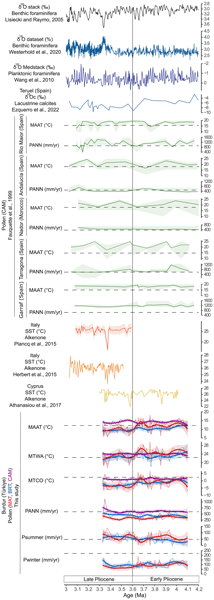
Response: We added sentences to explain the differences between the methods: “During the final part of the Early Pliocene (Zanclean period, 4–3.6 Ma), pollen-inferred climate reconstructions for the Western Mediterranean (Rio Maior, Andalucía, Nador, Tarragona, and Garraf) indicated warmer than present conditions (Fauquette et al., 1999, 2007) similar to the results for Burdur using CAM, a trend that is not reflected by the other methods (Fig. 7). This raises the question of the reliability of climatic reconstructions using the climatic amplitude method. However, other proxies also indicate a warmer climate than at present for this period: the LR04 benthic oxygen isotope stack (Lisiecki and Raymo, 2005) and the Global Reference benthic foraminifer oxygen Isotope Dataset (Westerhold et al., 2020) show lower δ18O values than today, in line with higher temperatures than today and a lower global ice volume, before the intensification of the northern Hemisphere glaciation (Maslin et al., 1998); sea surface temperature (SST) reconstructions based on alkenones from the island of Cyprus also reveal higher values compared to modern conditions (Athanasiou et al., 2017), although a cooling event is detected at ~3.91 Ma corresponding to the global MIS Gi16 (Athanasiou et al., 2017); temperature reconstructions from the Teruel site in Spain, based on lacustrine δ18Oc (Ezquerro et al., 2022) and from sites in Cyprus and Italy, based on planktonic δ18O (Colleoni et al., 2012 and references therein) also indicate warm conditions. The standard methods developed for more recent times are therefore perhaps not the most suitable for reconstructing the climate of the Early-Late Pliocene period, particularly as regards temperatures.
Westerhold, T., Marwan, N., Drury A.J., Liebrand D., et al., 2020. An astronomically dated record of Earth’s climate and its predictability over the last 66 million years. Science, 369, 1383-1387.
https://doi.org/10.1126/science.aba6853
Maslin, M.A., Li, X.S., Loutre, M.-F., Berger, A., 1998. The contribution of orbital forcing to the progressive intensification of Northern Hemisphere glaciation. Quaternary Science Reviews, 17, 4-5, 411-426. https://doi.org/10.1016/S0277-3791(97)00047-4
Line 811: “whereas Tükyie” Please check the spelling of the name "Türkiye" throughout your manuscript.
Response: The spelling of Türkiye has been systematically corrected throughout the manuscript.
Figure 8: Please, could you please add data for Burdur area in the Supplementary file in mm.month-1 scale. In order to see the data showing that there is no change in the amount of precipitation.
Does this simulation map cover your time range?. In Figure 2, your youngest age is >3.33Ma?
So I don't understand which of your examples in your Supplementary file you are using the precipitation amount against?
Spore and pollen data? For a precise comparison you should use plant data for point 14, since all your other points belong to the plant.
Response: We added a section in the Methods for the simulations part in the text and included the following sentence: “Due to age uncertainty and the limited availability of model simulations, we included the Burdur record, even though the time boundary is established at 3.33 Ma.” Unchanged conditions for the most recent period of the Burdur record are attributed in comparison to modern conditions.
Line 861: “Burdur shows a low proportion of coprophilous spores” Please added the name and plate.
Response: The pollen and NPP have been already described in the references cited.
Line 863: “However, these two sites do not cover the same time period and are associated with different environmental and climatic contexts.” While even these two close basins reflect a different environment from each other, the data only from the Burdur area do not allow a climatic and vegetational generalisation to cover the entire Eastern Mediterranean basin. Please reorganise your interpretations accordingly.
Response: We have incorporated the suggested references and revised the text to avoid extrapolating regional environmental interpretations.
Line 876: “Climate reconstructions indicate a climatic optimum of precipitation and temperature before the Early–Late Pliocene transition,” You said it was very cold compared to Botroyococcus.
Response: We did not interpret Botryococcus as a climatic indicator, but rather as a proxy for trophic conditions within the lake. Therefore, its occurrence does not contradict our climate reconstruction, which suggests a climatic optimum in terms of precipitation and temperature before the Early–Late Pliocene transition.
Line 886: for Burdur. Türkiye is a large region
Response: We modified the text “while southwestern Türkiye”.
-
AC1: 'Reply on RC1', Mary Robles, 13 May 2025
-
RC2: 'Comment on egusphere-2025-174', Anonymous Referee #2, 25 Mar 2025
I read with great interest the article " Vegetation and climate changes at the Early-Late Pliocene Transition around the Mediterranean Basin: A case from the Burdur Basin in Southwestern Anatolia" submitted by Robles and co-authors for publication in Climate of the Past. This is a key article for understanding the response of vegetation and climate in the Mediterranean in a climate system in equilibrium with CO2 levels similar to those of today. This topic is therefore of crucial importance, especially since regional climate divisions must be documented everywhere to understand their interactions.
I appreciate the effort put into carrying out the difficult palynological analyses of ancient sediments, as well as the data processing (PCA) and model-data comparison. The presentation of the results is very careful, whether in diagrams, summary tables, and their legends. The content of the article is generally clear, although it can still be improved thanks to the suggestions I offer below. The climate reconstructions are carried out seriously. The English seems rigorous to me, and the text is pleasant to read.
In my main comments, I recommend the following.
• The topic of protocereals seems well introduced to me, it is also well documented, and, in my opinion, it should be moved everywhere at the end of the sections on vegetation, whether in the objectives listed in the introduction or in the discussion, which is already the case in the sections on methods and results. It is more natural.
• I agree with the authors on the application of climate reconstruction methods in the conditions in which they are carried out here, i.e. without relict taxa and after the comparison showing that the west-east gradient is also marked for the study period. It is quite surprising how close the reconstructed values, regardless of the method used, are to current values, but it ultimately makes sense in view of the reconstructed pollen assemblages, or even the previous conclusions of the work carried out by Suc. I would have liked a comparison with external data in a graphical form. This is discussed in the section "Climate changes around the Mediterranean basin" but would in my opinion deserve a figure. For example, SST, isotopes on foraminifera in the eastern Mediterranean. This seems possible since the authors are confident in the ages assigned to the sequence studied.
• I find that the model-data comparison section is under-exploited and could be further emphasized to justify the ambition displayed by the title and the targeted journal. This comparison must be present in the abstract, listed in the objectives of the introduction, its methodology rigorously explained and a separate section (therefore with a title) devoted to it in the discussion.Given the added value of this study, I strongly recommend its publication, with the few modifications mentioned above.
Here are a few minor remarks:
• Part 5.2 Wetland dynamic
How does the dynamic observed from pollen and NPP adjust with sediment and the presence of shells stated in Figure 2? I would like a few lines explaining it.
• Part 5.3
I suggest to retitle this part “Vegetation change and plant diversity around the Mediterranean Basin” and add a table S4 with the list of all taxa determined in your study in order to understand how this site compare with others and the discussion and table S3.Below I detail the minor changes:
Line 67-69 : It is not stated why relevant for your study. Do they characterized the Pliocene Transition? : “ Moreover, two major cooling events characterized the Early-Late Pliocene transition, the MIS MG12 at ~3.58 Ma and the MIS M2 at ~3.3 Ma (Lisiecki and Raymo, 2005; De Schepper et al., 2014).”
Line 75: …region is poorly documented.
Line 91: Despite the fragmentary character of the information available, it seems that, prior to …
Line 138: there and below, can you please better explain when talking about modern lake Burdur or paleolake Burdur in Burdur Basin.
Figure 1: add a scale.
Line 177: in part 2.1, it is said sediment is “alluvialfan, fluvial and lacustrine deposits” which slightly different here. Can you please homogenise here or in part 2.1 and elsexhere (part 3.1 for example…)?
Line 212: were the measurements done on all Poaceae grains or in all samples where there is Poaceae grains?
Line 245 or 251: Check and correct reference(s) from Dugerdil.
Figure 2: A log presenting the sediment itself is needed here or in figure 3.
Line 351 Change Türkiye
Line 360: Precise in the caption that AP is here an average for the PAZ
Line 488: A large grain diameter is not necessarily associated with a large annulus or a large
pore. Replace by “The size of grain diameter is not correlated with annulus and pore sizes” and add correlation values to assert this information.
Figure 6: grey dashed lines (PAZ) are not easy to see, reinforce their color.
Line 535: Our pollen sampling?
Line 536: I don’t understand this sentence stating that cyclicities and magnetic. Rephrase it.
Line 546 and 566: salinity is usually expressed in ‰.
Line 613: rephrase this “steppe vegetation is dominated by Poaceae, Amaranthaceae, Artemisia, is recorded”
Line 702: Cupressaceae? Do you mean Taxodiaceae? Cf Table S3
Line 854 supress )
Line 855 There is an error here because Fig 5 or S2 are not presenting correlation values. But it is a good idea to actually give the correlation values.Citation: https://doi.org/10.5194/egusphere-2025-174-RC2 -
AC2: 'Reply on RC2', Mary Robles, 13 May 2025
We thank the reviewers for their attentive reading and their accurate comments. As detailed in the point-by-point reply below, we have carefully addressed every point raised, added substantial new data and analyses and thoroughly revised the manuscript.
General comments:
- The topic of protocereals seems well introduced to me, it is also well documented, and, in my opinion, it should be moved everywhere at the end of the sections on vegetation, whether in the objectives listed in the introduction or in the discussion, which is already the case in the sections on methods and results. It is more natural.
Response: We thank the reviewer for this suggestion. Following the recommendation, the section on large Poaceae (protocereals) has been repositioned in the vegetation section of the discussion.
- I agree with the authors on the application of climate reconstruction methods in the conditions in which they are carried out here, i.e. without relict taxa and after the comparison showing that the west-east gradient is also marked for the study period. It is quite surprising how close the reconstructed values, regardless of the method used, are to current values, but it ultimately makes sense in view of the reconstructed pollen assemblages, or even the previous conclusions of the work carried out by Suc. I would have liked a comparison with external data in a graphical form. This is discussed in the section "Climate changes around the Mediterranean basin" but would in my opinion deserve a figure. For example, SST, isotopes on foraminifera in the eastern Mediterranean. This seems possible since the authors are confident in the ages assigned to the sequence studied.
Response: We thank the reviewer for the suggestion. We will add a new figure comparing the climate reconstructions of Burdur with other palaeoclimatic records in the Mediterranean region.
- I find that the model-data comparison section is under-exploited and could be further emphasized to justify the ambition displayed by the title and the targeted journal. This comparison must be present in the abstract, listed in the objectives of the introduction, its methodology rigorously explained and a separate section (therefore with a title) devoted to it in the discussion.
Response: We thank the reviewer for this constructive comment. We revised the manuscript to emphasize the model-data comparison more clearly and consistently. Specifically:
We added a sentence on model-data comparison in the Abstract: “. A weak AMOC is identified in Europe, leading to cooler and wetter conditions primarily in the Northwestern Mediterranean. PlioMIP2 simulations show warmer conditions and a latitudinally contrasted precipitation pattern, with wetter conditions in Northern Europe and drier conditions in the south during the mid-Pliocene Warm Period (3.264–3.025 Ma). Simulations indicate that humid conditions are located more in the north compared to the proxy data.
We added a sentence on model data comparison in the Conclusion: “PlioMIP2 simulations show warmer conditions and a latitudinally contrasted precipitation pattern, with wetter conditions in Northern Europe and drier conditions in the south during the mid-Pliocene Warm Period (3.264–3.025 Ma). Simulations indicate that humid conditions are located more in the north compared to the proxy data. PlioMIP2 simulations highlight a warmer climate and a latitudinal gradient in precipitation, with wetter conditions in Northern Europe and drier conditions in southern regions. Compared to the proxy data, simulations show that humid conditions are located more to the north”
This objective is now explicitly listed in the Introduction: Our specific aims are to:
1) Reconstruct lake dynamics using pollen and Non-Pollen Palynomorphs (NPPs),
2) Reconstruct regional vegetation dynamics based on pollen,
3) Morphologically characterize large pollen grains of Poaceae (Cerealia-type),
4) Quantitatively reconstruct climate changes using a multi-method approach, including the Modern Analogue Technique, Weighted Averaging Partial Least Squares regression, Random Forest, and Boosted Regression Trees and Climatic Amplitude Method,
5) Compare with regional vegetation, climate reconstructions based on proxy data and model simulations (PlioMIP2) for the Mediterranean basin
We clarified the methodology for the model-data comparison in the Methods section: ” The Pliocene Model Intercomparison Project Phase 2 (PlioMIP2) simulations include the results of 13 coupled atmosphere-ocean global climate models (GCMs) that simulated precipitation during the mid-Pliocene Warm Period (mPWP; 3.264–3.025 Ma) with boundary conditions derived from the PRISM4 data set (Feng et al., 2022). The conditions include land-sea distribution, topography, bathymetry, vegetation, soils, lakes, and land ice cover, with a pCO2 concentration prescribed at 400 ppm. The simulations were run over an extended period, and the last 100 years of each simulation were used for the analysis. Changes in precipitation were calculated relative to pre-industrial values simulated by the same models.
A total of 62 proxy records including sedimentological indicators, palynological, floral or faunal, offshore marine records, and stable isotope analyses of organic and inorganic materials was compiled by Feng et al., (2022) for the entire world. The proxy records were required to include at least two age control points during the Pliocene. For the comparison, Feng et al., (2022) attributed wetter, drier, or unchanged conditions during the mPWP compared to late Quaternary or modern conditions. In the present study, we focus on the Mediterranean Basin with a total of 18 proxy records from the compilation of Feng et al. (2022) and we include the Burdur record as an additional dataset. Due to age uncertainty and the limited availability of model simulations, we included the Burdur record, even though the time boundary is established at 3.33 Ma.”
A new subsection titled “Model–data comparison for the Mediterranean Basin” has been included in the Discussion and the text has been developed : “Several factors could explain the differences between the proxy data and the PlioMIP2 model simulations. Firstly, proxy records often reflect average climate conditions due to limitations in temporal resolution and dating accuracy, whereas the PlioMIP2 simulations are designed to reconstruct a specific period (MIS KM5c) using present-day orbital parameters (Haywood et al., 2020; Feng et al., 2022). Moreover, these simulations can be limited in their regional representation of topography and land–sea distribution, which significantly influence local climate. PlioMIP2 simulations may also be influenced by changes in vegetation and ice sheet distribution, which are crucial parameters for incorporating long-term Earth system feedbacks, and these parameters are not fully represented in the models (Feng et al., 2022). Finally, while different models may show consistent results in certain regions (such as the Sahel and East Asia), discrepancies exist between individual models in terms of the spatial extent and intensity of the simulated signal in other regions (Feng et al., 2022).
Despite the differences between proxy data and model simulations, the hypothesis of a weak AMOC identified in Europe between 3.8 and 3 Ma, leading to cooler and wetter conditions primarily in the Northwestern Mediterranean, is consistent with the results of PlioMIP2 simulations. However, in the model, the geographical limit in the Iberian Peninsula appears located more to the north compared to the proxy data.”
Minor remarks:
Here are a few minor remarks:
- Part 5.2 Wetland dynamic
How does the dynamic observed from pollen and NPP adjust with sediment and the presence of shells stated in Figure 2? I would like a few lines explaining it.
Response: We completed the text in the subsection 5.2 and in the subpart “Dynamic of Lake Burdur”: “The presence of shells (Fig. 3B) is observed under oligotrophic or mesotrophic conditions.” of the Early Pliocene and “Shells (Fig. 3B) are primarily recorded during oligotrophic to mesotrophic conditions.” for the Late Pliocene.
- Part 5.3
I suggest to retitle this part “Vegetation change and plant diversity around the Mediterranean Basin” and add a table S4 with the list of all taxa determined in your study in order to understand how this site compare with others and the discussion and table S3.
Response: The title has been modified: “Vegetation changes and plant diversity around the Mediterranean Basin during the Early-Late Pliocene transition”
Below I detail the minor changes:
Line 67-69: It is not stated why relevant for your study. Do they characterized the Pliocene Transition? : “ Moreover, two major cooling events characterized the Early-Late Pliocene transition, the MIS MG12 at ~3.58 Ma and the MIS M2 at ~3.3 Ma (Lisiecki and Raymo, 2005; De Schepper et al., 2014).”
Response: We thank the reviewer for this comment. In the revised manuscript, we defined the Early-Late Pliocene transition. In the text, we included the events of MIS MG12 (~3.58 Ma) and MIS M2 (~3.3 Ma) as they represent globally recognized climatic events of the Pliocene. Although they are important markers of global climate variability, our age model does not allow for a detailed assessment of their expression in the Burdur record.
Line 75: …region is poorly documented.
Response: the verb of the sentence has been changed
Line 91: Despite the fragmentary character of the information available, it seems that, prior to …
Response: The sentence has been modified
Line 138: there and below, can you please better explain when talking about modern lake Burdur or paleolake Burdur in Burdur Basin.
Response: We have revised the manuscript to clarify the distinction between the modern Lake Burdur and the inferred paleolake phases within the Burdur Basin.
Figure 1: add a scale.
Response: A scale has been added on Figure 1.
Line 177: in part 2.1, it is said sediment is “alluvialfan, fluvial and lacustrine deposits” which slightly different here. Can you please homogenise here or in part 2.1 and elsexhere (part 3.1 for example…)?
Response: the text has been homogenized.
Line 212: were the measurements done on all Poaceae grains or in all samples where there is Poaceae grains?
Response: The measurements were carried out on all large Poaceae grains (Cerealia-type) in all samples where such grains were identified. We added the measurements of large Poaceae grains in supplementary data (see above).
Line 245 or 251: Check and correct reference(s) from Dugerdil.
Response: References have been checked.
Figure 2: A log presenting the sediment itself is needed here or in figure 3.
Response: The log and its sedimentological information are included with comparison to the general stratigraphy of the basin in a new Figure 3.
Figure 3. The studied drill-log of BS-87 within the stratigraphy for the Burdur basin-fill succession (Sickenberg & Tobien 1971, Lefevre et al. 1983, Karaman 1986, Price & Scott 1991, Saraç 2003, Platevoet et al. 2008, Alçiçek et al. 2013a,b, Demirel & Mayda 2014, Alçiçek et al. 2017, Özkaptan et al. 2018, Alçiçek et al. 2019). The chronostratigraphic units stand on Hilgen et al. (2012).
In the Material and methods part, in the subsection “3.2 Stratigraphy, paleomagnetism and magnetic susceptibility”, we added the text “The stratigraphy of the BS-87 core from Lake Burdur has been described.”
A new part in the Results included the figure 3 has been added: “4.2 Stratigraphy: The studied BS-87 drill core is predominantly composed of alternating greenish-grey, yellow-brown, and beige marlstone and siltstone (Fig. 2). Scattered gastropods are observed at the base of the core (360 m), as well as at 275 m, 130 m, 80 m, and between 60–20 m. Organic-rich layers are mainly present in the lower part of the sequence, particularly between 325–300 m and 260–210 m. Five dark grey to black coal seams are identified at approximately 177 m, 130 m, 110 m, 90 m, and 70 m. The top of the core is composed of rounded to subrounded gravelstone consisting of crystallized limestone.”
In the Discussion part, in the subsection “5.2 Vegetation changes and plant diversity around the Mediterranean Basin during the Early-Late Pliocene transition” and the subpart “Dynamic of Lake Burdur”, the text has been completed to include the stratigraphy of the core: “The stratigraphy of the lake reveals an alternation between marlstone and siltstone (Fig. 3), suggesting a shift between calm depositional conditions and more dynamic phases (Tiab and Donaldson, 2012). Marlstone consists of fine-grained, carbonate-rich deposits typically associated with calm, shallow, or stagnant waters, whereas siltstone reflects siliciclastic input, generally linked to runoff or episodes of increased erosion. This alternation may reflect climatic changes affecting the hydrodynamic of the basin.”
Alçiçek, M. C., Mayda, S., & Titov, V. V. (2013b.) Lower Pleistocene stratigraphy of the Burdur Basin of SW Anatolia. Comptes Rendus Palevol, 12, 1-11.
Alçiçek, M. C., Mayda, S., & Demirel, A. (2017). Discussion on “Neogene-Quaternary evolution of the Tefenni basin on the Fethiye-Burdur fault zone, SW Anatolia-Turkey. Journal of African Earth Science 118, 137-148 by R. Aksoy, S. Aksarı”. Journal of African Earth Sciences, 134, 794-799.
Demirel, A., & Mayda, S. (2014). A new Early Pleistocene mammalian fauna from Burdur Basin, SW Turkey. Russian Journal of Theriology, 13, 55-63.
Hilgen, F. J., Lourens, L. J., & Van Dam J. A. (2012). The Neogene period. In: F. M. Gradstein, J. G.
Lefevre, C., Bellon, H., & Poisson, A. (1983). Presence de leucitites dans le volcanisme Pliocene de la region d’Isparta (Taurus occidentales, Turkquie). Comptes Rendus de l'Académie des Sciences de Paris, 297, 369-372.
Ogg, M., Schmitz, & G., Ogg. (Eds.), The Geologic Time Scale 2012 (pp. 923-978). Oxford: Elsevier.
Karaman, E. (1986). Burdur dolayının genel stratigrafisi. Akdeniz Üniversitesi Isparta Mühendislik Fakültesi Dergisi 2, 23-36.
Platevoet, B., Scaillet, S., Guillou, H., Blamart, D., Nomade, S., Massault, M., Poisson, A., Elitok, Ö., Özgŭr, N., Yaǧmurlu, F., & Yılmaz, K. (2008). Pleistocene eruptive chronology of the Gölcük volcano, Isparta Angle, Turkey. Quaternaire, 19, 147-156.
Saraç G. (2003). Vertebrate fossil localities of Turkey. Scientific Report No. 10609, Mineral Research and Exploration Directorate of Turkey (MTA), Ankara, pp. 208.
Sickenberg, O., Tobien, H. (1971). New Neogene and Lower Quaternary vertebrate faunas in Turkey. Newsletters on Stratigraphy, 1, 51-61
Tiab, D. and Donaldson, E. C.: Chapter 1 - Introduction to Mineralogy, in: Petrophysics (Third Edition), edited by: Tiab, D. and Donaldson, E. C., Gulf Professional Publishing, Boston, 1–26,
Line 351: Change Türkiye
Response: The spelling of the name Türkiye has been verified.
Line 360: Precise in the caption that AP is here an average for the PAZ
Response: A sentence has been added: “Values represent the mean percentages for each PAZ.”
Line 488: A large grain diameter is not necessarily associated with a large annulus or a large pore. Replace by “The size of grain diameter is not correlated with annulus and pore sizes” and add correlation values to assert this information.
Response: We added a correlation matrix in the supplementary data and we completed the text: “The correlation analysis revealed that the diameter of large Poaceae pollen grains is weakly but significantly positively correlated with the diameter of the annulus (r = 0.22; p ≤ 0.05). In contrast, no significant relationship was observed between pollen grain diameter and pore size (Supplementary Figure S3).”
Supplementary Figure S3. Pearson’s correlation matrix showing significant correlations (p ≤ 0.05), with a color gradient denoting the Pearson correlation coefficient. The analysis was applied between (A) selected pollen taxa and (B) measurements performed on Cerealia-type pollen grains.
Figure 6: grey dashed lines (PAZ) are not easy to see, reinforce their color.
Response: We modified the figure to reinforce the grey color.
Figure 6: Lake Burdur pollen-inferred climate reconstruction based on five methods against depth: CAM (Climatic Amplitude Method), MAT (Modern Analogue Technique), WA-PLS (Weighted Averaging Partial Least Squares regression), BRT (Boosted Regression Trees) and RF (Random Forest). Large lines correspond to loess smoothed curves and shaded areas to the 95 % confidence interval. Black dashed lines correspond to modern climate values of Burdur. Grey dashed lines correspond to Pollen Assemblage Zones (Fig. 3A). MAAT: mean annual air temperature. MTWA: mean temperature of the warmest month. MTCO: mean temperature of the coldest month. PANN: mean annual precipitation. Psummer: summer precipitation. Pwinter: winter precipitation.
Line 535: Our pollen sampling?
Response: “Our” has been replaced by “the”.
Line 536: I don’t understand this sentence stating that cyclicities and magnetic. Rephrase it.
Response: We thank the reviewer for this comment. Our sampling interval corresponds to a temporal resolution of approximately 2–4 ka between samples. As a result, identifying cyclicities of around 20 ka in parameters such as magnetic susceptibility is not feasible, as this would provide only about 5 to 10 data points per cycle. For this reason, we did not attempt to interpret or search for such cyclicities in the magnetic susceptibility record. We have changed the sentence in the manuscript accordingly to improve clarity: “Therefore, it is not feasible to detect cyclicities of approximately 20 ka in parameters such as magnetic susceptibility, based on only 5 to 10 data per cycle.”
Line 546 and 566: salinity is usually expressed in ‰.
Response: the correction has been done.
Line 613: rephrase this “steppe vegetation is dominated by Poaceae, Amaranthaceae, Artemisia, is recorded”
Response: the sentence has been modified with the suggestion.
Line 702: Cupressaceae? Do you mean Taxodiaceae? Cf Table S3
Response: We modified the text.
Line 854: supress )
Response: the correction has been done.
Line 855: There is an error here because Fig 5 or S2 are not presenting correlation values. But it is a good idea to actually give the correlation values.
Response: We added a correlation matrix in the supplementary data (see above) and we completed the text: “High percentages of large pollen grains of Poaceae are significantly positively correlated with Cedrus (r = 0.60, p ≤ 0.05) and significantly negatively correlated with Amaranthaceae (r = –0.41, p ≤ 0.05) (Fig. 5; Supplementary Figure S3).”
-
AC2: 'Reply on RC2', Mary Robles, 13 May 2025


Interactive discussion
Status: closed
-
RC1: 'Comment on egusphere-2025-174', Anonymous Referee #1, 14 Mar 2025
Dear Authors,
Presenting palynological data from the Burdur region and revealing climate and vegetation findings specific to this area in your study is highly valuable. Such studies make significant contributions to understanding regional paleoenvironmental changes. However, there are some shortcomings and areas that need improvement in your study. Addressing the points mentioned below will make your work more comprehensive and robust.
Your study presents a variety of analyses and methods, which is commendable. However, these methods do not appear to be well connected in the discussion section. Each method provides an independent evaluation, but a cohesive overall conclusion has not been clearly established. Strengthening the connections between the different analyses would enhance the clarity and impact of your findings.
Additionally, the palynological data from the Burdur area alone can not fully represent the broader Eastern Mediterranean. This statement appears in multiple parts of your manuscript and could benefit from some revision.
In your study, you mention that Pliocene palynological studies in Anatolia are limited to the Ericek area. However, a more detailed literature review may reveal additional studies. To support this, I have included a few references that may be useful.
After reviewing your manuscript, I would also recommend reconsidering the title. Your study focuses on the palynological, palaeoclimatic, and palaeovegetational data from a borehole in Burdur, with comparisons to European vegetation. Adjusting the title to better reflect this scope could improve clarity for readers.
Moreover, while various methods were applied, they are not clearly interconnected in the discussion section. For example, the relationship of the PCA analysis to the overall study could be more explicitly addressed.
Finally, the manuscript currently lacks geological and sedimentological information regarding the drilling log. Clarifying where the samples were taken along the log and providing additional geological context would greatly strengthen the study.
In essence, this proposed publication is a detailed palynoflora description of the Burdur region, which is the only area belonging to GB Anatolia, comparison of these data with the published Western Mediterranean basins, comparison with the study only in the Ericek area although there are other Pliocene-aged floras from Anatolia, and comparison of the pollen records of the Black Sea in the study within the scope of the Mediterranean Basin. Although it contains important data for the Burdur area, I respectfully inform you that I cannot accept it because the study requires restructuring, adding sections (e.g. geology section), editing, adding a discussion section (by making a more detailed literature review) and editing the figures.
Regards
Reviewer
-
AC1: 'Reply on RC1', Mary Robles, 13 May 2025
We thank the reviewers for their attentive reading and their accurate comments. As detailed in the point-by-point reply below, we have carefully addressed every point raised, added substantial new data and analyses and thoroughly revised the manuscript.
General comments:
“Your study presents a variety of analyses and methods, which is commendable. However, these methods do not appear to be well connected in the discussion section. Each method provides an independent evaluation, but a cohesive overall conclusion has not been clearly established. Strengthening the connections between the different analyses would enhance the clarity and impact of your findings.”
Response: We will add a new figure comparing the climate reconstructions of Burdur with other palaeoclimatic records in the Mediterranean region and we will select, for Burdur, the BRT, MAT and CAM methods which provided the best R² and RMSE values.
Additionally, the palynological data from the Burdur area alone can not fully represent the broader Eastern Mediterranean. This statement appears in multiple parts of your manuscript and could benefit from some revision. In your study, you mention that Pliocene palynological studies in Anatolia are limited to the Ericek area. However, a more detailed literature review may reveal additional studies. To support this, I have included a few references that may be useful.
Response: We thank the reviewer for the references and have incorporated them into the manuscript.
After reviewing your manuscript, I would also recommend reconsidering the title. Your study focuses on the palynological, palaeoclimatic, and palaeovegetational data from a borehole in Burdur, with comparisons to European vegetation. Adjusting the title to better reflect this scope could improve clarity for readers.
Response: We have updated the title following your suggestion: “Vegetation and climate changes at the Early-Late Pliocene transition of the Burdur Basin in Southwestern Anatolia and comparison with the Mediterranean Basin”
Moreover, while various methods were applied, they are not clearly interconnected in the discussion section. For example, the relationship of the PCA analysis to the overall study could be more explicitly addressed.
Response: The discussion has been revised to better integrate the PCA analysis with the rest of the study.
Finally, the manuscript currently lacks geological and sedimentological information regarding the drilling log. Clarifying where the samples were taken along the log and providing additional geological context would greatly strengthen the study.
Response: The log and its sedimentological information are included with comparison to the general stratigraphy of the basin in a new Figure 3.
Figure 3. The studied drill-log of BS-87 within the stratigraphy for the Burdur basin-fill succession (Sickenberg & Tobien 1971, Lefevre et al. 1983, Karaman 1986, Price & Scott 1991, Saraç 2003, Platevoet et al. 2008, Alçiçek et al. 2013a,b, Demirel & Mayda 2014, Alçiçek et al. 2017, Özkaptan et al. 2018, Alçiçek et al. 2019). The chronostratigraphic units stand on Hilgen et al. (2012).
In the Material and methods part, in the subsection “3.2 Stratigraphy, paleomagnetism and magnetic susceptibility”, we added the text “The stratigraphy of the BS-87 core from Lake Burdur has been described.”
A new part in the Results included the figure 3 has been added: “4.2 Stratigraphy: The studied BS-87 drill core is predominantly composed of alternating greenish-grey, yellow-brown, and beige marlstone and siltstone (Fig. 2). Scattered gastropods are observed at the base of the core (360 m), as well as at 275 m, 130 m, 80 m, and between 60–20 m. Organic-rich layers are mainly present in the lower part of the sequence, particularly between 325–300 m and 260–210 m. Five dark grey to black coal seams are identified at approximately 177 m, 130 m, 110 m, 90 m, and 70 m. The top of the core is composed of rounded to subrounded gravelstone consisting of crystallized limestone.”
In the Discussion part, in the subsection 5.2 and the subpart “Dynamic of Lake Burdur”, the text has been completed to include the stratigraphy of the core: “The stratigraphy of the lake reveals an alternation between marlstone and siltstone (Fig. 3), suggesting a shift between calm depositional conditions and more dynamic phases (Tiab and Donaldson, 2012). Marlstone consists of fine-grained, carbonate-rich deposits typically associated with calm, shallow, or stagnant waters, whereas siltstone reflects siliciclastic input, generally linked to runoff or episodes of increased erosion. This alternation may reflect climatic changes affecting the hydrodynamic of the basin.”
Alçiçek, M. C., Mayda, S., & Titov, V. V. (2013b.) Lower Pleistocene stratigraphy of the Burdur Basin of SW Anatolia. Comptes Rendus Palevol, 12, 1-11.
Alçiçek, M. C., Mayda, S., & Demirel, A. (2017). Discussion on “Neogene-Quaternary evolution of the Tefenni basin on the Fethiye-Burdur fault zone, SW Anatolia-Turkey. Journal of African Earth Science 118, 137-148 by R. Aksoy, S. Aksarı”. Journal of African Earth Sciences, 134, 794-799.
Demirel, A., & Mayda, S. (2014). A new Early Pleistocene mammalian fauna from Burdur Basin, SW Turkey. Russian Journal of Theriology, 13, 55-63.
Hilgen, F. J., Lourens, L. J., & Van Dam J. A. (2012). The Neogene period. In: F. M. Gradstein, J. G. Ogg, M., Schmitz, & G., Ogg. (Eds.), The Geologic Time Scale 2012 (pp. 923-978). Oxford: Elsevier.
Karaman, E. (1986). Burdur dolayının genel stratigrafisi. Akdeniz Üniversitesi Isparta Mühendislik Fakültesi Dergisi 2, 23-36.
Lefevre, C., Bellon, H., & Poisson, A. (1983). Presence de leucitites dans le volcanisme Pliocene de la region d’Isparta (Taurus occidentales, Turkquie). Comptes Rendus de l'Académie des Sciences de Paris, 297, 369-372.
Platevoet, B., Scaillet, S., Guillou, H., Blamart, D., Nomade, S., Massault, M., Poisson, A., Elitok, Ö., Özgŭr, N., Yaǧmurlu, F., & Yılmaz, K. (2008). Pleistocene eruptive chronology of the Gölcük volcano, Isparta Angle, Turkey. Quaternaire, 19, 147-156.
Saraç G. (2003). Vertebrate fossil localities of Turkey. Scientific Report No. 10609, Mineral Research and Exploration Directorate of Turkey (MTA), Ankara, pp. 208.
Sickenberg, O., Tobien, H. (1971). New Neogene and Lower Quaternary vertebrate faunas in Turkey. Newsletters on Stratigraphy, 1, 51-61
Specific comments:
Line 1: After reading your work, you need to reorganise your title. This study includes palynological, palaeoclimatic and palaeovegetational data of the Pliocene from the borehole taken from Burdur, and includes a comparison of these data with European vegetation. I can suggest a title like ‘Vegetation and climate changes in the Early-Late Pliocene transition of the Burdur Basin in Southwestern Anatolia and comparison with the Mediterranean Basin’
Line 16: The title I suggested will be more coherent with your content and your focus
Response: We have updated the title based on your suggestion “Vegetation and climate changes at the Early-Late Pliocene transition of the Burdur Basin in Southwestern Anatolia and comparison with the Mediterranean Basin”
Line 38: “Following a climatic optimum in precipitation and temperature “Which one?
Response: We specified the time period in the text “Following a climatic optimum in precipitation and temperature during the Early Pliocene,”
Line 40: Your findings belong only to the Burdur area. You must reduce general explanations about the Mediterranean Basin. This is a local study. Focus on Burdur and its context.
Response: We have revised relevant sections to clarify that our findings are regional.
Line 44: Türkiye, The data set is not sufficient for a generalisation for the whole of Türkiye.
Response: We modified the statement to specify “southwestern Türkiye,” ensuring that our interpretations are geographically appropriate.
Line 54: Here you are making a comparison within the Pliocene in geological time. Why didn't you compare it to pre-industrial era as in the next sentence? What is the result when you compare the early Pliocene with the pre-industrial era?
Response: We added contextual comparison with the pre-industrial era in the introduction to emphasize the relevance of the Pliocene to understanding future climate change:
“The Pliocene is considered as the last geological epoch with similar atmospheric CO2 concentration (Masson-Delmotte et al., 2013)”
“reaching about 20 m above the present-day value (Dowsett and Cronin, 1990; Miller et al., 2012; Grant et al., 2019; Dumitru et al., 2019; Hearty et al., 2020). Considering future climate change, Earth System Model (ESM) projections, based on CO₂ concentrations by 2100 ranging from about 400 ppm to above 1100 ppm, indicate mass loss from the Greenland and Antarctic ice sheets, a projected sea-level rise of approximately 0.26 to 0.92 m above present-day levels, and an increase in global air temperatures ranging from 1.4°C to 4.4°C (compared to the period 1850–1900) depending on the scenario (IPCC, 2021, 2023). ”
We also added sentences at the end of the conclusion:
“This study highlights the complexity and spatial heterogeneity of past climate and vegetation responses across the Mediterranean basin during the Pliocene. Understanding the mechanisms and environmental impacts of past climate changes, mainly during the Pliocene, offers critical insights into the potential trajectories and regional impacts of ongoing and future climate change.”
Line 54: “During warm periods of the Pliocene?” Which period? You mean my Early Pliocene.
Response: We modified the beginning of the sentences in the introduction: ”During the mid-Pliocene Warm Period (mPWP; 3.264–3.025 Ma), atmospheric CO2 concentration” and “During the mid-Pliocene Warm Period, General Circulation Model (GCM)” to be more precise.
Line 70: “The Early Pliocene was characterized by Mediterranean climate conditions (summer droughts and cool-wet winters) in the Mediterranean Basin” Eastern Mediterranean? or Western Mediterranean?
Response: We specified: “in the Western Mediterranean Basin”
Line 88: There are studies for Pliocene palynoflora in Anatolia other than these two papers. The use of the results of this DSDP drilling in the Euxine basin in the Western Black Sea for the eastern Mediterranean is questionable. However, I am attaching the references of a few studies published in the literature that will allow you to make comparisons. Comparison with these studies will eliminate your lack of data for SW Anatolia.
e.g.
Tagliasacchi, E., Kayseri Özer, M. S., & Altay, T., (2024). Environmental, vegetational and climatic investigations during the Plio-Pleistocene in SW-Anatolia: A case study from the fluvio-lacustrine deposits in Uşak-Karahallı area. Palaeobiodiversity and Palaeoenvironments , vol.104, no.1, 29-51.
TUNCER, A., KARAYİĞİT, A. İ., OSKAY, R. G., TUNOĞLU, C., KAYSERİ ÖZER, M. S., GÜMÜŞ, B. A., ... Bulut, Y.(2023). A multi-proxy record of palaeoenvironmental and palaeoclimatic conditions during Plio-Pleistocene peat accumulation in the eastern flank of the Isparta Angle: A case study from the Şarkikaraağaç coalfield (Isparta, SW Central Anatolia). International Journal of Coal Geology , vol.265.
KAYSERİ ÖZER, M. S., Atalar, M., & Kovacova, M., (2019). Palaeovegetational evolution of the cankiri-corum Basin during the Mio-Pliocene (Central Anatolia) based on the IPR analysis method. PALAEOBIODIVERSITY AND PALAEOENVIRONMENTS , vol.99, no.4, 571-590.
KAYSERİ ÖZER, M. S., (2017). Cenozoic vegetation and climate change in Anatolia - A study based on the IPR-vegetation analysis. PALAEOGEOGRAPHY PALAEOCLIMATOLOGY PALAEOECOLOGY , vol.467, 37-68.
Yavuz-Işık, N., Saraç, G., Ünay, E., de Bruijn, H., 2011. Palynological analysis of Neogene mammal sites of Turkey — vegetational and climatic implications Yerbilimleri 32,
105–120.
Response: We thank the reviewer for pointing out additional references on the Pliocene palynoflora of Anatolia. We have reviewed the suggested literature and cited the relevant studies where appropriate in the revised manuscript. However, we note that the temporal constraints in most of these studies remain imprecise, and the limited number of analyzed samples significantly hinders direct comparison with our dataset. As such, while these works provide valuable regional context, they do not offer the resolution required for integration at the same interpretative level as the sites we have used.
Line 92: The data for the Ericek region does not represent a large area such as the Anatolian plateau. Please limit your use of regional terms to the area they cover. Throughout the manuscript.
Response: We revised the text throughout the manuscript to ensure regional terms are used appropriately and specifically.
Line 112: The data for your study was obtained from only one point. It is difficult to make an interpretation covering the Eastern Mediterranean. In this sense, your findings will represent local and microclimatic conditions. Please reorganise your evaluations from this point of view.
Response: We revised our interpretations to clearly frame our findings as representing regional conditions around the Burdur area, avoiding overgeneralizations.
Line 130: The general geological features of the region in Figure 1 should be expanded. Maybe under one title, with a description of the borehole log.
Response: The geological map is now updated with more detailed geological features (Figure 1). A new figure (Figure 3) has been added, presenting a detailed description of the BS-87 borehole log. The borehole log has been described in the Results part in a new subsection “4.2 Stratigraphy” and integrated in the Discussion part, in the subsection “5.2 Vegetation changes and plant diversity around the Mediterranean Basin during the Early-Late Pliocene transition” and the subpart “Dynamic of Lake Burdur” (see above).
Figure 1. (A) Tectonic map of the eastern Mediterranean showing major tectonic structures (after Bozkurt, 2003), (B) Geological maps of Acıgöl and Burdur Province and locations of selected cores and sections: Acıgöl C3 core (Andrieu-Ponel et al., 2021), Burdur Pmag section (Özkaptan et al., 2018) and Burdur BS-87 core (this study).
Line 145: “leading to a lake volume decrease of 39%” add with seasonal drought.
Response: We added in the text “with seasonal drought”.
Figure 1: A) Simplified tectonic map of Türkiye showing major neotectonic structures and neotectonic provinces. (Please added Refrences). Please added the graben tectonic structure. Central Anatolian Province
Response: Figure 1 has been revised accordingly and the simplified tectonic map of Türkiye now includes references (Bozkurt, 2003) (see above).
Line 154: What was the palaeogeography and palaeotopography like in the Pliocene? Please add discussion (in the discussion sections of your manuscript), taking into account the fact that if the palaeogeography was close to the present day, your data may show unique local conditions, just like today.
Response: The present-day environment in the region includes a higher proportion of arboreal pollen taxa (Andrieu et al., 2021), mainly Quercus. However, the landscape does indeed resemble certain steppe regions found in the Middle East or the Caucasus (such as in Armenia), where similar modern analogues are observed and frequently selected in our climate reconstructions.
Line 209: “size, with Pinus sylvestris being smaller” You only distinguished by height? The type pollen of Pinus sylvestris has a different morphological appearance.
Response: We thank the reviewer for this relevant comment. We have clarified the distinction made between Pinus types in the manuscript. In our study, we use a size-based classification to differentiate Pinus sylvestris-type pollen from Mediterranean Pinus-type pollen, based on the maximum grain length (L). This classification was developed from observations of modern Pinus pollen slides in the IMBE reference collection by Valérie Andrieu. The size differences are also supported by the illustrations in Reille’s pollen atlases (Reille, 1998). Both the reference and fossil pollen are mounted in glycerine between slide and coverslip, allowing direct comparison. Our observations led us to define two morphometric groups:
- Pinus sylvestris-type: L < 66 µm (typically found on the northern slopes of the Mediterranean and in mid- to high-altitude regions),
- Mediterranean Pinus-type: L > 66 µm
The measurements established by V. Andrieu for modern Pinus species are as follows:
- P. sylvestris: 62 < L < 66 µm
- P. brutia: 72 < L < 96 µm
- P. pinea: 86 < L < 94 µm
- P. maritima and P. pinaster: 84 < L < 100 µm
- P. halepensis: 88 < L < 108 µm
We doubt that P. sylvestris pollen can be reliably identified at the species level using morphological criteria, particularly in the case of the 3-million-year-old pollen from Burdur, which is in some instances quite degraded. However, species-level identification may be possible when 1) the pollen is well preserved, and 2) sufficient time is dedicated to detailed palynological analysis.
Following the reviewer’s suggestion, we have revised the manuscript text to replace Pinus sylvestris with "Pinus sylvestris-type", and we updated the Materials and Methods section as follows: “Pollen of Pinus sylvestris-type and Pinus mediterranean-type have been differentiated based on their size, with Pinus sylvestris-type < 66 µm and Pinus mediterranean-type > 66 µm (Reille, 1998).”
Line 212: “Aquatic taxa, fern spores, and NPPs (algae and fungal spores) were counted alongside pollen.” How did you evaluate these counts in your manuscript. Please include the methodology.
Response: We explained that we calculated and used the percentages for aquatic taxa, fern spores, and NPPs. We based the counts on a minimum of 300 terrestrial pollen grains to ensure a representative pollen signal.
Line 227: Please add other references to support your sentence.
Response: We added the references where appropriate.
Line 271: In this section, a photograph and/or digital drawing of the drilling log you sampled, sample locations and sedimentological and lithological characteristics should be added.
under the 4.1 or 4.2 title
Response: A new figure (Figure 3) has been added, presenting a detailed description of the BS-87 borehole log. The borehole log has been described in the Results part in a new subsection “4.2 Stratigraphy” and integrated in the Discussion part, in the subsection “5.2 Vegetation changes and plant diversity around the Mediterranean Basin during the Early-Late Pliocene transition” and the subpart “Dynamic of Lake Burdur” (see above).
Line 271: Why do you compare with Özkaplan et al. 2018?
Response: as Özkaplan et al. (2018) produced a magnetostratigraphy of the Burdur lacustrine sequence over 200 m, sampled about 20 km north of our drill core, it was necessary compare their results and ours to match the two sequences (see Discussion part, the subsection “5.1 Age-depth model”) and to build a more robust interpretation of the age constraints.
Figure 3: How did you distinguish between Amaranthaceae and Chenopodiaceae? Should they be written together? Poaceae is not steppic. Please move it in other herb. please added NAP. The values you interpret in the figure are not understood. It would be good to give counts as supplemanttery data.
Response: According to the APG IV (Angiosperm Phylogeny Group IV), the correct family name is now Amaranthaceae (The Angiosperm Phylogeny Group et al., 2016). The term Chenopodiaceae was previously used in older classifications (e.g., APG III and earlier), but it is now included within Amaranthaceae.
The Angiosperm Phylogeny Group, Chase, M. W., Christenhusz, M. J. M., Fay, M. F., Byng, J. W., Judd, W. S., Soltis, D. E., Mabberley, D. J., Sennikov, A. N., Soltis, P. S., and Stevens, P. F.: An update of the Angiosperm Phylogeny Group classification for the orders and families of flowering plants: APG IV, Botanical Journal of the Linnean Society, 181, 1–20, https://doi.org/10.1111/boj.12385, 2016.
Line 366: “A total of 53 samples were analyzed” Repetition. This sentence can be written as 46 samples were determined to contain sufficient palynomorphs for palaeoclimatic and palaeovegetational assessment. To remove repetition.
Response: The sentence has been simplified: “In the 53 samples analyzed from the Burdur Basin, 46 samples were polliniferous and 7 samples were sterile”
Line 372: “from PAZ 4 to 7, where the percentage of arboreal pollen is lower” There is an increase in Pinus in PAZ 7.
Response: We adapted the text: “from PAZ 4 to 6, where the percentage of arboreal pollen is lower (ca. 10%)”
Line 376: “PAZ 1 (247-184 m) records an open steppic vegetation dominated by Amaranthaceae (ca. 28%), Artemisia (ca. 23%), and Poaceae (ca. 16%),” The values you interpret in the figure 3a are not understood.
Response: The mean value for each PAZ was calculated and described in the text to support the figure.
Figure 4. Please italicise species names. Why did you make this analysis. You have not analysed it at all in the discussion section.
Response: We italicize species names of the figure 4
Figure 4: Principal component analysis (PCA) on selected terrestrial pollen taxa from the lacustrine succession of the Burdur Basin-fill (Türkiye). Sample map was coloured according to the PAZ (presented in Fig. 3).
Line 433: Please provide examples from the areas that do not fit the description you have mentioned.
Response: We completed the sentence: “, except for two samples in PAZ 5 (at depths of 69.6 m and 65.85 m), where arboreal pollen taxa are more abundant. On the contrary,”
Figure 5. In this study, in which you go into the detail of Cerealia pollen, it is necessary to put the sheet in the Cerealia extract.
Response: We added the measurements of large pollen grains of Poaceae in supplementary data.
Supplementary Table S2. Measurements of diameter of pollen grains, annulus and pores of large pollen grains of Poaceae from the core BS-87 Burdur against core depth.
Line 491: Please added the plate including Poaceae types.
Response: We used the distinction between Poaceae and Cerealia-type as established by Beug (2004). Since the focus of the manuscript is primarily on climate reconstruction, we believe that including a pollen plate is not essential. Even in studies centered on vegetation changes based on pollen, it is not common practice to include such plates.
Figure 6. please mark the early-late Pliocene boundary, even if possible. reorganise from old to young. Or if it is, it's not clear.
Response: Thank you for the suggestion. In paleoclimatology, it is standard practice to display data in this manner, with the choice of direction often depending on disciplinary conventions. However, we will clarify the Early–Late Pliocene boundary to improve readability.
Figure 6: Lake Burdur pollen-inferred climate reconstruction based on five methods against depth: CAM (Climatic Amplitude Method), MAT (Modern Analogue Technique), WA-PLS (Weighted Averaging Partial Least Squares regression), BRT (Boosted Regression Trees) and RF (Random Forest). Large lines correspond to loess smoothed curves and shaded areas to the 95 % confidence interval. Black dashed lines correspond to modern climate values of Burdur. Grey dashed lines correspond to Pollen Assemblage Zones (Fig. 3A). MAAT: mean annual air temperature. MTWA: mean temperature of the warmest month. MTCO: mean temperature of the coldest month. PANN: mean annual precipitation. Psummer: summer precipitation. Pwinter: winter precipitation.
Line 541: Your sampling frequency is 1 metre apart and some of your samples were steril. This resolution is useful to consider when making an environmental assessment. The increase or decrease of some of your palynomorphs should be taken into consideration. Since you do not know the percentage of these palynomorphs at levels where you cannot sample, you should be careful in interpretation.
Response: Thank you for your remark. We acknowledge the limitations related to our sampling resolution and the presence of sterile samples. In our interpretation, we have been careful to consider these aspects and avoid overinterpreting the data.
Line 542: “by two peaks of the planktonic colonial green” three
Response: We have applied the correction by replacing 'two' with 'three.
Line 746: “and the wide climatic range of taxa like Poaceae prevent full constraint of the climate reconstruction amplitude.” Poaceae wide climatic range and also in different environments. Cosmopolitan
Response: We thank the reviewer for the comment. We agree that Poaceae is a highly cosmopolitan family, present across a wide range of climatic and ecological conditions. Precisely because of this ecological diversity, it was challenging to constrain the climate reconstruction amplitude when Poaceae dominated the pollen assemblages.
Line 774: “to the results for Burdur using CAM. However, this trend is not reflected by the other methods (Fig. 6).” Why? Please explained.
Response: We added sentences to explain the differences between the methods: “During the final part of the Early Pliocene (Zanclean period, 4–3.6 Ma), pollen-inferred climate reconstructions for the Western Mediterranean (Rio Maior, Andalucía, Nador, Tarragona, and Garraf) indicated warmer than present conditions (Fauquette et al., 1999, 2007) similar to the results for Burdur using CAM, a trend that is not reflected by the other methods (Fig. 7). This raises the question of the reliability of climatic reconstructions using the climatic amplitude method. However, other proxies also indicate a warmer climate than at present for this period: the LR04 benthic oxygen isotope stack (Lisiecki and Raymo, 2005) and the Global Reference benthic foraminifer oxygen Isotope Dataset (Westerhold et al., 2020) show lower δ18O values than today, in line with higher temperatures than today and a lower global ice volume, before the intensification of the northern Hemisphere glaciation (Maslin et al., 1998); sea surface temperature (SST) reconstructions based on alkenones from the island of Cyprus also reveal higher values compared to modern conditions (Athanasiou et al., 2017), although a cooling event is detected at ~3.91 Ma corresponding to the global MIS Gi16 (Athanasiou et al., 2017); temperature reconstructions from the Teruel site in Spain, based on lacustrine δ18Oc (Ezquerro et al., 2022) and from sites in Cyprus and Italy, based on planktonic δ18O (Colleoni et al., 2012 and references therein) also indicate warm conditions. The standard methods developed for more recent times are therefore perhaps not the most suitable for reconstructing the climate of the Early-Late Pliocene period, particularly as regards temperatures.
Westerhold, T., Marwan, N., Drury A.J., Liebrand D., et al., 2020. An astronomically dated record of Earth’s climate and its predictability over the last 66 million years. Science, 369, 1383-1387.
https://doi.org/10.1126/science.aba6853
Maslin, M.A., Li, X.S., Loutre, M.-F., Berger, A., 1998. The contribution of orbital forcing to the progressive intensification of Northern Hemisphere glaciation. Quaternary Science Reviews, 17, 4-5, 411-426. https://doi.org/10.1016/S0277-3791(97)00047-4
Line 811: “whereas Tükyie” Please check the spelling of the name "Türkiye" throughout your manuscript.
Response: The spelling of Türkiye has been systematically corrected throughout the manuscript.
Figure 8: Please, could you please add data for Burdur area in the Supplementary file in mm.month-1 scale. In order to see the data showing that there is no change in the amount of precipitation.
Does this simulation map cover your time range?. In Figure 2, your youngest age is >3.33Ma?
So I don't understand which of your examples in your Supplementary file you are using the precipitation amount against?
Spore and pollen data? For a precise comparison you should use plant data for point 14, since all your other points belong to the plant.
Response: We added a section in the Methods for the simulations part in the text and included the following sentence: “Due to age uncertainty and the limited availability of model simulations, we included the Burdur record, even though the time boundary is established at 3.33 Ma.” Unchanged conditions for the most recent period of the Burdur record are attributed in comparison to modern conditions.
Line 861: “Burdur shows a low proportion of coprophilous spores” Please added the name and plate.
Response: The pollen and NPP have been already described in the references cited.
Line 863: “However, these two sites do not cover the same time period and are associated with different environmental and climatic contexts.” While even these two close basins reflect a different environment from each other, the data only from the Burdur area do not allow a climatic and vegetational generalisation to cover the entire Eastern Mediterranean basin. Please reorganise your interpretations accordingly.
Response: We have incorporated the suggested references and revised the text to avoid extrapolating regional environmental interpretations.
Line 876: “Climate reconstructions indicate a climatic optimum of precipitation and temperature before the Early–Late Pliocene transition,” You said it was very cold compared to Botroyococcus.
Response: We did not interpret Botryococcus as a climatic indicator, but rather as a proxy for trophic conditions within the lake. Therefore, its occurrence does not contradict our climate reconstruction, which suggests a climatic optimum in terms of precipitation and temperature before the Early–Late Pliocene transition.
Line 886: for Burdur. Türkiye is a large region
Response: We modified the text “while southwestern Türkiye”.
-
AC1: 'Reply on RC1', Mary Robles, 13 May 2025
-
RC2: 'Comment on egusphere-2025-174', Anonymous Referee #2, 25 Mar 2025
I read with great interest the article " Vegetation and climate changes at the Early-Late Pliocene Transition around the Mediterranean Basin: A case from the Burdur Basin in Southwestern Anatolia" submitted by Robles and co-authors for publication in Climate of the Past. This is a key article for understanding the response of vegetation and climate in the Mediterranean in a climate system in equilibrium with CO2 levels similar to those of today. This topic is therefore of crucial importance, especially since regional climate divisions must be documented everywhere to understand their interactions.
I appreciate the effort put into carrying out the difficult palynological analyses of ancient sediments, as well as the data processing (PCA) and model-data comparison. The presentation of the results is very careful, whether in diagrams, summary tables, and their legends. The content of the article is generally clear, although it can still be improved thanks to the suggestions I offer below. The climate reconstructions are carried out seriously. The English seems rigorous to me, and the text is pleasant to read.
In my main comments, I recommend the following.
• The topic of protocereals seems well introduced to me, it is also well documented, and, in my opinion, it should be moved everywhere at the end of the sections on vegetation, whether in the objectives listed in the introduction or in the discussion, which is already the case in the sections on methods and results. It is more natural.
• I agree with the authors on the application of climate reconstruction methods in the conditions in which they are carried out here, i.e. without relict taxa and after the comparison showing that the west-east gradient is also marked for the study period. It is quite surprising how close the reconstructed values, regardless of the method used, are to current values, but it ultimately makes sense in view of the reconstructed pollen assemblages, or even the previous conclusions of the work carried out by Suc. I would have liked a comparison with external data in a graphical form. This is discussed in the section "Climate changes around the Mediterranean basin" but would in my opinion deserve a figure. For example, SST, isotopes on foraminifera in the eastern Mediterranean. This seems possible since the authors are confident in the ages assigned to the sequence studied.
• I find that the model-data comparison section is under-exploited and could be further emphasized to justify the ambition displayed by the title and the targeted journal. This comparison must be present in the abstract, listed in the objectives of the introduction, its methodology rigorously explained and a separate section (therefore with a title) devoted to it in the discussion.Given the added value of this study, I strongly recommend its publication, with the few modifications mentioned above.
Here are a few minor remarks:
• Part 5.2 Wetland dynamic
How does the dynamic observed from pollen and NPP adjust with sediment and the presence of shells stated in Figure 2? I would like a few lines explaining it.
• Part 5.3
I suggest to retitle this part “Vegetation change and plant diversity around the Mediterranean Basin” and add a table S4 with the list of all taxa determined in your study in order to understand how this site compare with others and the discussion and table S3.Below I detail the minor changes:
Line 67-69 : It is not stated why relevant for your study. Do they characterized the Pliocene Transition? : “ Moreover, two major cooling events characterized the Early-Late Pliocene transition, the MIS MG12 at ~3.58 Ma and the MIS M2 at ~3.3 Ma (Lisiecki and Raymo, 2005; De Schepper et al., 2014).”
Line 75: …region is poorly documented.
Line 91: Despite the fragmentary character of the information available, it seems that, prior to …
Line 138: there and below, can you please better explain when talking about modern lake Burdur or paleolake Burdur in Burdur Basin.
Figure 1: add a scale.
Line 177: in part 2.1, it is said sediment is “alluvialfan, fluvial and lacustrine deposits” which slightly different here. Can you please homogenise here or in part 2.1 and elsexhere (part 3.1 for example…)?
Line 212: were the measurements done on all Poaceae grains or in all samples where there is Poaceae grains?
Line 245 or 251: Check and correct reference(s) from Dugerdil.
Figure 2: A log presenting the sediment itself is needed here or in figure 3.
Line 351 Change Türkiye
Line 360: Precise in the caption that AP is here an average for the PAZ
Line 488: A large grain diameter is not necessarily associated with a large annulus or a large
pore. Replace by “The size of grain diameter is not correlated with annulus and pore sizes” and add correlation values to assert this information.
Figure 6: grey dashed lines (PAZ) are not easy to see, reinforce their color.
Line 535: Our pollen sampling?
Line 536: I don’t understand this sentence stating that cyclicities and magnetic. Rephrase it.
Line 546 and 566: salinity is usually expressed in ‰.
Line 613: rephrase this “steppe vegetation is dominated by Poaceae, Amaranthaceae, Artemisia, is recorded”
Line 702: Cupressaceae? Do you mean Taxodiaceae? Cf Table S3
Line 854 supress )
Line 855 There is an error here because Fig 5 or S2 are not presenting correlation values. But it is a good idea to actually give the correlation values.Citation: https://doi.org/10.5194/egusphere-2025-174-RC2 -
AC2: 'Reply on RC2', Mary Robles, 13 May 2025
We thank the reviewers for their attentive reading and their accurate comments. As detailed in the point-by-point reply below, we have carefully addressed every point raised, added substantial new data and analyses and thoroughly revised the manuscript.
General comments:
- The topic of protocereals seems well introduced to me, it is also well documented, and, in my opinion, it should be moved everywhere at the end of the sections on vegetation, whether in the objectives listed in the introduction or in the discussion, which is already the case in the sections on methods and results. It is more natural.
Response: We thank the reviewer for this suggestion. Following the recommendation, the section on large Poaceae (protocereals) has been repositioned in the vegetation section of the discussion.
- I agree with the authors on the application of climate reconstruction methods in the conditions in which they are carried out here, i.e. without relict taxa and after the comparison showing that the west-east gradient is also marked for the study period. It is quite surprising how close the reconstructed values, regardless of the method used, are to current values, but it ultimately makes sense in view of the reconstructed pollen assemblages, or even the previous conclusions of the work carried out by Suc. I would have liked a comparison with external data in a graphical form. This is discussed in the section "Climate changes around the Mediterranean basin" but would in my opinion deserve a figure. For example, SST, isotopes on foraminifera in the eastern Mediterranean. This seems possible since the authors are confident in the ages assigned to the sequence studied.
Response: We thank the reviewer for the suggestion. We will add a new figure comparing the climate reconstructions of Burdur with other palaeoclimatic records in the Mediterranean region.
- I find that the model-data comparison section is under-exploited and could be further emphasized to justify the ambition displayed by the title and the targeted journal. This comparison must be present in the abstract, listed in the objectives of the introduction, its methodology rigorously explained and a separate section (therefore with a title) devoted to it in the discussion.
Response: We thank the reviewer for this constructive comment. We revised the manuscript to emphasize the model-data comparison more clearly and consistently. Specifically:
We added a sentence on model-data comparison in the Abstract: “. A weak AMOC is identified in Europe, leading to cooler and wetter conditions primarily in the Northwestern Mediterranean. PlioMIP2 simulations show warmer conditions and a latitudinally contrasted precipitation pattern, with wetter conditions in Northern Europe and drier conditions in the south during the mid-Pliocene Warm Period (3.264–3.025 Ma). Simulations indicate that humid conditions are located more in the north compared to the proxy data.
We added a sentence on model data comparison in the Conclusion: “PlioMIP2 simulations show warmer conditions and a latitudinally contrasted precipitation pattern, with wetter conditions in Northern Europe and drier conditions in the south during the mid-Pliocene Warm Period (3.264–3.025 Ma). Simulations indicate that humid conditions are located more in the north compared to the proxy data. PlioMIP2 simulations highlight a warmer climate and a latitudinal gradient in precipitation, with wetter conditions in Northern Europe and drier conditions in southern regions. Compared to the proxy data, simulations show that humid conditions are located more to the north”
This objective is now explicitly listed in the Introduction: Our specific aims are to:
1) Reconstruct lake dynamics using pollen and Non-Pollen Palynomorphs (NPPs),
2) Reconstruct regional vegetation dynamics based on pollen,
3) Morphologically characterize large pollen grains of Poaceae (Cerealia-type),
4) Quantitatively reconstruct climate changes using a multi-method approach, including the Modern Analogue Technique, Weighted Averaging Partial Least Squares regression, Random Forest, and Boosted Regression Trees and Climatic Amplitude Method,
5) Compare with regional vegetation, climate reconstructions based on proxy data and model simulations (PlioMIP2) for the Mediterranean basin
We clarified the methodology for the model-data comparison in the Methods section: ” The Pliocene Model Intercomparison Project Phase 2 (PlioMIP2) simulations include the results of 13 coupled atmosphere-ocean global climate models (GCMs) that simulated precipitation during the mid-Pliocene Warm Period (mPWP; 3.264–3.025 Ma) with boundary conditions derived from the PRISM4 data set (Feng et al., 2022). The conditions include land-sea distribution, topography, bathymetry, vegetation, soils, lakes, and land ice cover, with a pCO2 concentration prescribed at 400 ppm. The simulations were run over an extended period, and the last 100 years of each simulation were used for the analysis. Changes in precipitation were calculated relative to pre-industrial values simulated by the same models.
A total of 62 proxy records including sedimentological indicators, palynological, floral or faunal, offshore marine records, and stable isotope analyses of organic and inorganic materials was compiled by Feng et al., (2022) for the entire world. The proxy records were required to include at least two age control points during the Pliocene. For the comparison, Feng et al., (2022) attributed wetter, drier, or unchanged conditions during the mPWP compared to late Quaternary or modern conditions. In the present study, we focus on the Mediterranean Basin with a total of 18 proxy records from the compilation of Feng et al. (2022) and we include the Burdur record as an additional dataset. Due to age uncertainty and the limited availability of model simulations, we included the Burdur record, even though the time boundary is established at 3.33 Ma.”
A new subsection titled “Model–data comparison for the Mediterranean Basin” has been included in the Discussion and the text has been developed : “Several factors could explain the differences between the proxy data and the PlioMIP2 model simulations. Firstly, proxy records often reflect average climate conditions due to limitations in temporal resolution and dating accuracy, whereas the PlioMIP2 simulations are designed to reconstruct a specific period (MIS KM5c) using present-day orbital parameters (Haywood et al., 2020; Feng et al., 2022). Moreover, these simulations can be limited in their regional representation of topography and land–sea distribution, which significantly influence local climate. PlioMIP2 simulations may also be influenced by changes in vegetation and ice sheet distribution, which are crucial parameters for incorporating long-term Earth system feedbacks, and these parameters are not fully represented in the models (Feng et al., 2022). Finally, while different models may show consistent results in certain regions (such as the Sahel and East Asia), discrepancies exist between individual models in terms of the spatial extent and intensity of the simulated signal in other regions (Feng et al., 2022).
Despite the differences between proxy data and model simulations, the hypothesis of a weak AMOC identified in Europe between 3.8 and 3 Ma, leading to cooler and wetter conditions primarily in the Northwestern Mediterranean, is consistent with the results of PlioMIP2 simulations. However, in the model, the geographical limit in the Iberian Peninsula appears located more to the north compared to the proxy data.”
Minor remarks:
Here are a few minor remarks:
- Part 5.2 Wetland dynamic
How does the dynamic observed from pollen and NPP adjust with sediment and the presence of shells stated in Figure 2? I would like a few lines explaining it.
Response: We completed the text in the subsection 5.2 and in the subpart “Dynamic of Lake Burdur”: “The presence of shells (Fig. 3B) is observed under oligotrophic or mesotrophic conditions.” of the Early Pliocene and “Shells (Fig. 3B) are primarily recorded during oligotrophic to mesotrophic conditions.” for the Late Pliocene.
- Part 5.3
I suggest to retitle this part “Vegetation change and plant diversity around the Mediterranean Basin” and add a table S4 with the list of all taxa determined in your study in order to understand how this site compare with others and the discussion and table S3.
Response: The title has been modified: “Vegetation changes and plant diversity around the Mediterranean Basin during the Early-Late Pliocene transition”
Below I detail the minor changes:
Line 67-69: It is not stated why relevant for your study. Do they characterized the Pliocene Transition? : “ Moreover, two major cooling events characterized the Early-Late Pliocene transition, the MIS MG12 at ~3.58 Ma and the MIS M2 at ~3.3 Ma (Lisiecki and Raymo, 2005; De Schepper et al., 2014).”
Response: We thank the reviewer for this comment. In the revised manuscript, we defined the Early-Late Pliocene transition. In the text, we included the events of MIS MG12 (~3.58 Ma) and MIS M2 (~3.3 Ma) as they represent globally recognized climatic events of the Pliocene. Although they are important markers of global climate variability, our age model does not allow for a detailed assessment of their expression in the Burdur record.
Line 75: …region is poorly documented.
Response: the verb of the sentence has been changed
Line 91: Despite the fragmentary character of the information available, it seems that, prior to …
Response: The sentence has been modified
Line 138: there and below, can you please better explain when talking about modern lake Burdur or paleolake Burdur in Burdur Basin.
Response: We have revised the manuscript to clarify the distinction between the modern Lake Burdur and the inferred paleolake phases within the Burdur Basin.
Figure 1: add a scale.
Response: A scale has been added on Figure 1.
Line 177: in part 2.1, it is said sediment is “alluvialfan, fluvial and lacustrine deposits” which slightly different here. Can you please homogenise here or in part 2.1 and elsexhere (part 3.1 for example…)?
Response: the text has been homogenized.
Line 212: were the measurements done on all Poaceae grains or in all samples where there is Poaceae grains?
Response: The measurements were carried out on all large Poaceae grains (Cerealia-type) in all samples where such grains were identified. We added the measurements of large Poaceae grains in supplementary data (see above).
Line 245 or 251: Check and correct reference(s) from Dugerdil.
Response: References have been checked.
Figure 2: A log presenting the sediment itself is needed here or in figure 3.
Response: The log and its sedimentological information are included with comparison to the general stratigraphy of the basin in a new Figure 3.
Figure 3. The studied drill-log of BS-87 within the stratigraphy for the Burdur basin-fill succession (Sickenberg & Tobien 1971, Lefevre et al. 1983, Karaman 1986, Price & Scott 1991, Saraç 2003, Platevoet et al. 2008, Alçiçek et al. 2013a,b, Demirel & Mayda 2014, Alçiçek et al. 2017, Özkaptan et al. 2018, Alçiçek et al. 2019). The chronostratigraphic units stand on Hilgen et al. (2012).
In the Material and methods part, in the subsection “3.2 Stratigraphy, paleomagnetism and magnetic susceptibility”, we added the text “The stratigraphy of the BS-87 core from Lake Burdur has been described.”
A new part in the Results included the figure 3 has been added: “4.2 Stratigraphy: The studied BS-87 drill core is predominantly composed of alternating greenish-grey, yellow-brown, and beige marlstone and siltstone (Fig. 2). Scattered gastropods are observed at the base of the core (360 m), as well as at 275 m, 130 m, 80 m, and between 60–20 m. Organic-rich layers are mainly present in the lower part of the sequence, particularly between 325–300 m and 260–210 m. Five dark grey to black coal seams are identified at approximately 177 m, 130 m, 110 m, 90 m, and 70 m. The top of the core is composed of rounded to subrounded gravelstone consisting of crystallized limestone.”
In the Discussion part, in the subsection “5.2 Vegetation changes and plant diversity around the Mediterranean Basin during the Early-Late Pliocene transition” and the subpart “Dynamic of Lake Burdur”, the text has been completed to include the stratigraphy of the core: “The stratigraphy of the lake reveals an alternation between marlstone and siltstone (Fig. 3), suggesting a shift between calm depositional conditions and more dynamic phases (Tiab and Donaldson, 2012). Marlstone consists of fine-grained, carbonate-rich deposits typically associated with calm, shallow, or stagnant waters, whereas siltstone reflects siliciclastic input, generally linked to runoff or episodes of increased erosion. This alternation may reflect climatic changes affecting the hydrodynamic of the basin.”
Alçiçek, M. C., Mayda, S., & Titov, V. V. (2013b.) Lower Pleistocene stratigraphy of the Burdur Basin of SW Anatolia. Comptes Rendus Palevol, 12, 1-11.
Alçiçek, M. C., Mayda, S., & Demirel, A. (2017). Discussion on “Neogene-Quaternary evolution of the Tefenni basin on the Fethiye-Burdur fault zone, SW Anatolia-Turkey. Journal of African Earth Science 118, 137-148 by R. Aksoy, S. Aksarı”. Journal of African Earth Sciences, 134, 794-799.
Demirel, A., & Mayda, S. (2014). A new Early Pleistocene mammalian fauna from Burdur Basin, SW Turkey. Russian Journal of Theriology, 13, 55-63.
Hilgen, F. J., Lourens, L. J., & Van Dam J. A. (2012). The Neogene period. In: F. M. Gradstein, J. G.
Lefevre, C., Bellon, H., & Poisson, A. (1983). Presence de leucitites dans le volcanisme Pliocene de la region d’Isparta (Taurus occidentales, Turkquie). Comptes Rendus de l'Académie des Sciences de Paris, 297, 369-372.
Ogg, M., Schmitz, & G., Ogg. (Eds.), The Geologic Time Scale 2012 (pp. 923-978). Oxford: Elsevier.
Karaman, E. (1986). Burdur dolayının genel stratigrafisi. Akdeniz Üniversitesi Isparta Mühendislik Fakültesi Dergisi 2, 23-36.
Platevoet, B., Scaillet, S., Guillou, H., Blamart, D., Nomade, S., Massault, M., Poisson, A., Elitok, Ö., Özgŭr, N., Yaǧmurlu, F., & Yılmaz, K. (2008). Pleistocene eruptive chronology of the Gölcük volcano, Isparta Angle, Turkey. Quaternaire, 19, 147-156.
Saraç G. (2003). Vertebrate fossil localities of Turkey. Scientific Report No. 10609, Mineral Research and Exploration Directorate of Turkey (MTA), Ankara, pp. 208.
Sickenberg, O., Tobien, H. (1971). New Neogene and Lower Quaternary vertebrate faunas in Turkey. Newsletters on Stratigraphy, 1, 51-61
Tiab, D. and Donaldson, E. C.: Chapter 1 - Introduction to Mineralogy, in: Petrophysics (Third Edition), edited by: Tiab, D. and Donaldson, E. C., Gulf Professional Publishing, Boston, 1–26,
Line 351: Change Türkiye
Response: The spelling of the name Türkiye has been verified.
Line 360: Precise in the caption that AP is here an average for the PAZ
Response: A sentence has been added: “Values represent the mean percentages for each PAZ.”
Line 488: A large grain diameter is not necessarily associated with a large annulus or a large pore. Replace by “The size of grain diameter is not correlated with annulus and pore sizes” and add correlation values to assert this information.
Response: We added a correlation matrix in the supplementary data and we completed the text: “The correlation analysis revealed that the diameter of large Poaceae pollen grains is weakly but significantly positively correlated with the diameter of the annulus (r = 0.22; p ≤ 0.05). In contrast, no significant relationship was observed between pollen grain diameter and pore size (Supplementary Figure S3).”
Supplementary Figure S3. Pearson’s correlation matrix showing significant correlations (p ≤ 0.05), with a color gradient denoting the Pearson correlation coefficient. The analysis was applied between (A) selected pollen taxa and (B) measurements performed on Cerealia-type pollen grains.
Figure 6: grey dashed lines (PAZ) are not easy to see, reinforce their color.
Response: We modified the figure to reinforce the grey color.
Figure 6: Lake Burdur pollen-inferred climate reconstruction based on five methods against depth: CAM (Climatic Amplitude Method), MAT (Modern Analogue Technique), WA-PLS (Weighted Averaging Partial Least Squares regression), BRT (Boosted Regression Trees) and RF (Random Forest). Large lines correspond to loess smoothed curves and shaded areas to the 95 % confidence interval. Black dashed lines correspond to modern climate values of Burdur. Grey dashed lines correspond to Pollen Assemblage Zones (Fig. 3A). MAAT: mean annual air temperature. MTWA: mean temperature of the warmest month. MTCO: mean temperature of the coldest month. PANN: mean annual precipitation. Psummer: summer precipitation. Pwinter: winter precipitation.
Line 535: Our pollen sampling?
Response: “Our” has been replaced by “the”.
Line 536: I don’t understand this sentence stating that cyclicities and magnetic. Rephrase it.
Response: We thank the reviewer for this comment. Our sampling interval corresponds to a temporal resolution of approximately 2–4 ka between samples. As a result, identifying cyclicities of around 20 ka in parameters such as magnetic susceptibility is not feasible, as this would provide only about 5 to 10 data points per cycle. For this reason, we did not attempt to interpret or search for such cyclicities in the magnetic susceptibility record. We have changed the sentence in the manuscript accordingly to improve clarity: “Therefore, it is not feasible to detect cyclicities of approximately 20 ka in parameters such as magnetic susceptibility, based on only 5 to 10 data per cycle.”
Line 546 and 566: salinity is usually expressed in ‰.
Response: the correction has been done.
Line 613: rephrase this “steppe vegetation is dominated by Poaceae, Amaranthaceae, Artemisia, is recorded”
Response: the sentence has been modified with the suggestion.
Line 702: Cupressaceae? Do you mean Taxodiaceae? Cf Table S3
Response: We modified the text.
Line 854: supress )
Response: the correction has been done.
Line 855: There is an error here because Fig 5 or S2 are not presenting correlation values. But it is a good idea to actually give the correlation values.
Response: We added a correlation matrix in the supplementary data (see above) and we completed the text: “High percentages of large pollen grains of Poaceae are significantly positively correlated with Cedrus (r = 0.60, p ≤ 0.05) and significantly negatively correlated with Amaranthaceae (r = –0.41, p ≤ 0.05) (Fig. 5; Supplementary Figure S3).”
-
AC2: 'Reply on RC2', Mary Robles, 13 May 2025
Peer review completion


Journal article(s) based on this preprint
Viewed
| HTML | XML | Total | Supplement | BibTeX | EndNote | |
|---|---|---|---|---|---|---|
| 812 | 160 | 35 | 1,007 | 44 | 27 | 44 |
- HTML: 812
- PDF: 160
- XML: 35
- Total: 1,007
- Supplement: 44
- BibTeX: 27
- EndNote: 44
Viewed (geographical distribution)
| Country | # | Views | % |
|---|
| Total: | 0 |
| HTML: | 0 |
| PDF: | 0 |
| XML: | 0 |
- 1
Mary Robles
Valérie Andrieu
Pierre Rochette
Séverine Fauquette
Odile Peyron
François Demory
Oktay Parlak
Eliane Charrat
Belinda Gambin
Mehmet Cihat Alçiçek
The requested preprint has a corresponding peer-reviewed final revised paper. You are encouraged to refer to the final revised version.
- Preprint
(2172 KB) - Metadata XML
-
Supplement
(156 KB) - BibTeX
- EndNote
- Final revised paper
Dear Authors,
Presenting palynological data from the Burdur region and revealing climate and vegetation findings specific to this area in your study is highly valuable. Such studies make significant contributions to understanding regional paleoenvironmental changes. However, there are some shortcomings and areas that need improvement in your study. Addressing the points mentioned below will make your work more comprehensive and robust.
Your study presents a variety of analyses and methods, which is commendable. However, these methods do not appear to be well connected in the discussion section. Each method provides an independent evaluation, but a cohesive overall conclusion has not been clearly established. Strengthening the connections between the different analyses would enhance the clarity and impact of your findings.
Additionally, the palynological data from the Burdur area alone can not fully represent the broader Eastern Mediterranean. This statement appears in multiple parts of your manuscript and could benefit from some revision.
In your study, you mention that Pliocene palynological studies in Anatolia are limited to the Ericek area. However, a more detailed literature review may reveal additional studies. To support this, I have included a few references that may be useful.
After reviewing your manuscript, I would also recommend reconsidering the title. Your study focuses on the palynological, palaeoclimatic, and palaeovegetational data from a borehole in Burdur, with comparisons to European vegetation. Adjusting the title to better reflect this scope could improve clarity for readers.
Moreover, while various methods were applied, they are not clearly interconnected in the discussion section. For example, the relationship of the PCA analysis to the overall study could be more explicitly addressed.
Finally, the manuscript currently lacks geological and sedimentological information regarding the drilling log. Clarifying where the samples were taken along the log and providing additional geological context would greatly strengthen the study.
In essence, this proposed publication is a detailed palynoflora description of the Burdur region, which is the only area belonging to GB Anatolia, comparison of these data with the published Western Mediterranean basins, comparison with the study only in the Ericek area although there are other Pliocene-aged floras from Anatolia, and comparison of the pollen records of the Black Sea in the study within the scope of the Mediterranean Basin. Although it contains important data for the Burdur area, I respectfully inform you that I cannot accept it because the study requires restructuring, adding sections (e.g. geology section), editing, adding a discussion section (by making a more detailed literature review) and editing the figures.
Regards
Reviewer