
the Creative Commons Attribution 4.0 License.
the Creative Commons Attribution 4.0 License.
 | 11 Oct 2024
Fate of dissolved organic matter across the permafrost–nearshore water continuum: role of the intertidal sediments
Abstract. Increasing rates of coastal erosion and permafrost thaw along the Arctic coastline represent a major lateral source of dissolved organic matter (DOM) to the coastal environment, where it can meet multiple fates depending on its origin and composition. Along the (ground)water flow path, Iron (Fe)-hydroxides play an important role in the retention of terrestrial organic matter, but its role on DOM released from coastal thawing permafrost specifically remains poorly understood. To address this gap, we sampled permafrost meltwater, beach groundwater, and seawater samples from several coastal bluffs transects up to 2 km from the shoreline. Across the salinity gradient – from permafrost meltwater to nearshore waters - we found that dissolved organic carbon (DOC) and chromophoric dissolved organic matter (CDOM) concentrations decreased drastically, indicating significant removal processes along this continuum. Optical indices (aCDOM350, SUVA254, HIX) reflected changes in DOM composition and aromaticity, suggesting microbial degradation and mineral-organic interactions occur to transform DOM. Furthermore, a PARAFAC analysis of fluorescent DOM indicated that permafrost-derived DOM had a high molecular weight (HMW), humic, and terrigenous origin, while coastal ocean-derived FDOM was protein-rich, low molecular weight (LMW), and from microbial (autochthonous) origin. The optical signature of permafrost meltwater faded along the permafrost-nearshore water continuum. Controlled experiments with excess Fe2+ along constant oxygen bubbling showed a rapid (within 6 hours) and major decrease in DOC and CDOM, suggesting interaction with reactive Fe-hydroxides, acting as a permanent or temporary trap of permafrost-derived DOM. Overall, our findings highlight the role of intertidal and nearshore zones where subsurface flows regulate the persistence and reactivity of terrestrial DOM as it transits from permafrost to marine environments in the Arctic.
-
Notice on discussion status
The requested preprint has a corresponding peer-reviewed final revised paper. You are encouraged to refer to the final revised version.
-
Preprint
(4140 KB)
-
The requested preprint has a corresponding peer-reviewed final revised paper. You are encouraged to refer to the final revised version.
- Preprint
(4140 KB) - Metadata XML
- BibTeX
- EndNote
- Final revised paper


Journal article(s) based on this preprint
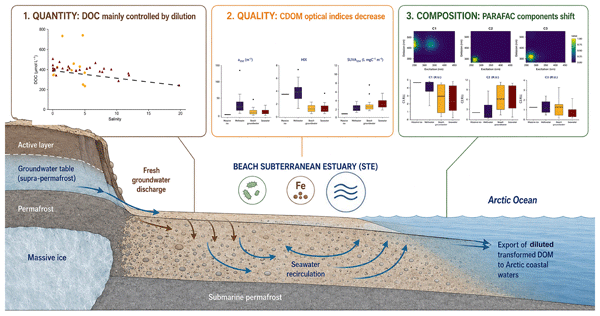
Climate change is accelerating permafrost thaw and coastal erosion, increasing dissolved organic matter (DOM) inputs to the Arctic Ocean. We show that, beyond seawater dilution, DOM is transformed as it passes through Arctic beach subterranean estuaries, shifting from humic-rich to more microbially processed material. These coastal zones act as biogeochemical reactors, modifying DOM before its export to coastal waters.
Interactive discussion
Status: closed
-
RC1: 'Comment on egusphere-2024-2945', Anonymous Referee #1, 16 Jan 2025
- AC1: 'Reply on RC1', Gwénaëlle Chaillou, 12 May 2025
-
EC1: 'Comment on egusphere-2024-2945', Gabriel Singer, 25 Mar 2025
This is an interesting manuscript about a potentially important mechanism of C-sequestration or C-metabolization associated with permafrost thaw at coastlines. The authors explore the properties and concentrations of dissolved organic matter (DOM) sourced from thawing permafrost along Arctic coastlines. They set off with the idea that DOM mobilized by thawing reaches the Arctic ocean through a coastal beach area, where sub-surface interactions with microbes or Fe could affect the fate of DOM. Their study largely rests on concentrations (DOC) and optical properties (absorbance, fluorescence) of DOM along a gradient from thawing permafrost to the coastal ocean, which in their specific area of research is heavily influenced by the Mackenzie River. In addition, they present experimental evidence that interactions with Fe could drive precipitation of DOM, thus representing a potential mechanism for C-sequestration in intertidal sediments.
The study is obviously of relevance in times of climate change with rapidly retreating Arctic coastlines caused by permafrost thawing. However, I find the study´s conclusions to be largely speculative and not resting on convincing evidence. In particular, I see three shortcomings that should be addressed before the manuscript may be considered for publication:
- The presented data largely consist of concentration gradients (DOC and other more or less quantitatively robust optical indicators) along a spatial gradient from thawing permafrost to the “open” coastal ocean. The latter is a brackish environment heavily influenced by the Mackenzie River. The authors observe a decrease of concentrations or optical signatures along this spatial gradient and along a gradient of increasing salinity. The offered interpretation is one tied to loss of DOM along this gradient, either through microbial respiration or through co-precipitation with Fe in intertidal sediments. The main issue I see is that the observed decrease of concentration may simply be caused by mixing of at least two different water bodies, namely thawing permafrost and seawater. If tidal influence (currently entirely unclear, no auxiliary data presented) plays a role, then there may even be a third water body, open ocean vs. river water, to consider. To conclude on carbon transformations from concentration gradients requires a careful consideration of mixing of various water bodies along the main environmental gradient of the study. A worthwhile approach to explore could be to predict DOM gradients based on salinity and then more carefully explore differences to actually observed data.
- The authors speculate about microbial respiration in the sediments to potentially transform DOM from permafrost into CO2. There seems to be anecdotal evidence of high CO2-concentrations in intertidal sediments, but to really turn this into a strong argument more in-depth evidence for microbial respiration needs to be presented more carefully.
- The second speculated mechanisms for DOM loss along the studied gradient is an “iron curtain” associated with redox gradients in the sediment that could act to sequester carbon in beach sediments. The authors present results of an experiment that shows loss of DOM in an experimental setting with surplus Fe and under strong oxygenation. Long-term effects remain unclear, which is a bit worrisome as DOM seems to increase again towards the end of the experiment. The study does not present any evidence for Fe nor for any “iron curtain” to actually occur in the studied intertidal sediments. Last, while microbial respiration may be argued to be an ongoing transformation process capable of removing substantial amounts of DOM along its way from permafrost to the ocean, the iron curtain mechanism is likely limited by the amount of Fe available in the sediments. Is such an iron curtain mechanism actually capable of influencing DOM-delivery to the ocean to a quantitatively relevant amount? How much Fe is available? How much DOM needs to be sequestered by that mechanism to explain the concentration drop in intertidal sediments? There may be a chance to combine experimental data with in-situ Fe and DOM concentrations (or DOM fractions) in a few simple back-of-the envelope computations probing the iron curtain for its potential relevance?
I have a few further minor comments, presented line-by-line below, that may help to provide an improved version of the manuscript.
17: “hydroxides” is plural, “its” is singular.
39: Graphical abstract: The left side is of limited use, but the right side of the graph could be turned into a more useful figure showing study design and main speculated mechanisms. Should then become a main figure in the manuscript.
52-53: a “source” cannot be mobilized, subject unclear in second sentence half.
74: establish STE as abbreviation for singular, eventually then write STEs in case plural is needed.
78: subject unclear.
80: “is” instead of “does”?
94: Clean up unclear phrase “site-specific scale approach”
97: who is “they”?
106: “height” rather than “high”.
109: 22% of what?
120: Who is “it”?
126: Meaning of “porewater into”?
134: Delete “thawing.
144: GF/F filters have no nominal pore size.
169: what is “the method”?
172-174: Given this statistically questionable approach, it seems fair to state at least from how many computed indices you selected those three?
185: State sample size for PARAFAC.
200: Given the importance of “oxidative precipitation of amorphous Fe-hydroxides” in this manuscript, please provide more background information in the introduction.
209: Sp is a weird abbreviation for salinity.
212: Explain “tidal pumping effect” with more detail.
216: Over-saturation is not logically explained here. Contact with the atmosphere will drive a water body towards saturation, from over- or undersaturation.
217-218: You actually invoke mixing effects here, why not consider them as explanation for concentration gradients?
230: Where would river water be on the LMWL?
236: Reconsider argument behind “suitable” here. You present no evidence for microbial transformations nor for mineral-organic interaction. Why is mixing of meltwater with river/sea water not an equally good explanation for concentration gradients?
244: The phrase “whatever the salinity” is used more often yet has unclear meaning.
254: Subject behind “they” unclear.
255-275: This section is hard to understand. I feel DOC and CDOM/FDOM are treated like separate fractions of DOM (this comment applies almost throughout the R&D), but that is not a permissible strategy. DOC is an analytical proxy for DOM quantity, optical properties may allow conclusions about DOM-“quality” or “composition” or act as proxy for specific optically active moieties. I guess the main point of this text section is that decoupling of these parameters along an environmental gradient suggests changes in composition and thus points to active processes? If so, it remains unclear whether you actually invoke this to happen in your study. Present evidence more to the point.
282: Here and in the following text, please respect that you have not measured molecular weight per se but at best an optical proxy for molecular weight.
284: The phrase “less significant” is not meaningful.
286: Photochemical process in darkness?
287-289: Seems speculative.
292-297: Unclear evidence for two sources of C2.
299: Seems weird to argue for “affinity” differing among analytical measures.
302-304: I remain a bit surprised that iron data is not presented in more detail. Sentence 303-304 not understandable.
311-316: Seems the Fe-effect experiences some sort of saturation at least in the experiment? Would this not be relevant in the beach itself as well?
Fig. 3: So, what do we really learn from these data? I cannot see that from the text.
Fig. 4: Consider ordering sites along the flowpath from meltwater to seawater. Font size generally much too small (also applies to other figures).
Citation: https://doi.org/10.5194/egusphere-2024-2945-EC1 - AC2: 'Reply on EC1 - Final response', Gwénaëlle Chaillou, 15 May 2025
Peer review completion


Interactive discussion
Status: closed
-
RC1: 'Comment on egusphere-2024-2945', Anonymous Referee #1, 16 Jan 2025
The manuscript “Fate of dissolved organic matter across the permafrost–nearshore water continuum: role of the intertidal sediments” by Flamand et al. reports on the important issue of land-ocean constituent transport induced by permafrost thawing and erosion. As such, the topic is very relevant and ties in two themes of which not nearly enough is known to date, namely organic carbon release from permafrost and subsequent processing underground within subterranean estuaries.
The data appears to be of good quality and the manuscript is overall well written. However, I still have some major concerns that should be addressed before the manuscript can be accepted for publication in Biogeosciences. Mainly, these entail the way the overarching theme, and later the data, are presented to support the proposed story.
Major comments:
The English syntax and grammar are often awkward or incorrect. The manuscript should be thoroughly checked before re-submission, either by a native English speaker amongst colleagues or a professional editing service.
The introduction is in parts unclear, especially regarding the influence of tDOM on coastal ecosystems. Does tDOM strongly influence the arctic marine ecosystem or does it get strongly removed and only a small fraction remains? At which point does the major turnover take place in the land-ocean aquatic continuum?
As a non-expert in permafrost biogeochemistry, I also found it difficult to understand the land-ocean aquatic continuum (if it can be called continuum, even) across permafrost-fringed coastlines. How does water transport mainly take place, via surface runoff or thawing and groundwater transport through permeable sediments? How might the impact of permafrost differ when it is delivered through (i) rivers, (ii) erosion and direct deposition into the ocean, and (iii) STEs? This aspect of the hydrology of the investigated locations is not well characterized yet. Figure 1 does show a bit of the sampled environments, but it is too superficial. The diagram in the graphical abstract should be adapted in a new Figure 2, for example (2A) to elaborate on the different flowpaths and permafrost delivery mechanisms to the coastal ocean, and (2B) to depict sampling points of this study.
Finally, provocatively speaking: Does STE processing (quantitatively and qualitatively speaking) even matter in this environment? What do STEs do here that other interfaces can’t? Redox fronts with potential iron curtains are named as major modulators, but iron distributions in the STE are not reported in the manuscript. What are the natural Fe-DOC ratios? What is the pH? Is there any information on sediment composition which might enhance OM adsorption, perhaps from earlier publications?
Figures (general comment):
Some Figures are in color, while others are only black and white. Just fully commit to color – most people read the papers online anyways. Figures 4 and 7 also have very small fonts. I don’t recall ever seeing salinity denoted as “Sp” before. Overall, the figure captions don’t describe all variables in the figures, so please provide comprehensive information there.
Tables:
There should be an additional table with environmental data (including iron, temperature, oxygen saturation) of all samples. I don’t want to have to download everything from PANGAEA to understand the system.
Minor comments:
Lines 16-18: The introduction of iron hydroxides and groundwater comes a bit abrupt after a generic phrase of “multiple fates” of DOM. The two sentences could be harmonized better to introduce first permafrost and then mention underground transport and its specifics as one of the pathways.
Lines 23-24, and throughout the manuscript: Maybe I didn’t find it in the manuscript but how can mineral-DOM interactions be disentangled from microbial processing? The former will target humics and “protein-like” material will remain so it might resemble microbial turnover and DOM production by selective retention.
Line 43: “60% of the world’s carbon”, is that correct? That would include inorganic carbon, no? Please clarify.
Lines 49-52: Add examples for permafrost. Does it supply something specific, i.e. a certain nutrient species or amount, that supplements/influences oceanic regimes?
Line 53: On which time scale is “rapid”? Are there any reference values for volumetric water fluxes from permafrost?
Lines 56-59: Like above, be more specific on how tDOM influences all these (or at least one of them) with an example or two.
Line 63: All throughout the riverine catchment? Or only in the estuary? Again, please be more specific if that information is available in the cited paper.
Line 66: Are there any estimates or examples to back up the statement about a strong tDOM influence on the arctic marine systems?
Lines 72-73: Why and where do these iron curtains form?
Lines 75-77: STEs are complex everywhere in the world. The introduction of STEs here is a bit uneven and should be clearer, especially for a permafrost audience who does not know the term.
Lines 77-78: “Its role (…) could be a key zone”? Please rephrase.
Line 80: “affinity with amorphous Fe-hydroxide in STE” sounds awkward. Please re-phrase/clarify.
Line 86: “Recent findings (…) characterized permafrost-derived DOM as LMW, proteinaceous” but later in the manuscript it reads as if the cited paper reported DOM as HMW humic-like (lines 337-339). The contradiction should be explained in more detail.
Lines 91-97: The rationales and aims are rather vague. I’m assuming that the study was planned with an expected outcome in mind. These expectations form the hypotheses and questions and should be mentioned here more clearly.
Line 94: Is that site-specific scale approach discussed later? Because I don’t think I found it again in the results & discussion.
Line 118: What is an “important lagoon system”?
Sections 2.1 and 2.2: As mentioned in the major comments, site and sampling descriptions would vastly improve from the addition of a schematic diagram, for example in the form of a cross-section depicting the coastal topography, location of permafrost layers and vegetation, mean water line, sampling point locations etc. At least this should be done for the high-resolution sampling site Kugmallit Bay. Two of the sites are located near a large river, was it sampled as well as an endmember? The river is mentioned in results & discussion for the first time which is too late. What are the tidal conditions? All potential endmember characteristics should be outlined in the introduction or site description of the methods section.
Line 153: The TOC-VCPN from Shimadzu is all capitals.
Line 155: µM here, but µ mol L-1 in the figures – please unify.
Line 173: What is significantly different? Was a statistical test performed to come to this conclusion?
Line 181: Consider calculating BIX to complement HIX in the revision, since tDOM transformation from one to the other is one of the proposed mechanisms.
Section 2.5: Was pH monitored? It governs Fe-DOM precipitation and was likely changed during FeCl addition. Consider repeating the experiment if you have backup samples, if only for a pH check.
Lines 209-210: What is the main factor influencing the salinity in the seawater? Groundwater or surface runoff and rivers?
Line 2019 Waska et al. 2021 does not take place in a microtidal environment.
Line 220: “the tidally input of oxygen is rapidly consumed” sounds weird. Please rephrase.
Lines 235-238: Yes, conditions in the STE are well-suited for transformations, but the groundwater endmember does not seem to stem from in situ meltwater. So, it could be from anywhere inland with unknown water ages, and might have been transformed extensively before entering the STE.
Lines 241-242: Does Figure 4 depict all samples from all sampling sites? The symbols should be color coded to disentangle different sites and perhaps even locations on the beach (upper vs. lower).
Line 251: What is “negatively decreased”?
Line 256: “The relationships in between is used” – not sure what that is supposed to mean – please clarify.
Lines 266-267: Not necessarily if other processes like adsorption affects CDOM more, then both can be simultaneously decreased but by different mechanisms, no?
Lines 285-290: An increase in aromatic DOM could also result from degradation of particulate organic matter within the STE.
Line 290: There is BIX! But where does it come from? A different study? Can the data be compared? Why is there no BIX for the present study?
Lines 292-297: I don’t follow the reasoning here. What is the autochtonous DOM in this story here? The optical parameters in Fig. 5 are not stable in seawater. They fluctuate quite a lot and have varying CDOM/DOC ratios. Assuming low temperatures and high freshwater fluxes they might just be the result of two endmembers (direct permafrost input and Mackenzie River).
Lines 303-305: To support this statement, Fe distribution and dynamics, and tidal range/extent of beach inundation of the study sites need to be reported in sufficient detail.
Lines 306-327: Can you add the CDOM/DOC ratios of the samples before and after Fe addition, so that they can be compared to the natural ratios depicted in Figure 5?
Line 338: shift from past to present tense, please be consistent
Line 339: Add more environmental and thematic context for the cited paper to support the comparison.
Line 345: Same as above, was that done at the same study sites? Why are related studies cited so late in the manuscript? They should be used in the introduction to set the stage for the story presented here.
Lines 348-350: Does this statement refer to the Chaillou et al. 2024 paper or the present study? It would be odd to finish results & discussion with a conclusion from another paper.
Line 354: “would be”?? Also, I thought that microbial degradation does not favor humic-like material.
Line 358: “submarine groundwater discharge”
Figures:
Graphical abstract: The dots in the left scatter plot are really small, as is the font size of the axis numbers.
Figure 4: Use colors, make the font bigger, denote different sampling sites if appropriate, add units to the boxplot axis titles.
Figure 5: Is “S” Salinity? It was “Sp” in Figure 4. Also, why are some symbols light grey which is not part of the color scale?
Figure 6: Use colors, and perhaps another chart type or design. For the majority of symbols in B) it is impossible to decipher any information. Consider adding a third graph depicting DOC/CDOM ratios, and adding a range of these ratios in Figure 5 for reference.
Figure 7: See comments for Figure 4.
Apologies for the delayed review! It took more time than originally anticipated...
Citation: https://doi.org/10.5194/egusphere-2024-2945-RC1 - AC1: 'Reply on RC1', Gwénaëlle Chaillou, 12 May 2025
-
EC1: 'Comment on egusphere-2024-2945', Gabriel Singer, 25 Mar 2025
This is an interesting manuscript about a potentially important mechanism of C-sequestration or C-metabolization associated with permafrost thaw at coastlines. The authors explore the properties and concentrations of dissolved organic matter (DOM) sourced from thawing permafrost along Arctic coastlines. They set off with the idea that DOM mobilized by thawing reaches the Arctic ocean through a coastal beach area, where sub-surface interactions with microbes or Fe could affect the fate of DOM. Their study largely rests on concentrations (DOC) and optical properties (absorbance, fluorescence) of DOM along a gradient from thawing permafrost to the coastal ocean, which in their specific area of research is heavily influenced by the Mackenzie River. In addition, they present experimental evidence that interactions with Fe could drive precipitation of DOM, thus representing a potential mechanism for C-sequestration in intertidal sediments.
The study is obviously of relevance in times of climate change with rapidly retreating Arctic coastlines caused by permafrost thawing. However, I find the study´s conclusions to be largely speculative and not resting on convincing evidence. In particular, I see three shortcomings that should be addressed before the manuscript may be considered for publication:
- The presented data largely consist of concentration gradients (DOC and other more or less quantitatively robust optical indicators) along a spatial gradient from thawing permafrost to the “open” coastal ocean. The latter is a brackish environment heavily influenced by the Mackenzie River. The authors observe a decrease of concentrations or optical signatures along this spatial gradient and along a gradient of increasing salinity. The offered interpretation is one tied to loss of DOM along this gradient, either through microbial respiration or through co-precipitation with Fe in intertidal sediments. The main issue I see is that the observed decrease of concentration may simply be caused by mixing of at least two different water bodies, namely thawing permafrost and seawater. If tidal influence (currently entirely unclear, no auxiliary data presented) plays a role, then there may even be a third water body, open ocean vs. river water, to consider. To conclude on carbon transformations from concentration gradients requires a careful consideration of mixing of various water bodies along the main environmental gradient of the study. A worthwhile approach to explore could be to predict DOM gradients based on salinity and then more carefully explore differences to actually observed data.
- The authors speculate about microbial respiration in the sediments to potentially transform DOM from permafrost into CO2. There seems to be anecdotal evidence of high CO2-concentrations in intertidal sediments, but to really turn this into a strong argument more in-depth evidence for microbial respiration needs to be presented more carefully.
- The second speculated mechanisms for DOM loss along the studied gradient is an “iron curtain” associated with redox gradients in the sediment that could act to sequester carbon in beach sediments. The authors present results of an experiment that shows loss of DOM in an experimental setting with surplus Fe and under strong oxygenation. Long-term effects remain unclear, which is a bit worrisome as DOM seems to increase again towards the end of the experiment. The study does not present any evidence for Fe nor for any “iron curtain” to actually occur in the studied intertidal sediments. Last, while microbial respiration may be argued to be an ongoing transformation process capable of removing substantial amounts of DOM along its way from permafrost to the ocean, the iron curtain mechanism is likely limited by the amount of Fe available in the sediments. Is such an iron curtain mechanism actually capable of influencing DOM-delivery to the ocean to a quantitatively relevant amount? How much Fe is available? How much DOM needs to be sequestered by that mechanism to explain the concentration drop in intertidal sediments? There may be a chance to combine experimental data with in-situ Fe and DOM concentrations (or DOM fractions) in a few simple back-of-the envelope computations probing the iron curtain for its potential relevance?
I have a few further minor comments, presented line-by-line below, that may help to provide an improved version of the manuscript.
17: “hydroxides” is plural, “its” is singular.
39: Graphical abstract: The left side is of limited use, but the right side of the graph could be turned into a more useful figure showing study design and main speculated mechanisms. Should then become a main figure in the manuscript.
52-53: a “source” cannot be mobilized, subject unclear in second sentence half.
74: establish STE as abbreviation for singular, eventually then write STEs in case plural is needed.
78: subject unclear.
80: “is” instead of “does”?
94: Clean up unclear phrase “site-specific scale approach”
97: who is “they”?
106: “height” rather than “high”.
109: 22% of what?
120: Who is “it”?
126: Meaning of “porewater into”?
134: Delete “thawing.
144: GF/F filters have no nominal pore size.
169: what is “the method”?
172-174: Given this statistically questionable approach, it seems fair to state at least from how many computed indices you selected those three?
185: State sample size for PARAFAC.
200: Given the importance of “oxidative precipitation of amorphous Fe-hydroxides” in this manuscript, please provide more background information in the introduction.
209: Sp is a weird abbreviation for salinity.
212: Explain “tidal pumping effect” with more detail.
216: Over-saturation is not logically explained here. Contact with the atmosphere will drive a water body towards saturation, from over- or undersaturation.
217-218: You actually invoke mixing effects here, why not consider them as explanation for concentration gradients?
230: Where would river water be on the LMWL?
236: Reconsider argument behind “suitable” here. You present no evidence for microbial transformations nor for mineral-organic interaction. Why is mixing of meltwater with river/sea water not an equally good explanation for concentration gradients?
244: The phrase “whatever the salinity” is used more often yet has unclear meaning.
254: Subject behind “they” unclear.
255-275: This section is hard to understand. I feel DOC and CDOM/FDOM are treated like separate fractions of DOM (this comment applies almost throughout the R&D), but that is not a permissible strategy. DOC is an analytical proxy for DOM quantity, optical properties may allow conclusions about DOM-“quality” or “composition” or act as proxy for specific optically active moieties. I guess the main point of this text section is that decoupling of these parameters along an environmental gradient suggests changes in composition and thus points to active processes? If so, it remains unclear whether you actually invoke this to happen in your study. Present evidence more to the point.
282: Here and in the following text, please respect that you have not measured molecular weight per se but at best an optical proxy for molecular weight.
284: The phrase “less significant” is not meaningful.
286: Photochemical process in darkness?
287-289: Seems speculative.
292-297: Unclear evidence for two sources of C2.
299: Seems weird to argue for “affinity” differing among analytical measures.
302-304: I remain a bit surprised that iron data is not presented in more detail. Sentence 303-304 not understandable.
311-316: Seems the Fe-effect experiences some sort of saturation at least in the experiment? Would this not be relevant in the beach itself as well?
Fig. 3: So, what do we really learn from these data? I cannot see that from the text.
Fig. 4: Consider ordering sites along the flowpath from meltwater to seawater. Font size generally much too small (also applies to other figures).
Citation: https://doi.org/10.5194/egusphere-2024-2945-EC1 - AC2: 'Reply on EC1 - Final response', Gwénaëlle Chaillou, 15 May 2025
Peer review completion
Journal article(s) based on this preprint
Climate change is accelerating permafrost thaw and coastal erosion, increasing dissolved organic matter (DOM) inputs to the Arctic Ocean. We show that, beyond seawater dilution, DOM is transformed as it passes through Arctic beach subterranean estuaries, shifting from humic-rich to more microbially processed material. These coastal zones act as biogeochemical reactors, modifying DOM before its export to coastal waters.
Data sets
Geochemical data collected in a coastal permafrost environment in the Beaufort sea area [dataset] Aude Flamand et al. https://doi.pangaea.de/10.1594/PANGAEA.960986
Viewed
| HTML | XML | Total | BibTeX | EndNote | |
|---|---|---|---|---|---|
| 5,274 | 902 | 1,198 | 7,374 | 245 | 391 |
- HTML: 5,274
- PDF: 902
- XML: 1,198
- Total: 7,374
- BibTeX: 245
- EndNote: 391
Viewed (geographical distribution)
| Country | # | Views | % |
|---|
| Total: | 0 |
| HTML: | 0 |
| PDF: | 0 |
| XML: | 0 |
- 1
Aude Flamand
Jean-François Lapierre
Gwénaëlle Chaillou

The requested preprint has a corresponding peer-reviewed final revised paper. You are encouraged to refer to the final revised version.
- Preprint
(4140 KB) - Metadata XML
The manuscript “Fate of dissolved organic matter across the permafrost–nearshore water continuum: role of the intertidal sediments” by Flamand et al. reports on the important issue of land-ocean constituent transport induced by permafrost thawing and erosion. As such, the topic is very relevant and ties in two themes of which not nearly enough is known to date, namely organic carbon release from permafrost and subsequent processing underground within subterranean estuaries.
The data appears to be of good quality and the manuscript is overall well written. However, I still have some major concerns that should be addressed before the manuscript can be accepted for publication in Biogeosciences. Mainly, these entail the way the overarching theme, and later the data, are presented to support the proposed story.
Major comments:
The English syntax and grammar are often awkward or incorrect. The manuscript should be thoroughly checked before re-submission, either by a native English speaker amongst colleagues or a professional editing service.
The introduction is in parts unclear, especially regarding the influence of tDOM on coastal ecosystems. Does tDOM strongly influence the arctic marine ecosystem or does it get strongly removed and only a small fraction remains? At which point does the major turnover take place in the land-ocean aquatic continuum?
As a non-expert in permafrost biogeochemistry, I also found it difficult to understand the land-ocean aquatic continuum (if it can be called continuum, even) across permafrost-fringed coastlines. How does water transport mainly take place, via surface runoff or thawing and groundwater transport through permeable sediments? How might the impact of permafrost differ when it is delivered through (i) rivers, (ii) erosion and direct deposition into the ocean, and (iii) STEs? This aspect of the hydrology of the investigated locations is not well characterized yet. Figure 1 does show a bit of the sampled environments, but it is too superficial. The diagram in the graphical abstract should be adapted in a new Figure 2, for example (2A) to elaborate on the different flowpaths and permafrost delivery mechanisms to the coastal ocean, and (2B) to depict sampling points of this study.
Finally, provocatively speaking: Does STE processing (quantitatively and qualitatively speaking) even matter in this environment? What do STEs do here that other interfaces can’t? Redox fronts with potential iron curtains are named as major modulators, but iron distributions in the STE are not reported in the manuscript. What are the natural Fe-DOC ratios? What is the pH? Is there any information on sediment composition which might enhance OM adsorption, perhaps from earlier publications?
Figures (general comment):
Some Figures are in color, while others are only black and white. Just fully commit to color – most people read the papers online anyways. Figures 4 and 7 also have very small fonts. I don’t recall ever seeing salinity denoted as “Sp” before. Overall, the figure captions don’t describe all variables in the figures, so please provide comprehensive information there.
Tables:
There should be an additional table with environmental data (including iron, temperature, oxygen saturation) of all samples. I don’t want to have to download everything from PANGAEA to understand the system.
Minor comments:
Lines 16-18: The introduction of iron hydroxides and groundwater comes a bit abrupt after a generic phrase of “multiple fates” of DOM. The two sentences could be harmonized better to introduce first permafrost and then mention underground transport and its specifics as one of the pathways.
Lines 23-24, and throughout the manuscript: Maybe I didn’t find it in the manuscript but how can mineral-DOM interactions be disentangled from microbial processing? The former will target humics and “protein-like” material will remain so it might resemble microbial turnover and DOM production by selective retention.
Line 43: “60% of the world’s carbon”, is that correct? That would include inorganic carbon, no? Please clarify.
Lines 49-52: Add examples for permafrost. Does it supply something specific, i.e. a certain nutrient species or amount, that supplements/influences oceanic regimes?
Line 53: On which time scale is “rapid”? Are there any reference values for volumetric water fluxes from permafrost?
Lines 56-59: Like above, be more specific on how tDOM influences all these (or at least one of them) with an example or two.
Line 63: All throughout the riverine catchment? Or only in the estuary? Again, please be more specific if that information is available in the cited paper.
Line 66: Are there any estimates or examples to back up the statement about a strong tDOM influence on the arctic marine systems?
Lines 72-73: Why and where do these iron curtains form?
Lines 75-77: STEs are complex everywhere in the world. The introduction of STEs here is a bit uneven and should be clearer, especially for a permafrost audience who does not know the term.
Lines 77-78: “Its role (…) could be a key zone”? Please rephrase.
Line 80: “affinity with amorphous Fe-hydroxide in STE” sounds awkward. Please re-phrase/clarify.
Line 86: “Recent findings (…) characterized permafrost-derived DOM as LMW, proteinaceous” but later in the manuscript it reads as if the cited paper reported DOM as HMW humic-like (lines 337-339). The contradiction should be explained in more detail.
Lines 91-97: The rationales and aims are rather vague. I’m assuming that the study was planned with an expected outcome in mind. These expectations form the hypotheses and questions and should be mentioned here more clearly.
Line 94: Is that site-specific scale approach discussed later? Because I don’t think I found it again in the results & discussion.
Line 118: What is an “important lagoon system”?
Sections 2.1 and 2.2: As mentioned in the major comments, site and sampling descriptions would vastly improve from the addition of a schematic diagram, for example in the form of a cross-section depicting the coastal topography, location of permafrost layers and vegetation, mean water line, sampling point locations etc. At least this should be done for the high-resolution sampling site Kugmallit Bay. Two of the sites are located near a large river, was it sampled as well as an endmember? The river is mentioned in results & discussion for the first time which is too late. What are the tidal conditions? All potential endmember characteristics should be outlined in the introduction or site description of the methods section.
Line 153: The TOC-VCPN from Shimadzu is all capitals.
Line 155: µM here, but µ mol L-1 in the figures – please unify.
Line 173: What is significantly different? Was a statistical test performed to come to this conclusion?
Line 181: Consider calculating BIX to complement HIX in the revision, since tDOM transformation from one to the other is one of the proposed mechanisms.
Section 2.5: Was pH monitored? It governs Fe-DOM precipitation and was likely changed during FeCl addition. Consider repeating the experiment if you have backup samples, if only for a pH check.
Lines 209-210: What is the main factor influencing the salinity in the seawater? Groundwater or surface runoff and rivers?
Line 2019 Waska et al. 2021 does not take place in a microtidal environment.
Line 220: “the tidally input of oxygen is rapidly consumed” sounds weird. Please rephrase.
Lines 235-238: Yes, conditions in the STE are well-suited for transformations, but the groundwater endmember does not seem to stem from in situ meltwater. So, it could be from anywhere inland with unknown water ages, and might have been transformed extensively before entering the STE.
Lines 241-242: Does Figure 4 depict all samples from all sampling sites? The symbols should be color coded to disentangle different sites and perhaps even locations on the beach (upper vs. lower).
Line 251: What is “negatively decreased”?
Line 256: “The relationships in between is used” – not sure what that is supposed to mean – please clarify.
Lines 266-267: Not necessarily if other processes like adsorption affects CDOM more, then both can be simultaneously decreased but by different mechanisms, no?
Lines 285-290: An increase in aromatic DOM could also result from degradation of particulate organic matter within the STE.
Line 290: There is BIX! But where does it come from? A different study? Can the data be compared? Why is there no BIX for the present study?
Lines 292-297: I don’t follow the reasoning here. What is the autochtonous DOM in this story here? The optical parameters in Fig. 5 are not stable in seawater. They fluctuate quite a lot and have varying CDOM/DOC ratios. Assuming low temperatures and high freshwater fluxes they might just be the result of two endmembers (direct permafrost input and Mackenzie River).
Lines 303-305: To support this statement, Fe distribution and dynamics, and tidal range/extent of beach inundation of the study sites need to be reported in sufficient detail.
Lines 306-327: Can you add the CDOM/DOC ratios of the samples before and after Fe addition, so that they can be compared to the natural ratios depicted in Figure 5?
Line 338: shift from past to present tense, please be consistent
Line 339: Add more environmental and thematic context for the cited paper to support the comparison.
Line 345: Same as above, was that done at the same study sites? Why are related studies cited so late in the manuscript? They should be used in the introduction to set the stage for the story presented here.
Lines 348-350: Does this statement refer to the Chaillou et al. 2024 paper or the present study? It would be odd to finish results & discussion with a conclusion from another paper.
Line 354: “would be”?? Also, I thought that microbial degradation does not favor humic-like material.
Line 358: “submarine groundwater discharge”
Figures:
Graphical abstract: The dots in the left scatter plot are really small, as is the font size of the axis numbers.
Figure 4: Use colors, make the font bigger, denote different sampling sites if appropriate, add units to the boxplot axis titles.
Figure 5: Is “S” Salinity? It was “Sp” in Figure 4. Also, why are some symbols light grey which is not part of the color scale?
Figure 6: Use colors, and perhaps another chart type or design. For the majority of symbols in B) it is impossible to decipher any information. Consider adding a third graph depicting DOC/CDOM ratios, and adding a range of these ratios in Figure 5 for reference.
Figure 7: See comments for Figure 4.
Apologies for the delayed review! It took more time than originally anticipated...