
the Creative Commons Attribution 4.0 License.
the Creative Commons Attribution 4.0 License.
 | 03 Feb 2026
Nocturnal production of N2O5 and ClNO2 in Delhi: driving factors and impacts
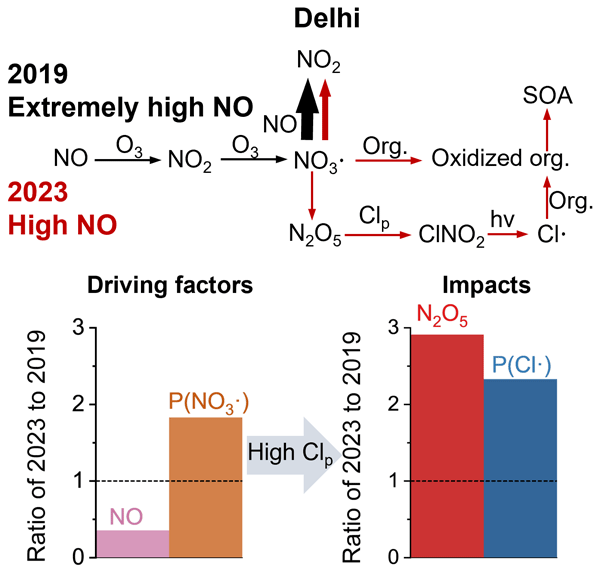
Abstract. Nitryl chloride (ClNO2) is an important Cl· precursor, originating from the heterogeneous reactions of dinitrogen pentoxide (N2O5) on chloride-containing particles. This N2O5-ClNO2 chemical process plays critical roles in chloride activation, nitrate formation, and thus air pollution. Here we present field measurements made in the early springtime of 2023 in Delhi and compare with a previous study conducted during the winter of 2019. We found elevated nocturnal levels of N2O5 and ClNO2, averaging 13 and 80 ppt, respectively, which are approximately doubled compared to observations in 2019. This change is primarily driven by the reduced nighttime NO levels, from 124±25 ppb in 2019 to 44±9 ppb in 2023. In addition, the chloride concentration (nighttime average 4.7 μg/m3) in Delhi is among the highest reported globally, driving efficient conversion of N2O5 to ClNO2. Decreased NO and elevated ClNO2 levels lead to higher NO3· and Cl· production that promote the oxidation of organics. Consistently, we observed increased fractions of gaseous nitrogen- and chlorine-containing organic products and a higher oxidation state of the organic aerosols. Our findings highlight the need for increased attention to atmospheric secondary pollution and stringent chlorine emissions control with the reduction of NOx in Delhi.
-
Notice on discussion status
The requested preprint has a corresponding peer-reviewed final revised paper. You are encouraged to refer to the final revised version.
-
Preprint
(1884 KB)
-
Supplement
(3640 KB)
-
The requested preprint has a corresponding peer-reviewed final revised paper. You are encouraged to refer to the final revised version.
- Preprint
(1884 KB) - Metadata XML
-
Supplement
(3640 KB) - BibTeX
- EndNote
- Final revised paper


Journal article(s) based on this preprint
Interactive discussion
Status: closed
-
RC1: 'Comment on egusphere-2026-73', Anonymous Referee #1, 09 Mar 2026
- AC1: 'Reply on RC1', Yijing Chen, 24 Jun 2026
-
RC2: 'Comment on egusphere-2026-73', Anonymous Referee #2, 03 Apr 2026
The manuscript entitled " Nocturnal production of N2O5 and ClNO2 in Delhi: driving factors and impacts" presents data and and analyses from a field study at a site in the megacity of Delhi conducted from 23rd Feb 2023 to 14th March 2023 (~21 days). A FIGAERO-I CIMS (Filter Inlet for Gases and AEROsols Iodide-Chemical Ionization-Time of Flight Mass Spectrometer) was used for measurements of several species including N2O5 and ClNO2 and HCl and on the basis of these measurements and data from air quality monitoring stations made near the site, the authors have sought to explain the influence of factors that affect night time chemistry and elevated levels of observed N2O5 and ClNO2 observed during their campaign relative to an earlier study conducting in the winter of 2019, which had reported lower levels of these species. While such a topic is certainly interesting and measurements using such instruments have rarely been made in India, I have serious concerns concerning the present work that prevent me from recommending publication of the paper in ACP.
These major concerns are summarized below:
Analyses that rests on multiple- assumptions whose basis seems unsound further compounded by use of non-research grade data measured at a nearby monitoring station for parameters that are fundamental for the analyzes such as accurate NO, NOx measurements. Although the authors have tried to compensate through purely statistical checks, unfortunately in my view these do not seem to be adequate to be able to trust the primary dataset used for the analyses. Here I am not referring to the CIMS data which also seems to have experienced some major technical issues pertaining to in field calibrations and sensitivity being off due to application of Levoglucosan based sensitivity, which the authors have characterized, acknowledged and corrected as best they could but the co-measured datasets from other instruments operated by the pollution control agencies. See for example Figure S5 where there are big differences between the NO nighttime levels at IITD site and RK Puram site (which was actually used) for analyses of the CIMS data at IITD. The temporal resolution has not been mentioned but it appears that at night there are occasions when the ozone is non zero despite several ppb of NO at the same time, which is a clear indication of suspect data quality. Since the entire discussion about the night time chemistry rests strongly on the accuracy of NO measurements, I see this as a major red flag in the design/limitation of the study. The complete lack of discussion of seasonality and seasonal emissions in comparison of the wintertime study and the present spring time study and vast generalization reflected in the title also render the scientific quality weak. It is strange that the authors did not include any speciated VOC measurements of alkenes and aromatics compounds and also for the surface area simply used the winter time value by Gani et al despite obviously different aerosol type and source affecting between winter and spring. Their main premise of changed NOx levels isn’t even explained in terms of why that should have happened between 2019 and 2023, despite more vehicles and sources. The present analyses being policy prescriptive, there is a need for caution in using just a month’s data, some of which though fundamental to the analyses is also of suspect quality to make sweeping assertions concerning nighttime processes. There also seem to be several important previous works from the region that the authors have missed to include including some recent ones published in ACP and GRL and STOTEN that shed light on the chemistry of halogenated species and other night time oxidants like Stabilized Criegee intermediates.
Specific comments:
L74-L77: ..far exceeding typical ranges….please justify….many recent works and data even post 2021 show such levels still occur…
L94-104: How would the local vegetation and canopy and buildings at IIT Delhi affect dry and wet deposition also considering that you actually use data from a site faraway for your calculations ?
L118-L121: Please provide calibration plots Vs RH for the RH regimes experienced during the campaign period to provide more confidence ….
L124-126: What additional precautions were taking to ensure the bottle supplied zero air used was free of VOC contaminants? Was this screened or further cleaned using catalytic convertors which is std practice ?
EDXRF: Details of the instrument and analysis methods are missing..also please check as it is not clear how 83 samples were obtained as 20 x 2= 40 samples. For what dates was freq increased to every 4 h? what were the PM mass concentration loadings? Was any check done with other techniques or BAM for mass closure?
L149-150: Two orders of magnitude lower is of grave concern!
L175: Please specify what you mean by neighbouring measurements…
L183-187: Too many assumptions linking to each other?
L207-L211: lack of VOC measurements and assumption of same value as was in 2019 in wintertime is definitely not valid….what is your basis? Even if for a moment one assumes NOx was much lower in 2023 relative to 2019 , then why would VOCs not have changed too…this is an example of inconsistent logic that one comes across on several occasions in the manuscript…
Overall, I think the novel aspect of the study are the CIMS measurements and my recommendation is that the authors should resubmit a new MS focusing only on those and comparing it with world-wide levels in other regions, removing flawed and speculative aspects that aim to be policy prescriptive without sound scientific basis.
Citation: https://doi.org/10.5194/egusphere-2026-73-RC2 - AC2: 'Reply on RC2', Yijing Chen, 24 Jun 2026
-
RC3: 'Comment on egusphere-2026-73', Anonymous Referee #3, 13 Apr 2026
Chen et al. present a comprehensive field measurement study investigating nocturnal N2O5-ClNO2 chemistry in Delhi. The study identifies the primary driver of N2O5 and ClNO2 enhancement in 2023 compared to 2019 as a substantial reduction in nocturnal NO concentrations, which mitigated the suppression of NO3 radical formation, and high particulate chloride concentration in Delhi also facilitated efficient conversion of N2O5 to ClNO2. This study is an additional piece of work which is important for better understanding of N2O5 heterogenous chemistry in high NO regions such as India. Overall, the manuscript is interesting but I think it needs to be significantly improved and strengthened prior to the decision of acceptance for publication. My detail comments are as below:
Title: I would suggest the authors to revise the title to be more specific and relevant to the major finding of this study.
Line 43: It is good to recommend, however, I think the authors should be more realistic when concluding. Stringent chlorine emissions control is preferable but at this stage it is not clear how chlorine emissions can be control since there are both anthropogenic and natural sources.
Line 61: Revise ‘arctic’ to remote polar and marine regions.
Line 69: ‘ingredients’ does not sound scientific. Maybe precursors will be better.
Line 128-129: What type of remaining detected gaseous compounds? Be more specific. Any basis for choosing the maximum sensitivities of chloroacetic acid?
Line 209-211: Agreed that the NO might still be the dominant loss for NO3. However, depends on the level of VOCs (I presumed that Delhi is a high VOCs emission region), the NO3 loss via VOCs might be a significant contribution to NO3. Can the authors clarify that the loss via VOC is not significant or is negligible?
Line 236-237: Any support for the efficient conversion of N2O5 to ClNO2?
Line 243-244: From Fig. S9, the authors did not do correlation analysis, so need to be careful with the description here. If there is please, please provide the correlation value.
Line 262-263: Clarify what is the new N2O5 driven ClNO2 enhancement pattern in 2023?
Line 270-271: I do not think a unity of ClNO2 yield will necessary occur even there is a high chloride concentration. Please revise the statement.
Line 285: I think drivers is not an appropriate word as the study only investigated a few factors. Please find a suitable description and revise them throughout the text.
Figure 2a: Suggest to revise the Figure 2a as it is hard to follow.
Line 340: Any proof to support that the chloride is in the form of semi-volatile NH4Cl?
Line 366: What is the justification for vertical intrusion contribute to the night-time ClNO2 as the nocturnal boundary layer is relatively stable at night?
Line 413-414: The authors calculated the Cl atom production from photolysis of Cl2, ClNO2, NHCl2, and NCl3. However, it is unknown how the calculations were done. I cannot find any information on the concentrations of Cl2, NHCl2, and NCl3.
Line 420: While the increase in chlorine-containing organic products is clear, the statement about "pronounced Cl-initiated oxidation" could be more nuanced.
Figure 6: I am not clear what is the main purpose of showing Fig. 6? The schematic is helpful but could be made more detailed to visually summarize the key differences (e.g., include relative sizes of NO, and the resulting radical and SOA outputs for 2019 vs. 2023). Furthermore, the N2O5 uptake can also produce Cl2 together with ClNO2. How do the authors consider about this pathway?
Line 494: ‘extensive characterization’ is over-stated.
Line 556: Double check the references as there are some duplications.
Supplementary info, Line 66: I have a concern on the measurement and calibration of N2O5 and ClNO2. Did the author check on the inlet loss or artefact of these compounds generated in the inlet? As the PM loadings are very high in Delhi, how did the measurements can assure that the inlet chemistry does not play significant role? This information should be added to the supplement.
Supplementary info, Line 91: Provide the standard deviation or error values for the gravimetric
weight loss analysis of chloroacetic acid.
Supplementary info, Line 139: What is RH parameterization? How to validate?
Supplementary info, Line 177: I am confused by the authors on what is the purpose of showing the ClNO2 in residual layer. The calculation has very high uncertainties and may not really represent the ‘real’ concentration of ClNO2. Please clarify or delete this unnecessary calculation.
Supplementary info, Figure S19: The smallest mixing ratios of N2O5 and ClNO2 points for the calibration are more than 2 ppb. I am concern about the response of CIMS on lower concentration region as the measured ambient concentrations typically fall below this low value. Have the authors conducted calibration for lower concentration? In addition, the HCl calibration also used “extremely” high concentration, how can this represent the ambient concentrations?
The authors should further polish the manuscript for grammatical errors and better clarity in the text.
Citation: https://doi.org/10.5194/egusphere-2026-73-RC3 - AC3: 'Reply on RC3', Yijing Chen, 24 Jun 2026
-
AC4: 'Revised main text and SI - trackchange', Yijing Chen, 24 Jun 2026
The comment was uploaded in the form of a supplement: https://egusphere.copernicus.org/preprints/2026/egusphere-2026-73/egusphere-2026-73-AC4-supplement.zip
Peer review completion


Interactive discussion
Status: closed
-
RC1: 'Comment on egusphere-2026-73', Anonymous Referee #1, 09 Mar 2026
The authors present field measurements of N2O5 and ClNO2 concentrations and other species conducted in New Delhi, India in Spring 2023 and compare results to previous measurements conducted in winter 2019. The authors find that concentrations of N2O5 and ClNO2 are higher in 2023 compared to 2019, and concentrations of NOx and particulate chloride are lower. N2O5 appears to be inversely related to concentrations of NOx, and ClNO2 is positively correlated with particulate chloride. Measurements of other organic compounds show evidence for the importance of Cl initiated oxidation reactions. These results would suggest that reductions in NOx can increase formation of secondary pollutants in Delhi (since Cl concentrations will be higher), which has important policy implications. Overall, the manuscript is well written and covers and important area of atmospheric chemistry research. In my opinion, the manuscript should be published in ACP after taking into consideration the comments below:
Main comment:
Considering the complex dependence of ClNO2 on N2O5 observed in New Delhi, would the authors like to discuss the possibility of processes other than N2O5 influencing concentrations of ClNO2?
Specific comments
- The figure numbers are not in chronological order throughout the text.
- Line 51-52: There seems to be references missing
- Line 77: Should this be S2b,c instead of S2b,d?
- Line 184: “invalidate” instead of “invalid”?
- Line 207: Is this the same Keq described in supplement line 134? If so, why are different expressions used?
- Line 280-281: shown in (d) instead of “shown in (c)”?
Citation: https://doi.org/10.5194/egusphere-2026-73-RC1 - AC1: 'Reply on RC1', Yijing Chen, 24 Jun 2026
-
RC2: 'Comment on egusphere-2026-73', Anonymous Referee #2, 03 Apr 2026
The manuscript entitled " Nocturnal production of N2O5 and ClNO2 in Delhi: driving factors and impacts" presents data and and analyses from a field study at a site in the megacity of Delhi conducted from 23rd Feb 2023 to 14th March 2023 (~21 days). A FIGAERO-I CIMS (Filter Inlet for Gases and AEROsols Iodide-Chemical Ionization-Time of Flight Mass Spectrometer) was used for measurements of several species including N2O5 and ClNO2 and HCl and on the basis of these measurements and data from air quality monitoring stations made near the site, the authors have sought to explain the influence of factors that affect night time chemistry and elevated levels of observed N2O5 and ClNO2 observed during their campaign relative to an earlier study conducting in the winter of 2019, which had reported lower levels of these species. While such a topic is certainly interesting and measurements using such instruments have rarely been made in India, I have serious concerns concerning the present work that prevent me from recommending publication of the paper in ACP.
These major concerns are summarized below:
Analyses that rests on multiple- assumptions whose basis seems unsound further compounded by use of non-research grade data measured at a nearby monitoring station for parameters that are fundamental for the analyzes such as accurate NO, NOx measurements. Although the authors have tried to compensate through purely statistical checks, unfortunately in my view these do not seem to be adequate to be able to trust the primary dataset used for the analyses. Here I am not referring to the CIMS data which also seems to have experienced some major technical issues pertaining to in field calibrations and sensitivity being off due to application of Levoglucosan based sensitivity, which the authors have characterized, acknowledged and corrected as best they could but the co-measured datasets from other instruments operated by the pollution control agencies. See for example Figure S5 where there are big differences between the NO nighttime levels at IITD site and RK Puram site (which was actually used) for analyses of the CIMS data at IITD. The temporal resolution has not been mentioned but it appears that at night there are occasions when the ozone is non zero despite several ppb of NO at the same time, which is a clear indication of suspect data quality. Since the entire discussion about the night time chemistry rests strongly on the accuracy of NO measurements, I see this as a major red flag in the design/limitation of the study. The complete lack of discussion of seasonality and seasonal emissions in comparison of the wintertime study and the present spring time study and vast generalization reflected in the title also render the scientific quality weak. It is strange that the authors did not include any speciated VOC measurements of alkenes and aromatics compounds and also for the surface area simply used the winter time value by Gani et al despite obviously different aerosol type and source affecting between winter and spring. Their main premise of changed NOx levels isn’t even explained in terms of why that should have happened between 2019 and 2023, despite more vehicles and sources. The present analyses being policy prescriptive, there is a need for caution in using just a month’s data, some of which though fundamental to the analyses is also of suspect quality to make sweeping assertions concerning nighttime processes. There also seem to be several important previous works from the region that the authors have missed to include including some recent ones published in ACP and GRL and STOTEN that shed light on the chemistry of halogenated species and other night time oxidants like Stabilized Criegee intermediates.
Specific comments:
L74-L77: ..far exceeding typical ranges….please justify….many recent works and data even post 2021 show such levels still occur…
L94-104: How would the local vegetation and canopy and buildings at IIT Delhi affect dry and wet deposition also considering that you actually use data from a site faraway for your calculations ?
L118-L121: Please provide calibration plots Vs RH for the RH regimes experienced during the campaign period to provide more confidence ….
L124-126: What additional precautions were taking to ensure the bottle supplied zero air used was free of VOC contaminants? Was this screened or further cleaned using catalytic convertors which is std practice ?
EDXRF: Details of the instrument and analysis methods are missing..also please check as it is not clear how 83 samples were obtained as 20 x 2= 40 samples. For what dates was freq increased to every 4 h? what were the PM mass concentration loadings? Was any check done with other techniques or BAM for mass closure?
L149-150: Two orders of magnitude lower is of grave concern!
L175: Please specify what you mean by neighbouring measurements…
L183-187: Too many assumptions linking to each other?
L207-L211: lack of VOC measurements and assumption of same value as was in 2019 in wintertime is definitely not valid….what is your basis? Even if for a moment one assumes NOx was much lower in 2023 relative to 2019 , then why would VOCs not have changed too…this is an example of inconsistent logic that one comes across on several occasions in the manuscript…
Overall, I think the novel aspect of the study are the CIMS measurements and my recommendation is that the authors should resubmit a new MS focusing only on those and comparing it with world-wide levels in other regions, removing flawed and speculative aspects that aim to be policy prescriptive without sound scientific basis.
Citation: https://doi.org/10.5194/egusphere-2026-73-RC2 - AC2: 'Reply on RC2', Yijing Chen, 24 Jun 2026
-
RC3: 'Comment on egusphere-2026-73', Anonymous Referee #3, 13 Apr 2026
Chen et al. present a comprehensive field measurement study investigating nocturnal N2O5-ClNO2 chemistry in Delhi. The study identifies the primary driver of N2O5 and ClNO2 enhancement in 2023 compared to 2019 as a substantial reduction in nocturnal NO concentrations, which mitigated the suppression of NO3 radical formation, and high particulate chloride concentration in Delhi also facilitated efficient conversion of N2O5 to ClNO2. This study is an additional piece of work which is important for better understanding of N2O5 heterogenous chemistry in high NO regions such as India. Overall, the manuscript is interesting but I think it needs to be significantly improved and strengthened prior to the decision of acceptance for publication. My detail comments are as below:
Title: I would suggest the authors to revise the title to be more specific and relevant to the major finding of this study.
Line 43: It is good to recommend, however, I think the authors should be more realistic when concluding. Stringent chlorine emissions control is preferable but at this stage it is not clear how chlorine emissions can be control since there are both anthropogenic and natural sources.
Line 61: Revise ‘arctic’ to remote polar and marine regions.
Line 69: ‘ingredients’ does not sound scientific. Maybe precursors will be better.
Line 128-129: What type of remaining detected gaseous compounds? Be more specific. Any basis for choosing the maximum sensitivities of chloroacetic acid?
Line 209-211: Agreed that the NO might still be the dominant loss for NO3. However, depends on the level of VOCs (I presumed that Delhi is a high VOCs emission region), the NO3 loss via VOCs might be a significant contribution to NO3. Can the authors clarify that the loss via VOC is not significant or is negligible?
Line 236-237: Any support for the efficient conversion of N2O5 to ClNO2?
Line 243-244: From Fig. S9, the authors did not do correlation analysis, so need to be careful with the description here. If there is please, please provide the correlation value.
Line 262-263: Clarify what is the new N2O5 driven ClNO2 enhancement pattern in 2023?
Line 270-271: I do not think a unity of ClNO2 yield will necessary occur even there is a high chloride concentration. Please revise the statement.
Line 285: I think drivers is not an appropriate word as the study only investigated a few factors. Please find a suitable description and revise them throughout the text.
Figure 2a: Suggest to revise the Figure 2a as it is hard to follow.
Line 340: Any proof to support that the chloride is in the form of semi-volatile NH4Cl?
Line 366: What is the justification for vertical intrusion contribute to the night-time ClNO2 as the nocturnal boundary layer is relatively stable at night?
Line 413-414: The authors calculated the Cl atom production from photolysis of Cl2, ClNO2, NHCl2, and NCl3. However, it is unknown how the calculations were done. I cannot find any information on the concentrations of Cl2, NHCl2, and NCl3.
Line 420: While the increase in chlorine-containing organic products is clear, the statement about "pronounced Cl-initiated oxidation" could be more nuanced.
Figure 6: I am not clear what is the main purpose of showing Fig. 6? The schematic is helpful but could be made more detailed to visually summarize the key differences (e.g., include relative sizes of NO, and the resulting radical and SOA outputs for 2019 vs. 2023). Furthermore, the N2O5 uptake can also produce Cl2 together with ClNO2. How do the authors consider about this pathway?
Line 494: ‘extensive characterization’ is over-stated.
Line 556: Double check the references as there are some duplications.
Supplementary info, Line 66: I have a concern on the measurement and calibration of N2O5 and ClNO2. Did the author check on the inlet loss or artefact of these compounds generated in the inlet? As the PM loadings are very high in Delhi, how did the measurements can assure that the inlet chemistry does not play significant role? This information should be added to the supplement.
Supplementary info, Line 91: Provide the standard deviation or error values for the gravimetric
weight loss analysis of chloroacetic acid.
Supplementary info, Line 139: What is RH parameterization? How to validate?
Supplementary info, Line 177: I am confused by the authors on what is the purpose of showing the ClNO2 in residual layer. The calculation has very high uncertainties and may not really represent the ‘real’ concentration of ClNO2. Please clarify or delete this unnecessary calculation.
Supplementary info, Figure S19: The smallest mixing ratios of N2O5 and ClNO2 points for the calibration are more than 2 ppb. I am concern about the response of CIMS on lower concentration region as the measured ambient concentrations typically fall below this low value. Have the authors conducted calibration for lower concentration? In addition, the HCl calibration also used “extremely” high concentration, how can this represent the ambient concentrations?
The authors should further polish the manuscript for grammatical errors and better clarity in the text.
Citation: https://doi.org/10.5194/egusphere-2026-73-RC3 - AC3: 'Reply on RC3', Yijing Chen, 24 Jun 2026
-
AC4: 'Revised main text and SI - trackchange', Yijing Chen, 24 Jun 2026
The comment was uploaded in the form of a supplement: https://egusphere.copernicus.org/preprints/2026/egusphere-2026-73/egusphere-2026-73-AC4-supplement.zip
Peer review completion
Journal article(s) based on this preprint
Viewed
| HTML | XML | Total | Supplement | BibTeX | EndNote | |
|---|---|---|---|---|---|---|
| 1,637 | 994 | 162 | 2,793 | 395 | 106 | 221 |
- HTML: 1,637
- PDF: 994
- XML: 162
- Total: 2,793
- Supplement: 395
- BibTeX: 106
- EndNote: 221
Viewed (geographical distribution)
| Country | # | Views | % |
|---|
| Total: | 0 |
| HTML: | 0 |
| PDF: | 0 |
| XML: | 0 |
- 1
Yijing Chen

Epameinondas Tsiligiannis
Ravi Kant Pathak
Jan B. C. Pettersson
Harsh Raj Mishra
Gazala Habib
Geetam Tiwari
Kebin He
Jingkun Jiang
The requested preprint has a corresponding peer-reviewed final revised paper. You are encouraged to refer to the final revised version.
- Preprint
(1884 KB) - Metadata XML
-
Supplement
(3640 KB) - BibTeX
- EndNote
- Final revised paper
The authors present field measurements of N2O5 and ClNO2 concentrations and other species conducted in New Delhi, India in Spring 2023 and compare results to previous measurements conducted in winter 2019. The authors find that concentrations of N2O5 and ClNO2 are higher in 2023 compared to 2019, and concentrations of NOx and particulate chloride are lower. N2O5 appears to be inversely related to concentrations of NOx, and ClNO2 is positively correlated with particulate chloride. Measurements of other organic compounds show evidence for the importance of Cl initiated oxidation reactions. These results would suggest that reductions in NOx can increase formation of secondary pollutants in Delhi (since Cl concentrations will be higher), which has important policy implications. Overall, the manuscript is well written and covers and important area of atmospheric chemistry research. In my opinion, the manuscript should be published in ACP after taking into consideration the comments below:
Main comment:
Considering the complex dependence of ClNO2 on N2O5 observed in New Delhi, would the authors like to discuss the possibility of processes other than N2O5 influencing concentrations of ClNO2?
Specific comments