
the Creative Commons Attribution 4.0 License.
the Creative Commons Attribution 4.0 License.
 | 09 Apr 2026
Antarctic sea ice response to meltwater due to Antarctic ice sheet mass loss in a multi-model ensemble
Abstract. We present the first multi-model study of the Antarctic sea ice response to enhanced meltwater due to dynamic mass loss from the Antarctic ice sheet. This meltwater flux (and its future increase under global warming) is not included in the most recent state-of-the-art climate model simulations used in CMIP6, representing a missing source of freshwater to the Southern Ocean. Previous climate model simulations have shown a wide range of responses in Antarctic sea ice and climate when this missing meltwater is introduced. Here, we analyze a new suite of 11 models comprising 43 ensemble members to assess the response to 0.1 Sv of Antarctic meltwater input at the ocean surface, evenly distributed around the Antarctic coastline under pre-industrial control forcing. Antarctic sea ice area increases in all models. However, there is a wide range in the response, with annual mean increases ranging from 0.71 to 4.14 million km2. There is also substantial variation in both the spatial distribution and the time scale of the sea ice response. The intermodel spread in sea ice response is influenced by the model mean-state sea ice area and volume, the prevalence of open-ocean deep convection, and the mean-state stratification of the ocean. These findings highlight the importance of model mean-state biases in determining the response to a missing Antarctic meltwater boundary condition.
-
Notice on discussion status
The requested preprint has a corresponding peer-reviewed final revised paper. You are encouraged to refer to the final revised version.
-
Preprint
(21281 KB)
-
The requested preprint has a corresponding peer-reviewed final revised paper. You are encouraged to refer to the final revised version.
- Preprint
(21281 KB) - Metadata XML
- BibTeX
- EndNote
- Final revised paper


Journal article(s) based on this preprint
Interactive discussion
Status: closed
-
RC1: 'Comment on egusphere-2026-658', Anonymous Referee #1, 21 Apr 2026
The comment was uploaded in the form of a supplement: https://egusphere.copernicus.org/preprints/2026/egusphere-2026-658/egusphere-2026-658-RC1-supplement.pdfCitation: https://doi.org/
10.5194/egusphere-2026-658-RC1 -
RC2: 'Reply on RC1', Anonymous Referee #2, 13 Jun 2026
Pauling et al. present the results of the Tier 1 SOFIA experiment: a multi-model ensemble simulating how Antarctic sea ice responds to spatially uniform meltwater flux from ice discharge. They find that the models exhibit a wide spread in the sea ice response, which can be attributed to mean-state sea ice area and volume, deep ocean convection, and mean-state ocean stratification. Overall, this is a well-written and scientifically valuable manuscript that fills a notable methodological gap. The limitations in the methodology are also appropriately qualified. My comments are primarily minor, and mostly pertain to presentation as opposed to methodology.
General comments:
- The authors should discuss the influence of spatial resolution on their results. As shown in Table 1, the different models used in SOFIA have varying spatial resolutions. The authors allude to the influence of spatial resolution in lines 275-278, where they discuss the AWI-ESM-1-REcoM model and its high resolution near the coast. Since the antwater experiment is dependent on specifically the grid cells adjacent to the coastline being perturbed by meltwater flux, I would think that differences in coastal grid cell resolution could have a significant influence on the results (e.g. finer resolution of continental shelf bathymetry and mesoscale circulation). The authors can also utilize existing literature on this topic (e.g. Rackow et al., 2022 (https://doi.org/10.1038/s41467-022-28259-y), who find a delayed sea ice response in higher-resolution CMIP5 simulations).
- The usage of “SI” to mean stratification index in a paper about sea ice (and where SIA and SIV are used as acronyms for sea ice-based metrics) is extremely confusing (e.g. in Fig. 10), I’d recommend changing that acronym to something more differentiated.
Specific comments:
- Table 1: The resolution column is confusingly formatted. When only one number is written, does this mean that the latitude and longitude spacing are on the same resolution? It would be better to explicitly write out all four numbers (both lat and lon for both ocean and atmosphere, even if they are the same), to avoid this confusion.
- 77-86: The specifics detailing the experimental design of SOFIA seems better suited to the “Data and Methods” section, rather than the Introduction. Instead, the Introduction may benefit from some more general contextualization of the SOFIA initiative.
- 91: Specify that piControl is a pre-industrial control run, and briefly describe the experiment and why you choose it, for glaciology-oriented readers less familiar with the CMIP world.
- 93: Is there a motivation behind the particular choice of the last 30 years? Is this selected because the model with the largest τ value has τ = 69.2, and 70 is the smallest number greater than that—so are you trying to select the greatest number of years that have all models in an equilibrium state? Whether that’s the reason or it’s something different, you should specify why you choose 30 years.
- 157: “Changes in sea ice volume are important for ocean–atmosphere fluxes of heat, moisture, and carbon as well as biology in this region”; add some representative citations here
- Fig. 10: In the caption, when you describe that the y-axis is “ensemble-mean Antarctic sea ice response,” clarify that this is the area response and not the volume response. Also, the legend overlaps with a datapoint in Fig. 10d.
- Fig. 10b: I’d be curious to see what this figure looks like as a correlation map, where you plot the correlation between ΔSIA and ΔSI for each grid cell. Are there geographic areas where this relationship better holds than others, and if so: does that provide you with any physical insight?
- 241-242: I'm unsure where the support for this statement is coming from in the paper. Fig. 10d doesn't show any significant trend between piControl sea ice volume and the change in sea ice area. Is it that the trend becomes significant when it's reported in percentage units, as opposed to km2? If so, make that clear, and provide a plot and/or quantitative support in the text. Also, is this statement assuming that thinness is interchangeable with sea ice volume?
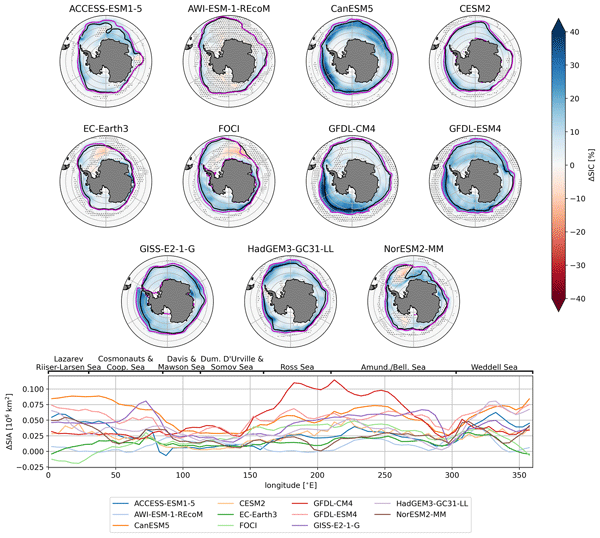
- 248: Fig. 4 does appear to show that there is a varying response between different models. Some models show a much more spatially homogeneous response (as a function of longitude) than others.You should mention this wide spread between the models. Which of these models are “consistent” with the simulations of Ashley et al. 2021? And are you able to attribute the differing behavior to different model representations of ocean circulation?
- 252: You refer to “sea ice volume changes shown here” but you are referencing Fig. 4, which is a figure of sea ice concentration. Shouldn't you be referencing figure 5?
- 256: I'm not sure this is immediately obvious from visual inspection of Fig. 2. Why not make a plot showing the derivative of this plot (i.e. the change in SIA with respect to time)? In lines 152-154, you should also quantify the difference between the magnitudes of the September and February increase, which can support this assertion.
- 280-283: Can you provide numbers quantifying these statements? E.g. what is the spatial variability in meltwater flux, and how much of the meltwater flux actually enters at depth instead of the surface?
- 290-291: This would benefit from some more context about the SOFIA protocol. Particularly as it pertains to future work building on this paper, you should briefly describe the design of the Tier 2 and Tier 3 SOFIA experiments.
Citation: https://doi.org/10.5194/egusphere-2026-658-RC2 -
AC2: 'Reply on RC2', Andrew G. Pauling, 16 Jul 2026
This appears to be a duplicate of the Comment from Anonymous Reviewer #2. Please refer to our response to that comment.
Citation: https://doi.org/10.5194/egusphere-2026-658-AC2
-
AC1: 'Reply on RC1', Andrew G. Pauling, 16 Jul 2026
The comment was uploaded in the form of a supplement: https://egusphere.copernicus.org/preprints/2026/egusphere-2026-658/egusphere-2026-658-AC1-supplement.pdf
-
RC2: 'Reply on RC1', Anonymous Referee #2, 13 Jun 2026
-
RC3: 'Comment on egusphere-2026-658', Anonymous Referee #2, 13 Jun 2026
Pauling et al. present the results of the Tier 1 SOFIA experiment: a multi-model ensemble simulating how Antarctic sea ice responds to spatially uniform meltwater flux from ice discharge. They find that the models exhibit a wide spread in the sea ice response, which can be attributed to mean-state sea ice area and volume, deep ocean convection, and mean-state ocean stratification. Overall, this is a well-written and scientifically valuable manuscript that fills a notable methodological gap. The limitations in the methodology are also appropriately qualified. My comments are primarily minor, and mostly pertain to presentation as opposed to methodology.
General comments:
- The authors should discuss the influence of spatial resolution on their results. As shown in Table 1, the different models used in SOFIA have varying spatial resolutions. The authors allude to the influence of spatial resolution in lines 275-278, where they discuss the AWI-ESM-1-REcoM model and its high resolution near the coast. Since the antwater experiment is dependent on specifically the grid cells adjacent to the coastline being perturbed by meltwater flux, I would think that differences in coastal grid cell resolution could have a significant influence on the results (e.g. finer resolution of continental shelf bathymetry and mesoscale circulation). The authors can also utilize existing literature on this topic (e.g. Rackow et al., 2022 (https://doi.org/10.1038/s41467-022-28259-y), who find a delayed sea ice response in higher-resolution CMIP5 simulations).
- The usage of “SI” to mean stratification index in a paper about sea ice (and where SIA and SIV are used as acronyms for sea ice-based metrics) is extremely confusing (e.g. in Fig. 10), I’d recommend changing that acronym to something more differentiated.
Specific comments:
- Table 1: The resolution column is confusingly formatted. When only one number is written, does this mean that the latitude and longitude spacing are on the same resolution? It would be better to explicitly write out all four numbers (both lat and lon for both ocean and atmosphere, even if they are the same), to avoid this confusion.
- 77-86: The specifics detailing the experimental design of SOFIA seems better suited to the “Data and Methods” section, rather than the Introduction. Instead, the Introduction may benefit from some more general contextualization of the SOFIA initiative.
- 91: Specify that piControl is a pre-industrial control run, and briefly describe the experiment and why you choose it, for glaciology-oriented readers less familiar with the CMIP world.
- 93: Is there a motivation behind the particular choice of the last 30 years? Is this selected because the model with the largest τ value has τ = 69.2, and 70 is the smallest number greater than that—so are you trying to select the greatest number of years that have all models in an equilibrium state? Whether that’s the reason or it’s something different, you should specify why you choose 30 years.
- 157: “Changes in sea ice volume are important for ocean–atmosphere fluxes of heat, moisture, and carbon as well as biology in this region”; add some representative citations here
- Fig. 10: In the caption, when you describe that the y-axis is “ensemble-mean Antarctic sea ice response,” clarify that this is the area response and not the volume response. Also, the legend overlaps with a datapoint in Fig. 10d.
- Fig. 10b: I’d be curious to see what this figure looks like as a correlation map, where you plot the correlation between ΔSIA and ΔSI for each grid cell. Are there geographic areas where this relationship better holds than others, and if so: does that provide you with any physical insight?
- 241-242: I'm unsure where the support for this statement is coming from in the paper. Fig. 10d doesn't show any significant trend between piControl sea ice volume and the change in sea ice area. Is it that the trend becomes significant when it's reported in percentage units, as opposed to km2? If so, make that clear, and provide a plot and/or quantitative support in the text. Also, is this statement assuming that thinness is interchangeable with sea ice volume?
- 248: Fig. 4 does appear to show that there is a varying response between different models. Some models show a much more spatially homogeneous response (as a function of longitude) than others.You should mention this wide spread between the models. Which of these models are “consistent” with the simulations of Ashley et al. 2021? And are you able to attribute the differing behavior to different model representations of ocean circulation?
- 252: You refer to “sea ice volume changes shown here” but you are referencing Fig. 4, which is a figure of sea ice concentration. Shouldn't you be referencing figure 5?
- 256: I'm not sure this is immediately obvious from visual inspection of Fig. 2. Why not make a plot showing the derivative of this plot (i.e. the change in SIA with respect to time)? In lines 152-154, you should also quantify the difference between the magnitudes of the September and February increase, which can support this assertion.
- 280-283: Can you provide numbers quantifying these statements? E.g. what is the spatial variability in meltwater flux, and how much of the meltwater flux actually enters at depth instead of the surface?
- 290-291: This would benefit from some more context about the SOFIA protocol. Particularly as it pertains to future work building on this paper, you should briefly describe the design of the Tier 2 and Tier 3 SOFIA experiments.
Citation: https://doi.org/10.5194/egusphere-2026-658-RC3 -
AC3: 'Reply on RC3', Andrew G. Pauling, 16 Jul 2026
The comment was uploaded in the form of a supplement: https://egusphere.copernicus.org/preprints/2026/egusphere-2026-658/egusphere-2026-658-AC3-supplement.pdf
Peer review completion


Interactive discussion
Status: closed
-
RC1: 'Comment on egusphere-2026-658', Anonymous Referee #1, 21 Apr 2026
The comment was uploaded in the form of a supplement: https://egusphere.copernicus.org/preprints/2026/egusphere-2026-658/egusphere-2026-658-RC1-supplement.pdf
-
RC2: 'Reply on RC1', Anonymous Referee #2, 13 Jun 2026
Pauling et al. present the results of the Tier 1 SOFIA experiment: a multi-model ensemble simulating how Antarctic sea ice responds to spatially uniform meltwater flux from ice discharge. They find that the models exhibit a wide spread in the sea ice response, which can be attributed to mean-state sea ice area and volume, deep ocean convection, and mean-state ocean stratification. Overall, this is a well-written and scientifically valuable manuscript that fills a notable methodological gap. The limitations in the methodology are also appropriately qualified. My comments are primarily minor, and mostly pertain to presentation as opposed to methodology.
General comments:
- The authors should discuss the influence of spatial resolution on their results. As shown in Table 1, the different models used in SOFIA have varying spatial resolutions. The authors allude to the influence of spatial resolution in lines 275-278, where they discuss the AWI-ESM-1-REcoM model and its high resolution near the coast. Since the antwater experiment is dependent on specifically the grid cells adjacent to the coastline being perturbed by meltwater flux, I would think that differences in coastal grid cell resolution could have a significant influence on the results (e.g. finer resolution of continental shelf bathymetry and mesoscale circulation). The authors can also utilize existing literature on this topic (e.g. Rackow et al., 2022 (https://doi.org/10.1038/s41467-022-28259-y), who find a delayed sea ice response in higher-resolution CMIP5 simulations).
- The usage of “SI” to mean stratification index in a paper about sea ice (and where SIA and SIV are used as acronyms for sea ice-based metrics) is extremely confusing (e.g. in Fig. 10), I’d recommend changing that acronym to something more differentiated.
Specific comments:
- Table 1: The resolution column is confusingly formatted. When only one number is written, does this mean that the latitude and longitude spacing are on the same resolution? It would be better to explicitly write out all four numbers (both lat and lon for both ocean and atmosphere, even if they are the same), to avoid this confusion.
- 77-86: The specifics detailing the experimental design of SOFIA seems better suited to the “Data and Methods” section, rather than the Introduction. Instead, the Introduction may benefit from some more general contextualization of the SOFIA initiative.
- 91: Specify that piControl is a pre-industrial control run, and briefly describe the experiment and why you choose it, for glaciology-oriented readers less familiar with the CMIP world.
- 93: Is there a motivation behind the particular choice of the last 30 years? Is this selected because the model with the largest τ value has τ = 69.2, and 70 is the smallest number greater than that—so are you trying to select the greatest number of years that have all models in an equilibrium state? Whether that’s the reason or it’s something different, you should specify why you choose 30 years.
- 157: “Changes in sea ice volume are important for ocean–atmosphere fluxes of heat, moisture, and carbon as well as biology in this region”; add some representative citations here
- Fig. 10: In the caption, when you describe that the y-axis is “ensemble-mean Antarctic sea ice response,” clarify that this is the area response and not the volume response. Also, the legend overlaps with a datapoint in Fig. 10d.
- Fig. 10b: I’d be curious to see what this figure looks like as a correlation map, where you plot the correlation between ΔSIA and ΔSI for each grid cell. Are there geographic areas where this relationship better holds than others, and if so: does that provide you with any physical insight?
- 241-242: I'm unsure where the support for this statement is coming from in the paper. Fig. 10d doesn't show any significant trend between piControl sea ice volume and the change in sea ice area. Is it that the trend becomes significant when it's reported in percentage units, as opposed to km2? If so, make that clear, and provide a plot and/or quantitative support in the text. Also, is this statement assuming that thinness is interchangeable with sea ice volume?
- 248: Fig. 4 does appear to show that there is a varying response between different models. Some models show a much more spatially homogeneous response (as a function of longitude) than others.You should mention this wide spread between the models. Which of these models are “consistent” with the simulations of Ashley et al. 2021? And are you able to attribute the differing behavior to different model representations of ocean circulation?
- 252: You refer to “sea ice volume changes shown here” but you are referencing Fig. 4, which is a figure of sea ice concentration. Shouldn't you be referencing figure 5?
- 256: I'm not sure this is immediately obvious from visual inspection of Fig. 2. Why not make a plot showing the derivative of this plot (i.e. the change in SIA with respect to time)? In lines 152-154, you should also quantify the difference between the magnitudes of the September and February increase, which can support this assertion.
- 280-283: Can you provide numbers quantifying these statements? E.g. what is the spatial variability in meltwater flux, and how much of the meltwater flux actually enters at depth instead of the surface?
- 290-291: This would benefit from some more context about the SOFIA protocol. Particularly as it pertains to future work building on this paper, you should briefly describe the design of the Tier 2 and Tier 3 SOFIA experiments.
Citation: https://doi.org/10.5194/egusphere-2026-658-RC2 -
AC2: 'Reply on RC2', Andrew G. Pauling, 16 Jul 2026
This appears to be a duplicate of the Comment from Anonymous Reviewer #2. Please refer to our response to that comment.
Citation: https://doi.org/10.5194/egusphere-2026-658-AC2
-
AC1: 'Reply on RC1', Andrew G. Pauling, 16 Jul 2026
The comment was uploaded in the form of a supplement: https://egusphere.copernicus.org/preprints/2026/egusphere-2026-658/egusphere-2026-658-AC1-supplement.pdf
-
RC2: 'Reply on RC1', Anonymous Referee #2, 13 Jun 2026
-
RC3: 'Comment on egusphere-2026-658', Anonymous Referee #2, 13 Jun 2026
Pauling et al. present the results of the Tier 1 SOFIA experiment: a multi-model ensemble simulating how Antarctic sea ice responds to spatially uniform meltwater flux from ice discharge. They find that the models exhibit a wide spread in the sea ice response, which can be attributed to mean-state sea ice area and volume, deep ocean convection, and mean-state ocean stratification. Overall, this is a well-written and scientifically valuable manuscript that fills a notable methodological gap. The limitations in the methodology are also appropriately qualified. My comments are primarily minor, and mostly pertain to presentation as opposed to methodology.
General comments:
- The authors should discuss the influence of spatial resolution on their results. As shown in Table 1, the different models used in SOFIA have varying spatial resolutions. The authors allude to the influence of spatial resolution in lines 275-278, where they discuss the AWI-ESM-1-REcoM model and its high resolution near the coast. Since the antwater experiment is dependent on specifically the grid cells adjacent to the coastline being perturbed by meltwater flux, I would think that differences in coastal grid cell resolution could have a significant influence on the results (e.g. finer resolution of continental shelf bathymetry and mesoscale circulation). The authors can also utilize existing literature on this topic (e.g. Rackow et al., 2022 (https://doi.org/10.1038/s41467-022-28259-y), who find a delayed sea ice response in higher-resolution CMIP5 simulations).
- The usage of “SI” to mean stratification index in a paper about sea ice (and where SIA and SIV are used as acronyms for sea ice-based metrics) is extremely confusing (e.g. in Fig. 10), I’d recommend changing that acronym to something more differentiated.
Specific comments:
- Table 1: The resolution column is confusingly formatted. When only one number is written, does this mean that the latitude and longitude spacing are on the same resolution? It would be better to explicitly write out all four numbers (both lat and lon for both ocean and atmosphere, even if they are the same), to avoid this confusion.
- 77-86: The specifics detailing the experimental design of SOFIA seems better suited to the “Data and Methods” section, rather than the Introduction. Instead, the Introduction may benefit from some more general contextualization of the SOFIA initiative.
- 91: Specify that piControl is a pre-industrial control run, and briefly describe the experiment and why you choose it, for glaciology-oriented readers less familiar with the CMIP world.
- 93: Is there a motivation behind the particular choice of the last 30 years? Is this selected because the model with the largest τ value has τ = 69.2, and 70 is the smallest number greater than that—so are you trying to select the greatest number of years that have all models in an equilibrium state? Whether that’s the reason or it’s something different, you should specify why you choose 30 years.
- 157: “Changes in sea ice volume are important for ocean–atmosphere fluxes of heat, moisture, and carbon as well as biology in this region”; add some representative citations here
- Fig. 10: In the caption, when you describe that the y-axis is “ensemble-mean Antarctic sea ice response,” clarify that this is the area response and not the volume response. Also, the legend overlaps with a datapoint in Fig. 10d.
- Fig. 10b: I’d be curious to see what this figure looks like as a correlation map, where you plot the correlation between ΔSIA and ΔSI for each grid cell. Are there geographic areas where this relationship better holds than others, and if so: does that provide you with any physical insight?
- 241-242: I'm unsure where the support for this statement is coming from in the paper. Fig. 10d doesn't show any significant trend between piControl sea ice volume and the change in sea ice area. Is it that the trend becomes significant when it's reported in percentage units, as opposed to km2? If so, make that clear, and provide a plot and/or quantitative support in the text. Also, is this statement assuming that thinness is interchangeable with sea ice volume?
- 248: Fig. 4 does appear to show that there is a varying response between different models. Some models show a much more spatially homogeneous response (as a function of longitude) than others.You should mention this wide spread between the models. Which of these models are “consistent” with the simulations of Ashley et al. 2021? And are you able to attribute the differing behavior to different model representations of ocean circulation?
- 252: You refer to “sea ice volume changes shown here” but you are referencing Fig. 4, which is a figure of sea ice concentration. Shouldn't you be referencing figure 5?
- 256: I'm not sure this is immediately obvious from visual inspection of Fig. 2. Why not make a plot showing the derivative of this plot (i.e. the change in SIA with respect to time)? In lines 152-154, you should also quantify the difference between the magnitudes of the September and February increase, which can support this assertion.
- 280-283: Can you provide numbers quantifying these statements? E.g. what is the spatial variability in meltwater flux, and how much of the meltwater flux actually enters at depth instead of the surface?
- 290-291: This would benefit from some more context about the SOFIA protocol. Particularly as it pertains to future work building on this paper, you should briefly describe the design of the Tier 2 and Tier 3 SOFIA experiments.
Citation: https://doi.org/10.5194/egusphere-2026-658-RC3 -
AC3: 'Reply on RC3', Andrew G. Pauling, 16 Jul 2026
The comment was uploaded in the form of a supplement: https://egusphere.copernicus.org/preprints/2026/egusphere-2026-658/egusphere-2026-658-AC3-supplement.pdf
Peer review completion
Journal article(s) based on this preprint
Model code and software
andrewpauling/sofiaice_tier1: sofiaice_tier1 Andrew Pauling https://zenodo.org/records/18476161
Viewed
| HTML | XML | Total | BibTeX | EndNote | |
|---|---|---|---|---|---|
| 621 | 232 | 39 | 892 | 52 | 48 |
- HTML: 621
- PDF: 232
- XML: 39
- Total: 892
- BibTeX: 52
- EndNote: 48
Viewed (geographical distribution)
| Country | # | Views | % |
|---|
| Total: | 0 |
| HTML: | 0 |
| PDF: | 0 |
| XML: | 0 |
- 1
Cited


Andrew G. Pauling

Inga J. Smith
Torge Martin
Jeff K. Ridley
David P. Stevens
Max Thomas
Rebecca L. Beadling
Christopher Danek
Tore Hattermann
Qian Li
John Marshall
Morven Muilwijk
Ariaan Purich
Neil C. Swart
The requested preprint has a corresponding peer-reviewed final revised paper. You are encouraged to refer to the final revised version.
- Preprint
(21281 KB) - Metadata XML