
the Creative Commons Attribution 4.0 License.
the Creative Commons Attribution 4.0 License.
 | 06 Feb 2026
Understanding the resilient carbon cycle response to the 2014–2015 Blob event in the Gulf of Alaska using a regional ocean biogeochemical model
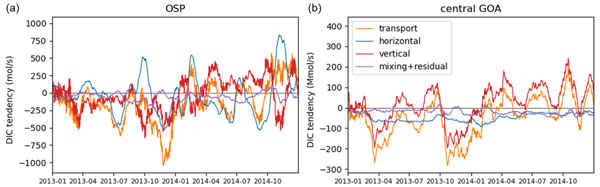
Abstract. Marine heatwaves (MHWs), characterized by anomalously high sea surface temperatures, are occurring with increasing frequency and intensity, profoundly impacting ocean circulation, biogeochemistry, and marine ecosystems. The MHW known as the Blob, which persisted in the subarctic NE Pacific from 2014 to 2015, significantly affected surrounding ecosystems. Warming-induced solubility reduction is expected to raise the partial pressure of carbon dioxide (pCO2) in the surface water, causing outgassing of CO2 to the atmosphere. Outgassing of CO2 is another source of atmospheric CO2 in addition to anthropogenic fossil fuel burning. However, moored observations at Ocean Station Papa (OSP; 145° W, 50° N) shows a moderate decrease in oceanic pCO2 during the Blob, resisting the warming-induced outgassing of CO2. This response is opposite of what is expected from warming alone, and instead has been attributed to reductions in dissolved inorganic carbon (DIC), although the mechanisms driving this reduction have remained unclear. We employed a regional model that accurately reproduces the temporal variability of oceanic pCO2 at OSP to investigate the cause of decrease pCO2 during the Blob. The analysis of model outputs indicates that the observed oceanic pCO2 decline resulted from the offset between warming-induced solubility reduction (increasing pCO2) and weakened physical transport of DIC (decreasing pCO2), with the latter dominating. Both horizontal and vertical transports played important roles. The near-surface carbon budget over the broad region was primarily driven by changes in the vertical transport. The decrease in DIC during the Blob resulted from the suppression of upwelling of DIC-rich subsurface waters in the winter of 2013. In this period, the horizontal transport also contributed substantially to DIC reduction. In particular, at OSP, the effect of the horizontal transport was comparable to that of the vertical transport, reflecting the northward advection of low-DIC water masses. These findings indicate that changes in physical circulation were the primary driver of the moderately enhanced CO2 uptake observed during the Blob. This study provides a critical insight into the complexity of biogeochemical response to extreme warming events and underscores the importance of resolving physical transport processes in assessing oceanic carbon uptake during MHWs.
-
Notice on discussion status
The requested preprint has a corresponding peer-reviewed final revised paper. You are encouraged to refer to the final revised version.
-
Preprint
(2900 KB)
-
Supplement
(1199 KB)
-
The requested preprint has a corresponding peer-reviewed final revised paper. You are encouraged to refer to the final revised version.
- Preprint
(2900 KB) - Metadata XML
-
Supplement
(1199 KB) - BibTeX
- EndNote
- Final revised paper


Journal article(s) based on this preprint
Interactive discussion
Status: closed
-
RC1: 'Comment on egusphere-2026-657', Anonymous Referee #1, 21 Feb 2026
-
AC1: 'Reply on RC1', Yumi Abe, 16 Apr 2026
The comment was uploaded in the form of a supplement: https://egusphere.copernicus.org/preprints/2026/egusphere-2026-657/egusphere-2026-657-AC1-supplement.pdf
-
AC1: 'Reply on RC1', Yumi Abe, 16 Apr 2026
-
RC2: 'Comment on egusphere-2026-657', Anonymous Referee #2, 05 Mar 2026
In this manuscript, the authors explore the impacts of a regional MHW (in the Northeast Pacific) on CO2 using a novel regional model configured for the Northeast Pacific that is validated, and compared, to observational products. Results indicate that changes in pCO2 are primarily driven by the compensation between increased temperatures (which raises pCO2) and lowered Dissolved Inorganic Carbon (DIC; which lowers pCO2) in the surface ocean. Results suggest that DIC is the dominant driver of changes in pCO2, and is decomposed to demonstrate that changes in DIC stem primarily from changes in transport (both vertical and horizontal). While I find the analysis robust, I believe that the authors could expand their work to strengthen their arguments and contribute to fundamental understandings of the impacts of MHW on regional marine carbon cycling.
First, I think it is important that the authors directly compare the physical manifestations of the Blob across model and observational products to demonstrate that they do show the same spatial and temporal extent. I would be curious to see how SST anomalies during the Blob compare across these data, and if differences in their representation might have any impact on interpretation of results.
If possible, I also recommend the expansion of this analysis to other manifestations of MHWs in the region (as described by Amaya 2020, and examined by Kohlman 2025) to demonstrate the robustness of these results across discrete warming events. I know that the 2019 MHW is outside of the integration for the model used in this study, but could you examine prior MHW? I am curious to see if the responses of pCO2 is identical or shows discrete differences for different MHW, as demonstrated by Kohlman 2025. This would also connect to the broader implications of this work – can the response demonstrated be considered the expected response in the Northeast Pacific? Or, is the response event-dependent.
I would also recommend a thorough read through to ensure consistency in the tense used throughout the manuscript.
Aside from the major comments above, I noted a few explicit instances in the text that could be clarified:
Line 17: also ‘is’ to ‘would be’
Line 34-35: I would suggest including an expanded definition of MHWs here to better orient the reader, i.e. “short-term statistical extremes in sea surface temperature, called marine heatwaves”
Line 168: ‘is at odds against’ could be simplified
Citation: https://doi.org/10.5194/egusphere-2026-657-RC2 -
AC2: 'Reply on RC2', Yumi Abe, 16 Apr 2026
The comment was uploaded in the form of a supplement: https://egusphere.copernicus.org/preprints/2026/egusphere-2026-657/egusphere-2026-657-AC2-supplement.pdf
-
AC2: 'Reply on RC2', Yumi Abe, 16 Apr 2026
-
RC3: 'Comment on egusphere-2026-657', Anonymous Referee #3, 25 Mar 2026
The comment was uploaded in the form of a supplement: https://egusphere.copernicus.org/preprints/2026/egusphere-2026-657/egusphere-2026-657-RC3-supplement.pdf
-
AC3: 'Reply on RC3', Yumi Abe, 16 Apr 2026
The comment was uploaded in the form of a supplement: https://egusphere.copernicus.org/preprints/2026/egusphere-2026-657/egusphere-2026-657-AC3-supplement.pdf
-
AC3: 'Reply on RC3', Yumi Abe, 16 Apr 2026
Peer review completion


Interactive discussion
Status: closed
-
RC1: 'Comment on egusphere-2026-657', Anonymous Referee #1, 21 Feb 2026
;;;;;;;;;; General comment:
Since about 10 years MHW have been recognized at regional or global scale. This is a “hot” (or “warm”) topic as this could impact ocean biogeochemistry, marine ecosystems and air-sea CO2 fluxes. For the oceanic carbon cycle, this has been recognized at regional scales, in the North Atlantic (e.g. Chau et al, 2024a; Müller et al, 2025), the subarctic Pacific Ocean (Bif et al, 2025), the Mozambique Channel (Metzl et al, 2025), or at global scale (Mignot et al, 2022; Ford, et al 2025). Here, the authors explore the impact of MHW in the North Pacific during the so-called Blob event in 2015-2017. In this region, the impact of MHW on CO2 flux has been studied (Mignot et al, 2022; Ford, et al 2025) but results presented different scenario: does the MHW lead to an increasing or decreasing of the ocean CO2 sink in the North Pacific. What are the drivers of the observed changes ?
Using a model, authors showed an intriguing result: the higher SST during the Blob cannot account for the changes of pCO2, not only at station P but also at regional scale in the Gulf of Alaska. I guess previous work analyzed the pCO2 change only, not the changes in DIC and associated processes. Here authors show that the transport is important. For validation/comparison authors used pCO2 from the Seaflux product (Fay et al 2021). This includes the CMEMS-FFNN product (identified in Figure 3). This product also offers results of the carbonate system properties (TALK, DIC). It would be useful to compare the DIC distribution from the model with the DIC derived from CMEMS-FFNN (Chau et al, 2024b).
The introduction is very clear as well as the description of the model, although one has to read Li et al (2025 unpublished) to get a view of the validation for the physics, nutrients and NPP. Here authors add a validation results for pCO2 (Figure 2 and 3). Figures are adapted but I would suggest add a map of the SST anomaly during the Blob for readers not familiar with this region/event. It would have been interesting to inform the regional changes in term of integrated CO2 fluxes (e.g. in TgC/yr) and it would be useful to add a table with the results of annual CO2 flux integrated over the investigated region (45-60N/155-125W) from the model and SeaFlux, before, during, and after the Blob event.
The manuscript is suitable for publication after minor revision. Specific and minor comments are listed below.
;;;;;;;; Specific comments
C-01: The Abstract is somehow long.
C-02: Line 31: Friedlingstein et al., (2022), not in reference
C-03: Line 36: “In particular, the persistent MHW that occurred in the subarctic NE Pacific from the winter of 2013 to 2015, known as the Blob…”. Here maybe add a map of the SST anomaly for readers not familiar with this region and the Blob event.
C-04: Line 82: “The model has been validated against a suite of physical and biogeochemical observations (Ito et al., 2025)”. Ito et al 2025, is apparently not yet published. “Biogeochemical observations” is somehow general. These authors compared the model with physical, nutrients (climatology not in-situ time-series data) or NPP, but not pCO2 or carbonate system data such as DIC or TALK (e.g. from GLODAP). It would be useful to specify that the validation concerned only surface waters, i.e. no water column observations used for validation although the results investigate the DIC changes in the water column as presented in Figure 6.
C-05: Line 83: “The simulated temporal variability of oceanic pCO₂ is validated with the NOAA (Pacific Marine Environmental Laboratory’s Ocean Climate Stations and Carbon groups) mooring at OSP (Emerson et al., 2011; Cronin et al., 2015).” Why selecting only this data-set for validation ? Would be interesting to use other data available in this region (e.g. from SOCAT, Bakker et al, 2016) or mention that there is no data for the investigated period to validate your simulation.
C-06: Line 92: “The regional ocean circulation and biogeochemistry model used in this study follows the configuration described in Ito et al. (2025), thus only a brief description is provided here, while full details can be found in their paper.” This is correct, but the reference is not yet published.
C-07: Line 162: Before showing the results for pCO2 I think a plot of SST anomalies during the Blob event should presented (for readers not familiar with this region and MHW, see comment C-03). Although this is presented in Figure 3 for OSP times-series, a regional map of SST anomalies would be useful to show the extent of the Blob and thus how this would impact the CO2 flux integrated over the full region (XXX TgC/yr).
C-08: Line 163: “…indicating that the GOA is on average a sink of atmospheric CO2 (Fig. 1a).” Maybe specify the region is a sink for all seasons ?
C-09: Line 172: Figure 1 caption: could you specify more clearly each panel (a,b,c,d).
C-10: Figure 1d: Not sure to understand Figure 1d: Authors use GLODAP to calculate pCO2 for the period 2014-2015. Are the DIC ALK data from GLODAP correspond to this period or did you correct DIC for this reference year (taking into account the anthropogenic signal). Please clarify.
C-11: Figure 1: As pCO2 (and thus DpCO2) present large seasonality, would it be better to show the maps of annual CO2 flux instead the mean DpCO2 ?.
C-12: Line 196: Authors write: “During the Blub, both the mooring observations and model show pronounced decline in oceanic pCO₂.” Typo: Blub or Blob ?
C-13: Line 213: Authors write: “Observations show that oceanic pCO₂ increases due to SST changes during the Blob by about +20 μatm…”. Please specify which observations? OSP time-series? Other observations ?
C-14: Line 216: Authors write:”… the net oceanic pCO₂ change of around −10 μatm is primarily driven by the DIC, explaining the oceanic pCO2 decreases during the Blob.” It would be useful to show the time-series of DIC result (e.g. to add in Figure 3). Is the model result coherent with other data-products such as CMEMS (Chau et al, 2024b).
C-15 Line 310: Betten et al., (2022). Check name for reference Batten et al., (2022).
C-16: In Supp. Mat.: “Figure S1: Climatology of DIC from the model. The star indicates the location of OSP”. Please, specify what is “climatology”: average for all seasons and for a period 2000-2017, or for a specific year ?
C-17: Why one calls this warming event a “Blob” ? Acronym for « Bizarre Large Ocean Bubble” ?
;;;;;;;;;;; Reference added in this review not listed in the manuscript
Bakker, D. C. E., et al: A multi-decade record of high-quality fCO2 data in version 3 of the Surface Ocean CO2 Atlas (SOCAT), Earth Syst. Sci. Data, 8, 383-413, doi:10.5194/essd-8-383-2016, 2016
Bif, M.B., Kellogg, C.T.E., Huang, Y. et al. Marine heatwaves modulate food webs and carbon transport processes. Nat Commun 16, 8535 (2025). https://doi.org/10.1038/s41467-025-63605-w
Chau, T.‐T.‐T., Chevallier, F., & Gehlen, M. (2024a). Global analysis of surface ocean CO2 fugacity and air‐sea fluxes with low latency. Geophysical Research Letters, 51, e2023GL106670. https://doi.
org/10.1029/2023GL106670
Chau, T.-T.-T., et al.,: CMEMS-LSCE: a global, 0.25°, monthly reconstruction of the surface ocean carbonate system, Earth Syst. Sci. Data, 16, 121–160, https://doi.org/10.5194/essd-16-121-2024, 2024b.
Ford, D. J., et al, 2025. Regionally different marine heatwave ocean carbon sink responses are consistent with carbonate understanding, Environ. Res. Commun., 7, 111009, DOI 10.1088/2515-7620/ae15e0
Metzl, N., Lo Monaco, C., Tribollet, A., Ternon, J.-F., Chevallier, F., and Gehlen, M.: New observations confirm the progressive acidification in the Mozambique Channel, Biogeosciences, 22, 7187–7204, https://doi.org/10.5194/bg-22-7187-2025, 2025.
;;;;;;;;; end review
Citation: https://doi.org/10.5194/egusphere-2026-657-RC1 -
AC1: 'Reply on RC1', Yumi Abe, 16 Apr 2026
The comment was uploaded in the form of a supplement: https://egusphere.copernicus.org/preprints/2026/egusphere-2026-657/egusphere-2026-657-AC1-supplement.pdf
-
AC1: 'Reply on RC1', Yumi Abe, 16 Apr 2026
-
RC2: 'Comment on egusphere-2026-657', Anonymous Referee #2, 05 Mar 2026
In this manuscript, the authors explore the impacts of a regional MHW (in the Northeast Pacific) on CO2 using a novel regional model configured for the Northeast Pacific that is validated, and compared, to observational products. Results indicate that changes in pCO2 are primarily driven by the compensation between increased temperatures (which raises pCO2) and lowered Dissolved Inorganic Carbon (DIC; which lowers pCO2) in the surface ocean. Results suggest that DIC is the dominant driver of changes in pCO2, and is decomposed to demonstrate that changes in DIC stem primarily from changes in transport (both vertical and horizontal). While I find the analysis robust, I believe that the authors could expand their work to strengthen their arguments and contribute to fundamental understandings of the impacts of MHW on regional marine carbon cycling.
First, I think it is important that the authors directly compare the physical manifestations of the Blob across model and observational products to demonstrate that they do show the same spatial and temporal extent. I would be curious to see how SST anomalies during the Blob compare across these data, and if differences in their representation might have any impact on interpretation of results.
If possible, I also recommend the expansion of this analysis to other manifestations of MHWs in the region (as described by Amaya 2020, and examined by Kohlman 2025) to demonstrate the robustness of these results across discrete warming events. I know that the 2019 MHW is outside of the integration for the model used in this study, but could you examine prior MHW? I am curious to see if the responses of pCO2 is identical or shows discrete differences for different MHW, as demonstrated by Kohlman 2025. This would also connect to the broader implications of this work – can the response demonstrated be considered the expected response in the Northeast Pacific? Or, is the response event-dependent.
I would also recommend a thorough read through to ensure consistency in the tense used throughout the manuscript.
Aside from the major comments above, I noted a few explicit instances in the text that could be clarified:
Line 17: also ‘is’ to ‘would be’
Line 34-35: I would suggest including an expanded definition of MHWs here to better orient the reader, i.e. “short-term statistical extremes in sea surface temperature, called marine heatwaves”
Line 168: ‘is at odds against’ could be simplified
Citation: https://doi.org/10.5194/egusphere-2026-657-RC2 -
AC2: 'Reply on RC2', Yumi Abe, 16 Apr 2026
The comment was uploaded in the form of a supplement: https://egusphere.copernicus.org/preprints/2026/egusphere-2026-657/egusphere-2026-657-AC2-supplement.pdf
-
AC2: 'Reply on RC2', Yumi Abe, 16 Apr 2026
-
RC3: 'Comment on egusphere-2026-657', Anonymous Referee #3, 25 Mar 2026
The comment was uploaded in the form of a supplement: https://egusphere.copernicus.org/preprints/2026/egusphere-2026-657/egusphere-2026-657-RC3-supplement.pdf
-
AC3: 'Reply on RC3', Yumi Abe, 16 Apr 2026
The comment was uploaded in the form of a supplement: https://egusphere.copernicus.org/preprints/2026/egusphere-2026-657/egusphere-2026-657-AC3-supplement.pdf
-
AC3: 'Reply on RC3', Yumi Abe, 16 Apr 2026
Peer review completion
Journal article(s) based on this preprint
Viewed
| HTML | XML | Total | Supplement | BibTeX | EndNote | |
|---|---|---|---|---|---|---|
| 1,222 | 511 | 118 | 1,851 | 269 | 248 | 297 |
- HTML: 1,222
- PDF: 511
- XML: 118
- Total: 1,851
- Supplement: 269
- BibTeX: 248
- EndNote: 297
Viewed (geographical distribution)
| Country | # | Views | % |
|---|
| Total: | 0 |
| HTML: | 0 |
| PDF: | 0 |
| XML: | 0 |
- 1

Takamitsu Ito
Amanda H. V. Timmerman
Christopher T. Reinhard
Joseph P. Montoya
The requested preprint has a corresponding peer-reviewed final revised paper. You are encouraged to refer to the final revised version.
- Preprint
(2900 KB) - Metadata XML
-
Supplement
(1199 KB) - BibTeX
- EndNote
- Final revised paper
;;;;;;;;;; General comment:
Since about 10 years MHW have been recognized at regional or global scale. This is a “hot” (or “warm”) topic as this could impact ocean biogeochemistry, marine ecosystems and air-sea CO2 fluxes. For the oceanic carbon cycle, this has been recognized at regional scales, in the North Atlantic (e.g. Chau et al, 2024a; Müller et al, 2025), the subarctic Pacific Ocean (Bif et al, 2025), the Mozambique Channel (Metzl et al, 2025), or at global scale (Mignot et al, 2022; Ford, et al 2025). Here, the authors explore the impact of MHW in the North Pacific during the so-called Blob event in 2015-2017. In this region, the impact of MHW on CO2 flux has been studied (Mignot et al, 2022; Ford, et al 2025) but results presented different scenario: does the MHW lead to an increasing or decreasing of the ocean CO2 sink in the North Pacific. What are the drivers of the observed changes ?
Using a model, authors showed an intriguing result: the higher SST during the Blob cannot account for the changes of pCO2, not only at station P but also at regional scale in the Gulf of Alaska. I guess previous work analyzed the pCO2 change only, not the changes in DIC and associated processes. Here authors show that the transport is important. For validation/comparison authors used pCO2 from the Seaflux product (Fay et al 2021). This includes the CMEMS-FFNN product (identified in Figure 3). This product also offers results of the carbonate system properties (TALK, DIC). It would be useful to compare the DIC distribution from the model with the DIC derived from CMEMS-FFNN (Chau et al, 2024b).
The introduction is very clear as well as the description of the model, although one has to read Li et al (2025 unpublished) to get a view of the validation for the physics, nutrients and NPP. Here authors add a validation results for pCO2 (Figure 2 and 3). Figures are adapted but I would suggest add a map of the SST anomaly during the Blob for readers not familiar with this region/event. It would have been interesting to inform the regional changes in term of integrated CO2 fluxes (e.g. in TgC/yr) and it would be useful to add a table with the results of annual CO2 flux integrated over the investigated region (45-60N/155-125W) from the model and SeaFlux, before, during, and after the Blob event.
The manuscript is suitable for publication after minor revision. Specific and minor comments are listed below.
;;;;;;;; Specific comments
C-01: The Abstract is somehow long.
C-02: Line 31: Friedlingstein et al., (2022), not in reference
C-03: Line 36: “In particular, the persistent MHW that occurred in the subarctic NE Pacific from the winter of 2013 to 2015, known as the Blob…”. Here maybe add a map of the SST anomaly for readers not familiar with this region and the Blob event.
C-04: Line 82: “The model has been validated against a suite of physical and biogeochemical observations (Ito et al., 2025)”. Ito et al 2025, is apparently not yet published. “Biogeochemical observations” is somehow general. These authors compared the model with physical, nutrients (climatology not in-situ time-series data) or NPP, but not pCO2 or carbonate system data such as DIC or TALK (e.g. from GLODAP). It would be useful to specify that the validation concerned only surface waters, i.e. no water column observations used for validation although the results investigate the DIC changes in the water column as presented in Figure 6.
C-05: Line 83: “The simulated temporal variability of oceanic pCO₂ is validated with the NOAA (Pacific Marine Environmental Laboratory’s Ocean Climate Stations and Carbon groups) mooring at OSP (Emerson et al., 2011; Cronin et al., 2015).” Why selecting only this data-set for validation ? Would be interesting to use other data available in this region (e.g. from SOCAT, Bakker et al, 2016) or mention that there is no data for the investigated period to validate your simulation.
C-06: Line 92: “The regional ocean circulation and biogeochemistry model used in this study follows the configuration described in Ito et al. (2025), thus only a brief description is provided here, while full details can be found in their paper.” This is correct, but the reference is not yet published.
C-07: Line 162: Before showing the results for pCO2 I think a plot of SST anomalies during the Blob event should presented (for readers not familiar with this region and MHW, see comment C-03). Although this is presented in Figure 3 for OSP times-series, a regional map of SST anomalies would be useful to show the extent of the Blob and thus how this would impact the CO2 flux integrated over the full region (XXX TgC/yr).
C-08: Line 163: “…indicating that the GOA is on average a sink of atmospheric CO2 (Fig. 1a).” Maybe specify the region is a sink for all seasons ?
C-09: Line 172: Figure 1 caption: could you specify more clearly each panel (a,b,c,d).
C-10: Figure 1d: Not sure to understand Figure 1d: Authors use GLODAP to calculate pCO2 for the period 2014-2015. Are the DIC ALK data from GLODAP correspond to this period or did you correct DIC for this reference year (taking into account the anthropogenic signal). Please clarify.
C-11: Figure 1: As pCO2 (and thus DpCO2) present large seasonality, would it be better to show the maps of annual CO2 flux instead the mean DpCO2 ?.
C-12: Line 196: Authors write: “During the Blub, both the mooring observations and model show pronounced decline in oceanic pCO₂.” Typo: Blub or Blob ?
C-13: Line 213: Authors write: “Observations show that oceanic pCO₂ increases due to SST changes during the Blob by about +20 μatm…”. Please specify which observations? OSP time-series? Other observations ?
C-14: Line 216: Authors write:”… the net oceanic pCO₂ change of around −10 μatm is primarily driven by the DIC, explaining the oceanic pCO2 decreases during the Blob.” It would be useful to show the time-series of DIC result (e.g. to add in Figure 3). Is the model result coherent with other data-products such as CMEMS (Chau et al, 2024b).
C-15 Line 310: Betten et al., (2022). Check name for reference Batten et al., (2022).
C-16: In Supp. Mat.: “Figure S1: Climatology of DIC from the model. The star indicates the location of OSP”. Please, specify what is “climatology”: average for all seasons and for a period 2000-2017, or for a specific year ?
C-17: Why one calls this warming event a “Blob” ? Acronym for « Bizarre Large Ocean Bubble” ?
;;;;;;;;;;; Reference added in this review not listed in the manuscript
Bakker, D. C. E., et al: A multi-decade record of high-quality fCO2 data in version 3 of the Surface Ocean CO2 Atlas (SOCAT), Earth Syst. Sci. Data, 8, 383-413, doi:10.5194/essd-8-383-2016, 2016
Bif, M.B., Kellogg, C.T.E., Huang, Y. et al. Marine heatwaves modulate food webs and carbon transport processes. Nat Commun 16, 8535 (2025). https://doi.org/10.1038/s41467-025-63605-w
Chau, T.‐T.‐T., Chevallier, F., & Gehlen, M. (2024a). Global analysis of surface ocean CO2 fugacity and air‐sea fluxes with low latency. Geophysical Research Letters, 51, e2023GL106670. https://doi.
org/10.1029/2023GL106670
Chau, T.-T.-T., et al.,: CMEMS-LSCE: a global, 0.25°, monthly reconstruction of the surface ocean carbonate system, Earth Syst. Sci. Data, 16, 121–160, https://doi.org/10.5194/essd-16-121-2024, 2024b.
Ford, D. J., et al, 2025. Regionally different marine heatwave ocean carbon sink responses are consistent with carbonate understanding, Environ. Res. Commun., 7, 111009, DOI 10.1088/2515-7620/ae15e0
Metzl, N., Lo Monaco, C., Tribollet, A., Ternon, J.-F., Chevallier, F., and Gehlen, M.: New observations confirm the progressive acidification in the Mozambique Channel, Biogeosciences, 22, 7187–7204, https://doi.org/10.5194/bg-22-7187-2025, 2025.
;;;;;;;;; end review