
the Creative Commons Attribution 4.0 License.
the Creative Commons Attribution 4.0 License.
 | 11 Mar 2026
Assessing Ozone Dynamics During the 2023 Summer STAQS Field Campaign Using Synergistic Observations and Model Simulations
Abstract. NASA's Tropospheric Emissions: Monitoring of Pollution (TEMPO) geostationary satellite sensor provides high temporal and spatial resolution measurements critical for monitoring air quality. During the Synergistic TEMPO Air Quality Science (STAQS) component of the 2023 AGES+ campaign, extensive surface, airborne, and remote-sensing observations were collected over the New York City/Long Island Sound region, enabling comprehensive investigation of ozone and its precursors, including nitrogen dioxide (NO2) and formaldehyde (HCHO). Evaluating TEMPO (version 3) NO2 and HCHO column retrievals against Pandora and GEO-CAPE Airborne Simulator (GCAS) observations shows TEMPO can capture urban-suburban pollution gradients and exhibits biases comparable to previous satellite validation studies with strong agreements for NO2 (R ≈ 0.79–0.81), though sharp transitions between high and low emission regions remain challenging. The high-resolution (1.33 km × 1.33 km) WRF-Chem simulation reproduces the major spatiotemporal patterns of surface ozone and NO2 (R ≈ 0.56–0.73), supporting its use to fill observational gaps. By integrating TEMPO, WRF-Chem, in situ measurements, and Tropospheric Ozone Lidar network and Doppler wind lidar observations, we characterize the spatiotemporal dynamics of ozone under different pollution regimes. High-pollution days involve early urban precursor accumulation, entrainment of pollutant-rich residual-layer air, and sea-breeze-driven recirculation toward coastal regions. Moderate days exhibit localized enhancements driven by transport, such as downwind plume transport, while low-pollution days show efficient dispersion and limited ozone formation. This multi-platform framework highlights the importance of resolving fine-scale variability in coastal and transition zones and demonstrates TEMPO's value for improving ozone forecasting and mitigation in complex environments
-
Notice on discussion status
The requested preprint has a corresponding peer-reviewed final revised paper. You are encouraged to refer to the final revised version.
-
Preprint
(78019 KB)
-
Supplement
(43332 KB)
-
The requested preprint has a corresponding peer-reviewed final revised paper. You are encouraged to refer to the final revised version.
- Preprint
(78019 KB) - Metadata XML
-
Supplement
(43332 KB) - BibTeX
- EndNote
- Final revised paper


Journal article(s) based on this preprint
Interactive discussion
Status: closed
- RC1: 'Comment on egusphere-2026-581', Anonymous Referee #1, 22 Mar 2026
-
RC2: 'Comment on egusphere-2026-581', Anonymous Referee #2, 18 May 2026
Overall, this is a well-written and scientifically valuable manuscript that combines multiple observational platforms, including TEMPO, GCAS, Pandora, TOLNet lidar observations, surface measurements, and WRF-Chem simulations, to investigate Long Island coastal ozone evolution and transport processes during the 2023 STAQS deployment periods. The multi-platform observational framework and integration of satellite, airborne, lidar, and modeling datasets provide a comprehensive perspective on ozone variability and coastal transport dynamics. The manuscript is generally well organized, and the observational analyses are detailed and informative. Before supporting publication in ACP, I have several comments as listed below:
(1) The manuscript relies heavily on simulated vertical ozone structure to support the residual-layer entrainment interpretation on July 28; however, model evaluation is primarily limited to surface ozone comparisons. Since the proposed mechanism depends strongly on elevated residual-layer ozone reservoirs and subsequent downward mixing, additional evaluation of the modeled vertical ozone distribution against the TOLNet ozone lidar observations would strengthen confidence in the interpretation.
(2) Because the interpretation depends strongly on sea-breeze-driven transport and coastal circulation evolution, additional evaluation of the simulated sea-breeze front against the available Doppler lidar wind observations would strengthen the manuscript. In particular, it would be helpful to assess whether the model accurately reproduces the timing, inland penetration, frontal position, and vertical structure of the observed sea-breeze circulation, since ozone transport pathways and recirculation patterns are highly sensitive to sea-breeze evolution for Long Island region.
(3) The interpretation of the July 28 ozone enhancement mechanism remains somewhat unconvincing to me. While the manuscript emphasizes residual-layer entrainment and overnight marine boundary-layer accumulation, the observational evidence for these mechanisms is not fully convincing. In particular, it is unclear whether elevated ozone concentrations were directly observed within the shallow marine boundary layer at the coastal sites. In addition, although the model simulations show elevated ozone aloft, I do not clearly see evidence of the subsequent downward transport or entrainment flux that would connect the elevated ozone reservoir to the later surface ozone enhancement.
Alternatively, the July 28 event may actually reflect coastal recirculation and convergence processes within the Long Island Sound region. The GCAS NO₂ and HCHO VCD observations suggest widespread photochemical processing across the coastal environment, while the spatial distribution of enhanced precursor levels appears consistent with convergence between the south shore sea breeze and opposing coastal/land-breeze circulations from Connecticut. Ozone produced in the urban downwind region could follow the south-shore sea-breeze and subsequently be transported toward the Long Island Sound region, where convergent coastal circulations could favor ozone accumulation and recirculation rather than primarily downward entrainment from elevated residual layers. If residual-layer entrainment is indeed an important contributor, it would be helpful if the model analysis could further quantify the relative contributions of residual-layer transport versus coastal convergence/recirculation processes to the observed July 28 ozone enhancement. Additional discussion of these potential convergence-driven ozone production mechanisms would strengthen the interpretation of the July 28 event.
Citation: https://doi.org/10.5194/egusphere-2026-581-RC2 - AC1: 'Comment on egusphere-2026-581', Claudia Bernier, 30 Jun 2026
Peer review completion


Interactive discussion
Status: closed
-
RC1: 'Comment on egusphere-2026-581', Anonymous Referee #1, 22 Mar 2026
This manuscript presents an analysis of O3 and precursor variability during the 2023 STAQS campaign over the NYC/LIS region, using a combination of TEMPO L2 v3 NO2 and HCHO retrievals, PANDORA observations, GCAS measurements, in situ aircraft data, TOLNet and Doppler lidar observations, and high-resolution WRF-Chem simulations. The topic is timely and relevant to ACP, particularly given the early scientific use of TEMPO observations in a complex urban-coastal environment where both chemistry and mesoscale meteorology play important roles. The manuscript also benefits from the unusually rich observational context available during STAQS. Overall, I find the study potentially suitable for publication after careful revision. The manuscript has clear strengths, but several of the central interpretations are currently stronger than the supporting evidence warrants. In particular, some conclusions regarding TEMPO performance across pollution regimes, the mechanistic attribution of the selected O3 episodes, and the use of HCHO/NO2 ratios in diagnosing chemical sensitivity require a more cautious and better substantiated presentation.
Several major issues must be addressed before the paper can be accepted for publication.
First, some important information of the method is missing, and some discussions require clarifications.
1. The manuscript draws broader conclusions about TEMPO performance than are currently supported by the available validation dataset.
The intercomparisons with PANDORA and GCAS are useful, but the dataset remains limited in ways that should be more explicitly reflected in the scope of the conclusions. In particular, the GCAS comparisons appear to rely on only two flight days, and the manuscript itself notes limited spatiotemporal coincidence, small sample sizes, and the possibility of sampling-related smoothing of gradients for short-lived species such as NO2.
Given these limitations, some of the broader statements regarding regime-dependent TEMPO performance appear too strong. In particular, the conclusion that TEMPO captures precursor variability more accurately under cleaner conditions, but is less capable in moderate or more complex environments, may be reasonable as a preliminary inference, but it is not yet demonstrated in a sufficiently systematic way. This manuscript would benefit from a clearer distinction between conclusions that are directly supported by the collocated comparisons and those that remain case-specific interpretations. At least, the authors should: (1) report sample sizes more consistently for each intercomparison and subset, (2) clarify which conclusions are robustly supported by the available coincidences, and (3) moderate language where the current evidence remains limited.
2. The mechanistic interpretation of the high-pollution cases, especially 28 July, remains more inferential than the manuscript currently acknowledges.
The interpretation of the 26 July case is comparatively well supported by the combination of precursor buildup, observed wind evolution, and the spatial O3 pattern. The interpretation of the 28 July case is less direct. The manuscript attributes the event to overnight accumulation within the shallow marine boundary layer and/or residual layer, followed by daytime entrainment into the growing boundary layer. While this is a plausible interpretation, the manuscript itself indicates that the evidence is indirect and that additional observations from the previous evening would have strengthened this conclusion.
This distinction is important because the scientific narrative of the paper relies substantially on the contrast between these two high-ozone cases. At present, the manuscript sometimes presents the 28 July mechanism in a manner that reads as demonstrated rather than inferred. I suggest revising this section so that the evidentiary basis is more transparent. In particular, the discussion should more clearly separate: direct observational support, model-assisted interpretation, and remaining uncertainty or plausible alternative explanations.
3. The manuscript relies heavily on WRF-Chem for process attribution, but the model evaluation provided is relatively limited for that purpose.
The authors state that Sect. 3.1.1 is not intended as a detailed model evaluation, but rather as a demonstration that the model can help fill observational gaps. That is a reasonable objective. However, later sections use WRF-Chem extensively to support process-level interpretations, including the vertical and horizontal continuity of pollution layers, precursor transport pathways, and residual-layer influences.
This creates some tension between the stated role of the model and the interpretive weight placed on it. The model skill shown in the manuscript appears acceptable in a broad sense, but not sufficiently comprehensive to support all of the more detailed mechanistic conclusions without additional caution. Surface NO2performance is only poor to moderate in several subregions, and some O3 performance is weaker in coastal areas than in the urban core. The manuscript would therefore benefit from one of two approaches: (1) provide a more thorough case-oriented model evaluation, particularly for the vertical structure that underpins the key interpretations, or (2) moderate the strength of conclusions that depend primarily on model results. At present, the manuscript does not always clearly distinguish between model use for interpolation/gap-filling and model use for mechanistic attribution.
4. The discussion of HCHO/NO2 (FNRs) ratios and O3 sensitivity requires substantially more caution.
The manuscript uses HCHO, NO2, and particularly HCHO/NO2 ratios to infer aspects of the photochemical environment and to discuss transitions toward more VOC-rich or NOx-limited conditions during selected episodes. However, the manuscript also shows that HCHO is the least robust component of the observational analysis. TEMPO HCHO exhibits only modest agreement with Pandora and essentially no correlation with GCAS, with substantial uncertainty and noise.
Given this, ratio-based interpretation needs to be presented much more carefully. In its current form, the manuscript risks assigning more diagnostic weight to the HCHO/NO2 ratio than the HCHO evaluation supports. If the authors wish to retain this discussion, they should explain why ratio-based inference remains informative despite the weak HCHO performance, and avoid wording that suggests a robust diagnosis of ozone sensitivity where the supporting evidence is uncertain. This point is central because the chemical interpretation of several cases depends on these ratio-based arguments.
5. The comparison between TEMPO NO2 columns and ACES in situ NO2 should be framed more explicitly as qualitative consistency, not validation.
The manuscript compares TEMPO tropospheric NO2 VCDs with ACES in situ NO2 mixing ratios and notes that the quantities differ in units and vertical representativeness. Such a comparison can still be useful as a qualitative illustration of spatial consistency, but it should not be interpreted too strongly. At present, the corresponding discussion appears to provide additional support for TEMPO performance in a manner that risks overstating what can be concluded from a column-versus-in-situ comparison. I suggest revising the text to make clear that this figure demonstrates qualitative coherence in spatial patterns, rather than constituting a formal validation.
Second, the manuscript lacks scientific explanations in some places.
- The manuscript would benefit from a clearer separation of its two main objectives: TEMPO evaluation and O3 process diagnosis. At present, the narrative sometimes shifts between these aims in a way that weakens the overall structure.
- The classification into high-, moderate-, and low-pollution days is useful, but the criteria should be presented more explicitly in the main text, ideally in a short summary table.
- The terminology around “moderate pollution” and “localized exceedances” should be used carefully and consistently. The manuscript notes that some events involved brief hourly concentrations above 70 ppb rather than exceedances of the MDA8 standard; this distinction should remain explicit throughout.
- Sample sizes (n) should be reported more systematically for all intercomparisons and subsets, including the overall TEMPO-Pandora and TEMPO-GCAS comparisons, the site-by-site Pandora analysis, and any regime-specific subsets. This is particularly important for evaluating the robustness of the reported correlations.
- Line 123: Please spell out TUV at its first occurrence.
- Lines 195 and 441: Please format the wind speed unit correctly as m s-1.
- Section 3.2: Please specify more clearly which O3 metric is being used. For example, at Line 326, it is not clear what is meant by moderate overall O3”and whether the quoted value of 60 ppb refers to a daily mean, daytime mean, MDA8, or another metric.
- Line 438: This sentence appears to be incomplete and should be checked.
Citation: https://doi.org/10.5194/egusphere-2026-581-RC1 -
RC2: 'Comment on egusphere-2026-581', Anonymous Referee #2, 18 May 2026
Overall, this is a well-written and scientifically valuable manuscript that combines multiple observational platforms, including TEMPO, GCAS, Pandora, TOLNet lidar observations, surface measurements, and WRF-Chem simulations, to investigate Long Island coastal ozone evolution and transport processes during the 2023 STAQS deployment periods. The multi-platform observational framework and integration of satellite, airborne, lidar, and modeling datasets provide a comprehensive perspective on ozone variability and coastal transport dynamics. The manuscript is generally well organized, and the observational analyses are detailed and informative. Before supporting publication in ACP, I have several comments as listed below:
(1) The manuscript relies heavily on simulated vertical ozone structure to support the residual-layer entrainment interpretation on July 28; however, model evaluation is primarily limited to surface ozone comparisons. Since the proposed mechanism depends strongly on elevated residual-layer ozone reservoirs and subsequent downward mixing, additional evaluation of the modeled vertical ozone distribution against the TOLNet ozone lidar observations would strengthen confidence in the interpretation.
(2) Because the interpretation depends strongly on sea-breeze-driven transport and coastal circulation evolution, additional evaluation of the simulated sea-breeze front against the available Doppler lidar wind observations would strengthen the manuscript. In particular, it would be helpful to assess whether the model accurately reproduces the timing, inland penetration, frontal position, and vertical structure of the observed sea-breeze circulation, since ozone transport pathways and recirculation patterns are highly sensitive to sea-breeze evolution for Long Island region.
(3) The interpretation of the July 28 ozone enhancement mechanism remains somewhat unconvincing to me. While the manuscript emphasizes residual-layer entrainment and overnight marine boundary-layer accumulation, the observational evidence for these mechanisms is not fully convincing. In particular, it is unclear whether elevated ozone concentrations were directly observed within the shallow marine boundary layer at the coastal sites. In addition, although the model simulations show elevated ozone aloft, I do not clearly see evidence of the subsequent downward transport or entrainment flux that would connect the elevated ozone reservoir to the later surface ozone enhancement.
Alternatively, the July 28 event may actually reflect coastal recirculation and convergence processes within the Long Island Sound region. The GCAS NO₂ and HCHO VCD observations suggest widespread photochemical processing across the coastal environment, while the spatial distribution of enhanced precursor levels appears consistent with convergence between the south shore sea breeze and opposing coastal/land-breeze circulations from Connecticut. Ozone produced in the urban downwind region could follow the south-shore sea-breeze and subsequently be transported toward the Long Island Sound region, where convergent coastal circulations could favor ozone accumulation and recirculation rather than primarily downward entrainment from elevated residual layers. If residual-layer entrainment is indeed an important contributor, it would be helpful if the model analysis could further quantify the relative contributions of residual-layer transport versus coastal convergence/recirculation processes to the observed July 28 ozone enhancement. Additional discussion of these potential convergence-driven ozone production mechanisms would strengthen the interpretation of the July 28 event.
Citation: https://doi.org/10.5194/egusphere-2026-581-RC2 - AC1: 'Comment on egusphere-2026-581', Claudia Bernier, 30 Jun 2026
Peer review completion
Journal article(s) based on this preprint
Viewed
| HTML | XML | Total | Supplement | BibTeX | EndNote | |
|---|---|---|---|---|---|---|
| 966 | 483 | 102 | 1,551 | 1,735 | 130 | 140 |
- HTML: 966
- PDF: 483
- XML: 102
- Total: 1,551
- Supplement: 1,735
- BibTeX: 130
- EndNote: 140
Viewed (geographical distribution)
| Country | # | Views | % |
|---|
| Total: | 0 |
| HTML: | 0 |
| PDF: | 0 |
| XML: | 0 |
- 1
Claudia M. Bernier

Matthew S. Johnson
John Sullivan
Guillaume Gronoff
Daniel Phoenix
Fred Moshary
Raul Alvarez
Brandi McCarty
Andrew Langford
Christoph Senff
Sunil Baidar
Laura Judd
The requested preprint has a corresponding peer-reviewed final revised paper. You are encouraged to refer to the final revised version.
- Preprint
(78019 KB) - Metadata XML
-
Supplement
(43332 KB) - BibTeX
- EndNote
- Final revised paper
This manuscript presents an analysis of O3 and precursor variability during the 2023 STAQS campaign over the NYC/LIS region, using a combination of TEMPO L2 v3 NO2 and HCHO retrievals, PANDORA observations, GCAS measurements, in situ aircraft data, TOLNet and Doppler lidar observations, and high-resolution WRF-Chem simulations. The topic is timely and relevant to ACP, particularly given the early scientific use of TEMPO observations in a complex urban-coastal environment where both chemistry and mesoscale meteorology play important roles. The manuscript also benefits from the unusually rich observational context available during STAQS. Overall, I find the study potentially suitable for publication after careful revision. The manuscript has clear strengths, but several of the central interpretations are currently stronger than the supporting evidence warrants. In particular, some conclusions regarding TEMPO performance across pollution regimes, the mechanistic attribution of the selected O3 episodes, and the use of HCHO/NO2 ratios in diagnosing chemical sensitivity require a more cautious and better substantiated presentation.
Several major issues must be addressed before the paper can be accepted for publication.
First, some important information of the method is missing, and some discussions require clarifications.
1. The manuscript draws broader conclusions about TEMPO performance than are currently supported by the available validation dataset.
The intercomparisons with PANDORA and GCAS are useful, but the dataset remains limited in ways that should be more explicitly reflected in the scope of the conclusions. In particular, the GCAS comparisons appear to rely on only two flight days, and the manuscript itself notes limited spatiotemporal coincidence, small sample sizes, and the possibility of sampling-related smoothing of gradients for short-lived species such as NO2.
Given these limitations, some of the broader statements regarding regime-dependent TEMPO performance appear too strong. In particular, the conclusion that TEMPO captures precursor variability more accurately under cleaner conditions, but is less capable in moderate or more complex environments, may be reasonable as a preliminary inference, but it is not yet demonstrated in a sufficiently systematic way. This manuscript would benefit from a clearer distinction between conclusions that are directly supported by the collocated comparisons and those that remain case-specific interpretations. At least, the authors should: (1) report sample sizes more consistently for each intercomparison and subset, (2) clarify which conclusions are robustly supported by the available coincidences, and (3) moderate language where the current evidence remains limited.
2. The mechanistic interpretation of the high-pollution cases, especially 28 July, remains more inferential than the manuscript currently acknowledges.
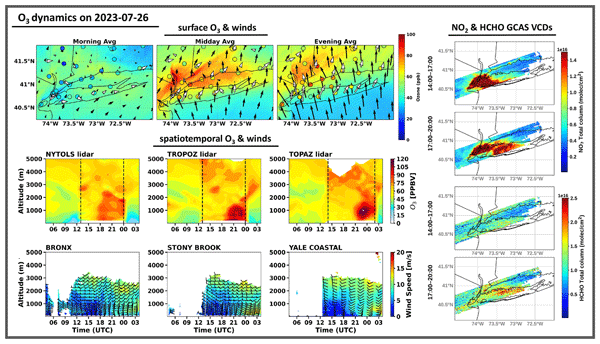
The interpretation of the 26 July case is comparatively well supported by the combination of precursor buildup, observed wind evolution, and the spatial O3 pattern. The interpretation of the 28 July case is less direct. The manuscript attributes the event to overnight accumulation within the shallow marine boundary layer and/or residual layer, followed by daytime entrainment into the growing boundary layer. While this is a plausible interpretation, the manuscript itself indicates that the evidence is indirect and that additional observations from the previous evening would have strengthened this conclusion.
This distinction is important because the scientific narrative of the paper relies substantially on the contrast between these two high-ozone cases. At present, the manuscript sometimes presents the 28 July mechanism in a manner that reads as demonstrated rather than inferred. I suggest revising this section so that the evidentiary basis is more transparent. In particular, the discussion should more clearly separate: direct observational support, model-assisted interpretation, and remaining uncertainty or plausible alternative explanations.
3. The manuscript relies heavily on WRF-Chem for process attribution, but the model evaluation provided is relatively limited for that purpose.
The authors state that Sect. 3.1.1 is not intended as a detailed model evaluation, but rather as a demonstration that the model can help fill observational gaps. That is a reasonable objective. However, later sections use WRF-Chem extensively to support process-level interpretations, including the vertical and horizontal continuity of pollution layers, precursor transport pathways, and residual-layer influences.
This creates some tension between the stated role of the model and the interpretive weight placed on it. The model skill shown in the manuscript appears acceptable in a broad sense, but not sufficiently comprehensive to support all of the more detailed mechanistic conclusions without additional caution. Surface NO2performance is only poor to moderate in several subregions, and some O3 performance is weaker in coastal areas than in the urban core. The manuscript would therefore benefit from one of two approaches: (1) provide a more thorough case-oriented model evaluation, particularly for the vertical structure that underpins the key interpretations, or (2) moderate the strength of conclusions that depend primarily on model results. At present, the manuscript does not always clearly distinguish between model use for interpolation/gap-filling and model use for mechanistic attribution.
4. The discussion of HCHO/NO2 (FNRs) ratios and O3 sensitivity requires substantially more caution.
The manuscript uses HCHO, NO2, and particularly HCHO/NO2 ratios to infer aspects of the photochemical environment and to discuss transitions toward more VOC-rich or NOx-limited conditions during selected episodes. However, the manuscript also shows that HCHO is the least robust component of the observational analysis. TEMPO HCHO exhibits only modest agreement with Pandora and essentially no correlation with GCAS, with substantial uncertainty and noise.
Given this, ratio-based interpretation needs to be presented much more carefully. In its current form, the manuscript risks assigning more diagnostic weight to the HCHO/NO2 ratio than the HCHO evaluation supports. If the authors wish to retain this discussion, they should explain why ratio-based inference remains informative despite the weak HCHO performance, and avoid wording that suggests a robust diagnosis of ozone sensitivity where the supporting evidence is uncertain. This point is central because the chemical interpretation of several cases depends on these ratio-based arguments.
5. The comparison between TEMPO NO2 columns and ACES in situ NO2 should be framed more explicitly as qualitative consistency, not validation.
The manuscript compares TEMPO tropospheric NO2 VCDs with ACES in situ NO2 mixing ratios and notes that the quantities differ in units and vertical representativeness. Such a comparison can still be useful as a qualitative illustration of spatial consistency, but it should not be interpreted too strongly. At present, the corresponding discussion appears to provide additional support for TEMPO performance in a manner that risks overstating what can be concluded from a column-versus-in-situ comparison. I suggest revising the text to make clear that this figure demonstrates qualitative coherence in spatial patterns, rather than constituting a formal validation.
Second, the manuscript lacks scientific explanations in some places.