
the Creative Commons Attribution 4.0 License.
the Creative Commons Attribution 4.0 License.
 | 04 Feb 2026
Impact of Extreme Rainfall on Triggering Conditions and Susceptibility for Shallow landslides: a case study in the Alpes-Maritimes region (France)
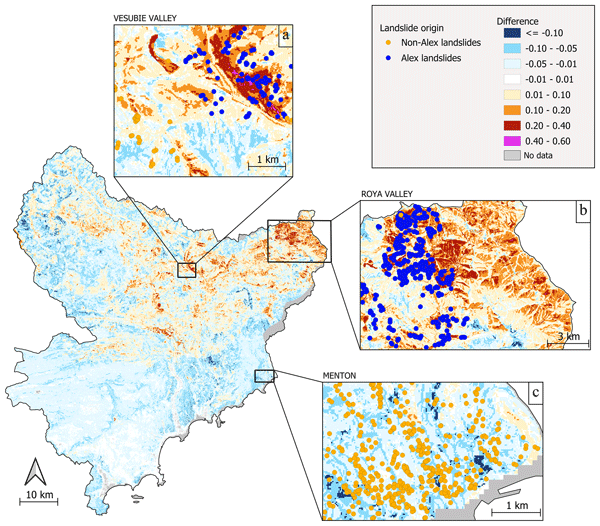
Abstract. Prediction of shallow landslides at the regional scale generally relies on statistical analyses of landslide inventories. Rainfall-duration thresholds and susceptibility maps are among the most common approaches to anticipate future landslide occurrences. However, the outputs and reliability of these approaches can be strongly affected by the representativeness of the landslides included in the inventory. This study specifically investigates the impact of landslides triggered by an extreme rainfall event on the determination of rainfall-duration thresholds and susceptibility maps. We consider the case of Storm Alex, a millennial return period rainfall event, which hit the Alpes-Maritimes region (France) on October 2, 2020. The analysis is based on an inventory of 5,383 shallow landslides, including 1,656 landslides triggered by Storm Alex. The CTRL-T algorithm was used to compute statistical rainfall-duration thresholds with and without the inclusion of Storm Alex landslides. A Random Forest approach was used to produce and compare susceptibility maps under the same two configurations. Results show that: (a) rainfall-duration thresholds derived from datasets including Storm Alex landslides are significantly higher; (b) the exceptional rainfall intensity triggered landslides in areas having an initial lower susceptibility; and (c) including these events in susceptibility modeling alters the spatial distribution of susceptibility values. This study provides a quantitative analysis of the impact of landslides triggered by extreme rainfall events on statistical prediction models.
-
Notice on discussion status
The requested preprint has a corresponding peer-reviewed final revised paper. You are encouraged to refer to the final revised version.
-
Preprint
(4083 KB)
-
The requested preprint has a corresponding peer-reviewed final revised paper. You are encouraged to refer to the final revised version.
- Preprint
(4083 KB) - Metadata XML
- BibTeX
- EndNote
- Final revised paper


Journal article(s) based on this preprint
Interactive discussion
Status: closed
-
RC1: 'Comment on egusphere-2026-458', Anonymous Referee #1, 17 Mar 2026
- AC1: 'Reply on RC1', Lucie Armand, 29 May 2026
-
RC2: 'Comment on egusphere-2026-458', Anonymous Referee #2, 03 Apr 2026
General comment
This study addresses a relevant question: how do landslides triggered by extreme rainfall events affect the calibration of statistically-based prediction tools. Using the case of Storm Alex, the authors demonstrate quantitatively that including such events in landslide inventories substantially alters both spatial and temporal prediction tools. The work is clear, well-written and structured. Figures are clear and useful. The results are supported by the data. The discussion is useful to highlight the strengths and limitations of the work. The sensitivity analysis on the assumed hour of landslide occurrence is valuable and strengthens the robustness of the rainfall threshold results. However, the implications for operational early warning system design could be discussed more explicitly in the conclusions.
Overall, the manuscript is interesting for NHESS readers and it can be published after major revisions.
I’ve found three main methodological issues in (1) the use of land cover map; (2) the definition of non-landslide sample and (3) the calculation of the rainfall thresholds. These should be addressed before the manuscript can be reconsidered for publication. Moreover, I’ve found some other minor technical comments.Specific comments
Predisposing factors:
- I wonder why the authors used the 2006 release of the Corine Land Cover, while more recent releases are available. Using a more recent Corine release would allow a better representation of the land cover conditions in the occurrence of the Alex storm.Landslide inventory:
- The used inventory is comprehensive and accurate. However, a known problem of landslide inventories is their completeness, particularly if the dataset dates back to previous centuries, as in this case. From Figure 3b, it is clear that the inventory completeness is different before and after 1850. My suggestion is to remove all data previous to 1850 and consider only post-1850 data. The completeness and reliability of the inventory would benefit from this.
- Something not clear to me: at line 195 the authors state that 1655 landslides were directly associated with Storm Alex, while at line 213 they state that 1335 landslides are associated with Storm Alex. Please clarify.ED rainfall thresholds:
- The warm and cold seasons should be defined.Non-landslide sampling:
- Why the author selected the same number of landslide and non-landslides points? Usually, in susceptibility and hazard analyses, an imbalance among landslide and non-landslide points is adopted, with a larger number of non-landslide points. See e.g. Steger et al. (2023, 2024); Nocentini et al. (2024). Indeed, this is much more consistent with physical reality, given that landslides are rare phenomena in both space and time. I suggest to use an imbalanced dataset of non-landslides points.Result – ED thresholds
- Looking at Figure 6, I see some issues.
First, I see some points in the graph with very low ED conditions (i.e. all points with cumulative rainfall lower than 10 mm, even with long durations). I think that these conditions are not realistic – probably due to errors in the rainfall products used or in the landslide timing of location, or rainfall underestimations. In any case, I suggest to remove these points, given that they represent rainfall conditions that can’t realistically trigger landslides.
Second, the uncertainty region of the WSAL threshold is larger than that of WoSAL one, despite the larger number of points (1704 for WSAL and 371 for WoSAL, if I have well understood). This can be done to two causes:
1) the distribution of the residuals for WSAL dataset is not Gaussian, as partially mentioned by the authors in the discussion;
2) the 133 ED conditions for the Alex storm are mostly repeated several times, i.e. data points corresponding to the same rainfall conditions (the same landslide and the same weather cell) are repeated multiple times. Also this is partially mentioned in the discussion.
If these two issues are confirmed, I have to say that both are not acceptable in the application of the frequentist method included in the CTRL-T tool. Indeed, if the point distribution is not gaussian, the method can’t be applied. Moreover, data points repetition should be avoided, because this alters the statistics behind the method used to define the thresholds. As an example, if the same ED condition is associated to more than one landslide, this is usually plotted and used in the calculations only once.
I suggest to check these issues and correct them if necessary.Results – Landslide susceptibility maps:
- Figure 9: I suggest adding two pie charts to show the percentage of cells in each susceptibility class. Moreover, I would use only one decimal digit. Please use point as decimal separator.Technical corrections
Please correct “rainfalls” with “rainfall” everywhere in the text.
L95-97: Please correct the percentage values. Their sum is now 105%.
L102: Please correct “mm.yr-1”
L118: I would say “The storm was responsible…”
L196: Please correct “Ales”
L355: Perhaps “44” should be corrected with “4”
L400: Not clear why those references are mentioned in this line.
Figures 9 and 11: Please use points as decimal separators.References:
Nocentini, N. et al (2024) Regional-scale spatiotemporal landslide probability assessment through machine learning and potential applications for operational warning systems: a case study in Kvam (Norway). Landslides 21, 2369–2387 (2024). https://doi.org/10.1007/s10346-024-02287-9
Steger, S. et al. (2023) Deciphering seasonal effects of triggering and preparatory precipitation for improved shallow landslide prediction using generalized additive mixed models, Nat. Hazards Earth Syst. Sci., 23, 1483–1506, https://doi.org/10.5194/nhess-23-1483-2023
Steger, S. et al. (2024) Adopting the margin of stability for space–time landslide prediction – A data-driven approach for generating spatial dynamic thresholds, Geoscience Frontiers, 15, 101822, 1125 https://doi.org/10.1016/j.gsf.2024.101822Citation: https://doi.org/10.5194/egusphere-2026-458-RC2 - AC2: 'Reply on RC2', Lucie Armand, 29 May 2026
Peer review completion


Interactive discussion
Status: closed
-
RC1: 'Comment on egusphere-2026-458', Anonymous Referee #1, 17 Mar 2026
The manuscript presents a solid and well-structured analysis of the impact of extreme rainfall events on landslide rainfall thresholds and susceptibility modelling. The dataset is comprehensive, and the methodological framework (CTRL-T and Random Forest) is appropriate and carefully implemented. The results are clear and provide meaningful insights into how extreme events can alter statistical models used for landslide prediction. Overall, the manuscript is suitable for publication after moderate revisions. However, several aspects could be further strengthened to improve clarity, robustness, and broader applicability. First, the discussion section should be slightly expanded to better generalize the findings beyond the study area, particularly addressing whether similar effects of extreme rainfall events on thresholds and susceptibility can be expected in other climatic and geomorphological contexts. Second, the limitations of the study should be more explicitly acknowledged, especially regarding the spatial representativeness of the Storm Alex landslides, the temporal inconsistency of the inventory, and the assumptions made in rainfall–landslide matching (e.g., fixed occurrence time). Third, a brief perspective on future research directions would be valuable, for example the need for non-stationary modelling frameworks, event-based calibration strategies, or hybrid approaches distinguishing between ordinary and extreme triggering conditions. Finally, moderate clarifications could be added regarding the influence of non-landslide sampling strategy and the potential uncertainty introduced by converting landslide polygons into points. With these moderate improvements, the manuscript will be further strengthened and make a valuable contribution to the field.
Citation: https://doi.org/10.5194/egusphere-2026-458-RC1 - AC1: 'Reply on RC1', Lucie Armand, 29 May 2026
-
RC2: 'Comment on egusphere-2026-458', Anonymous Referee #2, 03 Apr 2026
General comment
This study addresses a relevant question: how do landslides triggered by extreme rainfall events affect the calibration of statistically-based prediction tools. Using the case of Storm Alex, the authors demonstrate quantitatively that including such events in landslide inventories substantially alters both spatial and temporal prediction tools. The work is clear, well-written and structured. Figures are clear and useful. The results are supported by the data. The discussion is useful to highlight the strengths and limitations of the work. The sensitivity analysis on the assumed hour of landslide occurrence is valuable and strengthens the robustness of the rainfall threshold results. However, the implications for operational early warning system design could be discussed more explicitly in the conclusions.
Overall, the manuscript is interesting for NHESS readers and it can be published after major revisions.
I’ve found three main methodological issues in (1) the use of land cover map; (2) the definition of non-landslide sample and (3) the calculation of the rainfall thresholds. These should be addressed before the manuscript can be reconsidered for publication. Moreover, I’ve found some other minor technical comments.Specific comments
Predisposing factors:
- I wonder why the authors used the 2006 release of the Corine Land Cover, while more recent releases are available. Using a more recent Corine release would allow a better representation of the land cover conditions in the occurrence of the Alex storm.Landslide inventory:
- The used inventory is comprehensive and accurate. However, a known problem of landslide inventories is their completeness, particularly if the dataset dates back to previous centuries, as in this case. From Figure 3b, it is clear that the inventory completeness is different before and after 1850. My suggestion is to remove all data previous to 1850 and consider only post-1850 data. The completeness and reliability of the inventory would benefit from this.
- Something not clear to me: at line 195 the authors state that 1655 landslides were directly associated with Storm Alex, while at line 213 they state that 1335 landslides are associated with Storm Alex. Please clarify.ED rainfall thresholds:
- The warm and cold seasons should be defined.Non-landslide sampling:
- Why the author selected the same number of landslide and non-landslides points? Usually, in susceptibility and hazard analyses, an imbalance among landslide and non-landslide points is adopted, with a larger number of non-landslide points. See e.g. Steger et al. (2023, 2024); Nocentini et al. (2024). Indeed, this is much more consistent with physical reality, given that landslides are rare phenomena in both space and time. I suggest to use an imbalanced dataset of non-landslides points.Result – ED thresholds
- Looking at Figure 6, I see some issues.
First, I see some points in the graph with very low ED conditions (i.e. all points with cumulative rainfall lower than 10 mm, even with long durations). I think that these conditions are not realistic – probably due to errors in the rainfall products used or in the landslide timing of location, or rainfall underestimations. In any case, I suggest to remove these points, given that they represent rainfall conditions that can’t realistically trigger landslides.
Second, the uncertainty region of the WSAL threshold is larger than that of WoSAL one, despite the larger number of points (1704 for WSAL and 371 for WoSAL, if I have well understood). This can be done to two causes:
1) the distribution of the residuals for WSAL dataset is not Gaussian, as partially mentioned by the authors in the discussion;
2) the 133 ED conditions for the Alex storm are mostly repeated several times, i.e. data points corresponding to the same rainfall conditions (the same landslide and the same weather cell) are repeated multiple times. Also this is partially mentioned in the discussion.
If these two issues are confirmed, I have to say that both are not acceptable in the application of the frequentist method included in the CTRL-T tool. Indeed, if the point distribution is not gaussian, the method can’t be applied. Moreover, data points repetition should be avoided, because this alters the statistics behind the method used to define the thresholds. As an example, if the same ED condition is associated to more than one landslide, this is usually plotted and used in the calculations only once.
I suggest to check these issues and correct them if necessary.Results – Landslide susceptibility maps:
- Figure 9: I suggest adding two pie charts to show the percentage of cells in each susceptibility class. Moreover, I would use only one decimal digit. Please use point as decimal separator.Technical corrections
Please correct “rainfalls” with “rainfall” everywhere in the text.
L95-97: Please correct the percentage values. Their sum is now 105%.
L102: Please correct “mm.yr-1”
L118: I would say “The storm was responsible…”
L196: Please correct “Ales”
L355: Perhaps “44” should be corrected with “4”
L400: Not clear why those references are mentioned in this line.
Figures 9 and 11: Please use points as decimal separators.References:
Nocentini, N. et al (2024) Regional-scale spatiotemporal landslide probability assessment through machine learning and potential applications for operational warning systems: a case study in Kvam (Norway). Landslides 21, 2369–2387 (2024). https://doi.org/10.1007/s10346-024-02287-9
Steger, S. et al. (2023) Deciphering seasonal effects of triggering and preparatory precipitation for improved shallow landslide prediction using generalized additive mixed models, Nat. Hazards Earth Syst. Sci., 23, 1483–1506, https://doi.org/10.5194/nhess-23-1483-2023
Steger, S. et al. (2024) Adopting the margin of stability for space–time landslide prediction – A data-driven approach for generating spatial dynamic thresholds, Geoscience Frontiers, 15, 101822, 1125 https://doi.org/10.1016/j.gsf.2024.101822Citation: https://doi.org/10.5194/egusphere-2026-458-RC2 - AC2: 'Reply on RC2', Lucie Armand, 29 May 2026
Peer review completion
Journal article(s) based on this preprint
Viewed
| HTML | XML | Total | BibTeX | EndNote | |
|---|---|---|---|---|---|
| 1,083 | 493 | 101 | 1,677 | 339 | 343 |
- HTML: 1,083
- PDF: 493
- XML: 101
- Total: 1,677
- BibTeX: 339
- EndNote: 343
Viewed (geographical distribution)
| Country | # | Views | % |
|---|
| Total: | 0 |
| HTML: | 0 |
| PDF: | 0 |
| XML: | 0 |
- 1
Lucie Armand

Guillaume Chambon
Olivier Cerdan
Yannick Thiery
Nathalie Marçot
Louis Ferradou
Nicolas Saby
Séverine Bernardie
The requested preprint has a corresponding peer-reviewed final revised paper. You are encouraged to refer to the final revised version.
- Preprint
(4083 KB) - Metadata XML
The manuscript presents a solid and well-structured analysis of the impact of extreme rainfall events on landslide rainfall thresholds and susceptibility modelling. The dataset is comprehensive, and the methodological framework (CTRL-T and Random Forest) is appropriate and carefully implemented. The results are clear and provide meaningful insights into how extreme events can alter statistical models used for landslide prediction. Overall, the manuscript is suitable for publication after moderate revisions. However, several aspects could be further strengthened to improve clarity, robustness, and broader applicability. First, the discussion section should be slightly expanded to better generalize the findings beyond the study area, particularly addressing whether similar effects of extreme rainfall events on thresholds and susceptibility can be expected in other climatic and geomorphological contexts. Second, the limitations of the study should be more explicitly acknowledged, especially regarding the spatial representativeness of the Storm Alex landslides, the temporal inconsistency of the inventory, and the assumptions made in rainfall–landslide matching (e.g., fixed occurrence time). Third, a brief perspective on future research directions would be valuable, for example the need for non-stationary modelling frameworks, event-based calibration strategies, or hybrid approaches distinguishing between ordinary and extreme triggering conditions. Finally, moderate clarifications could be added regarding the influence of non-landslide sampling strategy and the potential uncertainty introduced by converting landslide polygons into points. With these moderate improvements, the manuscript will be further strengthened and make a valuable contribution to the field.