
the Creative Commons Attribution 4.0 License.
the Creative Commons Attribution 4.0 License.
 | 16 Jan 2026
Temperature and light regulated patterns of physiology, morphology and elemental stoichiometry in geographically distinct isolates of a cosmopolitan diatom
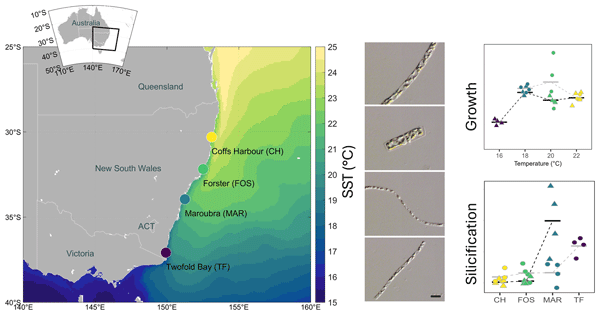
Abstract. Anthropogenic influence on climate change has profound and diverse consequences on marine ecosystems. At the base of the food web, phytoplankton, are experiencing altered temperature regimes. In south-east Australia, the southward extension of warm waters, driven in part by the East Australian Current (EAC), is rapidly warming regional ocean temperatures, leading to the intensification of marine heat waves (MHWs). In this study, we investigated thermally adapted Leptocylindrus danicus strains isolated from four distinct latitudes to determine how silica production rates vary with temperature and irradiance. We also explored how the intra-specific phenotypic variability affects physiology and silica production. We found strong latitudinal effects on strain-specific cell volume (ranging from 313 ± 22 µm2 to 2070 ± 105 µm3) and pigment quotas (chl a 1.04 ± 0.21 to 3.70 ± 1.17 pg cell-1; chl c 0.26 ± 0.07 to 2.09 ± 1.50 pg cell-1), both increasing with increasing temperature. There was also a significant effect of temperature on silicification rates, which varied depending on growth irradiance and cell normalisation. By identifying temperature and light regulated shifts in growth, morphology and silicification in a cosmopolitan diatom, we can gain an improved understanding of the range in intraspecific phenotypic variability of this key phytoplankton group. This study provides an assessment on how key diatom traits vary along a latitudinal gradient, providing unique insight into how ocean warming may influence resilience and adaptation potential of L. danicus, and how shift in physiology may impact diatom-regulated carbon and silicon cycling.
-
Notice on discussion status
The requested preprint has a corresponding peer-reviewed final revised paper. You are encouraged to refer to the final revised version.
-
Preprint
(1402 KB)
-
Supplement
(161 KB)
-
The requested preprint has a corresponding peer-reviewed final revised paper. You are encouraged to refer to the final revised version.
- Preprint
(1402 KB) - Metadata XML
-
Supplement
(161 KB) - BibTeX
- EndNote
- Final revised paper


Journal article(s) based on this preprint
Interactive discussion
Status: closed
-
RC1: 'Comment on egusphere-2026-45', Anonymous Referee #1, 27 Jan 2026
-
AC1: 'Reply on RC1', Katherina Petrou, 03 Feb 2026
The authors thank the reviewer for taking time to review our paper and provide the thoughtful comments and recommendations for discussion of our study. Thank you also for the reference to the paper by Kuefner et al. it is very interesting and nicely supports the important role of temperature on diatom silicification.
Microalgal acclimation is indeed short lived, the result of a few generations – covering several weeks. The authors are somewhat curious to know in what way the reviewer believes that including the temperature over a month would influence our interpretation? Does the reviewer have a hypothesis on this point? We have temperature data for each site over the spring period, and will add a range (SD) to the table as we agree this is more informative. We are grateful for the suggestion.
The authors agree with the reviewer that nutrients would also play an important role in physiology in situ, however, in Spring nutrients are often not limiting, hence diatom blooms off the coast of NSW occur typically in spring. Furthermore, the exclusion of nutrient manipulations was also a logistic one, to better control for the effect of temperature, considered the most significant driver (as was the case in Kuefner et al 2020). As our principal aim was to use latitudinally distinct strains to assess how temperature may influence silica production. That said, the authors like the idea of adding in situ nutrient data to provide a more detailed picture of the in situ Spring conditions.
I’m not sure the authors based our hypothesis on the increase temperature resulting in shorter generation time, impacting silicification and cell biovolume, rather we were following what our data showed. This interpretation is an attempt to explain the data, which we believe has merit and is grounded in literature and logic. While we openly acknowledge that other factors may influence cell characteristics and physiology, the interpretation needs to be limited to what was tested and manipulated, rather than extrapolate too broadly. That said, we agree with the point about the inclusion of discussion around nutrients and other potential influences and the need to test these with temperature and light.
The authors are grateful for this initial discussion around our study and will incorporate these key points into the revised version of the manuscript to deepen the discourse around the findings and the potential impacts.
Citation: https://doi.org/10.5194/egusphere-2026-45-AC1 -
RC2: 'Reply on AC1', Anonymous Referee #1, 03 Feb 2026
Thank you very much for your answers to my comments.
Concerning your question : generally, the environmental conditions characterizing the ecological niche of diatoms are measured during the month preceding sampling (see, for example, Carayon et al., 2019), as the lifespan, and therefore the acclimatization period of taxa is short. I would therefore have appreciated more precise information on environmental conditions, in order to be sure that the strains collected corresponded to the expected categories.
Citation: https://doi.org/10.5194/egusphere-2026-45-RC2 -
AC2: 'Reply on RC2', Katherina Petrou, 09 Feb 2026
Thank you for the clarification and the citation. The authors will endeavour to provide more information on the seasonal shifts in temperature and nutrients for these sites, depending on what data are available beyond the SST measurements. Of note however, the papers shared relate to riverine and freshwater environments. There are large differences in the dynamic nature of river systems and oceans, where river systems are highly dynamic and strongly influenced by weather and allocthonous input, in constrast ocean systems are relatively stable in their physico-chemical conditions.
Citation: https://doi.org/10.5194/egusphere-2026-45-AC2
-
AC2: 'Reply on RC2', Katherina Petrou, 09 Feb 2026
-
RC2: 'Reply on AC1', Anonymous Referee #1, 03 Feb 2026
-
AC1: 'Reply on RC1', Katherina Petrou, 03 Feb 2026
-
RC3: 'Comment on egusphere-2026-45', Anonymous Referee #2, 06 May 2026
The manuscript deals with the effect of temperature and light on the morphology, physiology and elemental stoichiometry (C, N, bSi) of four strains of the diatom Leptocylindrus danicus isolated at different latitudes along the East Australian coast. The data are interesting and of good quality, as well as the manuscript that is well written. Nevertheless, some aspects would require corrections and/or more in depth interpretation before publication.
Introduction: the references are quite dated and ones that are more recent are required, the same holds true for the discussion.
M and M:
-2.1: it would be necessary to add (in Supplementals) microscopic pictures of the four strains grown under the different light/temperature conditions, also for highlighting the fact that Leptocylindrus forms colonial chains.
-2.1: in line with the above comment, are the four strains still forming chains under the different temperature/light condition ? Are these chains similar among strains and growth conditions (length, etc.)? These aspects are essential for further interpreting the data, especially in an ecological framework.
-2.2: strain back-ups were maintained in f/2 medium (part 2.1), why switching to f/10 medium? The authors should discuss the consequences of such a change for their experiments, if any.
-2.2: please provide the spectrum of the light source in the Supplementals; regarding the effect of blue wavelengths on diatom biology, it is important to know if the LED white spectrum is cold, neutral or warm.
Results:
-I found it difficult to read the graphics: it would be clearer to show a legend that follows the same latitudinal gradient as map-Figure 1, i.e. CH-FOS-MAR-TF and not the opposite (Figures 2, 3, 5); similarly it would be more ‘usual’ to first pinpoint 55 µmol photons data before 100, especially as TF does perform growth under 100; this is especially misleading when reading Figure 4.
-Figure 4: why not computing NPQ and fitting NPQ vs. PAR curves? NPQ is an important process that strongly modulates photosynthetic productivity and I would not be surprised if showing differences among strains and growth conditions.
-Any explanation for the spreading of data points for FOS (Fig 2, 3) and MAR (Fig 5) as compared to the other strains?
-Table 3: a bit strange; while Fv/Fm T0 is used as a photophysiological trait (included in the PCA analysis Figure 7), Fv/Fm T24 is used a some kind of methodological index (verifying that the PDMPO treatment does not impair the photophysiology of cells): I suggest to keep Fv/Fm T0 in the manuscript and include it in Figure 4, and move Fv/Fm T24 in the Supplementals and cite it only the M and M part (2.4).
Discussion:
-4.1: see my comments for part 2.1; the fact that Leptocylindrus forms chains needs to be included here.
-4.1, line 442: the temperatures used in this study reflect the Spring situation, it would be good if the authors could provide the range of year-round temperatures for each latitude in order to check how much this range is broader than the delta 4°C examined here.
-4.1, line 449: division rate instead of reproductive rate ?
-4.2: I found the title of this section a bit exaggerated reading the fact that the delta Temperature is only 4°C and the delta light intensity is only 45 µmol photons; what if this delta would be increased ?
-4.3, lines 490-493: this interpretation should modulated by the fact that Leptocylindus forms chains, see my comments above.
Minor corrections:
-Line 130: space lacking between ‘100’ and ‘and’.
-Figure 6 shows no colour legend.
-Line 447: through instead of though ?
-Line 482: ‘which varies within and among a diatom species’, reformulate please.
Citation: https://doi.org/10.5194/egusphere-2026-45-RC3 -
AC3: 'Reply on RC3', Katherina Petrou, 08 May 2026
The authors thank the reviewer for their time and helpful suggestions and comments on their manuscript. With respect to references, we will review and revise all citations throughout and will update where appropriate to a newer citation.
Methods:
-The authors are somewhat confused by this suggestion of including images of the cells, as we have provided microscopy images of all strains under their respective light and temperature conditions in the supplementary file (Figure S1). However, the authors agree that this is an important element for this work and will ensure that we highlighting that all strains were colonial chains. All strains remained chain forming during the experiment, and yes their sizes varied by strain, not only the size of individual cells, but also chain length – greater explanation will be provided in this section (linked with the Figure S1) to set the groundwork for discussion on the potential role of strain morphology in the findings.
-The authors chose to run experiments at a much lower nutrient level, as experiments run in F/2 are highly artificial and may mask potential changes in response to treatments. For this reason, cultures were acclimated to grow in F/10 under their respective light and temperature treatments for 4-6 weeks before the measurements were obtained. Growth rates were obtained several times to ensure acclimation to experimental conditions. As such, the authors suspect that there were no direct consequences of changing growth conditions on the results of this experiment.
-The LED lights in the Climatron incubators were 4000K neutral white light, which means that there is more blue light than red, but it is not blue-shifted. We do not have a spectrum, but will include this information in the methods to inform the reader of the light source.
Results:
-With respect to the order of results along the x-axis: The authors were following the logic of low-high temperatures, rather than north to south latitudes. However, we see the referees point about consistency in the order, as presented in Figure 1 so we will re-plot the figures to reflect the site order with temperature, combining the two factors on the x-axis. Additionally, the authors appreciate the suggestion on presenting the low irradiance before the high irradiance for Figure 4, and the suggestion of including the FvFm T0 data here and remove Table 3. There is also the suggestion below about NPQ vs PAR (see response below). Given these suggestions, the authors will revisit the data and order in figure 4 to accommodate these changes.
-Figure 4: The authors agree that the NPQ of the strains can be informative and have determined and plotted these initially. However, in this study the NPQ vs PAR curves were not very different among growth conditions except for the Maroubra strain. We will investigate whether these data will be informative for the interpretation of the data and will look at the best way to include them into Figure 4.
-Explanation for the spreading of data points for FOS (Fig 2, 3) and MAR (Fig 5) as compared to the other strains? -The authors were likewise keen to find a plausible explanation for the spread in the data for the FOS 100umol photons (Fig 2, 3). We attempted to link the differences in the growth rates (spread in Figure 2) of the replicates with cell size differences (Figure 3), but unfortunately there was no correlation between these two parameters. For the MAR 100umol (Fig 5) the spread is attributed to the difference in silicification rates between the replicates. As the cell size and growth rates were relatively similar, we were unsure again of what could be driving such a spread. For this reason, we chose to show all data points and omit speculation for the large variability.
-Table 3: The authors are grateful for this suggestion and will action these changes and remove Table 3.
Discussion:
-4.1: The authors agree that the fact the cells were chain formers is an important point, and will highlight this fact in the discussion where necessary.
-4.1, The authors agree that including the local climatology for each site is a great suggestion and helps with respect to the other referee’s comment about seasonality and temperature. The authors will include the mean annual maximum and minimum SST for each site into Table 1. The authors agree that it helps to place the 6°C difference here in the broader thermal range for each strain.
-4.1, line 449: division rate instead of reproductive rate ? -This has been changed to division rate.
-4.2: On the exaggerated sub-heading – The sub-title was referring specifically to what our findings showed, where we measured stronger effects on C-allocation and elemental stoichiometry between growth irradiance rather than the 6°C difference in temperature. This is somewhat surprising, as temperature is often considered the bigger driver of physiology, however, the direct role of light in photosynthesis (and given the relatively small ranges in temperature), meant that light was a stronger determinant. That said, to tone down the statement the authors will edit the sub-heading to simply state the effect of light on C-allocation and stoichiometry, rather than quantifying it relative to temperature.
-4.3, lines 490-493: this interpretation should modulated by the fact that Leptocylindus forms chains, -The referee raises an important point, and while our focus was on differences in individual cell volume and silica production, the authors agree that this section needs to be include that we were referring to chain-forming species.
All minor corrections will be attended to. Thank you.
Citation: https://doi.org/10.5194/egusphere-2026-45-AC3
-
AC3: 'Reply on RC3', Katherina Petrou, 08 May 2026
Peer review completion


Interactive discussion
Status: closed
-
RC1: 'Comment on egusphere-2026-45', Anonymous Referee #1, 27 Jan 2026
The paper aims to identify temperature regulated patterns in silicification in multiple strains of the planctonic diatom L. danicus. By looking at strains with locally adapted thermal niches from South-East Australia, the authors aim to provide new insights into how ocean warming may influence a species’growth and how diatom phenotypic plasticity provides resilience to rapid environmental change.
General aspects in a few words :
- Does the paper address relevant scientific questions within the scope of BG?
The paper deals with interactions between biological, chemical, and physical processes in coastal environments and is thus completely within the scope of BG.
- Does the paper present novel concepts, ideas, tools, or data?
The concepts handled are not particularly new but data was specifically acquired for the paper.
- Are substantial conclusions reached?
Conclusions are contrasted and hardly generalizable to diatom communities as a whole.
- Are the results sufficient to support the interpretations and conclusions?
In my opinion, the experimental design, which only considers temperature and light, should also take nutrients into account. I elaborate on this aspect in the text below.
- Is the description of experiments and calculations sufficiently complete and precise to allow their reproduction by fellow scientists (traceability of results)?
Yes, experiments are particularly well described.
- Do the authors give proper credit to related work and clearly indicate their own new/original contribution?
Yes
- Does the title clearly reflect the contents of the paper?
Yes
- Does the abstract provide a concise and complete summary?
Yes
- Is the overall presentation well structured and clear? Is the language fluent and precise?
Yes, the paper si particularly well written. All the details necessary for a good understanding of the text and the objectives of the study are provided in fluent language. I have no comments regarding the form.
- Are mathematical formulae, symbols, abbreviations, and units correctly defined and used?
Yes
- Are the number and quality of references appropriate?
Yes
- Is the amount and quality of supplementary material appropriate?
Yes
Specific comments :
The article is very well written. The introduction sets out the context and objectives very clearly. The methodology is well described. I therefore have no comments on the structure or presentation of the manuscript, which is of very high quality.
However, I would like to raise two methodological points that I think are important to consider. I am aware that the authors cannot generate the additional data requested at this stage, but they could at least address the limitations of their experimental design in the discussion, in order to adjust their conclusions accordingly.
1) The interpretation of the results is based on the assumption that clones are adapted to contrasting temperature conditions in situ, and annual averages for the sampling sites are provided. However, diatoms are microalgae that reproduce very rapidly, so in general the environmental conditions describing the sampling site cover a period of one month (three weeks before sampling and one week after). Do the authors have temperature records for this time period at the sampling sites? If so, it would be important to include them as they may impact the interpretation of the results. It would also be important to have in situ nutrient measurements (N, P), as these greatly affect diatom growth and physiological status.
2) The article's hypothesis is based on the fact that the higher the temperature, the greater the productivity. The increase in temperature thus implies a shorter generation time and impacts silicification and cell biovolume. However, there are many other environmental drivers that can affect these charactristics, including bioavailability of nitrogen, phosphorus, and iron. Increased nutrients also act by increasing generation time (see for example Kuefner et al., 2020). The article focuses only on the influence of temperature on the potential of planktonic diatoms to adapt to climate change. However, climate change also induces changes in the availability of macronutrients. The introduction suggests that “warmer surface waters can cause a shallowing of the surface mixed layer, forming a barrier to vertical exchange of nutrients from depth and constraining phytoplankton in the upper surface waters, exposing them to high irradiances and reduced nutrient availability.” I therefore believe that it would have been important not only to measure nutrients at the sampling sites, but also to introduce the “nutrients” variable into the experimental design. The study would have benefited from combining temperature, irradiance, and nutrients in the experimental design. The study site and biological model chosen would therefore have been particularly interesting for advancing our knowledge of how planktonic species adapt to rising temperatures combined with low nitrogen and phosphorus availability. Although it is too late to add this variable, I believe it is important for the authors to enrich their discussion with this aspect.
I think the discussion could be strengthened by these two points. The discussion at this stage does not appear to be sufficiently in-depth. The first paragraph of this section is, moreover, a repetition of the introduction; it would be more interesting to summarize the results obtained.
Kuefner, W., Ossyssek, S., Geist, J., & Raeder, U. (2020). The silicification value: a novel diatom-based indicator to assess climate change in freshwater habitats. Diatom research, 35(1), 1-16.
Citation: https://doi.org/10.5194/egusphere-2026-45-RC1 -
AC1: 'Reply on RC1', Katherina Petrou, 03 Feb 2026
The authors thank the reviewer for taking time to review our paper and provide the thoughtful comments and recommendations for discussion of our study. Thank you also for the reference to the paper by Kuefner et al. it is very interesting and nicely supports the important role of temperature on diatom silicification.
Microalgal acclimation is indeed short lived, the result of a few generations – covering several weeks. The authors are somewhat curious to know in what way the reviewer believes that including the temperature over a month would influence our interpretation? Does the reviewer have a hypothesis on this point? We have temperature data for each site over the spring period, and will add a range (SD) to the table as we agree this is more informative. We are grateful for the suggestion.
The authors agree with the reviewer that nutrients would also play an important role in physiology in situ, however, in Spring nutrients are often not limiting, hence diatom blooms off the coast of NSW occur typically in spring. Furthermore, the exclusion of nutrient manipulations was also a logistic one, to better control for the effect of temperature, considered the most significant driver (as was the case in Kuefner et al 2020). As our principal aim was to use latitudinally distinct strains to assess how temperature may influence silica production. That said, the authors like the idea of adding in situ nutrient data to provide a more detailed picture of the in situ Spring conditions.
I’m not sure the authors based our hypothesis on the increase temperature resulting in shorter generation time, impacting silicification and cell biovolume, rather we were following what our data showed. This interpretation is an attempt to explain the data, which we believe has merit and is grounded in literature and logic. While we openly acknowledge that other factors may influence cell characteristics and physiology, the interpretation needs to be limited to what was tested and manipulated, rather than extrapolate too broadly. That said, we agree with the point about the inclusion of discussion around nutrients and other potential influences and the need to test these with temperature and light.
The authors are grateful for this initial discussion around our study and will incorporate these key points into the revised version of the manuscript to deepen the discourse around the findings and the potential impacts.
Citation: https://doi.org/10.5194/egusphere-2026-45-AC1 -
RC2: 'Reply on AC1', Anonymous Referee #1, 03 Feb 2026
Thank you very much for your answers to my comments.
Concerning your question : generally, the environmental conditions characterizing the ecological niche of diatoms are measured during the month preceding sampling (see, for example, Carayon et al., 2019), as the lifespan, and therefore the acclimatization period of taxa is short. I would therefore have appreciated more precise information on environmental conditions, in order to be sure that the strains collected corresponded to the expected categories.
Citation: https://doi.org/10.5194/egusphere-2026-45-RC2 -
AC2: 'Reply on RC2', Katherina Petrou, 09 Feb 2026
Thank you for the clarification and the citation. The authors will endeavour to provide more information on the seasonal shifts in temperature and nutrients for these sites, depending on what data are available beyond the SST measurements. Of note however, the papers shared relate to riverine and freshwater environments. There are large differences in the dynamic nature of river systems and oceans, where river systems are highly dynamic and strongly influenced by weather and allocthonous input, in constrast ocean systems are relatively stable in their physico-chemical conditions.
Citation: https://doi.org/10.5194/egusphere-2026-45-AC2
-
AC2: 'Reply on RC2', Katherina Petrou, 09 Feb 2026
-
RC2: 'Reply on AC1', Anonymous Referee #1, 03 Feb 2026
-
RC3: 'Comment on egusphere-2026-45', Anonymous Referee #2, 06 May 2026
The manuscript deals with the effect of temperature and light on the morphology, physiology and elemental stoichiometry (C, N, bSi) of four strains of the diatom Leptocylindrus danicus isolated at different latitudes along the East Australian coast. The data are interesting and of good quality, as well as the manuscript that is well written. Nevertheless, some aspects would require corrections and/or more in depth interpretation before publication.
Introduction: the references are quite dated and ones that are more recent are required, the same holds true for the discussion.
M and M:
-2.1: it would be necessary to add (in Supplementals) microscopic pictures of the four strains grown under the different light/temperature conditions, also for highlighting the fact that Leptocylindrus forms colonial chains.
-2.1: in line with the above comment, are the four strains still forming chains under the different temperature/light condition ? Are these chains similar among strains and growth conditions (length, etc.)? These aspects are essential for further interpreting the data, especially in an ecological framework.
-2.2: strain back-ups were maintained in f/2 medium (part 2.1), why switching to f/10 medium? The authors should discuss the consequences of such a change for their experiments, if any.
-2.2: please provide the spectrum of the light source in the Supplementals; regarding the effect of blue wavelengths on diatom biology, it is important to know if the LED white spectrum is cold, neutral or warm.
Results:
-I found it difficult to read the graphics: it would be clearer to show a legend that follows the same latitudinal gradient as map-Figure 1, i.e. CH-FOS-MAR-TF and not the opposite (Figures 2, 3, 5); similarly it would be more ‘usual’ to first pinpoint 55 µmol photons data before 100, especially as TF does perform growth under 100; this is especially misleading when reading Figure 4.
-Figure 4: why not computing NPQ and fitting NPQ vs. PAR curves? NPQ is an important process that strongly modulates photosynthetic productivity and I would not be surprised if showing differences among strains and growth conditions.
-Any explanation for the spreading of data points for FOS (Fig 2, 3) and MAR (Fig 5) as compared to the other strains?
-Table 3: a bit strange; while Fv/Fm T0 is used as a photophysiological trait (included in the PCA analysis Figure 7), Fv/Fm T24 is used a some kind of methodological index (verifying that the PDMPO treatment does not impair the photophysiology of cells): I suggest to keep Fv/Fm T0 in the manuscript and include it in Figure 4, and move Fv/Fm T24 in the Supplementals and cite it only the M and M part (2.4).
Discussion:
-4.1: see my comments for part 2.1; the fact that Leptocylindrus forms chains needs to be included here.
-4.1, line 442: the temperatures used in this study reflect the Spring situation, it would be good if the authors could provide the range of year-round temperatures for each latitude in order to check how much this range is broader than the delta 4°C examined here.
-4.1, line 449: division rate instead of reproductive rate ?
-4.2: I found the title of this section a bit exaggerated reading the fact that the delta Temperature is only 4°C and the delta light intensity is only 45 µmol photons; what if this delta would be increased ?
-4.3, lines 490-493: this interpretation should modulated by the fact that Leptocylindus forms chains, see my comments above.
Minor corrections:
-Line 130: space lacking between ‘100’ and ‘and’.
-Figure 6 shows no colour legend.
-Line 447: through instead of though ?
-Line 482: ‘which varies within and among a diatom species’, reformulate please.
Citation: https://doi.org/10.5194/egusphere-2026-45-RC3 -
AC3: 'Reply on RC3', Katherina Petrou, 08 May 2026
The authors thank the reviewer for their time and helpful suggestions and comments on their manuscript. With respect to references, we will review and revise all citations throughout and will update where appropriate to a newer citation.
Methods:
-The authors are somewhat confused by this suggestion of including images of the cells, as we have provided microscopy images of all strains under their respective light and temperature conditions in the supplementary file (Figure S1). However, the authors agree that this is an important element for this work and will ensure that we highlighting that all strains were colonial chains. All strains remained chain forming during the experiment, and yes their sizes varied by strain, not only the size of individual cells, but also chain length – greater explanation will be provided in this section (linked with the Figure S1) to set the groundwork for discussion on the potential role of strain morphology in the findings.
-The authors chose to run experiments at a much lower nutrient level, as experiments run in F/2 are highly artificial and may mask potential changes in response to treatments. For this reason, cultures were acclimated to grow in F/10 under their respective light and temperature treatments for 4-6 weeks before the measurements were obtained. Growth rates were obtained several times to ensure acclimation to experimental conditions. As such, the authors suspect that there were no direct consequences of changing growth conditions on the results of this experiment.
-The LED lights in the Climatron incubators were 4000K neutral white light, which means that there is more blue light than red, but it is not blue-shifted. We do not have a spectrum, but will include this information in the methods to inform the reader of the light source.
Results:
-With respect to the order of results along the x-axis: The authors were following the logic of low-high temperatures, rather than north to south latitudes. However, we see the referees point about consistency in the order, as presented in Figure 1 so we will re-plot the figures to reflect the site order with temperature, combining the two factors on the x-axis. Additionally, the authors appreciate the suggestion on presenting the low irradiance before the high irradiance for Figure 4, and the suggestion of including the FvFm T0 data here and remove Table 3. There is also the suggestion below about NPQ vs PAR (see response below). Given these suggestions, the authors will revisit the data and order in figure 4 to accommodate these changes.
-Figure 4: The authors agree that the NPQ of the strains can be informative and have determined and plotted these initially. However, in this study the NPQ vs PAR curves were not very different among growth conditions except for the Maroubra strain. We will investigate whether these data will be informative for the interpretation of the data and will look at the best way to include them into Figure 4.
-Explanation for the spreading of data points for FOS (Fig 2, 3) and MAR (Fig 5) as compared to the other strains? -The authors were likewise keen to find a plausible explanation for the spread in the data for the FOS 100umol photons (Fig 2, 3). We attempted to link the differences in the growth rates (spread in Figure 2) of the replicates with cell size differences (Figure 3), but unfortunately there was no correlation between these two parameters. For the MAR 100umol (Fig 5) the spread is attributed to the difference in silicification rates between the replicates. As the cell size and growth rates were relatively similar, we were unsure again of what could be driving such a spread. For this reason, we chose to show all data points and omit speculation for the large variability.
-Table 3: The authors are grateful for this suggestion and will action these changes and remove Table 3.
Discussion:
-4.1: The authors agree that the fact the cells were chain formers is an important point, and will highlight this fact in the discussion where necessary.
-4.1, The authors agree that including the local climatology for each site is a great suggestion and helps with respect to the other referee’s comment about seasonality and temperature. The authors will include the mean annual maximum and minimum SST for each site into Table 1. The authors agree that it helps to place the 6°C difference here in the broader thermal range for each strain.
-4.1, line 449: division rate instead of reproductive rate ? -This has been changed to division rate.
-4.2: On the exaggerated sub-heading – The sub-title was referring specifically to what our findings showed, where we measured stronger effects on C-allocation and elemental stoichiometry between growth irradiance rather than the 6°C difference in temperature. This is somewhat surprising, as temperature is often considered the bigger driver of physiology, however, the direct role of light in photosynthesis (and given the relatively small ranges in temperature), meant that light was a stronger determinant. That said, to tone down the statement the authors will edit the sub-heading to simply state the effect of light on C-allocation and stoichiometry, rather than quantifying it relative to temperature.
-4.3, lines 490-493: this interpretation should modulated by the fact that Leptocylindus forms chains, -The referee raises an important point, and while our focus was on differences in individual cell volume and silica production, the authors agree that this section needs to be include that we were referring to chain-forming species.
All minor corrections will be attended to. Thank you.
Citation: https://doi.org/10.5194/egusphere-2026-45-AC3
-
AC3: 'Reply on RC3', Katherina Petrou, 08 May 2026
Peer review completion
Journal article(s) based on this preprint
Viewed
| HTML | XML | Total | Supplement | BibTeX | EndNote | |
|---|---|---|---|---|---|---|
| 1,319 | 503 | 171 | 1,993 | 239 | 116 | 205 |
- HTML: 1,319
- PDF: 503
- XML: 171
- Total: 1,993
- Supplement: 239
- BibTeX: 116
- EndNote: 205
Viewed (geographical distribution)
| Country | # | Views | % |
|---|
| Total: | 0 |
| HTML: | 0 |
| PDF: | 0 |
| XML: | 0 |
- 1
Alyson M. Theseira
Daniel A. Nielsen
Penelope Ajani
Katherina Petrou

The requested preprint has a corresponding peer-reviewed final revised paper. You are encouraged to refer to the final revised version.
- Preprint
(1402 KB) - Metadata XML
-
Supplement
(161 KB) - BibTeX
- EndNote
- Final revised paper
The paper aims to identify temperature regulated patterns in silicification in multiple strains of the planctonic diatom L. danicus. By looking at strains with locally adapted thermal niches from South-East Australia, the authors aim to provide new insights into how ocean warming may influence a species’growth and how diatom phenotypic plasticity provides resilience to rapid environmental change.
General aspects in a few words :
The paper deals with interactions between biological, chemical, and physical processes in coastal environments and is thus completely within the scope of BG.
The concepts handled are not particularly new but data was specifically acquired for the paper.
Conclusions are contrasted and hardly generalizable to diatom communities as a whole.
In my opinion, the experimental design, which only considers temperature and light, should also take nutrients into account. I elaborate on this aspect in the text below.
Yes, experiments are particularly well described.
Yes
Yes
Yes
Yes, the paper si particularly well written. All the details necessary for a good understanding of the text and the objectives of the study are provided in fluent language. I have no comments regarding the form.
Yes
Yes
Yes
Specific comments :
The article is very well written. The introduction sets out the context and objectives very clearly. The methodology is well described. I therefore have no comments on the structure or presentation of the manuscript, which is of very high quality.
However, I would like to raise two methodological points that I think are important to consider. I am aware that the authors cannot generate the additional data requested at this stage, but they could at least address the limitations of their experimental design in the discussion, in order to adjust their conclusions accordingly.
1) The interpretation of the results is based on the assumption that clones are adapted to contrasting temperature conditions in situ, and annual averages for the sampling sites are provided. However, diatoms are microalgae that reproduce very rapidly, so in general the environmental conditions describing the sampling site cover a period of one month (three weeks before sampling and one week after). Do the authors have temperature records for this time period at the sampling sites? If so, it would be important to include them as they may impact the interpretation of the results. It would also be important to have in situ nutrient measurements (N, P), as these greatly affect diatom growth and physiological status.
2) The article's hypothesis is based on the fact that the higher the temperature, the greater the productivity. The increase in temperature thus implies a shorter generation time and impacts silicification and cell biovolume. However, there are many other environmental drivers that can affect these charactristics, including bioavailability of nitrogen, phosphorus, and iron. Increased nutrients also act by increasing generation time (see for example Kuefner et al., 2020). The article focuses only on the influence of temperature on the potential of planktonic diatoms to adapt to climate change. However, climate change also induces changes in the availability of macronutrients. The introduction suggests that “warmer surface waters can cause a shallowing of the surface mixed layer, forming a barrier to vertical exchange of nutrients from depth and constraining phytoplankton in the upper surface waters, exposing them to high irradiances and reduced nutrient availability.” I therefore believe that it would have been important not only to measure nutrients at the sampling sites, but also to introduce the “nutrients” variable into the experimental design. The study would have benefited from combining temperature, irradiance, and nutrients in the experimental design. The study site and biological model chosen would therefore have been particularly interesting for advancing our knowledge of how planktonic species adapt to rising temperatures combined with low nitrogen and phosphorus availability. Although it is too late to add this variable, I believe it is important for the authors to enrich their discussion with this aspect.
I think the discussion could be strengthened by these two points. The discussion at this stage does not appear to be sufficiently in-depth. The first paragraph of this section is, moreover, a repetition of the introduction; it would be more interesting to summarize the results obtained.
Kuefner, W., Ossyssek, S., Geist, J., & Raeder, U. (2020). The silicification value: a novel diatom-based indicator to assess climate change in freshwater habitats. Diatom research, 35(1), 1-16.