
the Creative Commons Attribution 4.0 License.
the Creative Commons Attribution 4.0 License.
 | 28 Jan 2026
Greek mountain snow cover halved in past four decades due to regional warming
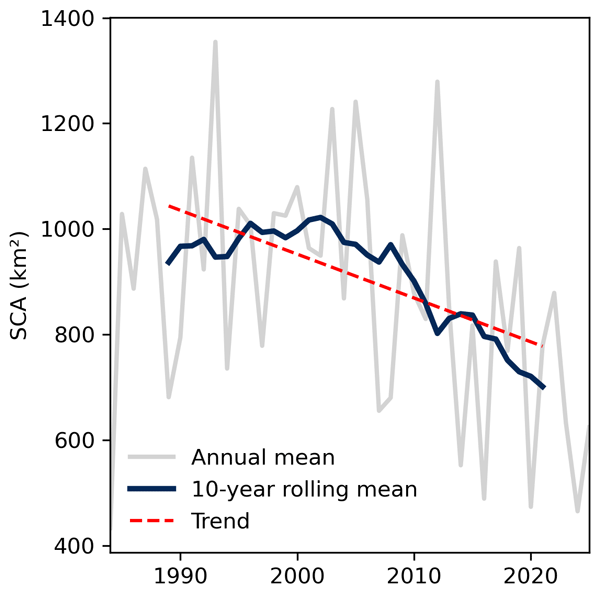
Abstract. Snowpacks in mountain regions with Mediterranean climates are exceptionally sensitive to climate warming. However, these marginal snowpacks are sparsely monitored, limiting our understanding of recent snow losses and constraining our ability to anticipate and manage future changes in mountain water supply. Here we present snowMapper v1.0, a modular, physics-informed, machine-learning-based model for reconstructing daily snow cover at high spatial resolution using satellite imagery and gridded climate products. snowMapper is fully configurable and features dedicated modules for masking, preprocessing, snow binarization, snow reconstruction, spatiotemporal aggregation, and validation. It performs with exceptionally high skill. Using snowMapper, we generate a monthly snow-cover climatology for ten of Greece’s highest mountain massifs for the period 1984–2025. Our results reveal a rapid and widespread decline in snow cover area (SCA), amounting to a ~58 % reduction relative to the 1984–2025 mean. We identify sustained warming throughout the snow season as the primary driver of this decline. Precipitation changes correlate with SCA only in early and mid-winter, underscoring the dual role of air temperature in controlling both accumulation (via snowfall fraction) and ablation processes. The North Atlantic Oscillation exerts only a modest influence on mid-winter SCA, and primarily when acting in conjunction with the Arctic Oscillation, representing a stark contrast to patterns observed in western Mediterranean mountain ranges. Finally, the absence of a strong relationship between SCA and the Atlantic Multidecadal Oscillation reinforces the conclusion that the observed trends lie outside the bounds of natural climate variability.
-
Notice on discussion status
The requested preprint has a corresponding peer-reviewed final revised paper. You are encouraged to refer to the final revised version.
-
Preprint
(8621 KB)
-
The requested preprint has a corresponding peer-reviewed final revised paper. You are encouraged to refer to the final revised version.
- Preprint
(8621 KB) - Metadata XML
- BibTeX
- EndNote
- Final revised paper


Journal article(s) based on this preprint
Interactive discussion
Status: closed
-
RC1: 'Comment on egusphere-2026-327', Mostafa Bousbaa, 16 Feb 2026
- AC1: 'Reply on RC1', Konstantis Alexopoulos, 20 Mar 2026
-
RC2: 'Comment on egusphere-2026-327', Simon Gascoin, 14 Mar 2026
This preprint presents an analysis of snow cover trends in the Greek mountains, a region where knowledge of the cryosphere remains limited. The manuscript reads very well. The methods and analyses are well illustrated, and the conclusions are clearly outlined. The code developed in this study should be readily transferable to other regions. Overall, I believe this is an original and important contribution.
Main comments
The paper has a double objective: (1) to introduce a new algorithm for snow cover area reconstruction, and (2) to present an original analysis of snow cover in the Greek mountains. The introduction is not focused specifically on snow cover in Greece, which is a good choice since it broadens the potential applications of the SnowMapper algorithm. However, it lacks a review of previous studies on snow cover in Greece, which is important for contextualizing the second part of the paper dedicated to snow cover trends in this region. In particular, the authors could better position their analysis with respect to the previous work of Masloumidis et al. (2025). I am also somewhat surprised that there appear to be no other relevant studies on this topic.
As acknowledged by the authors, a key challenge is the lack of satellite data prior to the 2000s. I believe the results would be strengthened if the authors tested the robustness of their trend analysis with respect to the increasing availability of satellite observations (Bayle et al., 2024). For example, the trend analysis could be repeated without the assimilation of satellite data. Another option (potentially better, but more difficult to implement) would be to limit the annual number of assimilated satellite observations to a constant value. At least, this issue should be discussed.
As noted by Reviewer 1, the calculation of the monthly SCA should be clarified: “Daily binary snow cover is converted to monthly fractional snow cover (FSC).”. This step involves both temporal and spatial aggregation. I assume that the authors computed the monthly average of the daily snow cover fraction within each mountain polygon. In that case, it is possible to obtain identical FSC values from very different snow conditions. For example, a constant 10% snow cover throughout an entire month would yield the same FSC as a short-lived 100% snow cover lasting only three days (assuming a 30-day month).
10% SCA × 30 days / 30 days per month = 10% / month
100% SCA × 3 days / 30 days per month = 10% / monthIf my understanding is correct, this limitation should be acknowledged and discussed.
Minor comments
In their literature review, the authors may also consider the study by Zakeri and Mariethoz (2024).
L169: Is this the full MicroMet algorithm, including the Barnes objective analysis scheme?
L366: typo (parentheses)
L399: I wonder if the significance in the “increase in the frequency of extremely low snow cover instances” is influenced by the temporal autocorrelation in the negative anomalies timeseries (i.e. a negative anomaly in April is more likely if there was a negative anomaly in March). I am not an expert in trend analysis but I suspect that this could inflate the trend significance?
References
Bayle, A., Gascoin, S., Berner, L. T., and Choler, P.: Landsat-based greening trends in alpine ecosystems are inflated by multidecadal increases in summer observations, Ecography, e07394, https://doi.org/10.1111/ecog.07394, 2024.
Masloumidis, I., Dafis, S., Kyros, G., Lagouvardos, K., and Kotroni, V.: Snow Cover and Depth Climatology and Trends in Greece, Climate, 13, https://doi.org/10.3390/cli13020034, 2025.
Zakeri, F. and Mariethoz, G.: Synthesizing long-term satellite imagery consistent with climate data: Application to daily snow cover, Remote Sens. Environ., 300, 113877, https://doi.org/10.1016/j.rse.2023.113877, 2024.
Citation: https://doi.org/10.5194/egusphere-2026-327-RC2 - AC2: 'Reply on RC2', Konstantis Alexopoulos, 20 Mar 2026
Peer review completion


Post-review adjustments


Interactive discussion
Status: closed
-
RC1: 'Comment on egusphere-2026-327', Mostafa Bousbaa, 16 Feb 2026
Overall Evaluation
The manuscript presents a valuable and well-structured reconstruction of snow cover using a hybrid gap-filling framework that combines decision-tree and machine learning approaches. The long-term dataset and the integration of multiple satellite sources represent a significant contribution to snow monitoring and hydrological applications.
The methodology is generally sound, and the results are relevant and promising. However, several methodological aspects require clarification to improve transparency and reproducibility, particularly regarding model configuration, data processing choices, and evaluation procedures. In addition, some figures and descriptions would benefit from clearer explanations to facilitate interpretation.
Overall, the manuscript is of good quality and suitable for publication after minor revisions addressing the points raised below.
Detailed Comments and Suggestions
Comment on Section 2.2 (snowMapper model overview):
The model overview is clear and well structured, and Figure 2 is informative. However, this section remains largely descriptive and would benefit from additional clarification. Specifically:
- The novelty of snowMapper relative to existing approaches is not clearly articulated. Please highlight the key contributions and what differentiates this framework from previous methods.
- The term “physics-informed” should be better defined (e.g., are physical constraints explicitly enforced, or are only physically meaningful variables used?).
- The “assimilation” step appears to rely on direct replacement of observations rather than a formal data assimilation approach; this should be clarified.
- The workflow could be described more explicitly (e.g., step-by-step process or simplified schematic), as Figure 2 is relatively complex and not always easy to follow.
Comment on Section 2.3.1 (Satellite imagery and MODIS processing):
The satellite data processing is generally well described; however, several methodological choices require further justification:
- The use of a fixed NDSI threshold (NDSI > 0.4) is not justified. Since optimal thresholds can vary depending on region, illumination conditions, and land cover, please explain how this value was validated for the Greek mountains. A sensitivity analysis or regional calibration would strengthen the approach.
- The 50% FSC threshold used to binarize MODIS data also appears empirical. Please clarify whether this threshold was calibrated or evaluated against alternative values.
- MODIS data were resampled from 500 m to 100 m using bicubic interpolation. Please justify this choice, as such resampling does not introduce new spatial information and may lead to smoothing artifacts. Why was this approach preferred over simpler methods (e.g., nearest neighbor) or dedicated downscaling techniques?
- The use of MODIS Terra only is not justified. Combining Terra (MOD10A1) and Aqua (MYD10A1) products is commonly used to reduce cloud contamination and improve temporal coverage. Please explain why Aqua data were not included, particularly given the importance of gap-filling in this study.
Comment on Section 2.3.4 (In situ data):
The training data are derived from stations in the Alps and Pyrenees rather than from Greece. Please justify the transferability of the model to Mediterranean snow conditions, which may differ significantly.
Comment on Section 2.4.1 (Machine learning classifier):
The Random Forest hyperparameters (e.g., number of trees = 30, minimum leaf size = 1, bag fraction = 0.5) are specified, but their selection is not justified. Please clarify how these values were chosen (e.g., cross-validation, sensitivity analysis, or empirical testing).
Comment on Section 2.4.5 (Final output):
The computation of monthly aggregates is not clearly described. Please clarify how daily snow cover is aggregated to monthly values (e.g., mean, maximum, or fraction of snow-covered days). In addition, the method used to convert daily binary snow maps into monthly fractional snow cover (FSC) should be explicitly defined.
Comment on Figure 4:
Figure 4 is not easy to interpret. The definition of “fraction of pixels” is unclear, and it is not specified how these monthly proportions are computed. Please provide additional information in the figure caption. In addition, the machine learning contribution appears relatively constant over time; please clarify how this fraction is computed and whether it varies across years.
Comment on Figure 5:
Although Figure 5 describes the temporal aggregation of the metrics, the evaluation methodology is not fully clear. Please clarify what datasets are being compared (e.g., model outputs vs. observations) and whether the evaluation is performed at the pixel level over the study area.
Citation: https://doi.org/10.5194/egusphere-2026-327-RC1 - AC1: 'Reply on RC1', Konstantis Alexopoulos, 20 Mar 2026
-
RC2: 'Comment on egusphere-2026-327', Simon Gascoin, 14 Mar 2026
This preprint presents an analysis of snow cover trends in the Greek mountains, a region where knowledge of the cryosphere remains limited. The manuscript reads very well. The methods and analyses are well illustrated, and the conclusions are clearly outlined. The code developed in this study should be readily transferable to other regions. Overall, I believe this is an original and important contribution.
Main comments
The paper has a double objective: (1) to introduce a new algorithm for snow cover area reconstruction, and (2) to present an original analysis of snow cover in the Greek mountains. The introduction is not focused specifically on snow cover in Greece, which is a good choice since it broadens the potential applications of the SnowMapper algorithm. However, it lacks a review of previous studies on snow cover in Greece, which is important for contextualizing the second part of the paper dedicated to snow cover trends in this region. In particular, the authors could better position their analysis with respect to the previous work of Masloumidis et al. (2025). I am also somewhat surprised that there appear to be no other relevant studies on this topic.
As acknowledged by the authors, a key challenge is the lack of satellite data prior to the 2000s. I believe the results would be strengthened if the authors tested the robustness of their trend analysis with respect to the increasing availability of satellite observations (Bayle et al., 2024). For example, the trend analysis could be repeated without the assimilation of satellite data. Another option (potentially better, but more difficult to implement) would be to limit the annual number of assimilated satellite observations to a constant value. At least, this issue should be discussed.
As noted by Reviewer 1, the calculation of the monthly SCA should be clarified: “Daily binary snow cover is converted to monthly fractional snow cover (FSC).”. This step involves both temporal and spatial aggregation. I assume that the authors computed the monthly average of the daily snow cover fraction within each mountain polygon. In that case, it is possible to obtain identical FSC values from very different snow conditions. For example, a constant 10% snow cover throughout an entire month would yield the same FSC as a short-lived 100% snow cover lasting only three days (assuming a 30-day month).
10% SCA × 30 days / 30 days per month = 10% / month
100% SCA × 3 days / 30 days per month = 10% / monthIf my understanding is correct, this limitation should be acknowledged and discussed.
Minor comments
In their literature review, the authors may also consider the study by Zakeri and Mariethoz (2024).
L169: Is this the full MicroMet algorithm, including the Barnes objective analysis scheme?
L366: typo (parentheses)
L399: I wonder if the significance in the “increase in the frequency of extremely low snow cover instances” is influenced by the temporal autocorrelation in the negative anomalies timeseries (i.e. a negative anomaly in April is more likely if there was a negative anomaly in March). I am not an expert in trend analysis but I suspect that this could inflate the trend significance?
References
Bayle, A., Gascoin, S., Berner, L. T., and Choler, P.: Landsat-based greening trends in alpine ecosystems are inflated by multidecadal increases in summer observations, Ecography, e07394, https://doi.org/10.1111/ecog.07394, 2024.
Masloumidis, I., Dafis, S., Kyros, G., Lagouvardos, K., and Kotroni, V.: Snow Cover and Depth Climatology and Trends in Greece, Climate, 13, https://doi.org/10.3390/cli13020034, 2025.
Zakeri, F. and Mariethoz, G.: Synthesizing long-term satellite imagery consistent with climate data: Application to daily snow cover, Remote Sens. Environ., 300, 113877, https://doi.org/10.1016/j.rse.2023.113877, 2024.
Citation: https://doi.org/10.5194/egusphere-2026-327-RC2 - AC2: 'Reply on RC2', Konstantis Alexopoulos, 20 Mar 2026
Peer review completion
Post-review adjustments
Journal article(s) based on this preprint
Viewed
| HTML | XML | Total | BibTeX | EndNote | |
|---|---|---|---|---|---|
| 1,067 | 944 | 80 | 2,091 | 58 | 113 |
- HTML: 1,067
- PDF: 944
- XML: 80
- Total: 2,091
- BibTeX: 58
- EndNote: 113
Viewed (geographical distribution)
| Country | # | Views | % |
|---|
| Total: | 0 |
| HTML: | 0 |
| PDF: | 0 |
| XML: | 0 |
- 1

Ian C. Willis
Hamish D. Pritchard
Giorgos Kyros
Vassiliki Kotroni
Konstantinos Lagouvardos
The requested preprint has a corresponding peer-reviewed final revised paper. You are encouraged to refer to the final revised version.
- Preprint
(8621 KB) - Metadata XML
Overall Evaluation
The manuscript presents a valuable and well-structured reconstruction of snow cover using a hybrid gap-filling framework that combines decision-tree and machine learning approaches. The long-term dataset and the integration of multiple satellite sources represent a significant contribution to snow monitoring and hydrological applications.
The methodology is generally sound, and the results are relevant and promising. However, several methodological aspects require clarification to improve transparency and reproducibility, particularly regarding model configuration, data processing choices, and evaluation procedures. In addition, some figures and descriptions would benefit from clearer explanations to facilitate interpretation.
Overall, the manuscript is of good quality and suitable for publication after minor revisions addressing the points raised below.
Detailed Comments and Suggestions
Comment on Section 2.2 (snowMapper model overview):
The model overview is clear and well structured, and Figure 2 is informative. However, this section remains largely descriptive and would benefit from additional clarification. Specifically:
Comment on Section 2.3.1 (Satellite imagery and MODIS processing):
The satellite data processing is generally well described; however, several methodological choices require further justification:
Comment on Section 2.3.4 (In situ data):
The training data are derived from stations in the Alps and Pyrenees rather than from Greece. Please justify the transferability of the model to Mediterranean snow conditions, which may differ significantly.
Comment on Section 2.4.1 (Machine learning classifier):
The Random Forest hyperparameters (e.g., number of trees = 30, minimum leaf size = 1, bag fraction = 0.5) are specified, but their selection is not justified. Please clarify how these values were chosen (e.g., cross-validation, sensitivity analysis, or empirical testing).
Comment on Section 2.4.5 (Final output):
The computation of monthly aggregates is not clearly described. Please clarify how daily snow cover is aggregated to monthly values (e.g., mean, maximum, or fraction of snow-covered days). In addition, the method used to convert daily binary snow maps into monthly fractional snow cover (FSC) should be explicitly defined.
Comment on Figure 4:
Figure 4 is not easy to interpret. The definition of “fraction of pixels” is unclear, and it is not specified how these monthly proportions are computed. Please provide additional information in the figure caption. In addition, the machine learning contribution appears relatively constant over time; please clarify how this fraction is computed and whether it varies across years.
Comment on Figure 5:
Although Figure 5 describes the temporal aggregation of the metrics, the evaluation methodology is not fully clear. Please clarify what datasets are being compared (e.g., model outputs vs. observations) and whether the evaluation is performed at the pixel level over the study area.