
the Creative Commons Attribution 4.0 License.
the Creative Commons Attribution 4.0 License.
 | 08 May 2026
A small-footprint Cavity Ring-Down Spectroscopy instrument for in-situ measurements of NO3 and N2O5
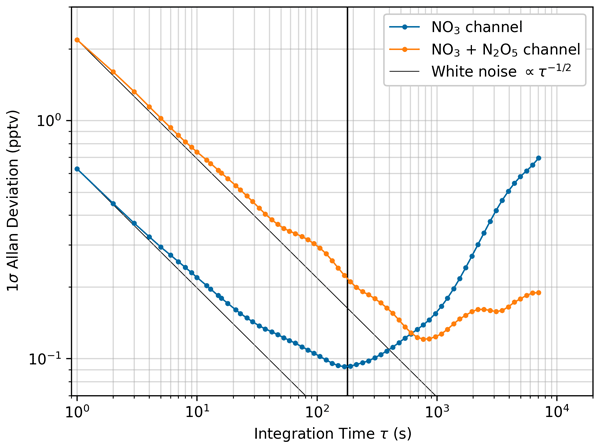
Abstract. We present a new, small-footprint instrument for point measurements of NO₃ and N₂O₅. Both molecules play an important role in nocturnal atmospheric chemistry, impacting the NOₓ-budget and the oxidation of biogenic volatile organic compounds. NO₃ and N₂O₅ are often present at concentrations of a few parts per trillion by volume (pptv) and their measurements in remote locations requires instrumentation that is easily transported and lightweight, but maintains high sensitivity and accuracy. We have constructed a relatively compact and light instrument for Cavity Ring-Down Spectroscopy (CRDS) with the dimensions (width × depth × height) of 55 × 55 × 150 cm and a weight of 50 kg that uses two independent cavities to quantify the mixing ratio of NO₃ using an inlet at room temperature and the sum of NO₃ + N₂O₅ via a thermal dissociation inlet. Under laboratory conditions, limits of detection (1σ Allan deviation at 1 s integration) for the NO₃ and (NO₃ + N₂O₅) channel are < 1 pptv and < 2 pptv, respectively. This improves to about 0.1 pptv and 0.2 pptv for 3-minute integration. The total measurement uncertainty for NO₃ is 9.8 % and ≥ 11.5 % for N₂O₅, depending on the NO₃-to-N₂O₅ ratio.
In this publication, we present design details of the instrument, discuss its performance in a controlled environment as well as during a field campaign. Additionally, we present measurements of transmission losses for NO₃ across different filter types and methods to reduce filter reactivity and allow reusability after a cleaning procedure.
-
Notice on discussion status
The requested preprint has a corresponding peer-reviewed final revised paper. You are encouraged to refer to the final revised version.
-
Preprint
(1656 KB)
-
Supplement
(608 KB)
-
The requested preprint has a corresponding peer-reviewed final revised paper. You are encouraged to refer to the final revised version.
- Preprint
(1656 KB) - Metadata XML
-
Supplement
(608 KB) - BibTeX
- EndNote
- Final revised paper


Journal article(s) based on this preprint
Interactive discussion
Status: closed
-
RC1: 'Comment on egusphere-2026-2487', Anonymous Referee #1, 01 Jun 2026
- AC1: 'Reply on RC1', Gunther Türk, 06 Jul 2026
-
RC2: 'Comment on egusphere-2026-2487', Anonymous Referee #2, 13 Jun 2026
Title: A small-footprint Cavity Ring-Down Spectroscopy instrument for in-situ measurements of NO3 and N2O5
Authors: G.N.T.E. Türk et al.
DOI: 10.5194/egusphere-2026-2487
This well-written pre-print describes an instrument for the detection of NO3 and N2O5 based on cavity-ring down spectroscopy. The instrument is state-of-the-art in this field and its experimental characterization together with field observations of NO3 and N2O5 are credible and justified in the manuscript. Indeed several instruments of this type are known in the literature (Brown et a. 2002, Dube et al. 2006, Crowley et al. 2010). Hence the authors should motivate the reasons for developing this instrument better. What kind of scientific measurements can be / will be performed with this instrument that could not be done with similar devices before?
The instrument has an interesting design and is thoroughly conceptualized; the authors present enough detail to justify the claimed performance (e.g. LOD, Allan variance, inlet loss characterization). Nevertheless, below are a few observations/comments as to where the manuscript could/should potentially be improved:
Line 22-67 (Introduction): The importance of NO3 and N2O5 for the nocturnal atmosphere is well outlined, and all relevant reactions and known facts are comprehensively described. However, the section is missing the motivation for improving detection of NO3 and N2O5 by CRDS. Why is it important to improve some of the engineering aspects of known devices to enable better measurements? What is the envisaged deployment of the instrument and the advancement of field-based detection of NO3 and N2O5 enabled by the instrument.
Line 55-57: Broadband methods, such as IBBCEAS, are also common alternatives to time dependent cavity ring-down methods and a couple of examples in the literature should be explicitly mentioned here; not only CEAS per se.
Line 97: “…installed in an aluminium rack…” How was this done - how is the aluminium frame connected to the carbon fibre tube cage system? Does the different thermal expansion between the carbon fibre tubes and the aluminium impinge on the alignment? See also lines 150/151.
Line 105 and Line 119: The authors do not state how the flow is generated. They only mention the “exhaust system”. What pump was used? Did you use any scrubber for NO?
Line 106: What is the length of the heated inlet? How is the heated inlet of the (NO3 & N2O5) channel thermally isolated from the NO3 channel inlet? Are these channels thermally fully isolated?
Line 107/108: Where is the temperature measured - not shown in Figure 1.
Line 109/110 & 114/115: What was the aerosol filter porosity? What particle sizes were targeted (1 mm)? How often are filters changed – what criteria were used? (This is indeed discussed later, hence a cross-reference to section 3.5 should be included appropriately.)
Automated filter changers are non-trivial devices, hence more details on the filter changer would be great in the supplementary material.
Line 116 (&126): The MFCs for the NO line and the purge flows are not shown in Figure 1. The way these flows are controlled should be shown in Figure 1, potentially also together with typical flow rates. This will not overload Figure 1.
Line 138: “… generate a high flow velocity…”. Can you state an estimated value of the flow velocity here?
Line 141: Including the o-rings schematically in Figure 2 would be helpful. The three point alignment concept is not well explained. Where is the seal made? How are misalignment caused by mechanical vibrations and thermal drift prevented? More explanations especially in Figure 2 would be good here. For field work this is critical.
Line 146-148: What is the distance of the off-axis alignment? What is the (1/e2)-beam diameter and how is the diameter determined/controlled? How did ring-down times compare between on- and off-axis alignment? Was that studied systematically? What losses are introduced by going "somewhat" off-axis? The authors state that there is only 4 mm diameter tube between the mirror and purge gas/sample air mixing volume. This appears to be critical. Depending on beam diameter there is very little room to “go off-axis”.
Line 160: Sentence structure. “…is driven…, is modulated…” please rephrase, e.g. delete second “is”.
Line 172: Band-pass filter not shown in Figure 1. Should be included.
Line 185: “ring-downs” is a bit casual. Replace by “ring-down decays” or “ring-down waveforms” or “ ring-down traces”.
Line 188: If there is no significant difference in the averaging approach, why did the authors not reduce computational overhead by eliminating the averaging of 5 ring-down times for a "1 sec data point". Read out noise?
Line 200-205: It would be useful to show the reaction schematic in the supplementary material.
Line 240: “…from newly dissociated NO3…” This is misleading and should read something like: “…from NO3 formed in the dissociated of N2O5…”
Line 247: "…taking an O3 level of 100 ppbv...".
The ozone concentration in the field varies and is usually probably significantly smaller than 100 ppbv, which is some sort of upper limit. The estimate of a discrepancy of +0.2 pptv is based on this maximum ozone level. The correction is dependent on ozone concentration. How can this be handled in the field? An additional ozone photometer with sufficient sensitivity and integration time would always be required.
The same applies to the NO3 & N2O5 channel.
Line 261: "clear air" -> "clean air" or "zero air" or "synthetic air"
Line 265: This is somewhat casually phrased. The Allan variance is not simply defined as the square root of the common 1σ standard deviation.
Line 270: Figure 4 should ideally not just show a line for each channel but the pivot (data-)points generating the line. The authors may want to consider showing the white noise ideal behaviour, i.e. a straight line with slope of -1/2 in a double log plot.
Line 285: “hinder” -> “reduce”
Line 308: “98 ± 4 % which is the mean and two standard deviations of all determined 𝑇𝑚𝑎𝑥 values.” -> “98% with a 2σ variation of all determined 𝑇𝑚𝑎𝑥 values of +2% and –4%.”
Table 1: In the table are values that are physically not meaningful; e.g. Pall #3, Cytiva#4. Errors should be capped at 100% transmission. I presume that the error in Tmax is indeed the square root of the covariance of the fit?
Line 330: After a detailed discussion of NO3 losses by aerosol filters (including additional data in the supplementary material), the authors reveal that by far the largest loss is caused by the automatic filter changer itself. However, statistics on the establishment of the stated 80 ± 5% are not presented. The discussion of the filter losses (while interesting from an experimental point of view) seems inappropriately long. More information on the automatic filter changer should be shown instead (what does “multiple times” mean and what were the conditions) and the bulk of the filter loss discussion could go into the Supplement.
Line 342/343: Does the clamping of the carbon fiber tubes on aluminium cause additional stress when heated – depends on the clamping design.
Line 345 – Figure 6: Two axes are not used in Figure 6. The figure would benefit from the upper axis showing the flow rates corresponding to the different residence times. In the caption kwall is called kw in the main text.
Line 363: Residence time stated as 0.24 s which is different from the value given in the previous section.
Lines 390 & 440: “Iupac” -> “IUPAC”
Supplementary Material:
Figure S2: The data shown for filter #1 AW15357 "after ozone treatment” is not physically meaningful. The error bars are too small and the transmission is systematically over 100%.
Citation: https://doi.org/10.5194/egusphere-2026-2487-RC2 - AC2: 'Reply on RC2', Gunther Türk, 06 Jul 2026
Peer review completion


Interactive discussion
Status: closed
-
RC1: 'Comment on egusphere-2026-2487', Anonymous Referee #1, 01 Jun 2026
Türk et al. describe a compact cavity ring-down spectrometer for quantification of NO3 and N2O5. In spite of its compactness, the instrument achieves excellent limits of detection and good accuracy. Sample ambient air measurements are presented.
Numerous such instruments have been described in the literature, including by the authors. While the manuscript is written well, the authors need to revise the discussion and explain what they would consider novel or different in their approach. Essentially, the manuscript requires a section comparing this new instrument with existing methods (include a Table summarizing these) as well as a critical discussion of this instrument's performance, advantages and disadvantages compared to existing methods.
Citation: https://doi.org/10.5194/egusphere-2026-2487-RC1 - AC1: 'Reply on RC1', Gunther Türk, 06 Jul 2026
-
RC2: 'Comment on egusphere-2026-2487', Anonymous Referee #2, 13 Jun 2026
Title: A small-footprint Cavity Ring-Down Spectroscopy instrument for in-situ measurements of NO3 and N2O5
Authors: G.N.T.E. Türk et al.
DOI: 10.5194/egusphere-2026-2487
This well-written pre-print describes an instrument for the detection of NO3 and N2O5 based on cavity-ring down spectroscopy. The instrument is state-of-the-art in this field and its experimental characterization together with field observations of NO3 and N2O5 are credible and justified in the manuscript. Indeed several instruments of this type are known in the literature (Brown et a. 2002, Dube et al. 2006, Crowley et al. 2010). Hence the authors should motivate the reasons for developing this instrument better. What kind of scientific measurements can be / will be performed with this instrument that could not be done with similar devices before?
The instrument has an interesting design and is thoroughly conceptualized; the authors present enough detail to justify the claimed performance (e.g. LOD, Allan variance, inlet loss characterization). Nevertheless, below are a few observations/comments as to where the manuscript could/should potentially be improved:
Line 22-67 (Introduction): The importance of NO3 and N2O5 for the nocturnal atmosphere is well outlined, and all relevant reactions and known facts are comprehensively described. However, the section is missing the motivation for improving detection of NO3 and N2O5 by CRDS. Why is it important to improve some of the engineering aspects of known devices to enable better measurements? What is the envisaged deployment of the instrument and the advancement of field-based detection of NO3 and N2O5 enabled by the instrument.
Line 55-57: Broadband methods, such as IBBCEAS, are also common alternatives to time dependent cavity ring-down methods and a couple of examples in the literature should be explicitly mentioned here; not only CEAS per se.
Line 97: “…installed in an aluminium rack…” How was this done - how is the aluminium frame connected to the carbon fibre tube cage system? Does the different thermal expansion between the carbon fibre tubes and the aluminium impinge on the alignment? See also lines 150/151.
Line 105 and Line 119: The authors do not state how the flow is generated. They only mention the “exhaust system”. What pump was used? Did you use any scrubber for NO?
Line 106: What is the length of the heated inlet? How is the heated inlet of the (NO3 & N2O5) channel thermally isolated from the NO3 channel inlet? Are these channels thermally fully isolated?
Line 107/108: Where is the temperature measured - not shown in Figure 1.
Line 109/110 & 114/115: What was the aerosol filter porosity? What particle sizes were targeted (1 mm)? How often are filters changed – what criteria were used? (This is indeed discussed later, hence a cross-reference to section 3.5 should be included appropriately.)
Automated filter changers are non-trivial devices, hence more details on the filter changer would be great in the supplementary material.
Line 116 (&126): The MFCs for the NO line and the purge flows are not shown in Figure 1. The way these flows are controlled should be shown in Figure 1, potentially also together with typical flow rates. This will not overload Figure 1.
Line 138: “… generate a high flow velocity…”. Can you state an estimated value of the flow velocity here?
Line 141: Including the o-rings schematically in Figure 2 would be helpful. The three point alignment concept is not well explained. Where is the seal made? How are misalignment caused by mechanical vibrations and thermal drift prevented? More explanations especially in Figure 2 would be good here. For field work this is critical.
Line 146-148: What is the distance of the off-axis alignment? What is the (1/e2)-beam diameter and how is the diameter determined/controlled? How did ring-down times compare between on- and off-axis alignment? Was that studied systematically? What losses are introduced by going "somewhat" off-axis? The authors state that there is only 4 mm diameter tube between the mirror and purge gas/sample air mixing volume. This appears to be critical. Depending on beam diameter there is very little room to “go off-axis”.
Line 160: Sentence structure. “…is driven…, is modulated…” please rephrase, e.g. delete second “is”.
Line 172: Band-pass filter not shown in Figure 1. Should be included.
Line 185: “ring-downs” is a bit casual. Replace by “ring-down decays” or “ring-down waveforms” or “ ring-down traces”.
Line 188: If there is no significant difference in the averaging approach, why did the authors not reduce computational overhead by eliminating the averaging of 5 ring-down times for a "1 sec data point". Read out noise?
Line 200-205: It would be useful to show the reaction schematic in the supplementary material.
Line 240: “…from newly dissociated NO3…” This is misleading and should read something like: “…from NO3 formed in the dissociated of N2O5…”
Line 247: "…taking an O3 level of 100 ppbv...".
The ozone concentration in the field varies and is usually probably significantly smaller than 100 ppbv, which is some sort of upper limit. The estimate of a discrepancy of +0.2 pptv is based on this maximum ozone level. The correction is dependent on ozone concentration. How can this be handled in the field? An additional ozone photometer with sufficient sensitivity and integration time would always be required.
The same applies to the NO3 & N2O5 channel.
Line 261: "clear air" -> "clean air" or "zero air" or "synthetic air"
Line 265: This is somewhat casually phrased. The Allan variance is not simply defined as the square root of the common 1σ standard deviation.
Line 270: Figure 4 should ideally not just show a line for each channel but the pivot (data-)points generating the line. The authors may want to consider showing the white noise ideal behaviour, i.e. a straight line with slope of -1/2 in a double log plot.
Line 285: “hinder” -> “reduce”
Line 308: “98 ± 4 % which is the mean and two standard deviations of all determined 𝑇𝑚𝑎𝑥 values.” -> “98% with a 2σ variation of all determined 𝑇𝑚𝑎𝑥 values of +2% and –4%.”
Table 1: In the table are values that are physically not meaningful; e.g. Pall #3, Cytiva#4. Errors should be capped at 100% transmission. I presume that the error in Tmax is indeed the square root of the covariance of the fit?
Line 330: After a detailed discussion of NO3 losses by aerosol filters (including additional data in the supplementary material), the authors reveal that by far the largest loss is caused by the automatic filter changer itself. However, statistics on the establishment of the stated 80 ± 5% are not presented. The discussion of the filter losses (while interesting from an experimental point of view) seems inappropriately long. More information on the automatic filter changer should be shown instead (what does “multiple times” mean and what were the conditions) and the bulk of the filter loss discussion could go into the Supplement.
Line 342/343: Does the clamping of the carbon fiber tubes on aluminium cause additional stress when heated – depends on the clamping design.
Line 345 – Figure 6: Two axes are not used in Figure 6. The figure would benefit from the upper axis showing the flow rates corresponding to the different residence times. In the caption kwall is called kw in the main text.
Line 363: Residence time stated as 0.24 s which is different from the value given in the previous section.
Lines 390 & 440: “Iupac” -> “IUPAC”
Supplementary Material:
Figure S2: The data shown for filter #1 AW15357 "after ozone treatment” is not physically meaningful. The error bars are too small and the transmission is systematically over 100%.
Citation: https://doi.org/10.5194/egusphere-2026-2487-RC2 - AC2: 'Reply on RC2', Gunther Türk, 06 Jul 2026
Peer review completion
Journal article(s) based on this preprint
Viewed
| HTML | XML | Total | Supplement | BibTeX | EndNote | |
|---|---|---|---|---|---|---|
| 296 | 140 | 44 | 480 | 57 | 48 | 44 |
- HTML: 296
- PDF: 140
- XML: 44
- Total: 480
- Supplement: 57
- BibTeX: 48
- EndNote: 44
Viewed (geographical distribution)
| Country | # | Views | % |
|---|
| Total: | 0 |
| HTML: | 0 |
| PDF: | 0 |
| XML: | 0 |
- 1
Gunther N. T. E. Türk

Simone T. Andersen
Patrick Dewald
Jan Schuladen
Jos Lelieveld
The requested preprint has a corresponding peer-reviewed final revised paper. You are encouraged to refer to the final revised version.
- Preprint
(1656 KB) - Metadata XML
-
Supplement
(608 KB) - BibTeX
- EndNote
- Final revised paper
Türk et al. describe a compact cavity ring-down spectrometer for quantification of NO3 and N2O5. In spite of its compactness, the instrument achieves excellent limits of detection and good accuracy. Sample ambient air measurements are presented.
Numerous such instruments have been described in the literature, including by the authors. While the manuscript is written well, the authors need to revise the discussion and explain what they would consider novel or different in their approach. Essentially, the manuscript requires a section comparing this new instrument with existing methods (include a Table summarizing these) as well as a critical discussion of this instrument's performance, advantages and disadvantages compared to existing methods.