
the Creative Commons Attribution 4.0 License.
the Creative Commons Attribution 4.0 License.
 | 02 Feb 2026
Organic amine weakens chloride depletion in coastal atmosphere
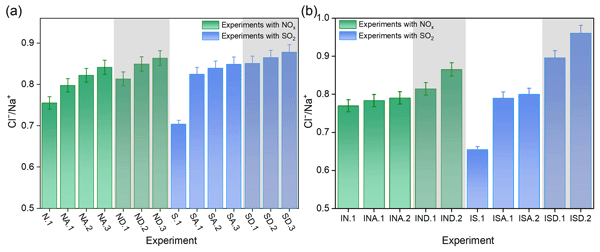
Abstract. Chloride depletion from sea salt aerosols (SSA) has frequently been observed in polluted coastal regions, severely impacting air quality and human health. However, the influencing mechanism of alkaline species in chloride depletion remains incompletely understood. Here, we report the first investigation of alkaline species including NH3 and an organic amine (dimethylamine, DMA) on chloride depletion and the subsequent formation of organic chlorinated compounds. Results showed that alkaline species could weaken chloride depletion caused by acidic gases, mainly due to acid-base neutralization. Specifically, chloride depletion in the presence of NOx decreased from 20.1 % to 15.8 % when NH3 concentration increased from 100 to 300 ppb. Chloride depletion also decreased from 18.6 % to 13.5 % with DMA concentration increasing from 50 to 150 ppb. The weakening effect of organic amine on chloride depletion is more pronounced than that of NH3, primarily because DMA has stronger alkalinity and nucleation ability. These alkaline species exhibit a stronger reduction of chloride depletion in the presence of SO2 than in the presence of NOx. The detection of organic chlorinated products, which were formed via active chlorine-induced oxidation, is consistent with the role of alkaline species in weakening chloride depletion. The formation of organic chlorinated compounds was weakened by the addition of alkaline species, indicating the significant role of alkaline species in reducing active chlorine. These findings suggest that alkaline species, more specifically organic amines, are significant factors influencing chloride depletion in the coastal atmosphere. This further enhances our understanding of chloride depletion phenomena in coastal regions.
-
Notice on discussion status
The requested preprint has a corresponding peer-reviewed final revised paper. You are encouraged to refer to the final revised version.
-
Preprint
(1109 KB)
-
Supplement
(564 KB)
-
The requested preprint has a corresponding peer-reviewed final revised paper. You are encouraged to refer to the final revised version.
- Preprint
(1109 KB) - Metadata XML
-
Supplement
(564 KB) - BibTeX
- EndNote
- Final revised paper


Journal article(s) based on this preprint
Interactive discussion
Status: closed
-
RC1: 'Comment on egusphere-2026-197', Anonymous Referee #1, 10 Feb 2026
-
AC1: 'Reply on RC1', Lin Du, 23 Apr 2026
The comment was uploaded in the form of a supplement: https://egusphere.copernicus.org/preprints/2026/egusphere-2026-197/egusphere-2026-197-AC1-supplement.pdf
-
AC1: 'Reply on RC1', Lin Du, 23 Apr 2026
-
RC2: 'Comment on egusphere-2026-197', Anonymous Referee #2, 11 Feb 2026
The manuscript presents a compelling and timely investigation into the role of alkaline species,specifically ammonia and DMA,in modulating the chemical aging of SSA. By providing the first experimental evidence that these basic gases can significantly weaken chloride depletion, the study addresses a critical gap in our understanding of the coastal atmospheric chlorine cycle. The finding that acid-base neutralization serves as a primary regulatory mechanism for reactive chlorine species production is a significant contribution that could help reconcile discrepancies between observed and modeled chloride deficits in coastal regions.
Despite its innovation, the study’s primary limitation lies in the concentration ranges employed; the use of 50–300 ppb of amines/ammonia significantly exceeds typical ambient levels (ppt to low ppb), which may exaggerate the observed inhibition effects and complicate the extrapolation to real-world conditions. Furthermore, while the study identifies organochlorines, the competitive kinetics between organic amine-acid neutralization and the oxidation of biogenic volatile organic compounds remain under-explored. Other specific comments or suggestions are as follows.
It would be better to explicitly cite recent studies and specific uncertainties highlighting the gap to predict Cl-depletion in amine-rich coastal or agricultural-marine interfaces. This frames the paper as a "missing piece" of the global chlorine budget.Discuss the shifting ratio of ammonia to organic amines in diverse coastal environments to emphasize the global relevance of the findings beyond a single simulated environment.Perform a "bridge" experiment or use kinetic modeling to demonstrate that the observed mechanisms persist at near-ambient (1–5 ppb) concentrations, thereby validating the atmospheric scalability of the results. Additionally, it would be beneficial to review the current field observations of chlorine depletion data to determine whether the chlorine depletion measured in laboratories can, to some extent, explain the observed values under actual atmospheric conditions.Since SSAs transition between aqueous and semi-solid states, how does this affect the neutralization efficiency of DMA compared to the more mobile ammonia should be discussed.Quantify the branching ratio between the formation of organochlorines and the simple neutralization of salts. Additionally, whether the products simulated in these experiments can correspond to the organochlorine species observed in field observations may also serve as one piece of evidence bridging laboratory and field studies.I suggest to briefly discuss the toxicological implications of the identified organochlorine compounds, as their stabilization in the particle phase (due to higher pH) might increase their persistence and long-range transport potential.Citation: https://doi.org/10.5194/egusphere-2026-197-RC2 -
AC2: 'Reply on RC2', Lin Du, 23 Apr 2026
The comment was uploaded in the form of a supplement: https://egusphere.copernicus.org/preprints/2026/egusphere-2026-197/egusphere-2026-197-AC2-supplement.pdf
-
AC2: 'Reply on RC2', Lin Du, 23 Apr 2026
Peer review completion


Interactive discussion
Status: closed
-
RC1: 'Comment on egusphere-2026-197', Anonymous Referee #1, 10 Feb 2026
Review of “Organic amine weakens chloride depletion in coastal atmosphere” by Song et al.
In this study, Song et al. convincingly show that bases such as NH3 and amines should be accounted for in studies of chloride depletion. This is a nice message since past work on the topic is more fixated on acids and doesn’t consider the bases which can counteract the action of acids to deplete chloride from sea salt. A more specific and interesting result is that the weakening effect of dimethylamine on chloride depletion is more than that of ammonia due to stronger alkalinity and nucleation ability. Their methods are robust and based on chamber experiments; I especially appreciated that they studied the formation of corresponding organic chlorinated compounds as a result of sea salt reactions.
The topic is of interest to the journal. The presentation quality was somewhat fair with English editing work needed still. Figure quality can be improved as well. I support publication subject to the authors addressing my comments below.
Major Comments:
How significant really are these somewhat small changes in chloride depletion (20.1% to 15.8% and 18.6% to 13.5%)? Are these even significant changes, and if so, what could the implications be of these changes in the atmosphere? Please in your response build more text as well into the paper to discuss the implications of this study as right now it is unclear to readers.
Could the authors provide a brief subsection in their paper to discuss limitations of their study and potential errors/uncertainties in the context of how future work along these lines can build on these results? Also, what can observational-based studies do differently than before in light of the results of this work?
Minor Comments:
Abstract: Near the beginning the authors don’t provide any details of the methods and readers wont know how the results were obtained (e.g., is this a lab study, field work, or modeling?).
Line 147-148: hard to understand this sentence “Despite NH3 addition…”
Data Availability: This statement is somewhat weak in that data should typically be archived at a public site with a DOI number.
Citation: https://doi.org/10.5194/egusphere-2026-197-RC1 -
AC1: 'Reply on RC1', Lin Du, 23 Apr 2026
The comment was uploaded in the form of a supplement: https://egusphere.copernicus.org/preprints/2026/egusphere-2026-197/egusphere-2026-197-AC1-supplement.pdf
-
AC1: 'Reply on RC1', Lin Du, 23 Apr 2026
-
RC2: 'Comment on egusphere-2026-197', Anonymous Referee #2, 11 Feb 2026
The manuscript presents a compelling and timely investigation into the role of alkaline species,specifically ammonia and DMA,in modulating the chemical aging of SSA. By providing the first experimental evidence that these basic gases can significantly weaken chloride depletion, the study addresses a critical gap in our understanding of the coastal atmospheric chlorine cycle. The finding that acid-base neutralization serves as a primary regulatory mechanism for reactive chlorine species production is a significant contribution that could help reconcile discrepancies between observed and modeled chloride deficits in coastal regions.
Despite its innovation, the study’s primary limitation lies in the concentration ranges employed; the use of 50–300 ppb of amines/ammonia significantly exceeds typical ambient levels (ppt to low ppb), which may exaggerate the observed inhibition effects and complicate the extrapolation to real-world conditions. Furthermore, while the study identifies organochlorines, the competitive kinetics between organic amine-acid neutralization and the oxidation of biogenic volatile organic compounds remain under-explored. Other specific comments or suggestions are as follows.
It would be better to explicitly cite recent studies and specific uncertainties highlighting the gap to predict Cl-depletion in amine-rich coastal or agricultural-marine interfaces. This frames the paper as a "missing piece" of the global chlorine budget.Discuss the shifting ratio of ammonia to organic amines in diverse coastal environments to emphasize the global relevance of the findings beyond a single simulated environment.Perform a "bridge" experiment or use kinetic modeling to demonstrate that the observed mechanisms persist at near-ambient (1–5 ppb) concentrations, thereby validating the atmospheric scalability of the results. Additionally, it would be beneficial to review the current field observations of chlorine depletion data to determine whether the chlorine depletion measured in laboratories can, to some extent, explain the observed values under actual atmospheric conditions.Since SSAs transition between aqueous and semi-solid states, how does this affect the neutralization efficiency of DMA compared to the more mobile ammonia should be discussed.Quantify the branching ratio between the formation of organochlorines and the simple neutralization of salts. Additionally, whether the products simulated in these experiments can correspond to the organochlorine species observed in field observations may also serve as one piece of evidence bridging laboratory and field studies.I suggest to briefly discuss the toxicological implications of the identified organochlorine compounds, as their stabilization in the particle phase (due to higher pH) might increase their persistence and long-range transport potential.Citation: https://doi.org/10.5194/egusphere-2026-197-RC2 -
AC2: 'Reply on RC2', Lin Du, 23 Apr 2026
The comment was uploaded in the form of a supplement: https://egusphere.copernicus.org/preprints/2026/egusphere-2026-197/egusphere-2026-197-AC2-supplement.pdf
-
AC2: 'Reply on RC2', Lin Du, 23 Apr 2026
Peer review completion
Journal article(s) based on this preprint
Viewed
| HTML | XML | Total | Supplement | BibTeX | EndNote | |
|---|---|---|---|---|---|---|
| 1,079 | 483 | 96 | 1,658 | 198 | 99 | 86 |
- HTML: 1,079
- PDF: 483
- XML: 96
- Total: 1,658
- Supplement: 198
- BibTeX: 99
- EndNote: 86
Viewed (geographical distribution)
| Country | # | Views | % |
|---|
| Total: | 0 |
| HTML: | 0 |
| PDF: | 0 |
| XML: | 0 |
- 1
Aijing Song
Zhaomin Yang
Li Xu
Narcisse Tsona Tchinda
The requested preprint has a corresponding peer-reviewed final revised paper. You are encouraged to refer to the final revised version.
- Preprint
(1109 KB) - Metadata XML
-
Supplement
(564 KB) - BibTeX
- EndNote
- Final revised paper
Review of “Organic amine weakens chloride depletion in coastal atmosphere” by Song et al.
In this study, Song et al. convincingly show that bases such as NH3 and amines should be accounted for in studies of chloride depletion. This is a nice message since past work on the topic is more fixated on acids and doesn’t consider the bases which can counteract the action of acids to deplete chloride from sea salt. A more specific and interesting result is that the weakening effect of dimethylamine on chloride depletion is more than that of ammonia due to stronger alkalinity and nucleation ability. Their methods are robust and based on chamber experiments; I especially appreciated that they studied the formation of corresponding organic chlorinated compounds as a result of sea salt reactions.
The topic is of interest to the journal. The presentation quality was somewhat fair with English editing work needed still. Figure quality can be improved as well. I support publication subject to the authors addressing my comments below.
Major Comments:
How significant really are these somewhat small changes in chloride depletion (20.1% to 15.8% and 18.6% to 13.5%)? Are these even significant changes, and if so, what could the implications be of these changes in the atmosphere? Please in your response build more text as well into the paper to discuss the implications of this study as right now it is unclear to readers.
Could the authors provide a brief subsection in their paper to discuss limitations of their study and potential errors/uncertainties in the context of how future work along these lines can build on these results? Also, what can observational-based studies do differently than before in light of the results of this work?
Minor Comments:
Abstract: Near the beginning the authors don’t provide any details of the methods and readers wont know how the results were obtained (e.g., is this a lab study, field work, or modeling?).
Line 147-148: hard to understand this sentence “Despite NH3 addition…”
Data Availability: This statement is somewhat weak in that data should typically be archived at a public site with a DOI number.