
the Creative Commons Attribution 4.0 License.
the Creative Commons Attribution 4.0 License.
 | 26 Mar 2026
Towards a Remote Sensing Solution to Quantify Nitrous Oxide Emissions by Integrating Shortwave and Thermal Infrared Bands
Abstract. Nitrous oxide (N2O) is a potent greenhouse gas whose emissions are dominated by natural and agricultural soils and are highly heterogeneous and episodic, yet existing observational techniques lack the spatial coverage and near-surface sensitivity needed to resolve this variability. In this study, we evaluate a remote sensing framework that integrates shortwave infrared (SWIR) and thermal infrared (TIR) spectral bands to enhance the detectability of column-integrated N2O mixing ratio (XN2O). To implement this, we expand the capacity of the SPLAT–VLIDORT radiative transfer model to jointly simulate both spectral regions and apply linear sensitivity analysis to quantify the XN2O measurement error and vertical sensitivity under realistic environmental conditions and instrumental designs. This framework is applied to both airborne and spaceborne instruments to evaluate the influence of platform characteristics on retrieval performance. The joint SWIR–TIR setting improves near-surface sensitivity relative to the TIR band alone while maintaining the low XN2O measurement error. It achieves single-sounding measurement error of approximately 3.2 ppb for an airborne instrument with a ground footprint size of 20 m and 1.1 ppb for spaceborne instrument with a footprint size of 0.7 km, while retaining sensitivity to the near-surface layers. Assuming XN2O variability is observable at twice the precision, natural XN2O variability inferred from in situ aircraft N2O observations in the US Midwest becomes observable beyond spatial aggregation scales of ∼ 2.5 km for airborne and ∼ 22 km for spaceborne instruments, subject to significant XN2O variation between flights. An independent, emission-based detectability analysis indicates that XN2O variability induced by uniform emissions of 5 nmol m−2 s−1 becomes observable beyond spatial averaging of about 2.1 km for airborne and 8.4 km for spaceborne instruments. Together, these results constitute a quantitative basis for N2O detectability using a joint SWIR–TIR setting, with a focus on diffuse soil emissions that are more difficult to detect yet dominate the global N2O budget, and they provide practical guidance for future N2O dedicated missions.
-
Notice on discussion status
The requested preprint has a corresponding peer-reviewed final revised paper. You are encouraged to refer to the final revised version.
-
Preprint
(2091 KB)
-
The requested preprint has a corresponding peer-reviewed final revised paper. You are encouraged to refer to the final revised version.
- Preprint
(2091 KB) - Metadata XML
- BibTeX
- EndNote
- Final revised paper


Journal article(s) based on this preprint
Interactive discussion
Status: closed
-
RC1: 'Comment on egusphere-2026-1482', Anonymous Referee #1, 23 Apr 2026
-
AC1: 'Reply on RC1', Ayesha Riaz, 27 May 2026
We sincerely thank the reviewer for the valuable comments and suggestions. All comments have been carefully addressed. Please find the attached document containing our detailed responses to the reviewer’s comments.
Thank you for your time and consideration.
-
AC1: 'Reply on RC1', Ayesha Riaz, 27 May 2026
-
RC2: 'Comment on egusphere-2026-1482', Anonymous Referee #2, 30 Apr 2026
Please find the review commnets on the preprint in the attached PDF file.
-
AC2: 'Reply on RC2', Ayesha Riaz, 27 May 2026
We sincerely thank the reviewer for the valuable comments and suggestions. All comments have been carefully addressed. Please find the attached document containing our detailed responses to the reviewer’s comments.
Thank you for your time and consideration.
-
AC2: 'Reply on RC2', Ayesha Riaz, 27 May 2026
Peer review completion


Interactive discussion
Status: closed
-
RC1: 'Comment on egusphere-2026-1482', Anonymous Referee #1, 23 Apr 2026
This paper discusses the design of both airborne and spaceborne instruments covering both the SWIR and TIR wavelength regions, and then discusses the achievable precision of N₂O observations based on detailed instrument specifications and retrieval conditions. The paper presents basic retrieval performances, such as measurement sensitivities to surface-layer’s concentrations, conducts a quantitative assessment of the conditions required to detect actual N₂O variations in the atmosphere, and discusses the detection limits of surface N₂O emissions varying depending on the emission amounts as well as practical methods for spatially aggregation of observed data. I was impressed by the comprehensiveness of this research. However, as the paper contains many equations and conditions/assumptions to elucidate overall measurement performances, it is sometimes hard to understand because of lack of explanations. The paper is suitable for the purpose of AMT journal and I recommend it to be published after adding necessary explanations and considering some revisions.
Major comments:
1) A priori covariance matrix for N2O retrieval
Judging from Figure 4(a), the N2O standard deviation profile seems to be overestimated compared to realistic variabilities in N2O concentrations in the atmosphere. If a priori covariance matrix is set by combinations with N2O standard deviation profile (Panel a) and its error correlation (Panel b), a priori error would be overestimated even if smaller γ values are applied, and consequently, measurement information introduced to retrieval results would be also overrated.
2) Hardware configurations for TIR band
The spaceborne instrument design for TIR band is presented in Table 1. The wavelength resolution (spectral sampling) is set to 0.25 nm at around 8-μm N2O absorption lines, which is rather high compared to current spaceborne-sensors in operation. Is such high-spectral resolution measurement feasible?
3) Discussion on XN2O measurement errors
If measurement errors shown in Figure 7 are calculated on the basis of Eq. 6, they are affected variabilities and sensitivities of H2O, CH4, and temperature (their Jacobians and a priori covariances) through the Gain matrix, unless spectral channels with purely N2O absorption are selected. In addition, does a γ factor that is introduced to modulate N2O a priori covariance matrix also affect the a priori covariance matrices of these other state vector parameters?
4) XN2O measurement errors for SWIR band
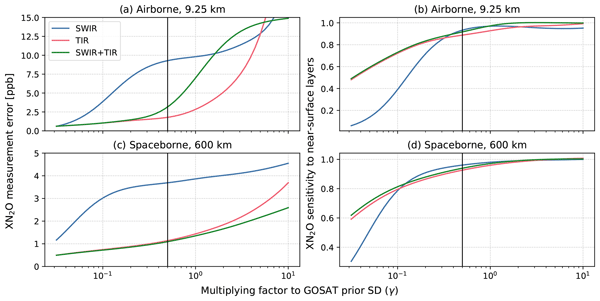
Although XN2O measurement error reductions with respect to a factor γ are understandable for TIR band, the SWIR case has a quite different characteristics both for airborne and spaceborne simulations; the SWIR measurement errors drop abruptly at a certain value of γ. It should be explained in more detail.
5) Calculation of Eq. 17 and Figure 10
Two different XN2O variabilities, for spaceborne and airborne cases, are calculated by using Eq. 17? In the calculation, which parameters come from the designed instruments and from MAIZE observations are not clear, so the authors should explain in more detain in the section 3.3.
Minor comments:
1) Introduction, page 2, line 42 and reference
Waldmann et al., 2026. This paper has been already accepted and published.
2) Introduction, page 3, line 57
It may be better to write XCO2 and XCH4 in this context.
3) 2. Data, Figure 2b
How can we see the values in the figure? It has two different vertical axes with different numbers [ppb].
4) 3. Measurement Methodology, page 8, lines 190-191
“.. so the weighting vector h … and zero otherwise.”
What does “zero” mean? When the elements of the weighing vector are zero, there is completely no N2O molecule?
5) 3. Measurement Methodology, page 9, lines 215-216
“The N2O standard deviation profile, …, by a factor of 5.76, reflecting the lower atmospheric abundance of N2O.”
Related question to one of the main comments; how do you determine such specific number, 5.76, for a factor for the N2O standard deviation profile.
6) 3. Measurement Methodology, Table 1
Why is wavelength range for TIR band different between airborne and spaceborne instruments? Just a limitation of the hardware configurations?
7) 3. Measurement Methodology, page 14, lines 293-205 (Eq. 14)
Can we simply assume the measurement error linearly decrease with respect to the distance that is adopted for data aggregation?
8) 3. Measurement Methodology, page 15, line 308
“… ΔdμN2O is the spatial differentiation of PBL N2O mixing ratio, denoted as μN2O.”
How to calculate PBL N2O mixing ratio from aircraft data? Just the average of all data under PBL height?
9) 3. Measurement Methodology, page 15, lines 313-314
I think accurate PBL height determination is a key for the analysis of this paper. It is better to explain how to estimate PBL height from aircraft data.
10) 3.3 Detectability of N2O emissions at different spatial scales
If I understand correctly, overall, this section seems to mix discussions/explanations of horizontal and vertical distances. It might be better to clearly distinguish between the two.
11) 4. Results, page 16, line 356
Why and how do you set a factor γ to 0.03 to 10?
12) 4. Results, Figure 7 (a) and (c)
XN2O measurement error shown in the figure is the error defined as Eqs. 6 and 14? If so, the estimated measurement error may be underestimated if the assumption of errors decreasing linearly with average distance is not valid. It is better to show also measurement errors of a “single-shot” observation for comparison.
13) 4. Results, page 17, lines 364-365
“In contrast, the SWIR and TIR bands alone have fewer observations, …”
What does this sentence mean?
14) 4. Results, Figure 7 (b) and (d)
The values are calculated by Eq. 8? Judging from the figures, TIR band has more sensitivity to near-surface layer (atmospheric 1st layer?) than I expected. In larger γ cases, SWIR sensitivity to near-surface is lowest and the combination one is highest (Panel b). The author should explain more about this.
15) 4. Results, Figure 10
It is better to explain a bit more what each of the circular makers indicates.
16) 4. Results, Figure 11
It is better to briefly touch on “white area” in the figure. Maybe due to a limitation of reliable calculations?
17) 4. Results, page 23, lines 478-481
“Using the mean semivariogram … than using the semivariogram of highest-variability flight (2022-05-27) …”
It may be better to add information such as “week wind and less mixing condition” for this flight.
18) 5. Discussion and Conclusions
This chapter is more suitable as “Summary and Conclusions”?
Citation: https://doi.org/10.5194/egusphere-2026-1482-RC1 -
AC1: 'Reply on RC1', Ayesha Riaz, 27 May 2026
We sincerely thank the reviewer for the valuable comments and suggestions. All comments have been carefully addressed. Please find the attached document containing our detailed responses to the reviewer’s comments.
Thank you for your time and consideration.
-
AC1: 'Reply on RC1', Ayesha Riaz, 27 May 2026
-
RC2: 'Comment on egusphere-2026-1482', Anonymous Referee #2, 30 Apr 2026
Please find the review commnets on the preprint in the attached PDF file.
-
AC2: 'Reply on RC2', Ayesha Riaz, 27 May 2026
We sincerely thank the reviewer for the valuable comments and suggestions. All comments have been carefully addressed. Please find the attached document containing our detailed responses to the reviewer’s comments.
Thank you for your time and consideration.
-
AC2: 'Reply on RC2', Ayesha Riaz, 27 May 2026
Peer review completion
Journal article(s) based on this preprint
Viewed
| HTML | XML | Total | BibTeX | EndNote | |
|---|---|---|---|---|---|
| 931 | 502 | 61 | 1,494 | 64 | 80 |
- HTML: 931
- PDF: 502
- XML: 61
- Total: 1,494
- BibTeX: 64
- EndNote: 80
Viewed (geographical distribution)
| Country | # | Views | % |
|---|
| Total: | 0 |
| HTML: | 0 |
| PDF: | 0 |
| XML: | 0 |
- 1
Ayesha Riaz

Brian D. Baker
Brian Buma
Karen E. Cady-Pereira
Christopher Chan Miller
William C. Eddy III
Betsy M. Farris
Thomas U. Kampe
Eric A. Kort
Nathan P. Leisso
Robert Spurr
Emily R. Stuchiner
Wendy H. Yang
The requested preprint has a corresponding peer-reviewed final revised paper. You are encouraged to refer to the final revised version.
- Preprint
(2091 KB) - Metadata XML
This paper discusses the design of both airborne and spaceborne instruments covering both the SWIR and TIR wavelength regions, and then discusses the achievable precision of N₂O observations based on detailed instrument specifications and retrieval conditions. The paper presents basic retrieval performances, such as measurement sensitivities to surface-layer’s concentrations, conducts a quantitative assessment of the conditions required to detect actual N₂O variations in the atmosphere, and discusses the detection limits of surface N₂O emissions varying depending on the emission amounts as well as practical methods for spatially aggregation of observed data. I was impressed by the comprehensiveness of this research. However, as the paper contains many equations and conditions/assumptions to elucidate overall measurement performances, it is sometimes hard to understand because of lack of explanations. The paper is suitable for the purpose of AMT journal and I recommend it to be published after adding necessary explanations and considering some revisions.
Major comments:
1) A priori covariance matrix for N2O retrieval
Judging from Figure 4(a), the N2O standard deviation profile seems to be overestimated compared to realistic variabilities in N2O concentrations in the atmosphere. If a priori covariance matrix is set by combinations with N2O standard deviation profile (Panel a) and its error correlation (Panel b), a priori error would be overestimated even if smaller γ values are applied, and consequently, measurement information introduced to retrieval results would be also overrated.
2) Hardware configurations for TIR band
The spaceborne instrument design for TIR band is presented in Table 1. The wavelength resolution (spectral sampling) is set to 0.25 nm at around 8-μm N2O absorption lines, which is rather high compared to current spaceborne-sensors in operation. Is such high-spectral resolution measurement feasible?
3) Discussion on XN2O measurement errors
If measurement errors shown in Figure 7 are calculated on the basis of Eq. 6, they are affected variabilities and sensitivities of H2O, CH4, and temperature (their Jacobians and a priori covariances) through the Gain matrix, unless spectral channels with purely N2O absorption are selected. In addition, does a γ factor that is introduced to modulate N2O a priori covariance matrix also affect the a priori covariance matrices of these other state vector parameters?
4) XN2O measurement errors for SWIR band
Although XN2O measurement error reductions with respect to a factor γ are understandable for TIR band, the SWIR case has a quite different characteristics both for airborne and spaceborne simulations; the SWIR measurement errors drop abruptly at a certain value of γ. It should be explained in more detail.
5) Calculation of Eq. 17 and Figure 10
Two different XN2O variabilities, for spaceborne and airborne cases, are calculated by using Eq. 17? In the calculation, which parameters come from the designed instruments and from MAIZE observations are not clear, so the authors should explain in more detain in the section 3.3.
Minor comments:
1) Introduction, page 2, line 42 and reference
Waldmann et al., 2026. This paper has been already accepted and published.
2) Introduction, page 3, line 57
It may be better to write XCO2 and XCH4 in this context.
3) 2. Data, Figure 2b
How can we see the values in the figure? It has two different vertical axes with different numbers [ppb].
4) 3. Measurement Methodology, page 8, lines 190-191
“.. so the weighting vector h … and zero otherwise.”
What does “zero” mean? When the elements of the weighing vector are zero, there is completely no N2O molecule?
5) 3. Measurement Methodology, page 9, lines 215-216
“The N2O standard deviation profile, …, by a factor of 5.76, reflecting the lower atmospheric abundance of N2O.”
Related question to one of the main comments; how do you determine such specific number, 5.76, for a factor for the N2O standard deviation profile.
6) 3. Measurement Methodology, Table 1
Why is wavelength range for TIR band different between airborne and spaceborne instruments? Just a limitation of the hardware configurations?
7) 3. Measurement Methodology, page 14, lines 293-205 (Eq. 14)
Can we simply assume the measurement error linearly decrease with respect to the distance that is adopted for data aggregation?
8) 3. Measurement Methodology, page 15, line 308
“… ΔdμN2O is the spatial differentiation of PBL N2O mixing ratio, denoted as μN2O.”
How to calculate PBL N2O mixing ratio from aircraft data? Just the average of all data under PBL height?
9) 3. Measurement Methodology, page 15, lines 313-314
I think accurate PBL height determination is a key for the analysis of this paper. It is better to explain how to estimate PBL height from aircraft data.
10) 3.3 Detectability of N2O emissions at different spatial scales
If I understand correctly, overall, this section seems to mix discussions/explanations of horizontal and vertical distances. It might be better to clearly distinguish between the two.
11) 4. Results, page 16, line 356
Why and how do you set a factor γ to 0.03 to 10?
12) 4. Results, Figure 7 (a) and (c)
XN2O measurement error shown in the figure is the error defined as Eqs. 6 and 14? If so, the estimated measurement error may be underestimated if the assumption of errors decreasing linearly with average distance is not valid. It is better to show also measurement errors of a “single-shot” observation for comparison.
13) 4. Results, page 17, lines 364-365
“In contrast, the SWIR and TIR bands alone have fewer observations, …”
What does this sentence mean?
14) 4. Results, Figure 7 (b) and (d)
The values are calculated by Eq. 8? Judging from the figures, TIR band has more sensitivity to near-surface layer (atmospheric 1st layer?) than I expected. In larger γ cases, SWIR sensitivity to near-surface is lowest and the combination one is highest (Panel b). The author should explain more about this.
15) 4. Results, Figure 10
It is better to explain a bit more what each of the circular makers indicates.
16) 4. Results, Figure 11
It is better to briefly touch on “white area” in the figure. Maybe due to a limitation of reliable calculations?
17) 4. Results, page 23, lines 478-481
“Using the mean semivariogram … than using the semivariogram of highest-variability flight (2022-05-27) …”
It may be better to add information such as “week wind and less mixing condition” for this flight.
18) 5. Discussion and Conclusions
This chapter is more suitable as “Summary and Conclusions”?