
the Creative Commons Attribution 4.0 License.
the Creative Commons Attribution 4.0 License.
 | 09 Mar 2026
A T-DINEOF model for multiple oceanic variables reconstruction
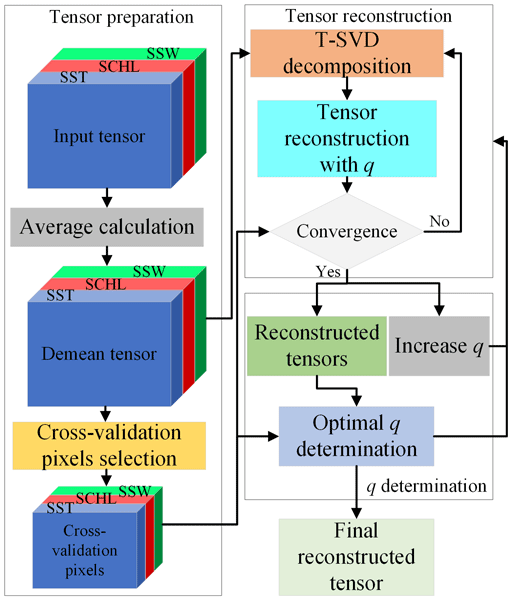
Abstract. Satellite-derived oceanic data are frequently affected by cloud cover, resulting in spatiotemporal gaps. The Multi-DINEOF method is widely used to reconstruct multiple oceanic variables. However, Multi-DINEOF essentially remains a matrix-based DINEOF approach and does not fully leverage the correlations among multiple variables. To address this limitation, this study proposes the T-DINEOF model, aiming to improve the accuracy of reconstructing multiple oceanic variables simultaneously. When applied to sea surface temperature (SST), sea surface chlorophyll-a (SCHL), and sea surface wind (SSW) collectively, T-DINEOF reduces root mean square error (RMSE) by 12.9 %, mean absolute error (MAE) by 13.8 %, and mean absolute percentage error (MAPE) by 11.9 % compared to Multi-DINEOF. For each individual oceanic variable, T-DINEOF outperforms both Multi-DINEOF and the original DINEOF methods, reducing RMSE by 9.0 and 14.7 %, MAE by 10.5 and 14.6 %, and MAPE by 13.7 and 13.4 % for SST; reducing RMSE by 9.3 and 11.8 %, MAE by 9.9 and 13.4 %, and MAPE by 8.3 and 11.8 % for SCHL; and reducing RMSE by 16.6 and 3.7 %, MAE by 16.8 and 3.5 %, and MAPE by 16.4 and 3.1 % for SSW. Additionally, T-DINEOF proves effective in regions with a high proportion of missing data and in cases of low data correlation.
-
Notice on discussion status
The requested preprint has a corresponding peer-reviewed final revised paper. You are encouraged to refer to the final revised version.
-
Preprint
(3289 KB)
-
Supplement
(374 KB)
-
The requested preprint has a corresponding peer-reviewed final revised paper. You are encouraged to refer to the final revised version.
- Preprint
(3289 KB) - Metadata XML
-
Supplement
(374 KB) - BibTeX
- EndNote
- Final revised paper


Journal article(s) based on this preprint
Interactive discussion
Status: closed
-
RC1: 'Comment on egusphere-2026-1164', Anonymous Referee #1, 23 Mar 2026
-
AC2: 'Reply on RC1', Bo Ping, 24 Mar 2026
We sincerely thank Reviewer 1 for the insightful comments on this manuscript. Our detailed responses to the reviewer’s comments have been compiled and provided in the Supplementary file.
-
RC2: 'Reply on AC2', Anonymous Referee #1, 25 Mar 2026
Thank you for the quick response from the authors. The authors have well-addressed most of my questions and comments, except for Comment 11. My initial expression might lead to misunderstanding, and what I meant is to examine the total monthly variation (Jan-Dec, not the monthly time series) of RMSE for each variable in each subregion (not over the entire study region) to better demonstrate the inherent seasonal patterns, rather than just some fluctuations during the experimental period.
Citation: https://doi.org/10.5194/egusphere-2026-1164-RC2 -
AC4: 'Reply on RC2', Bo Ping, 25 Mar 2026
According to the reviewer’s comments, we have recalculated and updated the monthly RMSE distributions of SST, SCHL, and SSW for the three subregions. The new results have replaced Fig. S3 in the Supplementary File, and the corresponding descriptions in the manuscript have been revised accordingly. Please refer to the attachment for details.
-
AC4: 'Reply on RC2', Bo Ping, 25 Mar 2026
-
RC3: 'Reply on AC2', Anonymous Referee #1, 25 Mar 2026
Publisher’s note: this comment is a copy of RC2 and its content was therefore removed on 16 June 2026.
Citation: https://doi.org/10.5194/egusphere-2026-1164-RC3 -
AC3: 'Reply on RC3', Bo Ping, 25 Mar 2026
Publisher’s note: this comment is a copy of AC4 and its content was therefore removed on 16 June 2026.
Citation: https://doi.org/10.5194/egusphere-2026-1164-AC3
-
AC3: 'Reply on RC3', Bo Ping, 25 Mar 2026
-
RC2: 'Reply on AC2', Anonymous Referee #1, 25 Mar 2026
-
AC2: 'Reply on RC1', Bo Ping, 24 Mar 2026
-
AC1: 'Comment on egusphere-2026-1164', Bo Ping, 24 Mar 2026
Publisher’s note: this comment is a copy of AC2 and its content was therefore removed on 16 June 2026.
Citation: https://doi.org/10.5194/egusphere-2026-1164-AC1 -
RC4: 'Comment on egusphere-2026-1164', Anonymous Referee #2, 11 May 2026
This manuscript presents a novel T-DINEOF model for simultaneous reconstruction of multiple oceanic variables (SST, SCHL, and SSW). The core contribution lies in replacing the matrix-based framework of Multi-DINEOF with a third-order tensor structure using T-SVD decomposition, which better preserves the intrinsic correlations among spatial, temporal, and variable dimensions. The experimental results demonstrate that T-DINEOF achieves superior reconstruction accuracy compared to both Multi-DINEOF and single-variable DINEOF, particularly in regions with high proportions of missing data. The manuscript is well-structured and the methodology is technically sound. However, I have several concerns that should be addressed in a revised version.
- Figure 7 combines data from three variables (SST, SCHL, and SSW) with different physical units into a single scatter density plot without axis labels or units. The same issue applies to Figure 13. Please either (a) plot each variable separately with proper physical units (°C for SST, mg/m³ for SCHL, and m/s for SSW) on the axes, or (b) if maintaining the combined plot format, clearly state in the figure caption that values are shown in original physical units after inverse normalization, and list the respective units for each variable.
- The longitude and latitude labels in Figures 9–11 appear compressed or distorted. Please check.
- The validation is performed only against the original satellite-derived data. Given that the original data themselves contain uncertainties and gaps, I suggest validating the reconstructed results against other high-quality monthly products (e.g., reanalysis data) to more rigorously assess the absolute accuracy of T-DINEOF.
- To better compare the detail-preserving capabilities of DINEOF, Multi-DINEOF, and T-DINEOF, I suggest adding local standard deviation maps or gradient maps.
- In Figures 7 and 13, a small number of points show underestimation relative to the 1:1 line. What causes this? Please analyze whether these underestimated points correspond to specific geographic regions (e.g., coastal upwelling zones, frontal regions), specific seasons (e.g., summer stratification periods), or specific variables (e.g., high chlorophyll values). This would help clarify the physical mechanisms behind the reconstruction bias.
- Figure 15 shows obvious periodic fluctuations in SST RMSE over time, particularly in subregion 1. Is this due to lower data availability in summer?
- In Figure 18, the three colored lines (blue, red, grey) are difficult to distinguish. Please revise the figure using more distinct colors, line styles, or symbols to ensure clear visual separation of the three cross-validation proportions.
- On page 10 (line 1), the manuscript states that 3% of existing pixels are selected as cross-validation pixels, while page 23 tests three proportions (3%, 10%, and 20%). Please clarify the rationale for selecting 3% in Section 3.2 (Methodology) rather than deferring this justification to the Discussion section. Readers should understand the basis for this choice when first encountering the method, not later in the paper.
Citation: https://doi.org/10.5194/egusphere-2026-1164-RC4 -
AC5: 'Reply on RC4', Bo Ping, 13 May 2026
We thank the reviewer for the valuable comments. Since the response includes figures and tables, we have provided the point-by-point replies in the Supplementary File.
-
RC5: 'Reply on AC5', Anonymous Referee #2, 14 May 2026
Thank you for your detailed responses to my comments. I am generally satisfied with most of the revisions. However, I still have some remaining concerns regarding Point 3 (validation) and Point 6 (seasonal RMSE periodicity).
Point 3: Validation against reanalysis data
The authors argue that large satellite-reanalysis discrepancies justify omitting independent validation. However, the manuscript mentions daily data experiments (Jan–Mar 2022, Sect. 4.2). Were daily reconstructed results validated against daily reanalysis or buoy data? Monthly averaging may amplify discrepancies; daily comparison would better assess whether the large RMSE reflects true reconstruction error or temporal resolution mismatch. I suggest including daily validation if available.
Point 6: Seasonal periodicity in SST RMSE (Figure 15)
I think there may be a misunderstanding in the explanation. The response states that summer SST exhibits "higher homogeneity" leading to "lower reconstruction errors," while winter has "stronger variability" causing "larger reconstruction errors." However, Figure 15a-c clearly shows higher SST RMSE in summer and lower RMSE in winter—the opposite pattern. I would suggest the authors verify whether the seasonal RMSE pattern aligns with missing data proportions.
Citation: https://doi.org/10.5194/egusphere-2026-1164-RC5 - AC6: 'Reply on RC5', Bo Ping, 15 May 2026
-
RC5: 'Reply on AC5', Anonymous Referee #2, 14 May 2026
-
RC6: 'Comment on egusphere-2026-1164', Anonymous Referee #3, 22 May 2026
Dear Authors,
Please find attached my review report. The report contains my detailed comments and recommendations regarding the manuscript.
-
AC7: 'Reply on RC6', Bo Ping, 23 May 2026
For the responses to Reviewer 3, please refer to the attached file.
-
RC7: 'Reply on AC7', Anonymous Referee #3, 27 May 2026
The authors have substantially revised the manuscript and provided detailed responses to my comments. The manuscript has improved in several important aspects, including clearer descriptions of preprocessing procedures, expanded discussion of methodological novelty, additional analyses of reconstruction characteristics, and a more detailed discussion of robustness and limitations. The additional explanations and newly added analyses strengthen the manuscript compared to the previous version.
However, although many concerns have been partially addressed, several important issues remain insufficiently resolved. The manuscript is considerably improved, but the current evidence still does not fully support several of the stronger conclusions presented. My remaining concerns primarily relate to validation rigor, strength of evidence supporting key claims, physical interpretation, and computational characterization.
Major Comments
- Validation methodology remains insufficiently justified
The authors explain that DINEOF-type methods are adaptive reconstruction approaches and therefore do not require conventional training, validation, and testing datasets. While this clarification is helpful, it does not fully address the central concern regarding validation rigor.
The primary issue is not whether machine-learning-style training is used, but whether the reconstruction evaluation framework provides sufficiently robust evidence of generalization and avoids overly optimistic estimates arising from strong spatial and temporal autocorrelation.
The current evaluation still appears to rely primarily on reconstruction performance at observed locations rather than demonstrating reconstruction under realistic missing-data structures. While this may follow common DINEOF practice, adherence to previous practice alone does not necessarily demonstrate methodological robustness.
The manuscript would be significantly strengthened through additional validation experiments using more realistic missing-data scenarios, such as:
- contiguous spatial masking,
- withheld scenes or temporal holdouts,
- cloud-like masking structures,
- block-based validation approaches.
At minimum, the limitations of the current validation framework should be discussed more explicitly.
- Claims regarding low-correlation performance remain stronger than the evidence currently supports
The authors clarify that correlations were calculated across the entire input tensor and report relatively weak correlations involving SSW. However, the conclusion that T-DINEOF performs better in low-correlation situations still appears stronger than the presented evidence justifies.
The current evidence is primarily based on a single dataset and a single low-correlation variable rather than multiple independent cases or systematically varying correlation regimes.
Therefore, either:
- stronger supporting analyses should be provided, or
- the conclusions regarding low-correlation performance should be moderated.
Currently, the results support improved performance for the presented dataset but do not yet convincingly demonstrate broader behavior under low-correlation conditions.
- Physical realism is improved but still only partially demonstrated
The addition of gradient maps represents a meaningful improvement and partially addresses previous concerns regarding physical interpretation.
However, gradient magnitude alone does not fully establish that reconstructed fields preserve oceanographically meaningful structures.
Additional quantitative evidence would strengthen this section, for example:
- variance preservation analyses,
- anomaly structure comparisons,
- feature-preservation metrics,
- spatial spectral analyses,
- evaluation of mesoscale structure retention.
The manuscript has improved substantially in this area, but stronger quantitative evidence would increase confidence that improvements extend beyond pixel-level statistics.
- Computational characterization remains limited
The authors acknowledge that T-DINEOF is computationally more expensive and discuss hardware specifications and relative convergence behavior.
However, the manuscript still lacks quantitative characterization of computational performance.
For a methodological contribution introducing a more computationally demanding tensor framework, readers would benefit from:
- approximate runtime comparisons,
- memory usage,
- scaling behavior,
- practical computational limitations.
Even approximate benchmarks would substantially improve the practical relevance of the study.
Comments that are adequately addressed
The following concerns have been addressed satisfactorily or substantially improved:
- preprocessing and normalization procedures are now sufficiently clarified;
- robustness discussion has improved considerably, including cross-validation fraction sensitivity and missing-data analyses;
- the explanation of novelty relative to Multi-DINEOF is significantly clearer;
- discussion of methodological limitations is improved.
The manuscript has improved considerably and addresses several previous concerns successfully. The proposed tensor-based extension remains scientifically relevant and potentially useful for multivariate ocean reconstruction.
However, important concerns remain regarding validation rigor, support for low-correlation claims, quantitative demonstration of physical realism, and computational characterization.
Therefore, although the manuscript is significantly stronger than the previous version, I recommend major revision. The remaining revisions should focus primarily on strengthening evidence and validation rather than introducing additional methodological complexity.
Citation: https://doi.org/10.5194/egusphere-2026-1164-RC7 - AC8: 'Reply on RC7', Bo Ping, 01 Jun 2026
-
RC7: 'Reply on AC7', Anonymous Referee #3, 27 May 2026
-
AC7: 'Reply on RC6', Bo Ping, 23 May 2026
Peer review completion


Interactive discussion
Status: closed
-
RC1: 'Comment on egusphere-2026-1164', Anonymous Referee #1, 23 Mar 2026
This manuscript presents a novel extension of the DINEOF method by incorporating tensor decomposition (T-SVD) to reconstruct multiple oceanic variables simultaneously. The proposed T-DINEOF model addresses a genuine limitation of the existing Multi-DINEOF approach, which essentially remains a matrix-based method that cannot fully exploit correlations across variables. The paper is well-structured, and the results demonstrate clear improvements across multiple accuracy metrics. I recommend making some revisions before acceptance.
Specific comments:
- Page 1 Line 38: “satellite-derived missing data reconstruction is receiving increasing attention" The phrasing can be improved. Suggest: "reconstruction of missing satellite-derived data”
- Page 4 Lines 21-23: Please also consider citing a paper with the detailed descriptions of current MODIS SST retrieval algorithm, e.g.: Jia, C., & Minnett, P. J. (2020). High latitude sea surface temperatures derived from MODIS infrared measurements. Remote Sensing of Environment, 251, 112094.
- Page 5 Line 12: Firstly, since the resolution of MODIS data (4 km) is higher than that of AMSR2 (25 km), “downscaled” should be used instead of “upscaled” if the MODIS data were adjusted to the resolution of AMSR2 data. Otherwise, “upscaled” is correct. Secondly, have the authors considered the impact of this spatial aggregation as using nearest-neighbor interpolation may introduce artifacts? Does that mean reconstructed datasets for all variables have the same spatial resolution? If so, can the authors make any comments on that considering the resolution of reconstructed MODIS data is lower in order to accommodate the AMSR2 data? A paragraph in the discussion section should be helpful.
- According to Table 1, the minimum SST in Subregion 3 is -1.81 ºC. Usually, a temperature threshold is applied to distinguish between ice (typically lower than -1.8°C) and open water. Even though this study excludes high latitude regions, but a sea ice mask is still necessary for SST data but it seems not mentioned in the text.
- Page 6 Line 8: In Southern Hemisphere, the summer/winter months are opposite to the Northern Hemisphere. Please revise the descriptions, not only in this sentence, but also in Line 15 and Line 16 (Subregions 1 and 3 have the same seasonal pattern, peaking in the winter).
- Page 12 Line 20: Please also highlight the red ellipse in Fig. 7b as it states “both methods tend to underestimate high-value pixels”.
- Page 13: For Fig. 7, the color bar is not consistent with the density color shown in the plots. Same in Fig. 13.
- For Figs. 9-11: Please do not consider the missing pixels as zero here because variables like SST could be 0 ºC causing unnecessary confusion (even though it is not the case for the northern Pacific in April), also because the difference between the reconstructed and original data is meaningless at those missing pixels. So, please set them as NaN and use another color for the missing pixels (e.g., gray) in the maps.
- Page 16 Line 8: Black ellipses are not found in Fig. 11d.
- For the figure captions of Figs. 9-11, please add the information of the time of the map.
- Page 20: For the temporal characteristics of the reconstruction accuracy, it might be useful to demonstrate the overall monthly RMSE variations during the experimental period to better reveal potential seasonal patterns.
- Page 20 Lines 21-23: The monthly RMSE time series show interesting patterns, particularly the periodic behavior in subregion 1 for SCHL. The explanation linking this to homogeneity is plausible but could be strengthened with quantitative correlation analysis between RMSE and standard deviation.
- Page 22 Line 16: The authors acknowledge that T-DINEOF requires longer computation times, but no quantitative comparison is provided. Given that computational cost is a practical concern for operational applications, an added table comparing runtime for Single-DINEOF, Multi-DINEOF, and T-DINEOF across the three subregions is helpful.
- Page 22 Lines 23-24: “if the source datasets contain systematic biases, such errors may be propagated”. This should be true for any reconstruction method. Please consider adding that tensor methods might be more susceptible to bias propagation because errors in one variable could affect others through the coupled decomposition.
- Page 25 Lines 1-2: Is the statement that “the optimal configuration for reconstruction is the SST-SCHL-SSW order” made barely based on the three input orders presented here or all the possible six input orders? If it is the former case, it is inappropriate using “optimal”. It should be always cautious using “optimal”.
Citation: https://doi.org/10.5194/egusphere-2026-1164-RC1 -
AC2: 'Reply on RC1', Bo Ping, 24 Mar 2026
We sincerely thank Reviewer 1 for the insightful comments on this manuscript. Our detailed responses to the reviewer’s comments have been compiled and provided in the Supplementary file.
-
RC2: 'Reply on AC2', Anonymous Referee #1, 25 Mar 2026
Thank you for the quick response from the authors. The authors have well-addressed most of my questions and comments, except for Comment 11. My initial expression might lead to misunderstanding, and what I meant is to examine the total monthly variation (Jan-Dec, not the monthly time series) of RMSE for each variable in each subregion (not over the entire study region) to better demonstrate the inherent seasonal patterns, rather than just some fluctuations during the experimental period.
Citation: https://doi.org/10.5194/egusphere-2026-1164-RC2 -
AC4: 'Reply on RC2', Bo Ping, 25 Mar 2026
According to the reviewer’s comments, we have recalculated and updated the monthly RMSE distributions of SST, SCHL, and SSW for the three subregions. The new results have replaced Fig. S3 in the Supplementary File, and the corresponding descriptions in the manuscript have been revised accordingly. Please refer to the attachment for details.
-
AC4: 'Reply on RC2', Bo Ping, 25 Mar 2026
-
RC3: 'Reply on AC2', Anonymous Referee #1, 25 Mar 2026
Publisher’s note: this comment is a copy of RC2 and its content was therefore removed on 16 June 2026.
Citation: https://doi.org/10.5194/egusphere-2026-1164-RC3 -
AC3: 'Reply on RC3', Bo Ping, 25 Mar 2026
Publisher’s note: this comment is a copy of AC4 and its content was therefore removed on 16 June 2026.
Citation: https://doi.org/10.5194/egusphere-2026-1164-AC3
-
AC3: 'Reply on RC3', Bo Ping, 25 Mar 2026
-
RC2: 'Reply on AC2', Anonymous Referee #1, 25 Mar 2026
-
AC1: 'Comment on egusphere-2026-1164', Bo Ping, 24 Mar 2026
Publisher’s note: this comment is a copy of AC2 and its content was therefore removed on 16 June 2026.
Citation: https://doi.org/10.5194/egusphere-2026-1164-AC1 -
RC4: 'Comment on egusphere-2026-1164', Anonymous Referee #2, 11 May 2026
This manuscript presents a novel T-DINEOF model for simultaneous reconstruction of multiple oceanic variables (SST, SCHL, and SSW). The core contribution lies in replacing the matrix-based framework of Multi-DINEOF with a third-order tensor structure using T-SVD decomposition, which better preserves the intrinsic correlations among spatial, temporal, and variable dimensions. The experimental results demonstrate that T-DINEOF achieves superior reconstruction accuracy compared to both Multi-DINEOF and single-variable DINEOF, particularly in regions with high proportions of missing data. The manuscript is well-structured and the methodology is technically sound. However, I have several concerns that should be addressed in a revised version.
- Figure 7 combines data from three variables (SST, SCHL, and SSW) with different physical units into a single scatter density plot without axis labels or units. The same issue applies to Figure 13. Please either (a) plot each variable separately with proper physical units (°C for SST, mg/m³ for SCHL, and m/s for SSW) on the axes, or (b) if maintaining the combined plot format, clearly state in the figure caption that values are shown in original physical units after inverse normalization, and list the respective units for each variable.
- The longitude and latitude labels in Figures 9–11 appear compressed or distorted. Please check.
- The validation is performed only against the original satellite-derived data. Given that the original data themselves contain uncertainties and gaps, I suggest validating the reconstructed results against other high-quality monthly products (e.g., reanalysis data) to more rigorously assess the absolute accuracy of T-DINEOF.
- To better compare the detail-preserving capabilities of DINEOF, Multi-DINEOF, and T-DINEOF, I suggest adding local standard deviation maps or gradient maps.
- In Figures 7 and 13, a small number of points show underestimation relative to the 1:1 line. What causes this? Please analyze whether these underestimated points correspond to specific geographic regions (e.g., coastal upwelling zones, frontal regions), specific seasons (e.g., summer stratification periods), or specific variables (e.g., high chlorophyll values). This would help clarify the physical mechanisms behind the reconstruction bias.
- Figure 15 shows obvious periodic fluctuations in SST RMSE over time, particularly in subregion 1. Is this due to lower data availability in summer?
- In Figure 18, the three colored lines (blue, red, grey) are difficult to distinguish. Please revise the figure using more distinct colors, line styles, or symbols to ensure clear visual separation of the three cross-validation proportions.
- On page 10 (line 1), the manuscript states that 3% of existing pixels are selected as cross-validation pixels, while page 23 tests three proportions (3%, 10%, and 20%). Please clarify the rationale for selecting 3% in Section 3.2 (Methodology) rather than deferring this justification to the Discussion section. Readers should understand the basis for this choice when first encountering the method, not later in the paper.
Citation: https://doi.org/10.5194/egusphere-2026-1164-RC4 -
AC5: 'Reply on RC4', Bo Ping, 13 May 2026
We thank the reviewer for the valuable comments. Since the response includes figures and tables, we have provided the point-by-point replies in the Supplementary File.
-
RC5: 'Reply on AC5', Anonymous Referee #2, 14 May 2026
Thank you for your detailed responses to my comments. I am generally satisfied with most of the revisions. However, I still have some remaining concerns regarding Point 3 (validation) and Point 6 (seasonal RMSE periodicity).
Point 3: Validation against reanalysis data
The authors argue that large satellite-reanalysis discrepancies justify omitting independent validation. However, the manuscript mentions daily data experiments (Jan–Mar 2022, Sect. 4.2). Were daily reconstructed results validated against daily reanalysis or buoy data? Monthly averaging may amplify discrepancies; daily comparison would better assess whether the large RMSE reflects true reconstruction error or temporal resolution mismatch. I suggest including daily validation if available.
Point 6: Seasonal periodicity in SST RMSE (Figure 15)
I think there may be a misunderstanding in the explanation. The response states that summer SST exhibits "higher homogeneity" leading to "lower reconstruction errors," while winter has "stronger variability" causing "larger reconstruction errors." However, Figure 15a-c clearly shows higher SST RMSE in summer and lower RMSE in winter—the opposite pattern. I would suggest the authors verify whether the seasonal RMSE pattern aligns with missing data proportions.
Citation: https://doi.org/10.5194/egusphere-2026-1164-RC5 - AC6: 'Reply on RC5', Bo Ping, 15 May 2026
-
RC5: 'Reply on AC5', Anonymous Referee #2, 14 May 2026
-
RC6: 'Comment on egusphere-2026-1164', Anonymous Referee #3, 22 May 2026
Dear Authors,
Please find attached my review report. The report contains my detailed comments and recommendations regarding the manuscript.
-
AC7: 'Reply on RC6', Bo Ping, 23 May 2026
For the responses to Reviewer 3, please refer to the attached file.
-
RC7: 'Reply on AC7', Anonymous Referee #3, 27 May 2026
The authors have substantially revised the manuscript and provided detailed responses to my comments. The manuscript has improved in several important aspects, including clearer descriptions of preprocessing procedures, expanded discussion of methodological novelty, additional analyses of reconstruction characteristics, and a more detailed discussion of robustness and limitations. The additional explanations and newly added analyses strengthen the manuscript compared to the previous version.
However, although many concerns have been partially addressed, several important issues remain insufficiently resolved. The manuscript is considerably improved, but the current evidence still does not fully support several of the stronger conclusions presented. My remaining concerns primarily relate to validation rigor, strength of evidence supporting key claims, physical interpretation, and computational characterization.
Major Comments
- Validation methodology remains insufficiently justified
The authors explain that DINEOF-type methods are adaptive reconstruction approaches and therefore do not require conventional training, validation, and testing datasets. While this clarification is helpful, it does not fully address the central concern regarding validation rigor.
The primary issue is not whether machine-learning-style training is used, but whether the reconstruction evaluation framework provides sufficiently robust evidence of generalization and avoids overly optimistic estimates arising from strong spatial and temporal autocorrelation.
The current evaluation still appears to rely primarily on reconstruction performance at observed locations rather than demonstrating reconstruction under realistic missing-data structures. While this may follow common DINEOF practice, adherence to previous practice alone does not necessarily demonstrate methodological robustness.
The manuscript would be significantly strengthened through additional validation experiments using more realistic missing-data scenarios, such as:
- contiguous spatial masking,
- withheld scenes or temporal holdouts,
- cloud-like masking structures,
- block-based validation approaches.
At minimum, the limitations of the current validation framework should be discussed more explicitly.
- Claims regarding low-correlation performance remain stronger than the evidence currently supports
The authors clarify that correlations were calculated across the entire input tensor and report relatively weak correlations involving SSW. However, the conclusion that T-DINEOF performs better in low-correlation situations still appears stronger than the presented evidence justifies.
The current evidence is primarily based on a single dataset and a single low-correlation variable rather than multiple independent cases or systematically varying correlation regimes.
Therefore, either:
- stronger supporting analyses should be provided, or
- the conclusions regarding low-correlation performance should be moderated.
Currently, the results support improved performance for the presented dataset but do not yet convincingly demonstrate broader behavior under low-correlation conditions.
- Physical realism is improved but still only partially demonstrated
The addition of gradient maps represents a meaningful improvement and partially addresses previous concerns regarding physical interpretation.
However, gradient magnitude alone does not fully establish that reconstructed fields preserve oceanographically meaningful structures.
Additional quantitative evidence would strengthen this section, for example:
- variance preservation analyses,
- anomaly structure comparisons,
- feature-preservation metrics,
- spatial spectral analyses,
- evaluation of mesoscale structure retention.
The manuscript has improved substantially in this area, but stronger quantitative evidence would increase confidence that improvements extend beyond pixel-level statistics.
- Computational characterization remains limited
The authors acknowledge that T-DINEOF is computationally more expensive and discuss hardware specifications and relative convergence behavior.
However, the manuscript still lacks quantitative characterization of computational performance.
For a methodological contribution introducing a more computationally demanding tensor framework, readers would benefit from:
- approximate runtime comparisons,
- memory usage,
- scaling behavior,
- practical computational limitations.
Even approximate benchmarks would substantially improve the practical relevance of the study.
Comments that are adequately addressed
The following concerns have been addressed satisfactorily or substantially improved:
- preprocessing and normalization procedures are now sufficiently clarified;
- robustness discussion has improved considerably, including cross-validation fraction sensitivity and missing-data analyses;
- the explanation of novelty relative to Multi-DINEOF is significantly clearer;
- discussion of methodological limitations is improved.
The manuscript has improved considerably and addresses several previous concerns successfully. The proposed tensor-based extension remains scientifically relevant and potentially useful for multivariate ocean reconstruction.
However, important concerns remain regarding validation rigor, support for low-correlation claims, quantitative demonstration of physical realism, and computational characterization.
Therefore, although the manuscript is significantly stronger than the previous version, I recommend major revision. The remaining revisions should focus primarily on strengthening evidence and validation rather than introducing additional methodological complexity.
Citation: https://doi.org/10.5194/egusphere-2026-1164-RC7 - AC8: 'Reply on RC7', Bo Ping, 01 Jun 2026
-
RC7: 'Reply on AC7', Anonymous Referee #3, 27 May 2026
-
AC7: 'Reply on RC6', Bo Ping, 23 May 2026
Peer review completion
Journal article(s) based on this preprint
Viewed
| HTML | XML | Total | Supplement | BibTeX | EndNote | |
|---|---|---|---|---|---|---|
| 983 | 353 | 186 | 1,522 | 146 | 124 | 143 |
- HTML: 983
- PDF: 353
- XML: 186
- Total: 1,522
- Supplement: 146
- BibTeX: 124
- EndNote: 143
Viewed (geographical distribution)
| Country | # | Views | % |
|---|
| Total: | 0 |
| HTML: | 0 |
| PDF: | 0 |
| XML: | 0 |
- 1
Bo Ping

Ruiting Yang
Yunshan Meng
Fenzhen Su
Cunjin Xue
The requested preprint has a corresponding peer-reviewed final revised paper. You are encouraged to refer to the final revised version.
- Preprint
(3289 KB) - Metadata XML
-
Supplement
(374 KB) - BibTeX
- EndNote
- Final revised paper
This manuscript presents a novel extension of the DINEOF method by incorporating tensor decomposition (T-SVD) to reconstruct multiple oceanic variables simultaneously. The proposed T-DINEOF model addresses a genuine limitation of the existing Multi-DINEOF approach, which essentially remains a matrix-based method that cannot fully exploit correlations across variables. The paper is well-structured, and the results demonstrate clear improvements across multiple accuracy metrics. I recommend making some revisions before acceptance.
Specific comments: