
the Creative Commons Attribution 4.0 License.
the Creative Commons Attribution 4.0 License.
 | 04 May 2026
AQUA v1: The Application for QUality Assessment for the Climate Change Adaptation Digital Twin
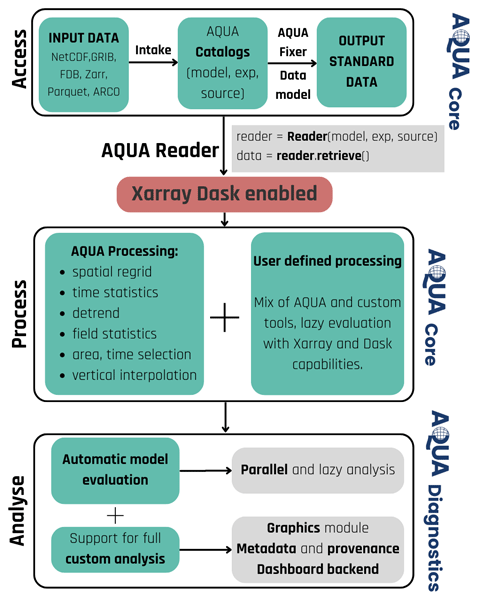
Abstract. The increasing availability of kilometer-scale climate simulations presents major challenges for data access, processing, and analysis due to the unprecedented volume and heterogeneity of the outputs. Different data formats, structures, and metadata conventions, require dedicated solutions to ensure interoperability and usability. We introduce AQUA (Application for QUality Assessment), a Python-based framework developed within the Climate Change Adaptation Digital Twin of the Destination Earth (DestinE) initiative, designed to support the automated evaluation of high-resolution global climate simulations. Although several diagnostic suites for the analysis of global climate model data are already available, AQUA provides a flexible and modular infrastructure for accessing and processing climate model output across various formats. By building on widely adopted Python libraries, it enables scalable, out-of-core computations. Its design supports integration into automated workflows and user-defined pipelines, facilitating both operational and research-oriented applications. This paper focuses on the architecture and core functionalities of the AQUA core, which handles data ingestion, standardization, and pre-processing. AQUA is open source and actively maintained, and aims to serve as a community tool for robust, reproducible, and efficient climate data analysis across projects and institutions.
-
Notice on discussion status
The requested preprint has a corresponding peer-reviewed final revised paper. You are encouraged to refer to the final revised version.
-
Preprint
(1177 KB)
-
The requested preprint has a corresponding peer-reviewed final revised paper. You are encouraged to refer to the final revised version.
- Preprint
(1177 KB) - Metadata XML
- BibTeX
- EndNote
- Final revised paper


Journal article(s) based on this preprint
Interactive discussion
Status: closed
-
RC1: 'Review of the manuscript “AQUA v1: The Application for QUality Assessment for the Climate Change Adaptation Digital Twin”', Anonymous Referee #1, 12 Jun 2026
- AC1: 'Reply on RC1', Matteo Nurisso, 27 Jul 2026
-
RC2: 'Comment on egusphere-2026-1115', Anonymous Referee #2, 15 Jun 2026
Review of “AQUA v1: The Application for QUality Assessment for the Climate Change Adaptation Digital Twin” by Nurisso et al., submitted to GMD.
General comment:
This manuscript introduces AQUA v1 (Application for QUality Assessment), a Python-based framework developed within the Climate Change Adaptation Digital Twin of the Destination Earth (DestinE) initiative. The tool is designed to support the automated evaluation of kilometer-scale, high-resolution global climate simulations.
The paper is well-written and represents an important contribution to the community by providing a useful tool for high-resolution climate model evaluation. The authors provide a good amount of detail, specifically focusing on the architecture and core functionalities of the AQUA core, which effectively handles data ingestion, standardization, and pre-processing.
A major strength of this work is the strategy presented in the package design. The manuscript demonstrates a reasonable degree of thought regarding the flexible and modular use of the package. By building on widely adopted Python libraries, AQUA successfully delivers a modular infrastructure that allows for scalable, out-of-core computations and handles data access across varying formats. Furthermore, its ability to integrate into automated workflows and user-defined pipelines makes it highly valuable for both operational and research-oriented applications. As an open-source, actively maintained framework, it is well-positioned to serve as a community tool that ensures interoperability, usability, and reproducible climate data analysis across different projects and institutions.
Overall, this manuscript provides a thorough and well-designed contribution to the climate modeling community. I have a few minor comments and technical suggestions detailed in the next section. Therefore, I recommend that the paper is acceptable for publication after the authors address the points raised in the specific comments below.
Specific comments:
Line 44: Please consider including the following reference for CMOR, which is the following one.
Mauzey, C., Doutriaux, C., Nadeau, D., Taylor, K. E., Durack, P. J., Betts, E., Cofino, A. S., Florek, P., Hogan, E., Rodriguez Gonzalez, J. M., Kettleborough, J., Nicholls, Z., Ogochi, K., Seddon, J., Wachsmann, F., & Weigel, T. (2026). The Climate Model Output Rewriter (CMOR) (3.14.3). Zenodo. https://doi.org/10.5281/zenodo.19869925
Line 66: Please use the representative reference paper for the PMP: Lee, J., Gleckler, P. J., Ahn, M.-S., Ordonez, A., Ullrich, P. A., Sperber, K. R., Taylor, K. E., Planton, Y. Y., Guilyardi, E., Durack, P., Bonfils, C., Zelinka, M. D., Chao, L.-W., Dong, B., Doutriaux, C., Zhang, C., Vo, T., Boutte, J., Wehner, M. F., Pendergrass, A. G., Kim, D., Xue, Z., Wittenberg, A. T., and Krasting, J.: Systematic and objective evaluation of Earth system models: PCMDI Metrics Package (PMP) version 3, Geosci. Model Dev., 17, 3919–3948, https://doi.org/10.5194/gmd-17-3919-2024, 2024.
Lines 65-73: Those two paragraphs are shorter than others, maybe they could be merged into one paragraph?
Lines 162-165: The authors note that the analysis performed with the integrated diagnostic suite will be covered in a separate publication ("Paper II"). While it is understandable that the detailed analysis is reserved for a future paper, the manuscript would be significantly strengthened by providing a brief overview or a high-level summary of the specific diagnostics currently considered or implemented in AQUA. Even a concise description or a bulleted list of key metrics and diagnostic categories would give readers a clearer, more immediate understanding of the package's practical capabilities.
Lines 517–521: The authors set an excellent and ambitious vision for AQUA to serve as a "blueprint for next-generation climate data analysis software." To further strengthen this concluding point, it would be highly beneficial to explicitly contextualize AQUA within the existing landscape of open-source, community-driven climate analysis packages. Since several successful community tools already share a similar open philosophy, briefly acknowledging these established frameworks would provide valuable context. This would help clarify how AQUA builds upon or uniquely complements existing efforts, making the manuscript's conclusion even more impactful.
Citation: https://doi.org/10.5194/egusphere-2026-1115-RC2 - AC2: 'Reply on RC2', Matteo Nurisso, 27 Jul 2026
Peer review completion


Interactive discussion
Status: closed
-
RC1: 'Review of the manuscript “AQUA v1: The Application for QUality Assessment for the Climate Change Adaptation Digital Twin”', Anonymous Referee #1, 12 Jun 2026
The manuscript “AQUA v1: The Application for QUality Assessment for the Climate Change Adaptation Digital Twin“ by Nurisso et al. the first part of a new software package (AQUA) that facilitates monitoring and evaluation of simulations performed by the Climate Change Adaptation Digital Twin of the Destination Earth initiative. The manuscript focuses on the description of the underlying code philosophy, code structure and core functionalities of AQUA and provides some examples about AQUA’s data handling performance.
The manuscript is very well written and well structured, and it provides the necessary information to understand the structure of the software without going too deep into technical details. The topic of the manuscript lays clearly withing the scope of GMD, and the new software could potentially be of interest to a substantial part of the climate modeling and Digital Twin community. There are, however, a few things that I would like to see addressed/discussed to help the reader better understand the work that has been done and what the novel parts of the work are.
I recommend the publication of the manuscript after revisions.
Comments/recommendations:
- I understand that the software was created with the monitoring and evaluation of simulations from ClimateDT with its specific requirements and needs in mind. The authors explain that AQUA could potentially also be used to evaluate simulations from CMIP or CORDEX. There are several other software packages around (some of them are mentioned in the introduction of the manuscript), however, that are used to do exactly that, and successfully doing so. If it is indeed a near-term goal of AQUA to be used for simulations from these projects then I would want to see a much more detailed discussion where AQUA would fit in the landscape of these already existing software packages, where the overlap between these packages and AQUA are, and where AQUA is unique. If this not a near-term goal of AQUA to evaluate the simulations from these projects then I think the discussion of AQUA should be clearer focused on the capabilities of AQUA with respect to evaluating simulations from ClimateDT.
- AQUA is software package that is added to a collection of already existing software packages that do similar things (although not specifically focused on the evaluation of data from ClimateDT). What are AQUA’s plans to interact with the rest of the evaluation community? What priorities do the AQUA developers have with regards of sharing efforts with the rest of the community to avoid development duplications?
- The authors have stressed the fact that AQUA is based on the WMO GRIB standards. However, the example of the smmregrid code performance is based on netCDF files. Would it not make sense to base this performance test on GRIB data?
More specific comments:
- Line 65: Spelling of “EsmValTool” should be “ESMValTool”
- Line 85: In the sentence “The Application for QUality Assessment (AQUA) is a Python3 package specifically tailored to address this challenge” it would be good to mention (again) that you refer to version 1 of AQUA (as stated in the manuscript title but not anywhere else)
- Line 88: "Paper II" is mentioned here and in some other parts of the manuscript, but this paper is not mentioned in the literature or in more detail in the text. I guess this paper is planned, but not in a stage yet to be referenced with more details. But if this is the case, I would recommend to mention in the text ONCE that this paper is planned and what the content of the paper will be, and then remove the rest of the references to this paper since it is not clear when it will be available.
- Line 176: “variables metadata” should be “variable metadata”?
- Line 202: “dataset” should be “datasets”?
- Line 291: “the coordinates nature” should be “the coordinates’ nature”?
- Line 309: “and a metadata” should be “and metadata”?
- Line 343: “to generate in highly efficient and modular” should be “to generate in a highly efficient and modular”?
- Line 396: The sentence “The computations have been done 3 times and the results presented average the times” seems redundant since very similar text is present in the paragraph before.
- Line 416: What do the authors mean with the sentence “It should be noted that Polytope is also sensitive to bandwidth, as it is based on remote access”? Does it mean that accessing the data as soon as it is the Data Lake is harder and slower? But is that not the whole point of doing analyses on data that span several years and not just the most recent month?
- Line 512: “CORDE” should be “CORDEX”?
- Line 517 to 521: In my opinion this last paragraph is aiming too high. There are novelties to AQUA in comparison to other software packages, but claiming that AQUA can be seen as a blueprint for future software packages that are “grounded in solid engineering, adapted to the new data landscape, and committed to enabling scientific progress” implies that all other software packages cannot provide any of this. And that is not correct. I would strongly recommend to carefully rephrase this paragraph.
- Figure 4 figure heading: “the different dataset” should be “the different datasets”?
Citation: https://doi.org/10.5194/egusphere-2026-1115-RC1 - AC1: 'Reply on RC1', Matteo Nurisso, 27 Jul 2026
-
RC2: 'Comment on egusphere-2026-1115', Anonymous Referee #2, 15 Jun 2026
Review of “AQUA v1: The Application for QUality Assessment for the Climate Change Adaptation Digital Twin” by Nurisso et al., submitted to GMD.
General comment:
This manuscript introduces AQUA v1 (Application for QUality Assessment), a Python-based framework developed within the Climate Change Adaptation Digital Twin of the Destination Earth (DestinE) initiative. The tool is designed to support the automated evaluation of kilometer-scale, high-resolution global climate simulations.
The paper is well-written and represents an important contribution to the community by providing a useful tool for high-resolution climate model evaluation. The authors provide a good amount of detail, specifically focusing on the architecture and core functionalities of the AQUA core, which effectively handles data ingestion, standardization, and pre-processing.
A major strength of this work is the strategy presented in the package design. The manuscript demonstrates a reasonable degree of thought regarding the flexible and modular use of the package. By building on widely adopted Python libraries, AQUA successfully delivers a modular infrastructure that allows for scalable, out-of-core computations and handles data access across varying formats. Furthermore, its ability to integrate into automated workflows and user-defined pipelines makes it highly valuable for both operational and research-oriented applications. As an open-source, actively maintained framework, it is well-positioned to serve as a community tool that ensures interoperability, usability, and reproducible climate data analysis across different projects and institutions.
Overall, this manuscript provides a thorough and well-designed contribution to the climate modeling community. I have a few minor comments and technical suggestions detailed in the next section. Therefore, I recommend that the paper is acceptable for publication after the authors address the points raised in the specific comments below.
Specific comments:
Line 44: Please consider including the following reference for CMOR, which is the following one.
Mauzey, C., Doutriaux, C., Nadeau, D., Taylor, K. E., Durack, P. J., Betts, E., Cofino, A. S., Florek, P., Hogan, E., Rodriguez Gonzalez, J. M., Kettleborough, J., Nicholls, Z., Ogochi, K., Seddon, J., Wachsmann, F., & Weigel, T. (2026). The Climate Model Output Rewriter (CMOR) (3.14.3). Zenodo. https://doi.org/10.5281/zenodo.19869925
Line 66: Please use the representative reference paper for the PMP: Lee, J., Gleckler, P. J., Ahn, M.-S., Ordonez, A., Ullrich, P. A., Sperber, K. R., Taylor, K. E., Planton, Y. Y., Guilyardi, E., Durack, P., Bonfils, C., Zelinka, M. D., Chao, L.-W., Dong, B., Doutriaux, C., Zhang, C., Vo, T., Boutte, J., Wehner, M. F., Pendergrass, A. G., Kim, D., Xue, Z., Wittenberg, A. T., and Krasting, J.: Systematic and objective evaluation of Earth system models: PCMDI Metrics Package (PMP) version 3, Geosci. Model Dev., 17, 3919–3948, https://doi.org/10.5194/gmd-17-3919-2024, 2024.
Lines 65-73: Those two paragraphs are shorter than others, maybe they could be merged into one paragraph?
Lines 162-165: The authors note that the analysis performed with the integrated diagnostic suite will be covered in a separate publication ("Paper II"). While it is understandable that the detailed analysis is reserved for a future paper, the manuscript would be significantly strengthened by providing a brief overview or a high-level summary of the specific diagnostics currently considered or implemented in AQUA. Even a concise description or a bulleted list of key metrics and diagnostic categories would give readers a clearer, more immediate understanding of the package's practical capabilities.
Lines 517–521: The authors set an excellent and ambitious vision for AQUA to serve as a "blueprint for next-generation climate data analysis software." To further strengthen this concluding point, it would be highly beneficial to explicitly contextualize AQUA within the existing landscape of open-source, community-driven climate analysis packages. Since several successful community tools already share a similar open philosophy, briefly acknowledging these established frameworks would provide valuable context. This would help clarify how AQUA builds upon or uniquely complements existing efforts, making the manuscript's conclusion even more impactful.
Citation: https://doi.org/10.5194/egusphere-2026-1115-RC2 - AC2: 'Reply on RC2', Matteo Nurisso, 27 Jul 2026
Peer review completion
Journal article(s) based on this preprint
Model code and software
AQUA Matteo Nurisso, Silvia Caprioli, Paolo Davini, Jost von Hardenberg, Natalia Nazarova, Supriyo Ghosh, Paolo Ghinassi, Marco Cadau, Emanuele Tovazzi, Nikolay Koldunov, Maqsood Mubarak Rajput, and Bruno Kinoshita https://doi.org/10.5281/zenodo.14906075
Interactive computing environment
high_res_data_access Matteo Nurisso https://github.com/koldunovn/high_res_data_access
Viewed
| HTML | XML | Total | BibTeX | EndNote | |
|---|---|---|---|---|---|
| 390 | 96 | 36 | 522 | 32 | 29 |
- HTML: 390
- PDF: 96
- XML: 36
- Total: 522
- BibTeX: 32
- EndNote: 29
Viewed (geographical distribution)
| Country | # | Views | % |
|---|
| Total: | 0 |
| HTML: | 0 |
| PDF: | 0 |
| XML: | 0 |
- 1

Jost von Hardenberg
Marco Cadau
Silvia Caprioli
Paolo Ghinassi
Supriyo Ghosh
Nikolay Koldunov
Natalia Nazarova
Maqsood Mubarak Rajput
Emanuele Tovazzi
Paolo Davini
The requested preprint has a corresponding peer-reviewed final revised paper. You are encouraged to refer to the final revised version.
- Preprint
(1177 KB) - Metadata XML
The manuscript “AQUA v1: The Application for QUality Assessment for the Climate Change Adaptation Digital Twin“ by Nurisso et al. the first part of a new software package (AQUA) that facilitates monitoring and evaluation of simulations performed by the Climate Change Adaptation Digital Twin of the Destination Earth initiative. The manuscript focuses on the description of the underlying code philosophy, code structure and core functionalities of AQUA and provides some examples about AQUA’s data handling performance.
The manuscript is very well written and well structured, and it provides the necessary information to understand the structure of the software without going too deep into technical details. The topic of the manuscript lays clearly withing the scope of GMD, and the new software could potentially be of interest to a substantial part of the climate modeling and Digital Twin community. There are, however, a few things that I would like to see addressed/discussed to help the reader better understand the work that has been done and what the novel parts of the work are.
I recommend the publication of the manuscript after revisions.
Comments/recommendations:
More specific comments: