
the Creative Commons Attribution 4.0 License.
the Creative Commons Attribution 4.0 License.
 | 12 Jan 2026
Ocean salinity across space-time scales: From water cycle indicator to dynamical driver
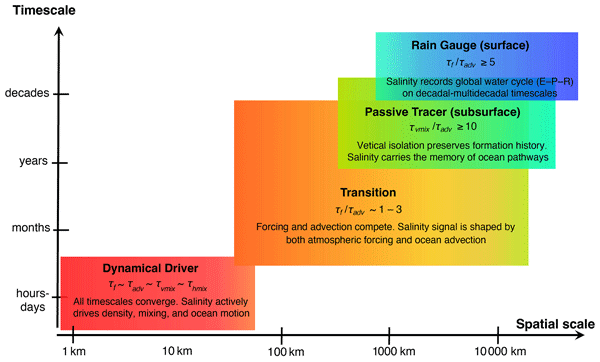
Abstract. Ocean salinity plays a complementary role in the climate system: it integrates changes in the global water cycle while also helping drive ocean circulation through its control on seawater density. Salinity has long been viewed as the ocean’s “rain gauge,” a largely passive recorder of surface evaporation, precipitation, and runoff. Yet salinity also shapes the currents and mixing that redistribute heat and freshwater, raising a central question: when does salinity mainly record climate forcing, and when does it actively influence climate dynamics? This review synthesizes two decades of satellite and in situ observations within a regime-dependent framework in which salinity’s function is set by the competition among freshwater forcing, advection, and mixing timescales. At basin scales (>1000 km) over decades, salinity tracks water-cycle change through pattern amplification, with fresh regions freshening and salty regions becoming saltier. At regional to mesoscale (∼10–500 km) and seasonal-to-interannual timescales, salinity traces circulation pathways; subsurface anomalies often reflect subduction and ventilation histories from years earlier. At submesoscales (O(10 km)) and synoptic timescales (hours to days), salinity becomes dynamically active, sharpening density fronts, modulating stratification, and altering mixing in ways that feed back on its own transport and air–sea exchange. Understanding ocean climate response requires resolving regime boundaries where these balances shift. The critical observational gap is global sea-surface salinity at O(10 km), where salinity transitions from passive tracer to active driver yet current satellite products cannot resolve this scale. Observations at regime boundaries would show how water-cycle intensification and ocean circulation changes interact, improving projections of climate change, ocean heat storage and distribution, and ecosystem dynamics at regional and global scales.
-
Notice on discussion status
The requested preprint has a corresponding peer-reviewed final revised paper. You are encouraged to refer to the final revised version.
-
Preprint
(30396 KB)
-
The requested preprint has a corresponding peer-reviewed final revised paper. You are encouraged to refer to the final revised version.
- Preprint
(30396 KB) - Metadata XML
- BibTeX
- EndNote
- Final revised paper


Journal article(s) based on this preprint
Interactive discussion
Status: closed
-
RC1: 'Comment on egusphere-2025-6562', Anonymous Referee #1, 02 Feb 2026
-
AC2: 'Reply on RC1', Lisan Yu, 24 Mar 2026
We sincerely thank Reviewer #1 for their time and careful evaluation of the manuscript. These constructive comments are greatly appreciated and have contributed to improving the clarity, rigor, and overall quality of the work. We have addressed each point below, and the corresponding changes are reflected in the revised manuscript.
This is an interesting and timely paper, summarizing both the past work of Lisan Yu at larger scales, and what happens at shorter scales (~10 km) which is a challenge for future satellite missions, as well as for the observations.
Thank you for your positive feedback.
My comments are mostly minor:
Section 3: Interannual time scales. I suggest to start by indicating how interannual is defined here (detrended and deseasonalized is too vague here (it could be both subannual periods or longer periods; also for figure 3, only 10 years are considered: how stable are the statistics presented for Corr Interannual variability ‘p stat’ are probably not enough…)
The reviewer is correct that “detrended and deseasonalized” is not sufficiently precise. We have added a clarification in both the text in section 3 specifying that interannual variability refers to year-to-year variations on timescales of 1–7 years, obtained by removing the long-term trend and mean seasonal cycle from monthly-mean fields.
On the concern about statistical stability with only 11 years of data: this is a fair point. The short record does limit the degrees of freedom for interannual statistics, and we have noted this explicitly in the revised figure caption. The low correlation threshold of r > 0.14 (p < 0.1) is a direct consequence of this limitation. We also note that the broad spatial patterns are consistent with results based on longer records (Vinogradova and Ponte, 2017; Yu 2023), which gives us some confidence that the patterns are not an artifact of the short analysis period.
In the river plume discussion (possibly 4.1.3, it could be good to also cite Olivier et al (2023)
Olivier, L., G. Reverdin, J. Boutin, R. Laxenaire, D. Iudicone, S. Pesant, Paulo Calil, J. Horstmann, D. Couet, J. M. Erta, A. Koch-Larrouy A. Bertrand, P. Rousselot, J.-L. Vergely, S. Speich, M. Araujo, 2024. Late summer northwestward Amazon plume pathway under the action of the North Brazil Current rings. Rem. Sens Res., 307, 114165, ISSN 0034-4257
This fits well in the ’ tf/tadv ~1 regime (if here one adopts tf on order of month (or months)
The reference has been added to two places in section 4.1.3. Thank you for the suggestion.
This may hint to a sight difficulty of the reading of table 2. Forcing of a river outflow might be of time scales of days, but can also be on the scale of a few weeks, even months (for the Amazone, given as an example later, for example). May be that should be mentioned beforehand. Thus near field will vary in spatial scale depending on the time scale considered. In the table, maybe use for that tf, the symbol to (tau of outflow). This would make the comparison with the previous discussion in the open ocean easier to follow. In table 4, for subsurface tvmix tadv, I consider that a particular type of subsurface signal. In the whole subduction regime, this is not so different (well, depends where, I agree).
I suspect there is an ambiguity exemplified on line 421, with mid-field tf is larger. What is meant is that the response time to plume change is on these time scales, not really the earlier river discharge time scale. The ambiguity in the whole par is that tf defined as discharge, which should have same time scale wherever one is… Same issue on line 427… One needs to redefine tf…
The reviewer raises a valid point that τf in Section 4.1.3 comprises two physically distinct timescales. Following the reviewer's suggestion, we have introduced τo as a dedicated symbol for the river outflow variability timescale and made the following changes to Section 4.1.3 and Table 2:
- In the opening paragraph, τo is defined and it is clarified that for large river systems such as the Amazon, τo can range from days (flood events) to months (seasonal discharge cycle), and that the spatial extent of the near-field will vary accordingly. All instances of τf/τadv have been replaced with τo/τadv.
- In the near-field paragraph, it is noted that τo ranges from days to weeks depending on the discharge event considered, while τadv remains set by boundary-current export timescales.
- In the mid-field paragraph, it is explicitly stated that τo remains set by discharge variability as before, but τadv has increased with distance to the point where it becomes comparable to τo, making clear that it is τadv that changes with distance, not τo.
- In the far-field paragraph, τf/τadv has been replaced with τo /τadv, and the range of τo is noted explicitly.
- In Table 2, the column header τf/τadv has been replaced with τo/τadv, and a footnote has been added clarifying that τo is independent of distance from the mouth while τadv increases with distance.
4.2.1: not so clear that there is subsurface intensification on Fig. 6 (specially in Atlantic Ocean), whereas it is shifted spatially (OK; in particular in southern Pacific). Wondering whether isopycnal representation would help (instead of Z-representation)
We thank the reviewer for this careful examination of Figure 6. The point about the Atlantic is well taken. The signal there is better described as a spatial displacement of the trend maximum poleward and downward from the surface forcing region rather than a clear vertical intensification, which is physically consistent with subduction along sloping isopycnals. We have revised the text accordingly. Regarding the suggestion to use isopycnal coordinates, we agree this would provide a more direct view of the subduction pathways. However, converting the EN4 product to isopycnal coordinates over the 1950–2019 period is not straightforward because the density field itself is evolving due to concurrent warming and salinity changes, and a simple conversion would mix salinity changes along isopycnals with isopycnal heaving. We have noted this as a direction for future work and added a brief comment in the text to this effect.
512: I am not sure that this is what explains the nearly vertical trend structure in tropical regions (what is referred to there?)
The last sentence of Section 4.2.3 could indeed be clearer about what “nearly vertical trend structure” refers to and how it relates to τvmix ~ τadv. We have revised the sentence to clarify that in tropical regions, strong upwelling and enhanced vertical mixing reduce the stratification barrier between surface and subsurface waters, allowing surface freshwater anomalies to be more readily communicated downward. As a result, the tropical trend structure tends to be more vertically uniform rather than showing the clear subsurface maximum characteristic of subtropical subduction. This is distinct from the subtropical regime where τvmix ≫ τadv and subduction preserves surface anomalies at depth along isopycnal pathways.
545: I don’t see the transition to salinity-dominated in GS winter at the smaller scales in the figure (it tends toward pi/4)
Thanks for the comment. The text and figure caption have been revised to more accurately reflect what Figure 7 shows. The text now reads:
“Near 10 km Tu approaches or drops below π/4 and Rρ approaches or falls below 1 in all three regimes, indicating a shift toward equal or salinity-dominated density gradients, though the transition is more pronounced in the open ocean and continental shelf regimes. In the Gulf Stream winter regime, Tu approaches π/4 but does not clearly cross below it, consistent with a transition toward equal T-S contribution rather than full salinity dominance (Yu 2026).”
The figure 7 caption has been revised accordingly.
551: Below Rd… Horizontal flow cannot maintain geostrophic balance… This is too much a statement.The previous sentence seems to me clearer and does not require this added explanation.
The sentence has been deleted.
L 568 is awkward: ‘Solar heating preferentially warms colder patches, because…’. The net feedback is not just solar heating (I guess there it was the longwave fluxes (a net cooling term; maybe use ‘radiative cooling’…) that were implied), but in the other terms (sensible and latent heat), and it is not the lower ocean heat content that is in itself the cause of differential heating, but the lower surface temperature… Maybe instead of ‘solar heating’ use ‘solar heat fluxes’ (thi is clear later on in the paper)
This is a good point. The net surface heat flux damping of temperature fronts involves radiative, sensible, and latent heat components, and it is the lower SST rather than the lower heat content that drives the differential heating. We have revised the sentence accordingly.
573: ‘depends on atmospheric state… and on sea surface temperature, rather than on salinity itself’ I would add that this can act as a positive feedback on salinity gradient, in regions where T and S are positively correlated. There, just as the latent heat flux might damp the temperature contrast, it could strengthen the salinity contrast. (one could also mention that on l.582)
In regions where T and S are positively correlated, such as where warm, salty subtropical waters meet cool, fresh subpolar waters, latent heat flux damping of the temperature contrast could indeed act to strengthen the salinity contrast, providing a positive feedback on the salinity gradient. We have added a sentence to this effect. Thanks for the suggestion.
l.578-582: however, if one starts from a ‘T-dominated’ front, there is a limit to this ‘stronger frontogenesis’, as when one gets close to pi/4, as salinity gradients increase relative to temperature gradients of these initially ‘T-dominated’ fronts, the horizontal surface temperature gradients tend to 0 , thus weakening the initial frontogenesis. I guess after what you refer to and describe in this paragraph is the descent towards ‘salinity dominated’ fronts…
The reviewer raised a subtle but important point. As salinity gradients increase relative to temperature gradients in an initially T-dominated front, the horizontal SST gradient weakens, which in turn reduces the frontogenetic forcing that was driving the initial intensification. We have revised section 4.3.2 accordingly and acknowledged this limit.
584: there is a vertical extent to which the resulting vertical velocities will act as a result of the frontogenesis; It is not because they are locally on order O(10-100m/day) that the particles will be displaced vertically, and ventilate the upper pycnocline (or 'upper' hasto be carefully defined).
The sentences in question have been revised to be more precise. Thanks for the comment.
588-599 seems to be another formulation of what is above. I think that these different paragraphs should be merged in a more coherent way.
We thank the reviewer for pointing this out. The two paragraphs have been merged into a single, more coherent discussion.
612 and 614. I understand the difference of what is meant here, but I believe that ‘because forcing persists longer than circulation can export them…’ and ‘lateral transport is faster than changes in forcing’ have many things in common, so one has to be a bit more careful in the separation of time-space to use the two (times and space) in a very clear fashion, which is somewhat ambiguous here.
The reviewer is correct that the two statements were indeed framed differently: one in terms of persistence in time and the other in terms of relative rates, but they were not clearly distinguished from each other. We have revised the text to make the separation between the rain-gauge and passive-tracer limits more explicit by framing both in terms of the τf/τadv ratio, and by clarifying that the passive-tracer limit can arise either from fast lateral transport or from vertical insulation of the interior.
611: even the ‘rain-gauge’ behavior is worded in strange way. It actually works mostly if advection has much longer time scale, and does not have time to export it; If it is the opposite, advection will carry it out (except if it recirculates in the same region; maybe feedback on circulation)… Actually as is on the table for forcing mechanisms is OK. I assume thus that there is also a spatial scale involved (a gyre for example, and one has to think also of the forcing as not local, but integrated spatially over these circulation patterns (2-D or 3-D)
This is a really good point that we had not made explicit previously. The rain-gauge behavior does involve a spatial dimension, as forcing must be coherent over the circulation domain, not just persistent in time. In a subtropical gyre, water recirculates through the same evaporative region repeatedly, so the effective forcing is the spatially integrated E–P over the gyre rather than the local instantaneous flux. We have added a sentence to this effect, as it actually strengthens the physical basis of the rain-gauge framework and connects naturally to the basin-scale pattern amplification discussed in Section 3.
663: formulation also strange ‘Once formed, an anomaly is transformed…’. What is meant here is that feedback is not in the same nature as for temperature, but obviously if in contact with the atmosphere, it is transformed by it! I would argue that in some regions there might be some feedback of temperature anomaly on salinity (a positive T anomaly could for example lead a positive anomaly due to excess evaporation (or vice-versa if it induces excess rainfall, depending on latitude, etc…)). The reverse is a little less obvious, except in the submesoscale context…
The reviewer makes a valid point. Salinity anomalies at the surface are indeed modified by E-P fluxes when in contact with the atmosphere, and indirect T-S feedbacks through evaporation and precipitation exist, particularly in subtropical and tropical regions. We have revised the text to clarify that what distinguishes salinity from temperature is the absence of a direct negative feedback: E and P are not controlled by the salinity state itself rather than a complete absence of atmospheric interaction. We have also added a note on indirect T-S feedbacks as the reviewer suggests.
By line 674, the spatial scale context is also recognized… (which is important)
We agree with the reviewer that the spatial scale dimension is important here and have added a sentence making it more explicit. The distinction between basin-scale and regional-scale behavior is not only about how long forcing persists relative to advection, but also about whether water stays within the same forcing regime during its transit. We think this addition strengthens the connection to the timescale framework developed in Section 4.
L 694: ‘mix downward… at the 10 km scale’. Another issue is also the role of these processes in intensifying surface signals (due to its overall influence on stratification)
This is an excellent point that we had not addressed explicitly. The role of submesoscale processes at 10 km is not limited to controlling vertical penetration of freshwater anomalies, ad they also influence near-surface stratification in ways that can intensify surface salinity signals. Submesoscale restratification after mixing events, for example, can trap freshwater near the surface and amplify surface anomalies. We have added a discussion to this effect, as it adds an important dimension to the argument for why O(10 km) resolution matters for satellite SSS observations.
-
AC2: 'Reply on RC1', Lisan Yu, 24 Mar 2026
-
RC2: 'Comment on egusphere-2025-6562', Anonymous Referee #2, 17 Mar 2026
The manuscript addresses a relevant and timely question regarding the role of the ocean salinity as water cycle indicator and as a driver of ocean circulation depending on the spatial and temporal scales. The manuscript provides some important key messages for enhancing model outcomes (the need of accurately modelling salinity dynamics) and future observation systems (why is it important to go towards 10km resolution in future Earth Observation systems). In my opinion the manuscript deserves its publication after some minor changes.
Figure 2: You could include the Chinese L-band mission COSM, which was launched in November 2024. Data is still not freely available, as far as this reviewer knows.
Figure 3: It is not clear which dataset is used for this figure. Could the authors include this information?. In addition, a paragraph explaining why the Arctic Ocean and the Nordic Seas are excluded from the study would be very helpful.
L185-190: When referring to “semi-enclosed seas,” it would be useful to clearly specify which regions are included (e.g., Black Sea, Hudson Bay, Chinese seas, Mediterranean Sea). Visually, a strong correlation is not evident in some of these regions, particularly in the eastern Mediterranean. Perhaps a zoomed-in panel focusing on the semi-enclosed seas could be included to better support the discussion.
Another more general comment on this section is, that perhaps it would be nice to include in Figure 3, the correlation with the advective term (correlation of tendency minus advective term with surface forcing), in order to better understand why surface forcing does not correlate well with salinity tendencies alone and which are the places where diffusivity and entrainment have a big role.
L205-210: Correlation close to the Gulf stream and Kuroshio seem to be large at seasonal scales (Figure 3a). Perhaps the red in the map is not statistically significant. It would be nice to distinguish the color among statistically significant (positive and negative) and not.
L245-250: The following sentence is difficult to understand (detection of SSS requires three ensemble members?) and should be rephrased for clarity: “Despite these complications, salinity exhibits higher signal-to-noise ratios than atmospheric variables, as detection requires fewer than three ensemble members for SSS versus substantially more for precipitation or E–P (Terray et al., 2012), because salinity integrates high-variance atmospheric forcing over time while spreading anomalies spatially.”
I suggest simplifying this sentence or splitting it into two or more shorter sentences.
L250-255: Sentence: “Natural decadal variability operates on timescales comparable to 10–30 year analysis periods” would be better placed at the beginning of the section, as it helps frame the discussion that follows.
L295–300: Could you include a reference associated with this statement: “These changes exceed 2σ natural variability (>95% confidence), showing human influence on ocean salinity patterns since 1960”?
L330–335: In the sentence
“Second, τvmix versus τadv controls whether subsurface waters preserve formation-era memory or respond to contemporary forcing,”
Should τadv be replaced by τf?
Table 1
Could the variables L and U be explained more clearly? It would also be helpful to provide a reference for each of the typical ranges listed.
Figure 5
The datasets used should be described in more detail, particularly for panels a, b, c, and d. For panels e and f, I assume they are derived from SMOS data, but this should be explicitly stated.
Additionally, are the temporal derivatives computed from monthly data and then subjected to harmonic analysis? Could you better explain how the method has been applied?
L430: In the expression L²/Kh, what does L represent?
L450: It is stated that the maximum negative trends in the Pacific are located at the surface (Fig. 6a) and are weaker than the positive trends at 200 m, but this is not clearly evident from the figure. Similarly, in the Atlantic (30–10°S), Fig. 6b appears to show that the maximum trend occurs within the upper 100 m.
L525-530: A brief definition on the Tuner angle and density ration will facilitate the understanding of the reader.
L794: One reference is missing from the bibliography.
Citation: https://doi.org/10.5194/egusphere-2025-6562-RC2 -
AC1: 'Reply on RC2', Lisan Yu, 24 Mar 2026
We sincerely thank Reviewer 2 for their time and effort in evaluating the manuscript. These constructive comments and suggestions are greatly appreciated and have been invaluable in improving the clarity, rigor, and overall quality of the work. We have carefully addressed each point raised and revised the manuscript accordingly, as detailed below. Reviewer comments are presented in blue italics, and my responses are shown in black.
The manuscript addresses a relevant and timely question regarding the role of the ocean salinity as water cycle indicator and as a driver of ocean circulation depending on the spatial and temporal scales. The manuscript provides some important key messages for enhancing model outcomes (the need of accurately modelling salinity dynamics) and future observation systems (why is it important to go towards 10km resolution in future Earth Observation systems). In my opinion the manuscript deserves its publication after some minor changes.
Thank you for the positive feedback. We are glad the key messages of the manuscript came through clearly.
Figure 2: You could include the Chinese L-band mission COSM, which was launched in November 2024. Data is still not freely available, as far as this reviewer knows.
Thank you for the suggestion. COSM has been added to Figure 2 and incorporated into related text throughout the manuscript.
Figure 3: It is not clear which dataset is used for this figure. Could the authors include this information?. In addition, a paragraph explaining why the Arctic Ocean and the Nordic Seas are excluded from the study would be very helpful.
As suggested, the data source used in Figure 3 has been added to the figure caption for clarity.
We also agree that the exclusion of the Arctic Ocean and the Nordic Seas should be explained more explicitly. This limitation arises from the spatial coverage of the Argo-based mixed layer depth product used in this study (Roemmich and Gilson, 2009), which is generally restricted to 60°S–65°N and provides only sparse sampling in the Nordic Seas and Arctic Ocean. Because mixed layer depth, h, is a key variable in the calculation of freshwater forcing, FWF = S₀(E–P)/h, our analysis is necessarily limited to regions where Argo observations provide sufficient coverage to estimate h reliably.
The following sentences are added to Section 2:
“It is also worth noting that Argo sampling is generally limited to 60°S–65°N, with sparse coverage in the Nordic Seas and Arctic Ocean. Because the mixed layer depth h derived from Argo is a key variable in computing the freshwater forcing term FWF = S0(E–P)/h (see Eq.(1)), the analyses presented in Section 3 are necessarily confined to regions where Argo provides sufficient coverage to estimate h reliably; the Arctic Ocean and Nordic Seas are therefore excluded.
L185-190: When referring to “semi-enclosed seas,” it would be useful to clearly specify which regions are included (e.g., Black Sea, Hudson Bay, Chinese seas, Mediterranean Sea). Visually, a strong correlation is not evident in some of these regions, particularly in the eastern Mediterranean. Perhaps a zoomed-in panel focusing on the semi-enclosed seas could be included to better support the discussion.
We agree that the term “semi-enclosed basins” was too broad in this context. To make the discussion more precise, we have replaced it with the specific regions intended here: the Mediterranean Sea and the Baltic Sea. The revised sentence now reads:
“The Mediterranean Sea and Baltic Sea provide particularly clear evidence where geometric constraints can enhance forcing signals. In the Mediterranean, salinification (0.10-0.15 psu) has been linked to 10-15% evaporation increases (Skliris et al., 2018), while in the Baltic, freshening (0.10-0.20 psu) is consistent with increased precipitation and runoff (Meier et al., 2006; Lehmann et al., 2022).”
Another more general comment on this section is, that perhaps it would be nice to include in Figure 3, the correlation with the advective term (correlation of tendency minus advective term with surface forcing), in order to better understand why surface forcing does not correlate well with salinity tendencies alone and which are the places where diffusivity and entrainment have a big role.
This is a thoughtful suggestion. We agree that showing the correlation between (∂S/∂t − advection) and E–P in Figure 3 could help clarify why surface forcing alone does not correlate strongly with salinity tendency, and identify regions where entrainment and diffusive processes are important. However, this analysis is difficult to interpret robustly when based on a monthly observationally-based mixed-layer salinity budget. The advective term derived from monthly-mean velocity fields does not include eddy contributions, and submonthly processes such as instantaneous entrainment are not resolved. Moreover, diffusive mixing and entrainment cannot be directly quantified with sufficient accuracy from available observational products, so the residual (∂S/∂t − advection) would contain not only the signature of surface forcing but also substantial contributions from unresolved oceanic processes. Its correlation with E–P would therefore be subject to considerable uncertainty and would not provide a clean separation of the roles of surface forcing, advection, diffusivity, and entrainment. We nevertheless agree this is a valuable diagnostic and regard it as an important direction for future work using high-resolution ocean model output, where the mixed-layer salinity budget can be more fully closed and contributions from eddies, entrainment, and mixing can be more realistically represented.
L205-210: Correlation close to the Gulf stream and Kuroshio seem to be large at seasonal scales (Figure 3a). Perhaps the red in the map is not statistically significant. It would be nice to distinguish the color among statistically significant (positive and negative) and not.
We note that in the original submitted figure, regions with p < 0.1 were outlined by thin black contours, though this was inadvertently omitted from the figure caption. Following the reviewer's suggestion, panels (a) and (b) have been revised with stippling added to regions where correlations are statistically significant (p< 0.1), making the distinction between significant and non-significant correlations more visually clear. The color scheme has also been updated to improve visibility of the stippling and to better match the colors used in panel (c). The figure caption has been updated accordingly.
L245-250: The following sentence is difficult to understand (detection of SSS requires three ensemble members?) and should be rephrased for clarity: “Despite these complications, salinity exhibits higher signal-to-noise ratios than atmospheric variables, as detection requires fewer than three ensemble members for SSS versus substantially more for precipitation or E–P (Terray et al., 2012), because salinity integrates high-variance atmospheric forcing over time while spreading anomalies spatially.”
I suggest simplifying this sentence or splitting it into two or more shorter sentences.
Thank you for pointing this out. The sentence has been revised and now reads as follows:
“Despite these complications, salinity exhibits higher signal-to-noise ratios than atmospheric variables such as precipitation or E–P, because salinity integrates high-variance atmospheric forcing over time while spreading anomalies spatially. As a result, detecting anthropogenic influence in SSS requires fewer than three ensemble members for SSS versus substantially more for precipitation or E-P (Terray et al., 2012).”
L250-255: Sentence: “Natural decadal variability operates on timescales comparable to 10–30 year analysis periods” would be better placed at the beginning of the section, as it helps frame the discussion that follows
The sentence has been placed at the beginning of the section.
L295–300: Could you include a reference associated with this statement: “These changes exceed 2σ natural variability (>95% confidence), showing human influence on ocean salinity patterns since 1960”?
References have been added. The sentence now reads as follows:
“These changes exceed 2σ natural variability (>95% confidence) (Zika et al. 2018), showing human influence on ocean salinity patterns since 1960 (Pierce et al., 2012; Terray et al., 2012).”
L330–335: In the sentence
“Second, τvmix versus τadv controls whether subsurface waters preserve formation-era memory or respond to contemporary forcing,”
Should τadv be replaced by τf?
We thank the reviewer for this comment. However, τf and τadv are two distinct timescales measuring different physical processes:
- τf measures the persistence of freshwater forcing
- τadv = L/U measures how fast currents redistribute anomalies.
Therefore τadv = L/U is retained as originally written.
Table 1
Could the variables L and U be explained more clearly? It would also be helpful to provide a reference for each of the typical ranges listed.
This is a helpful suggestion. Table 1 has been revised to include (1) clearer definitions of the scaling variables L, U, Kh, and Kv, and (2) references for each of the typical ranges listed.
Figure 5
The datasets used should be described in more detail, particularly for panels a, b, c, and d. For panels e and f, I assume they are derived from SMOS data, but this should be explicitly stated.
Additionally, are the temporal derivatives computed from monthly data and then subjected to harmonic analysis? Could you better explain how the method has been applied?
As suggested, the datasets used in Figure 5 have been added to the figure caption, along with a brief description clarifying that the salinity tendency ∂S/∂t is computed as the temporal derivative of monthly-mean SSS, and harmonic analysis is then applied to all monthly-mean fields.
L430: In the expression L²/Kh, what does L represent?
Definition of L has been added. The sentence now reads as follows:
“Pathway coherence depends on τf/τhmix, where τhmix = L2/Kh, with L being the spatial scale of the plume (~1500 km for the Amazon plume) and Kh the horizontal eddy diffusivity, determines survival against lateral stirring.”
L450: It is stated that the maximum negative trends in the Pacific are located at the surface (Fig. 6a) and are weaker than the positive trends at 200 m, but this is not clearly evident from the figure. Similarly, in the Atlantic (30–10°S), Fig. 6b appears to show that the maximum trend occurs within the upper 100 m.
We thank the reviewer for this careful reading of Section 4.2.1 and Figure 6. First, regarding the Pacific negative trends, we agree that a clear surface intensification is not evident in Fig. 6a and have revised the text to reflect this more accurately. Second, regarding the Atlantic 30–10°S band, the reviewer is correct that the maximum trend is concentrated in the upper 100 m rather than at 150–250 m as originally stated. We have revised the text accordingly, noting that the subduction signal in the Atlantic manifests as a spatial displacement of the trend maximum poleward and downward rather than as a clear subsurface intensification in depth coordinates. Both revisions bring the text into closer agreement with what Figure 6 actually shows, i.e., subsurface trends reflect subduction along isopycnal pathways rather than local forcing.
L525-530: A brief definition on the Tuner angle and density ration will facilitate the understanding of the reader.
Definitions of the Turner angle and density ratio have been added to the text. The paragraph now reads as follows:
“At mesoscales exceeding 100 km, density gradients in the Gulf Stream and open ocean are predominantly temperature-controlled with Turner angle Tu > π/4 and density ratio Rρ > 1, where the density ratio Rρ = αΔT/βΔS and Turner angle Tu = arctan(Rρ) together quantify the relative contributions of temperature and salinity to density, with ΔT and ΔS being temperature and salinity differences over equal distances of 350 m along the Saildrone track, and α and β being the thermal expansion and haline contraction coefficients, respectively.”
L794: One reference is missing from the bibliography.
Good catch. Li et al. 2020 was incorrectly cited as Li et al. 2019. This has been corrected.
-
AC1: 'Reply on RC2', Lisan Yu, 24 Mar 2026
Peer review completion


Interactive discussion
Status: closed
-
RC1: 'Comment on egusphere-2025-6562', Anonymous Referee #1, 02 Feb 2026
This is an interesting and timely paper, summarizing both the past work of Lisan Yu at larger scales, and what happens at shorter scales (~10 km) which is a challenge for future satellite missions, as well as for the observations.
My comments are mostly minor:
Section 3: Interannual time scales. I suggest to start by indicating how interannual is defined here (detrended and deseasonalized is too vague here (it could be both subannual periods or longer periods; also for figure 3, only 10 years are considered: how stable are the statistics presented for Corr Interannual variability ‘p stat’ are probably not enough…)
In the river plume discussion (possibly 4.1.3, it could be good to also cite Olivier et al (2023)
Olivier, L., G. Reverdin, J. Boutin, R. Laxenaire, D. Iudicone, S. Pesant, Paulo Calil, J. Horstmann, D. Couet, J. M. Erta, A. Koch-Larrouy A. Bertrand, P. Rousselot, J.-L. Vergely, S. Speich, M. Araujo, 2024. Late summer northwestward Amazon plume pathway under the action of the North Brazil Current rings. Rem. Sens Res., 307, 114165, ISSN 0034-4257.
This fits well in the ’ tf/tadv ~1 regime (if here one adopts tf on order of month (or months)
This may hint to a sight difficulty of the reading of table 2. Forcing of a river outflow might be of time scales of days, but can also be on the scale of a few weeks, even months (for the Amazone, given as an example later, for example). May be that should be mentioned beforehand. Thus near field will vay in spatial scale depending on the time scale considered. In the table, maybe use for that tf, the symbol to (tau of outflow). This would make the comparison with the previous dscussion in the open ocean easier to follow. In table 4, for subsurface tvmix tadv, I consider that a particular type of subsurfce signal. In the whole subduction regime, this is not so different (well, depends where, I agree).
I suspect there is an ambiguity exemplified on line 421, with mid-field tf is larger. What is meant is that the response time to plume change is on these time scales, not really the earlier river discharge time scale. The ambiguity in the whole par is that tf defined as discharge, which should have same time scale wherever one is… Same issue on line 427… One needs to redefine tf…
4.2.1: not so clear that there is subsurface intensification on Fig. 6 (specially in Atlantic Ocean), whereas it is shifted spatially (OK; in particular in southern Pacific). Wondering whether isopycnal representation would help (instead of Z-representation)
- l. 512: I am not sure that this is what explains the nearly vertical trend structure in tropical regions (what is referred to there?)
- l. 545: I don’t see the transition to salinity-dominated in GS winter at the smaller scales in the figure (it tends toward pi/4)
- l. 551: Below Rd… Horizontal flow cannot maintain geostrophic balance… This is too much a statement.The previous sentence seems to me clearer and does not require this added explanation.
L 568 is awkward: ‘Solar heating preferentially warms colder patches, because…’. The net feedback is not just solar heating (I guess there it was the longwave fluxes (a net cooling term; maybe use ‘radiative cooling’…) that were implied), but in the other terms (sensible and latent heat), and it is not the lower ocean heat content that is in itself the cause of differential heating, but the lower surface temperature… Maybe instead of ‘solar heating’ use ‘solar heat fluxes’ (thi is clear later on in the paper)
- l. 573: ‘depends on atmospheric state… and on sea surface temperature, rather than on salinity itself’ I would add that this can act as a positive feedback on salinity gradient, in regions where T and S are positively correlated. There, just as the latent heat flux might damp the temperature contrast, it could strengthen the salinity contrast. (one could also mention that on l.582)
l.578-582: however, if one starts from a ‘T-dominated’ front, there is a limit to this ‘stronger frontogenesis’, as when one gets close to pi/4, as salinity gradients increase relative to temperature gradients of these initially ‘T-dominated’ fronts, the horizontal surface temperature gradients tend to 0 , thus weakening the initial frontogenesis. I guess after what you refer to and describe in this paragraph is the descent towards ‘salinity dominated’ fronts…
- l. 584: there is a vertical extent to which the resulting vertical velocities will act as a result of the frontogenesis; It is not because they are locally on order O(10-100m/day) that the particles will be displaced vertically, and ventilate the upper pycnocline (or 'upper' hasto be carefully defined).
- l. 588-599 seems to be another formulation of what is above. I think that these different paragraphs should be merged in a more coherent way.
612 and 614. I understand the difference of what is meant here, but I believe that ‘because forcing persists longer than circulation can export them…’ and ‘lateral transport is faster than changes in forcing’ have many things in common, so one has to be a bit more careful in the separation of time-space to use the two (times and space) in a very clear fashion, which is somewhat ambiguous here.
- l. 611: even the ‘rain-gauge’ behavior is worded in strange way. It actually works mostly if advection has much longer time scale, and does not have time to export it; If it is the opposite, advection will carry it out (except if it recirculates in the same region; maybe feedback on circulation)… Actually as is on the table for forcing mechanisms is OK. I assume thus that there is also a spatial scale involved (a gyre for example, and one has to think also of the forcing as not local, but integrated spatially over these circulation patterns (2-D or 3-D)
- l. 663: formulation also strange ‘Once formed, an anomaly is transformed…’. What is meant here is that feedback is not in the same nature as for temperature, but obviously if in contact with the atmosphere, it is transformed by it! I would argue that in some regions there might be some feedback of temperature anomaly on salinity (a positive T anomaly could for example lead a positive anomaly due to excess evaporation (or vice-versa if it induces excess rainfall, depending on latitude, etc…)). The reverse is a little less obvious, except in the submesoscale context…
By line 674, the spatial scale context is also recognized… (which is important)
L 694: ‘mix downward… at the 10 km scale’. Another issue is also the role of these processes in intensifying surface signals (due to its overall influence on stratification)
Citation: https://doi.org/10.5194/egusphere-2025-6562-RC1 -
AC2: 'Reply on RC1', Lisan Yu, 24 Mar 2026
We sincerely thank Reviewer #1 for their time and careful evaluation of the manuscript. These constructive comments are greatly appreciated and have contributed to improving the clarity, rigor, and overall quality of the work. We have addressed each point below, and the corresponding changes are reflected in the revised manuscript.
This is an interesting and timely paper, summarizing both the past work of Lisan Yu at larger scales, and what happens at shorter scales (~10 km) which is a challenge for future satellite missions, as well as for the observations.
Thank you for your positive feedback.
My comments are mostly minor:
Section 3: Interannual time scales. I suggest to start by indicating how interannual is defined here (detrended and deseasonalized is too vague here (it could be both subannual periods or longer periods; also for figure 3, only 10 years are considered: how stable are the statistics presented for Corr Interannual variability ‘p stat’ are probably not enough…)
The reviewer is correct that “detrended and deseasonalized” is not sufficiently precise. We have added a clarification in both the text in section 3 specifying that interannual variability refers to year-to-year variations on timescales of 1–7 years, obtained by removing the long-term trend and mean seasonal cycle from monthly-mean fields.
On the concern about statistical stability with only 11 years of data: this is a fair point. The short record does limit the degrees of freedom for interannual statistics, and we have noted this explicitly in the revised figure caption. The low correlation threshold of r > 0.14 (p < 0.1) is a direct consequence of this limitation. We also note that the broad spatial patterns are consistent with results based on longer records (Vinogradova and Ponte, 2017; Yu 2023), which gives us some confidence that the patterns are not an artifact of the short analysis period.
In the river plume discussion (possibly 4.1.3, it could be good to also cite Olivier et al (2023)
Olivier, L., G. Reverdin, J. Boutin, R. Laxenaire, D. Iudicone, S. Pesant, Paulo Calil, J. Horstmann, D. Couet, J. M. Erta, A. Koch-Larrouy A. Bertrand, P. Rousselot, J.-L. Vergely, S. Speich, M. Araujo, 2024. Late summer northwestward Amazon plume pathway under the action of the North Brazil Current rings. Rem. Sens Res., 307, 114165, ISSN 0034-4257
This fits well in the ’ tf/tadv ~1 regime (if here one adopts tf on order of month (or months)
The reference has been added to two places in section 4.1.3. Thank you for the suggestion.
This may hint to a sight difficulty of the reading of table 2. Forcing of a river outflow might be of time scales of days, but can also be on the scale of a few weeks, even months (for the Amazone, given as an example later, for example). May be that should be mentioned beforehand. Thus near field will vary in spatial scale depending on the time scale considered. In the table, maybe use for that tf, the symbol to (tau of outflow). This would make the comparison with the previous discussion in the open ocean easier to follow. In table 4, for subsurface tvmix tadv, I consider that a particular type of subsurface signal. In the whole subduction regime, this is not so different (well, depends where, I agree).
I suspect there is an ambiguity exemplified on line 421, with mid-field tf is larger. What is meant is that the response time to plume change is on these time scales, not really the earlier river discharge time scale. The ambiguity in the whole par is that tf defined as discharge, which should have same time scale wherever one is… Same issue on line 427… One needs to redefine tf…
The reviewer raises a valid point that τf in Section 4.1.3 comprises two physically distinct timescales. Following the reviewer's suggestion, we have introduced τo as a dedicated symbol for the river outflow variability timescale and made the following changes to Section 4.1.3 and Table 2:
- In the opening paragraph, τo is defined and it is clarified that for large river systems such as the Amazon, τo can range from days (flood events) to months (seasonal discharge cycle), and that the spatial extent of the near-field will vary accordingly. All instances of τf/τadv have been replaced with τo/τadv.
- In the near-field paragraph, it is noted that τo ranges from days to weeks depending on the discharge event considered, while τadv remains set by boundary-current export timescales.
- In the mid-field paragraph, it is explicitly stated that τo remains set by discharge variability as before, but τadv has increased with distance to the point where it becomes comparable to τo, making clear that it is τadv that changes with distance, not τo.
- In the far-field paragraph, τf/τadv has been replaced with τo /τadv, and the range of τo is noted explicitly.
- In Table 2, the column header τf/τadv has been replaced with τo/τadv, and a footnote has been added clarifying that τo is independent of distance from the mouth while τadv increases with distance.
4.2.1: not so clear that there is subsurface intensification on Fig. 6 (specially in Atlantic Ocean), whereas it is shifted spatially (OK; in particular in southern Pacific). Wondering whether isopycnal representation would help (instead of Z-representation)
We thank the reviewer for this careful examination of Figure 6. The point about the Atlantic is well taken. The signal there is better described as a spatial displacement of the trend maximum poleward and downward from the surface forcing region rather than a clear vertical intensification, which is physically consistent with subduction along sloping isopycnals. We have revised the text accordingly. Regarding the suggestion to use isopycnal coordinates, we agree this would provide a more direct view of the subduction pathways. However, converting the EN4 product to isopycnal coordinates over the 1950–2019 period is not straightforward because the density field itself is evolving due to concurrent warming and salinity changes, and a simple conversion would mix salinity changes along isopycnals with isopycnal heaving. We have noted this as a direction for future work and added a brief comment in the text to this effect.
512: I am not sure that this is what explains the nearly vertical trend structure in tropical regions (what is referred to there?)
The last sentence of Section 4.2.3 could indeed be clearer about what “nearly vertical trend structure” refers to and how it relates to τvmix ~ τadv. We have revised the sentence to clarify that in tropical regions, strong upwelling and enhanced vertical mixing reduce the stratification barrier between surface and subsurface waters, allowing surface freshwater anomalies to be more readily communicated downward. As a result, the tropical trend structure tends to be more vertically uniform rather than showing the clear subsurface maximum characteristic of subtropical subduction. This is distinct from the subtropical regime where τvmix ≫ τadv and subduction preserves surface anomalies at depth along isopycnal pathways.
545: I don’t see the transition to salinity-dominated in GS winter at the smaller scales in the figure (it tends toward pi/4)
Thanks for the comment. The text and figure caption have been revised to more accurately reflect what Figure 7 shows. The text now reads:
“Near 10 km Tu approaches or drops below π/4 and Rρ approaches or falls below 1 in all three regimes, indicating a shift toward equal or salinity-dominated density gradients, though the transition is more pronounced in the open ocean and continental shelf regimes. In the Gulf Stream winter regime, Tu approaches π/4 but does not clearly cross below it, consistent with a transition toward equal T-S contribution rather than full salinity dominance (Yu 2026).”
The figure 7 caption has been revised accordingly.
551: Below Rd… Horizontal flow cannot maintain geostrophic balance… This is too much a statement.The previous sentence seems to me clearer and does not require this added explanation.
The sentence has been deleted.
L 568 is awkward: ‘Solar heating preferentially warms colder patches, because…’. The net feedback is not just solar heating (I guess there it was the longwave fluxes (a net cooling term; maybe use ‘radiative cooling’…) that were implied), but in the other terms (sensible and latent heat), and it is not the lower ocean heat content that is in itself the cause of differential heating, but the lower surface temperature… Maybe instead of ‘solar heating’ use ‘solar heat fluxes’ (thi is clear later on in the paper)
This is a good point. The net surface heat flux damping of temperature fronts involves radiative, sensible, and latent heat components, and it is the lower SST rather than the lower heat content that drives the differential heating. We have revised the sentence accordingly.
573: ‘depends on atmospheric state… and on sea surface temperature, rather than on salinity itself’ I would add that this can act as a positive feedback on salinity gradient, in regions where T and S are positively correlated. There, just as the latent heat flux might damp the temperature contrast, it could strengthen the salinity contrast. (one could also mention that on l.582)
In regions where T and S are positively correlated, such as where warm, salty subtropical waters meet cool, fresh subpolar waters, latent heat flux damping of the temperature contrast could indeed act to strengthen the salinity contrast, providing a positive feedback on the salinity gradient. We have added a sentence to this effect. Thanks for the suggestion.
l.578-582: however, if one starts from a ‘T-dominated’ front, there is a limit to this ‘stronger frontogenesis’, as when one gets close to pi/4, as salinity gradients increase relative to temperature gradients of these initially ‘T-dominated’ fronts, the horizontal surface temperature gradients tend to 0 , thus weakening the initial frontogenesis. I guess after what you refer to and describe in this paragraph is the descent towards ‘salinity dominated’ fronts…
The reviewer raised a subtle but important point. As salinity gradients increase relative to temperature gradients in an initially T-dominated front, the horizontal SST gradient weakens, which in turn reduces the frontogenetic forcing that was driving the initial intensification. We have revised section 4.3.2 accordingly and acknowledged this limit.
584: there is a vertical extent to which the resulting vertical velocities will act as a result of the frontogenesis; It is not because they are locally on order O(10-100m/day) that the particles will be displaced vertically, and ventilate the upper pycnocline (or 'upper' hasto be carefully defined).
The sentences in question have been revised to be more precise. Thanks for the comment.
588-599 seems to be another formulation of what is above. I think that these different paragraphs should be merged in a more coherent way.
We thank the reviewer for pointing this out. The two paragraphs have been merged into a single, more coherent discussion.
612 and 614. I understand the difference of what is meant here, but I believe that ‘because forcing persists longer than circulation can export them…’ and ‘lateral transport is faster than changes in forcing’ have many things in common, so one has to be a bit more careful in the separation of time-space to use the two (times and space) in a very clear fashion, which is somewhat ambiguous here.
The reviewer is correct that the two statements were indeed framed differently: one in terms of persistence in time and the other in terms of relative rates, but they were not clearly distinguished from each other. We have revised the text to make the separation between the rain-gauge and passive-tracer limits more explicit by framing both in terms of the τf/τadv ratio, and by clarifying that the passive-tracer limit can arise either from fast lateral transport or from vertical insulation of the interior.
611: even the ‘rain-gauge’ behavior is worded in strange way. It actually works mostly if advection has much longer time scale, and does not have time to export it; If it is the opposite, advection will carry it out (except if it recirculates in the same region; maybe feedback on circulation)… Actually as is on the table for forcing mechanisms is OK. I assume thus that there is also a spatial scale involved (a gyre for example, and one has to think also of the forcing as not local, but integrated spatially over these circulation patterns (2-D or 3-D)
This is a really good point that we had not made explicit previously. The rain-gauge behavior does involve a spatial dimension, as forcing must be coherent over the circulation domain, not just persistent in time. In a subtropical gyre, water recirculates through the same evaporative region repeatedly, so the effective forcing is the spatially integrated E–P over the gyre rather than the local instantaneous flux. We have added a sentence to this effect, as it actually strengthens the physical basis of the rain-gauge framework and connects naturally to the basin-scale pattern amplification discussed in Section 3.
663: formulation also strange ‘Once formed, an anomaly is transformed…’. What is meant here is that feedback is not in the same nature as for temperature, but obviously if in contact with the atmosphere, it is transformed by it! I would argue that in some regions there might be some feedback of temperature anomaly on salinity (a positive T anomaly could for example lead a positive anomaly due to excess evaporation (or vice-versa if it induces excess rainfall, depending on latitude, etc…)). The reverse is a little less obvious, except in the submesoscale context…
The reviewer makes a valid point. Salinity anomalies at the surface are indeed modified by E-P fluxes when in contact with the atmosphere, and indirect T-S feedbacks through evaporation and precipitation exist, particularly in subtropical and tropical regions. We have revised the text to clarify that what distinguishes salinity from temperature is the absence of a direct negative feedback: E and P are not controlled by the salinity state itself rather than a complete absence of atmospheric interaction. We have also added a note on indirect T-S feedbacks as the reviewer suggests.
By line 674, the spatial scale context is also recognized… (which is important)
We agree with the reviewer that the spatial scale dimension is important here and have added a sentence making it more explicit. The distinction between basin-scale and regional-scale behavior is not only about how long forcing persists relative to advection, but also about whether water stays within the same forcing regime during its transit. We think this addition strengthens the connection to the timescale framework developed in Section 4.
L 694: ‘mix downward… at the 10 km scale’. Another issue is also the role of these processes in intensifying surface signals (due to its overall influence on stratification)
This is an excellent point that we had not addressed explicitly. The role of submesoscale processes at 10 km is not limited to controlling vertical penetration of freshwater anomalies, ad they also influence near-surface stratification in ways that can intensify surface salinity signals. Submesoscale restratification after mixing events, for example, can trap freshwater near the surface and amplify surface anomalies. We have added a discussion to this effect, as it adds an important dimension to the argument for why O(10 km) resolution matters for satellite SSS observations.
-
RC2: 'Comment on egusphere-2025-6562', Anonymous Referee #2, 17 Mar 2026
The manuscript addresses a relevant and timely question regarding the role of the ocean salinity as water cycle indicator and as a driver of ocean circulation depending on the spatial and temporal scales. The manuscript provides some important key messages for enhancing model outcomes (the need of accurately modelling salinity dynamics) and future observation systems (why is it important to go towards 10km resolution in future Earth Observation systems). In my opinion the manuscript deserves its publication after some minor changes.
Figure 2: You could include the Chinese L-band mission COSM, which was launched in November 2024. Data is still not freely available, as far as this reviewer knows.
Figure 3: It is not clear which dataset is used for this figure. Could the authors include this information?. In addition, a paragraph explaining why the Arctic Ocean and the Nordic Seas are excluded from the study would be very helpful.
L185-190: When referring to “semi-enclosed seas,” it would be useful to clearly specify which regions are included (e.g., Black Sea, Hudson Bay, Chinese seas, Mediterranean Sea). Visually, a strong correlation is not evident in some of these regions, particularly in the eastern Mediterranean. Perhaps a zoomed-in panel focusing on the semi-enclosed seas could be included to better support the discussion.
Another more general comment on this section is, that perhaps it would be nice to include in Figure 3, the correlation with the advective term (correlation of tendency minus advective term with surface forcing), in order to better understand why surface forcing does not correlate well with salinity tendencies alone and which are the places where diffusivity and entrainment have a big role.
L205-210: Correlation close to the Gulf stream and Kuroshio seem to be large at seasonal scales (Figure 3a). Perhaps the red in the map is not statistically significant. It would be nice to distinguish the color among statistically significant (positive and negative) and not.
L245-250: The following sentence is difficult to understand (detection of SSS requires three ensemble members?) and should be rephrased for clarity: “Despite these complications, salinity exhibits higher signal-to-noise ratios than atmospheric variables, as detection requires fewer than three ensemble members for SSS versus substantially more for precipitation or E–P (Terray et al., 2012), because salinity integrates high-variance atmospheric forcing over time while spreading anomalies spatially.”
I suggest simplifying this sentence or splitting it into two or more shorter sentences.
L250-255: Sentence: “Natural decadal variability operates on timescales comparable to 10–30 year analysis periods” would be better placed at the beginning of the section, as it helps frame the discussion that follows.
L295–300: Could you include a reference associated with this statement: “These changes exceed 2σ natural variability (>95% confidence), showing human influence on ocean salinity patterns since 1960”?
L330–335: In the sentence
“Second, τvmix versus τadv controls whether subsurface waters preserve formation-era memory or respond to contemporary forcing,”
Should τadv be replaced by τf?
Table 1
Could the variables L and U be explained more clearly? It would also be helpful to provide a reference for each of the typical ranges listed.
Figure 5
The datasets used should be described in more detail, particularly for panels a, b, c, and d. For panels e and f, I assume they are derived from SMOS data, but this should be explicitly stated.
Additionally, are the temporal derivatives computed from monthly data and then subjected to harmonic analysis? Could you better explain how the method has been applied?
L430: In the expression L²/Kh, what does L represent?
L450: It is stated that the maximum negative trends in the Pacific are located at the surface (Fig. 6a) and are weaker than the positive trends at 200 m, but this is not clearly evident from the figure. Similarly, in the Atlantic (30–10°S), Fig. 6b appears to show that the maximum trend occurs within the upper 100 m.
L525-530: A brief definition on the Tuner angle and density ration will facilitate the understanding of the reader.
L794: One reference is missing from the bibliography.
Citation: https://doi.org/10.5194/egusphere-2025-6562-RC2 -
AC1: 'Reply on RC2', Lisan Yu, 24 Mar 2026
We sincerely thank Reviewer 2 for their time and effort in evaluating the manuscript. These constructive comments and suggestions are greatly appreciated and have been invaluable in improving the clarity, rigor, and overall quality of the work. We have carefully addressed each point raised and revised the manuscript accordingly, as detailed below. Reviewer comments are presented in blue italics, and my responses are shown in black.
The manuscript addresses a relevant and timely question regarding the role of the ocean salinity as water cycle indicator and as a driver of ocean circulation depending on the spatial and temporal scales. The manuscript provides some important key messages for enhancing model outcomes (the need of accurately modelling salinity dynamics) and future observation systems (why is it important to go towards 10km resolution in future Earth Observation systems). In my opinion the manuscript deserves its publication after some minor changes.
Thank you for the positive feedback. We are glad the key messages of the manuscript came through clearly.
Figure 2: You could include the Chinese L-band mission COSM, which was launched in November 2024. Data is still not freely available, as far as this reviewer knows.
Thank you for the suggestion. COSM has been added to Figure 2 and incorporated into related text throughout the manuscript.
Figure 3: It is not clear which dataset is used for this figure. Could the authors include this information?. In addition, a paragraph explaining why the Arctic Ocean and the Nordic Seas are excluded from the study would be very helpful.
As suggested, the data source used in Figure 3 has been added to the figure caption for clarity.
We also agree that the exclusion of the Arctic Ocean and the Nordic Seas should be explained more explicitly. This limitation arises from the spatial coverage of the Argo-based mixed layer depth product used in this study (Roemmich and Gilson, 2009), which is generally restricted to 60°S–65°N and provides only sparse sampling in the Nordic Seas and Arctic Ocean. Because mixed layer depth, h, is a key variable in the calculation of freshwater forcing, FWF = S₀(E–P)/h, our analysis is necessarily limited to regions where Argo observations provide sufficient coverage to estimate h reliably.
The following sentences are added to Section 2:
“It is also worth noting that Argo sampling is generally limited to 60°S–65°N, with sparse coverage in the Nordic Seas and Arctic Ocean. Because the mixed layer depth h derived from Argo is a key variable in computing the freshwater forcing term FWF = S0(E–P)/h (see Eq.(1)), the analyses presented in Section 3 are necessarily confined to regions where Argo provides sufficient coverage to estimate h reliably; the Arctic Ocean and Nordic Seas are therefore excluded.
L185-190: When referring to “semi-enclosed seas,” it would be useful to clearly specify which regions are included (e.g., Black Sea, Hudson Bay, Chinese seas, Mediterranean Sea). Visually, a strong correlation is not evident in some of these regions, particularly in the eastern Mediterranean. Perhaps a zoomed-in panel focusing on the semi-enclosed seas could be included to better support the discussion.
We agree that the term “semi-enclosed basins” was too broad in this context. To make the discussion more precise, we have replaced it with the specific regions intended here: the Mediterranean Sea and the Baltic Sea. The revised sentence now reads:
“The Mediterranean Sea and Baltic Sea provide particularly clear evidence where geometric constraints can enhance forcing signals. In the Mediterranean, salinification (0.10-0.15 psu) has been linked to 10-15% evaporation increases (Skliris et al., 2018), while in the Baltic, freshening (0.10-0.20 psu) is consistent with increased precipitation and runoff (Meier et al., 2006; Lehmann et al., 2022).”
Another more general comment on this section is, that perhaps it would be nice to include in Figure 3, the correlation with the advective term (correlation of tendency minus advective term with surface forcing), in order to better understand why surface forcing does not correlate well with salinity tendencies alone and which are the places where diffusivity and entrainment have a big role.
This is a thoughtful suggestion. We agree that showing the correlation between (∂S/∂t − advection) and E–P in Figure 3 could help clarify why surface forcing alone does not correlate strongly with salinity tendency, and identify regions where entrainment and diffusive processes are important. However, this analysis is difficult to interpret robustly when based on a monthly observationally-based mixed-layer salinity budget. The advective term derived from monthly-mean velocity fields does not include eddy contributions, and submonthly processes such as instantaneous entrainment are not resolved. Moreover, diffusive mixing and entrainment cannot be directly quantified with sufficient accuracy from available observational products, so the residual (∂S/∂t − advection) would contain not only the signature of surface forcing but also substantial contributions from unresolved oceanic processes. Its correlation with E–P would therefore be subject to considerable uncertainty and would not provide a clean separation of the roles of surface forcing, advection, diffusivity, and entrainment. We nevertheless agree this is a valuable diagnostic and regard it as an important direction for future work using high-resolution ocean model output, where the mixed-layer salinity budget can be more fully closed and contributions from eddies, entrainment, and mixing can be more realistically represented.
L205-210: Correlation close to the Gulf stream and Kuroshio seem to be large at seasonal scales (Figure 3a). Perhaps the red in the map is not statistically significant. It would be nice to distinguish the color among statistically significant (positive and negative) and not.
We note that in the original submitted figure, regions with p < 0.1 were outlined by thin black contours, though this was inadvertently omitted from the figure caption. Following the reviewer's suggestion, panels (a) and (b) have been revised with stippling added to regions where correlations are statistically significant (p< 0.1), making the distinction between significant and non-significant correlations more visually clear. The color scheme has also been updated to improve visibility of the stippling and to better match the colors used in panel (c). The figure caption has been updated accordingly.
L245-250: The following sentence is difficult to understand (detection of SSS requires three ensemble members?) and should be rephrased for clarity: “Despite these complications, salinity exhibits higher signal-to-noise ratios than atmospheric variables, as detection requires fewer than three ensemble members for SSS versus substantially more for precipitation or E–P (Terray et al., 2012), because salinity integrates high-variance atmospheric forcing over time while spreading anomalies spatially.”
I suggest simplifying this sentence or splitting it into two or more shorter sentences.
Thank you for pointing this out. The sentence has been revised and now reads as follows:
“Despite these complications, salinity exhibits higher signal-to-noise ratios than atmospheric variables such as precipitation or E–P, because salinity integrates high-variance atmospheric forcing over time while spreading anomalies spatially. As a result, detecting anthropogenic influence in SSS requires fewer than three ensemble members for SSS versus substantially more for precipitation or E-P (Terray et al., 2012).”
L250-255: Sentence: “Natural decadal variability operates on timescales comparable to 10–30 year analysis periods” would be better placed at the beginning of the section, as it helps frame the discussion that follows
The sentence has been placed at the beginning of the section.
L295–300: Could you include a reference associated with this statement: “These changes exceed 2σ natural variability (>95% confidence), showing human influence on ocean salinity patterns since 1960”?
References have been added. The sentence now reads as follows:
“These changes exceed 2σ natural variability (>95% confidence) (Zika et al. 2018), showing human influence on ocean salinity patterns since 1960 (Pierce et al., 2012; Terray et al., 2012).”
L330–335: In the sentence
“Second, τvmix versus τadv controls whether subsurface waters preserve formation-era memory or respond to contemporary forcing,”
Should τadv be replaced by τf?
We thank the reviewer for this comment. However, τf and τadv are two distinct timescales measuring different physical processes:
- τf measures the persistence of freshwater forcing
- τadv = L/U measures how fast currents redistribute anomalies.
Therefore τadv = L/U is retained as originally written.
Table 1
Could the variables L and U be explained more clearly? It would also be helpful to provide a reference for each of the typical ranges listed.
This is a helpful suggestion. Table 1 has been revised to include (1) clearer definitions of the scaling variables L, U, Kh, and Kv, and (2) references for each of the typical ranges listed.
Figure 5
The datasets used should be described in more detail, particularly for panels a, b, c, and d. For panels e and f, I assume they are derived from SMOS data, but this should be explicitly stated.
Additionally, are the temporal derivatives computed from monthly data and then subjected to harmonic analysis? Could you better explain how the method has been applied?
As suggested, the datasets used in Figure 5 have been added to the figure caption, along with a brief description clarifying that the salinity tendency ∂S/∂t is computed as the temporal derivative of monthly-mean SSS, and harmonic analysis is then applied to all monthly-mean fields.
L430: In the expression L²/Kh, what does L represent?
Definition of L has been added. The sentence now reads as follows:
“Pathway coherence depends on τf/τhmix, where τhmix = L2/Kh, with L being the spatial scale of the plume (~1500 km for the Amazon plume) and Kh the horizontal eddy diffusivity, determines survival against lateral stirring.”
L450: It is stated that the maximum negative trends in the Pacific are located at the surface (Fig. 6a) and are weaker than the positive trends at 200 m, but this is not clearly evident from the figure. Similarly, in the Atlantic (30–10°S), Fig. 6b appears to show that the maximum trend occurs within the upper 100 m.
We thank the reviewer for this careful reading of Section 4.2.1 and Figure 6. First, regarding the Pacific negative trends, we agree that a clear surface intensification is not evident in Fig. 6a and have revised the text to reflect this more accurately. Second, regarding the Atlantic 30–10°S band, the reviewer is correct that the maximum trend is concentrated in the upper 100 m rather than at 150–250 m as originally stated. We have revised the text accordingly, noting that the subduction signal in the Atlantic manifests as a spatial displacement of the trend maximum poleward and downward rather than as a clear subsurface intensification in depth coordinates. Both revisions bring the text into closer agreement with what Figure 6 actually shows, i.e., subsurface trends reflect subduction along isopycnal pathways rather than local forcing.
L525-530: A brief definition on the Tuner angle and density ration will facilitate the understanding of the reader.
Definitions of the Turner angle and density ratio have been added to the text. The paragraph now reads as follows:
“At mesoscales exceeding 100 km, density gradients in the Gulf Stream and open ocean are predominantly temperature-controlled with Turner angle Tu > π/4 and density ratio Rρ > 1, where the density ratio Rρ = αΔT/βΔS and Turner angle Tu = arctan(Rρ) together quantify the relative contributions of temperature and salinity to density, with ΔT and ΔS being temperature and salinity differences over equal distances of 350 m along the Saildrone track, and α and β being the thermal expansion and haline contraction coefficients, respectively.”
L794: One reference is missing from the bibliography.
Good catch. Li et al. 2020 was incorrectly cited as Li et al. 2019. This has been corrected.
-
AC1: 'Reply on RC2', Lisan Yu, 24 Mar 2026
Peer review completion
Journal article(s) based on this preprint
Viewed
| HTML | XML | Total | BibTeX | EndNote | |
|---|---|---|---|---|---|
| 1,761 | 1,761 | 109 | 3,631 | 89 | 163 |
- HTML: 1,761
- PDF: 1,761
- XML: 109
- Total: 3,631
- BibTeX: 89
- EndNote: 163
Viewed (geographical distribution)
| Country | # | Views | % |
|---|
| Total: | 0 |
| HTML: | 0 |
| PDF: | 0 |
| XML: | 0 |
- 1
The requested preprint has a corresponding peer-reviewed final revised paper. You are encouraged to refer to the final revised version.
- Preprint
(30396 KB) - Metadata XML
This is an interesting and timely paper, summarizing both the past work of Lisan Yu at larger scales, and what happens at shorter scales (~10 km) which is a challenge for future satellite missions, as well as for the observations.
My comments are mostly minor:
Section 3: Interannual time scales. I suggest to start by indicating how interannual is defined here (detrended and deseasonalized is too vague here (it could be both subannual periods or longer periods; also for figure 3, only 10 years are considered: how stable are the statistics presented for Corr Interannual variability ‘p stat’ are probably not enough…)
In the river plume discussion (possibly 4.1.3, it could be good to also cite Olivier et al (2023)
Olivier, L., G. Reverdin, J. Boutin, R. Laxenaire, D. Iudicone, S. Pesant, Paulo Calil, J. Horstmann, D. Couet, J. M. Erta, A. Koch-Larrouy A. Bertrand, P. Rousselot, J.-L. Vergely, S. Speich, M. Araujo, 2024. Late summer northwestward Amazon plume pathway under the action of the North Brazil Current rings. Rem. Sens Res., 307, 114165, ISSN 0034-4257.
This fits well in the ’ tf/tadv ~1 regime (if here one adopts tf on order of month (or months)
This may hint to a sight difficulty of the reading of table 2. Forcing of a river outflow might be of time scales of days, but can also be on the scale of a few weeks, even months (for the Amazone, given as an example later, for example). May be that should be mentioned beforehand. Thus near field will vay in spatial scale depending on the time scale considered. In the table, maybe use for that tf, the symbol to (tau of outflow). This would make the comparison with the previous dscussion in the open ocean easier to follow. In table 4, for subsurface tvmix tadv, I consider that a particular type of subsurfce signal. In the whole subduction regime, this is not so different (well, depends where, I agree).
I suspect there is an ambiguity exemplified on line 421, with mid-field tf is larger. What is meant is that the response time to plume change is on these time scales, not really the earlier river discharge time scale. The ambiguity in the whole par is that tf defined as discharge, which should have same time scale wherever one is… Same issue on line 427… One needs to redefine tf…
4.2.1: not so clear that there is subsurface intensification on Fig. 6 (specially in Atlantic Ocean), whereas it is shifted spatially (OK; in particular in southern Pacific). Wondering whether isopycnal representation would help (instead of Z-representation)
L 568 is awkward: ‘Solar heating preferentially warms colder patches, because…’. The net feedback is not just solar heating (I guess there it was the longwave fluxes (a net cooling term; maybe use ‘radiative cooling’…) that were implied), but in the other terms (sensible and latent heat), and it is not the lower ocean heat content that is in itself the cause of differential heating, but the lower surface temperature… Maybe instead of ‘solar heating’ use ‘solar heat fluxes’ (thi is clear later on in the paper)
l.578-582: however, if one starts from a ‘T-dominated’ front, there is a limit to this ‘stronger frontogenesis’, as when one gets close to pi/4, as salinity gradients increase relative to temperature gradients of these initially ‘T-dominated’ fronts, the horizontal surface temperature gradients tend to 0 , thus weakening the initial frontogenesis. I guess after what you refer to and describe in this paragraph is the descent towards ‘salinity dominated’ fronts…
612 and 614. I understand the difference of what is meant here, but I believe that ‘because forcing persists longer than circulation can export them…’ and ‘lateral transport is faster than changes in forcing’ have many things in common, so one has to be a bit more careful in the separation of time-space to use the two (times and space) in a very clear fashion, which is somewhat ambiguous here.
By line 674, the spatial scale context is also recognized… (which is important)
L 694: ‘mix downward… at the 10 km scale’. Another issue is also the role of these processes in intensifying surface signals (due to its overall influence on stratification)