
the Creative Commons Attribution 4.0 License.
the Creative Commons Attribution 4.0 License.
 | 07 Jan 2026
Detection of ozone recovery in the Arctic from ground-based measurements
Abstract. Contrary to the Antarctic, where ozone recovery has been observed for about a decade, the detection of positive ozone trends in the Arctic remains challenging due to higher natural variability of ozone in that region.
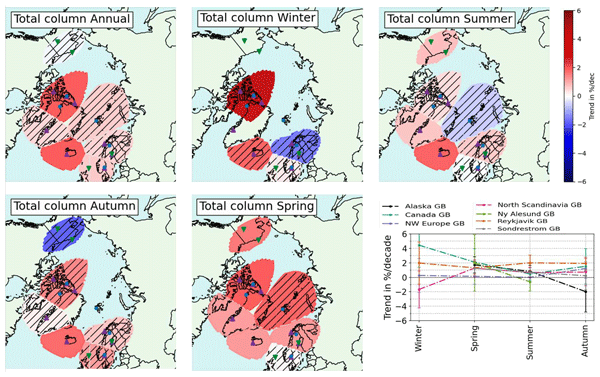
Using a merging of long-term ozone data from Fourier transform infrared spectrometers, ozonesondes, and Dobson and Brewer spectrophotometers, we present regional long-term trends (2000−2024) for total, stratospheric and tropospheric ozone. First, ground-based measurements are cross-compared to two satellite data sets (MEGRIDOP and IASI-CDR). This enables the detection of drifted ground-based data sets we further exclude from our study. We then use a representativeness study based on CAMS re-analysis data to define regions for which representative trends with reduced uncertainties are obtained by combining data sets from different instruments and stations. Annual and seasonal trends are calculated using a multiple linear regression technique involving a set of proxies that represent physical processes influencing the natural ozone variability. Annual trends indicate increasing total ozone over the Arctic, and are statistically significant over Canada and Reykjavik (+2.1 %/decade) and North-West Europe (Harestua and Lerwick, +0.7 %/decade). Ozone recovery is also observed over Canada in the mid-stratosphere (+2.0 %/decade) and over the North Pole region (Canada and Ny-Ålesund) in the upper stratosphere (+2.1 to +3.8 %/decade). By analysing the sensitivity of the ozone trends to the proxies, we observe a slow down of the expected ozone recovery, especially in the lower stratosphere, due to stratospheric cooling (-0.6 %/decade) and to the increase of volume of polar stratospheric clouds (-0.8 %/decade).
-
Notice on discussion status
The requested preprint has a corresponding peer-reviewed final revised paper. You are encouraged to refer to the final revised version.
-
Preprint
(12679 KB)
-
The requested preprint has a corresponding peer-reviewed final revised paper. You are encouraged to refer to the final revised version.
- Preprint
(12679 KB) - Metadata XML
- BibTeX
- EndNote
- Final revised paper


Journal article(s) based on this preprint
Interactive discussion
Status: closed
-
RC1: 'Comment on egusphere-2025-6473', Anonymous Referee #1, 03 Feb 2026
-
AC1: 'Reply on RC1', Caroline Jonas, 11 Feb 2026
Dear Reviewer,
We thank you for your careful examination of the beginning of the manuscript.
Indeed, a mistake in the description of the confidence interval calculation for the drifts based on the Theil-Sen regression was present in the text as you rightfully spotted and corrected. However, the mistake laid only in the text and we were actually carrying out the correct calculation, so that the error bars of drifts in the present manuscript correspond to the right Theil-Sen confidence interval estimates.
However, these error estimates indeed do not take into account the presence of autocorrelation in the dataset.
We have therefore computed the autocorrelation on the regression residuals in all datasets for which a drift is calculated. The autocorrelation is computed as the Pearson correlation coefficient between the residuals at t and at t+1 (lag-1). We find that 87% of all our datasets residuals have an autocorrelation strictly inferior to 0.2 in absolute value, while the 13% left have an autocorrelation comprised between 0.2 and 0.35 in absolute value. The median autocorrelation (in absolute value) is of 0.1075.
To rigorously account for this small autocorrelation, we have applied the block bootstrap method to re-evaluate the errors based on the Theil-Sen drifts. We have used 1000 bootstrap samples and a block size of n^(1/3), where n is the length of the dataset. The Theil-Sen method was applied on each bootstrap sample. The confidence interval of 95% was calculated by multiplying the square root of the bootstrap estimate of variance by z=1.96, which is the inverse of the standard normal cumulative distribution function FN(z)=alpha/2, where alpha=0.95.
The corresponding error bars obtained through this new method are presented in the supplement file. As expected, the changes are minimal and do not affect any of our conclusions. For the sake of accuracy, the manuscript will be modified according to these new calculations.
-
AC1: 'Reply on RC1', Caroline Jonas, 11 Feb 2026
-
RC2: 'Comment on egusphere-2025-6473', Anonymous Referee #2, 27 Feb 2026
Review of Jonas et al. "Detection of ozone recovery in the Arctic from ground-based measurements"
General comments
The submitted manuscript reports indications of ozone recovery in the Arctic, based on a carefully considered use of available ground-based instruments at multiple locations.
Firstly, the data records from the ground-based stations are compared to long-term satellite records to identify any outliers.
Secondly the individual stations are joined together in appropriate regional composites using analysis of ozone spatial variability at different heights in the atmosphere.
Thirdly, 2000-2024 trends are calculated using a multilinear regression model with selected proxy terms.
In the concluding section the results are compared in reasonable detail to other published work.
The topic is a very important one for atmospheric science and I have no hesitation in recommending publication in ACP once some comments below have been addressed. On the whole the work has been carried out very carefully and is well explained.
Specific comments
As the authors rightly point out, trend detection in the Arctic has proven very challenging due to the small signal compared to the variability. Secondly, over 2000-2024 we would expect to see significant circulation changes either forced or unforced (eg Arosio et al. ) which have the potential to mask changes due to chemical depletion. Figure 13 (which I think is a very good figure) demonstrates the difficulty being faced because the trend is so small compared to the other proxy terms. Therefore it is hard for the reader not to wonder whether the trends are really just an artefact of the many proxy terms. As shown in the well-known "Weber plot" [eg Fig 4-13 in Chipperfield, Santee et al. 2018] interannual variability in Arctic ozone is largely controlled by dynamics which can be well represented by the accumulated eddy heat flux. Although the authors have gone to quite some effort to avoid over fitting, none the less they are left with multiple proxies that are essentially dynamic effects in different forms. The use of temperature as a proxy is also slightly contentious because it isn't linked to any broader scale circulation features. I suspect here the temperature is capturing the zonally asymmetric features not picked up by the other proxies which are zonally symmetric.
On the other hand, the comparisons of trends in different geographic areas, different seasons and different partial columns all add together to make a much more convincing story.
I would therefore request that the authors discuss these points somewhat more specifically than at present, in other words, why should the reader believe that these are real trends?
A second point I would make is that it seems to me there are several unspoken assumptions in the approach used, which are all very reasonable but should be stated explicitly rather than just being implied. In this category I would include that individual stations with problems can be identified by comparing to the satellite dataset but that the drift in the satellite dataset can be identified with the combination of ground stations, and secondly, that monthly anomaly correlations between different stations imply the decadal trend is also correlated.
Future work would be accounting in more detail for the seasonal and geographic differences.
The manuscript is on the whole very well written. In one or two places, according to my own personal taste the wording is slightly too informal for a published scientific paper.
Technical comments
Line 6 – I would suggest not using "drifted" as an adjective like this, instead say "drifts in ground-based data sets"
Line 9 – I don't think you mean "natural", perhaps a better word would be "non-chemical"? Circulation changes influencing ozone resulting from GHG emissions aren't "natural".
Lines 27-30 The discussion of negative trends in the lower stratosphere has generally been in the context of mid-latitudes though rather than polar regions. Van der Gathen et al 2021 is really a different topic.
Line 37 (The recommendation for citing chapters of the ozone assessment is to list the two lead authors, eg Chipperfield & Santee et a;. 2022)
Line 40 "Parallely" change to "In parallel".
Line 41 "on it's own" change to "in its own right".
Lines 57-59 As above, the "Weber plot" shows how well internnual variability in Arctic ozone can be represented by simply the accumulated Eddy Heat Flux. so accounting for the dynamics is absolutely essential for what you're trying to do. LOTUS perhaps is aimed differently.
Line 62 "trends uncertainties" replace with "the uncertainties of our trends"
Line 80 Insert "and" before "6-hourly pressure"
Lines 85-88 The description of NDACC seems a bit overblown, eg "a massive effort". You list the total number of stations and the record of 35 years but of course in your work you are only considering a selection of these stations and only for 25 years.
Table 1 expand the abbreviation "DOFS" in the caption
Line 122 "lower" should be "below"
Lines 148-151 This approach is ok but potentially is a source of problems for interpretation of the lower stratospheric partial column, compared to the alternative of using "tropopause-relative co-ordinates".
Lines 159-160 This statement seems strange to me. Do you mean, different biases and starting dates would have an effect but you assume the effect is small? Please make this clearer.
Lines 170-173 The "A" and "B" notation doesn't seem to be defined properly. You also use it in the plots (eg Figs 4, 5).
Line 190 I like that you show the figure to help the reader more quickly understand your approach.
Line 197 "spotting" would be better as "detecting"
Lines 196-199 As mentioned earlier this seems like an assumption to me, but a reasonable one.
Figure 2 I like the idea of the figure but it doesn't seem very clear to me. I think the red dotted line is the bias and the solid horizontal line the zero-axis, but then where is the drift?
Lines 211-213 Is the different sampling frequency a problem in the troposphere, in that the ozonesondes are typically only make one flight a week?
Figure 3 – I like the figure but would prefer it to be orientated vertically like the iconic NDACC figure. Also then you could mark the different height ranges but also the alternative ones too in a dotted line say.
Lines 222-229 This finding is actually quite important for the ozonesonde community because it implies that more work is still needed (more than HEGIFTOM) to properly account for these changes.
Line 223 "resp." change to "respectively"
Line 235 – "recalibration" seems the wrong word
Line 237 "below" would be better as "equatorward"
Line 251 "problematic" is not quite right here, it would be better to say, eg "Having set aside the ground-based time series with identified problems"
Lines 252-254 Could you explain the way you formed the "zonal band" means more clearly please? Do you mean just 60-90, what I would call the "polar cap"?
Line 256 "is not drifted" replace with "does not show a drift"
Lines 257-258 Are you saying that it is well known that IASI has lost sensitivity over time in the high latitudes?
Lines 259-261 Does this mean you shouldn't be doing what you are doing?
Lines 269-271 I find this statement difficult to interpret. Do you mean that the drifts at individual locations all even out when added together? (When I first read the sentence I thought you meant you must have made a mistake).
Line 278 "ample" replace with "the many"
Line 295 Should be "square kilometres"
Line 296 Please re-word "Drowned out" – if they're truly "drowned out" you can't see them at all.
Line 309 – 317 I think some additional discussion is required here. I think you are assuming that correlations in the monthly anomalies will imply the long-term trends are also equal? Is this reasonable?
Line 361 "account for the natural variability of ozone" – really the proxies are "trying to account" because they are not totally successful, and rather than "natural" it's more the "non-chemical" variability of ozone.
Lines 386-368 I assume you calculate the volume of PSCs across all of the Arctic, or do you mean only at the location of each station? This seems like a tricky point because you don't know whether the air has been exposed to PSCs earlier in the season.
Line 371 The use of temperature as a proxy seems unusual to me. (It has a major effect as shown in Fig13.) The problem with using it is that it doesn't give you any information about what is causing the temperature change, you're not linking it to broader processes.
Line 377 It would be worth mentioning here that the proxies are not de-trended and you will discuss this later
Line 380-382 Just a comment, this method was widely used in ozone trend studies some years ago but seems to have become less fashionable
Lines 399-408 But what about if the tropopause has systematically risen over the last 20 years in some locations?
Lines 409-410 This is an unusual thing to say – does it imply that you have chosen the wrong proxies? Could you have used more relevant proxies for this part?
Lines 441-448 I think this is a very good discussion. I feel some authors confuse themselves with what exactly they're trying to show.
Figure 13 This is a very useful figure in my opinion.
Lines 534-535 In theory the zonal asymmetry should be able to be captured if you were using the right proxies, shouldn't it?
Citation: https://doi.org/10.5194/egusphere-2025-6473-RC2 - AC2: 'Reply on RC2', Caroline Jonas, 30 Mar 2026
Peer review completion


Interactive discussion
Status: closed
-
RC1: 'Comment on egusphere-2025-6473', Anonymous Referee #1, 03 Feb 2026
It appears that an inappropriate method has been used to calculate the Theil-Sen confidence intervals for the drifts of the ground-based/satellite time series. In addition, autocorrelation has also not been considered (Theil-Sen is appropriate only for time series without much autocorrelation). This needs to be looked into and resolved in a revision before my review can commence. Hence why for the moment I labeled the paper as "fair" as I need to fill in something (sorry about that). Note that for reasons outlined in my review addressing these issues may not materially affect the findings of the paper. Hence why I strongly encourage the authors to work towards a revision (or prove me wrong).
-
AC1: 'Reply on RC1', Caroline Jonas, 11 Feb 2026
Dear Reviewer,
We thank you for your careful examination of the beginning of the manuscript.
Indeed, a mistake in the description of the confidence interval calculation for the drifts based on the Theil-Sen regression was present in the text as you rightfully spotted and corrected. However, the mistake laid only in the text and we were actually carrying out the correct calculation, so that the error bars of drifts in the present manuscript correspond to the right Theil-Sen confidence interval estimates.
However, these error estimates indeed do not take into account the presence of autocorrelation in the dataset.
We have therefore computed the autocorrelation on the regression residuals in all datasets for which a drift is calculated. The autocorrelation is computed as the Pearson correlation coefficient between the residuals at t and at t+1 (lag-1). We find that 87% of all our datasets residuals have an autocorrelation strictly inferior to 0.2 in absolute value, while the 13% left have an autocorrelation comprised between 0.2 and 0.35 in absolute value. The median autocorrelation (in absolute value) is of 0.1075.
To rigorously account for this small autocorrelation, we have applied the block bootstrap method to re-evaluate the errors based on the Theil-Sen drifts. We have used 1000 bootstrap samples and a block size of n^(1/3), where n is the length of the dataset. The Theil-Sen method was applied on each bootstrap sample. The confidence interval of 95% was calculated by multiplying the square root of the bootstrap estimate of variance by z=1.96, which is the inverse of the standard normal cumulative distribution function FN(z)=alpha/2, where alpha=0.95.
The corresponding error bars obtained through this new method are presented in the supplement file. As expected, the changes are minimal and do not affect any of our conclusions. For the sake of accuracy, the manuscript will be modified according to these new calculations.
-
AC1: 'Reply on RC1', Caroline Jonas, 11 Feb 2026
-
RC2: 'Comment on egusphere-2025-6473', Anonymous Referee #2, 27 Feb 2026
Review of Jonas et al. "Detection of ozone recovery in the Arctic from ground-based measurements"
General comments
The submitted manuscript reports indications of ozone recovery in the Arctic, based on a carefully considered use of available ground-based instruments at multiple locations.
Firstly, the data records from the ground-based stations are compared to long-term satellite records to identify any outliers.
Secondly the individual stations are joined together in appropriate regional composites using analysis of ozone spatial variability at different heights in the atmosphere.
Thirdly, 2000-2024 trends are calculated using a multilinear regression model with selected proxy terms.
In the concluding section the results are compared in reasonable detail to other published work.
The topic is a very important one for atmospheric science and I have no hesitation in recommending publication in ACP once some comments below have been addressed. On the whole the work has been carried out very carefully and is well explained.
Specific comments
As the authors rightly point out, trend detection in the Arctic has proven very challenging due to the small signal compared to the variability. Secondly, over 2000-2024 we would expect to see significant circulation changes either forced or unforced (eg Arosio et al. ) which have the potential to mask changes due to chemical depletion. Figure 13 (which I think is a very good figure) demonstrates the difficulty being faced because the trend is so small compared to the other proxy terms. Therefore it is hard for the reader not to wonder whether the trends are really just an artefact of the many proxy terms. As shown in the well-known "Weber plot" [eg Fig 4-13 in Chipperfield, Santee et al. 2018] interannual variability in Arctic ozone is largely controlled by dynamics which can be well represented by the accumulated eddy heat flux. Although the authors have gone to quite some effort to avoid over fitting, none the less they are left with multiple proxies that are essentially dynamic effects in different forms. The use of temperature as a proxy is also slightly contentious because it isn't linked to any broader scale circulation features. I suspect here the temperature is capturing the zonally asymmetric features not picked up by the other proxies which are zonally symmetric.
On the other hand, the comparisons of trends in different geographic areas, different seasons and different partial columns all add together to make a much more convincing story.
I would therefore request that the authors discuss these points somewhat more specifically than at present, in other words, why should the reader believe that these are real trends?
A second point I would make is that it seems to me there are several unspoken assumptions in the approach used, which are all very reasonable but should be stated explicitly rather than just being implied. In this category I would include that individual stations with problems can be identified by comparing to the satellite dataset but that the drift in the satellite dataset can be identified with the combination of ground stations, and secondly, that monthly anomaly correlations between different stations imply the decadal trend is also correlated.
Future work would be accounting in more detail for the seasonal and geographic differences.
The manuscript is on the whole very well written. In one or two places, according to my own personal taste the wording is slightly too informal for a published scientific paper.
Technical comments
Line 6 – I would suggest not using "drifted" as an adjective like this, instead say "drifts in ground-based data sets"
Line 9 – I don't think you mean "natural", perhaps a better word would be "non-chemical"? Circulation changes influencing ozone resulting from GHG emissions aren't "natural".
Lines 27-30 The discussion of negative trends in the lower stratosphere has generally been in the context of mid-latitudes though rather than polar regions. Van der Gathen et al 2021 is really a different topic.
Line 37 (The recommendation for citing chapters of the ozone assessment is to list the two lead authors, eg Chipperfield & Santee et a;. 2022)
Line 40 "Parallely" change to "In parallel".
Line 41 "on it's own" change to "in its own right".
Lines 57-59 As above, the "Weber plot" shows how well internnual variability in Arctic ozone can be represented by simply the accumulated Eddy Heat Flux. so accounting for the dynamics is absolutely essential for what you're trying to do. LOTUS perhaps is aimed differently.
Line 62 "trends uncertainties" replace with "the uncertainties of our trends"
Line 80 Insert "and" before "6-hourly pressure"
Lines 85-88 The description of NDACC seems a bit overblown, eg "a massive effort". You list the total number of stations and the record of 35 years but of course in your work you are only considering a selection of these stations and only for 25 years.
Table 1 expand the abbreviation "DOFS" in the caption
Line 122 "lower" should be "below"
Lines 148-151 This approach is ok but potentially is a source of problems for interpretation of the lower stratospheric partial column, compared to the alternative of using "tropopause-relative co-ordinates".
Lines 159-160 This statement seems strange to me. Do you mean, different biases and starting dates would have an effect but you assume the effect is small? Please make this clearer.
Lines 170-173 The "A" and "B" notation doesn't seem to be defined properly. You also use it in the plots (eg Figs 4, 5).
Line 190 I like that you show the figure to help the reader more quickly understand your approach.
Line 197 "spotting" would be better as "detecting"
Lines 196-199 As mentioned earlier this seems like an assumption to me, but a reasonable one.
Figure 2 I like the idea of the figure but it doesn't seem very clear to me. I think the red dotted line is the bias and the solid horizontal line the zero-axis, but then where is the drift?
Lines 211-213 Is the different sampling frequency a problem in the troposphere, in that the ozonesondes are typically only make one flight a week?
Figure 3 – I like the figure but would prefer it to be orientated vertically like the iconic NDACC figure. Also then you could mark the different height ranges but also the alternative ones too in a dotted line say.
Lines 222-229 This finding is actually quite important for the ozonesonde community because it implies that more work is still needed (more than HEGIFTOM) to properly account for these changes.
Line 223 "resp." change to "respectively"
Line 235 – "recalibration" seems the wrong word
Line 237 "below" would be better as "equatorward"
Line 251 "problematic" is not quite right here, it would be better to say, eg "Having set aside the ground-based time series with identified problems"
Lines 252-254 Could you explain the way you formed the "zonal band" means more clearly please? Do you mean just 60-90, what I would call the "polar cap"?
Line 256 "is not drifted" replace with "does not show a drift"
Lines 257-258 Are you saying that it is well known that IASI has lost sensitivity over time in the high latitudes?
Lines 259-261 Does this mean you shouldn't be doing what you are doing?
Lines 269-271 I find this statement difficult to interpret. Do you mean that the drifts at individual locations all even out when added together? (When I first read the sentence I thought you meant you must have made a mistake).
Line 278 "ample" replace with "the many"
Line 295 Should be "square kilometres"
Line 296 Please re-word "Drowned out" – if they're truly "drowned out" you can't see them at all.
Line 309 – 317 I think some additional discussion is required here. I think you are assuming that correlations in the monthly anomalies will imply the long-term trends are also equal? Is this reasonable?
Line 361 "account for the natural variability of ozone" – really the proxies are "trying to account" because they are not totally successful, and rather than "natural" it's more the "non-chemical" variability of ozone.
Lines 386-368 I assume you calculate the volume of PSCs across all of the Arctic, or do you mean only at the location of each station? This seems like a tricky point because you don't know whether the air has been exposed to PSCs earlier in the season.
Line 371 The use of temperature as a proxy seems unusual to me. (It has a major effect as shown in Fig13.) The problem with using it is that it doesn't give you any information about what is causing the temperature change, you're not linking it to broader processes.
Line 377 It would be worth mentioning here that the proxies are not de-trended and you will discuss this later
Line 380-382 Just a comment, this method was widely used in ozone trend studies some years ago but seems to have become less fashionable
Lines 399-408 But what about if the tropopause has systematically risen over the last 20 years in some locations?
Lines 409-410 This is an unusual thing to say – does it imply that you have chosen the wrong proxies? Could you have used more relevant proxies for this part?
Lines 441-448 I think this is a very good discussion. I feel some authors confuse themselves with what exactly they're trying to show.
Figure 13 This is a very useful figure in my opinion.
Lines 534-535 In theory the zonal asymmetry should be able to be captured if you were using the right proxies, shouldn't it?
Citation: https://doi.org/10.5194/egusphere-2025-6473-RC2 - AC2: 'Reply on RC2', Caroline Jonas, 30 Mar 2026
Peer review completion
Journal article(s) based on this preprint
Viewed
| HTML | XML | Total | BibTeX | EndNote | |
|---|---|---|---|---|---|
| 2,567 | 1,250 | 171 | 3,988 | 174 | 142 |
- HTML: 2,567
- PDF: 1,250
- XML: 171
- Total: 3,988
- BibTeX: 174
- EndNote: 142
Viewed (geographical distribution)
| Country | # | Views | % |
|---|
| Total: | 0 |
| HTML: | 0 |
| PDF: | 0 |
| XML: | 0 |
- 1
Caroline Jonas

Corinne Vigouroux
Bavo Langerock
Robin Björklund
Anne Boynard
Thomas Carlund
Martine De Mazière
Peter Effertz
Quentin Errera
Matthias Frey
James W. Hannigan
Nis Jepsen
Rigel Kivi
Norrie Lyall
Mathias Palm
Maxime Prignon
Viktoria F. Sofieva
Kimberly Strong
Tove Svendby
David Tarasick
Laura Thölix
Roeland Van Malderen
Yana Virolainen
Sibylle von Löwis
Xiaoyi Zhao
The requested preprint has a corresponding peer-reviewed final revised paper. You are encouraged to refer to the final revised version.
- Preprint
(12679 KB) - Metadata XML
It appears that an inappropriate method has been used to calculate the Theil-Sen confidence intervals for the drifts of the ground-based/satellite time series. In addition, autocorrelation has also not been considered (Theil-Sen is appropriate only for time series without much autocorrelation). This needs to be looked into and resolved in a revision before my review can commence. Hence why for the moment I labeled the paper as "fair" as I need to fill in something (sorry about that). Note that for reasons outlined in my review addressing these issues may not materially affect the findings of the paper. Hence why I strongly encourage the authors to work towards a revision (or prove me wrong).