
the Creative Commons Attribution 4.0 License.
the Creative Commons Attribution 4.0 License.
 | 14 Jan 2026
Uncertainty of Antarctic sea ice concentration using passive microwave retrievals in the marginal ice zone
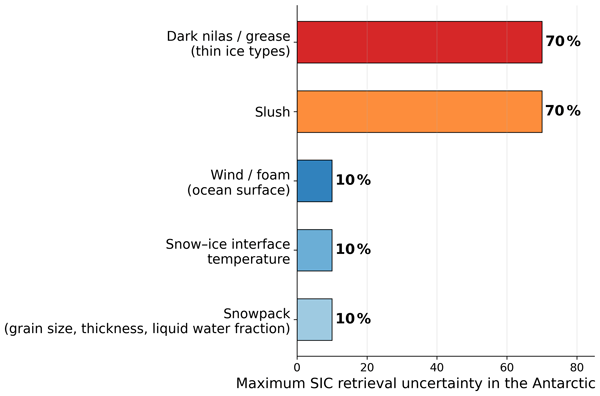
Abstract. Antarctic sea ice has experienced an unprecedented decline in the past decade (2016–2025). Changes in sea ice concentration (SIC) and derived sea ice extent have been monitored using microwave radiometers since the late 1970s, providing information about the polar response to global climate change, hence making SIC an invaluable variable for numerical models. However, in the highly dynamic Marginal Ice Zone (MIZ), the region in between the pack ice and the open ocean, physical properties undergo intense variability, which may impact the accuracy of the SIC products retrieved from brightness temperature measurements. For the purpose of this study the MIZ is defined as the area with SIC between 15 % and 80 %. We simulate the variations of brightness temperature due to changes in the physical parameters describing the sea ice, the snow and the ocean with the Snow Microwave Radiative Transfer Model (SMRT) and the Passive and Active Reference Microwave to Infrared Ocean model (PARMIO) for a range of prescribed SIC. We then apply the core of the Bootstrap SIC algorithm on the simulated brightness temperatures and compare the retrieved and prescribed SIC, yielding the SIC error. This allows us to assess the impact of changes on the SIC retrieval by means of numerical radiative transfer simulations. Our work identifies the key parameters leading to high uncertainty in the retrieval: in the snowpack, the liquid water content and snow grain size cause SIC uncertainties of 5–10 % in the summer MIZ. In the cold season, the most influential factor is the presence of thin ice, inducing errors up to 30 %. Ocean roughness caused by the high-wind conditions affects both warm and cold seasons and gives rise to biases up to 15 % on the lower SIC MIZ boundary. However, other snowpack parameters that were expected to modify the SIC results, such as the salinity or temperature, showed a negligible impact in the tested range. We found that the core of the Bootstrap algorithm is largely robust to the variations in the snowpack, with no parameter introducing errors greater than 10 % across the MIZ SIC range. In contrast, ocean surface roughness due to wind speed and the presence of thin ice in the pixel are the variables leading to the greatest uncertainties, suggesting they are the primary targets to achieve more accurate SIC retrievals.
Competing interests: At least one of the (co-)authors is a member of the editorial board of The Cryosphere. The peer-review process was guided by an independent editor, and the authors also have no other competing interests to declare.
Publisher's note: Copernicus Publications remains neutral with regard to jurisdictional claims made in the text, published maps, institutional affiliations, or any other geographical representation in this paper. While Copernicus Publications makes every effort to include appropriate place names, the final responsibility lies with the authors. Views expressed in the text are those of the authors and do not necessarily reflect the views of the publisher.-
Notice on discussion status
The requested preprint has a corresponding peer-reviewed final revised paper. You are encouraged to refer to the final revised version.
-
Preprint
(4124 KB)
-
The requested preprint has a corresponding peer-reviewed final revised paper. You are encouraged to refer to the final revised version.
- Preprint
(4124 KB) - Metadata XML
- BibTeX
- EndNote
- Final revised paper


Journal article(s) based on this preprint
Interactive discussion
Status: closed
-
RC1: 'Comment on egusphere-2025-6437', Anonymous Referee #1, 16 Jan 2026
-
AC1: 'Reply on RC1', Marta Stentella, 27 Apr 2026
The comment was uploaded in the form of a supplement: https://egusphere.copernicus.org/preprints/2026/egusphere-2025-6437/egusphere-2025-6437-AC1-supplement.pdf
-
AC1: 'Reply on RC1', Marta Stentella, 27 Apr 2026
-
RC2: 'Comment on egusphere-2025-6437', Anonymous Referee #2, 13 Feb 2026
Review of
Uncertainty of Antarctic sea ice concentration using passive microwave retrievals in the marginal ice zone
by Stentella, M., et al.
Summary: Changes in the surface properties of the sea ice / snow and open water surface in the marginal ice zone (sea ice concentration (SIC) 15% to 80% as defined in this manuscript) have an impact on microwave brightness temperatures (TB) used to compute the SIC. These surface properties could be different from those within the ice pack (> 80% SIC). This could have consequences on the retrieval uncertainty of the SIC because, typically, these retrieval methods are based on so-called tie points - i.e. reference TBs defined and/or selected for 0% and 100% SIC. This manuscript aims to better understand the contributions of various surface properties and their variation on the SIC retrieval using microwave TBs. For this purpose the authors use the SMRT model and the PARMIO model, simulating the TB response to various ranges of relevant surface properties (e.g. salinity, temperature, grain size and surface wind). Instead of presenting this response in form of TB or emissivity changes, the authors compute the resulting impact on the SIC retrieval for a few typical SIC values within the marginal ice zone.
The manuscript is very well written. The topic is interesting and deserves attention. The work and the results presented will contribute well to the existing knowledge in the field.
I have a number of general comments or concerns (see below) that I see mandatory to be improved in a revised version of the manuscript. These general comments are elaborated in the specific comments you will find further down. I also have a number of editoral comments which I put a the end.
General Comments:
GC1: The manuscript would benefit substantially from a more careful incorporation of work that has been done in this field.
GC2: The motivation to carry out this study - aka why do we need such an investigation when studies exist for open water and near-100% sea ice concentration - is not sufficiently clear or elaborated.
GC3: The motivation why you chose the retrieval algorithm you chose and the models you chose is not sufficiently well laid out.
GC4: It is not sufficiently clear how well the models chosen are fitting the purpose of your study. The results are not fully convincing and maybe they are not convincing because the choice of model parameters is not sufficiently well thought through.
GC5: It would be helpful for the reader whether your investigation targets ante-processing or post-processing "errors".Specific Comments:
L10: It is not entirely clear what you mean by "SIC error" in this context. I propose that you motivate further up why you are interested in the SIC error and why.L68-90 / Background: I suggest to elaborate on this section --> GC1 / GC2 / GC3 / GC5
I recommend to look into studies where weather and other effects on sea ice concentration retrieval using PM TBs have been studied or discussed. For instance: Oelke, 1997, Atmospheric signatures in sea-ice concentration estimates from passive microwaves: modelled and observed, International Journal of Remote Sensing; Kern, 2004, A new method for medium-resolution sea ice analysis using weather-influence corrected Special Sensor Microwave/Imager 85 GHz data, International Journal of Remote Sensing.This might be a starting point to dig into literature to understand and motivate your study. A lot is known already about which snow physical quantities and atmospheric quantities cause which errors / biases in the SIC retrieval. This needs to be laid out here. Also, that the thickness of sea ice when thin has an impact is well known. This needs to be laid out here as well. It would important to demonstrate what is going to be new in your study. Maybe it is just that SMRT has not yet been applied to the sea ice environment and this is the main motivation of the study. In any case, please make sure to point out the novelty and where your work makes progress in this field of research.
Secondly, you might find it helpful to look a bit into the more recent publications about sea-ice concentration retrieval, e.g. Lavergne et al., 2019, Version 2 of the EUMETSAT OSI SAF and ESA CCI sea-ice concentration climate data records, The Cryosphere.
Thirdly, the work of Kern et al. (2019, 2022) might enlight you a bit about the effect this natural TB-variability at 100% has on the SIC retrieval at 100% (and at 0%) and to some degree also for your SIC range: Kern et al., 2019, Satellite passive microwave sea-ice concentration data set intercomparison: closed ice and ship-based observations, The Cryosphere; Kern et al., 2022, Satellite passive microwave sea-ice concentration data set intercomparison using Landsat data, The Cryosphere.
Finally, you might want to motivate (even) a bit more why an investigation like the one you do, utilizing the Comiso Bootstrap Algorithm and the channels used could also serve to better understand retrieval uncertainties on the one hand and errors - aka - biases to what we believe is the truth on the other hand. In that context you might want to elaborate how your work is related to the sea ice concentration retrieval uncertainty estimates that are provided alongside the NOAA/NSIDC and EUMETSAT/OSI SAF products.
L94-102: --> GC4, I am wondering whether you could provide some evidence from the published literature that your choice of layers used to describe the snow on top of Antarctic sea ice is a reasonable representation of the true conditions. While depth hoar might be an ubiquituous feature on the old sea ice in the Weddell Sea I doubt a bit that this is a common feature for the sea ice in the marinal ice zone - which - to a large part might be forms of young / new ice and pancake ice. I note in this context that your "model" sea ice is first-year sea ice. I am also wondering what the two "superimposed sea ice layers" are? Are these a result of snow-ice formation processes? This is not sufficiently clear. What I am missing in your description is how humidity in the snow and salinity in the basal snow layers is treated.
How does the model compare to MEMLS and MEMLS modified for sea ice?
What I am missing in the description of the simulations (in general) is whether and how you take into account i) the incidence angle of around 53 degrees and ii) any surface roughness of the sea ice. What is the roughness length scale used for the sea ice?
L122-124: Given the fact that a considerable part of the marginal ice zone - particularly in the Southern Ocean - can be composed of young / new ice, the way how this ice type is treated is clearly not optimal. What you can resolve with this kind of representation is "dark nilas" - that kind of thin sea ice that forms (often still elastic) sheets of ice of up to 5 cm thickness. But this is only a small fraction of the thin ice that is encountered in the marginal ice zone (in the Southern Ocean). How about frazil and grease ice? How about thicker types of sheet ice such as light nilas (up to 10 cm), grey-ice (up to 15 cm), grey-white ice ...? And, finally, how about that classical type of young ice that is encountered in the Southern Ocean regularly: pancake ice which is characterized by small (10 cm) to large (3m) diameter ice floes, exhibiting rims of often several centimetres thick slush? --> GC4
L125-136: --> GC4, What I find is not sufficiently clear in this paragraph is the range of atmospheric conditions PARMIO is considering. Are these conditions given by theoretical formulas or is PARMIO driven by, e.g., atmospheric reanalysis data?
Secondly, you are quite exhaustive with respect to the treatment of foam. I was wondering, however, how relevant this is once you are within the MIZ? Does the model incorporate the influence of the fetch on the ocean surface roughness which is substantially reduced once being in the sea ice?
Finally, I was wondering whether you are also including any influence of the atmospheric water vapor or cloud liquid water (see, e.g., Ivanova et al. 2015 or the paper by Lavergne et al. 2019 which I mentioned earlier). The larger the open water fraction is the larger is the effect of these two parameters.
L138-145: "estimated SIC" --> Please provide information about the algorithm that was used to generate this SIC estimate. Please specify the grid that is used (polarstereographic or EASE2.0 I assume).
"date under analysis" --> this reads as if you are only considering a limited set of days. Please mention them and/or list them in a table.
"extending it 30 km into the ocean" --> it is not sufficiently clear what you aim with this 30 km wide margin. Do you want to include open ocean conditions? Then this margin is very likely far too small. Especially in the Southern Ocean there can be substantial regions that are covered with SIC < 15% but clearly > 0%. In addition to that the field-of-view (see one of my earlier comments) of the used AMSR2 channels is i) larger than the 12.5 km grid resolutions and ii) any strong gradients in the actual sea ice cover and hence the resulting TBs measured are blurred. Hence a compact sea ice cover in one grid cell can easily spill over to the next two grid cells adjacent to the ice edge - which is basically your 30 km margin; hence, in that case your margin does not allow you to have a "clean" open water signal. But as I stated above, the intention of using this 30km margin is not clearly enough stated.
Table 1: You provide the reference, the minimum and the maximum value. Would you mind to also include the steps with you varied the parameters through the range given?
The "Fraction_Volume_Water_SP" ... is what: the volumetric liquid water fraction? What is the unit? Please make sure that this is a range similar to those used in other / previous studies, e.g. Ulaby et al., Microwave Remote Sensing –Active and Passive, Vol III, ArtechHouse Inc., 1986. and/or explain how the range used by you translates into the range used be these other studies; therein volume water contents of 10% are considered. But perhaps your maximum value of 0.2 translates into 20%...
L150-155: This part is not sufficiently clear. You have n days (how many?) of AMSR2 observations (where exactly?). For these AMSR2 observations you have near 19 GHz and 36.5 GHz TB values AND sea-ice concentration values. Hence, from these observations you can select (within your region of interest) pixels where the SIC is exactly 100.0% and exactly 0.0% (see Kern et al., 2019, mentioned before, however, to understand what "exactly" 100% could mean with the kind of algorithms used, where SIC values above 100% are folded back into the range 0-100% and/or simply truncated). So, simply from the AMSR2 data set you can come up with a set of tie points, i.e. typical TB values (plus/minus a range) for the channels used and the two end members of the SIC distribution 0% and 100%. What do you then do with e model? This is not clear to me. You use the values given in Table 1 and tune them such that the distance between the simulated and the observed TB for 0% and 100% SIC matches the tie points you derived from the AMSR2 data? Why only "visually overlaps"? Don't you have a means to do that more accurately? What is not sufficiently clear how you "adjust" the parameters? Which parameter is given preference and why?
Figure 1 / caption: It is unclear how many days (and which days) worth of AMSR2 data are included in this figure. It is not sufficiently clear why the figures uses a point P that is representing a warm season snowpack. This implies that the AMSR2 TBs represent summer conditions.
I note that the maximum 19V TBs are located at values > 270K. This suggests a surface emissivity of almost 1 - which is contradicting existing knowledge a bit (I know, you are only plotting observations here but seeing such high values near the 100% SIC line rings a warning bell).
I note that there is a light indication of an "extended" open water tie point in the AMSR2 TB data (the inclined light point cloud going from point O towards the top right.)
Finally, warm snow pack and dry depth hoar layer seems not to be a realistic combination.
Table 2: So you keep the temperature of the sea ice at a constant -1.8degC and do not allow any gradient within the sea ice? Is this realistic? I think it might be realistic for ice type grease ice but it is not realistic for sheet ice such as dark and light nilas.
Did you check what typical values of the density of thin ice are used in the literature?
L196-200: "LWC" --> In Table 1 you write "Fraction_Volume_Water". Is this the same as LWC here? It would be good to use the same name for one variable or quantity and not two or more.
The response of the TB to the LWC of the snow pack should reveal some temperature dependence because the LWC is a strong function of the temperature. Also, if the topmost snow layer with a high LWC is thick enough the impact of any layer below should be rather small because all contributions being emitted from below the wet surface snow layer are attenuated therein and only the own emission of the wet snow surface layer determines the TB. And, you should see a difference between the 19 GHz and the 37 GHz channels in this regard because the lower frequency channels are known to penetrate (a bit) deeper into the snow pack.
I suggest to state more clearly where you are referring to snow parameters and where you are referring to sea ice parameters. It is density, temperature and salinity of the snow that show negligible impact, right?
L218/219: I cannot see this statement ("for instance, when the layer is absent (null thickness)") being supported by what is shown in Fig. 6 a, b)
Figure 2: Clearly, there seem to be largest changes at the higher sea-ice concentration values. I was wondering whether it would be worth to come up with an additional set of figures where you zoom into the TB development for SIC values > 50% or similar. You could, if you want, focus on those parameters there which have the largest impact. That way one could see (and potentially discuss) how TB changes related to an increase in LWC are counteracting TB changes related to an increase in grain size.
Aren't you surprized that none of the simulations you showed so far stretch more along that limb of TB observations that is located approximately where one would draw the "ice line" (see Fig. 1). What is the explanation for that?
Figure 3: Here my comment made earlier with respect to zooming in also makes a lot of sense because the colored data points are hard to see where you have a high density of AMSR2 TB observations.
Figure 4: How do these simulation results compare to results published in the literature (e.g. Andersen et al., 2006, Improved retrieval of sea ice total concentration from spaceborne passive microwave observations using numerical weather prediction model fields: An intercomparison of nine algorithms, Remote Sensing of Environment; Oelke, 1997 mentioned earlier, in relation to sea-ice retrieval and other studies related to wind vector retrieval using, e.g. WindSat?). Did you cross check your results?
Figure 5, panel a): What is your explanation for why all modeled TB combinations are located to the right of the line one would draw between the open water tie point and the ice line as shown in Fig. 1? How do these results compare to investigations done by others? There is some information about the impact of the thickness of thin ice on SIC retrieval accuracy in Ivanova et al., 2015, cited by you. In addition, there were several studies back in the 1990s or even 1980s where people investigated PM signatures of the different forms of thin ice - e.g. Cavalieri, 1994, A microwave technique for mapping thin sea ice, J. Geophys. Research - Oceans and references therein.
L243-248: --> GC5, "In Comiso (2013), ... of SIC." --> The error you are reporting here is - if I am not mistaken - for 100% SIC. I don't think Comiso reported on errors at different SIC values. Please also check whether what Comiso (2013) reports as error is comparable to what your results are representing. Your results are - to my understanding rather an estimate of the uncertainty of the retrieved SIC as a function of the actual snow and sea ice properties - hence how well the tie points chosen are meeting the actually encountered conditions. Uncertainty and error are two different things; uncertainties are ante-processing while an error values is obtained post-processing.
Your write about 2-3% of LWC (which is 0.2-0.3 in your notation of "FRACTION_SNOW_VOLUME"?). If you check the work of Garrity, 1992 (a chapter of the Book entitled "Microwave Remote Sensing of Sea ice" edited by Carsey) and also the book of Ulaby et al. (1986) you will see that penetration depths into snow and with that changes in the microwave emissivity begin to have a notable impact already at considerably smaller LWC values.
L255: "This sensitivity ... development stage." --> While this is a true statement your investigations do not back up this notion. You did not take into account sufficiently well the different development stages of young / thin sea ice in your work. See my previous comments about the set up of your model with respect to thin ice.
L259: "Worby, 2004)" --> My recollection of this work might be wrong but I think the main thing this work is referring to is the fact that the sea ice near the ice edge is often wet and overwashed by waves quite often, resulting in a microwave signature that is much closer to that of open water than that of sea ice and that this is the main reason why sea ice concentration maps often show too little sea ice in the MIZ / near the ice edge as demonstrated against ship-based observations. It is not necessarily the increased open water surface emissivity due to wind. But maybe I am wrong.
L260-263: "In addition ... AMSR2 observations." --> Please take into account / discuss here the issue I brought up earlier with respect to the limited fetch in the sea ice covered area which leads to a completely different ocean surface wave spectrum here than in the open, sea-ice free ocean.
L264-268: --> GC5, In this paragraph you again need to be more careful with the expressions used. You are mixing error, uncertainties and bias. Again, what you are investigating is contributing to a better understanding of the sea ice concentration retrieval uncertainty. You are not comparing sea ice concentrations retrieved from AMSR2 observations with independent SIC estimates in, e.g. thin sea ice areas. Then your results would be about the actually observed errors or biases in the retrieved product.
You chose to cite Andersen et al. (2007) here. I believe citing the work from 2006 (I mentioned that to you earlier) would be more to the point).I don't think that the two references "Notz and Worster" and "Gough et al" add much to the main context of this manuscript because they are not specifically referring to the surface physical properties relevant to the remote sensing with the aim to retrieve SIC.
L269-271: "a mask ... characteristics" --> Only a very careful reader would so far have guessed that the map you are using is circumpolar. I strongly recommend to add considerably more information about this part of your work earlier into your manuscript. What I would love to see is why you chose only ONE day per season; why you chose these particular two days and also how the SIC looks like. I recommend that you show a figure of 6 maps, 3 per season, with the actual sea ice concentration and the TBs of the 19V and 37V channels.
L283/284: This is certainly a very good idea. I made this comment earlier - but I indeed think that it would be very good to check whether, for instance, high LWC values are associated with particularly large or low snow grain radii. This is just one example.
The discussion would further benefit from a more in depth discussion of the effect in the different snow layers. What I am missing is a discussion of the penetration depth into / opacity of the snow as a function of LWC and, perhaps, also thickness. The observation that during winter the LWC in the depth hoar layer plays a considerably larger role than during summer is not sufficiently well discussed. I am, in that context also wondering, how realistic a high LWC in the depth hoar layer is. Also here, your manuscript would benefit from a more indepth discussion of the correctness the assumptions made for the model investigations. --> GC4
In addition to that, what is missing so far in your discussion is the fact that while your results show the sensitivity of two channels 19V and 37V to your selection of snow and sea ice physical parameters, the results about the resulting uncertainty in the SIC are based on the combined effect. You might want to discuss whether it isn't quite logical that the SIC change due to TBs reflecting different snow LWC is lower than expected when the changes in the two TBs due to LWC happen to be into the same direction. This is something that has been discussed to some degree in the Andersen et al. paper from 2006 illustrating that substantial changes in the TB at different frequencies due to various (atmospheric) parameters might not have an effect on the retrieved sea ice concentration because the effects cancel out each other.
Editoral Comments / Typos
L31/32: "pixel ... the spatial footprint of the sensor acquiring the measurement" --> This formulation is not correct. A "pixel" is something we know from digital images taken by our smartphones. In Earth System Sciences / the field of satellite remote sensing one only speaks of a pixel when the satellite images provide very fine spatial sampling, i.e. several tens of meters or less. It is more common to speak about a "grid cell" which then has a "grid cell area" or a "grid cell size" or a "grid resolution". These so-called grids on which satellite data, e.g. PM TBs are provided are the result of projecting the originally obtained TB measurements onto a regular grid representing the Earth Surface.
Now, a "spatial footprint" is something different. PM sensors measuring TBs have a frequency dependent footprint or "field-of-view". This is the projection of the antenna lobe at the surface and very often one uses the 3dB with of that cone intersecting the surface. Hence for a PM sensor of the kind used for sea ice concentration retrieval using incidence angles around 53 degrees the field-of-view is of elliptical shape. Individual measurements are obtained for every field-of-view and the resulting TBs are then sampled / projected into a regular grid.
In short: "pixel" and "spatial footprint" or "field-of-view" shall not be mixed. I strongly recommend to change any mentioning of "pixel" throughout the manuscript towards a more suitable expression.L37/38: "continuous ... otherwise" --> I suggest to be more specific and state explicitly that PM observations are daylight independent and also - widely - independent of cloud coverage.
L42/43: "seawater flooding ... sea ice overload" --> The three issues you are mentioning here all inter-connected and it might make sense to stress that. Seawater flooding is the result of a negative sea-ice freeboard (the ice-snow interface is located below the sea surface) due to a heavy snow load and snow ice formation is the result of such a flooding event (provided that temperatures stay below the freezing point).
L148: "pixel" --> "grid cell"
L179: What is the "prescribed" SIC?
L185: "1cm" --> Table 2 states 3 cm. What is correct?
L202: What do you mean by "contained impact"?
L213-219: Please make clear the reader understands that you are referring to the warm conditions example here.
L236: "their impact on the radiometric signal" --> Since you have been working with TBs and were not yet talking about the emissivities I suggest that you get back and write "on the measured brightness temperatures"
L237: "the T_B signature" --> I suggest to either write "the microwave signature" or "the T_B"
L240: "snow optical radius" --> I note that you (again) use different expressions for the same thing. In L235/236 you wrote "snow radius". I recommend to use one expression and make sure that the reader understands that here you are in fact referring to the snow grain radius which translates into the snow specific area (SSA) which then, in your paper, is the snow optical radius, is that correct?
L242: "Fig. 8" --> You are talking about the warm season in this sentence and hence you might not want to refer to Fig. 8.
L273-275: In Lavergne et al. (2019) you will find a different realization of the ice line which you could as well mention here.
L278: "the Antarctic continent" --> better: "Antarctic sea ice".
L286-288: This reads like a very elaborated and complicated sentence. Wouldn't it make sense to begin a bit more simple, stating that you investigated the sensitivity of sea ice concentration retrieval to a set of environmental parameters, among them snow and sea ice physical properties....? In particular, I don't see any "parameterization" I cannot see how your contribution will effectively improve sea-ice concentration retrieval other than better understanding the retrieval uncertainties.
L290: Please relate "optical radius" to the snow grain size for better understanding.
L298-300: "Importantly, ... models." --> Where did you show this in your manuscript?
L438-441: --> Two times the same reference.
Citation: https://doi.org/10.5194/egusphere-2025-6437-RC2 -
AC2: 'Reply on RC2', Marta Stentella, 27 Apr 2026
The comment was uploaded in the form of a supplement: https://egusphere.copernicus.org/preprints/2026/egusphere-2025-6437/egusphere-2025-6437-AC2-supplement.pdf
-
AC2: 'Reply on RC2', Marta Stentella, 27 Apr 2026
-
RC3: 'Comment on egusphere-2025-6437', Anonymous Referee #3, 19 Mar 2026
Review of “Uncertainty of Antarctic sea ice concentration using passive microwave retrievals in the marginal ice zone” by Stenella et al., 2025
Summary:
This manuscript investigates how variations in the physical properties of the snow-sea ice-ocean system contribute to errors in satellite‑derived sea‑ice concentration (SIC), with a focus on the Antarctic Marginal Ice Zone (MIZ), defined here as the region with SIC between 15% and 80%. Because the MIZ is highly dynamic, satellite-based SIC retrievals are known to be less reliable in this region. To explore this issue, the authors simulate microwave brightness temperatures (TBs) over snow-covered sea ice using the Snow Microwave Radiative Transfer Model (SMRT) and over open ocean using the Passive and Active Reference Microwave to Infrared Ocean (PARMIO) model. By tuning model forcing parameters, they generate TBs corresponding to prescribed “true” SIC values. These simulated TBs are then input into the core of the Bootstrap retrieval algorithm, enabling an assessment of how physical‑property variability affects retrieved SIC relative to the prescribed SIC.
General Comments (GCs):
Overall, the manuscript addresses an important topic for the polar remote-sensing community. The approach is promising, but several areas require strengthening for clarity, rigor, and contextual grounding in a revised version.
GC1: Although the introduction and background sections provide context on microwave SIC retrievals, they do not discuss documented retrieval biases, algorithm performance, and limitations of commonly used SIC products/algorithms (e.g. Kern et al 2019). Currently, the literature review appears incomplete and the motivation of the work would seem more applicable to the Arctic rather than the Antarctic. The most common type of ice found in the MIZ is pancake ice from autumn to mid-spring, and brash fragmented ice in summer. It is more difficult to define the MIZ mask in summertime given the fragmentation, as reported in the papers cited by the authors. The presence of frazil ice, slush and other interstitial types of ice is very common, and the use of a model that linearly combines open ocean with consolidated ice may not appear fully justified unless motivated (see also the next point on thin ice).
GC2: Several assumptions are presented without sufficient justification, citation or explanation. For instance, the choice of the warm or cold days is very arbitrary, and it is not explained nor justified (the dates are only known when reading the captions). Other points that would require further clarity are the definition of thin ice fraction and how it is accounted for in the calculations, the SIC mask and the sensitivity analysis done for SIC values of 10% and 90%, parameter ranges, and reference dataset)
GC3: The manuscript does not explain how point-based radiative transfer model outputs relate to the stated 12.5 km satellite resolution, nor whether any spatial aggregation or assumptions are applied. Furthermore, the known high spatial heterogeneity of Antarctic sea ice is not sufficiently accounted for in the analysis. The main issue is related to the choice of arbitrary days from the extensive AMSR2 record. The 15-80% mask can be very different in different days, especially in summertime, which would affect the swarm of Tb points that the model is expected to replicate.
GC4: In the Results, the evaluation framework lacks clarity. Terms such as error, bias, and uncertainty are used inconsistently, and the metric itself is not clearly defined. This creates conceptual ambiguity that affects both the interpretation of results and the framing of the study (i.e. the title). The metric should be clearly defined in the introduction and presented in the methodology.
GC5: Structurally, most of the result figures currently appear in the discussion rather than in the Results section, reducing clarity. Figure 2 and Figure 6 appear to show the same results from the sensitivity analyses, but in a different way. This is rather unclear and should be improved. Furthermore, the sensitivity analysis workflow is complex and scattered between Sec. 3.4 and 3.5.1. The steps are explained twice in two different ways, and this would benefit from a schematic diagram to guide readers.
Specific Comments:
Line 50: The manuscript refers to “errors,” while the study is framed as uncertainty based. This inconsistency should be resolved.
Line 52: Justify the choice of the bootstrap algorithm as opposed to alternative algorithms such as the enhanced NASA Team (NT2).
Line 55: Vichi. (2022) challenges this “classical” MIZ definition, is this the correct citation for this?
Line 78: Using TB for both pure ocean and pure sea ice is confusing, use the specific symbols for each. Also, briefly define “pure” presumably used for “only’’.
Lines 80- 81: Without using dedicated symbols for the pure ocean and sea ice, the symbols here seem to refer a different ocean and sea ice.
Section 3.1-2: Consider including a simple model architecture diagram with the complete model layering to aid the reader (e.g. Figure 2 in Picard et al. 2018). Importantly, explain the spatiotemporal scales within which the models are commonly applied. They are point-based models 1D models and this needs to be clarified.
Lines 123-124: Please include a citation or justification for the definition of thin ice.
Section 3.3: Please explain why you choose the AMSR-2 product and briefly mention limitations or later in the discussion.
Line 142: Include the temporal resolution of the dataset.
Lines 143-145: This is confusing. From what boundary is the 30 km measured? The masked boundary? If yes, then areas with <15% SIC are still included despite the initial mask.
Table 1: Parameter ranges are not clearly linked to their sources. Table 1 should include explicit citations for each parameter, ideally in a dedicated column.
Lines 150-152: Which dates are selected and what is guiding the choice?
Lines 159-160: The 10% SIC intervals contrasts Lines 168-170, where 15 % increments are considered. Clarify why this difference is necessary.
Lines 175-180: The evaluation metric appears to represent an error (difference from a true value), but this is not clearly defined as the target metric beforehand.
Lines 180-185: Please explain how this partitioning is applied to vary the proportion of thin ice. Since the SMRT is 1D layer model, what does proportion/fraction mean because it is not fraction of a grid cell for example?
Lines 210-220: The same metric described earlier as error is here referred to as bias. This inconsistency in terminology must be corrected.
Figure 5: This figure is used to conclude that thin ice has some of the largest contribution to the error as stated in the abstract but in the same abstract it is stated that salinity had an unexpected low contribution (Lines 15-20), which is not true according to this figure. Please clarify the abstract that salinity in first year ice has low contribution and that the influence of thin ice increases with increasing salinity.
Lines 268-271: This is a critical point and must be clarified in the method section because it is relevant to interpreting the results and its omission creates significant confusion. Please see earlier comments about the spatial scales of the models, without this information it is difficult to know how the evaluation is done given the use of point-based models and a gridded satellite product.
Furthermore, it is insufficient to acknowledge the drawback from doing a circumpolar aggregation when there is literature such as Raphael and Hobbs 2014 that highlight the significant Antarctic inter and intra-sectoral variability. Without specific treatment of sectors, the work remains exploratory. A better conceptual framework would be selecting specific points at given locations with desired contrasting conditions and demonstrating the novel evaluation approach for the specific SIC algorithm. Also, the impact of aggregating the satellite dataset is not addressed.
References:
Kern, S., Lavergne, T., Notz, D., Pedersen, L.T., Tonboe, R.T., Saldo, R. and Sørensen, A.M., 2019. Satellite passive microwave sea-ice concentration data set intercomparison: closed ice and ship-based observations. The Cryosphere, 13(12), pp.3261-3307.
Picard, G., Sandells, M. and Löwe, H., 2018. SMRT: An active–passive microwave radiative transfer model for snow with multiple microstructure and scattering formulations (v1. 0). Geoscientific Model Development, 11(7), pp.2763-2788.
Raphael, M.N. and Hobbs, W., 2014. The influence of the large‐scale atmospheric circulation on Antarctic sea ice during ice advance and retreat seasons. Geophysical Research Letters, 41(14), pp.5037-5045.
Vichi, M., 2022. An indicator of sea ice variability for the Antarctic marginal ice zone. The Cryosphere, 16(10), pp.4087-4106.
Citation: https://doi.org/10.5194/egusphere-2025-6437-RC3 -
AC3: 'Reply on RC3', Marta Stentella, 27 Apr 2026
The comment was uploaded in the form of a supplement: https://egusphere.copernicus.org/preprints/2026/egusphere-2025-6437/egusphere-2025-6437-AC3-supplement.pdf
-
AC3: 'Reply on RC3', Marta Stentella, 27 Apr 2026
Peer review completion


Interactive discussion
Status: closed
-
RC1: 'Comment on egusphere-2025-6437', Anonymous Referee #1, 16 Jan 2026
Review of “Uncertainty of Antarctic sea ice concentration using passive microwave retrievals in the marginal ice zone” by Marta Stentella et al.
The MS is describing the simulated sensitivity of the Bootstrap algorithm sea ice concentration estimates to snow-ice-ocean surface parameters simulated with SMRT for sea ice and PARMIO for open water in the MIZ - Antarctica. There are two cases with two first-year sea ice profiles (one in summer conditions and one in winter) and the simulated brightness temperatures are tuned by varying each of the snow-ice-ocean surface parameters (LWC, SGS…) until a match is made with observations. The default surface parameter values and range of variability are picked from the literature without specific reference.
Some things are unclear and needs to be specified, for example, judging from the plots, the sea ice concentration algorithm, which is used, is the frequency mode bootstrap, i.e. the part of the bootstrap algorithm normally used over open water. Is that correct?
The range over which the snow-ice-ocean parameter is varied has a large impact on the magnitude of the SIC variability. The handle on the parameter variability and the initial profile is very loose and therefore the magnitude of the SIC variability is very uncertain. I would suggest either to constrain the snow-ice-ocean parameter variability with models or observations or both.
Different sea ice concentration algorithms have different sensitivities to snow-ice-ocean variability (e.g. Tonboe et al. 2022) and for other commonly used algorithms (e.g. NT, NT2, ASI…), the sensitivity response may be different. I would suggest either to include more algorithms or to make this a case study for the Bootstrap algorithm.
The atmosphere (in addition to windspeed) is somehow included in the simulations, but the SIC variability due to water vapor and cloud liquid water is not quantified. At 36GHz and at low concentrations this is non-negligible. Anyway, a description of what is going on with the atmosphere is needed.
One of the major components of the SIC uncertainty in the MIZ is the resampling uncertainty (Tonboe et al., 2016; Lavergne et al., 2019). You also use a resampled dataset and part of the uncertainty in those data are due to this resampling uncertainty and part due to geophysical noise (that you simulate). It is not clear if the observed TB variability has an influence on the snow-ice-ocean parameter range of variability in T1, but you are only characterizing part of the ‘uncertainty’ with the simulations. I think that you should mention that.
I think that some references are missing from the reference list, some suggestions are given below.
Specific comments:
I suggest to change the title, for example: “Sensitivity of the Bootstrap SIC to surface parameters in the Antarctic MIZ”
P1, L3: delete “global”
P2, L40: Three surface types are assumed, first-year ice, multiyear ice and open water. New-ice and bare ice does not fit the ice-line. Please clarify.
P3, L83: replace “pure ice” with “100% ice”, and in general ‘pure water’ with ‘open water’.
P3, L86: add after “properties”: “or the fraction of new-ice within the resolution cell.”
P4, L88: Is the water tie-point adjusted daily? Please clarify.
P4, L91: why do you have empty sections?
P4, L114: It is unclear if there is a relationship between salinity, temperature and brine volume? I think that there should be.
P5, L118: Please explain why you have a microstructure model with hard spheres and then you use the IBA for computing the scattering. Is that consistent?
P5, L124: why this set-up and why 13PSU and 0.05m? please provide some references or explanation.
P5, L135: What other atmospheric contributions other than wind?
P5, L143: This is unclear… you only include datapoints with SIC >15%? And what do you use it for?
T1: please provide some specific references to these values. I guess that they are static when they don’t have a min and max?
P7, L157: Several of these parameters are closely correlated, e.g. brine volume and temperature, they will never vary independently. Please explain.
F1: P should be half way between ‘O’ and the intersect with the ice line if ‘P’ represents 50%, but it is not. Is it just a sketch? There is some confusion between the ice tie-point ‘A’ and the ice line ‘I’ in the figure caption. I think that you should include both the multiyear and first-year ice (‘A’) tie-points in the plot.
T2: Please explain: ‘Water substrate – True’? Please use sea ice terminology.
P15, L242: delete ‘existing’
Suggested references:
Lavergne, T., Sørensen, A. M., Kern, S., Tonboe, R., Notz, D., Aaboe, S., Bell, L., Dybkjær, G., Eastwood, S., Gabarro, C., Heygster, G., Killie, M. A., Brandt Kreiner, M., Lavelle, J., Saldo, R., Sandven, S., and Pedersen, L. T.: Version 2 of the EUMETSAT OSI SAF and ESA CCI sea-ice concentration climate data records, The Cryosphere, 13, 49–78, https://doi.org/10.5194/tc-13-49-2019, 2019.
Tonboe, R. T., Eastwood, S., Lavergne, T., Sørensen, A. M., Rathmann, N., Dybkjær, G., Pedersen, L. T., Høyer, J. L., and Kern, S.: The EUMETSAT sea ice concentration climate data record, The Cryosphere, 10, 2275–2290, https://doi.org/10.5194/tc-10-2275-2016, 2016.
Tonboe, R., Nandan, V., Mäkynen, M. P., Pedersen, L. T., Kern, S., Lavergne, T., Øelund, J., Dybkjar, G., Saldo, R., & Huntemann, M. (2022). Simulated Geophysical Noise in Sea Ice Concentration Estimates of Open Water and Snow-covered Sea Ice. IEEE Journal of Selected Topics in Applied Earth Observations and Remote Sensing, 15, 1309-1326. https://doi.org/10.1109/JSTARS.2021.3134021.
Citation: https://doi.org/10.5194/egusphere-2025-6437-RC1 -
AC1: 'Reply on RC1', Marta Stentella, 27 Apr 2026
The comment was uploaded in the form of a supplement: https://egusphere.copernicus.org/preprints/2026/egusphere-2025-6437/egusphere-2025-6437-AC1-supplement.pdf
-
AC1: 'Reply on RC1', Marta Stentella, 27 Apr 2026
-
RC2: 'Comment on egusphere-2025-6437', Anonymous Referee #2, 13 Feb 2026
Review of
Uncertainty of Antarctic sea ice concentration using passive microwave retrievals in the marginal ice zone
by Stentella, M., et al.
Summary: Changes in the surface properties of the sea ice / snow and open water surface in the marginal ice zone (sea ice concentration (SIC) 15% to 80% as defined in this manuscript) have an impact on microwave brightness temperatures (TB) used to compute the SIC. These surface properties could be different from those within the ice pack (> 80% SIC). This could have consequences on the retrieval uncertainty of the SIC because, typically, these retrieval methods are based on so-called tie points - i.e. reference TBs defined and/or selected for 0% and 100% SIC. This manuscript aims to better understand the contributions of various surface properties and their variation on the SIC retrieval using microwave TBs. For this purpose the authors use the SMRT model and the PARMIO model, simulating the TB response to various ranges of relevant surface properties (e.g. salinity, temperature, grain size and surface wind). Instead of presenting this response in form of TB or emissivity changes, the authors compute the resulting impact on the SIC retrieval for a few typical SIC values within the marginal ice zone.
The manuscript is very well written. The topic is interesting and deserves attention. The work and the results presented will contribute well to the existing knowledge in the field.
I have a number of general comments or concerns (see below) that I see mandatory to be improved in a revised version of the manuscript. These general comments are elaborated in the specific comments you will find further down. I also have a number of editoral comments which I put a the end.
General Comments:
GC1: The manuscript would benefit substantially from a more careful incorporation of work that has been done in this field.
GC2: The motivation to carry out this study - aka why do we need such an investigation when studies exist for open water and near-100% sea ice concentration - is not sufficiently clear or elaborated.
GC3: The motivation why you chose the retrieval algorithm you chose and the models you chose is not sufficiently well laid out.
GC4: It is not sufficiently clear how well the models chosen are fitting the purpose of your study. The results are not fully convincing and maybe they are not convincing because the choice of model parameters is not sufficiently well thought through.
GC5: It would be helpful for the reader whether your investigation targets ante-processing or post-processing "errors".Specific Comments:
L10: It is not entirely clear what you mean by "SIC error" in this context. I propose that you motivate further up why you are interested in the SIC error and why.L68-90 / Background: I suggest to elaborate on this section --> GC1 / GC2 / GC3 / GC5
I recommend to look into studies where weather and other effects on sea ice concentration retrieval using PM TBs have been studied or discussed. For instance: Oelke, 1997, Atmospheric signatures in sea-ice concentration estimates from passive microwaves: modelled and observed, International Journal of Remote Sensing; Kern, 2004, A new method for medium-resolution sea ice analysis using weather-influence corrected Special Sensor Microwave/Imager 85 GHz data, International Journal of Remote Sensing.This might be a starting point to dig into literature to understand and motivate your study. A lot is known already about which snow physical quantities and atmospheric quantities cause which errors / biases in the SIC retrieval. This needs to be laid out here. Also, that the thickness of sea ice when thin has an impact is well known. This needs to be laid out here as well. It would important to demonstrate what is going to be new in your study. Maybe it is just that SMRT has not yet been applied to the sea ice environment and this is the main motivation of the study. In any case, please make sure to point out the novelty and where your work makes progress in this field of research.
Secondly, you might find it helpful to look a bit into the more recent publications about sea-ice concentration retrieval, e.g. Lavergne et al., 2019, Version 2 of the EUMETSAT OSI SAF and ESA CCI sea-ice concentration climate data records, The Cryosphere.
Thirdly, the work of Kern et al. (2019, 2022) might enlight you a bit about the effect this natural TB-variability at 100% has on the SIC retrieval at 100% (and at 0%) and to some degree also for your SIC range: Kern et al., 2019, Satellite passive microwave sea-ice concentration data set intercomparison: closed ice and ship-based observations, The Cryosphere; Kern et al., 2022, Satellite passive microwave sea-ice concentration data set intercomparison using Landsat data, The Cryosphere.
Finally, you might want to motivate (even) a bit more why an investigation like the one you do, utilizing the Comiso Bootstrap Algorithm and the channels used could also serve to better understand retrieval uncertainties on the one hand and errors - aka - biases to what we believe is the truth on the other hand. In that context you might want to elaborate how your work is related to the sea ice concentration retrieval uncertainty estimates that are provided alongside the NOAA/NSIDC and EUMETSAT/OSI SAF products.
L94-102: --> GC4, I am wondering whether you could provide some evidence from the published literature that your choice of layers used to describe the snow on top of Antarctic sea ice is a reasonable representation of the true conditions. While depth hoar might be an ubiquituous feature on the old sea ice in the Weddell Sea I doubt a bit that this is a common feature for the sea ice in the marinal ice zone - which - to a large part might be forms of young / new ice and pancake ice. I note in this context that your "model" sea ice is first-year sea ice. I am also wondering what the two "superimposed sea ice layers" are? Are these a result of snow-ice formation processes? This is not sufficiently clear. What I am missing in your description is how humidity in the snow and salinity in the basal snow layers is treated.
How does the model compare to MEMLS and MEMLS modified for sea ice?
What I am missing in the description of the simulations (in general) is whether and how you take into account i) the incidence angle of around 53 degrees and ii) any surface roughness of the sea ice. What is the roughness length scale used for the sea ice?
L122-124: Given the fact that a considerable part of the marginal ice zone - particularly in the Southern Ocean - can be composed of young / new ice, the way how this ice type is treated is clearly not optimal. What you can resolve with this kind of representation is "dark nilas" - that kind of thin sea ice that forms (often still elastic) sheets of ice of up to 5 cm thickness. But this is only a small fraction of the thin ice that is encountered in the marginal ice zone (in the Southern Ocean). How about frazil and grease ice? How about thicker types of sheet ice such as light nilas (up to 10 cm), grey-ice (up to 15 cm), grey-white ice ...? And, finally, how about that classical type of young ice that is encountered in the Southern Ocean regularly: pancake ice which is characterized by small (10 cm) to large (3m) diameter ice floes, exhibiting rims of often several centimetres thick slush? --> GC4
L125-136: --> GC4, What I find is not sufficiently clear in this paragraph is the range of atmospheric conditions PARMIO is considering. Are these conditions given by theoretical formulas or is PARMIO driven by, e.g., atmospheric reanalysis data?
Secondly, you are quite exhaustive with respect to the treatment of foam. I was wondering, however, how relevant this is once you are within the MIZ? Does the model incorporate the influence of the fetch on the ocean surface roughness which is substantially reduced once being in the sea ice?
Finally, I was wondering whether you are also including any influence of the atmospheric water vapor or cloud liquid water (see, e.g., Ivanova et al. 2015 or the paper by Lavergne et al. 2019 which I mentioned earlier). The larger the open water fraction is the larger is the effect of these two parameters.
L138-145: "estimated SIC" --> Please provide information about the algorithm that was used to generate this SIC estimate. Please specify the grid that is used (polarstereographic or EASE2.0 I assume).
"date under analysis" --> this reads as if you are only considering a limited set of days. Please mention them and/or list them in a table.
"extending it 30 km into the ocean" --> it is not sufficiently clear what you aim with this 30 km wide margin. Do you want to include open ocean conditions? Then this margin is very likely far too small. Especially in the Southern Ocean there can be substantial regions that are covered with SIC < 15% but clearly > 0%. In addition to that the field-of-view (see one of my earlier comments) of the used AMSR2 channels is i) larger than the 12.5 km grid resolutions and ii) any strong gradients in the actual sea ice cover and hence the resulting TBs measured are blurred. Hence a compact sea ice cover in one grid cell can easily spill over to the next two grid cells adjacent to the ice edge - which is basically your 30 km margin; hence, in that case your margin does not allow you to have a "clean" open water signal. But as I stated above, the intention of using this 30km margin is not clearly enough stated.
Table 1: You provide the reference, the minimum and the maximum value. Would you mind to also include the steps with you varied the parameters through the range given?
The "Fraction_Volume_Water_SP" ... is what: the volumetric liquid water fraction? What is the unit? Please make sure that this is a range similar to those used in other / previous studies, e.g. Ulaby et al., Microwave Remote Sensing –Active and Passive, Vol III, ArtechHouse Inc., 1986. and/or explain how the range used by you translates into the range used be these other studies; therein volume water contents of 10% are considered. But perhaps your maximum value of 0.2 translates into 20%...
L150-155: This part is not sufficiently clear. You have n days (how many?) of AMSR2 observations (where exactly?). For these AMSR2 observations you have near 19 GHz and 36.5 GHz TB values AND sea-ice concentration values. Hence, from these observations you can select (within your region of interest) pixels where the SIC is exactly 100.0% and exactly 0.0% (see Kern et al., 2019, mentioned before, however, to understand what "exactly" 100% could mean with the kind of algorithms used, where SIC values above 100% are folded back into the range 0-100% and/or simply truncated). So, simply from the AMSR2 data set you can come up with a set of tie points, i.e. typical TB values (plus/minus a range) for the channels used and the two end members of the SIC distribution 0% and 100%. What do you then do with e model? This is not clear to me. You use the values given in Table 1 and tune them such that the distance between the simulated and the observed TB for 0% and 100% SIC matches the tie points you derived from the AMSR2 data? Why only "visually overlaps"? Don't you have a means to do that more accurately? What is not sufficiently clear how you "adjust" the parameters? Which parameter is given preference and why?
Figure 1 / caption: It is unclear how many days (and which days) worth of AMSR2 data are included in this figure. It is not sufficiently clear why the figures uses a point P that is representing a warm season snowpack. This implies that the AMSR2 TBs represent summer conditions.
I note that the maximum 19V TBs are located at values > 270K. This suggests a surface emissivity of almost 1 - which is contradicting existing knowledge a bit (I know, you are only plotting observations here but seeing such high values near the 100% SIC line rings a warning bell).
I note that there is a light indication of an "extended" open water tie point in the AMSR2 TB data (the inclined light point cloud going from point O towards the top right.)
Finally, warm snow pack and dry depth hoar layer seems not to be a realistic combination.
Table 2: So you keep the temperature of the sea ice at a constant -1.8degC and do not allow any gradient within the sea ice? Is this realistic? I think it might be realistic for ice type grease ice but it is not realistic for sheet ice such as dark and light nilas.
Did you check what typical values of the density of thin ice are used in the literature?
L196-200: "LWC" --> In Table 1 you write "Fraction_Volume_Water". Is this the same as LWC here? It would be good to use the same name for one variable or quantity and not two or more.
The response of the TB to the LWC of the snow pack should reveal some temperature dependence because the LWC is a strong function of the temperature. Also, if the topmost snow layer with a high LWC is thick enough the impact of any layer below should be rather small because all contributions being emitted from below the wet surface snow layer are attenuated therein and only the own emission of the wet snow surface layer determines the TB. And, you should see a difference between the 19 GHz and the 37 GHz channels in this regard because the lower frequency channels are known to penetrate (a bit) deeper into the snow pack.
I suggest to state more clearly where you are referring to snow parameters and where you are referring to sea ice parameters. It is density, temperature and salinity of the snow that show negligible impact, right?
L218/219: I cannot see this statement ("for instance, when the layer is absent (null thickness)") being supported by what is shown in Fig. 6 a, b)
Figure 2: Clearly, there seem to be largest changes at the higher sea-ice concentration values. I was wondering whether it would be worth to come up with an additional set of figures where you zoom into the TB development for SIC values > 50% or similar. You could, if you want, focus on those parameters there which have the largest impact. That way one could see (and potentially discuss) how TB changes related to an increase in LWC are counteracting TB changes related to an increase in grain size.
Aren't you surprized that none of the simulations you showed so far stretch more along that limb of TB observations that is located approximately where one would draw the "ice line" (see Fig. 1). What is the explanation for that?
Figure 3: Here my comment made earlier with respect to zooming in also makes a lot of sense because the colored data points are hard to see where you have a high density of AMSR2 TB observations.
Figure 4: How do these simulation results compare to results published in the literature (e.g. Andersen et al., 2006, Improved retrieval of sea ice total concentration from spaceborne passive microwave observations using numerical weather prediction model fields: An intercomparison of nine algorithms, Remote Sensing of Environment; Oelke, 1997 mentioned earlier, in relation to sea-ice retrieval and other studies related to wind vector retrieval using, e.g. WindSat?). Did you cross check your results?
Figure 5, panel a): What is your explanation for why all modeled TB combinations are located to the right of the line one would draw between the open water tie point and the ice line as shown in Fig. 1? How do these results compare to investigations done by others? There is some information about the impact of the thickness of thin ice on SIC retrieval accuracy in Ivanova et al., 2015, cited by you. In addition, there were several studies back in the 1990s or even 1980s where people investigated PM signatures of the different forms of thin ice - e.g. Cavalieri, 1994, A microwave technique for mapping thin sea ice, J. Geophys. Research - Oceans and references therein.
L243-248: --> GC5, "In Comiso (2013), ... of SIC." --> The error you are reporting here is - if I am not mistaken - for 100% SIC. I don't think Comiso reported on errors at different SIC values. Please also check whether what Comiso (2013) reports as error is comparable to what your results are representing. Your results are - to my understanding rather an estimate of the uncertainty of the retrieved SIC as a function of the actual snow and sea ice properties - hence how well the tie points chosen are meeting the actually encountered conditions. Uncertainty and error are two different things; uncertainties are ante-processing while an error values is obtained post-processing.
Your write about 2-3% of LWC (which is 0.2-0.3 in your notation of "FRACTION_SNOW_VOLUME"?). If you check the work of Garrity, 1992 (a chapter of the Book entitled "Microwave Remote Sensing of Sea ice" edited by Carsey) and also the book of Ulaby et al. (1986) you will see that penetration depths into snow and with that changes in the microwave emissivity begin to have a notable impact already at considerably smaller LWC values.
L255: "This sensitivity ... development stage." --> While this is a true statement your investigations do not back up this notion. You did not take into account sufficiently well the different development stages of young / thin sea ice in your work. See my previous comments about the set up of your model with respect to thin ice.
L259: "Worby, 2004)" --> My recollection of this work might be wrong but I think the main thing this work is referring to is the fact that the sea ice near the ice edge is often wet and overwashed by waves quite often, resulting in a microwave signature that is much closer to that of open water than that of sea ice and that this is the main reason why sea ice concentration maps often show too little sea ice in the MIZ / near the ice edge as demonstrated against ship-based observations. It is not necessarily the increased open water surface emissivity due to wind. But maybe I am wrong.
L260-263: "In addition ... AMSR2 observations." --> Please take into account / discuss here the issue I brought up earlier with respect to the limited fetch in the sea ice covered area which leads to a completely different ocean surface wave spectrum here than in the open, sea-ice free ocean.
L264-268: --> GC5, In this paragraph you again need to be more careful with the expressions used. You are mixing error, uncertainties and bias. Again, what you are investigating is contributing to a better understanding of the sea ice concentration retrieval uncertainty. You are not comparing sea ice concentrations retrieved from AMSR2 observations with independent SIC estimates in, e.g. thin sea ice areas. Then your results would be about the actually observed errors or biases in the retrieved product.
You chose to cite Andersen et al. (2007) here. I believe citing the work from 2006 (I mentioned that to you earlier) would be more to the point).I don't think that the two references "Notz and Worster" and "Gough et al" add much to the main context of this manuscript because they are not specifically referring to the surface physical properties relevant to the remote sensing with the aim to retrieve SIC.
L269-271: "a mask ... characteristics" --> Only a very careful reader would so far have guessed that the map you are using is circumpolar. I strongly recommend to add considerably more information about this part of your work earlier into your manuscript. What I would love to see is why you chose only ONE day per season; why you chose these particular two days and also how the SIC looks like. I recommend that you show a figure of 6 maps, 3 per season, with the actual sea ice concentration and the TBs of the 19V and 37V channels.
L283/284: This is certainly a very good idea. I made this comment earlier - but I indeed think that it would be very good to check whether, for instance, high LWC values are associated with particularly large or low snow grain radii. This is just one example.
The discussion would further benefit from a more in depth discussion of the effect in the different snow layers. What I am missing is a discussion of the penetration depth into / opacity of the snow as a function of LWC and, perhaps, also thickness. The observation that during winter the LWC in the depth hoar layer plays a considerably larger role than during summer is not sufficiently well discussed. I am, in that context also wondering, how realistic a high LWC in the depth hoar layer is. Also here, your manuscript would benefit from a more indepth discussion of the correctness the assumptions made for the model investigations. --> GC4
In addition to that, what is missing so far in your discussion is the fact that while your results show the sensitivity of two channels 19V and 37V to your selection of snow and sea ice physical parameters, the results about the resulting uncertainty in the SIC are based on the combined effect. You might want to discuss whether it isn't quite logical that the SIC change due to TBs reflecting different snow LWC is lower than expected when the changes in the two TBs due to LWC happen to be into the same direction. This is something that has been discussed to some degree in the Andersen et al. paper from 2006 illustrating that substantial changes in the TB at different frequencies due to various (atmospheric) parameters might not have an effect on the retrieved sea ice concentration because the effects cancel out each other.
Editoral Comments / Typos
L31/32: "pixel ... the spatial footprint of the sensor acquiring the measurement" --> This formulation is not correct. A "pixel" is something we know from digital images taken by our smartphones. In Earth System Sciences / the field of satellite remote sensing one only speaks of a pixel when the satellite images provide very fine spatial sampling, i.e. several tens of meters or less. It is more common to speak about a "grid cell" which then has a "grid cell area" or a "grid cell size" or a "grid resolution". These so-called grids on which satellite data, e.g. PM TBs are provided are the result of projecting the originally obtained TB measurements onto a regular grid representing the Earth Surface.
Now, a "spatial footprint" is something different. PM sensors measuring TBs have a frequency dependent footprint or "field-of-view". This is the projection of the antenna lobe at the surface and very often one uses the 3dB with of that cone intersecting the surface. Hence for a PM sensor of the kind used for sea ice concentration retrieval using incidence angles around 53 degrees the field-of-view is of elliptical shape. Individual measurements are obtained for every field-of-view and the resulting TBs are then sampled / projected into a regular grid.
In short: "pixel" and "spatial footprint" or "field-of-view" shall not be mixed. I strongly recommend to change any mentioning of "pixel" throughout the manuscript towards a more suitable expression.L37/38: "continuous ... otherwise" --> I suggest to be more specific and state explicitly that PM observations are daylight independent and also - widely - independent of cloud coverage.
L42/43: "seawater flooding ... sea ice overload" --> The three issues you are mentioning here all inter-connected and it might make sense to stress that. Seawater flooding is the result of a negative sea-ice freeboard (the ice-snow interface is located below the sea surface) due to a heavy snow load and snow ice formation is the result of such a flooding event (provided that temperatures stay below the freezing point).
L148: "pixel" --> "grid cell"
L179: What is the "prescribed" SIC?
L185: "1cm" --> Table 2 states 3 cm. What is correct?
L202: What do you mean by "contained impact"?
L213-219: Please make clear the reader understands that you are referring to the warm conditions example here.
L236: "their impact on the radiometric signal" --> Since you have been working with TBs and were not yet talking about the emissivities I suggest that you get back and write "on the measured brightness temperatures"
L237: "the T_B signature" --> I suggest to either write "the microwave signature" or "the T_B"
L240: "snow optical radius" --> I note that you (again) use different expressions for the same thing. In L235/236 you wrote "snow radius". I recommend to use one expression and make sure that the reader understands that here you are in fact referring to the snow grain radius which translates into the snow specific area (SSA) which then, in your paper, is the snow optical radius, is that correct?
L242: "Fig. 8" --> You are talking about the warm season in this sentence and hence you might not want to refer to Fig. 8.
L273-275: In Lavergne et al. (2019) you will find a different realization of the ice line which you could as well mention here.
L278: "the Antarctic continent" --> better: "Antarctic sea ice".
L286-288: This reads like a very elaborated and complicated sentence. Wouldn't it make sense to begin a bit more simple, stating that you investigated the sensitivity of sea ice concentration retrieval to a set of environmental parameters, among them snow and sea ice physical properties....? In particular, I don't see any "parameterization" I cannot see how your contribution will effectively improve sea-ice concentration retrieval other than better understanding the retrieval uncertainties.
L290: Please relate "optical radius" to the snow grain size for better understanding.
L298-300: "Importantly, ... models." --> Where did you show this in your manuscript?
L438-441: --> Two times the same reference.
Citation: https://doi.org/10.5194/egusphere-2025-6437-RC2 -
AC2: 'Reply on RC2', Marta Stentella, 27 Apr 2026
The comment was uploaded in the form of a supplement: https://egusphere.copernicus.org/preprints/2026/egusphere-2025-6437/egusphere-2025-6437-AC2-supplement.pdf
-
AC2: 'Reply on RC2', Marta Stentella, 27 Apr 2026
-
RC3: 'Comment on egusphere-2025-6437', Anonymous Referee #3, 19 Mar 2026
Review of “Uncertainty of Antarctic sea ice concentration using passive microwave retrievals in the marginal ice zone” by Stenella et al., 2025
Summary:
This manuscript investigates how variations in the physical properties of the snow-sea ice-ocean system contribute to errors in satellite‑derived sea‑ice concentration (SIC), with a focus on the Antarctic Marginal Ice Zone (MIZ), defined here as the region with SIC between 15% and 80%. Because the MIZ is highly dynamic, satellite-based SIC retrievals are known to be less reliable in this region. To explore this issue, the authors simulate microwave brightness temperatures (TBs) over snow-covered sea ice using the Snow Microwave Radiative Transfer Model (SMRT) and over open ocean using the Passive and Active Reference Microwave to Infrared Ocean (PARMIO) model. By tuning model forcing parameters, they generate TBs corresponding to prescribed “true” SIC values. These simulated TBs are then input into the core of the Bootstrap retrieval algorithm, enabling an assessment of how physical‑property variability affects retrieved SIC relative to the prescribed SIC.
General Comments (GCs):
Overall, the manuscript addresses an important topic for the polar remote-sensing community. The approach is promising, but several areas require strengthening for clarity, rigor, and contextual grounding in a revised version.
GC1: Although the introduction and background sections provide context on microwave SIC retrievals, they do not discuss documented retrieval biases, algorithm performance, and limitations of commonly used SIC products/algorithms (e.g. Kern et al 2019). Currently, the literature review appears incomplete and the motivation of the work would seem more applicable to the Arctic rather than the Antarctic. The most common type of ice found in the MIZ is pancake ice from autumn to mid-spring, and brash fragmented ice in summer. It is more difficult to define the MIZ mask in summertime given the fragmentation, as reported in the papers cited by the authors. The presence of frazil ice, slush and other interstitial types of ice is very common, and the use of a model that linearly combines open ocean with consolidated ice may not appear fully justified unless motivated (see also the next point on thin ice).
GC2: Several assumptions are presented without sufficient justification, citation or explanation. For instance, the choice of the warm or cold days is very arbitrary, and it is not explained nor justified (the dates are only known when reading the captions). Other points that would require further clarity are the definition of thin ice fraction and how it is accounted for in the calculations, the SIC mask and the sensitivity analysis done for SIC values of 10% and 90%, parameter ranges, and reference dataset)
GC3: The manuscript does not explain how point-based radiative transfer model outputs relate to the stated 12.5 km satellite resolution, nor whether any spatial aggregation or assumptions are applied. Furthermore, the known high spatial heterogeneity of Antarctic sea ice is not sufficiently accounted for in the analysis. The main issue is related to the choice of arbitrary days from the extensive AMSR2 record. The 15-80% mask can be very different in different days, especially in summertime, which would affect the swarm of Tb points that the model is expected to replicate.
GC4: In the Results, the evaluation framework lacks clarity. Terms such as error, bias, and uncertainty are used inconsistently, and the metric itself is not clearly defined. This creates conceptual ambiguity that affects both the interpretation of results and the framing of the study (i.e. the title). The metric should be clearly defined in the introduction and presented in the methodology.
GC5: Structurally, most of the result figures currently appear in the discussion rather than in the Results section, reducing clarity. Figure 2 and Figure 6 appear to show the same results from the sensitivity analyses, but in a different way. This is rather unclear and should be improved. Furthermore, the sensitivity analysis workflow is complex and scattered between Sec. 3.4 and 3.5.1. The steps are explained twice in two different ways, and this would benefit from a schematic diagram to guide readers.
Specific Comments:
Line 50: The manuscript refers to “errors,” while the study is framed as uncertainty based. This inconsistency should be resolved.
Line 52: Justify the choice of the bootstrap algorithm as opposed to alternative algorithms such as the enhanced NASA Team (NT2).
Line 55: Vichi. (2022) challenges this “classical” MIZ definition, is this the correct citation for this?
Line 78: Using TB for both pure ocean and pure sea ice is confusing, use the specific symbols for each. Also, briefly define “pure” presumably used for “only’’.
Lines 80- 81: Without using dedicated symbols for the pure ocean and sea ice, the symbols here seem to refer a different ocean and sea ice.
Section 3.1-2: Consider including a simple model architecture diagram with the complete model layering to aid the reader (e.g. Figure 2 in Picard et al. 2018). Importantly, explain the spatiotemporal scales within which the models are commonly applied. They are point-based models 1D models and this needs to be clarified.
Lines 123-124: Please include a citation or justification for the definition of thin ice.
Section 3.3: Please explain why you choose the AMSR-2 product and briefly mention limitations or later in the discussion.
Line 142: Include the temporal resolution of the dataset.
Lines 143-145: This is confusing. From what boundary is the 30 km measured? The masked boundary? If yes, then areas with <15% SIC are still included despite the initial mask.
Table 1: Parameter ranges are not clearly linked to their sources. Table 1 should include explicit citations for each parameter, ideally in a dedicated column.
Lines 150-152: Which dates are selected and what is guiding the choice?
Lines 159-160: The 10% SIC intervals contrasts Lines 168-170, where 15 % increments are considered. Clarify why this difference is necessary.
Lines 175-180: The evaluation metric appears to represent an error (difference from a true value), but this is not clearly defined as the target metric beforehand.
Lines 180-185: Please explain how this partitioning is applied to vary the proportion of thin ice. Since the SMRT is 1D layer model, what does proportion/fraction mean because it is not fraction of a grid cell for example?
Lines 210-220: The same metric described earlier as error is here referred to as bias. This inconsistency in terminology must be corrected.
Figure 5: This figure is used to conclude that thin ice has some of the largest contribution to the error as stated in the abstract but in the same abstract it is stated that salinity had an unexpected low contribution (Lines 15-20), which is not true according to this figure. Please clarify the abstract that salinity in first year ice has low contribution and that the influence of thin ice increases with increasing salinity.
Lines 268-271: This is a critical point and must be clarified in the method section because it is relevant to interpreting the results and its omission creates significant confusion. Please see earlier comments about the spatial scales of the models, without this information it is difficult to know how the evaluation is done given the use of point-based models and a gridded satellite product.
Furthermore, it is insufficient to acknowledge the drawback from doing a circumpolar aggregation when there is literature such as Raphael and Hobbs 2014 that highlight the significant Antarctic inter and intra-sectoral variability. Without specific treatment of sectors, the work remains exploratory. A better conceptual framework would be selecting specific points at given locations with desired contrasting conditions and demonstrating the novel evaluation approach for the specific SIC algorithm. Also, the impact of aggregating the satellite dataset is not addressed.
References:
Kern, S., Lavergne, T., Notz, D., Pedersen, L.T., Tonboe, R.T., Saldo, R. and Sørensen, A.M., 2019. Satellite passive microwave sea-ice concentration data set intercomparison: closed ice and ship-based observations. The Cryosphere, 13(12), pp.3261-3307.
Picard, G., Sandells, M. and Löwe, H., 2018. SMRT: An active–passive microwave radiative transfer model for snow with multiple microstructure and scattering formulations (v1. 0). Geoscientific Model Development, 11(7), pp.2763-2788.
Raphael, M.N. and Hobbs, W., 2014. The influence of the large‐scale atmospheric circulation on Antarctic sea ice during ice advance and retreat seasons. Geophysical Research Letters, 41(14), pp.5037-5045.
Vichi, M., 2022. An indicator of sea ice variability for the Antarctic marginal ice zone. The Cryosphere, 16(10), pp.4087-4106.
Citation: https://doi.org/10.5194/egusphere-2025-6437-RC3 -
AC3: 'Reply on RC3', Marta Stentella, 27 Apr 2026
The comment was uploaded in the form of a supplement: https://egusphere.copernicus.org/preprints/2026/egusphere-2025-6437/egusphere-2025-6437-AC3-supplement.pdf
-
AC3: 'Reply on RC3', Marta Stentella, 27 Apr 2026
Peer review completion
Journal article(s) based on this preprint
Viewed
| HTML | XML | Total | BibTeX | EndNote | |
|---|---|---|---|---|---|
| 1,674 | 957 | 130 | 2,761 | 140 | 129 |
- HTML: 1,674
- PDF: 957
- XML: 130
- Total: 2,761
- BibTeX: 140
- EndNote: 129
Viewed (geographical distribution)
| Country | # | Views | % |
|---|
| Total: | 0 |
| HTML: | 0 |
| PDF: | 0 |
| XML: | 0 |
- 1
Marta Stentella

Ghislain Picard
Petra Heil
Jacqueline Boutin
Emmanuel Dinnat
Stuart Corney
The requested preprint has a corresponding peer-reviewed final revised paper. You are encouraged to refer to the final revised version.
- Preprint
(4124 KB) - Metadata XML
Review of “Uncertainty of Antarctic sea ice concentration using passive microwave retrievals in the marginal ice zone” by Marta Stentella et al.
The MS is describing the simulated sensitivity of the Bootstrap algorithm sea ice concentration estimates to snow-ice-ocean surface parameters simulated with SMRT for sea ice and PARMIO for open water in the MIZ - Antarctica. There are two cases with two first-year sea ice profiles (one in summer conditions and one in winter) and the simulated brightness temperatures are tuned by varying each of the snow-ice-ocean surface parameters (LWC, SGS…) until a match is made with observations. The default surface parameter values and range of variability are picked from the literature without specific reference.
Some things are unclear and needs to be specified, for example, judging from the plots, the sea ice concentration algorithm, which is used, is the frequency mode bootstrap, i.e. the part of the bootstrap algorithm normally used over open water. Is that correct?
The range over which the snow-ice-ocean parameter is varied has a large impact on the magnitude of the SIC variability. The handle on the parameter variability and the initial profile is very loose and therefore the magnitude of the SIC variability is very uncertain. I would suggest either to constrain the snow-ice-ocean parameter variability with models or observations or both.
Different sea ice concentration algorithms have different sensitivities to snow-ice-ocean variability (e.g. Tonboe et al. 2022) and for other commonly used algorithms (e.g. NT, NT2, ASI…), the sensitivity response may be different. I would suggest either to include more algorithms or to make this a case study for the Bootstrap algorithm.
The atmosphere (in addition to windspeed) is somehow included in the simulations, but the SIC variability due to water vapor and cloud liquid water is not quantified. At 36GHz and at low concentrations this is non-negligible. Anyway, a description of what is going on with the atmosphere is needed.
One of the major components of the SIC uncertainty in the MIZ is the resampling uncertainty (Tonboe et al., 2016; Lavergne et al., 2019). You also use a resampled dataset and part of the uncertainty in those data are due to this resampling uncertainty and part due to geophysical noise (that you simulate). It is not clear if the observed TB variability has an influence on the snow-ice-ocean parameter range of variability in T1, but you are only characterizing part of the ‘uncertainty’ with the simulations. I think that you should mention that.
I think that some references are missing from the reference list, some suggestions are given below.
Specific comments:
I suggest to change the title, for example: “Sensitivity of the Bootstrap SIC to surface parameters in the Antarctic MIZ”
P1, L3: delete “global”
P2, L40: Three surface types are assumed, first-year ice, multiyear ice and open water. New-ice and bare ice does not fit the ice-line. Please clarify.
P3, L83: replace “pure ice” with “100% ice”, and in general ‘pure water’ with ‘open water’.
P3, L86: add after “properties”: “or the fraction of new-ice within the resolution cell.”
P4, L88: Is the water tie-point adjusted daily? Please clarify.
P4, L91: why do you have empty sections?
P4, L114: It is unclear if there is a relationship between salinity, temperature and brine volume? I think that there should be.
P5, L118: Please explain why you have a microstructure model with hard spheres and then you use the IBA for computing the scattering. Is that consistent?
P5, L124: why this set-up and why 13PSU and 0.05m? please provide some references or explanation.
P5, L135: What other atmospheric contributions other than wind?
P5, L143: This is unclear… you only include datapoints with SIC >15%? And what do you use it for?
T1: please provide some specific references to these values. I guess that they are static when they don’t have a min and max?
P7, L157: Several of these parameters are closely correlated, e.g. brine volume and temperature, they will never vary independently. Please explain.
F1: P should be half way between ‘O’ and the intersect with the ice line if ‘P’ represents 50%, but it is not. Is it just a sketch? There is some confusion between the ice tie-point ‘A’ and the ice line ‘I’ in the figure caption. I think that you should include both the multiyear and first-year ice (‘A’) tie-points in the plot.
T2: Please explain: ‘Water substrate – True’? Please use sea ice terminology.
P15, L242: delete ‘existing’
Suggested references:
Lavergne, T., Sørensen, A. M., Kern, S., Tonboe, R., Notz, D., Aaboe, S., Bell, L., Dybkjær, G., Eastwood, S., Gabarro, C., Heygster, G., Killie, M. A., Brandt Kreiner, M., Lavelle, J., Saldo, R., Sandven, S., and Pedersen, L. T.: Version 2 of the EUMETSAT OSI SAF and ESA CCI sea-ice concentration climate data records, The Cryosphere, 13, 49–78, https://doi.org/10.5194/tc-13-49-2019, 2019.
Tonboe, R. T., Eastwood, S., Lavergne, T., Sørensen, A. M., Rathmann, N., Dybkjær, G., Pedersen, L. T., Høyer, J. L., and Kern, S.: The EUMETSAT sea ice concentration climate data record, The Cryosphere, 10, 2275–2290, https://doi.org/10.5194/tc-10-2275-2016, 2016.
Tonboe, R., Nandan, V., Mäkynen, M. P., Pedersen, L. T., Kern, S., Lavergne, T., Øelund, J., Dybkjar, G., Saldo, R., & Huntemann, M. (2022). Simulated Geophysical Noise in Sea Ice Concentration Estimates of Open Water and Snow-covered Sea Ice. IEEE Journal of Selected Topics in Applied Earth Observations and Remote Sensing, 15, 1309-1326. https://doi.org/10.1109/JSTARS.2021.3134021.