
the Creative Commons Attribution 4.0 License.
the Creative Commons Attribution 4.0 License.
 | 13 Jan 2026
Predicting the risk of individual tree fall along powerlines in Norway with a mechanistic wind risk model and machine learning
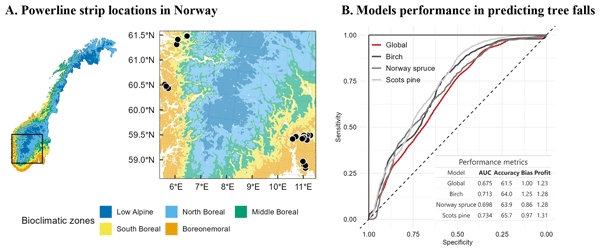
Abstract. Tree falls along linear infrastructures and in particular powerlines pose a significant economic, safety and environmental challenge for the companies and institutions managing these infrastructures. The quick progression and affordability of remote sensing technologies such as drone-based inventories offers the opportunity to quickly and efficiently map individual trees along these infrastructures, enabling precise vegetation management to reduce risks. Here, we show how the hybrid empirical and mechanistic wind risk model ForestGALES can be applied to assess the vulnerability of individual trees to windfalls along selected powerlines in southern Norway. The validation dataset contained 180 recorded individual tree falls along powerlines from the winter 2020–2021. There was no major wind event recorded that winter. However, still, the ForestGALES model performed adequately, with an AUC (area under the curve) of 0.67. Combining the vulnerability index from ForestGALES with all other available tree and environmental variables in a machine learning model (extreme gradient boost algorithm) did however significantly improve the prediction performance. These results highlight how a combination of high-quality remote sensing data at the individual tree level can be utilized with ForestGALES and machine learning to provide managers with high-resolution vulnerability information for vegetation management.
-
Notice on discussion status
The requested preprint has a corresponding peer-reviewed final revised paper. You are encouraged to refer to the final revised version.
-
Preprint
(1487 KB)
-
The requested preprint has a corresponding peer-reviewed final revised paper. You are encouraged to refer to the final revised version.
- Preprint
(1487 KB) - Metadata XML
- BibTeX
- EndNote
- Final revised paper


Journal article(s) based on this preprint
Interactive discussion
Status: closed
-
RC1: 'Comment on egusphere-2025-6363', Sophie Crommelinck, 10 Feb 2026
-
AC1: 'Reply on RC1', Morgane Merlin, 02 Mar 2026
Dear referee,
We thank you for taking the time to review our manuscript and for your comments. We have drafted a new explanatory figure which, we hope, better explains our approach in the study. This new figure would replace the current Figure 2. We welcome further comments on the new figure and its caption.
The new figure caption would read: Figure 2. Methodological approach used in the study. Box A: The input data (Soil data, Seasonal data, Tree data and Wind + Exposure) are processed and fed into ForestGales to obtain the Critical Wind Speed and subsequently the Probability of Damage. In addition, the input datasets and the Critical Wind Speed datasets are used in a machine learning (ML) algorithm (XGBoost). The ForestGales calculated probability of damage and the machine learning datasets are evaluated against a validation dataset - the recorded tree falls along powerlines during the winter 2020-2021 to assess the performance of the two methods. Box B: Graphical representation of the different model options considered in the study split into three categories: 1. the Seasonal Scenario used (section 2.3.1 in the text), 2. the Tree Data processing (section 2.1.2 in the text) and 3. the use of the Wind and Exposure data (section 2.2 & 2.3.2 in the text).We supplement the text lines 270 with a short description of the distance to the edge and gap size calculations which was in the previous Figure 2 legend. The suggested revision is: "The distance to the edge of the forest and the associated forest gap size were calculated during the data processing step in four directions (see section 2.1.1). Three alternatives were retained when calculating the CWS: i. the “closest largest gap” was defined using the linear optimizer function of the lpSolve package in R (Berkelaar, 2024), ii. the “minimum” was simply the closest forest edge and iii. the “mean” the average of the distances to and size of the non-forested gaps in the four considered directions (to and from the powerline, and along the powerline direction)."
We welcome any further comment on these suggested changes.
Best regards,
The authors-
RC2: 'Reply on AC1', Sophie Crommelinck, 03 Mar 2026
Hello,
sounds like a good improvement. Unfortunately I haven't found any option to actually see the new figure.
Kind regards.
Citation: https://doi.org/10.5194/egusphere-2025-6363-RC2 -
CC1: 'Reply on RC2', Barry Gardiner, 03 Mar 2026
Here are Dropbox links to the new Figures. I hope it is what you needed.
https://www.dropbox.com/scl/fi/tynusa15jikwcdjlqe54e/modelling_figure2.png?rlkey=qlztrlnzsgt0ye4z6sib50ynu&dl=0
https://www.dropbox.com/scl/fi/zyax9pwry7e1sw1p8xo9d/modelling_figure4.png?rlkey=tr17wi1s44idsehr1u79v5a1a&dl=0
https://www.dropbox.com/scl/fi/aemg04y5ej1m7fgrx52q7/potential_crownasymm_fig.png?rlkey=tzpky6u8j1tx2zw38q9qt1ecm&dl=0I have also attached as Supplement
Best regards, Barry Gardiner
-
RC3: 'Reply on CC1', Sophie Crommelinck, 03 Mar 2026
Thanks for the clarification, now I managed to find the figure.
I think the figure explains your work very well and is a good modification of your manuscript.
Citation: https://doi.org/10.5194/egusphere-2025-6363-RC3 - AC3: 'Reply on RC3', Morgane Merlin, 27 Apr 2026
-
RC3: 'Reply on CC1', Sophie Crommelinck, 03 Mar 2026
-
CC1: 'Reply on RC2', Barry Gardiner, 03 Mar 2026
-
RC2: 'Reply on AC1', Sophie Crommelinck, 03 Mar 2026
-
AC1: 'Reply on RC1', Morgane Merlin, 02 Mar 2026
-
RC4: 'Comment on egusphere-2025-6363', Anonymous Referee #2, 31 Mar 2026
Dear Authors,
Thank you for submitting the manuscript. The study addresses an important topic on wind damage modelling and is generally well written, clearly structured, and supported by relevant literature. The integration of field data and modelling approaches provides valuable contributions to improving the understanding of wind risk for individual tree fall along powerlines in Norway using ForestGALES and machine learning.
However, several aspects of the methodology and parameter description require further clarification to ensure transparency, reproducibility, and scientific rigor. Detailed comments and points for clarification are provided in the attached PDF file for your consideration.
Overall, the manuscript has strong potential for publication. Addressing the points raised, particularly those related to methodological clarity and parameter definition, will substantially improve the robustness and reproducibility of the study.
- AC2: 'Reply on RC4', Morgane Merlin, 24 Apr 2026


Interactive discussion
Status: closed
-
RC1: 'Comment on egusphere-2025-6363', Sophie Crommelinck, 10 Feb 2026
Dear authors,
Thank you for submitting this interesting manuscript on predicting the risk of individual tree fall along powerlines.
While the current results (in terms of accuracy) may not yet support immediate practical implementation, I believe your work makes a valuable contribution to the ongoing development of methods in this highly relevant field.
You have clearly highlighted and discussed the limitations of your study, which helps clarify the significance of your contribution for fellow researchers.
Overall, the manuscript is well written and well structured. I suggest that you could further improve the Materials and Methods section by including figures that illustrate your approach in greater detail.
Kind regards,
Citation: https://doi.org/10.5194/egusphere-2025-6363-RC1 -
AC1: 'Reply on RC1', Morgane Merlin, 02 Mar 2026
Dear referee,
We thank you for taking the time to review our manuscript and for your comments. We have drafted a new explanatory figure which, we hope, better explains our approach in the study. This new figure would replace the current Figure 2. We welcome further comments on the new figure and its caption.
The new figure caption would read: Figure 2. Methodological approach used in the study. Box A: The input data (Soil data, Seasonal data, Tree data and Wind + Exposure) are processed and fed into ForestGales to obtain the Critical Wind Speed and subsequently the Probability of Damage. In addition, the input datasets and the Critical Wind Speed datasets are used in a machine learning (ML) algorithm (XGBoost). The ForestGales calculated probability of damage and the machine learning datasets are evaluated against a validation dataset - the recorded tree falls along powerlines during the winter 2020-2021 to assess the performance of the two methods. Box B: Graphical representation of the different model options considered in the study split into three categories: 1. the Seasonal Scenario used (section 2.3.1 in the text), 2. the Tree Data processing (section 2.1.2 in the text) and 3. the use of the Wind and Exposure data (section 2.2 & 2.3.2 in the text).We supplement the text lines 270 with a short description of the distance to the edge and gap size calculations which was in the previous Figure 2 legend. The suggested revision is: "The distance to the edge of the forest and the associated forest gap size were calculated during the data processing step in four directions (see section 2.1.1). Three alternatives were retained when calculating the CWS: i. the “closest largest gap” was defined using the linear optimizer function of the lpSolve package in R (Berkelaar, 2024), ii. the “minimum” was simply the closest forest edge and iii. the “mean” the average of the distances to and size of the non-forested gaps in the four considered directions (to and from the powerline, and along the powerline direction)."
We welcome any further comment on these suggested changes.
Best regards,
The authors-
RC2: 'Reply on AC1', Sophie Crommelinck, 03 Mar 2026
Hello,
sounds like a good improvement. Unfortunately I haven't found any option to actually see the new figure.
Kind regards.
Citation: https://doi.org/10.5194/egusphere-2025-6363-RC2 -
CC1: 'Reply on RC2', Barry Gardiner, 03 Mar 2026
Here are Dropbox links to the new Figures. I hope it is what you needed.
https://www.dropbox.com/scl/fi/tynusa15jikwcdjlqe54e/modelling_figure2.png?rlkey=qlztrlnzsgt0ye4z6sib50ynu&dl=0
https://www.dropbox.com/scl/fi/zyax9pwry7e1sw1p8xo9d/modelling_figure4.png?rlkey=tr17wi1s44idsehr1u79v5a1a&dl=0
https://www.dropbox.com/scl/fi/aemg04y5ej1m7fgrx52q7/potential_crownasymm_fig.png?rlkey=tzpky6u8j1tx2zw38q9qt1ecm&dl=0I have also attached as Supplement
Best regards, Barry Gardiner
-
RC3: 'Reply on CC1', Sophie Crommelinck, 03 Mar 2026
Thanks for the clarification, now I managed to find the figure.
I think the figure explains your work very well and is a good modification of your manuscript.
Citation: https://doi.org/10.5194/egusphere-2025-6363-RC3 - AC3: 'Reply on RC3', Morgane Merlin, 27 Apr 2026
-
RC3: 'Reply on CC1', Sophie Crommelinck, 03 Mar 2026
-
CC1: 'Reply on RC2', Barry Gardiner, 03 Mar 2026
-
RC2: 'Reply on AC1', Sophie Crommelinck, 03 Mar 2026
-
AC1: 'Reply on RC1', Morgane Merlin, 02 Mar 2026
-
RC4: 'Comment on egusphere-2025-6363', Anonymous Referee #2, 31 Mar 2026
Dear Authors,
Thank you for submitting the manuscript. The study addresses an important topic on wind damage modelling and is generally well written, clearly structured, and supported by relevant literature. The integration of field data and modelling approaches provides valuable contributions to improving the understanding of wind risk for individual tree fall along powerlines in Norway using ForestGALES and machine learning.
However, several aspects of the methodology and parameter description require further clarification to ensure transparency, reproducibility, and scientific rigor. Detailed comments and points for clarification are provided in the attached PDF file for your consideration.
Overall, the manuscript has strong potential for publication. Addressing the points raised, particularly those related to methodological clarity and parameter definition, will substantially improve the robustness and reproducibility of the study.
- AC2: 'Reply on RC4', Morgane Merlin, 24 Apr 2026
Peer review completion


Journal article(s) based on this preprint
Viewed
| HTML | XML | Total | BibTeX | EndNote | |
|---|---|---|---|---|---|
| 1,456 | 689 | 140 | 2,285 | 83 | 95 |
- HTML: 1,456
- PDF: 689
- XML: 140
- Total: 2,285
- BibTeX: 83
- EndNote: 95
Viewed (geographical distribution)
| Country | # | Views | % |
|---|
| Total: | 0 |
| HTML: | 0 |
| PDF: | 0 |
| XML: | 0 |
- 1
Barry Gardiner
Svein Solberg
The requested preprint has a corresponding peer-reviewed final revised paper. You are encouraged to refer to the final revised version.
- Preprint
(1487 KB) - Metadata XML
Dear authors,
Thank you for submitting this interesting manuscript on predicting the risk of individual tree fall along powerlines.
While the current results (in terms of accuracy) may not yet support immediate practical implementation, I believe your work makes a valuable contribution to the ongoing development of methods in this highly relevant field.
You have clearly highlighted and discussed the limitations of your study, which helps clarify the significance of your contribution for fellow researchers.
Overall, the manuscript is well written and well structured. I suggest that you could further improve the Materials and Methods section by including figures that illustrate your approach in greater detail.
Kind regards,