
the Creative Commons Attribution 4.0 License.
the Creative Commons Attribution 4.0 License.
 | 03 Feb 2026
Spectral Nudging Impacts on Precipitation Downscaling in the Conformal Cubic Atmospheric Model, version CCAM-2504: Insights from Summer 2011
Abstract. This study evaluates the impacts of spectral nudging on rainfall when dynamically downscaling with the Conformal Cubic Atmospheric Model (CCAM). The study focuses on the extreme 2010 – 11 La Niña, in conjunction with the Madden – Julian Oscillation (MJO), across the CORDEX – Australasia domain at 12.5 km with CCAM nested in ERA-5 reanalysis. Sixteen simulations were performed, systematically varying nudging wavelength, vertical extent, frequency, and variable choice, and evaluated against GPM-IMERG precipitation and ERA5 reanalysis. Configurations at short nudging wavelengths (∼500 – 1500 km), with high-frequency updates (1 h), and including pressure, wind and temperature delivered the most robust performance. These setups reduced large-scale rainfall biases, improved spatial and temporal correlations, reproduced vertical structure and moisture convergence more realistically, and achieved the closest agreement with observed mean and extreme observed rainfall. In contrast, coarse-scale (3000 km), full-column constraints, or nudging limited to pressure or wind variables degraded performance, producing oversmoothed variability, misplaced convection, and unrealistic rainfall patterns. Overall, the results demonstrate that carefully tuned spectral nudging enhances the fidelity of both mean and extreme rainfall in CCAM, while preserving large-scale teleconnections associated with La Niña, MJO, and retaining mesoscale variability. This study strengthens confidence in CCAM downscaling for CORDEX – Australasia, with implications extending to other CORDEX domains and applications.
-
Notice on discussion status
The requested preprint has a corresponding peer-reviewed final revised paper. You are encouraged to refer to the final revised version.
-
Preprint
(4654 KB)
-
Supplement
(1326 KB)
-
The requested preprint has a corresponding peer-reviewed final revised paper. You are encouraged to refer to the final revised version.
- Preprint
(4654 KB) - Metadata XML
-
Supplement
(1326 KB) - BibTeX
- EndNote
- Final revised paper


Journal article(s) based on this preprint
Interactive discussion
Status: closed
-
CC1: 'Comment on egusphere-2025-5847', Peter B Gibson, 19 Feb 2026
The comment was uploaded in the form of a supplement: https://egusphere.copernicus.org/preprints/2026/egusphere-2025-5847/egusphere-2025-5847-CC1-supplement.pdfCitation: https://doi.org/
10.5194/egusphere-2025-5847-CC1 -
AC5: 'Reply on CC1', Son C. H. Truong, 26 May 2026
The comment was uploaded in the form of a supplement: https://egusphere.copernicus.org/preprints/2026/egusphere-2025-5847/egusphere-2025-5847-AC5-supplement.pdf
-
AC5: 'Reply on CC1', Son C. H. Truong, 26 May 2026
-
CEC1: 'Comment on egusphere-2025-5847 - No compliance with the policy of the journal', Juan Antonio Añel, 13 Mar 2026
Dear authors,
Unfortunately, after checking your manuscript, it has come to our attention that it does not comply with our "Code and Data Policy".
https://www.geoscientific-model-development.net/policies/code_and_data_policy.html
You have archived your code on GitHub. However, GitHub is not a suitable repository for scientific publication. GitHub itself instructs authors to use other long-term archival and publishing alternatives, such as Zenodo. In addition, to access the data necessary to replicate your work you link several servers that do not fulfil GMD’s requirements for a persistent data archive, in some cases they are generic portals, not the specific data. The sites that you cite do not comply with our policy because:
- They do not appear to have a published policy for data preservation over many years or decades (some flexibility exists over the precise length of preservation, but the policy must exist).
- They do not appear to have a published mechanism for preventing authors from unilaterally removing material. Archives must have a policy which makes removal of materials only possible in exceptional circumstances and subject to an independent curatorial decision,If we have missed a published policy which does in fact address this matter satisfactorily, please post a response linking to it. If you have any questions about this issue, please post them in a reply.
The GMD review and publication process depends on reviewers and community commentators being able to access, during the discussion phase, the code and data on which a manuscript depends, and on ensuring the provenance of replicability of the published papers for years after their publication. Please, therefore, publish your code and data in one of the appropriate repositories and reply to this comment with the relevant information (link and a permanent identifier for it (e.g. DOI)) as soon as possible. We cannot have manuscripts under Discussion that do not comply with our policy. Therefore, your manuscript should have not been accepted for Discussions and peer-review in the journal, and the current situation is irregular.
Please, remember that the 'Code and Data Availability’ section must also be modified to cite the new repository locations, and corresponding references added to the bibliography.
I must note that if you do not fix this problem, we cannot continue with the peer-review process or accept your manuscript for publication in GMD.
Juan A. Añel
Geosci. Model Dev. Executive EditorCitation: https://doi.org/10.5194/egusphere-2025-5847-CEC1 -
AC1: 'Reply on CEC1', Son C. H. Truong, 15 Mar 2026
March 15, 2026
Professor. Juan A. Añel
Geoscientific Model Development Executive EditorDear Prof. Añel,
Thank you for your comments regarding the Code and Data Policy. We have updated our manuscript to ensure full compliance. Specifically:
- The CCAM model code (version CCAM-2504), including post-processing scripts and running scripts, is now archived in Zenodo with a persistent DOI: https://doi.org/10.5281/zenodo.19018138.
- All datasets referenced in the manuscript now link to persistent data archives with DOIs:
- ERA5 hourly data: https://doi.org/10.24381/cds.bd0915c6
- GPCP daily CDR v3.2: https://doi.org/10.5067/MEASURES/GPCP/DATA305
- CMORPH v1.0 CRT: https://doi.org/10.25921/w9va-q159
- IMERG Final Run product (Version 07): https://doi.org/10.5067/GPM/IMERGDF/DAY/06
- All Python scripts used to generate figures are archived at Zenodo: https://doi.org/10.5281/zenodo.18423588.
The manuscript’s “Code and Data Availability” section has been revised accordingly, and all dataset references are cited with persistent identifiers. The revised manuscript and its associated track-change version have been sent to editor@mailarchive.copernicus.org and Polina Shvedko polina.shvedko@copernicus.org. The updated “Code and Data Availability” section is included below:
Code and data availability
The CCAM model code used in this study, including the main CCAM code (version CCAM-2504), post-processing scripts, and running scripts, is archived at Zenodo: https://doi.org/10.5281/zenodo.19018138. The ERA5 hourly data from 1940 to present can be downloaded from https://doi.org/10.24381/cds.bd0915c6 (Hersbach et al., 2023). The Global Precipitation Climatology Project (GPCP) daily CDR v3.2 (Huffman et al., 2023) can be downloaded at https://doi.org/10.5067/MEASURES/GPCP/DATA305. The Climate Prediction Center morphing method (CMORPH) v1.0 CRT (Joyce et al., 2004; Xie et al., 2017) can be downloaded at https://doi.org/10.25921/w9va-q159. The Integrated Multi-Satellite Retrievals for the Global Precipitation Measurement IMERG Final Run product (Version 07; Huffman et al., 2019), distributed by NASA GES DISC can be downloaded at https://doi.org/10.5067/GPM/IMERGDF/DAY/06. All figures presented in this manuscript were generated using Python scripts, which are publicly available at https://doi.org/10.5281/zenodo.18423588. All references of the datasets are listed in the in-text data citation references.
We believe these updates fully address the journal’s Code and Data Policy requirements. Thank you for your consideration.
Best regards,
Truong Cong Hoang SonThe Commonwealth Scientific and Industrial Research Organisation (CSIRO)
-
CEC2: 'Reply on AC1', Juan Antonio Añel, 16 Mar 2026
Dear authors,
Many thanks for your reply. However, it does not fully solve the issues raised in my previous commentary. For your work you use ERA5, GPCP, the Integrated Multi-Satellite Retrievals for the Global Precipitation Measurement IMERG Final Run product, and CMORPH) v1.0 CRT. However, you have not stored the data used. To get access to them you provide links to webpages that are not trusted long term repositories that we can accept, and moreover, they are generic links to full datasets, not the specific data you have used. Therefore, as requested in the previous comment, store the specific data that you have used properly, and reply to this comment with a modified Code and Data Availability section that we can accept.
Juan A. Añel
Geosci. Model Dev. Executive Editor
Citation: https://doi.org/10.5194/egusphere-2025-5847-CEC2 -
AC2: 'Reply on CEC2', Son C. H. Truong, 18 Mar 2026
Subject: Revised Code and Data Availability Section (Response to GMD Editor)
Dear Prof. Añel,
Thank you for your feedback and patience. As requested, we have updated the Code and Data Availability section of the manuscript to fully address the concerns raised in your previous comment. We have now archived the datasets used in our analysis (ERA5, GPCP, CMORPH, and IMERG precipitation data) at Zenodo: https://doi.org/10.5281/zenodo.19077484. The updated Code and Data Availability section has been revised accordingly and is included below for your review:
Code and Data Availability
The CCAM model code used in this study, including the main CCAM code (version CCAM-2504), post-processing scripts, and running scripts, is archived at Zenodo: https://doi.org/10.5281/zenodo.19018138. The observational and reanalysis datasets used in this study (ERA5, GPCP, CMORPH, and IMERG precipitation data) is archived at Zenodo: https://doi.org/10.5281/zenodo.19077484. Original datasets remain available from their providers: ERA5 (Hersbach et al., 2023): https://doi.org/10.24381/cds.bd0915c6; GPCP (Huffman et al., 2023): https://doi.org/10.5067/MEASURES/GPCP/DATA305; CMORPH (Joyce et al., 2004; Xie et al., 2017): https://doi.org/10.25921/w9va-q159; IMERG (Huffman et al., 2019): https://doi.org/10.5067/GPM/IMERGDF/DAY/06. All figures presented in this manuscript were generated using Python scripts, which are publicly available at https://doi.org/10.5281/zenodo.18423588. All references of the datasets are listed in the in-text data citation references
We hope these changes fully meet your requirements for reproducibility and compliance with the journal’s Code and Data Policy. Please let us know if there are any further issues or if any additional modifications are needed. Thank you again for your guidance and support throughout this process.
Kind regards,
Son C. H. Truong
On behalf of all authorsMarch 18, 2026
-
CEC3: 'Reply on AC2', Juan Antonio Añel, 18 Mar 2026
Dear authors,
Many thanks for your reply. We can consider now the current version of your manuscript in compliance with the Code and Data policy of the journal.
Juan A. Añel
Geosci. Model Dev. Executive Editor
Citation: https://doi.org/10.5194/egusphere-2025-5847-CEC3
-
CEC3: 'Reply on AC2', Juan Antonio Añel, 18 Mar 2026
-
AC2: 'Reply on CEC2', Son C. H. Truong, 18 Mar 2026
-
AC1: 'Reply on CEC1', Son C. H. Truong, 15 Mar 2026
-
RC1: 'Comment on egusphere-2025-5847', Anonymous Referee #1, 27 Mar 2026
General Comments (Recommendation: Reject)
This manuscript investigates the sensitivity of precipitation simulations to different spectral nudging configurations using the CCAM model for summer 2011. While the topic is relevant to regional climate modeling, the study offers limited novelty and insufficient scientific advancement beyond what has already been extensively documented in the literature.
The primary conclusions that optimal nudging involves intermediate wavelengths (∼500-1500 km), inclusion of wind and temperature, and higher-frequency updates are well established in previous studies, many of which are cited by the authors. The manuscript does not offer new physical understanding, methodological innovation, or conceptual development. Instead, it simply reproduces expected results using a different model configuration, which does not constitute a sufficient contribution for publication.
Although the study is reasonably structured, it does not adequately engage with or build upon recent developments in the field. Notably, there is a lack of discussion of more recent literature, and few (if any) references on spectral nudging from the past 6 years are included. This weakens the positioning of the work within the current state of research.
Moreover, the experimental design is overly simplistic and incremental, essentially consisting of turning nudging parameters on and off (e.g., variables, wavelength, frequency) without a clear scientific hypothesis or attempt to address unresolved questions in the field. This type of sensitivity testing has been performed extensively over the past decade, and the outcomes reported here are entirely predictable. As such, the study lacks both originality and intellectual depth.
In its current form, the manuscript does not meet the level of originality and impact required for publication.
Major Comments
1. Lack of Novelty and Originality
The main findings, such as the benefits of nudging wind and temperature, the optimal wavelength (~500-1500 km), and the use of high-frequency (1-hour) nudging, have been extensively documented in prior studies (e.g., Omrani et al. 2015; Alexandru et al. 2009; Gómez and Miguez-Macho 2017; Tang et al. 2017).
The manuscript does not introduce new theory, methodology, diagnostics, or coupling strategies, but instead presents a largely incremental parameter sensitivity analysis with expected outcomes. The experimental design, testing combinations of variables (p, u, v, t, q), wavelengths (500-3000 km), and nudging frequencies (1h vs 3h), follows well-established frameworks and does not reflect a new scientific hypothesis or conceptual advance.
Previous studies have already explored a wide range of spectral nudging configurations, with general consensus on key aspects, including:
- The need for weaker nudging coefficients for moisture compared to dynamical variables (Spero et al., 2014, 2018; Hu et al., 2018);
- Applying temperature nudging above the boundary layer and below the tropopause, and moisture nudging below the tropopause (Gómez and Miguez-Macho, 2017; Spero et al., 2014, 2018; Huang et al., 2021);
- Avoiding nudging within the boundary layer to preserve surface and turbulence processes.
- Combination of wind and moisture nudging can outperform wind-temperature nudging in simulating cloud fraction and precipitation (Lai and Gan, 2025).
Given this context, the manuscript requires a much clearer articulation of its novel contribution and how it advances beyond existing knowledge. In its current form, the study largely reaffirms established findings.
2. Limited Scope (Single Case Study)
The analysis is based on a single extreme event (2010-2011 La Niña), which the authors acknowledge as a limitation. Consequently, the conclusions regarding “optimal” nudging configurations are not robust or generalizable.
To strengthen the findings, I suggest multi-year simulations and the inclusion of multiple climate regimes (e.g., El Niño, neutral years) to ensure statistical robustness and broader applicability.
3. Insufficient Mechanistic Insight
Although the results show that spectral nudging improves precipitation simulation, the manuscript lacks in-depth physical interpretation. The analysis remains largely descriptive, without sufficiently explaining why certain configurations perform better.
In particular, the analysis of vertically integrated MFC instead of single pressure level or a discussion on the relative contributions of thermodynamic vs. dynamic processes in precipitation.
Although several process-level variables are examined, the physical understanding behind the results from different nudging experiments remains limited. More detailed process-level analysis is needed. Please analyze in more depth the reasons for the overestimation or underestimation of precipitation, particularly focusing on the physical processes involved. This analysis is crucial to understanding the limitations and sensitivities of the nudging approach.
4. Evaluation Metrics
The evaluation relies primarily on standard metrics (MAPE, correlation, RMSE), which provide limited insight into model performance for extremes. It is recommended to include additional metrics commonly used in precipitation verification, such as: Threat Score (TS), Probability of Detection (POD), False Alarm Rate (FAR) for each grid point.
Furthermore, the validation relies heavily on satellite-based products, despite acknowledged uncertainties (particularly in R1 and R3). The study lacks validation against in situ observations (e.g., rain gauges or station data), which is critical for assessing precipitation biases, especially in regions with high observational uncertainty.
Lastly, while the manuscript evaluates region-averaged outcomes, it does not examine finer-scale variability. Incorporating comparisons with weather station data would help assess the model’s ability to capture local-scale features and improve the robustness of conclusions.
Here are some additional and specific comments:
L50 As noted by the authors, moisture nudging is a debated technique. It would be valuable to explore in more depth the effects of moisture nudging, particularly in relation to precipitation simulations.
L66 Needs to be supported by appropriate references.
L85 add (GPM) and “GES DISC” needs clarification.
L110-111 CABLE and UCLEM need clarification.
L115 Model configuration section. The authors should more thoroughly acknowledge and engage with prior work before presenting their experimental design. A comprehensive review of relevant studies is essential. In addition, the rationale behind the model experiment design should be clearly justified.
L116 The choice of wavelengths (3000, 1500, and 500 km) requires clearer justification. Previous studies generally suggest that a range of ~1000-2000 km is more appropriate. The authors should explain the rationale behind their selected values and clarify how these choices align with the goal of minimizing nudging while still achieving improved simulation performance.
L124 Justify the choice of vertical levels for nudging. Many studies suggest nudging above the PBL to avoid disturbing surface layer physics. Why use 0.5 and 1 levels? Also, the PBL height is variable during the simulation, so the nudging should ideally follow the PBL rather than be fixed at a single level.
L124 The choice of 3000 km wavelength for the PUVTQ configuration is questionable. As identified in the literature, this wavelength may not be optimal and combining temperature and moisture could lead to overestimated rainfall due to thermodynamic inconsistencies. Further investigation is needed for experiments using PUVT and PUVQ with better parameter configurations.
L138 A more thorough time-series validation is needed to assess model performance over time.
L144 Justify the choice of 700 hPa for validation. But Figure 7 shows 875hPa? Consider using depth-integrated values for a more comprehensive analysis.
L151 Justify the domain selections for the simulations. Why was this specific region chosen? Why southwest Australia exclude?
L166 The maximum precipitation in IMERG is around 20–25 mm/day, but the bias in Figure 2 reaches -9 mm/day. Suggest showing both simulated rainfall and bias side by side for clearer interpretation.
L177 Figure S3 should present the spatial distribution of correlation and RMSE for daily precipitation at each grid point across the Australian continent (December 2010-March 2011). The current domain-averaged view does not adequately capture the model’s spatial accuracy in rainfall representation.
L185 This suggests a potential model physics issue. The convective parameterization might be suited for continental regions but not for tropical ones. Have different convective parameterization schemes been tested? Please provide evidence and further exploration.
L203: To strengthen the conclusions, compare the model results with weather station data, particularly in regions where GPM data uncertainties are high.
Section 3.1.1: Including a table that summarizes performance metrics and time-series comparisons for each region, along with extreme rainfall statistics (e.g., TH), and highlighting the best values would provide clearer and more comprehensive insights.
L220 Figure 4 is difficult to interpret due to excessive clutter. Simplify the figure or highlight the key differences to make it more readable.
L275 Consider using depth-integrated MFC for a more comprehensive analysis. And also compare the domain-average.
L309 Figure 8 compares nudged simulations with ERA5. It would be more informative to compare against independent observational data or other reanalysis products, since nudging toward ERA5 variables naturally leads to higher correlation with ERA5 itself. While moisture nudging improves moisture simulation, it does not improve precipitation. The authors should provide a more detailed analysis to explain the reasons behind this discrepancy.
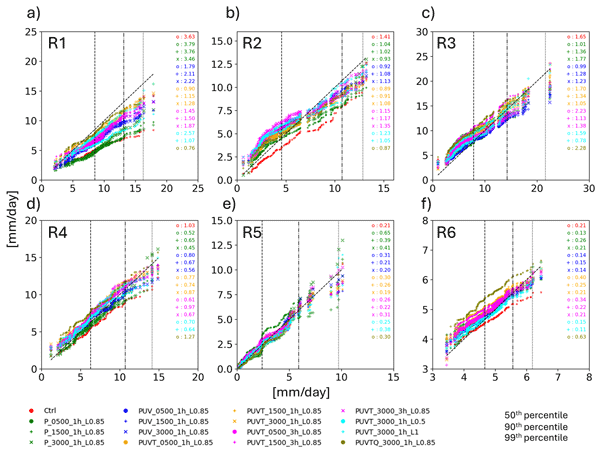
The figures are cluttered and some are difficult to read due to poor visibility or excessive similarity. Figures 2, 6, 7, and 10 are too similar to clearly differentiate the results. Additionally, some colored lines in Figures 4, 5, and 8 have poor visibility. These should be adjusted for better clarity. Furthermore, there is no need to present all experiment results. For instance, it is well known that nudging P produces the worst results, so repeating the experiment across all wavelengths (3000, 1500, 500 km) is unnecessary, especially since 500 km is clearly the most effective. Reducing redundant figures and focusing on the most significant results will improve the clarity and impact of the presentation.
Include key and latest references on spectral nudging to strengthen the context and scientific grounding of the study. Suggested references are provided above:
Spero TL, Nolte CG, Mallard MS, Bowden JH (2018) A maieutic exploration of nudging strategies for regional climate applications using the WRF model.
Mai X, Qiu X, Yang Y, Ma Y (2020) Impacts of spectral nudging parameters on dynamical downscaling in summer over Mainland China. Front Earth Sci 8.
Huang Z, Zhong L, Ma Y, Fu Y (2021) Development and evaluation of spectral nudging strategy for the simulation of summer precipitation over the Tibetan plateau using WRF (v4.0). Geosci Model Dev 14:2827–2841.
Hutson, A., Fujisaki-Manome, A., & Lofgren, B. (2024). Testing the sensitivity of a WRF-based great lakes regional climate model to cumulus parameterization and spectral nudging. Journal of Hydrometeorology, 25(7), 1007-1025.
Lai, W., & Gan, J. (2025). On spectral nudging and dynamics to improve representation of marine cloud and precipitation over the China sea in summer. Theoretical and Applied Climatology, 156(8), 444.
Citation: https://doi.org/10.5194/egusphere-2025-5847-RC1 -
AC3: 'Reply on RC1', Son C. H. Truong, 26 May 2026
The comment was uploaded in the form of a supplement: https://egusphere.copernicus.org/preprints/2026/egusphere-2025-5847/egusphere-2025-5847-AC3-supplement.pdf
-
RC2: 'Comment on egusphere-2025-5847', Ralph Trancoso, 05 Apr 2026
General comments
I read the discussion paper entitled “Spectral Nudging Impacts on Precipitation Downscaling in the Conformal Cubic Atmospheric Model, version CCAM-2504: Insights from Summer 2011”, submitted to GMD by Truong and colleagues. The Conformal Cubic Atmospheric Model (CCAM) is a reputable regional modelling platform developed by this group and widely used in Australia and globally for downscaling global climate models. Several meaningful recent scientific contributions have featured CCAM and evaluated its runs, demonstrating added value as well as systematic biases. Therefore, this group effort to enhance and further develop the model is very important for the regional model scientific community, climate adaptation and resilience building. For instance, CCAM simulations have been submitted to the CORDEX archive of CMIP6 downscaled projections for the Australasian domain by distinct modelling groups using varying experiment designs and their outcomes are featured in a range of climate services portal providing application-ready data.
A key characteristic of CCAM is that it runs over a stretched grid with maximum spatial resolution over the target region, which enables to reconcile global and regional climate processes – such as the influence of large-scale SST patterns, global circulation processes, as well as local and regional topography on precipitation. To impose boundary conditions and forcings, a technique named spectral nudging is used as opposed to lateral nudging traditionally used in other modelling platforms for data assimilation at their boundaries. This allows the regional model to develop its own high-resolution details, such as local storms or terrain-influenced winds, without drifting away from the overarching global weather patterns. An advantage of spectral nudging is that it prevents internal model variability from causing the regional simulation to deviate unrealistically from the global state it is meant to represent. However, spectral nudging needs to be tuned to optimise its performance. The paper undertakes an assessment of how systematically varying nudging wavelength, vertical extent, frequency, and variable choice influence the performance of precipitation simulations during an extreme 2010 – 11 La Niña. GPM-IMERG precipitation and ERA5 reanalysis datasets are used as ground truth. It shows that configurations at short nudging wavelengths (∼500 – 1500 km), with high-frequency updates (1 h), and including pressure, wind and temperature delivered the most robust performance.
I believe the paper suits the journal scope well and will be of interest of the climate modellers community. My recommendation is for it to be published after minor revisions.
Specific comments
Title: “version CCAM-2504” does not need to be listed in the title. Suggest move it to abstract. Title will be more concise
L31: Chapman et al (2023) Earth’s Future - would be a more suitable citation for this statement.
https://agupubs.onlinelibrary.wiley.com/doi/full/10.1029/2023EF003548
L31: Sugata et al., 2025 should by Narsey et al (2025) instead, as Sugata is his first name. Another suitable citation to be included for the BARPA model and to back the statement would be Howard et al (2024) GMD - https://gmd.copernicus.org/articles/17/731/2024/
L38: add Huang et al (2021) GMD as it demonstrates more recent development in spectral nudging published in the same journal - https://gmd.copernicus.org/articles/14/2827/2021/
L56-57: “While RCM performance has been evaluated in Australasia (Liu et al., 2024; Ma et al., 2025; Truong and Thatcher, 2025)” – I would see value in expanding this as a paragraph outlining the recent CCAM evaluation papers by Chapman, Gibson, Ma, Shoereter and others to better showcase what has already been evaluated in CCAM, its advantages (e.g., added value), limitations (e.g. systematic biases) and what is still outstanding, such as the systematic evaluation of spectral nudging configuration and sensitivity which may enhance advantages and constrain limitations. Consider also adding a quick description on the extent to which CCAM has been used in CORDEX CMIP6 with some examples to set the scene on why there’s a need to keep improving it.
Regarding the use of ERA5 reanalysis – it would be worthy to add a sentence or two justifying its usage against BARRA2 – i.e., need for global coverage as CCAM runs globally. Many readers may not grasp that and may think BARRA2 might be more suitable given the higher horizontal/spatial resolution closer to the 12 km CCAM runs that are being assessed.
L97: “(Imran and Eván 2025)” should be (Imran and Evans 2025)
L103: Sugata et al (2025) should be Narsey et al (2025). Suggest inclusion of Chapman et al (2023) Earth’s Future.
L103-105: suggest inclusion of a Queensland’s study that uses this CCAM experiment design – i.e., driven by SSTs and ice sheets
L112: “Thatcher and McGregor (2008) introduced a scale-selective filtering approach (e.g., spectral nudging)” – this statement may confuse the readers as the main topic for the paper is spectral nudging, which now appears as “scale-selective filtering”. Needs further explanation for clarity.
L142: “, where n is the number” – remove “,”
L150: 3.1.1 Spatial variability of precipitation – please introduce the figure in the text before inserting them for context and guidance of figure interpretation. This applies to all other figures.
L158-159: “R1 and R3 belong to the CORDEX – SEA domain” – they are also part of the CORDEX Australasian domain, right? At least partially.
Methods – after reading the results, methods seem incomplete. Authors need to better explain the experiment design, sub-regions selection, and assessment metrics presented in their results and figures.
Figure 1 and its description :155-162 should be presented in methods instead as no result is presented about spatial variability of precipitation. It’s clearly about experiment design, variable horizontal resolution, and sub-regions – which are all methods.
Fig 2 – as stated above, please move figure to after its description (L166-187) otherwise no context and guidance is provided for interpretation.
Fig 2 subpanels – consider plotting average bias over the entire domain as annotation per sub-panel as a quantitative indicator of model configuration performance, should be useful for interpretation along with spatial patterns. This could be included after sub-panel config name separate by colon or dash. The annotations could be placed over the map on the bottom left corner of each subpanel. Alternatively, a table could be added with additional parameters, such as average bias, absolute bias, correlation, etc.
Fig 3 – suggest adding axis names for the three dimensions: x-axis, y-axis and radial components. And don’t forget to move the Taylor diagrams to after the description paragraph.
L196: A sentence introducing the analytical strategy would be useful to guide the reader – e.g., “Next, we assess the performance of the spectral nudging configuration over the six regions presented in Fig 1 using Taylor diagrams…”
L203-204: “in convective (R1) and orographic (R3) regions,” – it would be nice to have mentioned this as an analytical strategy for the selection of regions in the methods. Please insert this information when moving Fig 1 and description to the methods.
L200-205: Maybe consider a supplementary information table (or heatmap) with all metrics for the entire domain and sub-domains summarising the results for the 16 spectral nudging configurations.
Fig 5 is insightful, but I could not find the ground truth that should be used as reference to compare simulations against as IMERG has no colour / line attributed to it in the legend. By looking closer, it looks like it is the black line that is not attributed to anything else. Just need to add it to IMERG I the legend and maybe consider making it thicker to stand out amongst the other 16 time-series.
I like the consistency of colours over the figures subpanels tittles, symbols in the Taylor diagrams and plot/time-series lines – these show authors are committed to present a quality material with substantial attention to detail.
L282: this is the first time a figure is referred in the text before its appearance. This makes the material more intelligible, and this style should be adopted as standard.
Fig 7: this is very nice visualization of circulation patterns and how wind field influences moisture fluxes. Well done!
Fig 8: row numbers and axis titles are disproportionately large, please reduce font size.
Fig 10 is insightful as it shows large biases in extreme rainfall for all spectral nudging configurations. This shows that the technique has limitations and is not supposed to resolve a much bigger issue which is, for instance, the underestimation of monsoonal rainfall in northern Australia regardless of the configuration used. This point could be added to the discussion.
I like the concluding remarks with explicit recommendation of spectral nudging configuration based on the results of this experiment and the clear outlining of limitations – there are overarching issues in regional climate modelling that spectral nudging will not be able to fix and readers should lower their expectations.
References format is not fully consistent – refer to L533-539 for an example – sometimes two authors references have “&”, sometimes not. Sometimes year appears after authors, sometimes in the end, sometimes in brackets. Sometimes colon is used too - see below highlighted in bold
“Hong, S. Y., & Chang, E. C. (2012). Spectral nudging sensitivity simulations in a regional climate model. Asia-Pacific Journal of Atmospheric Sciences, 48(4), 345–355. https://doi.org/10.1007/s13143-012-0033-3
Imran, H.M., Evans, J.P. Observational uncertainty in the added value of regional climate modelling over Australia. Clim Dyn 63, 73 (2025).https://doi.org/10.1007/s00382-024-07562-y
Isphording, R. N., Alexander, L. V., Bador, M., Green, D., Evans, J. P., and Wales, S.: A Standardized Benchmarking Framework to Assess Downscaled Precipitation Simulations, J. Climate, 37, 1089–1110, https://doi.org/10.1175/JCLI-D-23 0317.1, 2024.”
Congratulations on the excellent research. I am looking forward to seeing it published!
Regards,
Ralph Trancoso
Citation: https://doi.org/10.5194/egusphere-2025-5847-RC2 -
AC4: 'Reply on RC2', Son C. H. Truong, 26 May 2026
The comment was uploaded in the form of a supplement: https://egusphere.copernicus.org/preprints/2026/egusphere-2025-5847/egusphere-2025-5847-AC4-supplement.pdf
-
AC4: 'Reply on RC2', Son C. H. Truong, 26 May 2026
Peer review completion


Interactive discussion
Status: closed
-
CC1: 'Comment on egusphere-2025-5847', Peter B Gibson, 19 Feb 2026
The comment was uploaded in the form of a supplement: https://egusphere.copernicus.org/preprints/2026/egusphere-2025-5847/egusphere-2025-5847-CC1-supplement.pdf
-
AC5: 'Reply on CC1', Son C. H. Truong, 26 May 2026
The comment was uploaded in the form of a supplement: https://egusphere.copernicus.org/preprints/2026/egusphere-2025-5847/egusphere-2025-5847-AC5-supplement.pdf
-
AC5: 'Reply on CC1', Son C. H. Truong, 26 May 2026
-
CEC1: 'Comment on egusphere-2025-5847 - No compliance with the policy of the journal', Juan Antonio Añel, 13 Mar 2026
Dear authors,
Unfortunately, after checking your manuscript, it has come to our attention that it does not comply with our "Code and Data Policy".
https://www.geoscientific-model-development.net/policies/code_and_data_policy.html
You have archived your code on GitHub. However, GitHub is not a suitable repository for scientific publication. GitHub itself instructs authors to use other long-term archival and publishing alternatives, such as Zenodo. In addition, to access the data necessary to replicate your work you link several servers that do not fulfil GMD’s requirements for a persistent data archive, in some cases they are generic portals, not the specific data. The sites that you cite do not comply with our policy because:
- They do not appear to have a published policy for data preservation over many years or decades (some flexibility exists over the precise length of preservation, but the policy must exist).
- They do not appear to have a published mechanism for preventing authors from unilaterally removing material. Archives must have a policy which makes removal of materials only possible in exceptional circumstances and subject to an independent curatorial decision,If we have missed a published policy which does in fact address this matter satisfactorily, please post a response linking to it. If you have any questions about this issue, please post them in a reply.
The GMD review and publication process depends on reviewers and community commentators being able to access, during the discussion phase, the code and data on which a manuscript depends, and on ensuring the provenance of replicability of the published papers for years after their publication. Please, therefore, publish your code and data in one of the appropriate repositories and reply to this comment with the relevant information (link and a permanent identifier for it (e.g. DOI)) as soon as possible. We cannot have manuscripts under Discussion that do not comply with our policy. Therefore, your manuscript should have not been accepted for Discussions and peer-review in the journal, and the current situation is irregular.
Please, remember that the 'Code and Data Availability’ section must also be modified to cite the new repository locations, and corresponding references added to the bibliography.
I must note that if you do not fix this problem, we cannot continue with the peer-review process or accept your manuscript for publication in GMD.
Juan A. Añel
Geosci. Model Dev. Executive EditorCitation: https://doi.org/10.5194/egusphere-2025-5847-CEC1 -
AC1: 'Reply on CEC1', Son C. H. Truong, 15 Mar 2026
March 15, 2026
Professor. Juan A. Añel
Geoscientific Model Development Executive EditorDear Prof. Añel,
Thank you for your comments regarding the Code and Data Policy. We have updated our manuscript to ensure full compliance. Specifically:
- The CCAM model code (version CCAM-2504), including post-processing scripts and running scripts, is now archived in Zenodo with a persistent DOI: https://doi.org/10.5281/zenodo.19018138.
- All datasets referenced in the manuscript now link to persistent data archives with DOIs:
- ERA5 hourly data: https://doi.org/10.24381/cds.bd0915c6
- GPCP daily CDR v3.2: https://doi.org/10.5067/MEASURES/GPCP/DATA305
- CMORPH v1.0 CRT: https://doi.org/10.25921/w9va-q159
- IMERG Final Run product (Version 07): https://doi.org/10.5067/GPM/IMERGDF/DAY/06
- All Python scripts used to generate figures are archived at Zenodo: https://doi.org/10.5281/zenodo.18423588.
The manuscript’s “Code and Data Availability” section has been revised accordingly, and all dataset references are cited with persistent identifiers. The revised manuscript and its associated track-change version have been sent to editor@mailarchive.copernicus.org and Polina Shvedko polina.shvedko@copernicus.org. The updated “Code and Data Availability” section is included below:
Code and data availability
The CCAM model code used in this study, including the main CCAM code (version CCAM-2504), post-processing scripts, and running scripts, is archived at Zenodo: https://doi.org/10.5281/zenodo.19018138. The ERA5 hourly data from 1940 to present can be downloaded from https://doi.org/10.24381/cds.bd0915c6 (Hersbach et al., 2023). The Global Precipitation Climatology Project (GPCP) daily CDR v3.2 (Huffman et al., 2023) can be downloaded at https://doi.org/10.5067/MEASURES/GPCP/DATA305. The Climate Prediction Center morphing method (CMORPH) v1.0 CRT (Joyce et al., 2004; Xie et al., 2017) can be downloaded at https://doi.org/10.25921/w9va-q159. The Integrated Multi-Satellite Retrievals for the Global Precipitation Measurement IMERG Final Run product (Version 07; Huffman et al., 2019), distributed by NASA GES DISC can be downloaded at https://doi.org/10.5067/GPM/IMERGDF/DAY/06. All figures presented in this manuscript were generated using Python scripts, which are publicly available at https://doi.org/10.5281/zenodo.18423588. All references of the datasets are listed in the in-text data citation references.
We believe these updates fully address the journal’s Code and Data Policy requirements. Thank you for your consideration.
Best regards,
Truong Cong Hoang SonThe Commonwealth Scientific and Industrial Research Organisation (CSIRO)
-
CEC2: 'Reply on AC1', Juan Antonio Añel, 16 Mar 2026
Dear authors,
Many thanks for your reply. However, it does not fully solve the issues raised in my previous commentary. For your work you use ERA5, GPCP, the Integrated Multi-Satellite Retrievals for the Global Precipitation Measurement IMERG Final Run product, and CMORPH) v1.0 CRT. However, you have not stored the data used. To get access to them you provide links to webpages that are not trusted long term repositories that we can accept, and moreover, they are generic links to full datasets, not the specific data you have used. Therefore, as requested in the previous comment, store the specific data that you have used properly, and reply to this comment with a modified Code and Data Availability section that we can accept.
Juan A. Añel
Geosci. Model Dev. Executive Editor
Citation: https://doi.org/10.5194/egusphere-2025-5847-CEC2 -
AC2: 'Reply on CEC2', Son C. H. Truong, 18 Mar 2026
Subject: Revised Code and Data Availability Section (Response to GMD Editor)
Dear Prof. Añel,
Thank you for your feedback and patience. As requested, we have updated the Code and Data Availability section of the manuscript to fully address the concerns raised in your previous comment. We have now archived the datasets used in our analysis (ERA5, GPCP, CMORPH, and IMERG precipitation data) at Zenodo: https://doi.org/10.5281/zenodo.19077484. The updated Code and Data Availability section has been revised accordingly and is included below for your review:
Code and Data Availability
The CCAM model code used in this study, including the main CCAM code (version CCAM-2504), post-processing scripts, and running scripts, is archived at Zenodo: https://doi.org/10.5281/zenodo.19018138. The observational and reanalysis datasets used in this study (ERA5, GPCP, CMORPH, and IMERG precipitation data) is archived at Zenodo: https://doi.org/10.5281/zenodo.19077484. Original datasets remain available from their providers: ERA5 (Hersbach et al., 2023): https://doi.org/10.24381/cds.bd0915c6; GPCP (Huffman et al., 2023): https://doi.org/10.5067/MEASURES/GPCP/DATA305; CMORPH (Joyce et al., 2004; Xie et al., 2017): https://doi.org/10.25921/w9va-q159; IMERG (Huffman et al., 2019): https://doi.org/10.5067/GPM/IMERGDF/DAY/06. All figures presented in this manuscript were generated using Python scripts, which are publicly available at https://doi.org/10.5281/zenodo.18423588. All references of the datasets are listed in the in-text data citation references
We hope these changes fully meet your requirements for reproducibility and compliance with the journal’s Code and Data Policy. Please let us know if there are any further issues or if any additional modifications are needed. Thank you again for your guidance and support throughout this process.
Kind regards,
Son C. H. Truong
On behalf of all authorsMarch 18, 2026
-
CEC3: 'Reply on AC2', Juan Antonio Añel, 18 Mar 2026
Dear authors,
Many thanks for your reply. We can consider now the current version of your manuscript in compliance with the Code and Data policy of the journal.
Juan A. Añel
Geosci. Model Dev. Executive Editor
Citation: https://doi.org/10.5194/egusphere-2025-5847-CEC3
-
CEC3: 'Reply on AC2', Juan Antonio Añel, 18 Mar 2026
-
AC2: 'Reply on CEC2', Son C. H. Truong, 18 Mar 2026
-
AC1: 'Reply on CEC1', Son C. H. Truong, 15 Mar 2026
-
RC1: 'Comment on egusphere-2025-5847', Anonymous Referee #1, 27 Mar 2026
General Comments (Recommendation: Reject)
This manuscript investigates the sensitivity of precipitation simulations to different spectral nudging configurations using the CCAM model for summer 2011. While the topic is relevant to regional climate modeling, the study offers limited novelty and insufficient scientific advancement beyond what has already been extensively documented in the literature.
The primary conclusions that optimal nudging involves intermediate wavelengths (∼500-1500 km), inclusion of wind and temperature, and higher-frequency updates are well established in previous studies, many of which are cited by the authors. The manuscript does not offer new physical understanding, methodological innovation, or conceptual development. Instead, it simply reproduces expected results using a different model configuration, which does not constitute a sufficient contribution for publication.
Although the study is reasonably structured, it does not adequately engage with or build upon recent developments in the field. Notably, there is a lack of discussion of more recent literature, and few (if any) references on spectral nudging from the past 6 years are included. This weakens the positioning of the work within the current state of research.
Moreover, the experimental design is overly simplistic and incremental, essentially consisting of turning nudging parameters on and off (e.g., variables, wavelength, frequency) without a clear scientific hypothesis or attempt to address unresolved questions in the field. This type of sensitivity testing has been performed extensively over the past decade, and the outcomes reported here are entirely predictable. As such, the study lacks both originality and intellectual depth.
In its current form, the manuscript does not meet the level of originality and impact required for publication.
Major Comments
1. Lack of Novelty and Originality
The main findings, such as the benefits of nudging wind and temperature, the optimal wavelength (~500-1500 km), and the use of high-frequency (1-hour) nudging, have been extensively documented in prior studies (e.g., Omrani et al. 2015; Alexandru et al. 2009; Gómez and Miguez-Macho 2017; Tang et al. 2017).
The manuscript does not introduce new theory, methodology, diagnostics, or coupling strategies, but instead presents a largely incremental parameter sensitivity analysis with expected outcomes. The experimental design, testing combinations of variables (p, u, v, t, q), wavelengths (500-3000 km), and nudging frequencies (1h vs 3h), follows well-established frameworks and does not reflect a new scientific hypothesis or conceptual advance.
Previous studies have already explored a wide range of spectral nudging configurations, with general consensus on key aspects, including:
- The need for weaker nudging coefficients for moisture compared to dynamical variables (Spero et al., 2014, 2018; Hu et al., 2018);
- Applying temperature nudging above the boundary layer and below the tropopause, and moisture nudging below the tropopause (Gómez and Miguez-Macho, 2017; Spero et al., 2014, 2018; Huang et al., 2021);
- Avoiding nudging within the boundary layer to preserve surface and turbulence processes.
- Combination of wind and moisture nudging can outperform wind-temperature nudging in simulating cloud fraction and precipitation (Lai and Gan, 2025).
Given this context, the manuscript requires a much clearer articulation of its novel contribution and how it advances beyond existing knowledge. In its current form, the study largely reaffirms established findings.
2. Limited Scope (Single Case Study)
The analysis is based on a single extreme event (2010-2011 La Niña), which the authors acknowledge as a limitation. Consequently, the conclusions regarding “optimal” nudging configurations are not robust or generalizable.
To strengthen the findings, I suggest multi-year simulations and the inclusion of multiple climate regimes (e.g., El Niño, neutral years) to ensure statistical robustness and broader applicability.
3. Insufficient Mechanistic Insight
Although the results show that spectral nudging improves precipitation simulation, the manuscript lacks in-depth physical interpretation. The analysis remains largely descriptive, without sufficiently explaining why certain configurations perform better.
In particular, the analysis of vertically integrated MFC instead of single pressure level or a discussion on the relative contributions of thermodynamic vs. dynamic processes in precipitation.
Although several process-level variables are examined, the physical understanding behind the results from different nudging experiments remains limited. More detailed process-level analysis is needed. Please analyze in more depth the reasons for the overestimation or underestimation of precipitation, particularly focusing on the physical processes involved. This analysis is crucial to understanding the limitations and sensitivities of the nudging approach.
4. Evaluation Metrics
The evaluation relies primarily on standard metrics (MAPE, correlation, RMSE), which provide limited insight into model performance for extremes. It is recommended to include additional metrics commonly used in precipitation verification, such as: Threat Score (TS), Probability of Detection (POD), False Alarm Rate (FAR) for each grid point.
Furthermore, the validation relies heavily on satellite-based products, despite acknowledged uncertainties (particularly in R1 and R3). The study lacks validation against in situ observations (e.g., rain gauges or station data), which is critical for assessing precipitation biases, especially in regions with high observational uncertainty.
Lastly, while the manuscript evaluates region-averaged outcomes, it does not examine finer-scale variability. Incorporating comparisons with weather station data would help assess the model’s ability to capture local-scale features and improve the robustness of conclusions.
Here are some additional and specific comments:
L50 As noted by the authors, moisture nudging is a debated technique. It would be valuable to explore in more depth the effects of moisture nudging, particularly in relation to precipitation simulations.
L66 Needs to be supported by appropriate references.
L85 add (GPM) and “GES DISC” needs clarification.
L110-111 CABLE and UCLEM need clarification.
L115 Model configuration section. The authors should more thoroughly acknowledge and engage with prior work before presenting their experimental design. A comprehensive review of relevant studies is essential. In addition, the rationale behind the model experiment design should be clearly justified.
L116 The choice of wavelengths (3000, 1500, and 500 km) requires clearer justification. Previous studies generally suggest that a range of ~1000-2000 km is more appropriate. The authors should explain the rationale behind their selected values and clarify how these choices align with the goal of minimizing nudging while still achieving improved simulation performance.
L124 Justify the choice of vertical levels for nudging. Many studies suggest nudging above the PBL to avoid disturbing surface layer physics. Why use 0.5 and 1 levels? Also, the PBL height is variable during the simulation, so the nudging should ideally follow the PBL rather than be fixed at a single level.
L124 The choice of 3000 km wavelength for the PUVTQ configuration is questionable. As identified in the literature, this wavelength may not be optimal and combining temperature and moisture could lead to overestimated rainfall due to thermodynamic inconsistencies. Further investigation is needed for experiments using PUVT and PUVQ with better parameter configurations.
L138 A more thorough time-series validation is needed to assess model performance over time.
L144 Justify the choice of 700 hPa for validation. But Figure 7 shows 875hPa? Consider using depth-integrated values for a more comprehensive analysis.
L151 Justify the domain selections for the simulations. Why was this specific region chosen? Why southwest Australia exclude?
L166 The maximum precipitation in IMERG is around 20–25 mm/day, but the bias in Figure 2 reaches -9 mm/day. Suggest showing both simulated rainfall and bias side by side for clearer interpretation.
L177 Figure S3 should present the spatial distribution of correlation and RMSE for daily precipitation at each grid point across the Australian continent (December 2010-March 2011). The current domain-averaged view does not adequately capture the model’s spatial accuracy in rainfall representation.
L185 This suggests a potential model physics issue. The convective parameterization might be suited for continental regions but not for tropical ones. Have different convective parameterization schemes been tested? Please provide evidence and further exploration.
L203: To strengthen the conclusions, compare the model results with weather station data, particularly in regions where GPM data uncertainties are high.
Section 3.1.1: Including a table that summarizes performance metrics and time-series comparisons for each region, along with extreme rainfall statistics (e.g., TH), and highlighting the best values would provide clearer and more comprehensive insights.
L220 Figure 4 is difficult to interpret due to excessive clutter. Simplify the figure or highlight the key differences to make it more readable.
L275 Consider using depth-integrated MFC for a more comprehensive analysis. And also compare the domain-average.
L309 Figure 8 compares nudged simulations with ERA5. It would be more informative to compare against independent observational data or other reanalysis products, since nudging toward ERA5 variables naturally leads to higher correlation with ERA5 itself. While moisture nudging improves moisture simulation, it does not improve precipitation. The authors should provide a more detailed analysis to explain the reasons behind this discrepancy.
The figures are cluttered and some are difficult to read due to poor visibility or excessive similarity. Figures 2, 6, 7, and 10 are too similar to clearly differentiate the results. Additionally, some colored lines in Figures 4, 5, and 8 have poor visibility. These should be adjusted for better clarity. Furthermore, there is no need to present all experiment results. For instance, it is well known that nudging P produces the worst results, so repeating the experiment across all wavelengths (3000, 1500, 500 km) is unnecessary, especially since 500 km is clearly the most effective. Reducing redundant figures and focusing on the most significant results will improve the clarity and impact of the presentation.
Include key and latest references on spectral nudging to strengthen the context and scientific grounding of the study. Suggested references are provided above:
Spero TL, Nolte CG, Mallard MS, Bowden JH (2018) A maieutic exploration of nudging strategies for regional climate applications using the WRF model.
Mai X, Qiu X, Yang Y, Ma Y (2020) Impacts of spectral nudging parameters on dynamical downscaling in summer over Mainland China. Front Earth Sci 8.
Huang Z, Zhong L, Ma Y, Fu Y (2021) Development and evaluation of spectral nudging strategy for the simulation of summer precipitation over the Tibetan plateau using WRF (v4.0). Geosci Model Dev 14:2827–2841.
Hutson, A., Fujisaki-Manome, A., & Lofgren, B. (2024). Testing the sensitivity of a WRF-based great lakes regional climate model to cumulus parameterization and spectral nudging. Journal of Hydrometeorology, 25(7), 1007-1025.
Lai, W., & Gan, J. (2025). On spectral nudging and dynamics to improve representation of marine cloud and precipitation over the China sea in summer. Theoretical and Applied Climatology, 156(8), 444.
Citation: https://doi.org/10.5194/egusphere-2025-5847-RC1 -
AC3: 'Reply on RC1', Son C. H. Truong, 26 May 2026
The comment was uploaded in the form of a supplement: https://egusphere.copernicus.org/preprints/2026/egusphere-2025-5847/egusphere-2025-5847-AC3-supplement.pdf
-
RC2: 'Comment on egusphere-2025-5847', Ralph Trancoso, 05 Apr 2026
General comments
I read the discussion paper entitled “Spectral Nudging Impacts on Precipitation Downscaling in the Conformal Cubic Atmospheric Model, version CCAM-2504: Insights from Summer 2011”, submitted to GMD by Truong and colleagues. The Conformal Cubic Atmospheric Model (CCAM) is a reputable regional modelling platform developed by this group and widely used in Australia and globally for downscaling global climate models. Several meaningful recent scientific contributions have featured CCAM and evaluated its runs, demonstrating added value as well as systematic biases. Therefore, this group effort to enhance and further develop the model is very important for the regional model scientific community, climate adaptation and resilience building. For instance, CCAM simulations have been submitted to the CORDEX archive of CMIP6 downscaled projections for the Australasian domain by distinct modelling groups using varying experiment designs and their outcomes are featured in a range of climate services portal providing application-ready data.
A key characteristic of CCAM is that it runs over a stretched grid with maximum spatial resolution over the target region, which enables to reconcile global and regional climate processes – such as the influence of large-scale SST patterns, global circulation processes, as well as local and regional topography on precipitation. To impose boundary conditions and forcings, a technique named spectral nudging is used as opposed to lateral nudging traditionally used in other modelling platforms for data assimilation at their boundaries. This allows the regional model to develop its own high-resolution details, such as local storms or terrain-influenced winds, without drifting away from the overarching global weather patterns. An advantage of spectral nudging is that it prevents internal model variability from causing the regional simulation to deviate unrealistically from the global state it is meant to represent. However, spectral nudging needs to be tuned to optimise its performance. The paper undertakes an assessment of how systematically varying nudging wavelength, vertical extent, frequency, and variable choice influence the performance of precipitation simulations during an extreme 2010 – 11 La Niña. GPM-IMERG precipitation and ERA5 reanalysis datasets are used as ground truth. It shows that configurations at short nudging wavelengths (∼500 – 1500 km), with high-frequency updates (1 h), and including pressure, wind and temperature delivered the most robust performance.
I believe the paper suits the journal scope well and will be of interest of the climate modellers community. My recommendation is for it to be published after minor revisions.
Specific comments
Title: “version CCAM-2504” does not need to be listed in the title. Suggest move it to abstract. Title will be more concise
L31: Chapman et al (2023) Earth’s Future - would be a more suitable citation for this statement.
https://agupubs.onlinelibrary.wiley.com/doi/full/10.1029/2023EF003548
L31: Sugata et al., 2025 should by Narsey et al (2025) instead, as Sugata is his first name. Another suitable citation to be included for the BARPA model and to back the statement would be Howard et al (2024) GMD - https://gmd.copernicus.org/articles/17/731/2024/
L38: add Huang et al (2021) GMD as it demonstrates more recent development in spectral nudging published in the same journal - https://gmd.copernicus.org/articles/14/2827/2021/
L56-57: “While RCM performance has been evaluated in Australasia (Liu et al., 2024; Ma et al., 2025; Truong and Thatcher, 2025)” – I would see value in expanding this as a paragraph outlining the recent CCAM evaluation papers by Chapman, Gibson, Ma, Shoereter and others to better showcase what has already been evaluated in CCAM, its advantages (e.g., added value), limitations (e.g. systematic biases) and what is still outstanding, such as the systematic evaluation of spectral nudging configuration and sensitivity which may enhance advantages and constrain limitations. Consider also adding a quick description on the extent to which CCAM has been used in CORDEX CMIP6 with some examples to set the scene on why there’s a need to keep improving it.
Regarding the use of ERA5 reanalysis – it would be worthy to add a sentence or two justifying its usage against BARRA2 – i.e., need for global coverage as CCAM runs globally. Many readers may not grasp that and may think BARRA2 might be more suitable given the higher horizontal/spatial resolution closer to the 12 km CCAM runs that are being assessed.
L97: “(Imran and Eván 2025)” should be (Imran and Evans 2025)
L103: Sugata et al (2025) should be Narsey et al (2025). Suggest inclusion of Chapman et al (2023) Earth’s Future.
L103-105: suggest inclusion of a Queensland’s study that uses this CCAM experiment design – i.e., driven by SSTs and ice sheets
L112: “Thatcher and McGregor (2008) introduced a scale-selective filtering approach (e.g., spectral nudging)” – this statement may confuse the readers as the main topic for the paper is spectral nudging, which now appears as “scale-selective filtering”. Needs further explanation for clarity.
L142: “, where n is the number” – remove “,”
L150: 3.1.1 Spatial variability of precipitation – please introduce the figure in the text before inserting them for context and guidance of figure interpretation. This applies to all other figures.
L158-159: “R1 and R3 belong to the CORDEX – SEA domain” – they are also part of the CORDEX Australasian domain, right? At least partially.
Methods – after reading the results, methods seem incomplete. Authors need to better explain the experiment design, sub-regions selection, and assessment metrics presented in their results and figures.
Figure 1 and its description :155-162 should be presented in methods instead as no result is presented about spatial variability of precipitation. It’s clearly about experiment design, variable horizontal resolution, and sub-regions – which are all methods.
Fig 2 – as stated above, please move figure to after its description (L166-187) otherwise no context and guidance is provided for interpretation.
Fig 2 subpanels – consider plotting average bias over the entire domain as annotation per sub-panel as a quantitative indicator of model configuration performance, should be useful for interpretation along with spatial patterns. This could be included after sub-panel config name separate by colon or dash. The annotations could be placed over the map on the bottom left corner of each subpanel. Alternatively, a table could be added with additional parameters, such as average bias, absolute bias, correlation, etc.
Fig 3 – suggest adding axis names for the three dimensions: x-axis, y-axis and radial components. And don’t forget to move the Taylor diagrams to after the description paragraph.
L196: A sentence introducing the analytical strategy would be useful to guide the reader – e.g., “Next, we assess the performance of the spectral nudging configuration over the six regions presented in Fig 1 using Taylor diagrams…”
L203-204: “in convective (R1) and orographic (R3) regions,” – it would be nice to have mentioned this as an analytical strategy for the selection of regions in the methods. Please insert this information when moving Fig 1 and description to the methods.
L200-205: Maybe consider a supplementary information table (or heatmap) with all metrics for the entire domain and sub-domains summarising the results for the 16 spectral nudging configurations.
Fig 5 is insightful, but I could not find the ground truth that should be used as reference to compare simulations against as IMERG has no colour / line attributed to it in the legend. By looking closer, it looks like it is the black line that is not attributed to anything else. Just need to add it to IMERG I the legend and maybe consider making it thicker to stand out amongst the other 16 time-series.
I like the consistency of colours over the figures subpanels tittles, symbols in the Taylor diagrams and plot/time-series lines – these show authors are committed to present a quality material with substantial attention to detail.
L282: this is the first time a figure is referred in the text before its appearance. This makes the material more intelligible, and this style should be adopted as standard.
Fig 7: this is very nice visualization of circulation patterns and how wind field influences moisture fluxes. Well done!
Fig 8: row numbers and axis titles are disproportionately large, please reduce font size.
Fig 10 is insightful as it shows large biases in extreme rainfall for all spectral nudging configurations. This shows that the technique has limitations and is not supposed to resolve a much bigger issue which is, for instance, the underestimation of monsoonal rainfall in northern Australia regardless of the configuration used. This point could be added to the discussion.
I like the concluding remarks with explicit recommendation of spectral nudging configuration based on the results of this experiment and the clear outlining of limitations – there are overarching issues in regional climate modelling that spectral nudging will not be able to fix and readers should lower their expectations.
References format is not fully consistent – refer to L533-539 for an example – sometimes two authors references have “&”, sometimes not. Sometimes year appears after authors, sometimes in the end, sometimes in brackets. Sometimes colon is used too - see below highlighted in bold
“Hong, S. Y., & Chang, E. C. (2012). Spectral nudging sensitivity simulations in a regional climate model. Asia-Pacific Journal of Atmospheric Sciences, 48(4), 345–355. https://doi.org/10.1007/s13143-012-0033-3
Imran, H.M., Evans, J.P. Observational uncertainty in the added value of regional climate modelling over Australia. Clim Dyn 63, 73 (2025).https://doi.org/10.1007/s00382-024-07562-y
Isphording, R. N., Alexander, L. V., Bador, M., Green, D., Evans, J. P., and Wales, S.: A Standardized Benchmarking Framework to Assess Downscaled Precipitation Simulations, J. Climate, 37, 1089–1110, https://doi.org/10.1175/JCLI-D-23 0317.1, 2024.”
Congratulations on the excellent research. I am looking forward to seeing it published!
Regards,
Ralph Trancoso
Citation: https://doi.org/10.5194/egusphere-2025-5847-RC2 -
AC4: 'Reply on RC2', Son C. H. Truong, 26 May 2026
The comment was uploaded in the form of a supplement: https://egusphere.copernicus.org/preprints/2026/egusphere-2025-5847/egusphere-2025-5847-AC4-supplement.pdf
-
AC4: 'Reply on RC2', Son C. H. Truong, 26 May 2026
Peer review completion
Journal article(s) based on this preprint
Viewed
| HTML | XML | Total | Supplement | BibTeX | EndNote | |
|---|---|---|---|---|---|---|
| 1,487 | 516 | 166 | 2,169 | 341 | 102 | 189 |
- HTML: 1,487
- PDF: 516
- XML: 166
- Total: 2,169
- Supplement: 341
- BibTeX: 102
- EndNote: 189
Viewed (geographical distribution)
| Country | # | Views | % |
|---|
| Total: | 0 |
| HTML: | 0 |
| PDF: | 0 |
| XML: | 0 |
- 1

Marcus J. Thatcher
Phuong Loan Nguyen
Lisa V. Alexander
John L. McGregor
The requested preprint has a corresponding peer-reviewed final revised paper. You are encouraged to refer to the final revised version.
- Preprint
(4654 KB) - Metadata XML
-
Supplement
(1326 KB) - BibTeX
- EndNote
- Final revised paper