
the Creative Commons Attribution 4.0 License.
the Creative Commons Attribution 4.0 License.
 | 14 Jan 2026
Spatiotemporal optimization of NOx and VOC emissions using a hybrid inversion framework and its implication for ozone sensitivity diagnosis
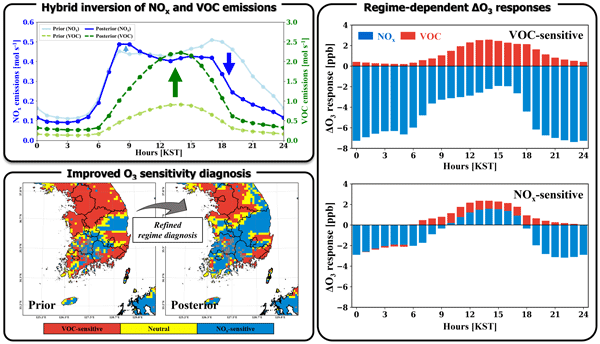
Abstract. Ozone (O3) over South Korea has risen in recent years, underscoring the need to accurately quantify emissions of nitrogen oxides (NOx) and volatile organic compounds (VOC). We develop a hybrid inverse modeling framework that couples the Finite Difference Mass Balance (FDMB) method with four-dimensional variational (4D-Var) assimilation using the Community Multiscale Air Quality (CMAQ) model to jointly constrain spatiotemporal NOx and VOC emissions. The inversion is constrained by Tropospheric Monitoring Instrument (TROPOMI) NO2 and HCHO columns and by surface NO2 and O3 from the air quality monitoring station network. The analysis covers 1–14 May 2022, a period of climatologically high O3. Optimized NOx emissions exhibit strong diurnal adjustments relative to the prior (nighttime reductions up to 51 % and daytime increases up to 14 %). The joint inversion of NOx and VOC delivers the largest improvement in O3 simulations, achieving the best agreement with observations (IOA > 0.8). Constrained emissions shift O3 sensitivity from VOC-sensitive to NOx-sensitive across much of the domain, improving spatial consistency with TROPOMI-derived formaldehyde-to-NO2 ratio (FNR) diagnostics. Adjoint-based hourly ΔO3 responses reveal regime- and hour-dependent behavior: VOC controls are most effective under VOC-sensitive conditions, whereas NOx controls are more direct under NOx-sensitive conditions. Importantly, because O3 titration is immediate while photochemical production requires finite reaction time, emissions released approximately 1–2 hours earlier have the greatest influence on current O3, motivating hour-specific, regime-specific controls. Overall, the hybrid framework improves O3 simulations and sensitivity-regime diagnosis, enabling spatiotemporally resolved precursor emission reduction guidance for effective O3 mitigation.
-
Notice on discussion status
The requested preprint has a corresponding peer-reviewed final revised paper. You are encouraged to refer to the final revised version.
-
Preprint
(2388 KB)
-
Supplement
(560 KB)
-
The requested preprint has a corresponding peer-reviewed final revised paper. You are encouraged to refer to the final revised version.
- Preprint
(2388 KB) - Metadata XML
-
Supplement
(560 KB) - BibTeX
- EndNote
- Final revised paper


Journal article(s) based on this preprint
Interactive discussion
Status: closed
- RC1: 'Comment on egusphere-2025-5837', Anonymous Referee #1, 02 Apr 2026
-
RC2: 'Comment on egusphere-2025-5837', Anonymous Referee #2, 18 Apr 2026
The manuscript by Moon et al. presents the application of a recently developed hybrid (mass balance / 3D-Var / 4D-Var) inverse modeling scheme to constrain emissions of NOx and VOC emissions in Korea. The work is new and noteworthy, and includes an analysis of O3 regimes using adjoint sensitivities. Some of the results, such as the agreement of the posterior simulations with satellite-based assessments of NOx vs VOC limited regimes, are really quite impressive. The inversion itself could use a bit more evaluation, given that there aren’t any independent measurements of NO2 or O3 used, and the VOC assessment is limited to 5 Pandora sites. Meanwhile, the posterior simulation shows dramatic BVOC emission increases throughout the country that aren’t really evaluated — checking isoprene levels would seem to be an essential step here. These and some other issue are described in my comments below.
Large comments:
Section 2.3.1:
- Why apply FDMB to NOx and VOCs sequentially, rather than simultaneously, and iteratively? See e.g. Choi, J., D. K. Henze, K. C. Wells, and D. B. Millet, Joint inversion of satellite-based isoprene and
formaldehyde observations to constrain emissions of non-methane volatile organic compounds, J. Geo-
phys. Res., 130, 13, e2024JD042070, https://doi.org/10.1029/2024JD042070.
- As noted above, why not iterate the FDMB, to minimize smearing and nonlinear errors and also pickup some feedback of the VOC constraints on the NOx?
- For the FDMB part, what drove the decision to assimilate NO2 first and then HCHO, rather than the other way around?
Eq 8: It seems to me that e_i is an emission within some time window defined as t to t-1, and n is the total number of time windows. It would be useful to clarify this, and also state what is the time window (1 hour? 1 day?) and how many are there in total (n)? Also, relating y_i to H_{i-1}(e_{i-1}) doesn’t seem correct, unless the time window between i and i-1 is longer than the lifetime of the species in question. Otherwise, the estimate of the observation at y_i would be impacted by emissions at times i-1, i-2, i-3, etc. I guess from line 201 that the difference between time i and i-1 is 24 hours, in which case it is very incorrect when assimilating AQMS O3 observations to assume that only emission e_{i-1} would impact the model estimate that corresponds to observation y_i. I don’t know if this is just an issue with how the authors wrote out this equation, or if they actually conducted the inversion this way (which wouldn’t seem correct); hopefully just the former.
General: Why is this hybrid approach better than just applying 4D-Var to assimilate satellite and AQMS measurements simultaneously? It seems like the addition of a 3D-Var and FDMB inversion as a precursor to this add computational cost and complexity, but I’m not sure if the value has been explained or demonstrated. If, for example, this approach for example allows the 4D-Var inversion to converge in fewer iterations, that should be stated (and demonstrated).
225: I suppose it will be mentioned later what observations are used for the evaluation (presumably some that aren’t used for the assimilation…) but maybe that could be stated here as well? Ok, I see later in section 3.2 that they are evaluating against AQMS NO2, O3, and Pandora HCHO. But since AQMS NO2 and O3 were used in the assimilation, this is not a good test of the robustness of the posterior emissions. It does show that the modeling framework was correctly implemented, but one should evaluate against independent data. It seems that was only done with Pandora HCHO. Pandora would have NO2 as well — why was this not used? Also, are there not any other VOC measurements in Korea to compare against? What about from KORUS-AQ or other? The BVOC emission changes shown in Fig 5 seem very large — can these be evaluated against any isoprene observations? From CrIS? In Choi et al. (2025), Fig 10, it was found that HCHO assimilation led to very high isoprene concentrations compared to KORUS-AQ aircraft observations; however, assimilation of isoprene did not lead to these large over-estimates, nor did joint isoprene-HCHO inversions. I thus am concerned that that the large BVOC emissions found here might be compensating for a different issue in the model.
Fig 9: The consistency here is quite impressive! Especially given the differences evident in the prior model (Fig S3). I liked this result a lot.
Fig 10 / Conclusions: I also found this figure very interesting and a useful way to present information. Can the authors explain the chemical mechanism whereby emissions of VOCs lead to O3 depletion under NOx-sensitive conditions? I also wonder if the authors care to speculate about what might be effective emissions control strategies, given these results? Should urban NOx emissions controls be stricter at night, for example? Or what if one used the prior model to make a policy recommendation — how incorrect might that have been, compared to using the posterior results?
Smaller comments:
31: Is there anything else that the adjoint sensitivities show, in terms of spatial or hourly characteristics? That VOC controls are most effective under VOC sensitive conditions is rather obvious / circular, as this is explained on lines 48-50.
61: Applied, not proposed, as you’re citing applications here rather than the first papers to propose new methods (with the exception of Cooper 2017, though if you’re referring to FDMB not IFDMB, I believe the correct citation would be Lamsal 2011?).
72: To my knowledge the first study to combine 4D-Var and mass balance in a hybrid fashion was: Qu, Z., D. K. Henze, N. Theys, J. Wang, W. Wang, Hybrid mass balance / 4D-Var joint inversion of NOx and SO2 emissions in East Asia, J. Geophys. Res., 124, 8203–8224, https://doi.org/10.1029/2018JD030240.
73: The word “Nevertheless” doesn’t really fit here, as the preceding text wasn’t related to the topic of spatial vs temporal emissions adjustments. Also, I’m not sure I believe the “most studies” here — did the authors really do an exhaustive review of all top-down emissions studies? I can think of large numbers that constrain hourly, daily, weekly, or monthly emissions, in applications spanning from NOx to CO2. So perhaps overall this sentence / topic just needs to be revised.
190: I don’t see how there’s anything intrinsic to FDMB that prevents it from being applied separately to emissions at different times. Emissions in different grid cells in space are already treated separately; it would be trivial to extend to emissions at different times.
197: Given Eq 8, B is the error covariance of the emission scaling factor, not the emissions.
198: How is the 100% emission error translated into a value within B, which is the error covariance for the emissions scaling factor? Is a doubling of emissions (alpha = 2) penalized equivalently to a zeroing out of the emissions (alpha = 0) or halving (alpha = 0.5)?
200: Please provide the values of the measurement errors and representativeness errors, and how the latter were obtained. I don’t see either of these quantified here nor in section 2.2.1.
203: Please show the L curve and provide the optimal value of gamma that was found. Ok.. I see this now in the supplemental and later in section 3.1. Well, in Fig S2, I don’t believe that J_B or J_O have been defined (I know what they are, in terms of portions of Eq 8, but others may not).
210: I don’t disagree that most studies have focused on a single species; however, there are many that have conducted joint inversions of NOx along with other species, such as VOCs, CO, NH3, SO2…. Some attention to the literature in this regards is warranted.
Fig 3: Within 4D-Var, the flowchart doesn’t make too much sense to me. I would think that it should be CMAQ fwd —> CMAQ adjoint —> 4D-Var solver (gradient based minimizer) —> an arrow back to CMAQ forward (because 4D-Var requires iteration) and another arrow to 4D-Var posterior emissions. And perhaps another arrow from here to Hybrid Emissions? Because the Hybrid emissions are themselves the emissions that result from the 4D-Var solution, yes? Also, later on e.g. line 244 the authors refer to “posterior emissions” so it would be good, as I’ve suggested, to specifically identify what these are in the flowchart.
249: It’s a bit confusing as here it seems that the time difference between t1 and t2 is an hour, where in the previous section it was 24 hrs.
Fig 5: perhaps show the 2nd and 3rd columns as differences from the prior? or from each other? It’s hard to see the NOx emission changes at all.
Citation: https://doi.org/10.5194/egusphere-2025-5837-RC2 - AC1: 'Comment on egusphere-2025-5837', Wonbae Jeon, 23 May 2026
Peer review completion


Interactive discussion
Status: closed
-
RC1: 'Comment on egusphere-2025-5837', Anonymous Referee #1, 02 Apr 2026
The manuscript, „Spatiotemporal optimization of NOx and VOC emissions using a hybrid inversion framework and its implication for ozone sensitivity diagnosis”, presents a methodology for optimizing emission inventory data for regional air quality model simulations in South Korea. This is achieved using hybrid data assimilation approach, which first adjusts the emissions of NOx and VOC using TROPOMI observations with the finite difference mass balance, and then refines the emission optimization with 4D-var data assimilation of ground-based air quality monitoring stations (NO2 and O3) and Pandora spectrometers (HCHO). The conducted study covers a two-week period in May 2022, for which the emission adjustment as well as the simulation analysis improvement are evaluated. Additionally, spatially resolved ozone sensitivity regimes are derived for South Korea, showing a shift towards larger regions becoming NOx sensitive with the newly derived emissions. Finally, the change in O3 response to NOx and VOC emissions is evaluated over time, showing the different precursors’ individual behaviour and their daytime dependences.
Overall, the manuscript’s scientific topic is very important for the air quality community. Since uncertainties in emission inventories remain the primary source of uncertainty in model predictions, the proposed approach offers a sophisticated methods to address the existing challenges in accurately representing ozone concentrations and its primary precursors, NOx and VOC. Furthermore, the presented hybrid inverse modelling method provides an advanced top-down approach that jointly optimizes NOx and biogenic and anthropogenic VOC emission inventories. The current aim of reducing NOx emissions in East Asia results in a shift in the ozone sensitivity regime, as demonstrated here. In terms of guidance for O3 policy management, the manuscript proposes a time and ozone regime dependent analysis of adjoint sensitivities for O3 responses to the precursor emissions. With these comprehensive methods and analysis, the manuscript complies well with the scope of ACP.
Although, I consider the methods and analysis presented in the manuscript to be of high scientific significance and rate the presentation quality as high, I have major concerns about parts of the applied methods, which I will discuss in more detail in the following section. In conclusion, I recommend accepting the manuscript for publication in ACP once my major and minor concerns have been addressed.
Major comments:
- The methodology described in section 2.5 and illustrated in Figure 4 is not clear. How exactly is the adjoint model driven by the posterior emissions? The relationship between the “local hour” and the two-week average remains unclear. Is this done for every hour individually within the two-week analysis period? What does “d” represent in equation (9)? What is “D” as a set of analysis days? Is this an average over the two weeks? Is “g” really the grid, or does it refer to individual grid cells? Could you please explain what is meant by “receptor hour” and how the cost function Jr is treated (e.g. minimizing procedure)? Equations (10) to (12) should be explained in words, with the different variables introduced precisely to give the reader a better understanding and ensure reproducibility. In addition, please add information to the text on how the 24-hour simulations are selected, and how t1 and t2 are relating to these 24-hour windows. There is a hint in the caption of Fig. 4, however, this information should also be included in the main text. Finally, please add a paragraph describing Fig. 4 to the section. The current presentation is insufficient for understanding the derivation of ΔO3 responses.
- Regarding the evaluation presented in section 3.2, I have some concerns about whether this is a fair and robust method of evaluating the benefits of the emission corrections. In general, comparing concentrations of the prior and posterior simulations with observed concentrations is a valid approach. However, as I understand it, the NO2 and O3 observations used for the evaluation are the same as those used for the optimization experiments. Therefore, the evaluation data forms part of the model, and it is obvious that the posterior results in better performance and statistics. Consequently, I consider the conclusion drawn in lines 347-348, “indicating enhanced model performance in reproducing observed O3 concentrations”, to be misleading. I would like to suggest using independent observations for validation. This could be achieved by withholding some stations from the network for validation purposes, or by finding additional data that the model has not seen.
- For the hybrid optimization approaches, it remains unclear how the daily derived emission corrections are taken into account in the analysis. Are the corrected emission profiles from the previous day used as prior for the following day? Or is the same prior temporal emission profile always used? How are the prior emission profiles implemented? What does the prior in Figure 6 base itself on?
- I find the hybrid modelling approach very interesting. However, could you please provide insights into the individual contribution of the FDMB and 4D-var data assimilation to the emission correction? Which optimization approach drives the corrections? Is the hybrid approach the most effective method, or would using one method provide sufficient results at lower computational cost?
- Regarding the discussion about O3 policy management in section 3.4, it would be interesting to assess the impact of AVOC emissions on the O3 responses. As only AVOC emissions can be actively regulated while BVOC emissions are controlled by nature, it would be interesting to see to how efficient possible AVOC controls would actually be.
Minor comments:
The abstract misses information about the emission being optimized and that the study focuses on South Korea.
In general, the manuscript uses many abbreviations that are partly not very common. If introduced paragraphs ago, the reader gets distracted with going back and searching the abbreviation. Thus, I recommend reducing those, as much as possible. Examples are: in line 29, “IOA” is not even defined in the abstract; in line 82 “ΔO3 responses” are used without introduction; in line 235, FNR is introduced – I suggest, just using HCHO-to-NO2 ratio instead of FNR.
Line 23: insert “data” before assimilation.
Line 26: In the abstract, you refer to “a period of climatologically high O3” (line 26). This is unclear. How can a period of two weeks be climatological? Please improve the wording to better relate the O3 burden of the selected episode to climatological O3 values.
Line 29: I recommend writing “Optimized emissions” instead of “Constrained emissions”.
Lines 31 and 32: The terms “VOC controls” and “NOx controls” are not clear at this stage of the manuscript. Please rephrase.
Line 49: Should the first word not be increase instead of decrease? Please double check.
Line 52: Please delete the word “paradoxically”.
Line 63: Insert “data” before assimilation.
Line 71: Please replace “combining the mass balance and the 4D-Var have been recently proposed” by “combining mass balance and 4D-Var has recently been proposed”.
Line 84: “a unit perturbation” is unclear. Please explain.
Line 89: I would like to suggest using the wording “spatiotemporal corrections” here instead of “spatiotemporal changes” in emissions and concentrations.
Line 98: Please provide the horizontal resolution of the modelling domains, at least for D2 in the text.
Figure 1: The blue triangle ASOS stations are hard to see on the map. Try to remove the province boundaries.
Lines 112 and 113: Please introduce all chemical variables not just by their chemical abbreviation but also by name. Please consider replacing the “or” by an “and”.
Line 119: Please provide information about the initial (for D1 and D2) and boundary (for D1) conditions used for the CMAQ simulations. Do you start from a climatology or from some spin-up simulations?
Line 126: You refer to 619 AQMS sites. Are these divided into data used for the assimilation/inversion and data used for the validation of the posterior analysis? See also major comment (2).
Line 129: Please explain the “(0,10)” and “(1,11)”. At the moment, these values are not clear.
Line 151: Please define AMFapriori in the text.
Line 159: How do you define changes in concentrations and emissions? Is it the correction due to the inversion or is it a change between integration time steps? How do the 10% perturbation of line 164 relate to this? Is this defining ∆E?
Line 178: It is unclear what “employed it as the constraint” means here.
Figure 2: It remains unclear what the input to the FDMB really is (connection between green and blue dashed boxes). Furthermore, it is not explained what “i” is in the equation E(i), because there is no dependence on i here. How does the equation E(i) refer to equation (3) in the text? Why is Ωa−Ωo used here?
Line 187: Please clarify to what the “two-week-averaged column density” refers? Observations or model or both?
Line 195: Please check if “(n)” should not be “i=0, n”?
Line 196 and equation (8): The definition of the observation operator is unclear. The observations are concentrations or column densities, not emissions. Why do you subtract 𝑦𝑖 − 𝐻𝑖−1(𝑒𝑖−1)? Why do the indices differ? Please explain i and t.
Line 198: Please explain the uncertainty of 100%. What does this represent as error considered here?
Line 223: Please specify the observations used here.
Figure 4: Do not separate “Δ” and “O3” in a line break (line 265).
Line 281: The Hybrid_NOx experiment did not change any VOC emissions. Does this mean that there is no adjoint chemistry taken into account in the optimization procedure? Is the optimized emission vector restricted to NOx emissions only in the cost function? Wouldn’t it be possible to also derive corrections for VOC emissions when just assimilating NOx observations, due to the chemical coupling in the ozone chemistry in the model? In contrary in line 337 you refer to little improvements for the VOC in the Hybrid_NOx experiment. How is this corrections induced and why is there no correction in Figure 5?
Figure 5: I would like to suggest difference plots for the analysis increments, because it is not possible to identify if there are only emission increases or also decreases in the posteriors.
Table 1: Please clarify if the values presented are mean values averaged over the all stations and over the analysis period.
Figure 7: The caption misses the “comparison to the observations”. Also, is the data really averaged over South Korea or over all station locations?
Line 339: Please add a short explanation of the index of agreement, as this is not a very common and widely used statistical value.
Line 361: Do you mean the Prior experiment of the Hybrid_NOx approach?
Line 368: Please add a reference to Figure S3 here. Otherwise, the reader is wondering why you compare the posterior to TROPOMI and not the Prior.
Line 394: Is it the mean of 1-14 May 2022?
Lines 394-395: “Panels (a) and (c) show, for each local hour, the ΔO3 at that hour resulting from emissions integrated over all emission times (Eq. (12)).” Please explain, what this means. What is the local hour?
Figure 9: Why is there missing data in the model analysis? Additionally, is there no data over the ocean?
Line 411: Please double check if the first sentence of this paragraph can be expressed clearer after addressing my concerns described in the major comment (1).
Line 433: Please explain how this approach reduces data and why the computational demands decrease?
Line 444: Are their any ideas to what could be expected from a Hybrid_VOC experiment?
Lines 453 and 454: Please add “emissions” after “NOx” and “AVOC and BVOC”.
Line 470: Please revise “NOx contributes” with “NOx emissions contribute”.
Citation: https://doi.org/10.5194/egusphere-2025-5837-RC1 -
RC2: 'Comment on egusphere-2025-5837', Anonymous Referee #2, 18 Apr 2026
The manuscript by Moon et al. presents the application of a recently developed hybrid (mass balance / 3D-Var / 4D-Var) inverse modeling scheme to constrain emissions of NOx and VOC emissions in Korea. The work is new and noteworthy, and includes an analysis of O3 regimes using adjoint sensitivities. Some of the results, such as the agreement of the posterior simulations with satellite-based assessments of NOx vs VOC limited regimes, are really quite impressive. The inversion itself could use a bit more evaluation, given that there aren’t any independent measurements of NO2 or O3 used, and the VOC assessment is limited to 5 Pandora sites. Meanwhile, the posterior simulation shows dramatic BVOC emission increases throughout the country that aren’t really evaluated — checking isoprene levels would seem to be an essential step here. These and some other issue are described in my comments below.
Large comments:
Section 2.3.1:
- Why apply FDMB to NOx and VOCs sequentially, rather than simultaneously, and iteratively? See e.g. Choi, J., D. K. Henze, K. C. Wells, and D. B. Millet, Joint inversion of satellite-based isoprene and
formaldehyde observations to constrain emissions of non-methane volatile organic compounds, J. Geo-
phys. Res., 130, 13, e2024JD042070, https://doi.org/10.1029/2024JD042070.
- As noted above, why not iterate the FDMB, to minimize smearing and nonlinear errors and also pickup some feedback of the VOC constraints on the NOx?
- For the FDMB part, what drove the decision to assimilate NO2 first and then HCHO, rather than the other way around?
Eq 8: It seems to me that e_i is an emission within some time window defined as t to t-1, and n is the total number of time windows. It would be useful to clarify this, and also state what is the time window (1 hour? 1 day?) and how many are there in total (n)? Also, relating y_i to H_{i-1}(e_{i-1}) doesn’t seem correct, unless the time window between i and i-1 is longer than the lifetime of the species in question. Otherwise, the estimate of the observation at y_i would be impacted by emissions at times i-1, i-2, i-3, etc. I guess from line 201 that the difference between time i and i-1 is 24 hours, in which case it is very incorrect when assimilating AQMS O3 observations to assume that only emission e_{i-1} would impact the model estimate that corresponds to observation y_i. I don’t know if this is just an issue with how the authors wrote out this equation, or if they actually conducted the inversion this way (which wouldn’t seem correct); hopefully just the former.
General: Why is this hybrid approach better than just applying 4D-Var to assimilate satellite and AQMS measurements simultaneously? It seems like the addition of a 3D-Var and FDMB inversion as a precursor to this add computational cost and complexity, but I’m not sure if the value has been explained or demonstrated. If, for example, this approach for example allows the 4D-Var inversion to converge in fewer iterations, that should be stated (and demonstrated).
225: I suppose it will be mentioned later what observations are used for the evaluation (presumably some that aren’t used for the assimilation…) but maybe that could be stated here as well? Ok, I see later in section 3.2 that they are evaluating against AQMS NO2, O3, and Pandora HCHO. But since AQMS NO2 and O3 were used in the assimilation, this is not a good test of the robustness of the posterior emissions. It does show that the modeling framework was correctly implemented, but one should evaluate against independent data. It seems that was only done with Pandora HCHO. Pandora would have NO2 as well — why was this not used? Also, are there not any other VOC measurements in Korea to compare against? What about from KORUS-AQ or other? The BVOC emission changes shown in Fig 5 seem very large — can these be evaluated against any isoprene observations? From CrIS? In Choi et al. (2025), Fig 10, it was found that HCHO assimilation led to very high isoprene concentrations compared to KORUS-AQ aircraft observations; however, assimilation of isoprene did not lead to these large over-estimates, nor did joint isoprene-HCHO inversions. I thus am concerned that that the large BVOC emissions found here might be compensating for a different issue in the model.
Fig 9: The consistency here is quite impressive! Especially given the differences evident in the prior model (Fig S3). I liked this result a lot.
Fig 10 / Conclusions: I also found this figure very interesting and a useful way to present information. Can the authors explain the chemical mechanism whereby emissions of VOCs lead to O3 depletion under NOx-sensitive conditions? I also wonder if the authors care to speculate about what might be effective emissions control strategies, given these results? Should urban NOx emissions controls be stricter at night, for example? Or what if one used the prior model to make a policy recommendation — how incorrect might that have been, compared to using the posterior results?
Smaller comments:
31: Is there anything else that the adjoint sensitivities show, in terms of spatial or hourly characteristics? That VOC controls are most effective under VOC sensitive conditions is rather obvious / circular, as this is explained on lines 48-50.
61: Applied, not proposed, as you’re citing applications here rather than the first papers to propose new methods (with the exception of Cooper 2017, though if you’re referring to FDMB not IFDMB, I believe the correct citation would be Lamsal 2011?).
72: To my knowledge the first study to combine 4D-Var and mass balance in a hybrid fashion was: Qu, Z., D. K. Henze, N. Theys, J. Wang, W. Wang, Hybrid mass balance / 4D-Var joint inversion of NOx and SO2 emissions in East Asia, J. Geophys. Res., 124, 8203–8224, https://doi.org/10.1029/2018JD030240.
73: The word “Nevertheless” doesn’t really fit here, as the preceding text wasn’t related to the topic of spatial vs temporal emissions adjustments. Also, I’m not sure I believe the “most studies” here — did the authors really do an exhaustive review of all top-down emissions studies? I can think of large numbers that constrain hourly, daily, weekly, or monthly emissions, in applications spanning from NOx to CO2. So perhaps overall this sentence / topic just needs to be revised.
190: I don’t see how there’s anything intrinsic to FDMB that prevents it from being applied separately to emissions at different times. Emissions in different grid cells in space are already treated separately; it would be trivial to extend to emissions at different times.
197: Given Eq 8, B is the error covariance of the emission scaling factor, not the emissions.
198: How is the 100% emission error translated into a value within B, which is the error covariance for the emissions scaling factor? Is a doubling of emissions (alpha = 2) penalized equivalently to a zeroing out of the emissions (alpha = 0) or halving (alpha = 0.5)?
200: Please provide the values of the measurement errors and representativeness errors, and how the latter were obtained. I don’t see either of these quantified here nor in section 2.2.1.
203: Please show the L curve and provide the optimal value of gamma that was found. Ok.. I see this now in the supplemental and later in section 3.1. Well, in Fig S2, I don’t believe that J_B or J_O have been defined (I know what they are, in terms of portions of Eq 8, but others may not).
210: I don’t disagree that most studies have focused on a single species; however, there are many that have conducted joint inversions of NOx along with other species, such as VOCs, CO, NH3, SO2…. Some attention to the literature in this regards is warranted.
Fig 3: Within 4D-Var, the flowchart doesn’t make too much sense to me. I would think that it should be CMAQ fwd —> CMAQ adjoint —> 4D-Var solver (gradient based minimizer) —> an arrow back to CMAQ forward (because 4D-Var requires iteration) and another arrow to 4D-Var posterior emissions. And perhaps another arrow from here to Hybrid Emissions? Because the Hybrid emissions are themselves the emissions that result from the 4D-Var solution, yes? Also, later on e.g. line 244 the authors refer to “posterior emissions” so it would be good, as I’ve suggested, to specifically identify what these are in the flowchart.
249: It’s a bit confusing as here it seems that the time difference between t1 and t2 is an hour, where in the previous section it was 24 hrs.
Fig 5: perhaps show the 2nd and 3rd columns as differences from the prior? or from each other? It’s hard to see the NOx emission changes at all.
Citation: https://doi.org/10.5194/egusphere-2025-5837-RC2 - AC1: 'Comment on egusphere-2025-5837', Wonbae Jeon, 23 May 2026
Peer review completion
Journal article(s) based on this preprint
Viewed
| HTML | XML | Total | Supplement | BibTeX | EndNote | |
|---|---|---|---|---|---|---|
| 1,469 | 813 | 123 | 2,405 | 293 | 106 | 156 |
- HTML: 1,469
- PDF: 813
- XML: 123
- Total: 2,405
- Supplement: 293
- BibTeX: 106
- EndNote: 156
Viewed (geographical distribution)
| Country | # | Views | % |
|---|
| Total: | 0 |
| HTML: | 0 |
| PDF: | 0 |
| XML: | 0 |
- 1
Jeonghyeok Moon

Sujong Jeong
Yunsoo Choi
Hyun Cheol Kim
Soon-Young Park
Juseon Bak
Jung-Woo Yoo
Jaehyeong Park
Dongjin Kim
Hyeonsik Choe
Chae-Yeong Yang
The requested preprint has a corresponding peer-reviewed final revised paper. You are encouraged to refer to the final revised version.
- Preprint
(2388 KB) - Metadata XML
-
Supplement
(560 KB) - BibTeX
- EndNote
- Final revised paper
The manuscript, „Spatiotemporal optimization of NOx and VOC emissions using a hybrid inversion framework and its implication for ozone sensitivity diagnosis”, presents a methodology for optimizing emission inventory data for regional air quality model simulations in South Korea. This is achieved using hybrid data assimilation approach, which first adjusts the emissions of NOx and VOC using TROPOMI observations with the finite difference mass balance, and then refines the emission optimization with 4D-var data assimilation of ground-based air quality monitoring stations (NO2 and O3) and Pandora spectrometers (HCHO). The conducted study covers a two-week period in May 2022, for which the emission adjustment as well as the simulation analysis improvement are evaluated. Additionally, spatially resolved ozone sensitivity regimes are derived for South Korea, showing a shift towards larger regions becoming NOx sensitive with the newly derived emissions. Finally, the change in O3 response to NOx and VOC emissions is evaluated over time, showing the different precursors’ individual behaviour and their daytime dependences.
Overall, the manuscript’s scientific topic is very important for the air quality community. Since uncertainties in emission inventories remain the primary source of uncertainty in model predictions, the proposed approach offers a sophisticated methods to address the existing challenges in accurately representing ozone concentrations and its primary precursors, NOx and VOC. Furthermore, the presented hybrid inverse modelling method provides an advanced top-down approach that jointly optimizes NOx and biogenic and anthropogenic VOC emission inventories. The current aim of reducing NOx emissions in East Asia results in a shift in the ozone sensitivity regime, as demonstrated here. In terms of guidance for O3 policy management, the manuscript proposes a time and ozone regime dependent analysis of adjoint sensitivities for O3 responses to the precursor emissions. With these comprehensive methods and analysis, the manuscript complies well with the scope of ACP.
Although, I consider the methods and analysis presented in the manuscript to be of high scientific significance and rate the presentation quality as high, I have major concerns about parts of the applied methods, which I will discuss in more detail in the following section. In conclusion, I recommend accepting the manuscript for publication in ACP once my major and minor concerns have been addressed.
Major comments:
Minor comments:
The abstract misses information about the emission being optimized and that the study focuses on South Korea.
In general, the manuscript uses many abbreviations that are partly not very common. If introduced paragraphs ago, the reader gets distracted with going back and searching the abbreviation. Thus, I recommend reducing those, as much as possible. Examples are: in line 29, “IOA” is not even defined in the abstract; in line 82 “ΔO3 responses” are used without introduction; in line 235, FNR is introduced – I suggest, just using HCHO-to-NO2 ratio instead of FNR.
Line 23: insert “data” before assimilation.
Line 26: In the abstract, you refer to “a period of climatologically high O3” (line 26). This is unclear. How can a period of two weeks be climatological? Please improve the wording to better relate the O3 burden of the selected episode to climatological O3 values.
Line 29: I recommend writing “Optimized emissions” instead of “Constrained emissions”.
Lines 31 and 32: The terms “VOC controls” and “NOx controls” are not clear at this stage of the manuscript. Please rephrase.
Line 49: Should the first word not be increase instead of decrease? Please double check.
Line 52: Please delete the word “paradoxically”.
Line 63: Insert “data” before assimilation.
Line 71: Please replace “combining the mass balance and the 4D-Var have been recently proposed” by “combining mass balance and 4D-Var has recently been proposed”.
Line 84: “a unit perturbation” is unclear. Please explain.
Line 89: I would like to suggest using the wording “spatiotemporal corrections” here instead of “spatiotemporal changes” in emissions and concentrations.
Line 98: Please provide the horizontal resolution of the modelling domains, at least for D2 in the text.
Figure 1: The blue triangle ASOS stations are hard to see on the map. Try to remove the province boundaries.
Lines 112 and 113: Please introduce all chemical variables not just by their chemical abbreviation but also by name. Please consider replacing the “or” by an “and”.
Line 119: Please provide information about the initial (for D1 and D2) and boundary (for D1) conditions used for the CMAQ simulations. Do you start from a climatology or from some spin-up simulations?
Line 126: You refer to 619 AQMS sites. Are these divided into data used for the assimilation/inversion and data used for the validation of the posterior analysis? See also major comment (2).
Line 129: Please explain the “(0,10)” and “(1,11)”. At the moment, these values are not clear.
Line 151: Please define AMFapriori in the text.
Line 159: How do you define changes in concentrations and emissions? Is it the correction due to the inversion or is it a change between integration time steps? How do the 10% perturbation of line 164 relate to this? Is this defining ∆E?
Line 178: It is unclear what “employed it as the constraint” means here.
Figure 2: It remains unclear what the input to the FDMB really is (connection between green and blue dashed boxes). Furthermore, it is not explained what “i” is in the equation E(i), because there is no dependence on i here. How does the equation E(i) refer to equation (3) in the text? Why is Ωa−Ωo used here?
Line 187: Please clarify to what the “two-week-averaged column density” refers? Observations or model or both?
Line 195: Please check if “(n)” should not be “i=0, n”?
Line 196 and equation (8): The definition of the observation operator is unclear. The observations are concentrations or column densities, not emissions. Why do you subtract 𝑦𝑖 − 𝐻𝑖−1(𝑒𝑖−1)? Why do the indices differ? Please explain i and t.
Line 198: Please explain the uncertainty of 100%. What does this represent as error considered here?
Line 223: Please specify the observations used here.
Figure 4: Do not separate “Δ” and “O3” in a line break (line 265).
Line 281: The Hybrid_NOx experiment did not change any VOC emissions. Does this mean that there is no adjoint chemistry taken into account in the optimization procedure? Is the optimized emission vector restricted to NOx emissions only in the cost function? Wouldn’t it be possible to also derive corrections for VOC emissions when just assimilating NOx observations, due to the chemical coupling in the ozone chemistry in the model? In contrary in line 337 you refer to little improvements for the VOC in the Hybrid_NOx experiment. How is this corrections induced and why is there no correction in Figure 5?
Figure 5: I would like to suggest difference plots for the analysis increments, because it is not possible to identify if there are only emission increases or also decreases in the posteriors.
Table 1: Please clarify if the values presented are mean values averaged over the all stations and over the analysis period.
Figure 7: The caption misses the “comparison to the observations”. Also, is the data really averaged over South Korea or over all station locations?
Line 339: Please add a short explanation of the index of agreement, as this is not a very common and widely used statistical value.
Line 361: Do you mean the Prior experiment of the Hybrid_NOx approach?
Line 368: Please add a reference to Figure S3 here. Otherwise, the reader is wondering why you compare the posterior to TROPOMI and not the Prior.
Line 394: Is it the mean of 1-14 May 2022?
Lines 394-395: “Panels (a) and (c) show, for each local hour, the ΔO3 at that hour resulting from emissions integrated over all emission times (Eq. (12)).” Please explain, what this means. What is the local hour?
Figure 9: Why is there missing data in the model analysis? Additionally, is there no data over the ocean?
Line 411: Please double check if the first sentence of this paragraph can be expressed clearer after addressing my concerns described in the major comment (1).
Line 433: Please explain how this approach reduces data and why the computational demands decrease?
Line 444: Are their any ideas to what could be expected from a Hybrid_VOC experiment?
Lines 453 and 454: Please add “emissions” after “NOx” and “AVOC and BVOC”.
Line 470: Please revise “NOx contributes” with “NOx emissions contribute”.